




Abstract
The rise of cross-sectoral collaboration initiatives has been widely documented. While schools and third-sector organizations share important educational goals in these initiatives, the predictors of their identification with common goals have not been examined systemically to date. This article analyses predictors of common goal identification within educational collaborative initiatives through a case study of a German initiative aimed at tackling inequality in education. By implementing a mixed-methods design – including surveys, semi-structured interviews and social network analysis, combined with logistic regression and qualitative content analysis – we demonstrate that an actor’s identification with the common goal is shaped not only by individual characteristics, but also by his/her relative position within the collaboration. Findings of this study have practical implications for networked leadership and school principals’ work and training, since they inform regarding the particular settings, skills and knowledge needed for managing cross-sectoral collaboration to the benefit of schools.
Keywords
Introduction
The results of international student assessments (such as PISA and TIMSS) have raised concerns about the global competitiveness of educational systems in many countries including the USA, UK and Germany. In response, interest has surged in the role of cross-sectoral collaborations and social networks in processes of educational improvement (Woodland and Mazur, 2018). During the last decade, a high number of cross-sectoral initiatives have emerged worldwide, whereby formal education actors (e.g. schools and universities) and external non-formal education actors (e.g. non-profit organizations and foundations) seek to address jointly some of the pressing challenges in education (Coburn, 2005). Indeed, research has shown that cooperation between schools and third-sector organizations in educational collaborative networks can assist in addressing these challenges, when adequately designed (Kolleck, 2016, 2017; Berkovich and Foldes, 2012; Díaz-Gibson et al., 2017; Eyal and Yarm, 2018). Such networks can promote various goals; for example, they can motivate more migrant adolescents to pursue academic tracks in schools, encourage marginalized students to enter higher education, or foster environmental education in schools (Feys and Devos, 2015).
These cross-sectoral initiatives have been found to improve the flow of knowledge, enhance mutual learning and embed resources, thus facilitating collaborative problem solving. Hence, they are widely regarded as valuable tools in the development, implementation and sustainability of innovative educational solutions (Kappauf and Kolleck, 2018; Kania and Kramer, 2011). Nevertheless, such alliances can become enclaves of marginalization and inequality if implemented problematically (Kolleck, 2017). Specifically, we (Yemini and and Sagie, 2015) and others documented how such networks, when ruled by different and opposing agendas, may lead to increased inequality within the education system as a whole (Lubienski, 2003). Moreover, Diaz-Gibson and colleagues (2017) raised concern about the role of such initiatives in developing and sustaining leadership and change.
In a study published in this journal (Yemini, 2018), we showed how such collaborations are interwoven with conflicting goal-setting processes, led by various stakeholders, thus impeding the work of the state education system. Yet despite the growing presence of external agencies in state schooling in many countries and contexts, there is still a dearth of research on the implications of the third-sector involvement in education, and in particular on the practical means of establishing and managing cross-sectoral collaborations (Eyal and Yarm, 2018).
Several studies have shown that positive impact can be attained through fruitful collaboration among actors of different educational organizations (e.g. schools or universities) in a particular region, by enabling collective problem solving (e.g. Kania and Kramer, 2011; Whiteford et al., 2017). Often, organizations lack the ability to solve problems within the education system single-handedly. In such cases, cross-sectoral collaboration of actors who loyally promote mutual goals can attain substantial effects. Moreover, generally speaking, social change that stems from collaboration and joint understanding (rather than from isolated intervention by individuals or their organizations) is more sustainable (Kolleck, 2017). Thus, collective impact is regarded as successful when organizations from different sectors seek to solve the same educational problems and identify themselves with similar social goals (Kania and Kramer, 2011). However, as Townsend (2015) notes, such collaborations promote hybrid forms of leadership, arising from the quest for participation on the one hand, and the aspiration for inter-group, networked leadership on the other. This pursuit of both leadership and participation is combined with the general need of such interactions to establish joint goals that support the development of a common identity and trust between the actors involved (e.g. Hatcher, 2014). Naturally, upon establishing collaboration, the initial goals and aims of each participant might differ; as such, different participants’ engagement in the process and thus their commitment to the shared goals may be limited. Notably, however, although respective partners’ identification with common goals in such initiatives is considered a main criterion for success, the predictors of such identification with common goals have not been systematically analysed to date.
This study seeks to help overcome this research gap through a mixed-methods research aimed to better understand the identification with common goals of actors involved in a cross-sectoral, collaborative educational initiative in Germany. Through the prism of this case study, we aim to answer the following questions. What are the predictors of identification with common goals in cross-sectoral, collaborative educational initiatives? What roles do the respective positions of the various partners within the collaborative framework of such initiatives play in regard to their respective goal identification?
In analysing these questions, we intend to provide new empirical insights into the influences on stakeholders’ identification with common goals in collaborative educational ventures, while on a broader level, offering an account of how individuals are influenced by their positions in social networks. Hence, this analysis builds upon recent studies that examine the application of educational collaborative networks to different issues and at different policy levels (Walzer, Weaver and McGuire, 2016), alongside analyses demonstrating the effects of social networks on community and school improvement (Duffy and Gallagher, 2017; Moolenaar et al., 2014).
In so doing, this article also aims to contribute to a tremendously expanding research field – that of third-sector involvement and cross-sectoral alliances in education (Kolleck, 2019; Eyal and Yarm, 2018). The present study enriches this research field by presenting new empirical insights and first evidence on the predictors of common goal identification in an illustrative educational collaborative endeavour in Germany. Notably, managing such collaborations has become a critical part of the leadership roles within schools and local educational authorities (Diaz-Gibson et al., 2017). Against this background, this study also aims to provide valuable information for educational practitioners and policy makers concerned with the opportunities and challenges inherent in engaging third-sector organizations in public education.
To answer the research questions, we draw on social network theory (SNT) (Russell et al., 2015). Given that no specific theory on identification with common goals exists, we use SNT, which stipulates that an actor’s identification with goals is inferred from the actor’s relative position in information flows (Kolleck, Jörgens and Well, 2017) rather than from an actor’s self-assessment or personal/institutional characteristics. Hence, the different roles of actors (such as schools, higher education institutions, or early education providers) involved in a given collective impact initiative are determined by their action, behaviour and communication strategies, as reflected in the actors’ positions in issue-specific networks (White, 2008).
Empirically, we focus on the collaboration patterns and individual characteristics of actors involved in the collective impact programme ‘RuhrFutur’, which was initiated in the German Ruhr area to address issues concerning educational inequality. This article is part of a larger study aimed at understanding how external actors participate in state education systems (Kolleck, 2019), which examined various aspects of this collaborative initiative. Notably, we use SNT to analyse an assembly of individuals and organizations metaphorically described (and self-described) as a ‘network’. To avoid confusion, we apply the term ‘cross-sectoral collaboration initiative’ to describe the phenomenon, which we analyse through the prism of SNT.
The article proceeds as follows. In the next section, we provide a brief description of the background scholarship on collective impact and social networks in education, as well as the theoretical approach of this article. Next, we present out methods. Here we also discuss the challenges in collecting the data involving a broad range of formal and informal education actors and introduce social network analysis (SNA) as an alternative methodological approach. In the following sections, we describe and then discuss empirical findings. Finally, we outline some prospects for future research in the concluding sections.
Theoretical orientation
Cross-sectoral approaches to foster collective impact
The growth of initiatives to implement innovations in education has drawn attention to the conditions inherent to successful innovation processes (Townsend, 2015). Specifically, the expanding quest to innovate education revealed the fact that various types of social relations underlie the implementation and diffusion of educational innovation (i.e. new social concepts with the mission of solving educational problems) (Kolleck, Jörgens and Well, 2017). Simultaneously, this trend has revealed a lack of collaboration both within schools and between schools and with other educational organizations (Diaz-Gibson, 2017). As Bryk and colleagues explain: ‘[w]hile innovations abound in education, we argue that the field suffers from a lack of purposeful collective action. Instead, actors work with different theories of the same problem, activities are soloed, and local solutions remain local’ (Bryk, Gomez and Grunow, 2011: 130). Scholars and practitioners in education have become aware that social relations are essential for successful educational reform and school development (Kolleck, 2016; Daly and Finnigan, 2010; Duffy and Gallagher, 2017; Little, 2005; Moolenaar et al., 2014). This notion is supported by empirical results revealing that cooperation, social networks and common goals help educational organizations such as universities or schools to strengthen instructional programme coherence, thereby improving student achievements (Wells et al., 2015).
Hence, a growing number of scholars and practitioners have developed cross-sectoral collaborations with the aim of improving educational quality and fostering interaction between schools and third-sector organizations. For example, Bryk, Gomez and Grunow (2011) introduced the concept of networked communities, which builds on the notion of professional learning communities (e.g. Stoll et al., 2006). The networked communities notion focuses on the role of school development through collaborations, arguing that social relations within these collaborations support learning processes. The turnaround strategies implemented collaboratively by various actors in the education field to support low-performing schools (e.g. Peurach and Neumerski, 2015) comprise further examples of such educational initiatives. In both cases, successful implementation largely depends on collaborative, cross-sectoral actions, executed through compatible actions among the partners. Moreover, these initiatives share the feature of uniting local leaders from different sectors (e.g. teachers, principals, heads of foundations, government officials, university presidents and school district representatives, as well as non-profit and advocacy groups) to set a list of common goals in seeking to address current challenges in the educational system (Kania and Kramer, 2011).
Drawing on a broad range of practical experiences, Bryk, Gomez and Grunow (2011) conclude that cross-sectoral initiatives are effective when they find answers ‘to three seemingly straightforward questions: First, what problem(s) are we trying to solve? Second, whose expertise is needed to solve these problems? And third, what are the social arrangements that will enable this work?’ (Bryk, Gomez and Grunow, 2011: 129). In addition, the authors note the relevance of the backbone organization’s responsibility for implementing networked communities. The importance of an organizational unit or a central office for bridging between different sectors in educational change efforts has already been established in other studies, such as in the context of the No Child Left Behind initiative (see Daly and Finnigan, 2010). Here too, cross-sectoral collaborations are based on the condition that various actors develop common goals, ‘a shared working theory, common measures, and communication mechanisms’, aiming to ‘anchor collective problem solving’ (Bryk et al., 2015: 172).
However, given that the study of policy implementation through networks only recently commenced within education research, our knowledge of cross-sectoral collaborations in education remains limited (Lima, 2010; Peurach, 2011; Wohlstetter et. al., 2003). Specifically, although the effects of collaborations with common goals are often conceptualized as the ‘attainment of positive network level outcomes that could not normally be achieved by individual organizational participants acting independently’ (Provan and Kenis, 2007: 230), inadequate attention has been directed towards the predictors of the identification with common goals in educational networks.
The present study applies SNT to examine the predictors of the identification with common goals and the role social networks play in collective impact initiatives. Specifically, we use SNT to better understand goal identification in a collective impact initiative in Germany. This undertaking is innovative in two respects. First, no systematic empirical analysis of the implementation of collaborative initiatives in education has been conducted to date. Second, the predictors of common goal identification are yet to be studied.
SNT conceptualizes social networks as ‘a finite set or sets of actors and the relation or relations defined on them’ (Wasserman and Faust, 2009: 20). These networks result from permanent interaction and negotiations. Exchange and deliberation within social networks enable actors to exert influence, generate new knowledge, and promote ideological and structural change in educational systems (Kolleck, 2016). Such adherence to joint goals is crucial in managing initiatives in schools, as we showed in a study published in this journal (Yemini, Addi-Raccah and Katarivas, 2015; Yemini, 2018).
Identification with goals is conceptualized largely through the prism of goal commitment theory, which emphasizes that people perform better when they are committed to achieving personal goals (e.g. Locke and Latham, 2006). Hence, goal commitment is traditionally more related to individual performance and to the self-efficacy of individuals who follow certain goals. From this perspective, it is critical that individuals understand precisely what is expected of them, so that they can formulate a distinct, easy-to-follow set of goals for their own individual use. Clearly defined goals with vital subjective importance can support motivation and help individuals to focus their behaviour in a specific direction (Matos et al., 2017). However, this situation differs drastically in educational initiatives involving cross-sectoral collaboration, since many different actors with various professional affiliations must follow the joint goals that are set. Furthermore, common goals in such initiatives usually do not address the specific needs of the actors involved, but rather are stated in vague terms of general aims related to political challenges (such as a quest to strengthen educational justice or to tackle inequality). The present research seeks to understand various actors’ respective commitment to these stated common goals.
In contrast to rational choice theories (RCT), which conceptualize human action as a process controlled by individuals who govern choices by choosing between several pre-defined alternatives (Ditton and Krüsken, 2010), the present study applies SNT to focus on the interdependency of individual action and the social context within which the individual is currently situated. Thus, the conception of goal identification used in this article differs from the particular assumptions of either methodological individualism or methodological structuralism (Borgatti and Lopez-Kidwell, 2011) and regards individuals as embedded in social network structures, thus possessing a certain amount of agency, while also adhering to the existing and newly established social structures. In contrast to ‘traditional social research’, which explains an individual’s outcomes or characteristics as a function of other characteristics of the same individual, SNT considers the social environment of individual action (Borgatti et al., 2009: 893). From this perspective, the identification of actors involved in collective impact or cross-sectoral collaborations depends in part on the particular actor’s position in the network structure. When studying the commitment to joint goals in cross-sectoral collaborations, it is vital to consider the embeddedness and the location (centrality, etc.) of each actor within the network.
From this perspective, the advantage resulting from an individual’s embeddedness within a network relates to the relative importance of this person’s position in terms of ‘social capital’ (see also Moolenaar et al., 2014). Social capital can be defined as the aggregate of individual or collective resources linked to a durable network of (more or less institutionalized) relationships of mutual acquaintance (Bourdieu, 2011). As such, we infer an actor’s goal identification from his/her relative position in issue-specific information flow channels (Kolleck, 2016), rather than on the basis of the actor’s self-assessment or subjective interests. Hence, in a collaborative initiative, a stakeholder’s role is determined by its action, behaviour and communication strategies, as reflected in this stakeholder’s specific undertakings in issue-specific networks (White, 2008).
We view cross-sectoral collaboration as a social interaction process whereby various actors communicate, discuss, develop and re-shape ideas jointly. The actors’ commitment to the common goals is constantly negotiated and can be studied through understanding of the relative position of each of the actors within the collaboration. We apply SNT as a tool to delve into the positions of these individual actors and to reveal the possible links between their respective positions and their commitment to the common goals.
This theoretical approach enables us to include network-analytical parameters (i.e. parameters of the structure of social relations) systematically in the study of stakeholder goal identification. In this study, we apply this prism to the specific case study of the RuhrFutur cross-sectoral collaboration for education improvement in the German Ruhr area.
A case study of collective impact: RuhrFutur in Ruhr, Germany
The Ruhr region is the largest metropolitan area in Germany and among the five largest metropolitan areas in Europe. It consists of 53 cities and municipalities with five million inhabitants (including about a million children/young people) on an area close to 4,500 square kilometres. This region is characterized by increasing social polarization and a high proportion of migrants, especially among youth (Kappauf and Kolleck, 2018).
The first attempt to introduce an educational initiative based on the principles of collective impact in Germany was made in the Ruhr area through the RuhrFutur programme in 2013. In response to critiques regarding performance of the federal education system, the federal state government of North Rhine Westphalia, along with the Marcator Foundation and five local universities, founded RuhrFutur as a joint educational initiative applying experimental innovation and cross-sectoral collaboration, with the aim of spreading innovative approaches and systematic change within the education system.
According to the RuhrFutur website, the coalition seeks to strengthen educational justice in this area by improving cooperation between schools and extracurricular educational organizations. RuhrFutur publications note as special features of this collective impact initiative its regional approach and its funding by one single foundation (the Mercator Foundation), which grants 15 million Euros for each of its two phases (its first phase lasted from 2013 to 2017, the second runs from 2018 to 2022). The RuhrFutur office was founded as a backbone organization with a total of 15 employees. By engaging a small number of employees and limiting the funding period, the Foundation’s intention was to provide seed capital or start-up funding, under the assumption (as expressed in personal communications with RuhrFutur officials) that the initiative will function on its own without a backbone organization or external funding after 10 years.
As mentioned above, one of the most important principles of collective impact initiatives is its participants’ identification with common goals. Hence, directly after the formation of RuhrFutur, its members developed the common goal of motivating adolescents from less privileged socioeconomic backgrounds to enter higher education. Specifically, the initiative seeks to create strong collaboration between schools, universities and third-sector organizations in order to encourage the most disadvantaged young people to pursue higher education. The present empirical study aims to reveal the extent to which partners and participants in the RuhrFutur initiative identify with this goal, and through this to detect the predictors of high goal identification among agents in collaborative networks.
Methods
Sampling/data collection
As described in the next section (‘Instrumentation’), overall, the study followed a mixed-method approach, combining qualitative and quantitative techniques and synthesizing the results of both approaches. The larger study (mentioned above) uses qualitative results to validate and interpret the quantitative results, whereas the current article mainly presents findings from a quantitative study based on data collected through an online survey. The questionnaire was sent to individuals from a broad range of roles and positions in the various organizations included in the cross-sectoral initiative, so as to capture a maximum number of people actively engaged in the field of RuhrFutur. Using this strategy, we were able to reach all levels of hierarchy within specific organizations.
To include as many participants and collaborating professionals within the initiative as possible, we employed a snowball approach, drawing on contacts provided by the RuhrFutur office. In the first wave, questionnaires asking for names and contact details of persons with whom respondents had been in contact were sent to all individuals known to engage in any professional relations with RuhrFutur (N = 584). Then, in accordance with Kowald and Axhausen (2012), the individuals whom respondents of the first wave in this ‘name-generating phase’ mentioned were recruited as participants for our study and were sent questionnaires. Overall, we used four waves to include all new names provided by ‘previous’ respondents. By applying this snowball procedure, we were able to collect data of each of these individuals and thus to perform complete SNA. Moreover, this strategy enabled us to detect and investigate a significant number of participants and thus to define the network boundaries as closely as possible.
Instrumentation
In accordance with the above-described recruitment procedure, in 2015, 21 individuals involved in the RuhrFutur initiative were surveyed in a qualitative, explorative study using semi-structured interviews and qualitative network maps (Kahn and Antonucci, 1980; Trezzini, 1998) to assess the situation of the educational initiative. Drawing on initial qualitative results and on established measurement instruments, we developed a quantitative questionnaire to collect information on a variety of issues related to the implementation of the RuhrFutur initiative via an online survey. In this article, we focus specifically on the participants’ identification with common goals and understandings.
To measure identification with RuhrFutur’s fundamental goal, participants were asked to rate the extent they agree or disagree that the goal of ‘encouraging adolescents from underprivileged socioeconomic backgrounds to pursue higher education’ is personally important to their work for the initiative (with Likert-type answers ranging from 1 ‘disagree completely’ to 5 ‘agree completely’). For the analyses presented in this paper, the answers were dichotomized to fit the empirical distribution of the answers and the low representation of the first answer category. Specifically, ‘completely agree’ and ‘agree’ were combined into one category and thus compared with the remaining categories, enabling us to investigate the high goal identification group in comparison to the low identification group.
Orientation towards the initiative’s goal of supporting young people from less privileged backgrounds to pursue higher education was analysed with respect to a variety of measures. For example, respondents of our study were asked about their professional relationship with the initiative – specifically, their main occupational field, the duration of their collaboration, and their professional status within the initiative (i.e. whether they belong to the initiative’s leadership or how closely they collaborate with it). Participants also provided information concerning their own socio-demographic characteristics (i.e. gender, age, formal education, training). Finally, respondents offered various details regarding their social embeddedness in the initiative’s network, which facilitated network analyses and the computation of network-analytical parameters (Burt, 1984; Merluzzi and Burt, 2013).
Network analytical parameters express the centrality and influence of actors in a network and are generated using the names provided in the name-generating questions. Generally, such network parameters can be determined using a multitude of algorithms. For example, a count of the sheer number of contacts an actor has (i.e. indegree centrality) comprises one commonly known and applied parameter. However, we used the ‘eigenvector’ parameter, since it takes into account the quality of the actor’s contacts, indicating an actor’s prominence and the extent of his/her access to the resources necessary for achieving influence (Ibarra, 1993). Hence, eigenvector is considered the most appropriate measure to identify influence in non-hierarchical networks (Kolleck, Well, Sperzel and Jörgens, 2017). In comparison to other centrality measures (e.g. indegree centrality), eigenvector indicates the extent of a particular actor’s influence within a network in relation to the relative influence of the actor’s contacts. In other words, an actor is influential if he/she is linked to other influential actors. Technically speaking, the parameter measures the relative scores to all nodes in the network (Leontief, 1941; Seeley, 1949) and considers that a connection to an ‘influential’ node contributes more to an actor’s influence (i.e. to this actor’s eigenvector score) than do connections to less influential nodes.
Statistical analysis
As mentioned above, network participants’ identification with the initiative’s objective of ‘encouraging young people from underprivileged backgrounds to pursue higher education’ was analysed with respect to a variety of potential predictors (including social network analytical parameters). Through this analysis, respondents with high goal identification were compared to the ones with lower goal identification (see ‘Instrumentation’ section above).
We expressed continuous predictor variables as means±SD and categorical predictors as frequencies and percentages. Comparisons between groups were performed using the χ2 test and the t-test. The initial set of respondent characteristics was reduced to a reasonable number of predictor variables for goal identification. To achieve this, theoretically meaningful variables and variables found to be significant in bivariate analysis (P ≤ 0.1) were entered into multivariable logistic regression. In stepwise processes, variables were included in and excluded from the model according to their P-values and their contribution to measures of model fit (Cox and Snell’s as well as Nagelkerke’s pseudo R 2). Thus, variables with independent influences on goal identification were retained in the model. In addition to main effects, potential interactions between pairs of covariates were assessed. Effects with a P-value of less than 0.05 (two-sided) were considered significant. The effect-size estimates (odds ratios [OR]) of the independent predictor variables of the final model are shown with P-values. Calculations were carried out using SPSS 24.0 (IBM, Chicago, Illinois, USA).
The social network analytical parameter eigenvector, which we considered as a potential predictor for goal identification in the analysis, was computed with SPSS 24 (Analytic Technologies, Lexington, Kentucky, USA). Network visualizations were created using Gephi 0.9.1 (Bastian, Heymann and Jacomy, 2009). To transform the networks into maps, we applied the algorithm Force Atlas 2, which is a continuous algorithm for network spatialization based on a linear-linear model, according to which attraction and repulsion work in proportion to the distance between the nodes (Jacomy et al., 2014).
The Mercator Foundation, one of the initiators and funders of the RuhrFutur initiatives, funded the larger study that this paper is based on. Nevertheless, the authors attained full access to all participants and maintained full independence in conducting the research. All participants were guaranteed anonymity, and the data was treated with strict confidentiality for the research purpose only. No RuhrFutur staff ever had any access to the raw data at any stage of the research.
Despite our direct access to the informants involved in the initiative, this study may nevertheless suffer from biases relating to the readiness of certain actors to reveal their authentic views. Moreover, since such cross-sectoral collaborations are quite dynamic, the relative location of each of the actors is not constant; this variability may influence the reliability of our findings to a certain extent. To tackle this challenge, we triangulated our findings with the results from the larger study, while aiming to bring in the authentic voice of our informants.
Results
Description of the sample and the social network
In total, 954 individuals were invited to take part in the online survey; of these, 786 participated (response rate: 82.4%). Among these respondents, 334 (42.5%) stated that they had been working for or collaborating with the initiative and were asked the full range of questions. A total of 236 participants answered the question on goal identification mentioned above.
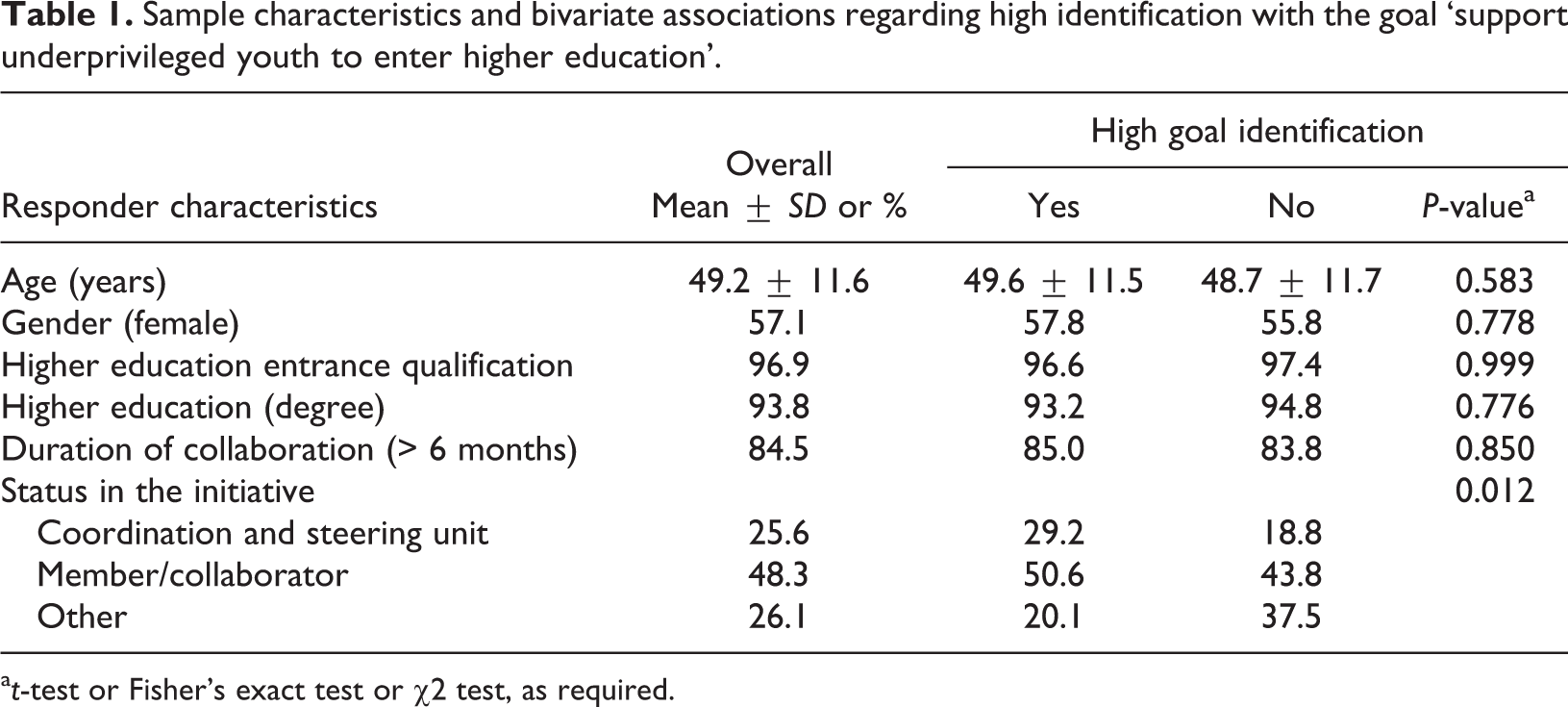
Respondents are predominantly female (57.1%), middle-aged (mean age 49.2 ± 11.6 years), and highly formally educated (96.9% with entrance qualification for higher education, 93.8% with higher education) (see Table 1). In addition, 84.5% of the participants had been collaborating with or working for RuhrFutur over more than six months, 25.6% belong to the initiative’s leadership unit, and 48.3% work for or collaborate with the initiative.
Sample characteristics and bivariate associations regarding high identification with the goal ‘support underprivileged youth to enter higher education’.
a t-test or Fisher’s exact test or χ2 test, as required.
As expected, the sample is highly heterogeneous with regard to occupational field. Larger proportions of participants were employed in municipalities (26%), higher education (24.1%) and early childhood care or schools (19.1%), whereas smaller numbers of respondents were employed in the following sectors: Mercator Foundation or RuhrFutur office (11.9%), organizations or NGOs (10.3%) and state agencies (8.5%) (see Figure 1).
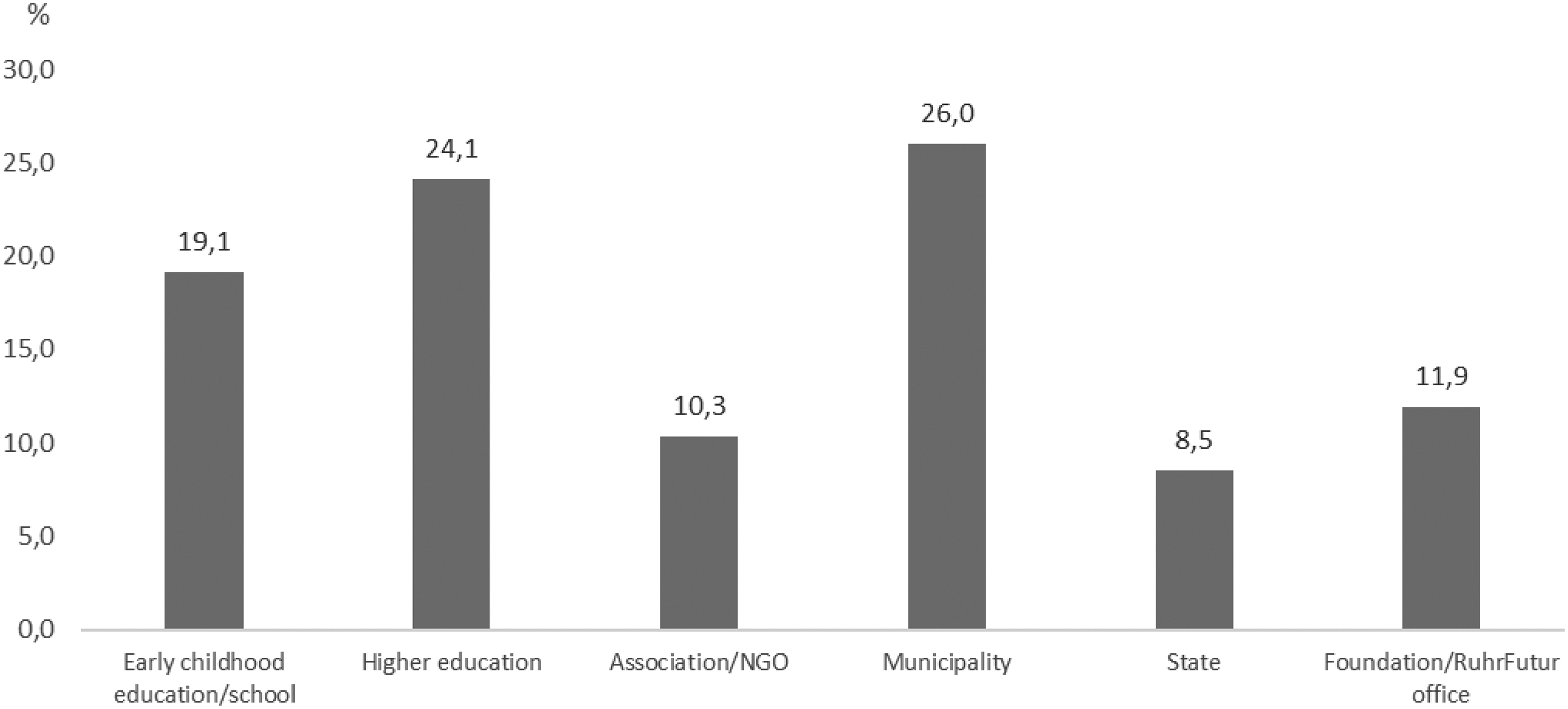
Distribution (percentage) of respondents according to their main occupational field.
Finally, the occupational field was linked to the position of the respondents within the network, as is shown in the visualization of the RuhrFutur network in Figure 2.
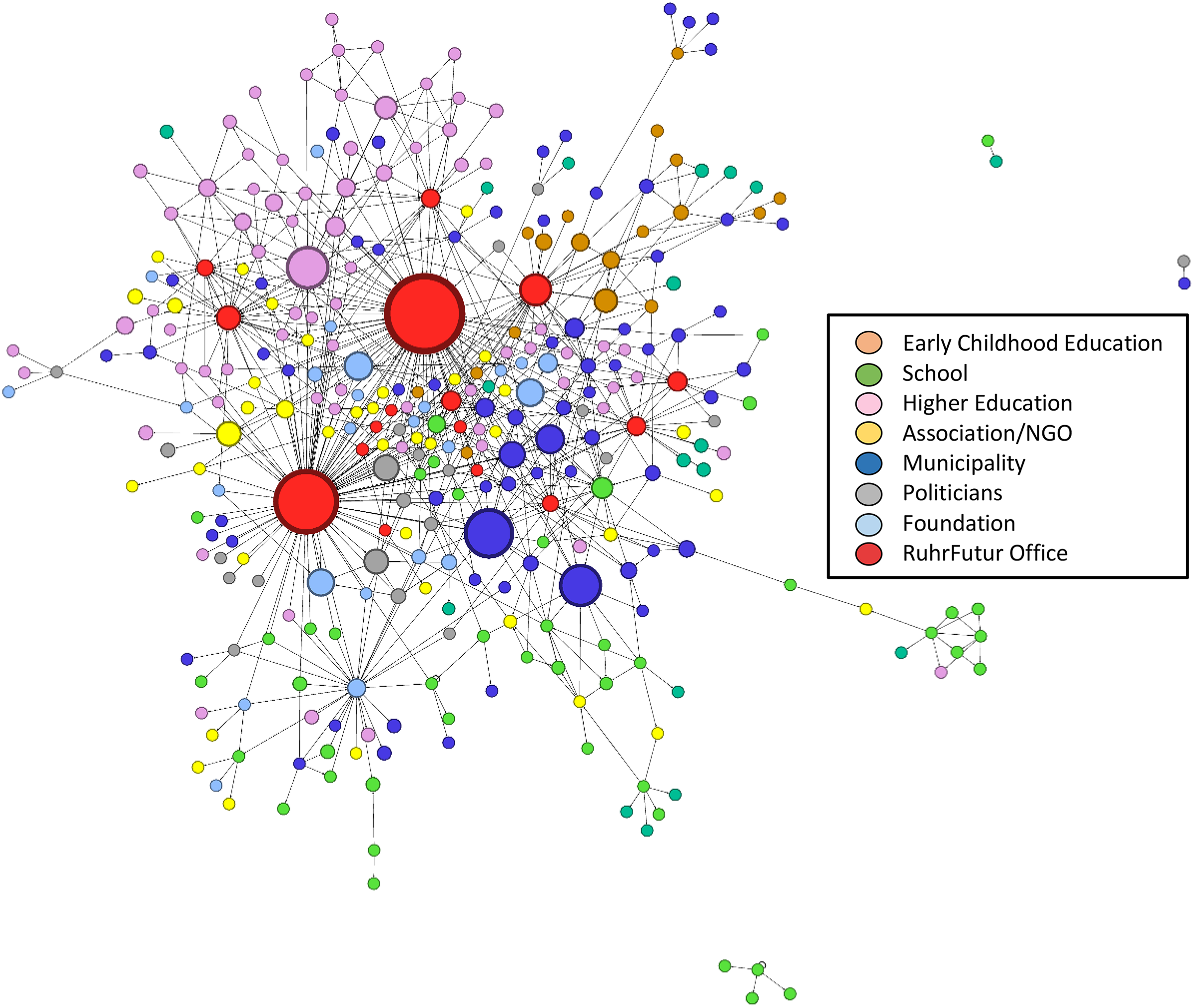
The RuhrFutur network, according to eigenvector centrality (visualization based on the Force Atlas 2 algorithm, as provided by the computer program; Fruchterman and Reingold, 1991).
In the figure, the nodes represent the respondents (actors). The connections visualize both the cooperation and the transfer of information within the context of RuhrFutur. The colour of the nodes expresses the actors’ professional affiliation and the size of the nodes visualizes their influence and centrality. The larger the node appears in the figure, the higher its value is according to eigenvector centrality (i.e. the more influential the actor is within the RuhrFutur network).
Figure 2 illustrates that centrality and influence in the RuhrFutur network were unevenly distributed. While the network was characterized by a large number of actors with low centrality values, a few actors with large nodes apparently control the cooperation and information flows.
Predictors of goal identification
Overall, the vast majority of participants (65.7%) considered the goal of ‘encouraging adolescents from underprivileged socioeconomic backgrounds to pursue higher education’ to be important, thus expressing strong identification with the initiative’s common goal. However, goal identification was related to the ‘main occupational field’ of the respondents, that is, the professional sector they were employed in. Whereas participants working in higher education were overrepresented in the high goal identification group (83.1%), those working in early childhood care or school were underrepresented (46.5%) (see Figure 3).
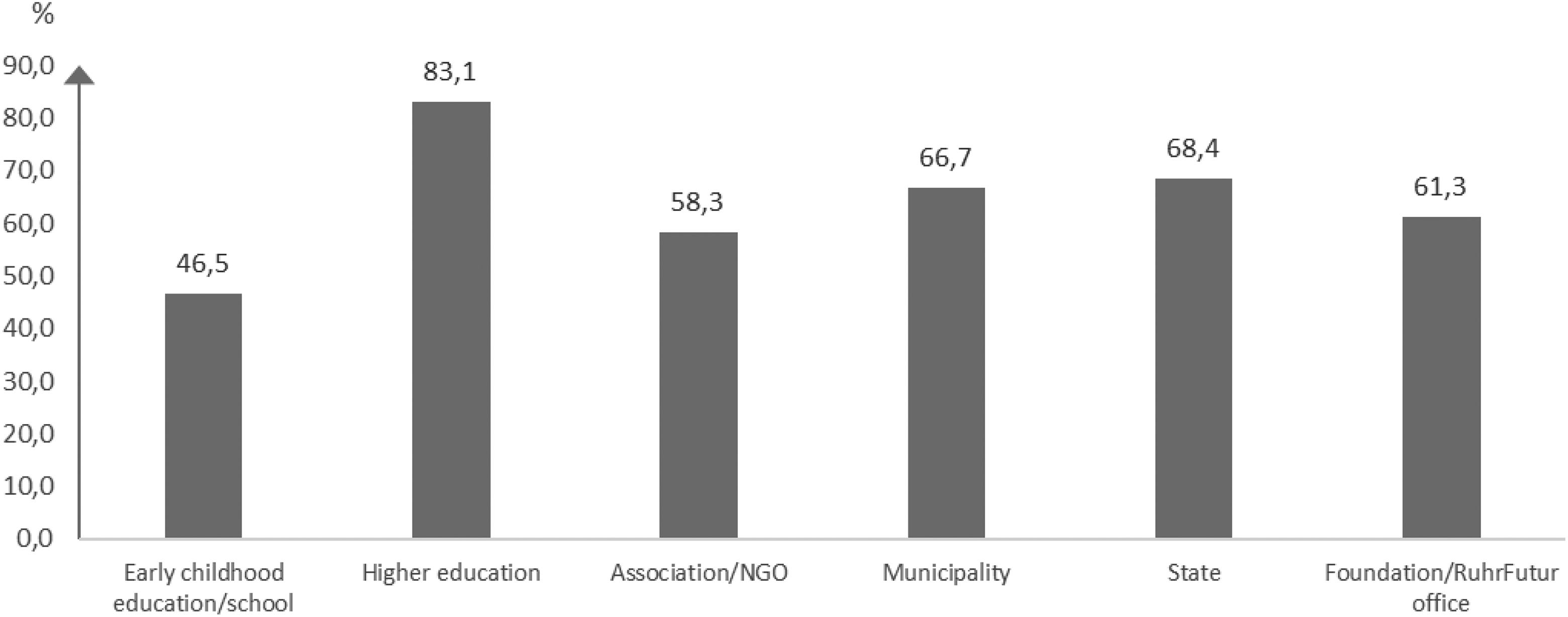
Percentages of respondents with high goal identification, according to their main occupational field.
Goal identification was also associated with respondents’ professional status in the initiative. Particularly, we found a higher proportion of participants employed by or collaborating with the initiative in the group with high goal identification than in the group with low identification with the common goal, while the opposite was true for individuals who did not have such an immediate relationship with the initiative (see Table 1).
Furthermore, we found an association between goal identification and the position of the respondent in the initiative’s network, as measured by the social network parameter eigenvector. Specifically, the mean eigenvector was higher among the participants with high goal identification than among the ones with low goal identification (0.5 versus 0.3, P < 0.001). In other words, respondents with a relatively central position (according to eigenvector centrality) were overrepresented in the group with high goal identification. All other participant characteristics (including the duration of collaboration and socio-demographic attributes) failed to produce significant associations with goal identification in bivariate analyses.
In multivariable logistic regression, two variables – main occupational field and the network parameter eigenvector – demonstrated an independent influence on goal identification, whereas all other variables failed to achieve significance. Table 2 presents the estimates (ORs) for these two predictor variables.
Results of logistic regression for high goal identification concerning ‘support underprivileged youth to enter higher education’.
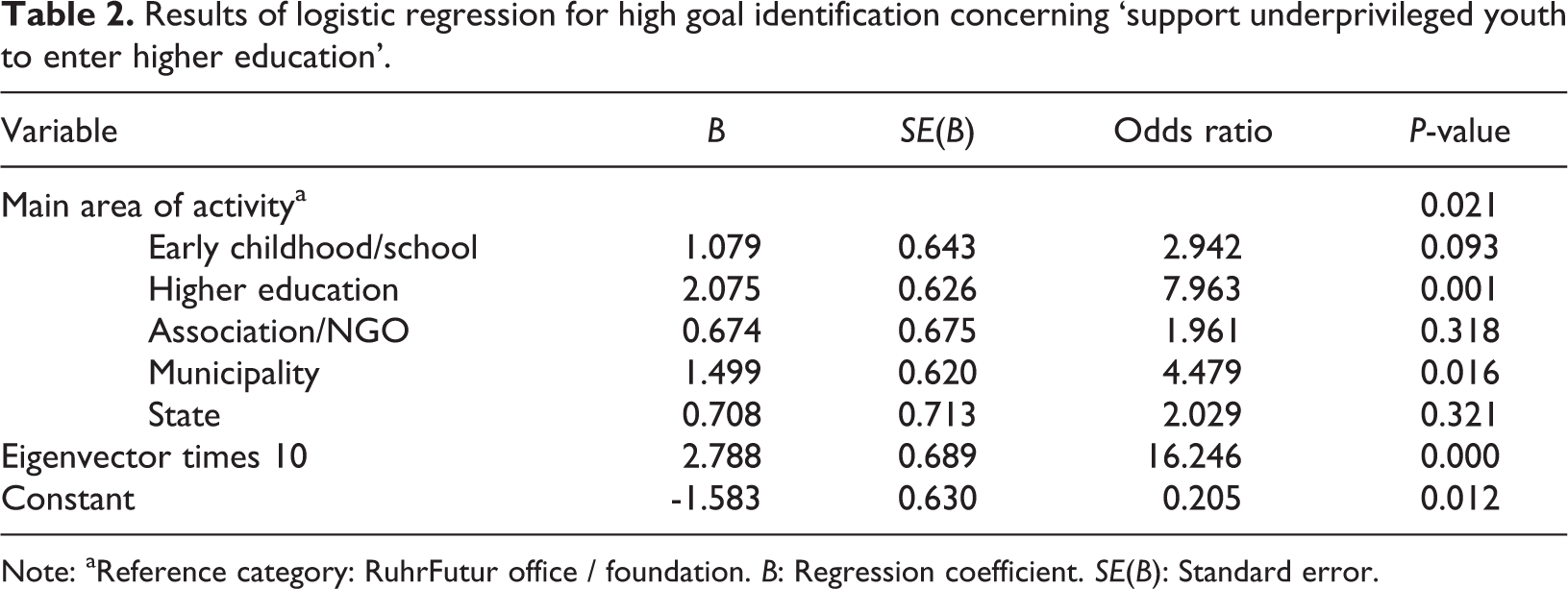
Note: aReference category: RuhrFutur office / foundation. B: Regression coefficient. SE(B): Standard error.
The results show that the probability of belonging to the group with high goal identification improved when the network parameter eigenvector increased (OR 16.2). In other words, participants with a relatively central position in the RuhrFutur network were much more likely to be found among the individuals with high goal identification than among the ones with low goal identification. Additionally, compared to the respondents employed at the RuhrFutur office or the Foundation, those working in higher education or in municipalities had a much larger probability of belonging to the group with high goal identification than to the group with low goal identification (ORs 8.0 and 4.5, respectively). Nagelkerke’s pseudo R 2 for the final model was 0.210.
Discussion and conclusions
This article aimed to reveal the predictors of common goal identification among participants in a cross-sectoral collaboration initiative, vis-à-vis their respective positions within the initiative. Common goals are crucial in initiating and implementing collaborative projects (Feys and Devos, 2015), especially in cases of cross-sectoral partnerships with various actors who may hold conflicting agendas (Koranyi and Kolleck, 2017). In the case study presented here, we investigated common goal identification of participants in a collaborative cross-sectoral initiative in Germany that seeks to tackle social problems in the Ruhr region. We collected data via an online survey, asking respondents – all of whom are participants in the RuhrFutur initiative – to identify other actors in the initiative and to report on the extent to which they themselves are committed to the stated programme goal of supporting underprivileged adolescents in entering higher education. We applied SNA to this data to reveal potential predictors of goal identification, including respondents’ respective social embeddedness within the initiative.
Most of our respondents are employed in municipalities, higher education, and early childhood care or schools (in line with our initial expectations regarding the sample composition). Given the high response rate, we assume our sample to be fairly representative of the initiative’s members and collaborating actors. Notably, the comparatively high percentage of actors from the field of higher education typifies this specific initiative, which focuses on gaining access to higher education; other collective impact initiatives in education tend to focus on formal education, and accordingly consist predominantly of school-based actors (Henig et al., 2016).
In general, the respondents expressed high identification with the initiative’s goal. This result is not surprising, given the relatively large number of respondents actively engaged in the implementation of the educational collaborative network and the process of joint goal development that the initiators undertook in establishing the collaboration. Nevertheless, we found differing levels of common goal identification among different groups of respondents, identified using logistic regression in accordance with SNT. This theory locates the source of human action and goal identification not only in individual attributes, but also in the structure of social relations and the individual positions of actors in the network.
Hence, our study confirms network analytical assumptions by demonstrating that the network parameter eigenvector centrality and occupational field are significant predictors of actors’ identification with the central goal of this collective impact initiative. This understanding extends previous findings on the effects of social networks and network structures regarding educational development in different educational sectors (e.g. Daly and Finnigan, 2010; Duffy and Gallagher, 2017; Moolenaar et al., 2014) by demonstrating the effects of social relations on common goal identification.
More specifically, our results demonstrate that actors employed by higher education institutions or municipalities are more likely to express high goal identification with the RuhrFutur initiative than are the administrative staff of the RuhrFutur office or of the Mercator Foundation, although the administrative personnel were in closest proximity to the original goal-setting process. Gillam, Counts and Garstka (2016) suggest a similar outcome, showing a significant positive correlation between policy mandates and collaboration. We explain our finding in light of the proximity of the professional respondents’ area of activity to the intended goal and the relatively short existence of the RuhrFutur initiative at the time of data collection.
The most significant finding, however, is that the more influential (i.e. central) actors within the RuhrFutur network were more likely to exhibit high goal identification. Although this outcome is not surprising, as we assume that central persons within a collaborative initiative are those with high commitment and, thus, high identification with the initiative’s goals, in practice the marginal actors in cross-sectoral initiatives might have the most substantial effect on the field. Thus, if these ‘peripheral’ actors suffer from lower identification with the initiative’s goals, the entire initiative might function less effectively than expected. Indeed, Gillam, Counts and Garstka (2016) provide evidence for this interpretation in identifying social relations as a predictor of collaboration and thus of an initiative’s success.
In addition to its contribution to the explanation of goal identification, SNA has also demonstrated its applicability in exploring the structure of the internal relations within the initiative in great detail. With SNA, we were able to confirm that centrality and influence in the RuhrFutur network are unevenly distributed. While the network is characterized by a large number of actors with low centrality values, there are only few large nodes that control the cooperation and information flows within the social network. These findings coincide with our assumptions about the relevance of the backbone organization in collective impact initiatives (e.g. Hanleybrown et al., 2012). Moreover, this apparently important role of backbone organizations must be considered in the context of the short duration of the educational initiative. At the time of our data collection, the initiative had been operational for less than three years. The finding of the dominant role of a few individual actors in the network (see Figure 2) may hint at a problematic situation, given the Foundation’s intention to limit the funding period of the project. Specifically, this finding raises doubt regarding the initiative’s ability to survive when the backbone organization and its central nodes disappear. Similar challenges were documented in Israel (Berkovich and Foldes, 2012), where third-sector organizations were ultimately limited in their ability to implement significant transformation in collaboration with other partners, due to limited resources. This article makes initial steps towards empirically analysing the phenomenon of stakeholder goal identification within collaborative initiatives. Furthermore, we have shown how a network perspective can help educational actors to engage local capacity to solve problems and achieve overarching goals.
Specifically, this study reveals that analysing social relations can help to provide a better understanding of the goal identification of actors involved in cross-sectoral initiatives. Moreover, identification with specific common goals depends on actors’ respective positions within the particular network. By making the structure of social networks explicit and by identifying the predictors of identification with common goals, this study suggests an approach to better understand the mechanisms of common goal identification – one of the conditions regarded to be most important for successful cross-sectoral collaboration and collective impact (e.g. Kania and Kramer, 2011). Finally, our study focuses attention on collective impact initiatives in a country other than the United States, where most research on the issue took place.
Practical implications
In addition to the empirical results we found regarding the predictors of identification with common goals and the effects of social relations and actors’ positions in cross-sectoral collaborations or collective impact initiatives, the study’s findings may also have practical implications. Our results point to crucial lessons for educational policy makers, administrators, manager, leaders and academics regarding the implementation of educational collaborative networks and cross-sectoral initiatives. Since the success of such initiatives depends on instilling identification with common goals among actors involved from within the school and beyond it, the lack of research in this area is surprising. Specifically, results of the study may also have practical implications for school principals’ work and training, because principals can ignite an understanding of the skills and knowledge needed for managing such interactions in a way that can benefit schools.
We suggest that in establishing and managing cross-sectoral collaboration, policy makers and other actors must take into account the variations between actors in their respective commitment to the shared goals. This variation exists regarding not only their professional and social characteristics, but also their respective position within the initiative’s network. Since the effectiveness of such initiatives is often based on the interactions between the relatively marginal actors and the target population, it is crucial to devote specific attention to ‘peripheral’ actors’ identification with the initiative’s goals.
Additionally, we question the role of foundations within cross-sectoral initiatives, suggesting that these organizations’ centrality might seriously impede the achievement of the common goals if they suddenly alter their strategies due to their own internal preferences. Hence, in establishing and sustaining such initiatives, stakeholders should consider the key position held by the backbone organizations, as the resources invested by them are more volatile and uncertain than state support is.
In general, our study provides some insights into how a network approach might be useful for leaders, educational policy makers, administrators and managers. The way network concepts have been used to improve school leadership and to help leadership researchers to identify how leaders are affected by network structure, and how they might themselves make use of networked leadership to increase their impact, has been discussed conceptually in more depth elsewhere. For instance, Hadfield and Jopling (2012) argue that a more structurally pluralist network theory could provide a more specific analysis and result in ‘a better understanding of the structural characteristics of networks, and their interactions, especially how they shape leaders’ agency, and how leaders use the structural characteristics in order to exert their influence’ (Hadfield and Jopling, 2012: 113). Our study contributes to this stream of research by providing more empirical evidence on the skills and knowledge needed for managing cross-sectoral partnerships in a way that can benefit schools.
Footnotes
Acknowledgements
We would like to thank Judith Warren Little, Lea Susanne Helm, for their help and valuable input.
Declaration of conflicting interests
The author(s) declared no potential conflicts of interest with respect to the research, authorship, and/or publication of this article.
Funding
This research has been funded by the Mercator foundation under grant number A16015 and the Deutsche Forschungsgemeinschaft under grant number KO 4997/4-1, FOR 1745.
