




Abstract
In today's universities, women are still underrepresented in senior leadership positions. The research-focused systems and structures that support the progression of men often work against women who are drawn to alternative career paths within the academy for a variety of reasons. UK universities have seen an increase in teaching-focused career paths as well as ‘Third Space’ roles, which navigate an increasing space between purely professional and purely academic jobs. Since 2018, four research-intensive universities in the UK have appointed women to the position of PVC Education who have come from Third Space, academic development backgrounds. This paper explores their career paths and experiences and identifies that they have had to constantly navigate between professional and academic contracts in order to negotiate their own progression, thus creating their own space in which they are able to advance. The paper considers whether women in the Third Space end up trapped in a ‘glass classroom’ or whether a more fundamental political and transformational act in gender and Third Space career progression is emerging.
Introduction
In UK higher education in 2021, women are still the exception rather than the norm in senior levels of university leadership. Out of 24 of the most elite, research-intensive institutions, known as the ‘Russell Group’, only eight are headed by women; of the fourteen former members of the smaller research-intensive institutions formerly known as the ‘1994 Group’ numbers are much worse with only two being headed by women. In 2018/2019, 73.3% of all professors were male (AdvanceHE 2020). This limited progression to senior ranks is even more marked when it is considered against the backdrop of increasing participation in higher education of women as both students and lower-ranked staff, and a range of interventions and policies in an attempt to support the progression of women (Fitzgerald, 2020). Higher education plays a big role in the UK economy today (Burkinshaw et al., 2018) – in 2011, UK higher education contributed £73 billion to the economy, nearly 3% of the gross domestic product (GDP), and employed over 378,000 people. As a major recipient of public funding, it is therefore incumbent upon the sector to demonstrate equitable employment practices, as well as for social justice reasons and the provision of positive role-modelling for students prior to future employment in any sector. In spite of all this, ‘universities continue to ignore the empirical evidence’ (Burkinshaw et al., 2018: 3 of 19) that their structures, cultures and hierarchies continue to replicate masculinity and favour men into senior leadership positions.
It is widely agreed in the academic literature that the current neoliberal discourses on university systems and structures reflect a dominant white male culture, focusing on quality measures based on Total Quality Management philosophy, research domination and a conflation of quantitative metrics where the values are normatively masculine (Bensimon, 1995; Burkinshaw and White, 2017). These combine together to perpetuate a myth of meritocracy – that women compete on an equal footing with men – when the playing field is far from even to start with. At the same time, universities have created teaching-only career tracks, and there has also been an increase of ‘Third Space’ roles (Whitchurch, 2009) which sit between purely academic and purely professional services career paths. Third Space roles are defined by Whitchurch (2006) as ‘hybrid workers’ in higher education who work across functional boundaries and tend to work on widely encompassing projects such as academic development, widening access, student mental health and wellbeing and student satisfaction. In spite of the increase in a variety of career paths in academia, there is, however, little evidence of parity of esteem with the continuing dominance of the traditional, research-focused path.
The route to the top is therefore still dominated by white men and a traditional, research-heavy career path and does not reflect the diversity of roles in the academy. As such, female leaders’ experiences in higher education often involve them navigating the spaces that are not dominated by men and identifying opportunities within those spaces in which they can access leadership roles (Fitzgerald, 2018, 2020).
Against this complex backdrop, four research-intensive UK universities appointed women from ‘Third Space Professional’ backgrounds to the roles of PVC Education leadership appointments. Both the growth of the second-tier leadership layer and the dominance of appointments from those with a traditional disciplinary research background and therefore usually men have been well documented in the literature (Shepherd, 2018; Smith and Adams, 2008). This paper reports results of semi-structured interviews that were conducted with each of the four post-holders and explores their Third Space career trajectories. Given the rarity of this approach, this paper focuses on whether education-focused, Third Space career routes may be methods that the gendered culture of universities uses to ensure that women are not strategically positioned on a career pathway to leadership (Morley, 2014), thus trapping them into a ‘glass classroom’. If this is the case, then there are lessons to be learned from the respondents in this study on how to subvert the dominant system and make it work better for women's career progression.
The four cases reported here may appear to be enacting a political and transformational act in gender equality – but the question remains as to whether this is part of reinforcing existing barriers and an uneven playing field. Are universities still only permitting access to a limited number of roles at the top, which are teaching-related and therefore deemed to be ‘acceptable’ for women, and thus trapping them into a ‘glass classroom’ from which they cannot progress any further? Or is the ‘glass classroom’ actually another term for the showcase for their skills and abilities that has enabled them to progress to this level?
This paper reviews literature around the gendered career paths in higher education and, in particular, the education route, followed by the literature on Third Space careers in academia. It is argued that the combination of these two pathways in academic development 1 have enabled women to create their own space away from men and negotiate their own ways of leading that have combined enough of the traditional elements to enable a small number to progress further. Although these women have progressed to the top, they have encountered structural and systemic limitations on the way that need to be addressed in order for UK higher education to make any real progress on addressing gender imbalances at the most senior levels.
The gendered pathway in higher education
UK higher education has seen an era of unprecedented change since the Dearing Report in 1997 (Dearing, 1997) and some of those changes have been important in terms of addressing some inequalities of participation and access to education, and of improving university teaching. Marshall (2019) comments that the changes have led to an ‘unbundling of traditional higher education’ (Marshall, 2019: 4) and the intense competition reinforced by league tables has led to a need for institutions to continually pursue excellence in every avenue. The development of the sector being subject to market forces has led to the introduction of new managerialism – the application of practices generally found in business to public sector organisations – now a dominant feature of modern universities (Itzin and Newman, 1995). New managerialism has, in turn, led to a focus on ‘bureaucratic procedures’ rather than education (Bush, 2018) and in higher education, the result has been a preponderance of targets, key performance indicators and a focus on what can be measured as opposed to educational purpose and aims (Connolly et al., 2019). As such, easily measured outputs such as publications in high-ranked journals and grants have featured highly within this culture. These markers of esteem have been particularly prevalent in the pre-1992 research-intensive universities and lead to what Acker (1997) and Brooks (1997) refer to as ‘performativity’ which tends to be strongly gendered and has been referred to as ‘masculine’ managerialism.
The problem with the pursuit of ‘excellence’, besides the lack of a workable definition, is that the fundamental systems, structures, processes and cultures of HEIs are inherently masculinised and male-dominated, not least because they were historically designed by men, for men (O’Connor, 2019). Attempts to address some of the gender issues have involved initiatives such as Athena SWAN in the UK, which, in spite of focusing attention in the right direction, have failed to make much significant difference to the numbers of female leaders or professoriate even in those institutions that obtained the highest award of gold. It is worth noting, however, that Athena SWAN has shone light on existing inequalities that might otherwise be overlooked (Burkinshaw et al., 2018). Indeed, continuing to have such schemes at the very least moves away from forms of ‘gender denial’ and perpetuating a sense that this has all been ‘fixed’ (Broadbridge and Simpson, 2011).
Many gender equality interventions in higher education are however simply attempts to ‘fix’ women and make them more like men, instead of ensuring that the work women do and are drawn to, has equal status, and that fundamental structures and systems are overhauled to reduce male domination and barriers to women's progression to seniority are removed (O’Connor, 2019). For example, in spite of women being drawn to teaching activities and collegiate working, the promotions criteria in research-intensive universities remain resolutely weighted in favour of research achievements. Burkinshaw et al. (2018) make reference to the perpetual nature of ‘the boys club’ and ‘taps on the shoulder’ for progression to posts where there is a lack of transparency in the recruitment processes. But they also highlight that women, too, can and do benefit from these ‘taps on the shoulder’ and should be prepared to speak out against the covert processes that act structurally to perpetuate a masculine-dominated system and maintain closed doors to the majority.
The combination of masculinised HEIs along with the performativity of neo-liberalism have combined to make a toxic environment for women's progression to senior leadership positions and O’Connor (2019) calls for a fundamental ‘root and branch’ approach to the problem. As such, identifying spaces which women carve out for their own (Fitzgerald, 2018, 2020) acts simply as a sticking plaster over the issue and does not address it comprehensively enough for long-lasting change. To some extent, this is evidenced by the fact that teaching-track and Third Space roles continue to be considered second-rate academic career options. Burkinshaw et al. (2018) are, however, a little more optimistic and claim that the notion of ‘fixing universities’ rather than ‘fixing women’ is starting to gain traction.
At the same time, neo-liberalism has also seen a shift whereby universities have moved away from the old-style forms of collegiate leadership where it was common for academics to take it in turns to take on the challenges of running the institution for the primary benefit of the faculty above others (Shepherd, 2015). Today it would be highly unusual to find UK universities that do not have a senior leadership team comprised of both academics and professional services staff. The academic roles, in particular, include large portfolio responsibilities such as research and teaching (or ‘education’). This has not, however, improved the situation for women as they continue to struggle with the immediate problem of ‘think leader, think male’. Women's physical appearances and behaviour are under constant scrutiny as to what is deemed ‘acceptable’ in the male-dominated environment within which they work and whether they are therefore appropriate ‘leadership material’. Acceptability is based on constraint and containment and restricted to operating within spheres that are deemed to be socially appropriate (Fitzgerald, 2018; Kamerlin and Wittung-Stafshede, 2020). The masculine nature of the performative environment of neoliberal higher education means that women are always ‘the other’ and their physical presence presents a threat to the male-dominated leadership environment.
The work done by Blackmore, Coate and Kandiko-Howson into prestige factors in academic leadership (Blackmore and Kandiko, 2011; Coate and Howson, 2016) has further identified the additional-gendered aspect of this – that more women than men taken on additional responsibilities that are not recognised nor rewarded in the same way as research and scholarly activities. Indeed, what Macfarlane (2011) refers to as ‘unbundling’ or ‘deskilling’ of academic roles may instead be an alternative way of looking at important academic work that is unrecognised and undervalued – and is also almost certainly gendered (Macfarlane, 2011). Macfarlane himself refers to this work as ‘academic housekeeping’ – the very term reinforces the assumption that this work will be largely done by women, and is not usually recognised in academic promotion criteria, thus continuing to limit progression to senior leadership roles for women.
The gendered dimension of academic workloads indicates that women spend more time on teaching-related activities than men and less time on those related to research – thus inherently disadvantaging their progression through the academy where progression is dependent on research outputs (Misra et al., 2011). The focus on teaching is also recognised by Angervall and Beach (2020) as being historically socially constructed as being deemed appropriate for women due to its caring connotations. This supports women choosing this as a career path in academia, yet also penalises them due to the perfomativity that is associated with research in the neoliberal context. This makes it difficult for them to progress their careers on an equal footing to men and again demonstrates that the rewards in academia have an inherent gender bias to them. Angervall and Beach (2020) also make the point that women more than men are at the demands of greedy homelives as well as greedy career roles, which further inhibits their progression.
Fitzgerald (2019) asserts that women have always identified and carved out their own spaces in order to progress their careers in academia (Fitzgerald, 2019). This appears to be a contributing factor in encouraging many women to focus their careers on teaching which is less rewarded in terms of recognition and progression than research and prestige factors (Angervall and Beach, 2020; Coate and Howson, 2016). In Angervall and Beach's (2020) study of academics in education departments across six universities in Sweden, the women appeared to value teaching and administration work over research, which they identified with a particularly masculine expression of performativity – based on citations and public profile. The women were less attracted to what they perceived as overt symbols of power and competitiveness, leading to entrenched problems with the promotions process, which frequently favours things that can be easily measured, e.g. grant income and publications, over those that cannot – for example, the extent of one's collegiality or collaborative working on projects that benefit the wider institution (Burkinshaw et al., 2018). It is, however, unclear how much of this stems from a genuine interest as opposed to the response of women to limited permitted activities and spaces. Women may express preferences for activities where they have been encouraged but are still being ‘shuttered’ into a ‘glass classroom’ and not supported on a trajectory to the top (Morley, 2014).
In the study reported here, the concept of space is of particular interest. The four women interviewed are the only academic developers to have progressed to senior leadership roles in research-intensive, pre-1992 universities in the UK. Not only have they sought out spaces where they as women are able to progress, but they have had the added dimension of being ‘Third Space’ staff, a largely under-recognised group within UK higher education.
Third space professionals
The move of staff from academic development backgrounds into PVC Education roles in the pre-1992 sector is a further progression of what Celia Whitchurch (2006, 2008, 2009, 2012, 2019) has termed ‘Third Space Professionals’ and indicative of the increasing complexity of the current higher education landscape. The growth of Third Space Professionals has emerged for a number of reasons including the lack of certainty and stability in academic careers and of linear progression. As such, higher education staff are increasingly moving between professional and academic roles to advance their career in academia, as well as taking on new and emerging quasi-academic roles in response to the growth of student numbers. Individuals in the sector are now increasingly likely to create their own portfolio career according to their own preferences, rather than being constrained by the traditional academic structure. Furthermore, staff of all ages and descriptions are increasingly desirous of flexibility, which fits well with the institutions themselves who benefit from this in order to cover more services over longer periods of time.
Whitchurch (2019) points out that these ‘mixed roles’ are no longer unusual and it is increasingly common to find staff with academic backgrounds and credentials – often with doctorates – occupying them. These staff have sometimes moved into these roles from their doctoral studies due to the lack of opportunities in purely academic roles for the numbers graduating. This phenomenon is also indicative of the success of the researcher development agenda which has helped to prepare doctoral students for roles beyond mainstream academic ones 2 . There are a wider variety of job-opportunities on interesting projects in today's universities as well as more information available to support doctoral students in making career decisions than was previously on offer.
Creating a space to the top in universities
The work done by Fitzgerald (2018, 2019, 2020) and Whitchurch (2006, 2008, 2009, 2012, 2019) can be brought together to identify the particular space, the ‘glass classroom’, that the female academic developers in this study have created. Academic development as an activity focuses on enhancing the educational experience of students through, usually, institution-wide initiatives and services, and attracts approximately 70% women to 30% men (Green and Little, 2016). It is also a career path which contains a variety of different contract types. Academic developers can be on any range of contract type from professional services through to teaching-and-research academic contracts, with those on teaching-focused contracts somewhere in the middle. Largely this appears to depend on the type of institution – for example, the more traditional research-intensive institutions appear to eschew academic contracts for their academic developers, thus further limiting career progression, whereas in the post-1992 sector, these are more common.
The progression of four, female academic developers to senior leadership positions in pre-1992 research-intensive universities is a departure from the norm for these institutions, and the ‘glass classroom’ for these women has provided a showcase of their abilities which has helped their career progression. As such, there is much that this can inform about career trajectories and whether advancement opportunities for women and Third Space professionals are genuinely being opened up, or whether they are remain restricted to one small space – the ‘glass classroom’. In this regard, this study contributes a new perspective on the intersectionality of being both female and in a Third Space career and how these combine to impact women's career progression in academia.
Methods
The aim of the study was to understand the experiences, identities, career progression and leadership of change of PVCs Education in pre-1992 research-intensive universities in the UK who came from an academic development background rather than via the traditional, disciplinary route. A detailed discussion focusing on the aspect of academic identities can be found in Denney (2020), Research-intensive universities were defined as current members of the Russell Group (24 institutions) and former members of the 1994-Group of smaller research-intensive universities whereby second-tier leaders in the roles of PVC Education or equivalent were identified as being from academic development backgrounds (n = three). A further, third tier, Deputy Pro-Vice Chancellor Student Learning Experience, at a Russell Group university was also identified as having an academic development background she was additionally included in the sample (n = four). Collectively in this paper, they are referred to as PVCs Education. Academic development backgrounds were defined as having been a member of staff of an academic development unit and all four participants in the study had headed up such units either as their previous role prior to their progression to their current senior post or just before that.
Given the very small size of the sample and the prominence of the people in these positions, the participants would be easily identifiable. This was therefore discussed with the participants and it was agreed that whilst the usual processes to anonymise the data and ensure confidentiality would be followed, an additional step would be included to allow participants to view outputs prior to submission to ensure that they were comfortable with the level of anonymity. This was approved in the research ethics application process.
In order to understand the experiences, career progression, identities and the drivers for change from the perspectives of the participants themselves – the ‘lived experiences’ of the participants (Miles et al., 2020: 7) – a qualitative approach based on Glaser and Strauss's (2017) grounded theory was taken. Semi-structured interviews of approximately on hour in length were conducted with all four participants and they were asked the same core set of questions. Participants were encouraged to talk around the broad topics (open questions were used to facilitate wider discussion) and interesting aspects that emerged in the early interviews were subsequently incorporated into the later ones. All interviewees were asked for additional written data such as job descriptions and relevant strategy documents. The interviews were audio-recorded, and transcribed and, along with the additional documents were analysed.
The coding framework used an initial round of descriptive terms and subsequently interpretative codes and finally pattern codes (Miles et al., 2020). In reality, the process was iterative and at various stages of the analysis, relevant literature was consulted in order to identify links between the pattern codes and theory. This resulted in returning to the original transcripts and audio files a number of times to ensure that all nuances were captured accurately. The initial descriptive and interpretative coding was shared with members of the UK Heads of Educational Development Group (HEDG) at their Spring 2020 meeting and then subsequently with the research participants themselves to test out the initial findings as a form of data analysis triangulation. Following the initial coding, further reading around gender and the Third Space in higher education was conducted, which led to subsequent further coding of the transcripts which led to the findings for this paper. Figure 1 explains the process graphically.
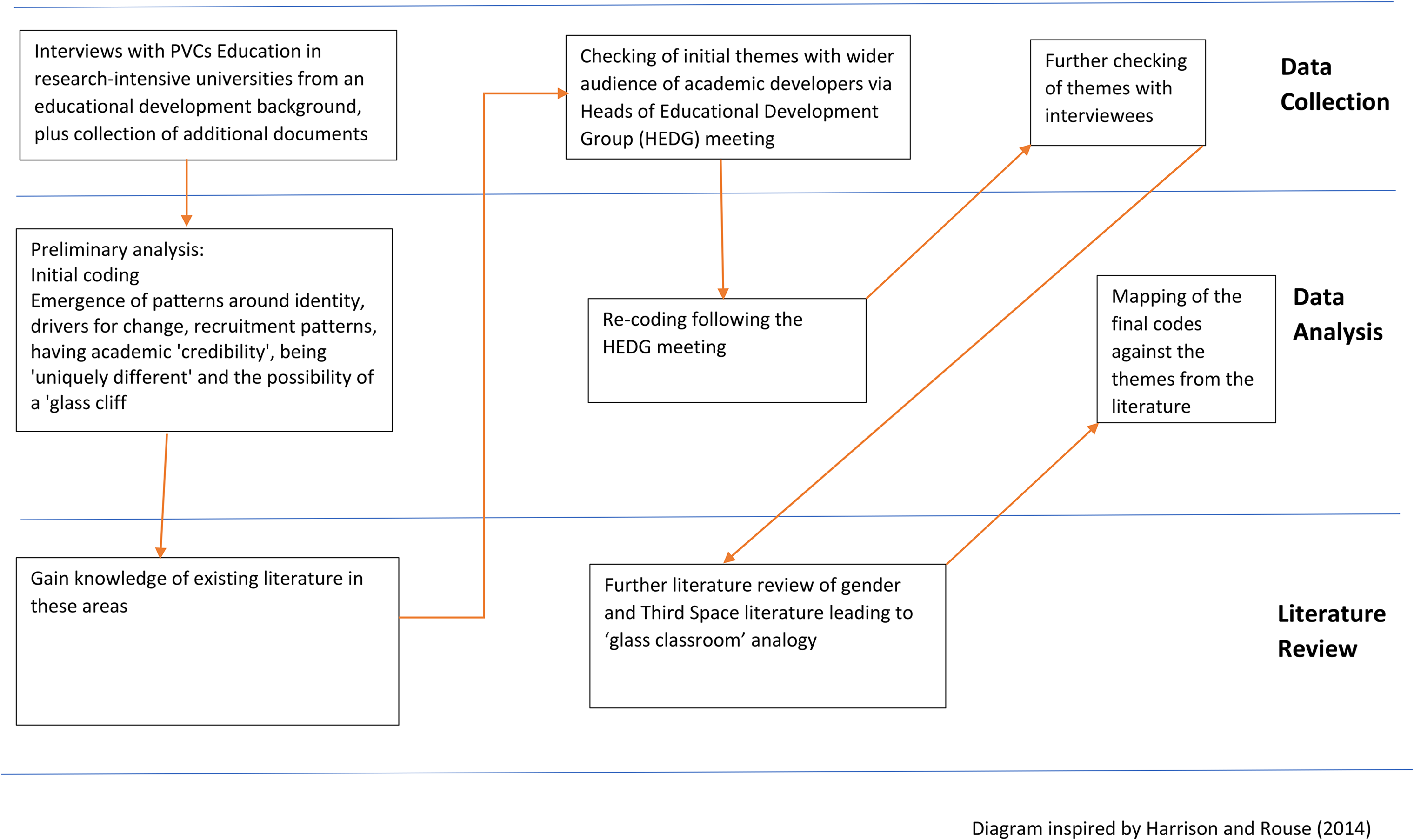
Data collection and analysis.
Findings
The findings are presented according to the following themes: Background to the Culture Change; Career Progression – Navigating the Third Space; Esteem Factors and Redefining Knowledge and Uniquely Different, followed by discussion and conclusions. Additional quotes mapped against each theme can be found in Appendix 1.
Background to the culture change
To some extent, research-intensive universities have been somewhat shielded from the changes in the sector around teaching as they have been able to rely on their eminent research reputations to continue to attract students and funding and therefore have not, for some time at least, felt the same pressures as other institutions. This appears to have changed with the introduction of the Teaching Excellence Framework (TEF), and the role of National Student Survey (NSS) scores as a key metric in TEF. All of a sudden, the universities that were continually at the top of all of the league tables were languishing much further down when it came to teaching.
The interviewees were asked about how they had come to be appointed to the role and all commented on the cultural changes that the universities were intending to achieve. The interviews identified both internal and external drivers for change which resulted in a situation where these drivers became juxtaposed with the reality that the majority of the academic workforce in the research-intensive universities have come from a traditional route through academia. As such, the overriding culture of the institution is focused on the importance of research and the shift to a focus on the enhancement of teaching is therefore highly significant: ‘this is the first time that this institution had gone outside to appoint to this post. So in the whole history of the institution, they have previously always appointed a willing professor from one of the subject areas …the institution was being particularly challenged when it came to the National Student Survey and TEF and so on…’ [Interviewee 2]
The PVCs were brought in on a mandate for change originating from a combination of external pressures such as poor outcomes in TEF (none of the institutions surveyed had obtained Gold) and NSS together with internal changes – three of the institutions had recently had a new Vice-Chancellor, combined with an existing academic workforce very focused on research. These factors coincided to create an environment ready for a culture shift in teaching and created the drive for identifying new senior leaders with the expertise and credibility to lead on these changes. This, therefore, led to the break with tradition of appointing senior leaders either from within the internal academic ranks or externally but of candidates with disciplinary research prestige who happen to have an interest in education. This in itself is an important move which opens up the senior ranks to women with expertise from educational backgrounds but without the traditional disciplinary research prestige.
Career progression – navigating the third space
At the start of the interviews, participants were asked to describe their career journey to the PVC post, which revealed movement between academic and professional services contracts and agency and self-motivation in order to progress: ‘I basically loved [X institution] but I was hitting my head against the wall in a couple of areas and hadn’t succeeded to get promoted there and was getting a bit frustrated with it so a professorship came up at [Y institution]’ [Interviewee 3] ‘it was a bit difficult for me at first because in order to become that Director in that situation, I’d had to, once again, forego my academic role’ [Interviewee 2]
All of the four interviewees had moved back and forth between professional services contracts and academic contracts in order to negotiate their own progression to a senior level. None of them accepted that a professional services contract was a barrier to their own personal career trajectory although they did acknowledge that it was not possible to move internally within a professional services role – promotion was only attainable from within the academic contract type. Their own individual agency and motivation, however, ensured that they negotiated where they could and moved institutions when there was no more internal progression to be had.
Esteem factors and redefining knowledge
Part of the agency and the ability to move between different contract types were down to the commitment of the individuals in this study to engage with work that was not within their job description, but provided them with factors that could be recognised within the academy as esteem factors. All four of the interviewees talked about being involved with national networks, contributing to national projects of sector importance and also about publishing research and getting grants – thereby using their ‘glass classroom’ to showcase their abilities in an academically recognisable way – although they also acknowledged the tensions with education as being a poorly recognised disciplinary area: ‘education, let's face it, doesn't have a high status. So, if you have expertise in education, there are a lot of academics [who think]…that doesn't impress me’ [Interviewee 1] ‘I…developed quite a national profile’ [Interviewee 2]
As a result, the interviewees felt that they were at the forefront of trying to ensure that education and pedagogy were more equitably recognised and treated within the organisation, at least partly due to the gender issues too: ‘that was why I fought so many times in my career to get the kind of recognition that I think this kind of expertise needs… unless you recognise that this too is scholarly expertise and it's a really strategically important evidence informed, theoretically framed, values based, dynamic kind of field of scholarly insight and leadership and strategic thinking. If you don’t recognise it as that to enough of an extent that you can reward it with the appropriate titles that you recognise other kinds of expertise is, then you’re sunk before you start, because you’re already conveying to everybody the idea that this is a kind of rather sort of service level subservient type of field and…I’ve always argued, and there's lots of evidence in the analysis, that these inequalities are very gender-based and so because we know that traditionally education has been a more feminised discipline’ [Interviewee 2]
There was the recognition by the interviewees that the research-intensive institutions need to recognise the value of pedagogic expertise and that as this tends to be female-dominated, that there is an issue here with enabling women to be recognised and to progress. In this context, the ‘glass classroom’ was recognised as being a phenomenon that was trapping women and preventing progression.
‘Uniquely different’?
Behind the recruitment of these four academic development staff into senior academic leadership positions in the pre-1992 research-intensive sector is an assumption that they bring something different to those key positions that the traditional appointment route has not previously provided. This can be defined as the pedagogic expertise identified in the previous section, but the interviewees also commented on other aspects of being an academic developer that made them ‘uniquely different’ and better positioned to be able to effect the changes necessary within the research-intensives to enhance students’ educational experiences.
Firstly, interviewees noted that they had already worked closely with an equivalent second-tier academic leader in another organisation and had developed a good insight into what the position entails; secondly, that the work that they had undertaken as academic developers was all about implementing change, contributing to strategies and doing and understanding best practice based on research. Lastly and most emphasised, all interviewees referred to the ability to work across different disciplines and understanding in order to bring academic colleagues on board with the changes. The following sections look at each of these in turn.
Insights into the position
Academic Developers usually work closely with a number of people in their university. They are often placed centrally and although they may have a direct reporting line to, for example, an HR Director, they almost always work closely with the PVC Education or equivalent role.
‘The thing is if you're an educational academic developer you're effectively…special adviser to the pro vice chancellor.’ [Interviewee 4]
This involves them in a number of tasks that provide unique preparation for moving up into the PVC role themselves. For example, these might include the preparation and implementation of a teaching and learning / education strategy. The academic development position, therefore, serves almost as an apprenticeship for the PVC role although not one formally recognised as such in any way.
The implications of this are that academic developers are closely aligned with national policies and the evidence-base for enhancing teaching and learning in higher education. They bring this with them into leadership roles in a way in which academics who have progressed via a more traditional department, research route would not be able to do. Furthermore, academic development roles also involve implementing the changes articulated in a strategy and therefore the ‘apprenticeship’ provides good preparation for advancement, although more by serendipity than structure.
Implementing change
Part of the reason for the interest in the phenomenon of staff from Academic Development backgrounds being appointed to PVC Education positions in the pre-1992 research-intensive sector is that this heralds important culture change within those institutions. As discussed previously, there is a ‘perfect storm’ of external pressures combined with internal changes, that has created the right environment for the appointment of these people at this time. They are therefore appointed with a mandate to implement changes and in the interviews, the participants spoke about their previous experiences that they consider make them well qualified to do this.
‘our work is around change, engendering change, supporting change, sticking with it when it gets tough, you know, seeing, doing the research, getting the evidence, making it conceptually crisp and clear so that the community can come with you.’ [Interviewee 4]
The fact that the institutions are keen to make a shift is clearly demonstrated here along with the desire to get the right people in place to enable them to implement those changes. The point made by all of the interviewees was that they were all very accustomed to implementing change because that is the main role of the academic developer, and that this was, therefore, a key aspect in them being selected for the PVC position.
‘The sort of soft line is let's get parity between education and research but actually to do that requires quite a lot of disruption, quite a lot of counter-cultural work which is disruptive…I think that's one of the things that academic developers can bring to the role. We are change agents but in the process of doing that, we disrupt existing orders of things, hierarchies, orthodoxies.’ [Interviewee 3]
One of the participants also talked about dealing with resistance to change as being a critical element of being an academic developer and preparation for the PVC role: ‘I have met academics from every discipline. I've had resistance across the board and [former institution] was pretty good at that kind of thing because they were pretty upfront when they were like you were wasting my time. And that gives you huge amount of skills.’ [Interviewee 1]
The skills in implementing educational change effectively is inherent in the job of the academic developer because they were used to working across all the different disciplines in the university. Interviewee 4 also highlighted that this was a key aspect in making them distinct from colleagues who might have progressed to the PVC role via a more traditional route: ‘And if you go through the academic route, if you're in your department, however much work you do across it is not you who's doing the work of getting into departments…speaking to all the different student groups, speaking to all different stuff, understanding the different ontologies that people come from in the different disciplines and really adjusting the concepts that you're trying to get through…I think if you come though the faculty route, you don't have that in the same way…’[Interviewee 4]
The ‘perfect storm’ of circumstances is therefore a critical element in the progression of academic developers into PVC roles and the consistent element throughout this is leadership of change. The culture change is initiated by a recognition that continuing to avoid the external pressures is not a viable option. In three of the institutions new Vice Chancellors were brought in on a mandate for leading change and this is then cascaded down to the next tier to the PVC Education role which is where the educational strategy is led from. The appointment of academic developers is crucial to the ability to effect educational changes as these are people who have previously implemented change across all discipline areas. Academic developers are recognised as being able to influence and bring about change through persuasion, negotiation and influencing (Connolly et al., 2019) thus making them distinct from anyone who has progressed to the second-tier level from a more traditional route. This aspect of working across different discipline areas was highlighted by all of the participants as a crucial element of what makes them uniquely different and will be discussed next.
Trans-disciplinary working
At the core of academic development work is the need to support the enhancement of education across different disciplines within a university. Whilst some universities may well employ disciplinary specialists to help with this, the more common model is a central academic development unit which exists to implement the education strategy at the behest of the PVC Education and usually to provide some form of continuous professional development and training for the academic community. As such, the ability to understand and work across different disciplines is crucial. All of the participants in this study identified this and claimed that this particular factor is what makes them uniquely different from PVCs in pre-1992 research-intensive universities.
‘…having done that so many times with so many different disciplines, it gives you a huge amount of examples to draw on…Most people from a standard academic background will be really experienced in their field, but won’t have experienced all that diversity that you get from different disciplines.’ [Interviewee 2]
That ability to ‘speak the languages’ across disciplines is crucial to be able to get people on board with change, and it was posited that this was not something that you would get if you had come through the traditional academic progression route: ‘it's the interdisciplinarity that gets you in the end. I mean, you suddenly talk to [a] social scientist and…with the mathematicians… And you need to understand what makes these people tick, what is important to them, how is their teaching and how are their students different to what you expect.’ [Interviewee 4]
The participants in this study identify that each discipline within academia uses a common language within their field (Becher and Trowler, 2001) and therefore, as an academic developer, they develop skill in speaking the different disciplinary languages to enable them to work effectively across the institution. This is something quite distinct about being positioned centrally but also having an academic dimension to the role that separates them from those who come through the more traditional route to PVC roles and may only be able to speak the language of their own discipline. This was an aspect that all of the participants in this study identified strongly as making them distinct from those coming from a traditional, disciplinary route.
Discussion and conclusions
In spite of the route to senior leadership in UK universities continuing to be highly gendered and structurally stacked against women, four women have created a unique journey to the top in elite research-intensive universities. This arguably illustrates the point that Fitzgerald (2018, 2020) and Kamerlin et al. (2020) make about women identifying spaces within which they can demonstrate leadership and are deemed socially appropriate, but how much does this really challenge the status quo for women and for Third Space professionals? It is an interesting development for several reasons which are discussed further here.
Firstly, whilst the move of Third Space professionals to senior leadership roles in research-intensive academic institutions is a positive indication that these universities are being more broad-sighted in their appointment to these roles, it does not necessarily indicate more positive regard for the Third Space overall. The reality is still that universities do not appreciate how those in the Third Space fit into the career structure, and the agency that the individuals in this study had to demonstrate in progressing their own careers through moving between professional services and academic contracts continues to indicate this. There was a considerable debate in each of the interviews about the dichotomy between being on a professional services contract or being on an academic contract and there were clear implications for identity, progression and the extent to which they felt respected and valued in the institution. This reflects the continuing lack of esteem awarded to teaching-focused and Third Space roles which have thus become spaces for women to occupy.
Furthermore, the contract-type is only one aspect in the ability to progress their careers as those in this study had to focus on publishing, getting grants and being involved in high-esteem external projects, often on the side and in addition to their full-time role, indicating the continuing pervasiveness of the prestige factors necessary for career progression in academia. As such, they have played into the requirements of performativity to progress to some extent (Acker 1997; Brooks 1997) and this contrasts with the findings of Angervall and Beach (2020) and Misra et al. (2011) who found that women were less attracted to the ‘symbols of power and competitiveness’ displayed through research. Until there is more widespread recognition of the value of teaching and Third Space roles, there will continue to be barriers to progression for those who lie outside of the main academic roles unless they resort to doing additional, unpaid, work to generate academic prestige outputs.
Secondly, the progression of women to senior leadership roles in prestigious research-intensive universities is still limited in other ways. It is notable that the current female Vice chancellors in the Russell Group are largely scientists, thus perpetuating the issue of progressing from within a recognised and established research discipline, and continuing to fustrate those whose expertise is within the discipline of higher education. Fitzgerald identifies women's leadership in higher education as constantly balancing being the ‘other’ as women in a masculine-dominated environment but also needing acceptance and male patronage which when they become accepted, can lead to ostracisation by other women (Broadbridge and Simpson, 2011; Burkinshaw et al., 2018; Chamorro-Premuzic, 2019; Fitzgerald, 2018). Linking this with the evidence that women identify and create their own spaces in which to progress, it is possible that two different and distinct forces are at play in the top echelons of the UK's elite universities. Firstly, the women with scientific disciplinary backgrounds may have played by the masculine rules, pursued careers in established male-dominated disciplines and essentially, therefore, accessed senior leadership through working with the systems and structures designed by men for men (O’Connor, 2019). The participants in this study, however, have not accessed the senior ranks by this method. Instead, it is notable that three out of the four women in this study started their careers in a form of education other than higher education (schools and Further Education colleges) and then subsequently moved into universities as Third Space academic developers. In this regard, they can be seen as having identified, and created, a unique space in which they were able to demonstrate leadership and obtain recognition, and to progress, subject to still having to obtain some of the prestige factors necessary for advancement in academia. This space – academic development – is sufficiently education-enough to be deemed culturally ‘suitable’ for women, but there is still an essentially masculine component of needing to gain the academic credibility necessary to progress further from this space. In particular, the use of professional services contracts for these women, who were consistently engaged in academic work such as researching, publishing, getting grants and influencing national policy is an indicator of cultural controls intended to keep women, and Third Space staff, in a constrained box – the ‘glass classroom’.
In this study, the metaphor of the ‘glass classroom’ has been used to denote both positive and negative elements. The participants used the teaching-focused aspect of their career to their advantage, through showcasing work that was recognisable by research-intensive institutions as having academic credibility. At the same time, the ‘glass classroom’ can also be a trap and an illusion. The illusion is one of ‘equality’ in that women are increasingly visible as members of staff in UK universities, but the trap is that they are corralled into spaces that are deemed ‘appropriate’ and which are difficult to progress from without displaying the same prestige factors as those from traditional research-focused routes. Hence, the women in this study provide the exception rather than the norm. Ultimately time will tell whether the women in this study fall prey to a ‘glass cliff’ or whether they are actually the ‘trailblazers’ for a political and transformational act in gender and Third Space equality.
Recommendations for further research
The sample for this study was very small due to the fact that the project looked solely at academic developers progressing to senior leadership in elite, research-intensive universities in the UK. The numbers of academic developers who have progressed to senior leadership in post-1992 universities are greater, and the situation is different in other international contexts as well. Further research could therefore usefully identify the progression stories of those women and to assess the impact of the context on gender and Third Space advancement.
Footnotes
Acknowledgements
The author would like to thank the participants of this study for their time and openness in sharing their experiences and the anonymous reviewers for their comments which helped to strengthen the paper considerably.

Notes
Author biography
Appendix 1. Table of Illustrative Quotes Mapped against Themes
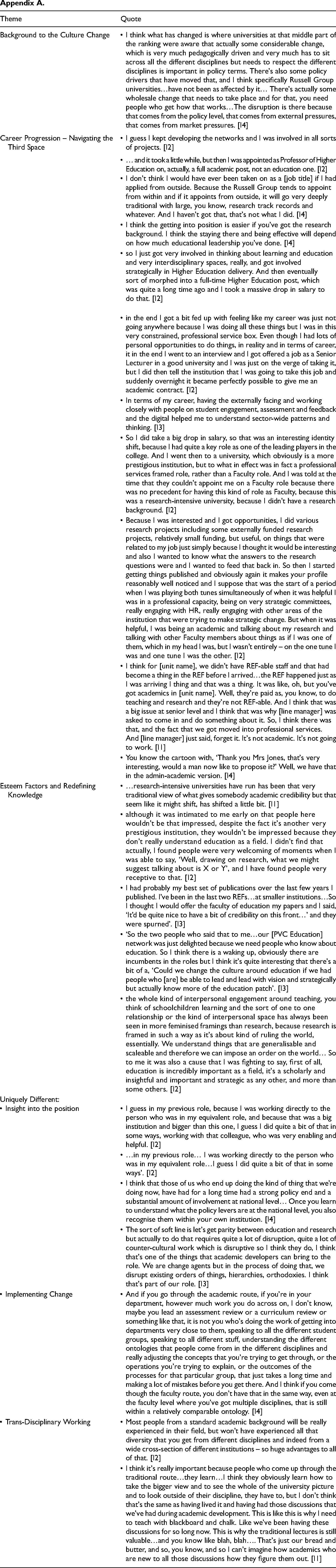
| Theme | Quote |
|---|---|
| Background to the Culture Change |
I think what has changed is where universities at that middle part of the ranking were aware that actually some considerable change, which is very much pedagogically driven and very much has to sit across all the different disciplines but needs to respect the different disciplines is important in policy terms. There's also some policy drivers that have moved that, and I think specifically Russell Group universities…have not been as affected by it… There's actually some wholesale change that needs to take place and for that, you need people who get how that works…The disruption is there because that comes from the policy level, that comes from external pressures, that comes from market pressures. [I4] |
| Career Progression – Navigating the Third Space |
I guess I kept developing the networks and I was involved in all sorts of projects. [I2] |
|
… and it took a little while, but then I was appointed as Professor of Higher Education on, actually, a full academic post, not an education one. [I2] |
|
|
I don't think I would have ever been taken on as a [job title] if I had applied from outside. Because the Russell Group tends to appoint from within and if it appoints from outside, it will go very deeply traditional with large, you know, research track records and whatever. And I haven't got that, that's not what I did. [I4] |
|
|
I think the getting into position is easier if you've got the research background. I think the staying there and being effective will depend on how much educational leadership you’ve done. [I4] |
|
|
so I just got very involved in thinking about learning and education and very interdisciplinary spaces, really, and got involved strategically in Higher Education delivery. And then eventually sort of morphed into a full-time Higher Education post, which was quite a long time ago and I took a massive drop in salary to do that. [I2] |
|
|
in the end I got a bit fed up with feeling like my career was just not going anywhere because I was doing all these things but I was in this very constrained, professional service box. Even though I had lots of personal opportunities to do things, in reality and in terms of career, it in the end I went to an interview and I got offered a job as a Senior Lecturer in a good university and I was just on the verge of taking it, but I did then tell the institution that I was going to take this job and suddenly overnight it became perfectly possible to give me an academic contract. [I2] |
|
|
In terms of my career, having the externally facing and working closely with people on student engagement, assessment and feedback and the digital helped me to understand sector-wide patterns and thinking. [I3] |
|
|
So I did take a big drop in salary, so that was an interesting identity shift, because I had quite a key role as one of the leading players in the college. And I went then to a university, which obviously is a more prestigious institution, but to what in effect was in fact a professional services framed role, rather than a Faculty role. And I was told at the time that they couldn’t appoint me on a Faculty role because there was no precedent for having this kind of role as Faculty, because this was a research-intensive university, because I didn’t have a research background. [I2] |
|
|
Because I was interested and I got opportunities, I did various research projects including some externally funded research projects, relatively small funding, but useful, on things that were related to my job just simply because I thought it would be interesting and also I wanted to know what the answers to the research questions were and I wanted to feed that back in. So then I started getting things published and obviously again it makes your profile reasonably well noticed and I suppose that was the start of a period when I was playing both tunes simultaneously of when it was helpful I was in a professional capacity, being on very strategic committees, really engaging with HR, really engaging with other areas of the institution that were trying to make strategic change. But when it was helpful, I was being an academic and talking about my research and talking with other Faculty members about things as if I was one of them, which in my head I was, but I wasn’t entirely – on the one tune I was and one tune I was the other. [I2] |
|
|
I think for [unit name], we didn’t have REF-able staff and that had become a thing in the REF before I arrived…the REF happened just as I was arriving I thing and that was a thing. It was like, oh, but you've got academics in [unit name]. Well, they're paid as, you know, to do teaching and research and they're not REF-able. And I think that was a big issue at senior level and I think that was why [line manager] was asked to come in and do something about it. So, I think there was that, and the fact that we got moved into professional services. And [line manager] just said, forget it. It's not academic. It's not going to work. [I1] |
|
|
You know the cartoon with, ‘Thank you Mrs Jones, that's very interesting, would a man now like to propose it?’ Well, we have that in the admin-academic version. [I4] |
|
| Esteem Factors and Redefining Knowledge |
…research-intensive universities have run has been that very traditional view of what gives somebody academic credibility but that seem like it might shift, has shifted a little bit. [I1] |
|
although it was intimated to me early on that people here wouldn’t be that impressed, despite the fact it's another very prestigious institution, they wouldn’t be impressed because they don’t really understand education as a field. I didn’t find that actually, I found people were very welcoming of moments when I was able to say, ‘Well, drawing on research, what we might suggest talking about is X or Y’, and I have found people very receptive to that. [I2] |
|
|
I had probably my best set of publications over the last few years I published. I’ve been in the last two REFs…at smaller institutions…So I thought I would offer the faculty of education my papers and I said, ‘It’d be quite nice to have a bit of credibility on this front…’ and they were spurned’. [I3] |
|
|
‘So the two people who said that to me…our [PVC Education] network was just delighted because we need people who know about education. So I think there is a waking up, obviously there are incumbents in the roles but I think it's quite interesting that there's a bit of a, ‘Could we change the culture around education if we had people who [are] be able to lead and lead with vision and strategically but actually know more of the education patch’. [I3] |
|
|
the whole kind of interpersonal engagement around teaching, you think of schoolchildren learning and the sort of one to one relationship or the kind of interpersonal space has always been seen in more feminised framings than research, because research is framed in such a way as it's about kind of ruling the world, essentially. We understand things that are generalisable and scaleable and therefore we can impose an order on the world… So to me it was also a cause that I was fighting to say, first of all, education is incredibly important as a field, it's a scholarly and insightful and important and strategic as any other, and more than some others. [I2] |
|
| Uniquely Different: | |
|
Insight into the position |
I guess in my previous role, because I was working directly to the person who was in my equivalent role, and because that was a big institution and bigger than this one, I guess I did quite a bit of that in some ways, working with that colleague, who was very enabling and helpful. [I2] |
|
…in my previous role… I was working directly to the person who was in my equivalent role…I guess I did quite a bit of that in some ways’. [I2] |
|
|
I think that those of us who end up doing the kind of thing that we’re doing now, have had for a long time had a strong policy end and a substantial amount of involvement at national level… Once you learn to understand what the policy levers are at the national level, you also recognise them within your own institution. [I4] |
|
|
The sort of soft line is let's get parity between education and research but actually to do that requires quite a lot of disruption, quite a lot of counter-cultural work which is disruptive so I think they do, I think that's one of the things that academic developers can bring to the role. We are change agents but in the process of doing that, we disrupt existing orders of things, hierarchies, orthodoxies. I think that's part of our role. [I3] |
|
|
Implementing Change |
And if you go through the academic route, if you're in your department, however much work you do across on, I don't know, maybe you lead an assessment review or a curriculum review or something like that, it is not you who's doing the work of getting into departments very close to them, speaking to all the different student groups, speaking to all different stuff, understanding the different ontologies that people come from in the different disciplines and really adjusting the concepts that you're trying to get through, or the operations you're trying to explain, or the outcomes of the processes for that particular group, that just takes a long time and making a lot of mistakes before you get there. And I think if you come though the faculty route, you don't have that in the same way, even at the faculty level where you've got multiple disciplines, that is still within a relatively comparable ontology. [I4] |
|
Trans-Disciplinary Working |
Most people from a standard academic background will be really experienced in their field, but won’t have experienced all that diversity that you get from different disciplines and indeed from a wide cross-section of different institutions – so huge advantages to all of that. [I2] |
|
I think it's really important because people who come up through the traditional route…they learn…I think they obviously learn how to take the bigger view and to see the whole of the university picture and to look outside of their discipline, they have to, but I don't think that's the same as having lived it and having had those discussions that we've had during academic development. This is like this is why I need to teach with blackboard and chalk. Like we've been having these discussions for so long now. This is why the traditional lectures is still valuable…and you know like blah, blah…. That's just our bread and butter, and so, you know, and so I can't imagine how academics who are new to all those discussions how they figure them out. [I1] |
Appendix 2. Interview Questions
(1) Please introduce yourself and tell me how long you have been in your current position and what that position is, giving me your exact job title?
(2) Please tell me how you were recruited for this role? i.e. Head-hunted / applied for the position via open, external competition / internally recruited, etc?
(3) How long is your contract? Is it open-ended or fixed term? If fixed term, for how long? Are there any expectations that you will go into a faculty academic role at the end of your term of office?
(4) Please describe for me your current role and any particular remit you have or priorities that you were employed specifically to implement. Do you have any documentation (e.g. job advert, job description, strategy, etc) that you could let me have to support this please?
(5) Please describe to me your career ‘road map’ to date and talk to me about how you have got to your current position. Are there any people, events or things that you would identify has having particularly influenced you along the way.
(6) What difference do you think it makes and has made, coming into this role from an educational development background? What are the benefits and disadvantages of being from an educational development background as opposed to a traditional academic research background?
(7) Have you encountered any issues of academic credibility or negative impact on persuasion of academic colleagues as a result of coming from an educational development background?
(8) What's been the biggest surprise to you, on coming into this role, that you consider that your background as an educational developer didn’t prepare you for?
(9) What advice would you give to an educational development colleague who is thinking of aiming to get a VP / DVC / PVC Education role in a research-intensive institution?
(10) Would you consider experience of working as an academic in a faculty role important for being a PVC / DVC?
(11) And what advice would you give to research-intensive universities on who they appoint to these positions?
(12) How do you see yourself now? Do you see yourself as ‘different’ from other VPs / DVCs / PVCs Education in research-intensive universities? How has your perception of your identity changed over time?
(13) Is there anything else that you think might be of interest for me to know?