




Abstract
The present study explores the effect of teachers’ authentic leadership in second chance programmes on students’ psychological need satisfaction climate (according to self-determination theory), and the manner in which teachers’ gender moderates this effect. Data collected from 60 teachers and 183 students in second chance programmes in Israel were analysed at the group level. The study found that for male teachers, authentic leadership negatively predicted psychological need satisfaction climate in the classroom. The implications of findings for authentic leadership in general and for teaching in second chance programmes are discussed.
Keywords
Introduction
Despite the growing acknowledgement of teachers’ leadership (Duignan, 2014; Pounder, 2006), empirical research on school teachers as leaders of their students is scarce (for a notable exception, see Cheng, 1994). One theory that has gained popularity since the early 2000s, and which may be of particular value for teaching, is authentic leadership theory (Banks et al., 2016; Gardner et al., 2011; Wang et al., 2014). The idea of authentic leadership emerged in the educational literature in the late 1990s/early 2000s (Begley, 2001; Duignan and Bhindi, 1997), and was developed in management studies (Gardner et al., 2011). Scholars have suggested that authentic leaders possess self-awareness and commitment to their values and goals, which stems from their life stories, and they are influenced by external factors such as their family, significant figures in their lives, key experiences and professional experience (Begley, 2001; Gardner et al., 2005). Claims in the educational literature suggest that ‘the self of the teacher is at the heart of good teaching’ (Dirkx, 2006: 29), and that teachers’ authenticity and self-awareness are key in effective teaching (Cranton and Carusetta, 2004; Johnson and LaBelle, 2017).
Management studies reported that authentic leadership contributes to followers’ fulfilment of psychological needs and improves their performance (Leroy et al., 2015). In this same vein, satisfaction of students’ basic psychological needs in school (specifically their needs for autonomy, competence and relatedness) was found to contribute to their school-related engagement (Diseth et al., 2012; Tian et al., 2014). Yet no exploration has been conducted to date on the influence of teachers’ authentic leadership on the fulfilment of the students’ basic psychological needs. Support for such school-related experience and its promotion are considered cardinal in second chance programmes (Ross and Gray, 2005). Second chance programmes are alternative educational settings designed to promote re-entry and re-engagement of youths at risk who dropped out of regular schools (Savelsberg et al., 2017).
We add to this model, which originated in management studies, the key element of gender, which often remains outside the scope of research on leadership in education (Banks, 2000; Blackmore, 2013; Shakeshaft, 1989). This oversight in educational leadership studies is worrying because gender is considered a key structural variable that affects the dynamic of leadership (Ayman and Korabik 2010). 1 With regard to authentic leadership, it has been argued that leaders’ gender affects the dynamic and outcomes of authentic leadership (Christo-Baker and Wilbur, 2017; Kapasi et al., 2016; Liu et al., 2015). The purpose of the present study is to investigate an integrative model in the context of second chance programmes in which the effect of teachers’ authentic leadership on students’ psychological need satisfaction climate is moderated by teachers’ gender.
Theoretical background
Teachers’ authentic leadership
The educational literature on authentic leadership has raised the idea of value-inspired or value-based leadership (Begley, 2001; Duignan, 2014). Authentic leadership, dominated by integrity, moral purpose and ethical conduct is said to positively affect students, enabling ‘their human spirit to soar’ (Duignan, 2014: 164). In defining teachers’ authentic leadership, we draw on one of the main definitions in the managerial literature, suggesting that authentic leaders have four core capabilities (Avolio and Walumbwa, 2014): (a) self-awareness, expressed in the high perceptiveness by individuals of their environment, understanding of their strengths and weaknesses, identification of their influence on others, and understanding of how others perceive their influence; (b) balanced processing of information, defined as the ability of individuals to listen attentively to different points of view and opinions before making decisions; (c) internalisation of a moral perspective, defined as conduct based on internal moral values and on doing the right thing out of a desire for fairness and justice; and (d) relative transparency, defined as honesty, integrity and the absence of ulterior motives in relations with others. Similar elements emerged in educational works with respect to the definition of authentic leadership; for example, self-identification of the ‘authentic self’, influence of one’s personal moral values on one’s behaviour and relationships, and sensitivity to others (see Begley, 2001; Duignan and Bhindi, 1997).
Empirical research that addresses the phenomenon of authentic leadership in the business world shows that authentic leaders exert a positive influence on their followers (Leroy et al., 2015; Wang et al., 2014). In the world of education as well, education researchers have expressed an interest in the concept of authentic leadership (Begley, 2001; Wilson, 2014) and explored various aspects related to the authentic leadership of school principals (Bird et al., 2012; Fox et al., 2015). Quantitative studies reported positive correlations between school leaders’ authentic leadership and teachers’ level of commitment and confidence in their work (Bird et al., 2010; Wang and Bird, 2011), as well as positive correlations between the school leaders’ authentic leadership and teachers’ psychological empowerment, withdrawal and citizenship behaviours (Shapira-Lishchinsky and Tsemach, 2014). Qualitative works explored how teacher mentees perceive their mentors as authentic leaders (Shapira-Lishchinsky and Levy-Gazenfrantz, 2015, 2016).
Yet there is little reference in the literature to teachers as authentic leaders of their students. Few works address teachers’ authentic leadership directly or indirectly. Greenier and Whitehead’s (2016) qualitative study of language teachers’ authentic leadership demonstrates how self-awareness, relative transparency, internalisation of a strong set of morals, and balanced processing of information are reflected in teachers’ work at school. Lumpkin et al.’s (2014) theoretical paper on teacher leaders suggests that they conduct themselves in classrooms with high emotional and cognitive self-awareness, which leads them to make informed decisions. The researchers also argued that such teachers demonstrate self-confidence and self-regulation, honesty, fairness and reliability, and have elevated interpersonal skills and good communication.
Authentic leadership resonates with the idea that kindergarten to 12th grade (K-12) teachers need to ‘keep it real’ in challenging educational settings (Woodruff, 1996), with the aim of encouraging students to perceive the teacher as an actual human being (Brookfield, 1990). Authentic teachers are considered valuable in teaching youths at risk (Johnson and Stevens, 2006; Krane et al., 2016) in ‘alternative schools’ or ‘second chance programmes’, and this claim has received some empirical attention recently. Youths at risk are defined as ‘failing in school and unsuccessful in making the transition to work and adult life, and as a consequence unable to make a full contribution to active society’ (Organisation for Economic Co-operation and Development (OECD), 1995: 21). They are in ‘greater likelihood for the development of delinquency, substance abuse, or other anti-social and self-destructive behaviors’ (Wright, 1996: 4). Blum-DeStefano’s (2014) interviews with 19 students at risk stressed the importance of seeing the teacher as a ‘real’ person and of connecting authentically with the teacher to promote academic success and social integration. Luster (2015) found that building authentic teacher–student relationships promotes both social and emotional engagement in the schooling of youths at risk.
Teachers’ authentic leadership and psychological need satisfaction climate
Self-determination theory (SDT) distinguishes between types of motivation for action (Deci and Ryan, 2000). The most basic distinction is between intrinsic motivation, which involves doing something because it is interesting or enjoyable, and extrinsic motivation, which involves doing something out of an external motive that is not related to the activity itself, such as hope for material reward or a desire to avoid punishment (Deci et al., 2017). According to SDT, the more one perceives the activity as self-expressive and based on one’s own tendencies, interests, beliefs or personal goals, the more one feels that the activity is self-directed (Deci and Ryan, 2000).
According to SDT, there are three psychological needs that help support intrinsic motivation (Deci and Ryan, 2000; Deci et al., 2017): (a) autonomy, an internal freedom of action; (b) competence, a sense of ability to perform the relevant task; and (c) relatedness, a sense that a person is part of one’s social environment and community. In a given social context, shared perceptions of practices that are supported by the context shape the psychological climate along three dimensions: the level of freedom of action (i.e. autonomy-supportive climate), the scope of resources that support task performance (i.e. competence-supportive climate) and the level of encouragement to create meaningful relationships (i.e. relatedness-supportive climate) (Karanika-Murray et al., 2017). Theoretical and empirical studies on SDT in educational and learning environments suggest that climates that support psychological need satisfaction – specifically, autonomy-supportive climates – promote intrinsic motivation (Black and Deci, 2000; Núñez and León, 2015; Reeve and Jang, 2006).
Various studies show that teachers’ support of students’ basic psychological needs for autonomy, competence and relatedness facilitates students’ autonomous self-regulation for learning, academic performance and wellbeing (Kage and Namiki, 1990; Niemiec and Ryan, 2009; Ryan and Grolnick, 1986). According to Niemiec and Ryan (2009), students are autonomous when they willingly devote time and energy to their studies, and are competent when they feel able to meet the challenges of their schoolwork. In these educational environments, teachers often allow students to choose and encourage them to feel competent and to exert effort (Dincer et al., 2012; Jang et al., 2016; Leroy et al., 2007; Reeve and Jang, 2006).
Previous research in business settings suggests that authentic leaders have a positive influence on meeting followers’ psychological needs (Leroy et al., 2015). Although this connection has not been examined with respect to teachers’ authentic leadership and psychological need satisfaction climate, some research has addressed the relationship between an authentic teacher and students’ motivation. For example, Crippen (2012) found that the relationship between authentic teachers and their students is characterised by trust, respect, loyalty and honesty, which lead to a positive learning experience and stimulate intrinsic motivation, allowing students to express their views independently and without fear. Anderman (2003), who studied students’ sense of belonging in school, which is one of the three basic psychological needs, has argued that teachers with high self-regulation abilities promote a learning environment based on trust, mutual respect and fairness, bolster the students’ sense of belonging and reinforce their motivation. Therefore, based on the literature, it is reasonable to assume that the teachers’ authentic leadership promotes a psychological need satisfaction climate, as expressed in students’ reports. Thus, we hypothesise that:
Hypothesis 1: Teachers’ authentic leadership is positively related to psychological need satisfaction climate.
Gendered construction of authentic leadership performance and its effect on outcomes
Exploration of the effects of authentic leadership requires shifting from treating authenticity as a trait to thinking about it as a performance (Liu et al., 2015). The literature suggests that authentic leadership can manifest in two forms (Qu et al., 2019): enabling authentic leadership with benevolent value-content manifested through ‘humility, integrity, accountability, security, and vulnerability’ (Udani and Lorenzo-Molo, 2013: 385), and controlling authentic leadership, which is value-free and often prioritising self-expression, even at the expense of others (Zander, 2013). These manifestations reflect collective versus individualistic models (Ibarra, 2015), which parallel feminine and masculine viewpoints. Francis (2000) argued that in western society, masculinity and femininity are opposing constructs: rationality versus emotion, strength versus frailty, aggression versus care, competition versus cooperation, activity versus passivity, independence versus dependence, etc.
Over the years, gender has remained relatively unexplored in relation to authentic leadership, and researchers have not distinguished between male and female authentic leaders (Liu et al., 2015). But in recent years, researchers have argued that leaders’ gender affects the outcomes of authentic leadership (Christo-Baker and Wilbur, 2017; Kapasi et al., 2016). The logic behind these claims can be traced to gender reproduction theory (Brannon, 2016; Laslett and Brenner, 1989; Young and Hurlic, 2007), which suggests that gender is a socially constructed characteristic, based on biological sex type (Laslett and Brenner, 1989). In other words, certain characteristics (i.e. gender roles or stereotypes) have become historically and socially associated with men, while others have become associated with women, causing both to reproduce gender-related behaviour in various arenas. The practical enacted manifestations associated with being male or female are termed ‘doing gender’ (West and Zimmerman, 1987).
Caza et al. (2010), who explored authentic leadership, found measurement equivalence with regard to gender, but also that women and men are ‘constrained in their performances of both gender and authenticity’ (Liu et al., 2015: 239). According to Eagly and Johannesen-Schmidt (2001), people internalise their gender role, which manifests in different performance of leadership roles, so that gender affects the type of manifestation of authentic leadership, and thereby alters the outcome. For example, men in leadership positions tend to adopt individualism, authoritativeness and paternalism as a model of ideal action, and shy away from relational practices (Fletcher, 2004; Martin and Collinson, 1998). Scholars have suggested that male leaders adopt a type of authentic leadership that is more masculine (Hopkins and O’Neil, 2015; Woolley et al., 2011). Thus, being an ‘authentic’ male leader is often associated with manifestations of controlling authentic leadership and with relatively less favourable outcomes (Liu et al., 2015). By contrast, women in leadership positions tend to be less aggressive than their male counterparts (Bligh and Kohles, 2008).
Doing gender is quite common in teaching. Similarly to all people, teachers invest effort in maintaining their gender. External attention to male teachers’ masculinity is often noticed by teachers. Male teachers, especially those teaching young students, negotiate tensions in their gender identity (Francis and Skelton, 2001; Sargent, 2000). Allan (1993) interviewed male school teachers in the US and reported that they felt conflicted because they were expected to act as male role models in a job and an environment dominated by women. Although men working in non-traditional occupations report feelings of comfort in a feminine group and environment, they describe using strategies to re-establish their masculinity, including relabelling, status enhancement and distancing from the feminine elements (Simpson, 2004). Thus, we propose that authentic leadership of male teachers tends to be more controlling than that of female teachers, and therefore it is less strongly associated with positive outcomes, such as a psychological need satisfaction climate. Hence:
Hypothesis 2: The relations between teacher’s authentic leadership and psychological need satisfaction climate are moderated by teachers’ gender, and are weaker for male than for female teachers.
Method
The study sought to examine the relationship between authentic teacher leadership and the psychological need satisfaction climate in second chance programmes. We adopted a quantitative research design because there are valid theory-based measures of authentic leadership and basic psychological needs that have proven useful (Duignan, 2014; Gardner et al., 2011; Van den Broeck et al., 2016). The study focused on HILA (Hebrew acronyms of Basic Education and Supplementary Studies), an Israeli second chance programme designed to provide education and to narrow educational gaps for youths at risk. The programme is managed by the Department of Education of Children and Youths at Risk in the Pedagogic Administration of the Ministry of Education, and it is operated by local authorities and youth protection institutions. The programme operates in 196 units (151 local authorities and 45 youth protection institutions, prisons and detention centres) and includes about 1300 teachers and over 7000 youths at risk.
The curriculum of the HILA programme is flexible and tailored to the needs and abilities of the students. The studies take the form of individual or group learning, and study groups are small. The number of weekly study hours ranges from 3 to 18. Each teacher employed in the programme undergoes training and has responsibility over a study group. The present research was approved by the institutional review board (IRB) and by the Office of the Chief Scientist at the Ministry of Education.
Participants and procedure
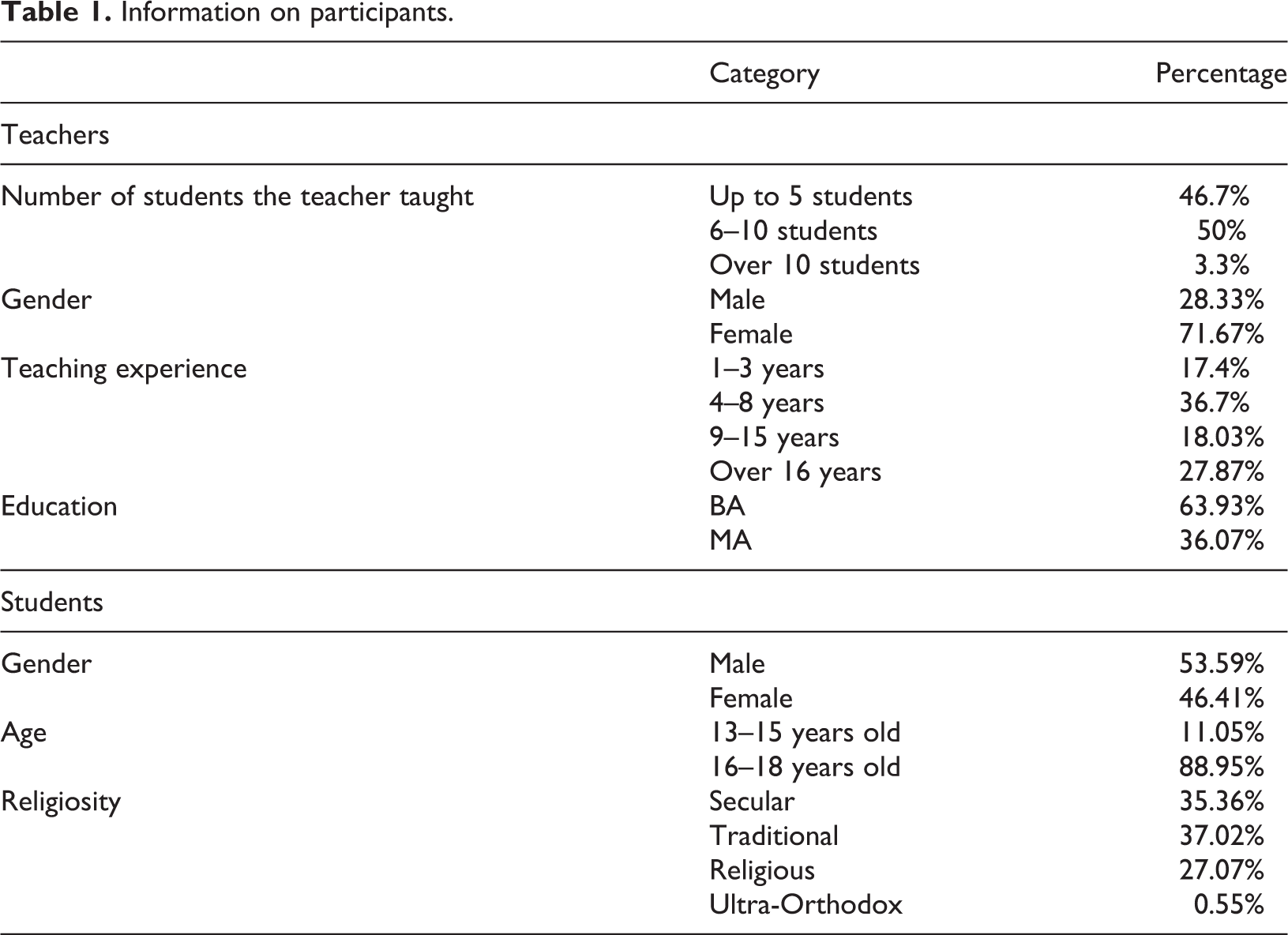
We approached the central management of the HILA programme to obtain a list of all unit managers. A formal letter of invitation to participate in the sample was sent to all unit managers, with follow-up telephone communication to clarify information and ascertain their willingness to participate, and to obtain permission to conduct research in their units. In the units that agreed to participate, the research was introduced to the teachers at a staff meeting, and willing teachers were enlisted in the research. Thus, the sampling method was non-random. Specifically, we used a quota sampling in which ‘subjects are selected by convenience until the specified number of subjects for a specific subgroup is reached’ (Panacek and Thompson, 2007: 76). We pre-set the targeted number of participating teachers to 60. Inclusion criteria for teacher participants were: (a) being employed by the HILA programme; (b) willingness to participated in the study; and (c) command of the Hebrew language. There were no exclusion criteria, so all of the HILA teachers were considered as potential participants. Individuals on formal leave from work (sick, maternity, etc.) during the time of data collection were not included in the study. The study sample included 60 teachers (reporting on their authentic leadership) and 181 students aged 13–18 (reporting on psychological need satisfaction climate) from different units of the HILA programme, across the country. The number of students reporting per teacher ranged from 2 to 5. Information on participants is presented in Table 1.
Information on participants.
Participation of HILA units in the study depended on the agreement of the unit manager. The units and their participants were guaranteed anonymity and assured that publication would not result in identification of the unit or of the participants. To ensure unbiased responses, we made sure to stress anonymity and the fact that responses will not be made available to other individuals beside the research team (Pellegrin and Currey, 2011). The teachers completed a self-reported authentic leadership questionnaire. Two months later, students of the participating teachers were asked by email to participate in the study. Those who agreed completed an online questionnaire about the satisfaction of their basic psychological needs in their study group. The informed consent forms signed by the students stated that non-participation would have no effect on them, and that they would be able to terminate their participation at any time without consequences. Signed informed consent forms were obtained from all participants. When data collection efforts were completed, all identifying information of participating units and individuals was removed and replaced with identifying serial codes.
Measures
Teacher’s authentic leadership
The study used Neider and Schriesheim’s (2011) authentic leadership inventory, which contains 16 statements and is divided into 4 subcategories: self-awareness, relative transparency, internalisation of moral perspective, and balanced processing of information. We adapted the questionnaire from other-report to self-report. Although generally other-report is used to assess leaders’ authenticity, self-reports by leaders (i.e. felt authenticity) are considered ‘more closely aligned with authentic leadership theory, and the nature of authenticity itself’ (Qu et al., 2019: 1029). An example of an item from the self-awareness subcategory is: ‘I solicit feedback for improving my dealings with others.’ An example of an item from a relative transparency subcategory is: ‘I clearly state what I mean’. An example of an item from the internalisation of a moral perspective subcategory is: ‘I show consistency between my beliefs and actions.’ An example of an item from the balanced information processing subcategory is: ‘I ask for ideas that challenge my core beliefs.’ Teachers were asked to indicate agreement on a 5-point Likert scale, ranging from 1 (do not agree at all) to 5 (agree to a great extent). An exploratory factor analysis with Varimax rotation produced four factors with eigenvalues above 1, which accounted for 60.06% of the variance. As it is common in authentic leadership research, the factors were averaged to one authentic leadership score (Mortier et al., 2016; Qu et al., 2019). Cronbach’s alpha for the scale was good (α = .81).
Psychological need satisfaction climate
The study used the psychological need satisfaction questionnaire by Kunter et al. (2007), which contains 16 items and is divided into the following subcategories: autonomy (example item: ‘In this lesson we are taught to work independently’), competence (example item: ‘In this lesson I am considered capable of solving difficult tasks’) and relatedness (example item: ‘In this lesson I feel accepted by my classmates’). Students were asked to indicate agreement on a 5-point Likert scale, ranging from 1 (do not agree at all) to 5 (agree to a great extent). According to Kunter et al. (2007), the reliability of the subcategories in the questionnaire was as follows: autonomy α = .75, competence α = .82 and relatedness α = .84. Kunter et al. (2007) also argued that a ‘two-factor solution which combined autonomy and competence items in a single factor was also empirically valid’ (498). An exploratory factor analysis with Varimax rotation produced two factors with eigenvalues above 1, which accounted for 60.14% of the variance. The analysis indicated a two-factor structure: an autonomy- and competence-supportive climate factor (α = .92) and a relatedness-supportive climate factor (α = .70). Interclass correlation coefficient (ICC) (Bliese, 1998) results (i.e. 23.7% for autonomy- and competence-supportive climate and 25.4% for relatedness-supportive climate) supported aggregation to group level.
Teacher’s gender
The teachers’ gender was coded for all respondents (1 = female, 2 = male).
Controls
Previous research indicated that teachers’ seniority has a positive effect on autonomy support climate in educational settings mediated by teachers’ self-efficacy (Leroy et al., 2007). Group size is also considered a factor that may affect need satisfaction (Jang et al., 2016). Therefore, teachers’ experience and group size were used as controls.
Results
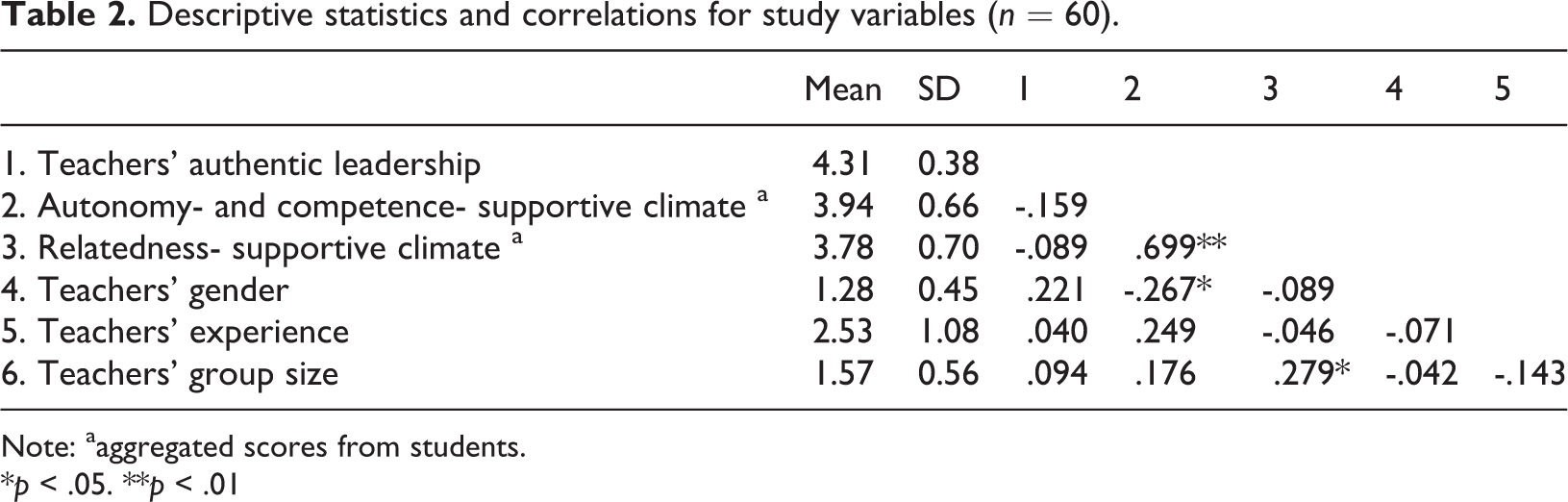
Descriptive statistics and correlations for study variables are presented in Table 2.
Descriptive statistics and correlations for study variables (n = 60).
Note: aaggregated scores from students.
*p < .05. **p < .01
As shown in Table 2, the correlations between teacher’s authentic leadership and the two types of psychological need satisfaction climate were not significant (ps > .05), therefore Hypothesis 1 was not supported.
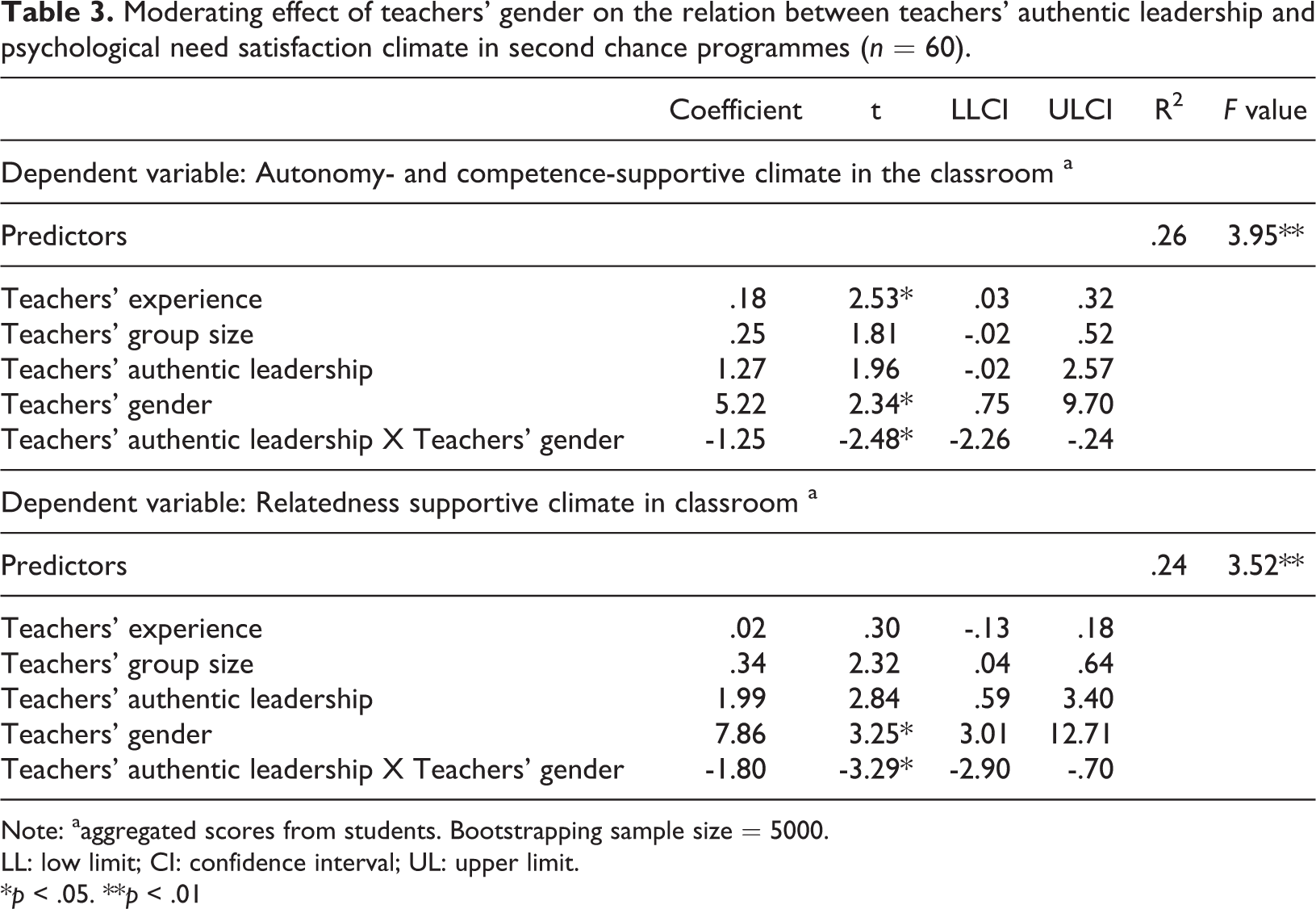
To explore the moderation effect of teachers’ gender on the correlations between teacher’s authentic leadership and the two types of psychological need satisfaction climate, we used bootstrapping PROCESS macro for SPSS (i.e. Model 1) developed by Hayes (2013) (Table 3). The PROCESS macro allows exploring two- and three-way interactions in models and to preform simple slope analysis (Hayes, 2013). Simple slope analysis decomposes a significant interaction to further understand the nature of the relations between the main variables, at different levels of the moderator (Aiken and West, 1991). PROCESS can handle regression models using variables with different types of scale of measurement, such as dichotomous, multi-categorical and continuous variables (Hayes and Rockwood, 2017; see also http://processmacro.org/faq.html).
Moderating effect of teachers’ gender on the relation between teachers’ authentic leadership and psychological need satisfaction climate in second chance programmes (n = 60).
Note: aaggregated scores from students. Bootstrapping sample size = 5000.
LL: low limit; CI: confidence interval; UL: upper limit.
*p < .05. **p < .01
As shown in Table 3, the interactions between teachers’ gender and authentic leadership significantly predict autonomy- and competence-supportive climate (B = -1.25, p < .05), as well as relatedness-supportive climate (B = -1.80, p < .05). Therefore, Hypothesis 2 was supported.
We plotted the significant interactions. The simple slope effects are presented in Figures 1 and 2.
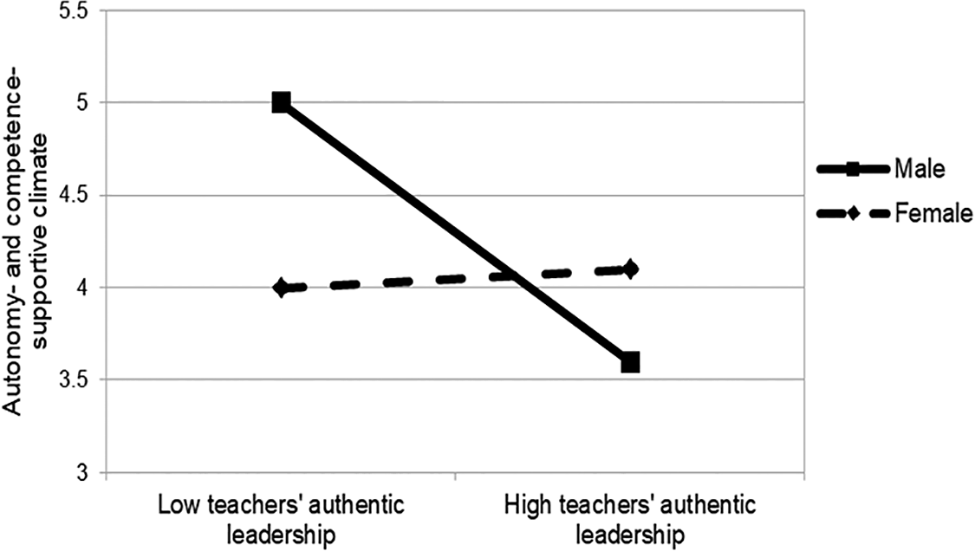
The moderating effect of teachers’ gender on the effect of teachers’ authentic leadership on autonomy- and competence-supportive climate.
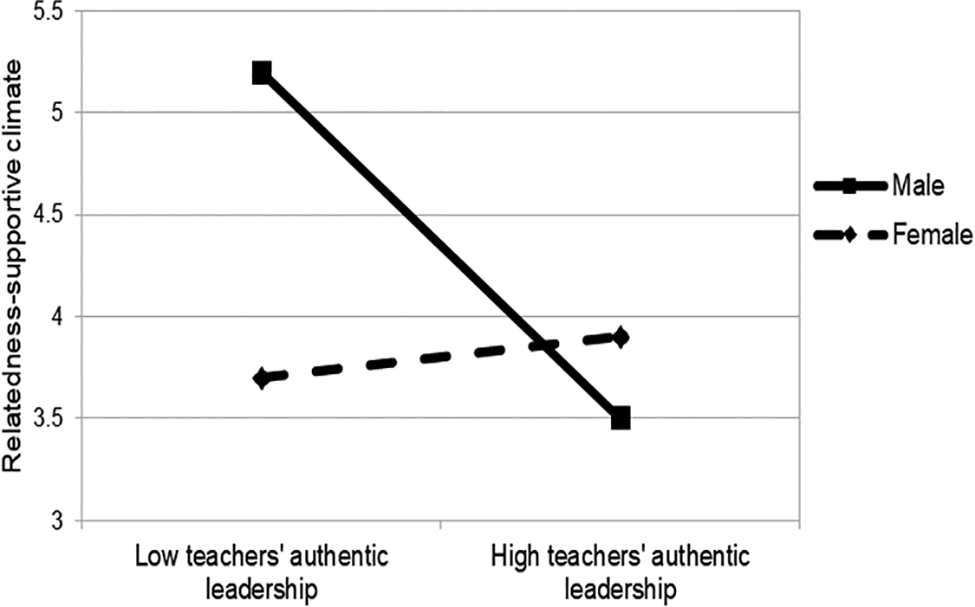
The moderating effect of teachers’ gender on the effect of teachers’ authentic leadership on relatedness-supportive climate.
As shown in Figure 1, when predicting autonomy- and competence-supportive climate, the relationship between teachers’ authentic leadership and autonomy- and competence-supportive climate was negative for male teachers (solid line; coefficient = -1.23, t = -2.75, p < .01) and non-significant for female teachers (dashed line; coefficient = .01, t = .07, p = .93). As shown in Figure 2, when predicting relatedness-supportive climate, the relationship between teachers’ authentic leadership and relatedness-supportive climate was negative for male teachers (solid line; coefficient = -1.61, t = -3.31, p < .01) and positive but non-significant for female teachers (dashed line; coefficient = .19, t = .76, p = .44).
Discussion
In this study, we examined the hypothesis that teachers’ authentic leadership is related to psychological need satisfaction climate in second chance programmes, and that teachers’ gender has a moderating role in this relation. We did so to extend authentic leadership theory to the domain of teacher–student relations. We found no significant direct relation between teachers’ authentic leadership and psychological need satisfaction climate, but we found that in the case of male teachers, authentic leadership negatively and significantly predicts autonomy- and competence-supportive climate and relatedness-supportive climate in the classroom.
A key contribution of the study is the conceptualisation of teachers as authentic leaders for their students. The study extends the relatively new empirical knowledge base on authentic leadership of educational personnel (Bird et al., 2010; Shapira-Lishchinsky and Levy-Gazenfrantz, 2015, 2016; Shapira-Lishchinsky and Tsemach, 2014; Wang and Bird, 2011) to the context of teacher–student relations, which is considered to be particularly useful in challenging educational settings (Woodruff, 1996) and with youths at risk (Johnson and Stevens, 2006; Luster, 2015). Thus, the current research extends the findings of previous theoretical and qualitative studies on the positive effect of teachers’ authentic leadership (Blum-DeStefano, 2014; Greenier and Whitehead, 2016; Lumpkin et al., 2014), and contributes to more rigorous quantitative testing. The literature often idealises authentic leadership in general, and in education in particular. For example, with regard to this leadership model, Crippen (2012: 197) argued that schools are all about relationships, and relationships are developed, in part, through caring, listening, trust, honesty and collaboration. They are about reaching out to each other first, by trying to understand and being true to ourselves (authentic) and then by trying to understand and appreciate our colleagues.
A second contribution of the study is to add to the limited knowledge of the role of gender in the authentic leadership literature (Liu et al., 2015). The findings suggest that when men feel authentic, they enact it in a more controlling manner that has a negative effect on psychological need satisfaction climate. Thus, masculine gender role makes teachers reproduce gender-related behaviour when teaching youths at risk. This is consistent with existing claims arguing that one of central manifestations of authentic leadership is a value-free, individualistic approach that prioritises the self at the expense of others (Ibarra, 2015; Zander, 2013), and it is more likely to be adopted by males (Liu et al., 2015). We found no support, however, of the opposite claim that associates women with manifestation of authentic leadership as enabling, collective and benevolent (Ibarra, 2015; Udani and Lorenzo-Molo, 2013). The absence of a significant correlation may suggest that some women have adopted a masculine point of view on enacting authenticity as part of their organisational role. Some claim that in the context of educational leadership, quantitative analyses are not suitable for understanding social constructions related to leading in education (Heck and Hallinger, 2005). The present work shows that if the right theoretical framework is adopted, method is not a barrier.
An additional contribution of this study is to shed light on the lack of association between teachers’ authentic leadership effect and students’ psychological need satisfaction climate, at least in second chance programmes. These findings differ from the earlier ones on authentic leadership in business organisations, where authentic leadership has been found to significantly and positively contribute to meeting employees’ psychological needs (Leroy et al., 2015). These findings also contrast with theoretical and qualitative studies of the positive effect of authentic leadership on teacher–student relationships (Greenier and Whitehead, 2016; Lumpkin et al., 2014). The former studies, however, have focused on leadership in normative educational settings, whereas the present study focuses on a unique student population of detached youths, whose motivational academic baseline and manner of re-engagement are more complex (Ross and Gray, 2005).
Another contribution of the study is to lend support to the new claim in authentic leadership research, according to which leaders’ authenticity should not be evaluated from their followers’ perspective but from the leaders’ self-reports (Qu et al., 2019). This strategy is consistent with the basic idea in authentic leadership theory that by their words and actions, leaders express their authentic selves (Gardner et al., 2005). Our findings show that existing empirical support for the relations between authentic leadership and psychological need satisfaction (Leroy et al., 2015) could not be replicated using self-reports on authentic leadership. The change in measurement, which is better aligned with theoretical claims, may have considerably affected our way of assessing earlier findings on the antecedents and outcomes of authentic leadership (Banks et al., 2016; Gardner et al., 2011).
Practical implications
The findings of the study have practical implications as well. First, we suggest that teachers should be aware of the limitations of their authentic leadership, and of the fact that in the classroom, their authentic leadership may manifest in a controlling manner and produce unfavourable outcomes. Qu et al. (2019) argued that authentic leaders who make efforts to restrain power-pursuit inclination in their relationship with followers can promote positive outcomes. Second, as the negative effect was found specifically for male teachers in second chance programmes, we suggest that this issue should be addressed in training. For example, Wester and Vogel (2002) made helpful recommendations on how to address gender roles in professional training, which may counter or reduce the effect of traditional male socialisation.
The present study has several limitations that could be addressed in future research. First, it did not account for the effect of societal and workplace conditions on teachers’ authentic leadership. Duignan and colleagues (Duignan, 2014; Duignan and Bhindi, 1997) have suggested that post-modern societal reality and popular educational governance policies (e.g. standards, assessment and accountability) can influence authentic leadership and its effects. Thus, we recommend that future studies also investigate societal and workplace conditions, which have been suggested as possible causes of value conflicts of authentic leaders (Begley, 2001). Second, although we collected data from both teachers and students, which reduces common method variance, collecting data at two time points in a longitudinal field research eliminates common method variance concern and may allow causal inferences (see Antonakis et al., 2010). Third, we assessed authentic leadership based on self-report, whereas most empirical literature relies on follower ratings; therefore, caution should be exercised in comparisons with earlier findings. Transformational leadership research has proven that outcomes of self-ratings and other-ratings of leadership are relatively close (Qu et al., 2019), but this has not been established to date with regard to authentic leadership. It is therefore recommended to replicate this study with other-reports. Fourth, it is unclear whether our findings produced in educational settings serving youths at risk may be replicated in regular school settings. Therefore, additional exploration in different educational settings is needed. Fifth, the current work is based on a quantitative methodology that limits insights on concepts of interest to a priori notions; qualitative exploration may produce a richer account of teachers’ and their students’ experiences of authentic leadership and of its relation to students’ psychological need satisfaction climate.
Conclusions
In his legacy paper on ‘Authenticity in educational leadership’, Duignan (2014: 161) argued that (p)ositive psychology and well-being are currently seen as central to the learning cultures and leadership practices of numerous schools in a number of countries, and it, increasingly, focuses on developing a better understanding of the impact of authentic leaders on the performance outcomes of students and teachers.
Footnotes
Declaration of conflicting interests
The authors declared no potential conflicts of interest with respect to the research, authorship and/or publication of this article.
Funding
The authors received no financial support for the research, authorship, and/or publication of this article.
