




Abstract
This article utilises the model of authentic leadership by Bill George et al. to explore the extent to which gender influences teacher leader authenticity in the school workplace. Four male and four female Secondary Heads of School were asked to complete George et al.’s authentic leadership self-assessment tool and provide a written commentary reflecting on and contextualising their performance in five key areas identified by George et al.: Purpose – Passion; Values – Behaviour; Heart – Compassion; Relationships – Connectedness and Self-discipline – Consistency. The responses of the four male teacher leaders were compared with those of the four female teacher leaders and the results show that the male teacher leaders rated themselves more positively than female counterparts in all areas except Relationships – Connectedness. In all five categories the written reflections suggest that male and female leaders have gendered approaches to the notion of authenticity and conceive of school leadership in markedly different ways.
Introduction
Authenticity has a history that can be traced back to ancient Greece where it had at its roots phrases such as ‘know thyself’ and ‘to thine own self be true’. Authentic leadership appeared in Leadership and Management theory in the 1960s predominantly in the USA and principally in the corporate world as a means to define how leaders express their role and relationships with colleagues within their organisations. As authentic leadership has gradually permeated the professional development of the public sector in the USA and the United Kingdom, it has been adopted by school leaders in the UK as an approach which seeks to conceptualise how best to create and lead school communities that are cohesive and perform effectively (Auerbach, 2012; Begley, 2003).
George et al. (2007) are major contributors to the theory of authentic leadership in corporate America. Broadly subscribing to the belief that people are most effective in leadership roles when they are able to be themselves, George et al. created a model of authentic leadership consisting of five dimensions, each associated with an observable characteristic of leadership behaviour. The dimensions are: Purpose and Passion, Values and Behaviour, Relationships and Connectedness, Self-discipline and Consistency, and Heart and Compassion. This article seeks to deploy George et al.’s five dimensions of authentic leadership to compare the way in which male and female teacher leaders evaluate their own authenticity in their school workplaces. George et al.’s authentic leadership self-assessment tool was completed by four male and four female Secondary Heads of School. They were then asked to provide free text comments reflecting on the reasons for their scores in each of the five key areas identified by George et al.: Purpose – Passion; Values – Behaviour; Heart – Compassion; Relationships – Connectedness and Self-discipline – Consistency. The scores and written responses of the four male teacher leaders were compared with those of the four female teacher leaders. Exploration of the results sought to determine whether the gender identity and associated expected behaviours of the teacher leaders had any bearing upon the way in which they conceived of their own authenticity as leaders.
Theoretical perspectives
This article subscribes to Butler’s theory that identity categories are ‘instruments of regulatory regimes’ and ‘the normalising categories of oppressive structures’ (1990: 13–14). Gender is regarded as performative, that is something people do rather than have or are. Identity is neither natural nor stable; but constantly produced and regulated in line with social norms and conventions (Butler, 1993). Behaviours that are continually constituted through repeated practice give the appearance of being innately embodied but instead comprise the enactment of the gendered self (Butler, 1990). In common with Butler, this article posits gender transcends the private and become intertwined with social and political discourses of power, aimed at the preservation of social institutions, such as the family, the state and education (Gray, 2010). Social institutions including schools, sanction those identities and relationships that celebrate masculinity in males and femininity in females. Norms and expectations of gender are key to formulating the climate in contemporary school communities. Schools privilege what are seen as biologically predetermined, hierarchically dichotomised and power-ridden categories of gendered identity (Gray, 2010). Rigid binaries of male/female, boy/girl are engineered from the earliest years of formal education. Schools preserve and perpetuate the norms of masculinity and femininity, equating masculinity with strength, activity and rationality; and recognising in femininity, the inverse features of weakness, passivity and emotionality.
Leadership can be broadly defined as holding an influence which moves others to think and behave in a particular way (Fassinger et al., 2010). Historically, in Western society, leadership evolved from the notion of great male leaders commanding authority and controlling their followers (Rieh, 2010). More recently, theories of leadership present models in which authority needs to be earned and depends on the leader convincing others of their credibility, by exhibiting traits, skills and expertise that convince potential followers that a leader is worthy of following. Fassinger et al. (2010) observes that followers, motivated by self-interest, are rewarded, praised or punished for specific behaviours determined by the leader. This transactional interplay model of leadership is however, contingent upon leaders being beyond reproach themselves, emanating power and not presenting perceived weaknesses that followers may take advantage of (Fassinger et al., 2010). Heterosexual, white, masculine and able bodied, are all desirable descriptors embedded in Western conceptualisations of leadership, including school leadership. Despite a teaching population in the UK that is overwhelmingly female, the traditional notion of the Headteacher, is a trope in which the masculine white male, continues to prosper.
Literature
Payne and Smith (2018) note that normative gender embodiment serves as strong, emotional organising factors in educational leadership. School communities have a diverse and often disparate array of members, sometimes spanning several generations. School children and young people are at the heart of the community but the adults invested in the education of the children, in the form of teachers, governors, parents and community leaders, often bring to the school community a whole host of political, social and spiritual views. Uniting stakeholders from such incongruent backgrounds can be extremely challenging for all school leaders and calls for considerable diplomacy, conservatism and in some cases restraint.
The theorisation of gender and school leadership has focussed in large part on the under-representation of women in Headteacher roles despite teaching being seen as ‘women’s work’ (Acker, 1994). Leadership theory and practice has frequently couched it as a ‘male norm’ (Eagly and Carli, 2003; Patterson et al., 2012) or at best as gender neutral transcending gender. This assumes that the gendered body is not important to the way in which leadership is enacted. Depictions of male and female leadership have consequently remained fairly fixed and the role of the school leader remains largely entrenched in an essentialist paradigm of identity that posits male and female gender as stable, natural and inherent.
In common with many aspects of education leadership, theorisation of gender and leadership is rooted in business and in particular corporate America (see Sandberg for example). Subscribing to an essentialist perspective of gender and school leadership, Krüger (2008) argues that we should acknowledge the differences between female and male school leadership but recognise the strengths in the diversity of a gendered approach. She argues for mixed teams in school leadership acknowledging that the role of the school leader is more complex than ever. Krüger states that a combination of masculine and feminine approaches to in school leadership results in a broader repertoire of leadership behaviours and consequently a more flexible approach to leadership activity. Also rooted in essentialism, a study by Fennell (2005) examined the experiences of female school leaders during a period of change management for their institutions. Fennel observed that inherent within the relationship building with stakeholders the female leaders demonstrated an abundance of effective listening and communication skills, negotiation and recognition of the contribution of others. Common visions were clear and contributions were encouraged from the entire school community. Fennell (2005) found that the male and female differences in leadership approaches were more pronounced in schools than they were in business. Drawing on measures identified by Eagly (2005), Fennel found that female leaders inspired in followers additional effort and a tendency to go above and beyond. Followers had high levels of satisfaction in the effectiveness of the female leaders, when compared with ratings of effectiveness for male leaders (see also Kaiser and Wallace, 2016). Although there is evidence that the behaviours of female leaders are rated more positively by their followers, when compared by their male counterparts, evidence by Eagly (2005) suggests that female leaders are judged less favourably overall than male leaders by both male and female followers. The success of female leaders is closely aligned with the extent to which they display leadership traits in a way that does not compromise their femininity (Powell and Butterfield, 2016). There is evidence that women followers are sometimes critical of female leaders who lack femininity but it is male followers who most are most ardently opposed to female leaders who display masculine traits (Eagly and Karau, 2002). Krüger (2008) found that both male and female teachers preferred to work for a male leader than a female one. Drawing on a study by van Eck et al. (1994), Krüger states that even where teaching teams were exclusively female (most usually in primary schools), the preference of the female teachers was for a male leader. Krüger observed that women in schools have lower status if they are the gender minority but conversely, men in a gender minority in schools have higher status. Krüger states
It appears that through teacher expectations and the attachment of a certain status to male and female leadership behaviour, biologically determined sex differences become gender differences in leadership. Thus, men have more freedom to adopt different styles of leadership without invoking negative reactions. (2008: 164)
Feminist and in particular Butlerian approaches to gendered leadership reject biological and binary models of gender and recognise instead that gender and gendered leadership is a social construct. It is Butler’s view that gender is culturally formed and is a domain of agency or freedom that conspires against those who are nonconforming in their gender presentation. Female leaders are caught in the bind of needing to display leadership characteristics that detract from their gender intelligibility. The behaviours most commonly associated with being male are also those that are associated with being a leader. Behaviours associated with being a follower or a subordinate are allied to the behaviours we associate with being female and in particular feminine.
Authentic leadership is then potentially problematic when considered within a poststructuralist theoretical framework. When a subject is understood as the outcome of discursive practices (Butler, 1990), their identity is understood as fluid and constantly produced and reproduced in response to social, cultural and political influences. There is then no authentic ‘core’ self and authenticity like gender instead is a series of behaviours repeated over time to give the impression of being intrinsic to one’s own ‘core’ identity or self.
Eagly (2005) observes that authentic leadership is more challenging for female leaders than their male peers and more generally for members of outsider groups such as LGBT leaders for example (Lee, 2020). Eagly warns against encouraging women and outsiders to simply be themselves and express their heartfelt values in their workplaces and calls for more recognition in authentic leadership training of the complexity of positions from which male and female leaders develop leadership styles and approaches. Eagly states that in some cases female leaders seeking authenticity may require some degree of unlearning of their behaviours.
Gardiner (2013) suggests that to be authentic leaders we must ultimately define ourselves. According to Ladkin and Taylor (2010), authentic leadership is enacted through the way in which the body is presented to others but it ultimately rests with followers to verify or determine whether the authenticity is accepted. Sinclair (2013) concurs stating authenticity is allocated, or not, by followers according to often unconsciously held cultural and societal norms about how the members of certain social groups should look and behave (p. 241).
Patterson et al. (2012) observes that followers are more likely to ascribe to men those behaviours consistent with leadership such as drive, ambition and aggression whilst followers tend to attribute women with behaviours consistent with kindness, support and community building. (Patterson et al., 2012).
In authentic leadership, the use of autobiography is often key to the way in which leaders present themselves to their followers (George et al., 2007). Autobiography relates to the stories that leaders tell their followers about their past experience and is key in how identities are constructed. According to George et al. (2007) they often involve adversity and in particular describe the way in which the adversity was overcome. Autobiographies of leaders also provides a narrative for how leaders themselves set out their relationship with their followers and peers, and how they conceive of and practice their own identities. The autobiographical stories of leadership also play an important role in perpetuating gendered discourses of leadership (Kapasi et al., 2016).
Stories of leadership are often thick with signifiers of gender. Males are encouraged to use language that conveys strength, bravery and authority, whilst in the autobiographies of female leaders narratives are often bound in language of collaboration and team working (Mavin et al., 2010). This difference in the autobiographical accounts of authentic leadership show how power is used to not only construct gendered difference in the appropriateness of language but also how it creates a hierarchy in this difference which favours male over female leadership narratives.
Conversely, autobiographical accounts can be important tools for deconstructing the leadership narratives of those leaders whose stories are neglected in the broader literature (Hogan, 2008). Leadership development must encourage in women leaders, autobiographies that transgress typical depictions of what we understand of a male and female leader. Women should be encouraged to claim narratives that convey strength, bravery and authority so that female leadership has autobiographies that are more diverse and less prescriptive and rooted in essentialist tropes of what it is to be male and female.
According to George et al. (2007), authentic leaders constantly test themselves through real-world experiences, framing and reframing their leadership narrative to ensure they remain intelligible and convincing to their followers as a leader. George et al. found that most of the leaders interviewed for their study had at one point or other been profoundly shaped by an adverse experience. As a consequence of this, the most authentic leaders in George et al.’s study were those who did not lead for their own success or gratification, rather they were motivated by their adverse experience(s) to serve other people and make a positive difference. According to George et al., the most authentic leaders, brought people together around a shared mission and values. From interviews with their leader participants, they identified five principles that are key to authentic leadership:
Purpose – Passion
Authentic leaders understands their purpose, which is driven by passion that emanates from their narrative.
Values – Behaviour
Authentic leaders live their values, practicing them through their behaviours and setting an example for others to follow. These value behaviours are particularly tested when leaders are under pressure, or there are periods of adversity for their workplace community.
Heart – Compassion
Authentic leaders help their followers to see the worth and deeper purpose of their work.
Relationships – Connectedness
Authentic leaders create enduring and genuine relationships through their authentic connection with their workplace community.
Self-discipline – Consistency
Authentic leaders convert their values into consistent actions that others can rely on.
Authentic leadership requires integrity, reflection and honesty to help persuade and engage followers in a common purpose and shared goals. Followers in turn maybe inspired to adopt the values of the leader and engage in transformative leadership behaviours themselves (Avolio and Gardner, 2005). This serves the interests of the leader, their followers and in the case of the school workplace, the academic success of its children and young people.
Methodological approach
Eight Teacher Leaders participated in the study. They were asked to compete a self-assessment questionnaire based on the one utilised by George et al. (2007). They were also invited to comment on the reasons for their scores via free text comments boxes (see appendix 1). Four male and four female secondary Headteachers participated. All identified as heterosexual and cis gendered. All were part of the researcher’s professional networks and were contacted personally by the researcher and invited to take part. Whilst the age and experience of participants was not explicitly sought, they were each asked how long they had been in their current leadership roles. The results in Figure 1 show the leadership role history of each teacher.
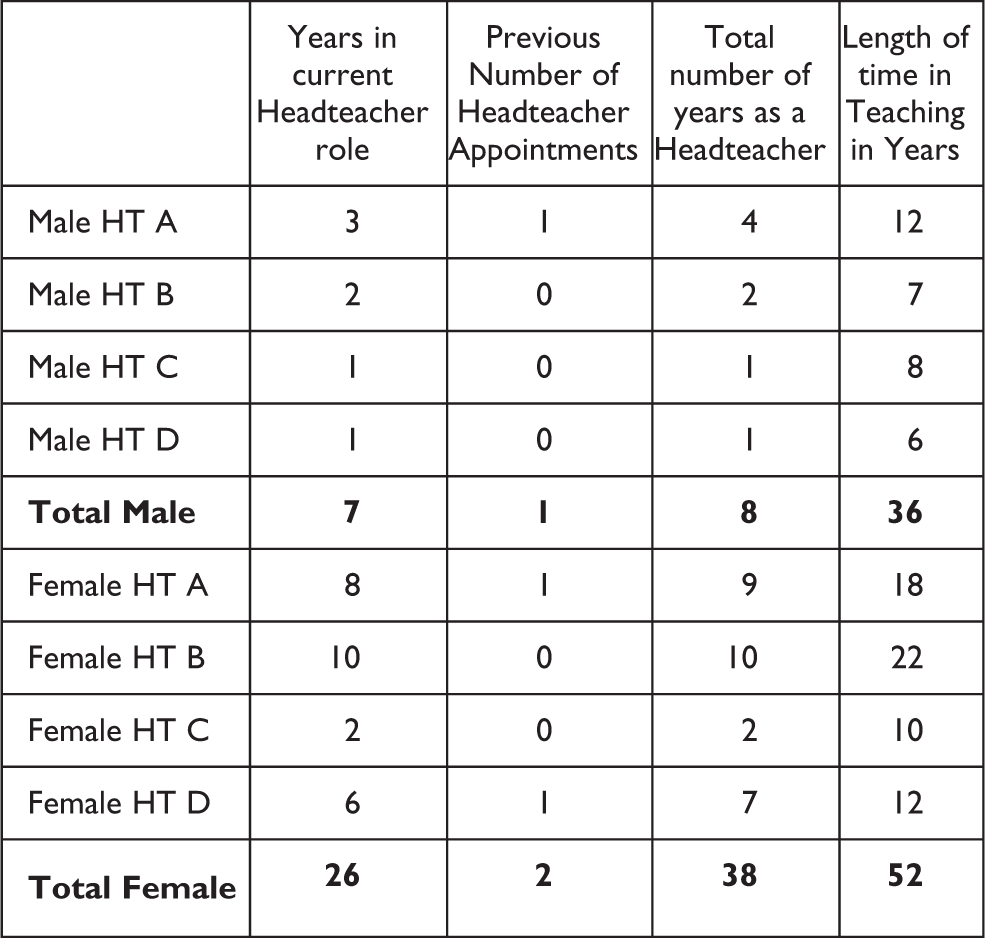
Time spent in Headteacher role(s) by gender.
The data set shows that the male teachers were significantly less experienced than their female counterparts. Between them, the male Headteachers had only 8 years as a Headteacher between them compared with 38 years combined for the female Headteachers. Only one of the male Headteachers had been a Headteacher before compared with two of the female Headteachers. The male Heads appeared to have been promoted into Headteacher positions more quickly than their female peers with a combined number of year in teaching totalling 36, an average of 9 years per person. This contrasted with an average of 13 years in teaching for each female Headteacher and a collective number of years served of 52.
It is important to acknowledge the background of the researcher. She is former teacher leader and mentor to female leaders on a school leadership programme. It is imperative then to recognise that the sense-making that has taken place for the purpose of this article has been co-constructed by both the participants and the researcher, with the latter contextualising the written responses through the lens of interpreting the written reflections in light of her own challenges as a female teacher and leader.
George et al.’s self-assessment questionnaire was designed for use by corporate America and the tone and phrasing of the questions reflects this. In order to ensure that it was appropriate for a school leadership context, two of the phrases in the questions were altered slightly so that the meaning and context was clearer and more applicable to education. Statement 12, originally said, ‘I always tell the truth, both within and outside of the company because integrity runs deep within the fabric of my soul’. This was altered to read, I always tell the truth, both within and outside of the school workplace because integrity runs deep within the fabric of my soul.
Statement 15 was also altered from ‘I would never act in a way that is inconsistent with the company’s values’, to instead say: ‘I would never act in a way that is inconsistent with the school’s values’.
The data set of eight self-assessments, along with the free text comments in each subsection was analysed initially by collating the scores out of 20 by gender identity in for each of the authentic leadership dimensions as shown in Figure 2.
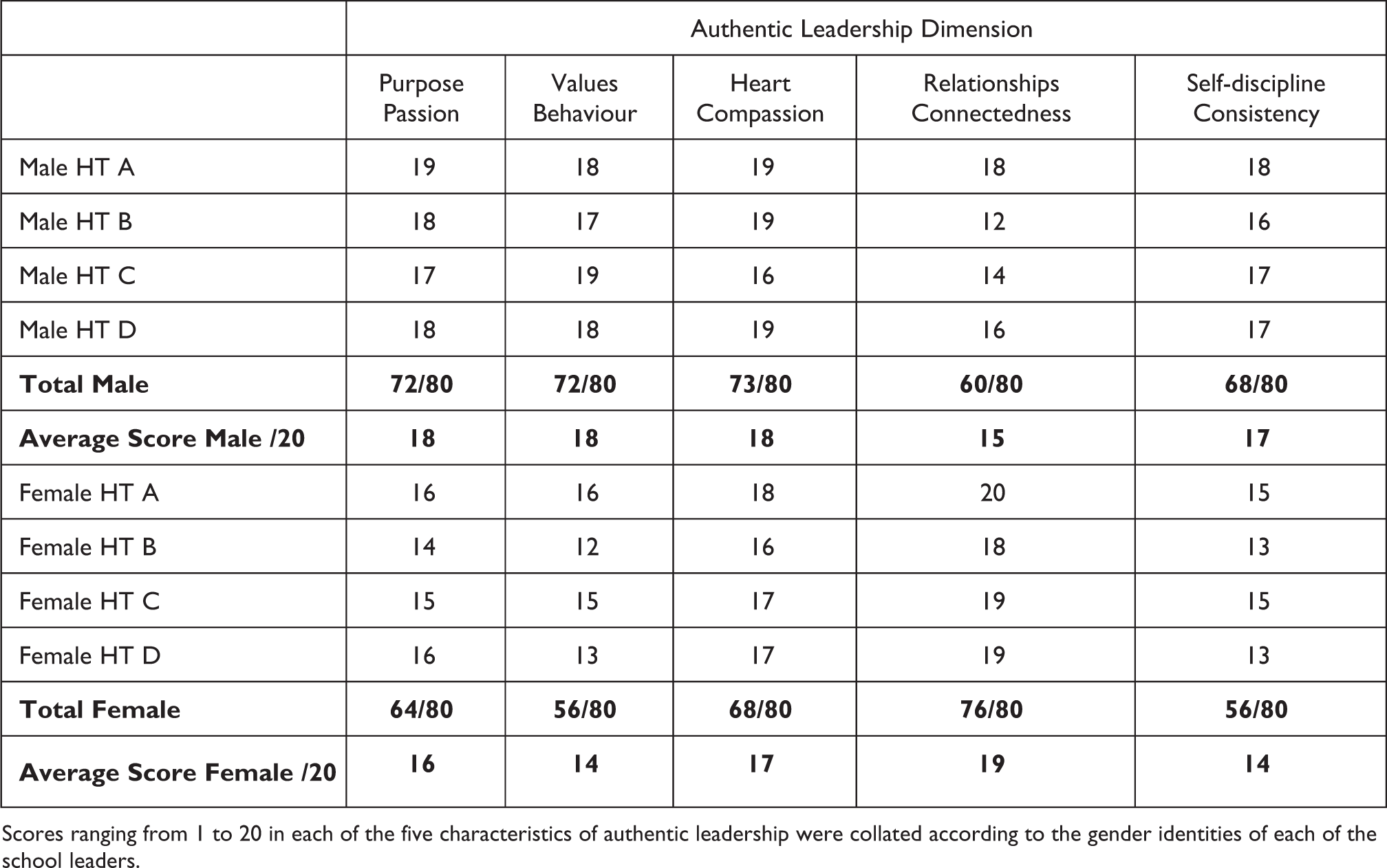
Self-Assessment scores on the Authentic Leadership Dimensions of George et al.
Figure 3 shows the average score on each characteristic split by gender identity.
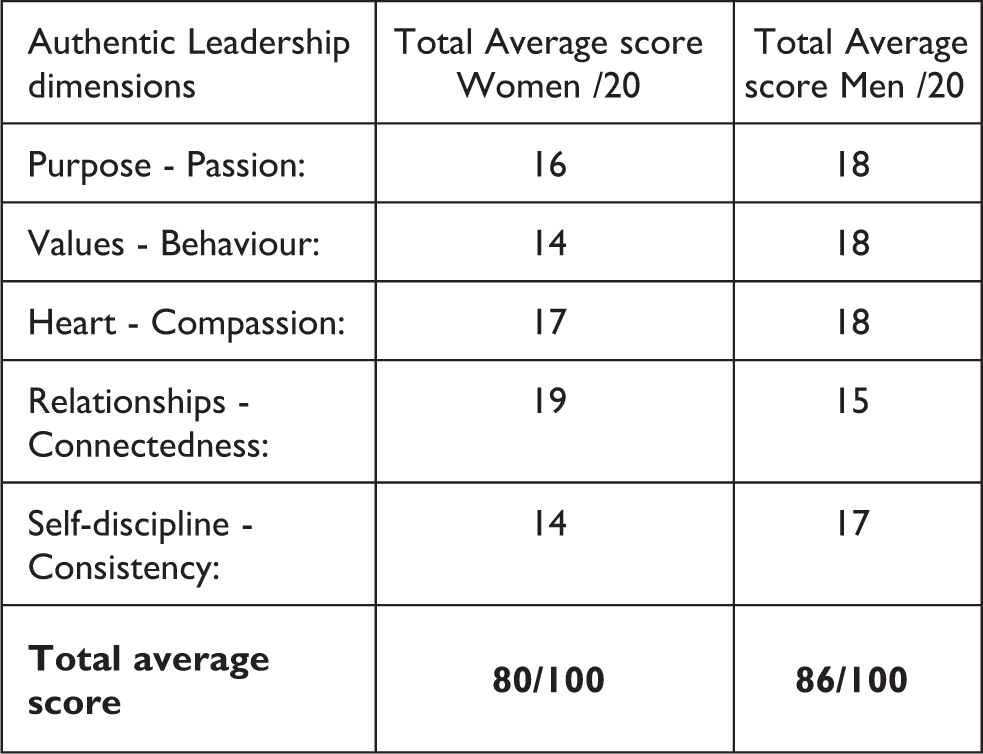
Average score on each characteristic split by gender identity.
After the scores on each dimension had been collated, emergent coding (Carspecken, 2001) was utilised across the free text responses according to the gender identities of the teacher leaders. The collated comments produced a number of themes under each of George et al.’s five principles of authentic leadership each of which are discussed in Figure 4.
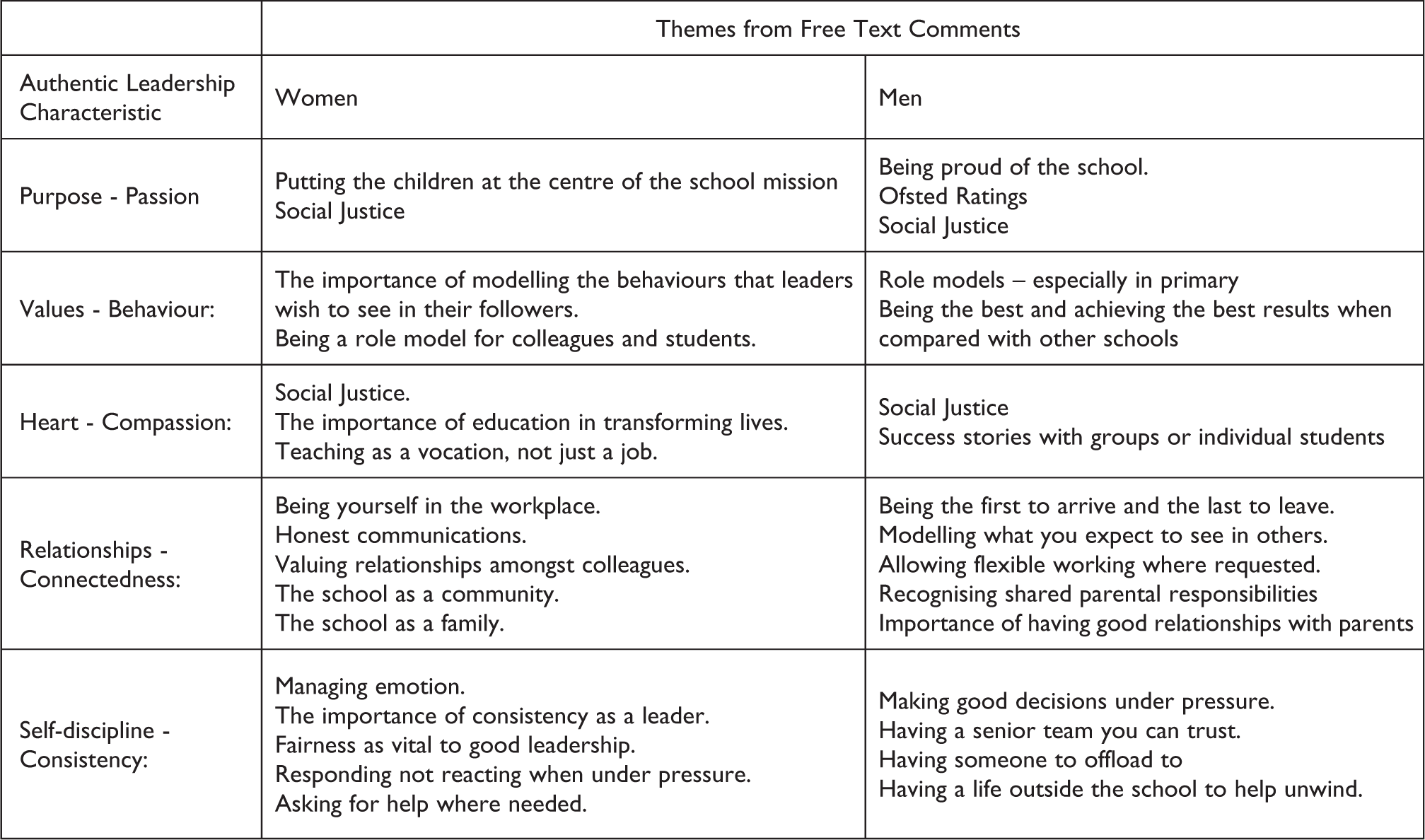
Themes from free text comments on each characteristic split by gender identity.
Discussion
Overall, the results show that the male Headteachers rated themselves as authentic leaders more positively than their female peers. The men scored an average of 86% for authenticity compared with a self-assessment score of 80% for the female Headteachers. Males also rated themselves more positively on all of the five dimensions except Relationships – Connectedness, where they rated themselves at an average of 15/20 compared with 19/20 for the female teacher leaders. The self-assessment scores are now considered in light of the free text comments provided to contextualise the scores.
Purpose – Passion
In Purpose – Passion, both the male and female leaders cited social justice and the opportunity to change lives for the better through access to higher education, as one of the major motivating factors committing them to their careers in education. However, beyond this, purpose and passion was expressed differently. Three of the four male teachers mentioned pride for what the school is able to achieve and two explicitly referred to Ofsted ratings and as being important to their sense of success.
I am a proud Head and I want our school to be the best it can be. I am committed to doing whatever it takes to ensure that our young people can be whoever and whatever they want to be. (Male B)
Whilst the male teachers seemed focussed on measurable success for social justice, three of the female leaders referred to their roles as parents and two showed a desire to replicate the passion and purpose what they would want from the teachers of their own children. For example, one female teacher, described how she would want the teachers in the school her own children attended to be fully committed and so feels that she needs to model and reciprocate this as a duty to other parents.
I always remind myself who we are doing this for. I also think of my own children. They are not at my school, but I would want their teachers to give 100% and so it’s important that we do the same for the children we teach. (Female C)
What is also striking in this comment, is the way in which this female Headteacher uses the word ‘we’ rather than I when referencing the school she leads. This is in contrast to Male Headteacher B above who seems to take sole responsibility for the success or failure of the school. Both male and female leaders acutely express concern for personal reputation, and both are driven by the need to get good outcomes for the young people. However, success is described differently, with men aware of benchmarking presumably against the performance of other schools and the female leaders not wishing to let down other people, particularly parents.
Values – Behaviours
In Values and Behaviours the male teachers scored an average of 18/20 compared with a score of 14/20 for the female leaders. Both described the importance of being a role model for colleagues and young people. The male teachers were more conscious of being visible to school stakeholders and in particular two of the four males described themselves as first to arrive in the morning and last to leave in the evening. They also mentioned pride and aligned pride with leadership that enabled to the school to thrive.
In comparison, the female leaders referenced their gender and two expressed the importance of girls and women in the school community seeing women in leadership positions to overturn the stereotype of the male school leader. Female A stated
I think it is really important to show girls, their mothers and my female colleagues that women can be effective leaders. Hopefully I can inspire them to be bolder and more confident than they might have been otherwise. (Female A)
O’Neill et al. (2008) identify a double-bind dilemma for women in leadership in which they must adopt traditionally male behaviours to be seen as successful, yet at the same time must be intelligible through their gendered presentation, i.e. show femininity. O’Neill et al. (2008) describe a ‘think leadership-think male’ mindset and assert that the behaviours expected of leaders such as competitiveness, ambition and confidence remain a stubbornly masculine trope. Here, a Female leader A describes a determination to change the narrative and by her actions, through a desire to show other females in her school community that leadership is not the preserve of masculinity. However, rather than ascribing to herself typically masculine traits, instead she uses the phrase ‘bolder and more confident’. This phrase is itself typically feminine and not a phrase one would associate hearing from male leaders. It suggests instead that women start from a place in which they lack boldness or confidence and as such imply that female leadership needs to rise up from a place of inferiority. An example of this can be seen in the WomenEd movement with its strap-line and hashtag ‘What would you do if you were 10% braver?’ Whilst a hugely successful and empowering movement for female school leaders, implicit in the tag-line, is that being as you are is not sufficient and you must instead adopt the typically male trait of bravery if you are to be successful in leadership. This shows the challenges for women of adopting masculine language without sacrificing their femininity, and suggests a growing lexicon of female leadership language that is bound in a trope of daring to be more masculine.
Heart – Compassion
In the Heart – Compassion dimension, where authentic leaders help their followers to see the worth and deeper purpose of their work, again the male leaders scored themselves more positively than their female counterparts. The male Headteachers scored 73/80 compared with 68/80 for the female leaders. In common with the Purpose and Passion dimension, again both genders wrote of a drive to achieve social justice for the children and young people within the communities they serve. Within their determination to improve the life chances of pupils and providing them with choice, it was apparent that the male teachers were more focussed on the metrics the students achieved.
I feel incredible pride on results day. The thing that gives me most satisfaction is seeing someone get the grades to go off to university. (Male D)
The views of the female leaders were not dissimilar, in that they were also driven by helping young people achieve whatever they could. Female Headteacher C wrote,
Nobody goes into teaching for the money. We do it because we want to change the lives and the life chances of the communities we serve. Sometimes that means seeing them off to uni, but for others it might be an apprenticeship or college, or just helping them stay out of trouble. I feel we have been successful if our kids leave us and go on to have happy lives, whatever that means for them. (Female C)
It is interesting that for Female Headteacher C, this dimension of authentic leadership meant ensuring the pupils got the most appropriate outcome for them, even if this was not necessarily through the academic achievement on which schools are measured. Instead, she wrote of success being linked to happiness or avoiding crime, much softer dimensions of success on which schools are critically not measured.
Graves et al. (2012) note that the responses in this study may be typical of the gendered response to educational success. They state that modern organisations have systems, policies and norms that favour men and the ‘male life experience’ (p. 4). They add, ‘behaviors and values regarded as the norm at work tend to favor traits and characteristics traditionally associated with maleness and to undervalue traits and characteristics traditionally associated with femininity’ (p. 4). Formally, success as a school leader is measured in pupil attainment and the grade awarded by the Ofsted Inspectorate. The successes Female Headteacher C describes are more self-determined and personalised. An apprenticeship or employment for school leavers are not metrics publically celebrated in the same way as examination results are, and happiness, wellbeing and good mental health is not measured as part of a school’s success.
O’Neill et al. (2008) observe that large organisations such as businesses and schools reward the individual achievements of the leader, for example through a pay review. This often results in the achievements of female leaders not being recognised to the same extent because their leadership styles, language and behaviours tend towards the collaborative and relational which, suggest a team effort and by comparison are undervalued (Eagly et al., 1995). O’Neill et al. (2008) add that research on performance, leadership, and influence in teams has similarly shown that men display a more self-assertive and dominant style than their female peers who instead adopt a style that has at its core the development of others, especially through mentoring, coaching and work-shadowing opportunities.
Relationships – Connectedness
Relationships – Connectedness was the only one of George et al.’s dimensions in which the female Headteachers rated themselves more positively when compared with their male peers, with scores of 60/80 and 76/80 respectively. The male leaders did in this section make references to staff as family and cited the importance of communication and community. However, one of the free text comments expanded on this and appeared to conflate the notion of family with team which hinted at a sense of competition between schools. Male Headteacher C wrote:
My staff are like my family. The atmosphere is such that we can go to each other when we feel down and need picking back up again. We are a team, we want to be the best and we look out for each other. (Male C)
In contrast, the female leaders referenced family very differently. Two of them explicitly mentioned the caring responsibilities of their colleagues and the challenges some face in fulfilling work and family commitments.
It’s important that I stay mindful of the fact that staff have caring responsibilities and increasingly that care is shared equally between men and women. I try and be as flexible as I can but teaching isn’t a role where working from home is easy. (Female A)
Moreau et al. (2007) observe that schools are often described as ‘feminised’ work environments. They suggest that the under-representation of women in school leadership is often due to caring responsibilities at home for either children or elderly relatives, which overwhelming still fall to females. This leaves many women choosing either to prioritise leadership or to pursue caring responsibilities. Those trying to do both often face feelings of guilt or failure towards whichever area of responsibility is not being attended to.
Self-discipline – Consistency
The final dimension of authentic leadership is Self-discipline – Consistency. Here the male leaders scored 68/80 compared with the female leaders who self-assessed themselves more harshly scoring 56/80 combined. Free text comments demonstrated the importance to male leaders of modelling what they wanted to see in others and that being present and visible on the school campus from early in the morning until late in the evening was a trait they saw as key to their authenticity as leaders. They also wrote about the importance of making sound decisions under pressure and of having trust in their senior team. The female leaders interpreted self-discipline and consistency more personally, writing of the importance of managing emotion, being consistent when dealing with staff members and responding rather than reacting when under pressure.
This is the thing I’m working on. It is important to respond not react and not let those you manage know if you are worried or upset about something. (Female B)
Only one of the male leaders mentioned emotion and was far less self-critical than his female peer when considering displays of his own emotion in the school workplace.
If I am in a bad mood, my staff know by now it’s only because I care and this school really matters to me. (Male D)
The difference between the response of Female B and Male D is striking. Both refer to failing to keep their emotions in check when under pressure. However, the female leader sees it as weakness and a fault she is trying to correct whilst her male peer forgives himself for being in a bad mood and expects his colleagues to also understand.
Both male and female leaders shared the view that help from other people was important but there appeared to be a gendered way in which this manifested itself. The women wrote of seeking someone to go to when they needed help, typically a mentor, a governor or trustee. In contrast, the male leaders sought confidantes outside the school community and appeared to be more adept at switching off from the pressures of leadership.
I’m lucky I have someone outside school to offload to but work-life balance is also key. I have a full life outside school and can switch off and concentrate on other things when I need to. (Male B)
This comment hints at the Male B having considerable leisure time which is at odds with the early mornings and late evenings they model in school for other staff. It suggests that this male leader at least does not have significant caring responsibilities and is able to take part in hobbies and other activities that provide a distraction from the school workplace and help him to unwind. This is consistent with the work of Moreau and Robertson (2019) who found considerable differences in in the caring responsibilities of male and female education leaders across the education workforce. They identified that many white, middle-class, male heterosexual educators had a ‘bachelor boy’ (p.5) existence and were less likely to experience the tensions arising from combining care and paid work. Moreau and Robertson concluded that educational leadership and management positions in particular were incompatible with caring responsibilities.
Concluding comments
This article reflects a small scale study comparing the scores and responses of just eight Headteachers and generalisations are inappropriate. However, it has identified that the male and female leaders surveyed conceived of and performed authentic leadership differently with male leaders rating themselves more positively than their female peers on every dimension of authentic leadership except Relationships – Connectedness.
Although teaching has long been a feminised profession, men are more likely to occupy leadership roles and progress faster than women to Headteacher positions. Our data showed that male leaders were promoted into Headteacher positions after an average of 9 years compared with an average of 13 years for their female leader peers. Although the proportion of women in leadership roles in England has increased in recent years, they are still under-represented, according to data released by the Department for Education in England and Wales. While women make up 85% of all teachers in primary schools they occupy just 73% of Headteacher posts. The disparity is more marked in secondary schools. Women constitute 62% of the teaching population, but just 38% of Headteachers. Specific leadership programmes aimed at increasing the number of women in leadership roles (see for example, Women Ed) are doing much to support women achieve leadership roles. However, this study has shown that men find the embodiment of authentic leadership easier to achieve than women and both male and female school leaders have gendered approaches to the notion of authenticity and conceive of school leadership in markedly different ways.
Footnotes
Declaration of conflicting interests
The author(s) declared no potential conflicts of interest with respect to the research, authorship, and/or publication of this article.
Funding
The author(s) received no financial support for the research, authorship, and/or publication of this article.
