



Abstract
At present, nuclear power plant is developing rapidly, and its application has been involved in many aspects including life, military, industry and many other important fields, bringing benefits to people’s life. However, the nuclear power plant has a relatively special structure. Once a safety accident occurs, the consequences will be unimaginable, and the cost of its operation and maintenance will be relatively high. Therefore, how to effectively diagnose the health status of the nuclear power plant is an urgent problem to be solved. On the above-mentioned research background, we need to study nuclear power plant health diagnosis method. Considering the characteristic of the nuclear power plant system and special failure mode, both the safety and economy, a health condition diagnosis method based on analytic hierarchy process and fuzzy comprehensive evaluation method is proposed for the structural characteristics and functional characteristics of nuclear power plants. According to the special failure mode and complex system structure of nuclear power plant, the evaluation index system based on failure mode is constructed by laying the system using the hierarchical analysis method, and the system is scored by fuzzy comprehensive evaluation method. The health status makes a coarse-grained diagnosis and provides a reference for the development of the operation and maintenance strategy.
Keywords
Introduction
Under the current energy structure with fossil fuels as the core, the pollution generated is very serious, and environmental problems are also emerging. In addition, due to the non-renewable energy’s features, nowadays sustainability has become a focus issue. 1,2 How to adjust the energy structure is an important issue to be solved urgently in the world. Nuclear energy has great potential, and it is very clean and environmentally friendly. Its development and utilization will bring great benefits to the adjustment of energy structure. Therefore, the research on nuclear energy in the world is getting deeper and deeper. 3
In the evaluation of nuclear power plants, a type of problem often encountered is that there is no obvious fault in the system, but the actual performance is in a degraded state. At this time, the whole system can still reach a part of the mission target. The system with such a special failure mode is called a partial failure system, 4 which makes it hard to evaluate the health situation of the system. In addition, the various failure modes of nuclear power also complicate the problem. 5
There has been a lot of methods for nuclear power plant health diagnosis. 6 These methods can be roughly classified into model-based methods, 7 data-driven methods 8 and signal-based methods. 9 But the traditional evaluation methods are often limited to binary logic that the system is good or bad, which is too absolute. Additionally, the actual reliability of the system in use will be greatly reduced considering the dependence of complex system failures. 10,11 Thus when evaluating nuclear power plants, it is easy to overestimate the fault state of the system and improve the priority in the operation and maintenance strategy. It will cause waste of operation and maintenance costs.
Therefore, a health situation diagnosis method based on analytic hierarchy process (AHP) and fuzzy comprehensive evaluation method is proposed for the structural characteristics and functional characteristics of nuclear power plants. The evaluation index system based on failure mode is constructed by laying the system using the hierarchical analysis method, and the system is scored by fuzzy comprehensive evaluation method. The health status makes a coarse-grained diagnosis and provides a reference for the development of the operation and maintenance strategy.
Research framework of nuclear power plant diagnostic technology
In the related technical research of nuclear power plant, there is a common problem, that is, the performance degradation of a certain functional unit of the system, but the corresponding function can still be achieved to a certain extent. For the typical system containing such units, it is called partial failure system. 4,10
The failure mode is that although the component can still complete its function, part of the capability loss will affect its expected performance. It is possible that most fluid system components in a nuclear power plant can perform the expected functions but may not meet the success threshold described in the final safety analysis report or technical specifications. 4,10
However, in the traditional evaluation methods, fault tree 12,13 is mostly adopted to conduct relevant modelling and description of the failure mode of nuclear power plant. However, this kind of method has a prominent problem, that is, when the system fails to achieve the expected performance in the process of operation, the failure of the system will be judged. Already mentioned above, the complexity of the nuclear power plant and redundancy design makes ‘partial failure mode’ widespread, which is the problem that the traditional method is difficult to avoid.
In addition, due to the particularity of nuclear power plant 14 , it will bring great disasters when the safety accidents happen. Thus there is a strong need to judge the health statement of nuclear power plant and formulate a proper strategy to prevent safety accidents.
To sum up, the nuclear power plant system is complex. In order to ensure its safe operation, it is necessary to set up a relevant index system to analyze the health status of nuclear power plant. Besides, due to the particularity of the system itself, there exists the so-called ‘partial failure’ mode, which doesn’t need to be fixed immediately. Instead, the component or subsystem under “partial failure” mode should be monitored more strictly. It is crucial to combine the information such as history data and expert knowledge to train neural network model to forecast the future failure. Based on the result, it’s more convenient to develop a reasonable and efficient operational strategy to reduce operational costs.
It can be seen that this process is divided into two major links, one is a relatively rough and primary state judgement and the other is a relatively strict and advanced fault diagnosis and trend prediction, as shown in Figure 1. This article will discuss the primary health status diagnosis technology in detail.

Process of nuclear power plant health status diagnosis.
Modelling of fault index system of nuclear power plant
Introduction of nuclear power plant structure
Nuclear power plant is widely used at present, among which the most commonly used is the nuclear power plant of pressurized water reactor (PWR). The main components of nuclear power plant include reactor, primary circuit system, secondary circuit system and other systems. 15 Among them, the reactor and primary system are responsible for generating heat energy and transferring it to the secondary circuit system, which receives the transferred heat energy and converts it into electric energy and mechanical energy through steam. Other systems ensure the safe and normal operation of the system. According to the brief introduction, the primary circuit system and the secondary circuit system are the core parts of the nuclear power plant. Among them, the primary system needs to work closely with the reactor, and the working environment is very harsh. The secondary circuit system mainly realizes energy conversion, which is the key position for the nuclear power plant to change energy into available electric energy and mechanical energy. Its safe and normal operation directly affects the work efficiency of the whole nuclear power plant. Therefore, the safety analysis of nuclear power plant should be carried out for both primary and secondary circuits, that is, the safety and economy of the system should be taken into account, so as to improve the operation and maintenance strategy of nuclear power plant. The following is a detailed introduction of the main components of primary system and secondary system of nuclear power plant. 16
For the primary circuit system, it mainly includes:
Main cooling system: It is the core part of the primary circuit and is mainly responsible for the circulation of coolant. Primary cooling system transfers heat to the secondary circuit to generate electricity and mechanical energy through the circulation of the coolant flow. In addition, the cooling system, which is the second line of defence to prevent the spread of radioactive waste, also uses the voltage regulator to ensure the primary circuit in the pressure balance.
Pressure safety system: The voltage regulator is the core component of the pressure safety system. When the fault occurs or is interfered by external factors, the internal pressure of the primary circuit system will change suddenly. The voltage regulator is responsible for ensuring the pressure balance inside the primary system, so that the pressure is relatively stable and keeps fluctuating within the allowable range. At the same time, it can also discharge some harmful gases from the coolant into the system.
Water quality control system: Under the working environment of high temperature, high pressure and high radiation, the equipment is likely to suffer from corrosion and produce a large amount of sediments. The water quality control system is responsible for purifying the water, ensuring the quality of the coolant, removing some existing impurities and so on to ensure the normal service life of the parts.
Auxiliary water system: This system includes cooling water system, make-up water system, primary shielding water system and refuelling charging and drainage system. It is responsible for providing cooling water, supplying qualified water under various working conditions and temporary charging and drainage during refuelling.
Radioactive waste disposal system: It is mainly responsible for dealing with the radioactive waste generated by the reactor, which is the first line of defence.
Other safety auxiliary systems include waste heat removal system, stowage safety spray system, safety injection system and stowage ventilation and temperature control system.
The summarization of the main function of each subsystem is shown in Table 1.
Primary circuit system’s main subsystem.

For the secondary circuit system, it mainly includes:
Steam system: The steam system is mainly divided into the main steam system and auxiliary steam system, including the main system and equipment such as steam bypass discharge system, main steam turbine high-pressure cylinder, steam turbine shaft seal system, main feed pump steam turbine, steam separation reheater system, auxiliary feed pump steam turbine, deaerator and steam converter.
Steam discharge system: It is the steam bypass discharge system. When the nuclear power plant encounters some faults or external interference during operation, the pressure in the steam generator will increase sharply. At this time, the steam discharge system will discharge excess steam to ensure the pressure balance in the steam generator.
Condensate – feed water system: Saturated steam will enter the main condenser, which is known as condensate process. And condensate water can be put back into use after a series of treatment, which is known as feed water process.
Circulating water system: mainly responsible for providing cooling water for the main condenser to condense the steam.
The summarization of the main function of each subsystem is shown in Table 2.
Secondary circuit system’s main subsystem.

Analytic hierarchy process
AHP is a new decision-making analysis method proposed by T. L. Saaty in the 1970s. It was initially applied to the relevant projects of the U.S. Department of Defence. Due to its excellent universality, it has been promoted and applied in other fields. The decision objective is set first. Secondly, according to the corresponding professional knowledge, the system is divided into different levels. At all levels, the elements are compared with each other. Thirdly, according to the hierarchical structure, the corresponding judgement matrix can be obtained, based on which the related indicators of the system can be analyzed to make proper decisions. Its advantage is that it is simple and fast and can describe the complex system level by layers of indicators. At the same time, it can change the evaluation from qualitative to quantitative and judge the importance of various factors through the determined weight, so as to facilitate the comparison.
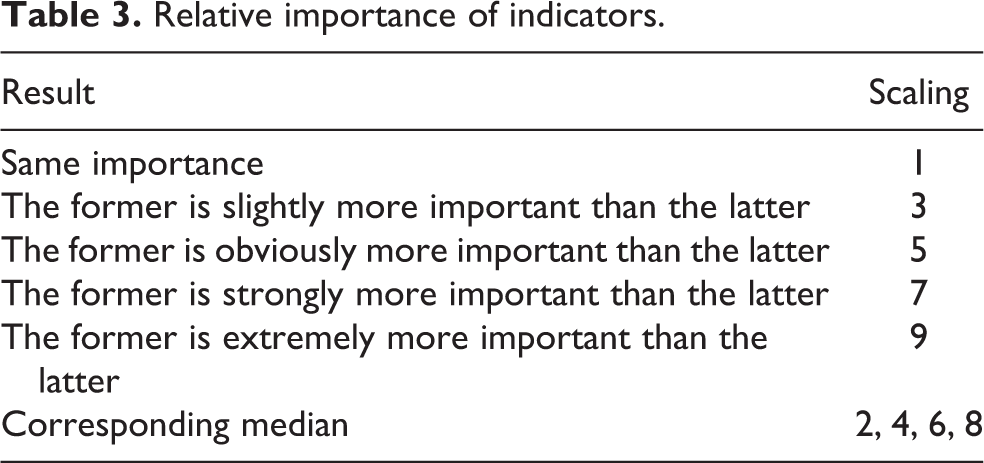
The basic steps are as follows. 1) set the corresponding index system according to decision objective and the specific structure of the system, 2) determine the importance degree of all elements by comparing them with each other, and 3) give a score to every element, which usually ranges from 1 to 9, and the meaning of the scores is as shown in Table 3.
Relative importance of indicators.
After pairwise comparison of all elements in the hierarchy, the corresponding judgement matrix can be constructed. Next, the importance of each element, that is, the index to the upper structure, needs to be determined, so the weight of each element needs to be calculated. First, normalization is carried out. Let the number of indicators in the group be n:
Calculate the product of each row element of the judgement matrix

where

Normalize vector

Finally, consistency test is carried out

where
Consistency index RIs value.

Fuzzy comprehensive evaluation method
Fuzzy comprehensive evaluation method is usually used to solve the problem of fuzzy things existing in the objective world. The related theory of fuzzy sets was proposed by Chad et al. in 1965 and applied to the study of uncertainty of things. The basic idea is to use the relevant theory of fuzzy mathematics to comprehensively evaluate the practical problems, quantify the elements of qualitative analysis and judge through the membership degree method, so as to solve the practical problems. Its advantage is that it can describe the actual fuzzy problem quantitatively and depict the essential characteristics of the problem. The basic steps are shown below:
First, the collection of evaluation objects is determined as U, and let there be a total of m evaluation indicators

Then determine the set of evaluation results as V, and suppose there are n evaluation results

The fuzzy matrix R is determined to describe the corresponding relationship between the evaluation object and the evaluation result

where
To determine the weight of each index, the method such as AHP can be used for calibration.
For the final fuzzy vector, according to the principle of maximum membership, that is, if the tth fuzzy vector is the largest, then it is considered that the evaluation object is the most likely to belong to the evaluation result.
Construction of index system
In order to construct the AHP hierarchical structure, it is first necessary to classify the main failure modes of nuclear power plant and classify these failure modes by comprehensively considering the functions, structures and other characteristics of nuclear power plant. The types of faults can be roughly divided into three categories, including:
Sensor fault: This type of fault refers to the fault of the sensor used to monitor and collect data, resulting in abnormal data collected, which will have an impact on the health status diagnosis. When the data source is confirmed to be reliable, this type of fault is not within the scope of research.
Actuator failure: This type of failure refers to the improper operation of the control system or its own mechanical failure resulting in unhealthy system state.
System fault: This kind of fault refers to the abnormal running state of the whole system caused by problems such as pipeline or reactivity. The main characteristic is that the input and output characteristics of the system change to distinguish it from the actuator fault.
The core part of the nuclear power plant is the primary and secondary circuit system. The following is the establishment of the index system for these two parts. According to the relevant literature research, the hierarchical structure of common faults of the nuclear power plant in these two systems can be sorted out based on the system function or structure. 17,18 For the primary circuit system, its fault index system is shown in Table 5.
Fault index system of primary circuit system.

For the secondary circuit system, its fault index system is shown in Table 6.
Fault index system of secondary circuit system.

Experiment and analysis
To summarize, the steps of this method above can be shown as below: Establish the index system of fault of nuclear power plant. Make sure every fault index a reasonable relative weight. Evaluate the health status of each component. Calculate the health status score of the system.
When the method is applied in specific cases, the above-mentioned fault index system should be applied to set the weight of each index based on AHP, and the consistency test should be carried out. After the consistency test, the fuzzy comprehensive evaluation can be carried out.
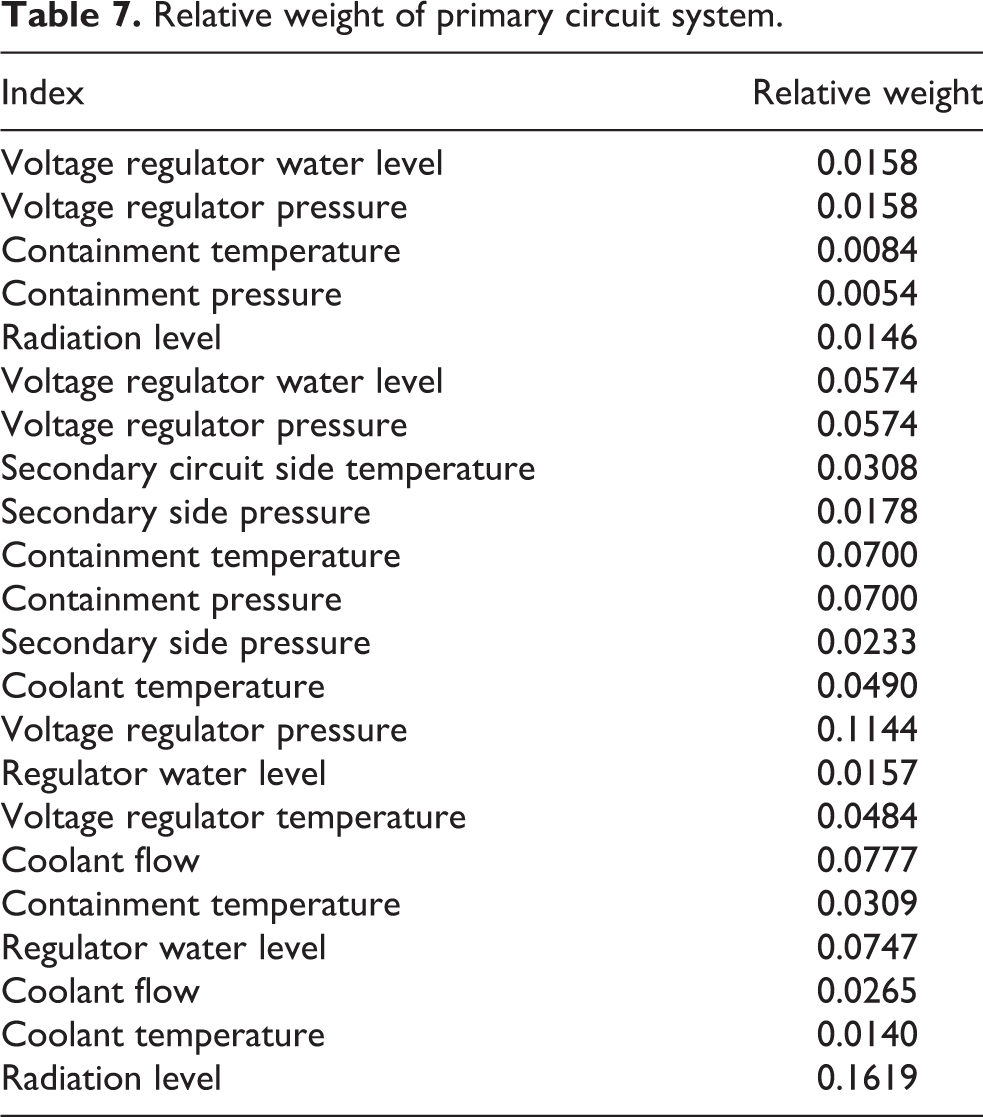
Only a simple correlation verification analysis is carried out here. According to the relevant description in the ‘Analytic hierarchy process’ section, the judgement matrix is first established, and the relative weight of the primary circuit system is directly given in Table 7.
Relative weight of primary circuit system.
The relative weight of the secondary circuit system is directly given in Table 8.
Relative weight of secondary circuit system.

Then according to the relevant method steps described in the ‘Fuzzy comprehensive evaluation method’ section, each specific underlying element can be evaluated, and the final relative weight of AHP is used as the weight in the fuzzy comprehensive evaluation method to score the primary system and realize the initial health status assessment.
For the primary circuit and secondary circuit systems of nuclear power plant, we can separately set up the corresponding fuzzy matrix. According to the above steps, we will first need to determine the evaluation object collection of the two circuit systems. For the primary circuit system, the elements of the evaluation object set U are the bottom elements of Table 3; for the secondary circuit system, the elements of the evaluation object set U are the bottom elements of Table 4. Then we need to construct the evaluation results set. Because of the hundred-mark system, we should separate 0∼100 to 10 intervals, and each interval is an evaluation result. When an expert gives a score in the interval, we regard the corresponding interval is the given evaluation result. And the evaluation results set is

If an expert gives a score of 62 to an evaluation object, it is deemed that the evaluation result of the expert is
For the fuzzy vector, after the evaluation results are obtained according to the principle of maximum membership, the mean value of the expert scores corresponding to the evaluation results is calculated and used as the final evaluation result

Conclusion
The combination of AHP and fuzzy comprehensive evaluation method can judge the health status of nuclear power plant effectively and conveniently. This method divides the nuclear power plant related fault indicators into different levels, establishes an index system of faults to calculate the weight of each index relative to the system based on the AHP, gives a final score of the health status of the system combined with fuzzy comprehensive evaluation method so as to quantify the health status of nuclear power plant, and finally realizes the nuclear power plant’s primary health diagnosis simply and easily.
This article studies the relevant system structure and function characteristics of the nuclear power plant, combines AHP with fuzzy comprehensive evaluation method to build the model and set fault index systems for the primary circuit and secondary circuit systems of nuclear power plant, which has obtained some valuable results in primary health diagnosis technology. Compared with traditional health state diagnosis method of nuclear power plant, the ‘partial failure’ mode is also considered in this method to evaluate the health state, which is more comprehensive than the former ones. And as for the recent method based on neural network, this method is easier than them to execute.
The main content of this article is exploring a simple and quick method to judge the health status of nuclear power plant roughly, and providing a reference basis for senior health diagnosis technology. The senior health diagnosis technology will be more focused on system fault analysis, which is the core content of the health status diagnosis technology, and will also be the future research emphasis.
If successful progress is made in the study of the graded state of health technology combining the primary and advanced, it will effectively improve the health diagnosis efficiency of nuclear power plant and reduce the economic cost. Furthermore, according to the result based on the method, we can record the health state score in different time, which can be used to predict the health state of the system in the future. It is significant to optimize the operation and maintenance strategies.
Footnotes
Declaration of conflicting interests
The author(s) declared no potential conflicts of interest with respect to the research, authorship, and/or publication of this article.
Funding
The author(s) disclosed receipt of the following financial support for the research, authorship, and/or publication of this article: This work was supported by the National Key R&D Program of China (no. 2018YFF0214705): Management and Control System of Health Status for Typical Industrial Equipment Driven by Big Data.
