




Abstract
Motion model and model updater are two necessary components for online visual tracking. On the one hand, an effective motion model needs to strike the right balance between target processing, to account for the target appearance and scene analysis, and to describe stable background information. Most conventional trackers focus on one aspect out of the two and hence are not able to achieve the correct balance. On the other hand, the admirable model update needs to consider both the tracking speed and the model drift. Most tracking models are updated on every frame or fixed frames, so it cannot achieve the best performance. In this article, we solve the motion model problem by collaboratively using salient region detection and image segmentation. Particularly, the two methods are for different purposes. In the absence of prior knowledge, the former considers image attributes like color, gradient, edges, and boundaries then forms a robust object; the latter aggregates individual pixels into meaningful atomic regions by using the prior knowledge of target and background in the video sequence. Taking advantage of their complementary roles, we construct a more reasonable confidence map. For model update problems, we dynamically update the model by analyzing scene with image similarity, which not only reduces the update frequency of the model but also suppresses the model drift. Finally, we use these improved building blocks not only to do comparative tests but also to give a basic tracker, and extensive experimental results on OTB50 show that the proposed methods perform favorably against the state-of-the-art methods.
Keywords
Introduction
Visual object tracking is an important problem in computer vision. 1 –6 It is a task that estimates the trajectory of a target in a video sequence. 7 The tracker has no prior knowledge of the target to be tracked such as category and shape. Despite extensive research on visual tracking, it remains challenging problems in handling complex target appearance changes caused by pose, occlusion (OCC), illumination, and motion.
An important insight is that the tracking problem should be considered as a balance between the scene and the target. Specifically, it is not only accurate description of the target appearance but also a comprehensive access to the scene information. Another important vision is that the video is highly relevant but redundant. And, finding another balance between the relevant and redundant is important for improving tracking speed and accuracy.
How to find these balances of the above issues? We need to think of the tracking problem itself. The simplest way is to observe it through the bioinspired perspective. When people track a target, their eyes will pay more attention to the target itself, and for the surrounding environment, they will have a general division. For example, when we track a pedestrian, we will be more concerned about his characteristics (such as the color of clothes, the size of the body, etc.), and for the surrounding environment, we generally only need to know some rough scenes (such as tall buildings, trees, etc.). In the process of tracking, we can feel that we are not very concerned about every moment because the brain will be very clever to remove some of the approximate fragment, and focus on the target and scene changes.
Based on these intuitions, we know that we should solve the sample selection problem from the perspective of spatial dimension and tackle the tracking process problem from the perspective of time dimension. And according to the research of Wang et al., the tracker is composed of several modules: motion model, feature extractor, observation model, model updater, and ensemble post-processor. 8 In particular, motion model and model updater (MMMU) contain many details that can affect the tracking result, but they are rarely considered in most of the tracking methods. Coincidentally, our above ideas can be used to enrich these two components and thence this article will focus on them.
First, the motion model generates object proposals, it samples from the raw input image to forecast the possible candidate locations so as to confirm the scope of target searching. An effective sample selection mechanism can provide high-quality training samples which make the tracker recovers from failure and estimates appearance changes accurately. Hence, it is important to get more accurate samples in motion model. We develop a collaborative method based on image segmentation and salient region detection to analyze the appearance samples, the former is used to obtain more comprehensive scene information and the latter is used to find more accurate target samples. This method differs significantly from the existing motion model, such as the sliding window, which is prone to drifting in fast motion (FM) or large deformation (DEF) video. Specifically, we employ simple linear iterative clustering (SLIC) algorithm for image segmentation 9 and exploit frequency-tuned saliency analysis algorithm (FT) for salient region detection. 10
Second, it is critical to enhance the model updater of a tracker that adopts tracking-by-detection approach. Most of the tracking methods update the observation model in each frame, it reduces efficiency and more critical is that poor tracking results can cause the classifier to be contaminated, thus causing drift. Different from other tracking paradigms that update model in a fixed manner such as updated every two frames, we formulate a simple and quick method to update observation model dynamically with image similarity. It not only improves the tracking speed but also increases the accuracy. We will introduce a perceptual hash (pHash) algorithm 11 in detail for image similarity. 12
The overview of our approach is illustrated in Figure 1. The original image is subjected to image segmentation processing and salient region detection, respectively, in motion model. Followed by cooperative learning, the processed information will be sent to the tracking framework. After getting the tracking result, the current scene and the estimated target will be compared with their own recent stable values to determine whether to update the classifier in model updater.

The overview of our MMMU tracking. By improving the motion model, we employ image segmentation and salient region detection methods for obtaining comprehensive and accurate sample set. The target samples are in the orange rectangle box, and the scene samples are in the purple rectangle box. In the model update component, we use image similarity method to get very similar frames (the green dots) and large difference frames (the red dots). By reducing the update of these frames, the tracking method can achieve better speed and accuracy. MMMU: motion model and model updater.
In summary, our main contribution is to address the traditional tracking problems by effectively ameliorating the MMMU: In order to make more rational use of the visual properties of the image, image segmentation is used to obtain more meaningful atomic regions in the field of color; salient region detection is used to describe human’s visual attention mechanism which involves distance, color, intensity, and texture. We use both methods to handle tracking scenes and targets in motion model thus achieving a more balanced appearance for visual tracking. We propose a novel method to determine whether the estimated target is reliable in the time dimension and make a decision whether to update the observation model by using the hash of image similarity.
Then, we have validated the two components separately (CT Tracker 13 with improved motion model and CF2 Tracker 14 with improved model updater) and designed a basic tracker named MMMU tracking. Experimental results on OTB50 15 show that the improved components are valid and our basic tracker performs favorably against most of the state-of-the-art methods.
Related work
Most trackers use statistical learning techniques to take charge of constructing robust object descriptors and building effective mathematical models for target identification. 16 –23 As estimated object position is converted into labeled samples, it is hard to give the accurate estimation of the object position. Wang et al. used an inverse sparse representation formulation and a locally weighted distance metric to propose a sparsity-based tracking algorithm. 24 Hare et al. 25 integrate the labeling positive and negative samples procedure into the learner by using online kernelized structured output support vector machine (SO-SVM; Struck). Choi et al. exploited an arbitration algorithm between a finite impulse response (FIR) filter and optical flow by adaptive neuro-fuzzy inference system for tracking research. 26 And there are also many tracking algorithms 27 that focus on appearance and motion model definition to deal with the complex scene and avoid drifting.
Compressed sensing theory is introduced into visual object tracking by Zhang et al. CT extracts Haar-like features in the compressed domain as the input characteristics to the classifier. It aims to design an effective appearance model and first compresses sample images of the foreground target and the background using the same sparse measurement matrix to efficiently extract the low-dimensional object descriptors. 13
In general, targets are chosen as the positive samples to update the classifier, and low correlation samples may often be included since they are not correct enough, which causes the failure of the updating of the classifier. 28 Therefore, sample selection is an important task for alleviating drift in the motion model. Additionally, massive amounts of training samples would hinder the online updating of the classifier without an appropriate sample selection strategy. Liu et al. design a sparsity-constrained sample selection strategy to choose some representative support samples from a large number of training samples on the updating stage. 29 It is necessary to integrate the samples contribution into the optimization procedure when observing the appearance of the target. 30
Most discriminative trackers apply continuous learning strategy, where the observation model is updated rigorously in every frame. Research results show that excessive update strategy will lead to both lower frame rates and degradation of robustness because of over-fitting in the recent frames. 31,32 So we refine the strategy of model updater by analyzing the stability of scene.
Our approach
Different from most of the appearance-based detection methods, 33 we solve the robustness tracking problem by improving the model updater and the motion model.
Motion model improvement
Image segmentation
In order to obtain a comprehensive scene sample, a simple way is to gather the image scene into several blocks according to a certain rule and then select the appropriate sample on each block to ensure the comprehensiveness of the sample set. We use image segmentation to solve this problem.
Image segmentation process clusters pixels by the similarity of their feature and divides the raw image into several specific regions that may correspond to the tracked object. Superpixel is a kind of image segmentation algorithm, which provides a convenient primitive to compute local image features. SLIC is a popular superpixel algorithm which is fast, easy to use, and produces high-quality segmentations. 9
We segment the first frame into N superpixels. A color histogram is extracted as the feature vector fi for each superpixel
Each cluster

And positive values indicate high confidence to assign fc(j) to target. To obtain a confidence map for the t th frame, we first segment a surrounding region of the target into nsp superpixels and then compute every superpixel confidence value. The surrounding region of the target is a square area, and its side length is

where ft(i) and fc(j) denote the feature vector of the i th superpixel in the t th frame and the j th cluster center in the first frame, respectively. Intuitively, the nearer the feature of a superpixel ft(i) is close to the targets cluster center fc(j), the more likely this superpixel belongs to the target area.
In the t th frame, each pixel shares the same confidence value Ct(i). The surrounding area of the target is scanned with a sliding window that has the same size as the bounding box. At each position, the sum of the confidence value in this sliding window is computed, which demonstrates evidence for separating the target from the background. Then, the location of sliding window with the maximum value response will be selected as the new candidate location. 9
From the visualization in Figure 2, the objects with the same attributes in the scene are aggregated together, such as lawns, shrubs, leaves, and “baby monster.” Thus, we can select the comprehensive scene samples easily. Although this method can obtain image regions with a certain common trait, and these regions can provide comprehensive and reasonable scene samples, but it is not suitable for dividing the target area. For example, it often mixes some parts from the scene and target. Therefore, we need other way to solve the target sample selection.
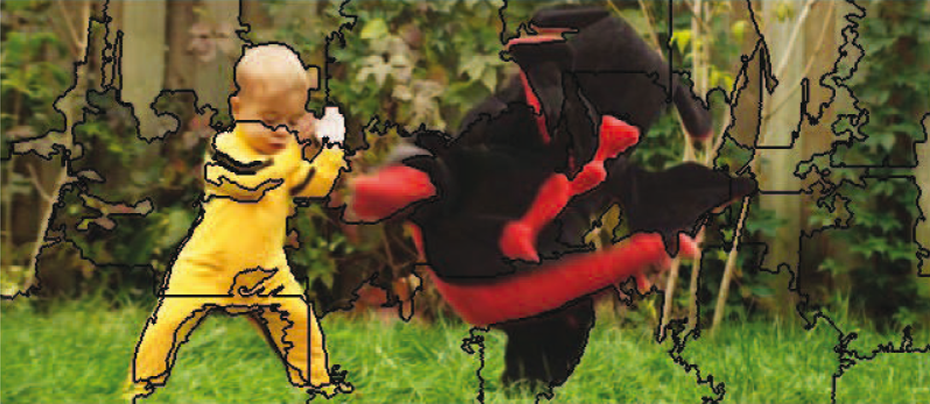
Dragon baby processed by SLIC. SLIC: simple linear iterative clustering.
Salient region detection
Through the above analysis, the superpixels result is not stable, it only provides a coarse over-segmented image. So, we need an effective method to focus on the target appearance. And, saliency is intentionally regarded as visual attention, and it is determined as the local contrast of an image region with respect to its neighborhood. 10 The study of saliency detection comes from biological research. It is utilized to interpret complex scenes now. Scene analysis technique is integrated into visual tracking pipeline, which will significantly improve the performance, because it can separate the target from the background using high-quality saliency maps.
Frequency-tuned saliency analysis algorithm (FT) method can emphasize the largest salient objects and uniformly highlight whole salient regions. 10 The frequency-tuned saliency analysis is formulated as follows

where Iμ is the mean image feature vector of color and luminance,
As shown in Figure 3, we can intuitively observe that the kite surfer’s pants receives the maximum response, and his body gets the maximum response, and legs and torso also have the high correlation. It basically constitutes the target. It is worth noting that the spray and the water are well distinguished, and these meaningful distinctions help us to choose samples exactly.

After processing by saliency analysis algorithm, the target becomes more pronounced. And it is easier to obtain accurate target samples.
After analyzing the two components, we need to combine the motion model with the model updater.
To select high-quality samples, we construct a target–background confidence map according to the similarity of superpixels in the surrounding region of the target between new frame and the first frame. Then it is refined by salient region detection result, and the confidence map can facilitate tracker to distinguish the target and the background accurately. 34 Finally, to accelerate the tracker, we control the model updater by judging the stability of scene and computing image similarity between frames.
As shown in Figure 2, the result of superpixels is not stable. It only provides a coarse over-segmented image. To get the likelihood that superpixel members whether belong to the target area, we still need the prior knowledge of the targets bounding box in the first frame. Figure 3 shows that salient region detection provides the probability of each pixel belonging to the foreground target, the result can be used to refine confidence map, we know that each pixel of the i th superpixel in the t th frame shares the same confidence value Ct(i), and each pixel has a sailency value in map St. Therefore, the fusion weight Cmap t can be formulated as follows

where wct(i) and wst are the min–max normalization of Ct(i) and St, respectively; here, we use a simple linear fusion method. After several tests, we determined ϕ = 0.5.
Model updater improvement
Image similarity
We have integrated superpixels segmentation and salient region detection into motion model, and this procedure improves the performance of the base model. However, there is a computational overhead, which will slow down the base model. And another obvious fact is that update classifier frame-by-frame not only reduces the tracking speed but also may “pollute” the classifier.
So we refine the strategy of model update to accelerate our tracker, the classifier will only be updated when the scene is not stable (background significantly changes). We analyze the stability of scene by comparing the similarity of incoming frame with the previous frames. Here, we use a pHash algorithm 11 to get the fingerprints of images which has several properties: Images can be scaled larger or smaller, have different aspect ratios, even minor coloring differences. 35
But, these images will still match similar images. The fingerprint result will not vary as long as the overall structure of the image remains the same. 35 The main steps of pHash are summarized in algorithm 1, and we can compare the difference of images by computing hamming distance of their hash vector.
pHash algorithm.

We use Basketball sequence to show the advantages of pHash in achieving stable scenes and target. This sequence mainly describes the Celtics player Rajon Rondo’s defense process in an NBA game. As illustrated in Figure 4, Rondo’s entire defense process is divided into 11 scenes by his movements such as turning, jogging, running, landing, defense, and so on. Take scene 3 (about from frames #140 to #180) in Figure 4 as an example, when the opponent took the ball and ready to attack, Rondo quickly ran back to the defensive position. For easy observation, we select the scene range which is twice the target size and has the same center. We plot the Hamming distance of each frame with its previous two frames by using pHash, as shown in Figure 5; we find that the distribution of these data is consistent with the analysis of the video sequence changes in Figure 4. In particular, some data anomalies such as frames #650, #678, and #707. Besides the shortcomings of the algorithm, we know that this phenomenon occurs because the color and shape of the image have undergone great changes, as illustrated in Figure 4 “specialness.”

Several major changes to the target in Basketball sequence.

Hamming distance of each frame’s scene with its previous two frames in Basketball sequence.
Update strategy
Let ht represents the image’s hash vector calculated by algorithm 1 in frame t, and pt denotes the hamming distance of current frame with its previous two frames, it is predicted by

It is worth noting that when t < 3, pt is meaningless. Based on this, we can define ptt and pts, respectively, which is used to represent the hamming distance of the target and the scene. Then, we define the threshold fc, and when it has a value of 1, the classifier updates, and when it has a value of 0, the classifier pauses the update. Our update strategy is based on the facts as follows: First, if the images are sufficiently similar, we do not make changes; second, if the difference between images is particularly large, we still stop updating the classifier. So, we set the update strategy as follows when 1 ≤ t < 3, fc = 1; when 3 ≤ t < 5

when 5 ≤ t

where ε is a threshold for the similarity between images and δ is a threshold for the difference between images. Based on the above strategy, we reduce the update of very similar frames to achieve faster-tracking speed and avoid updating the frame with very large difference to ensure that the classifier will not be mistakenly trained. As a result, our strategy can reduce the loss of target drift.
Tracking framework
Basic tracker MMMU
We build our tracking framework based on the works of Wang et al. 8 We also divide the tracking framework into five parts: motion model, model updater, feature extractor, ensemble post-processor, and observation model. 8 We have already elaborated on MMMU. As for the feature extractor, we choose (HOG + Raw Color) and this feature representation simply concatenates the Histogram of Oriented Gradient (HOG) and raw color features. In ensemble post-processor section, we use Online Trajectory Optimization methods, which is from the study by Bailer et al. 36 Our observation model is inspired by Struck 25 which exploits SO-SVM.
We define an arbitrary sample s as follows in frame t: s = (x, y, r)T, where the coordinate points of the tracking rectangle are denoted by (x, y)T and its scale is r. Unlike the maximum likelihood FIR filter proposed by Pak et al.
37
Although their approach to obtain the filter by maximizing the likelihood function is innovative, we think a linear model F can produce higher scores to samples in our framework. Here,

where ϕ(t, s) represents the feature map of sample s, and w is the appearance parameter. We want the target score

where

Therefore, the optimal state

where C is scalar parameter and
Experiment
Data Sets and evaluation methodology
We validate our methods on OTB50, which covers common challenges, such as illumination variation, scale variation (SV), OCC, DEF, motion blur, FM, in-plane rotation (IPR), out-plane rotation, out-of-view, background clutters, and low resolution (LR). 15 To better evaluate and analyze our methods, we mainly use this evaluation: one-pass evaluation (OPE).
Components test
Comparison of the CT with improved motion model
As a classic tracking method, CT 13 exhibits poor performance in tracking performance because of simple feature representation and simple motion model. Therefore, CT is suitable for verifying the effectiveness of our improved motion model. To evaluate the impact of improved motion model, we compare our model with the standard CT on OTB50 15 and get OPE to verify the performance. The results shown in Figure 6 confirm that our method significantly outperforms the baseline tracker CT in OPE protocol, and the score has increased by about 50%. And we only reduced by 1.836 frames/s in MATLAB R2014b on a PC with Intel i5 CPU 2.6 GHz.

The success plots and precision plots for our improved CT and CT (without image segmentation, salient region detection, and image similarity).
In addition, we compare our tracker with seven tracking algorithms on OTB50, and these trackers are proposed almost the same period with CT. They are CSK, 38 SCM, 39 Struck, 25 ASLA, 40 TLD, 41 MIL, 42 and CT. The results in Figure 7 also show that our method almost get the best performance.
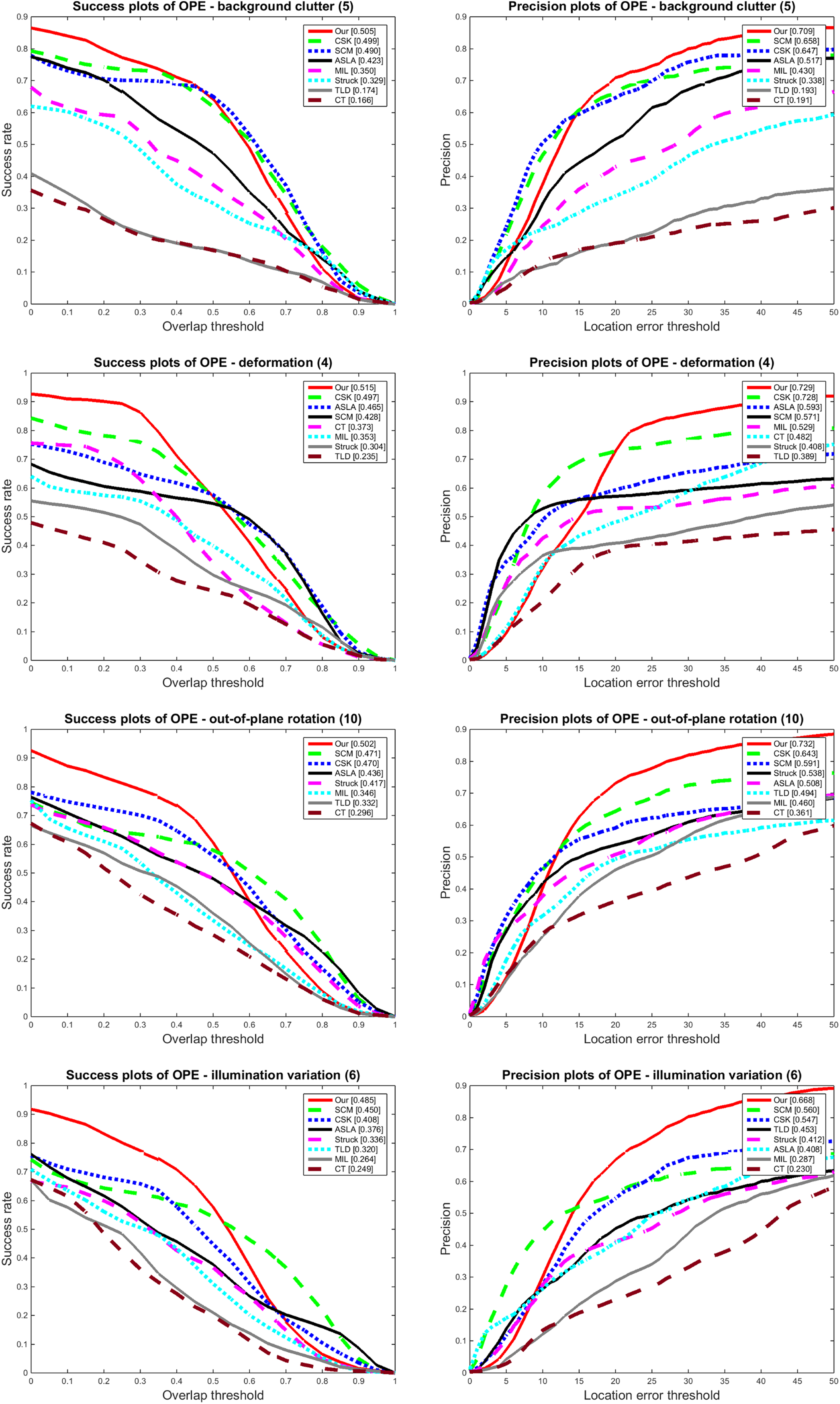
The success plots (left column) and precision plots (right column) between our improved CT tracker and some other classic trackers.
Comparison of the CF2 with improved model updater
In order to verify the validity of the improved model update, we employ CF2 tracker, 14 which exploits rich feature hierarchies of Convolutional Neural Networks (CNNs) as the experimental object. As a result of the richer feature, CF2 has perfect tracking performance, but also because it uses CNNs to make CF2 tracker relatively poor. Therefore, we optimize CF2 with improved model updater and name the new tracker CF2 with Improved Model Updater (IMU). In addition, after repeated tests from a large-scale data set, we define ε = 3 and δ = 15.
We compare the speed and accuracy of the two trackers. As we known, CF2 is an excellent performance tracker, but runs slowly. We experimented on the Graphics Processing Unit (GPU) server, and their respective running speed is shown in Figure 8. Experiments show that CF2 with improved model updater in the running speed has indeed been significantly improved. And even more gratifying is that in addition to speed up 1/3, its tracking effect has also been improved to some extent. As shown in Figure 9, we can see that the improved tracker has improved on 8 attributes (there are 11 attributes in total). Experiments show that our approach not only reduces the number of classifier updates but also avoids the classifier incorrectly updating.

Under the same GPU conditions, the CF2 with improved model updater (CF2 with IMU) and CF2 operating speed comparison.

The success plots of OPE (top row) and the area under receiver operating characteristic curve (AUC) scores over 11 attributes (bottom row) made by improved CF2 tracker (model updater) and CF2 on OTB50. OPE: one-pass evaluation.
Basic tracker test
Our basic tracker MMMU will be tested in MATLAB on a 2.6-GHz Intel Core i5 CPU with 8-GB memory by quantitative comparison and qualitative comparison. For quantitative comparison, we have chosen some representative trackers, such as Struck, 25 ASLA, 40 SCM, 39 TLD, 43 CXT, 44 VTD, 45 VTS, 46 LSK, 47 CSK, 48 DFT, 49 MTT, 50 OAB, 51 MIL, 42 CPF, 52 KCF, 53 and occ aware. 54 For qualitative comparison, we choose seven trackers, including CT, 13 TLD, 43 KCF, 53 MIL, 42 C-COT, 55 MUSTer, 56 and DSST. 57 All tests were performed on TB50. 15
Quantitative comparison
As shown in Figure 11, Our tracker is ahead of all other tracking methods on all attributes in OPE success plots, especially in this DEF attribute, MMMU leads the best performance of KCF approximately 29.545%. The results from Figure 12 show that MMMU is significantly ahead of the opponents in 10 attributes except LR in OPE precision plots and just reduced by 2.201%. Therefore, as shown in Figures 11(a) and 12(a), our MMMU has shown a greater advantage both in the success and precision plots of OPE protocol.

Under the same CPU conditions, the MMMU and occ aware tracker operating speed comparison.

Success plots of OPE for MMMU and top 10 classic trackers in OTB50. In particular, we present success plots for 11 attributes. OPE: one-pass evaluation; MMMU: motion model and model updater.
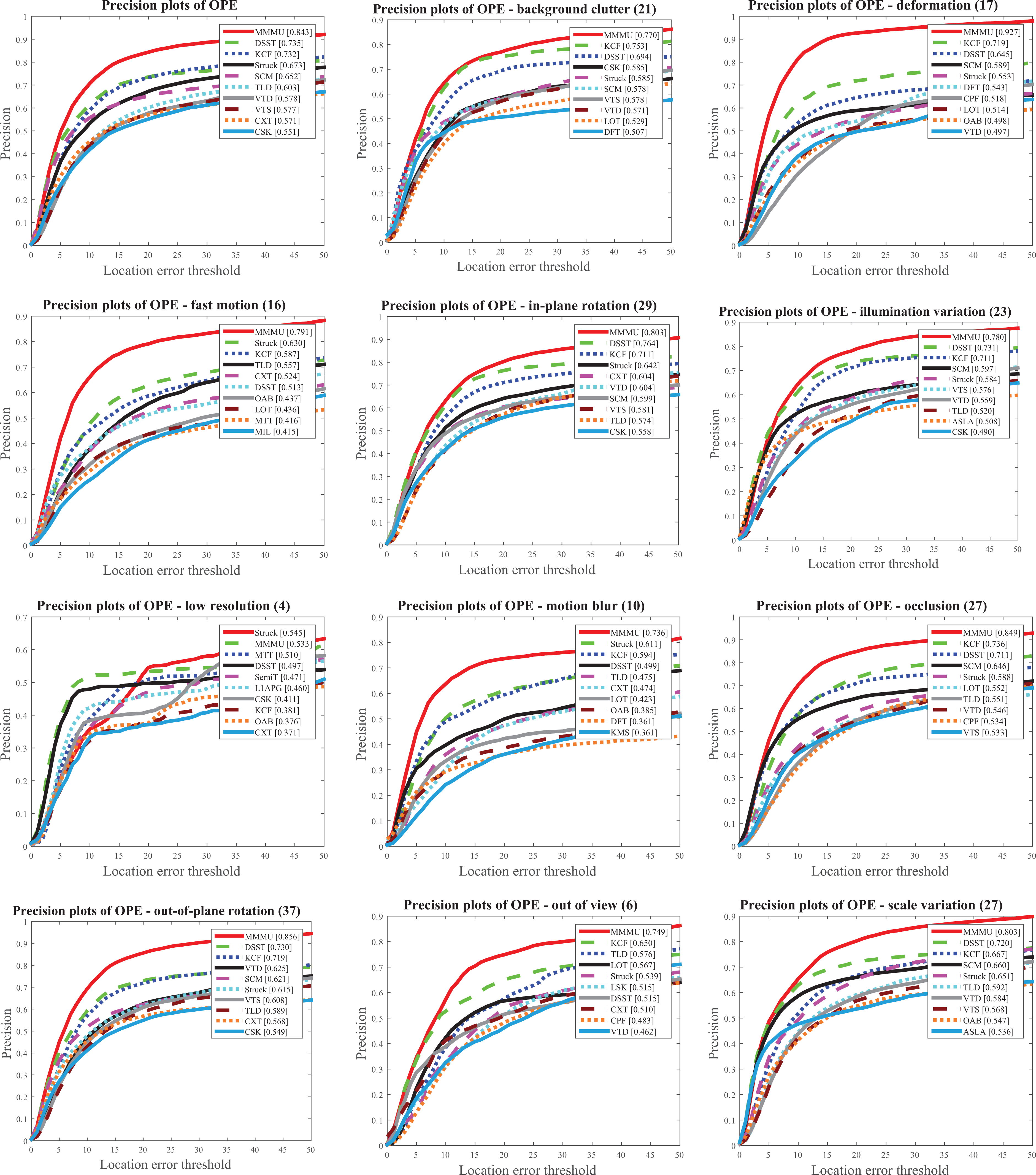
Precision plots of OPE for MMMU and top 10 classic trackers in OTB50. In particular, we present precision plots for 11 attributes. OPE: one-pass evaluation; MMMU: motion model and model updater.
In particular, we compare our MMMU to occ_aware tracker 54 which is a superior performance tracking algorithm. As shown in Figure 13, the two methods have their own advantages in the OPE protocol: in the precision plots of Figure 13(a), occ_aware is better than MMMU; in the success plots of Figure 13(b), MMMU has better performance. As shown in Table 1, our MMMU is superior to occ_aware in nine attributes of the success plots and four attributes of the precision plots. Therefore, MMMU is slightly dominant than occ_aware in OPE protocol.

Success & precision plots of OPE for MMMU tracker and occ aware tracker in OTB 50.
Compare with occ_aware tracker in success and precision plots of OPE.a

OPE: one-pass evaluation; MMMU: motion model and model updater; IV: illumination variation; OPR: out-plane rotation; SV: scale variation; OCC: occlusion; DEF: deformation; MB: motion blur; FM: fast motion; IPR: in-plane rotation; OV: out-of-view; BC: background clutter; LR: low resolution.
aThe best results are denoted in italics.
However, in terms of running speed, MMMU occupy an absolute advantage, as shown in Figure 10; MMMU is 44 times faster than occ_aware in the same platform.
Qualitative comparison
FM is a typical problem in tracking research, such as Deer sequence in Figure 14(a), CT loses its target since frame #0007, TLD drifts completely since frame #0014, KCF incorrectly locates the target since frame #0035, and MIL also loses the target after the next several frames. Because of the rapid movement, the target will be far away from current position, but the range of current frame samples selection is fixed (generally rectangular or circular areas centered on the target). These samples, especially nontarget samples, may not represent the next frame target and its surrounding appearance; therefore, the samples of the current frame selected by this method are not suitable for training the classifier. This is the main reason why all other four trackers fail. Our method does not fix the sample selection region; hence, MMMU in this video series has good robustness. The same situation appears in Jumping sequence shown in Figure 14(b), CT and KCF lose their targets since frame #0027 and frame #0096, respectively.

Tracking frames results on several typical examples. (a) Deer, (b) Jumping, (c) CarScale, and (d) Freeman3.
In OTB50, there are many moving car videos that involve SVs. We choose one of the typical examples for analysis. CarScale video is challenging for scale variation and cluttered background, as shown in Figure 14(c). 15 From frames #0001 to #0085, each tracker has a good performance because the scale of the car changes very little. After frame #86, due to the SV, CT, TLD, and MIL have an unstable track. When a tree appears in front of the camera in frame #0155, OCC directly leads to CT and TLD failure. In frame #242, DSST partly drift. Our MMMU is still excellent.
Face tracking is a common tracking problem, SV, IPR, and out-of-plane rotation are usually the characteristics of this problem. From the results in Figure 14(d), Freeman3 sequence, we find that MIL and CT have bad track from frame #47. In frame #102, when the target turns around, MIL tracks an erroneous target. In frame #437, KCF loses its target because of SV and IPR. Finally, TLD and MIL also retracks to the target, but MMMU maintains the correct trace all the time.
Conclusion
In this article, we propose efficient methods for conventional visual tracking in MMMU. Our method more comprehensively considers the visual-spatial attention factors in the appearance template, such as color, distance, intensity, and texture. Through cooperation between salient region detection and image segmentation, we get an effective motion model which has the right balance between target processing and scene analysis. Inspired by the biological memory system, we further develop an effective online model updater using fast image similarity to measure the rationality of the estimated target and current scene in the time dimension for reducing the frequency of the model update and the probability of classifier error updates. The experimental results prove that the MMMU performs favorably against most trackers in terms of efficiency and accuracy.
Footnotes
Authors’ note
This paper was presented in part at the CCF Chinese Conference on Computer Vision, Tianjin, 2017. This paper was recommended by the program committee.
Declaration of conflicting interests
The author(s) declared no potential conflicts of interest with respect to the research, authorship, and/or publication of this article.
Funding
The author(s) disclosed receipt of the following financial support for the research, authorship, and/or publication of this article: This work was supported in part by the National Key Technology R&D Program under grant 2015BAH52F00 and in part by the National Natural Science Foundation of China under grant 61304262.
