



Abstract
Purpose
The study aims to provide a comprehensive account of the association of five MDM4 gene polymorphisms (rs1380576, rs1563828, rs10900598, rs11801299, and rs4245739) with susceptibility to cancer.
Methods
A literature search for eligible candidate gene studies published before 27 February 2021 was conducted in PubMed, Medline and Web of Science. The following combinations of main keywords were used: (MDM4 OR MDMX OR HDMX OR mouse double minute 4 homolog) AND (polymorphism OR mutation OR variation OR SNP OR genotype) AND (cancer OR tumor OR neoplasm OR malignancy OR carcinoma OR adenocarcinoma). Potential sources of heterogeneity were sought out via meta-regression, subgroup and sensitivity analysis.
Results
Overall, a total of 15 articles with 21,365 cases and 29,280 controls for five polymorphisms of the MDM4 gene were enrolled. In the stratified analysis of rs1380576, we found that Asians might have less susceptibility to cancer. We found that rs4245739 was correlated with a decreased risk of cancer for Asians and breast cancer susceptibility. However, for other polymorphisms, the results showed no significant association with cancer risk.
Conclusion
MDM4 rs1380576 polymorphism is negatively associated with the risk of cancer in the Asian population. MDM4 rs4245739 polymorphism is inversely associated with cancer risk for Asians and breast cancer susceptibility.
Introduction
Murine double minute 4 (MDM4), also known as MDMX or HDMX, is a structurally homologous protein of murine double minute 2 (MDM2). 1 MDM4 shares an N-terminal p53-binding domain with MDM2, which is the major negative regulator of TP53 during various malignancies. 2 Overexpressed MDM4 has been observed in many types of cancer, which might lead to the decrease of p53 activity and tumorigenesis.3,4 The presence of single nucleotide polymorphism (SNP) of MDM4 may affect its protein level, which could affect the expression of the tumor suppressor gene TP53 in various types of cancers.
Recently, many studies have demonstrated the association between MDM4 polymorphisms and risks of various cancers. However, these results are inconsistent, which might be due to the heterogeneity within cancer types, ethnicities, genotyping, source of control, HWE, small sample sizes, data source, and so on. Previous meta-analysis included many studies with incomplete data or obvious heterogeneity, resulting in low reliability of the results.5-8 Recently, more consistent studies about this topic were published. These studies yielded findings inconsistent with previous results. Hashemi et al. 9 reported that rs4245739 and rs11801299 had no significant correlation with breast cancer (BC) risk, while rs1380576 might be a protective factor for BC risk. Zhao et al. 10 reported that rs4245739 might play a protective role in colorectal cancer risk. Mohammad Khanlou et al. 11 reported that rs4245739 had no significant effect in thyroid cancer. To eliminate this inconsistency, it is necessary to update the meta-analysis after controlling the heterogeneity to accurately determine the association between genetic variation of MDM4 gene and cancer susceptibility.
Methods
Literature search
We conducted a systematic literature search on PubMed, Medline, and Web of Science to retrieve all eligible publications on the association between MDM4 polymorphisms and the risk of cancer (up to 27 February 2021) with the following keywords: (MDM4 OR MDMX OR HDMX OR mouse double minute 4 homolog) AND (polymorphism OR mutation OR variation OR SNP OR genotype) AND (cancer OR tumor OR neoplasm OR malignancy OR carcinoma OR adenocarcinoma). The language of enrolled studies was restricted to English. After careful screening, five polymorphisms were left for further investigation.
Inclusion criteria and exclusion criteria
Articles enrolled in our meta-analysis satisfied the following inclusion criteria: (a) case–control studies that evaluated the association between MDM4 polymorphisms and cancer risk; (b) publications focusing on population genetic polymorphisms; (c) articles with sufficient genotype data to assess odds ratios (ORs) and the corresponding 95% confidence intervals (CIs); and (d) the control subjects satisfied the HWE. The major exclusion criteria were: (a) case-only studies, case reports or reviews; (b) studies without raw data for the MDM4 genotype; and (c) combined with other influencing factors.
Data extraction
Two investigators (YW and ZY) independently extracted the data. All the case–control studies satisfied the inclusion criteria and consensus for any controversy was achieved. The data from the eligible articles comprise the first author's name, year of publication, ethnicity, source of control, cancer type and numbers of cases and controls in MDM4 genotypes. Ethnicity was categorized as ‘Asian’, ‘Caucasian’, and ‘Iranian-Azeri’.
Statistical analysis
The risk between the MDM4 polymorphisms and cancer was evaluated using summary ORs and the corresponding 95% CIs in allelic (B vs. A), dominant (BA + BB vs. AA), and recessive (BB vs. BA + AA) models (A: wild allele; B: mutated allele). Cochrane's Q-statistic test was used to assess the heterogeneity between studies, and the inconsistency was quantified with the I2 statistic. The substantial heterogeneity was considered significant when I2 > 50% or PQ ≤ 0.1; then, a random effects model was used; otherwise, the fixed effects model was applied. Meta-regression analysis was performed to determine the potential sources of heterogeneity. Subgroup meta-analysis was performed by cancer type, ethnicity, genotyping, and the source of control. We also conducted sensitivity analysis to assess stability of the results by omitting one study each time to exclude studies. HWE was estimated by the asymptotic test, and deviation was considered when P < 0.05. The potential publication bias of the eligible studies was evaluated by Begg's and Egger's regression test quantitatively. The data was analyzed using the Stata 14.0 software (version 14.0; Stata Corporation, College Station, Texas, USA). A two-tailed P < 0.05 was considered statistically significant.
Results
Main characteristics of the enrolled studies
The study selection processes were presented in Figure 1. For polymorphisms of MDM4 gene (rs1380576, rs1563828, rs10900598, rs11801299, and rs4245739), a total of 15 articles (including 29 case–control studies) with 21,365 cases and 29,280 controls met the inclusion criteria.9-23 A total of 14 studies were performed in Asians, 11 studies were performed in Caucasians, and four studies in Iranian-Azeri. Controls of 19 studies were population-based controls and 10 studies were hospital-based controls. All studies were in compliance with HWE. Table 1 showed the characteristics of all the eligible studies and genotype frequency distributions of the five MDM4 polymorphisms included in our meta-analysis. The Newcastle-Ottawa scale (NOS) was used to evaluate the quality of the enrolled studies, as shown in Supplementary Table 1.
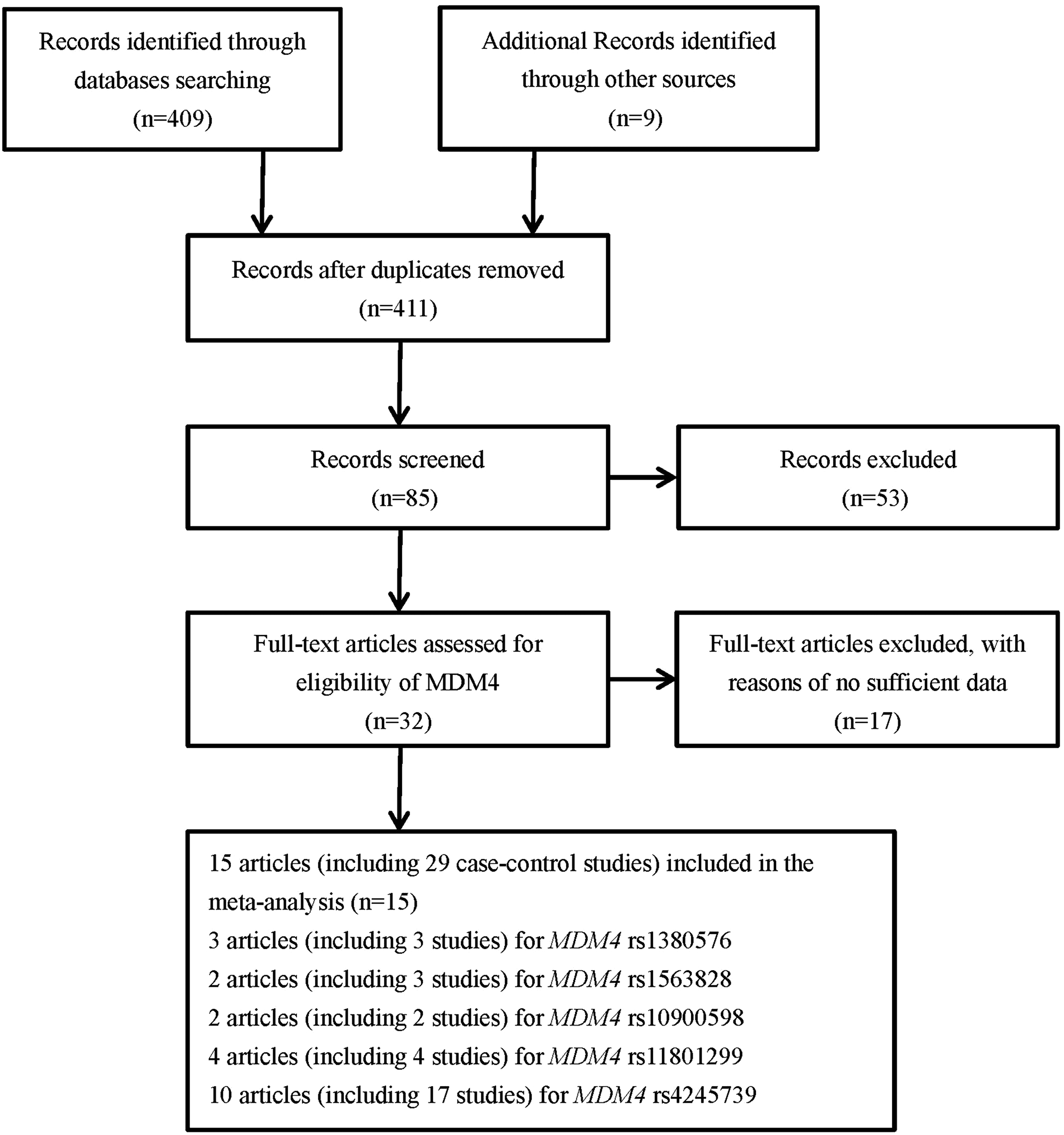
Flow chart of studies selection process for mouse double minute 4 homolog gene polymorphisms.
Characteristics of eligible case–control studies included in the meta-analysis.
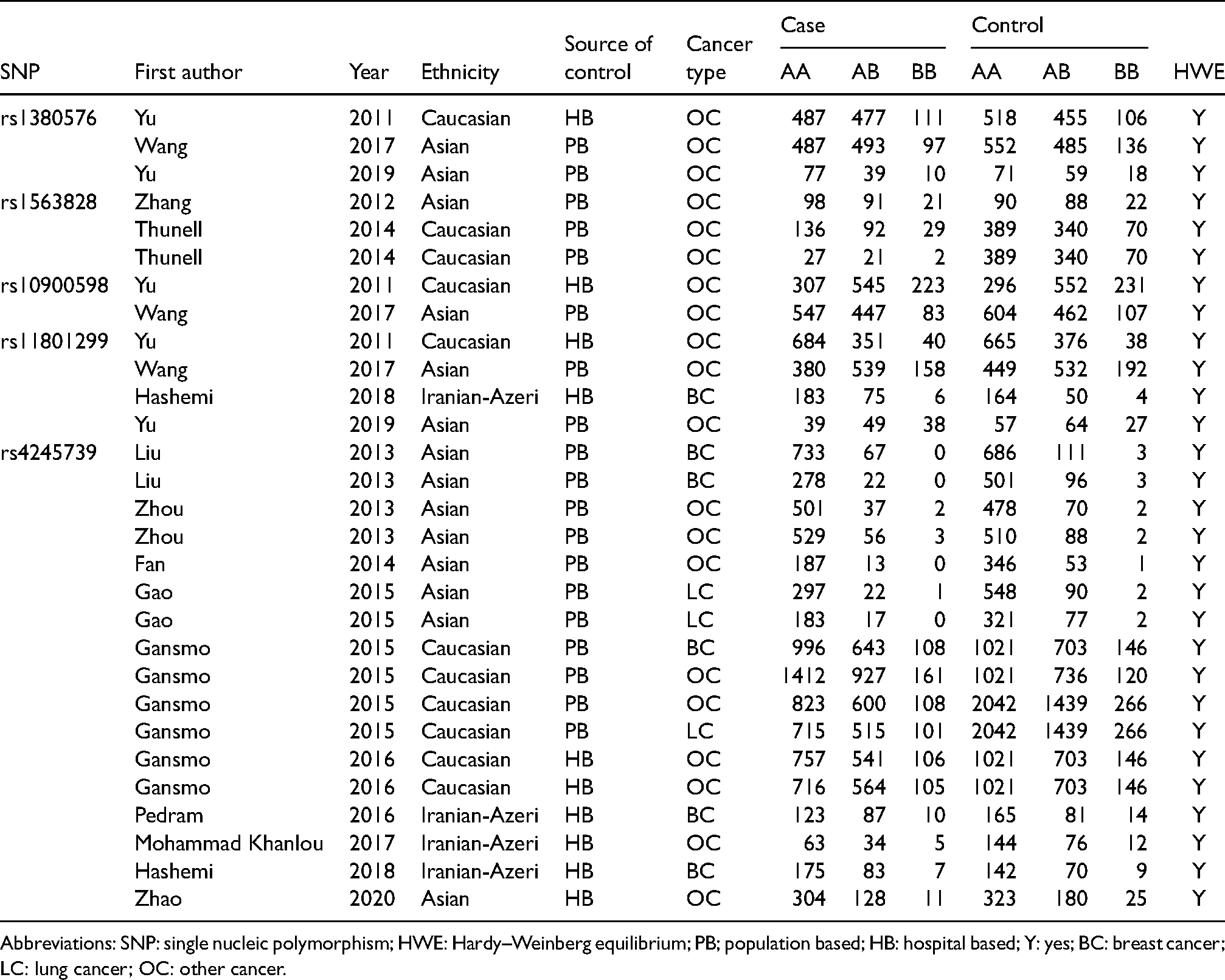
Abbreviations: SNP: single nucleic polymorphism; HWE: Hardy–Weinberg equilibrium; PB; population based; HB: hospital based; Y: yes; BC: breast cancer; LC: lung cancer; OC: other cancer.
Quantitative synthesis
rs1380576
The pooled results based on three included studies (including 2278 cases and 2400 controls) indicated that no significant association between rs1380576 polymorphism and cancer risk was found.12,15,16 However, in the stratification analysis by ethnicity, we observed that the Asian group was significantly related to a reduced risk of cancer in a recessive model (BB vs. AA + AB: OR = 0.74, 95% CI = 0.57–0.96, P = 0.023, Supplementary Figure 1). Moreover, when the subgroup analysis was performed based on source of controls, the population-based control group was significantly related to a decreased risk of cancer in a recessive model (BB vs. AA + AB: OR = 0.74, 95%CI = 0.57–0.96, P = 0.023) (Supplementary Table 2).
rs1563828
The pooled results based on three included studies (including 517 cases and 1798 controls) indicated that no significant association between rs1563828 polymorphism and cancer risk was found.13,14 Further subgroup analysis by ethnicity and genotyping also indicated that no significant result was uncovered (Supplementary Table 3).
rs10900598
The pooled results based on two included studies (including 2152 cases and 2252 controls) suggested no significant association between rs1563828 polymorphism and cancer risk12,15 (Supplementary Table 4).
rs11801299
The pooled results based on four included studies (including 2542 cases and 2618 controls) indicated that no significant association between rs11801299 polymorphism and risk of cancer was uncovered.9,12,15,16 Moreover, in the subgroup analysis by ethnicity, source of control, and genotyping, similar results were found (Supplementary Table 5).
rs4245739
The pooled results based on 17 included studies (including 13,876 cases and 20,212 controls) indicated that rs4245739 was significantly related to a reduced risk of cancer in allelic contrast (B vs. A: OR = 0.83, 95% CI = 0.75–0.92, P = 0.000) and dominant model (AB + BB vs. AA: OR = 0.81, 95% CI = 0.71–0.91, P = 0.001).9-11,17-23 Then, in the stratification analysis by cancer type, we observed that rs4245739 polymorphism was significantly related to a decreased risk of breast cancer in a recessive model (BB vs. AA + AB: OR = 0.75, 95% CI = 0.59–0.95, P =0.019, Figure 2). In addition, in the stratification analysis by ethnicity, we observed that rs4245739 polymorphism was significantly related to a decreased cancer risk for Asians in allelic contrast (B vs. A: OR = 0.56, 95% CI = 0.48–0.66, P = 0.000, Figure 3), dominant model (BB + AB vs. AA: OR = 0.54, 95% CI = 0.46–0.64, P = 0.000) and recessive model (BB vs. AA + AB: OR = 0.56, 95% CI = 0.32–0.98, P = 0.041). Moreover, when the subgroup analysis was performed based on source of controls, the population-based control group was significantly related to a decreased risk of cancer in allelic contrast (B vs. A: OR = 0.73, 95% CI = 0.63–0.84, P = 0.000), dominant model (BB + AB vs. AA: OR = 0.69, 95% CI = 0.58–0.82, P = 0.000) (Table 2).
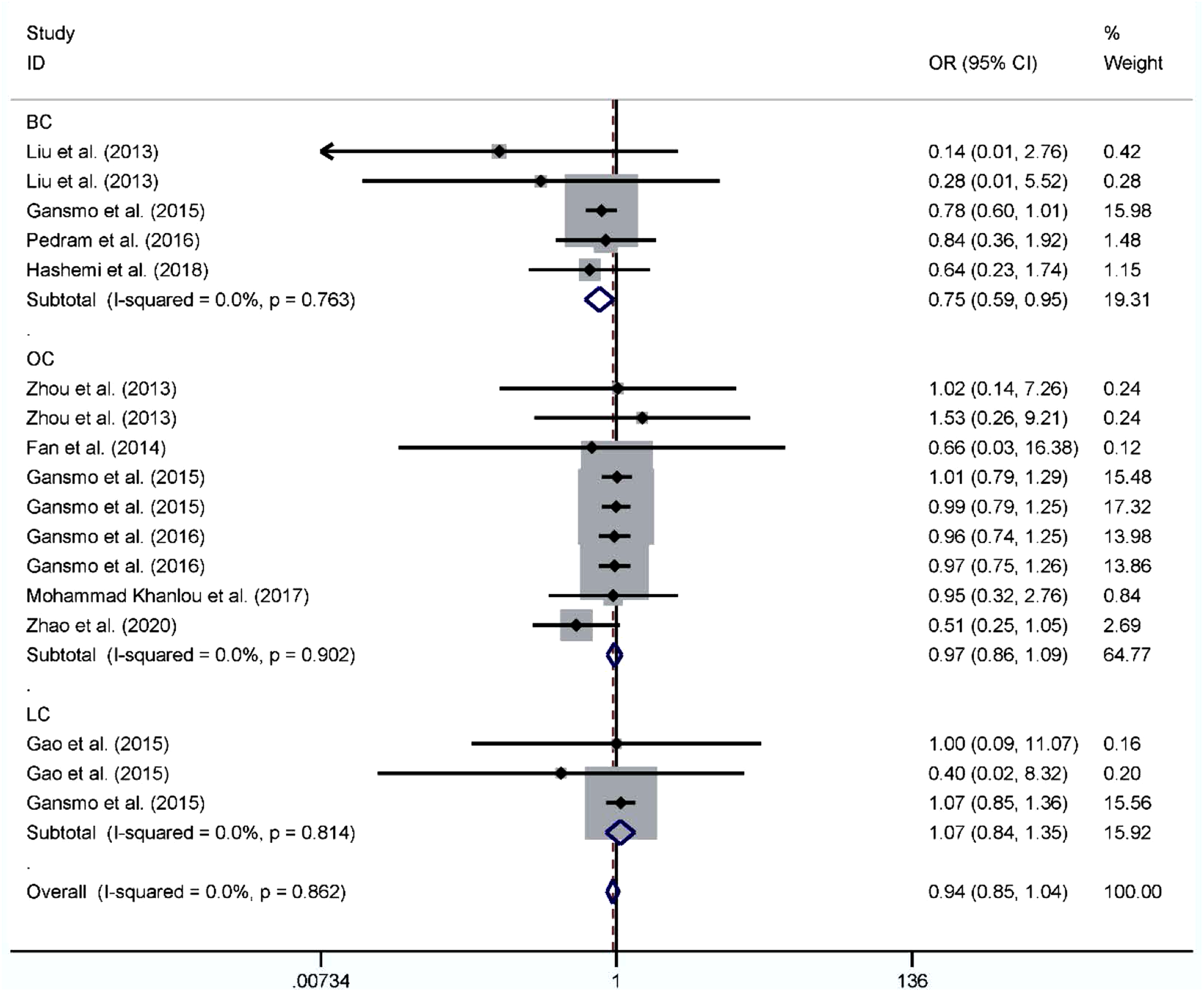
Forest plot of mouse double minute 4 homolog rs4245739 polymorphism and cancer risk in recessive model stratified by cancer type. Note: BC, breast cancer; LC, lung cancer; OC, other cancer.
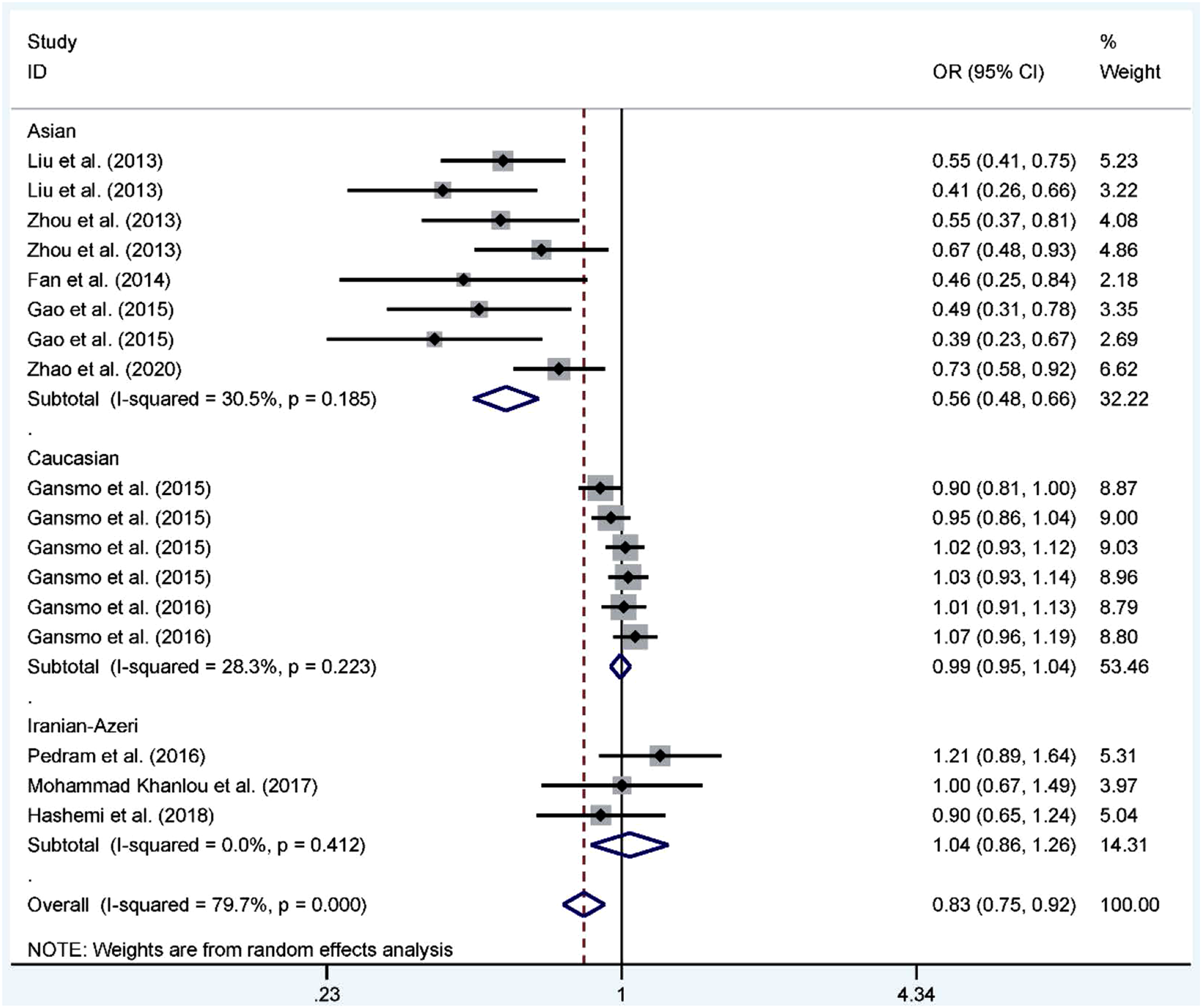
Forest plot of mouse double minute 4 homolog rs4245739 polymorphism and cancer risk in allele contrast stratified by ethnicity.
Meta-analysis of rs4245739.
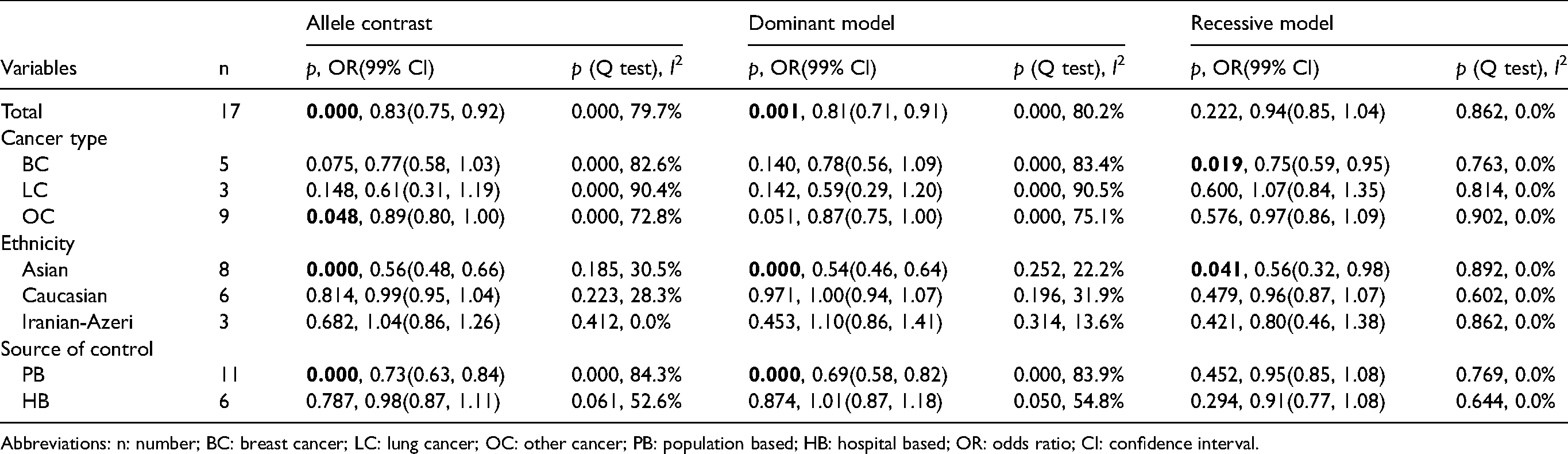
Abbreviations: n: number; BC: breast cancer; LC: lung cancer; OC: other cancer; PB: population based; HB: hospital based; OR: odds ratio; CI: confidence interval.
Sensitivity analysis and publication bias
Sensitivity analyses were performed to evaluate the influence of each separate case–control study. The results showed that there was no material alteration in corresponding pooled ORs for rs1380576, rs1563828, rs10900598, rs11801299, and rs4245739 (Supplementary Figures 2 to 6). In addition, Begg's test and Egger's regression test were performed to evaluate the publication bias. As for rs1380576, rs1563828, rs10900598, and rs11801299, no evidence of publication bias was identified. However, publication bias was detected for rs4245739 (Supplementary Table 6 and Supplementary Figures 7 to 11).
Meta-regression analysis
Because of the high heterogeneity and publication bias in the meta-analysis of rs4245739, we performed a meta-regression to determine the potential source of heterogeneity. The main source of significant heterogeneity was ethnicity in allelic contrast (B vs. A: t = 5.17, 95% CI = 0.23–0.56, P = 0.000), dominant model (BB + AB vs. AA: t = 5.40, 95% CI = 0.25–0.58, P = 0.000; Supplementary Table 7 and Supplementary Figures 12 to 14)
The Preferred Reporting Items for Systematic Reviews and Meta-analysis (PRISMA) checklist is reported in Supplementary Table 8.
Discussion
MDM4 is a structurally homologous protein of MDM2, and they share an N-terminal p53-binding domain. MDM4 can inhibit the degradation of MDM2 protein via the Really Interesting New Gene finger domain. 2 The MDM4/MDM2 complex can induce the degradation of TP53 through the ubiquitin–proteasome pathway to inhibit TP53 activities. 24 TP53 is one of most important tumor suppressor genes. Therefore, MDM4 may play an important role in tumorigenesis. Many studies have investigated the relationship between the SNP polymorphisms of MDM4 gene and cancer risk. However, due to incomplete data or obvious heterogeneity, the results are still controversial. Recently, more consistent studies about this topic have been published. Therefore, we conducted this updated meta-analysis after controlling the heterogeneity to accurately determine the association between genetic variation of MDM4 gene and cancer susceptibility.
In this study, a total of 15 articles including 29 case–control studies were enrolled to validate the association between five MDM4 gene polymorphisms (rs1380576, rs1563828, rs10900598, rs11801299, and rs4245739) and the risk of cancer. We identified that rs4245739 was inversely associated with the risk of cancer under different allele contrast and dominant model. However, for MDM4 rs1380576, rs1563828, rs10900598, and rs11801299 polymorphisms, no significant association with cancer risk was uncovered.
In subgroup meta-analysis stratified by ethnicity and source of control, we found that rs1380576 has significantly reduced cancer susceptibility in Asians and population-based control subgroups in a recessive model. Wang et al. 8 and Zhai et al. 7 reported that rs1380576 polymorphism was not associated with cancer susceptibility. Wang et al.25,26 included two inadequate studies, one of which had insufficient data; the other had unmatched HWE. Zhai et al.26, 27 also included two inadequate studies, one of which had duplicate data; the other did not match HWE. We only included three studies with less heterogeneity. Despite the small sample size, we still could conclude that rs1380576 might reduce cancer susceptibility in the Asian population. However, more studies are needed to confirm this result.
For MDM4 rs1563828 and rs10900598, few studies reported their relationship with cancer in each group. No significant results were found. We excluded studies with high heterogeneity and added new studies with less heterogeneity. Because of the small sample size, we cannot draw any conclusions based on the current literature.
For MDM4 rs11801299, Wang et al. 8 and Zhai et al. 7 included only one sufficient study. Three more studies about MDM4 rs11801299 have been published recently. Our results showed that MDM4 rs11801299 was not associated with cancer susceptibility in various models. More larger sample size studies are needed for further evaluation.
For MDM4 rs4245739, we strictly followed the inclusion and exclusion criteria to include the studies. We excluded a large sample size study because of unclear control, 28 which could lead to great bias. We also excluded a study reported by Wynendaele et al., 29 which was not a human case–control study. Our meta-analysis showed that rs4245739 had significantly reduced cancer susceptibility in allele contrast and dominant model. However, publication bias was detected for rs4245739 and meta-regression analysis revealed that the main source of significant heterogeneity was ethnicity. In subgroup meta-analysis stratified by ethnicity, we found that rs4245739 showed significantly reduced cancer susceptibility in Asians. We also found that rs4245739 had significantly reduced breast cancer susceptibility in a recessive model. This result needs more large sample size studies for further evaluation.
In this study, we spent great effort in searching for eligible studies. We conducted a systematic and comprehensive search to obtain more accurate and reliable results. We then used NOS to evaluate the quality of the included studies, and eliminated low-quality studies to improve overall research quality. In order to eliminate heterogeneity, meta-regression and subgroup analysis were performed. Sensitivity analysis was used to test the stability of the studies. In addition, Egger's and Begg's tests were used to evaluate publication bias. However, several limitations of this meta-analysis should be considered. First, the small sample size limited the reliability of the results. Second, we only evaluated the studies published in English language, which might influence the effects of the polymorphisms. Third, we could not get enough data to evaluate relationship between MDM4 polymorphisms and cancer types. Fourth, publication bias was detected for rs4245739, which could lead to large deviations in the results. Fifth, we did not assess the linkage disequilibrium, which might not properly reflect the function. Future large sample case–control studies are needed to investigate the functions of MDM4 polymorphisms.
Conclusion
Our meta-analysis suggests that MDM4 rs1380576 polymorphism is negatively associated with the risk of cancer in the Asian population. However, MDM4 rs4245739 polymorphism is inversely associated with cancer risk for Asians and breast cancer susceptibility. Further well-designed case–control studies with larger sample size are needed to confirm these findings.
Supplemental Material
sj-jpg-1-jbm-10.1177_17246008211033874 - Supplemental material for Five MDM4 gene polymorphisms on cancer risk: An updated systematic review and meta-analysis
Supplemental material, sj-jpg-1-jbm-10.1177_17246008211033874 for Five MDM4 gene polymorphisms on cancer risk: An updated systematic review and meta-analysis by Yaxuan Wang, Zhan Yang, Xueliang Chang, Jingdong Li and Zhenwei Han in The International Journal of Biological Markers
Supplemental Material
sj-jpg-2-jbm-10.1177_17246008211033874 - Supplemental material for Five MDM4 gene polymorphisms on cancer risk: An updated systematic review and meta-analysis
Supplemental material, sj-jpg-2-jbm-10.1177_17246008211033874 for Five MDM4 gene polymorphisms on cancer risk: An updated systematic review and meta-analysis by Yaxuan Wang, Zhan Yang, Xueliang Chang, Jingdong Li and Zhenwei Han in The International Journal of Biological Markers
Supplemental Material
sj-jpg-3-jbm-10.1177_17246008211033874 - Supplemental material for Five MDM4 gene polymorphisms on cancer risk: An updated systematic review and meta-analysis
Supplemental material, sj-jpg-3-jbm-10.1177_17246008211033874 for Five MDM4 gene polymorphisms on cancer risk: An updated systematic review and meta-analysis by Yaxuan Wang, Zhan Yang, Xueliang Chang, Jingdong Li and Zhenwei Han in The International Journal of Biological Markers
Supplemental Material
sj-jpg-4-jbm-10.1177_17246008211033874 - Supplemental material for Five MDM4 gene polymorphisms on cancer risk: An updated systematic review and meta-analysis
Supplemental material, sj-jpg-4-jbm-10.1177_17246008211033874 for Five MDM4 gene polymorphisms on cancer risk: An updated systematic review and meta-analysis by Yaxuan Wang, Zhan Yang, Xueliang Chang, Jingdong Li and Zhenwei Han in The International Journal of Biological Markers
Supplemental Material
sj-jpg-5-jbm-10.1177_17246008211033874 - Supplemental material for Five MDM4 gene polymorphisms on cancer risk: An updated systematic review and meta-analysis
Supplemental material, sj-jpg-5-jbm-10.1177_17246008211033874 for Five MDM4 gene polymorphisms on cancer risk: An updated systematic review and meta-analysis by Yaxuan Wang, Zhan Yang, Xueliang Chang, Jingdong Li and Zhenwei Han in The International Journal of Biological Markers
Supplemental Material
sj-jpg-6-jbm-10.1177_17246008211033874 - Supplemental material for Five MDM4 gene polymorphisms on cancer risk: An updated systematic review and meta-analysis
Supplemental material, sj-jpg-6-jbm-10.1177_17246008211033874 for Five MDM4 gene polymorphisms on cancer risk: An updated systematic review and meta-analysis by Yaxuan Wang, Zhan Yang, Xueliang Chang, Jingdong Li and Zhenwei Han in The International Journal of Biological Markers
Supplemental Material
sj-jpg-7-jbm-10.1177_17246008211033874 - Supplemental material for Five MDM4 gene polymorphisms on cancer risk: An updated systematic review and meta-analysis
Supplemental material, sj-jpg-7-jbm-10.1177_17246008211033874 for Five MDM4 gene polymorphisms on cancer risk: An updated systematic review and meta-analysis by Yaxuan Wang, Zhan Yang, Xueliang Chang, Jingdong Li and Zhenwei Han in The International Journal of Biological Markers
Supplemental Material
sj-jpg-8-jbm-10.1177_17246008211033874 - Supplemental material for Five MDM4 gene polymorphisms on cancer risk: An updated systematic review and meta-analysis
Supplemental material, sj-jpg-8-jbm-10.1177_17246008211033874 for Five MDM4 gene polymorphisms on cancer risk: An updated systematic review and meta-analysis by Yaxuan Wang, Zhan Yang, Xueliang Chang, Jingdong Li and Zhenwei Han in The International Journal of Biological Markers
Supplemental Material
sj-jpg-9-jbm-10.1177_17246008211033874 - Supplemental material for Five MDM4 gene polymorphisms on cancer risk: An updated systematic review and meta-analysis
Supplemental material, sj-jpg-9-jbm-10.1177_17246008211033874 for Five MDM4 gene polymorphisms on cancer risk: An updated systematic review and meta-analysis by Yaxuan Wang, Zhan Yang, Xueliang Chang, Jingdong Li and Zhenwei Han in The International Journal of Biological Markers
Supplemental Material
sj-jpg-10-jbm-10.1177_17246008211033874 - Supplemental material for Five MDM4 gene polymorphisms on cancer risk: An updated systematic review and meta-analysis
Supplemental material, sj-jpg-10-jbm-10.1177_17246008211033874 for Five MDM4 gene polymorphisms on cancer risk: An updated systematic review and meta-analysis by Yaxuan Wang, Zhan Yang, Xueliang Chang, Jingdong Li and Zhenwei Han in The International Journal of Biological Markers
Supplemental Material
sj-jpg-11-jbm-10.1177_17246008211033874 - Supplemental material for Five MDM4 gene polymorphisms on cancer risk: An updated systematic review and meta-analysis
Supplemental material, sj-jpg-11-jbm-10.1177_17246008211033874 for Five MDM4 gene polymorphisms on cancer risk: An updated systematic review and meta-analysis by Yaxuan Wang, Zhan Yang, Xueliang Chang, Jingdong Li and Zhenwei Han in The International Journal of Biological Markers
Supplemental Material
sj-jpg-12-jbm-10.1177_17246008211033874 - Supplemental material for Five MDM4 gene polymorphisms on cancer risk: An updated systematic review and meta-analysis
Supplemental material, sj-jpg-12-jbm-10.1177_17246008211033874 for Five MDM4 gene polymorphisms on cancer risk: An updated systematic review and meta-analysis by Yaxuan Wang, Zhan Yang, Xueliang Chang, Jingdong Li and Zhenwei Han in The International Journal of Biological Markers
Supplemental Material
sj-jpg-13-jbm-10.1177_17246008211033874 - Supplemental material for Five MDM4 gene polymorphisms on cancer risk: An updated systematic review and meta-analysis
Supplemental material, sj-jpg-13-jbm-10.1177_17246008211033874 for Five MDM4 gene polymorphisms on cancer risk: An updated systematic review and meta-analysis by Yaxuan Wang, Zhan Yang, Xueliang Chang, Jingdong Li and Zhenwei Han in The International Journal of Biological Markers
Supplemental Material
sj-jpg-14-jbm-10.1177_17246008211033874 - Supplemental material for Five MDM4 gene polymorphisms on cancer risk: An updated systematic review and meta-analysis
Supplemental material, sj-jpg-14-jbm-10.1177_17246008211033874 for Five MDM4 gene polymorphisms on cancer risk: An updated systematic review and meta-analysis by Yaxuan Wang, Zhan Yang, Xueliang Chang, Jingdong Li and Zhenwei Han in The International Journal of Biological Markers
Supplemental Material
sj-docx-15-jbm-10.1177_17246008211033874 - Supplemental material for Five MDM4 gene polymorphisms on cancer risk: An updated systematic review and meta-analysis
Supplemental material, sj-docx-15-jbm-10.1177_17246008211033874 for Five MDM4 gene polymorphisms on cancer risk: An updated systematic review and meta-analysis by Yaxuan Wang, Zhan Yang, Xueliang Chang, Jingdong Li and Zhenwei Han in The International Journal of Biological Markers
Supplemental Material
sj-docx-16-jbm-10.1177_17246008211033874 - Supplemental material for Five MDM4 gene polymorphisms on cancer risk: An updated systematic review and meta-analysis
Supplemental material, sj-docx-16-jbm-10.1177_17246008211033874 for Five MDM4 gene polymorphisms on cancer risk: An updated systematic review and meta-analysis by Yaxuan Wang, Zhan Yang, Xueliang Chang, Jingdong Li and Zhenwei Han in The International Journal of Biological Markers
Supplemental Material
sj-docx-17-jbm-10.1177_17246008211033874 - Supplemental material for Five MDM4 gene polymorphisms on cancer risk: An updated systematic review and meta-analysis
Supplemental material, sj-docx-17-jbm-10.1177_17246008211033874 for Five MDM4 gene polymorphisms on cancer risk: An updated systematic review and meta-analysis by Yaxuan Wang, Zhan Yang, Xueliang Chang, Jingdong Li and Zhenwei Han in The International Journal of Biological Markers
Supplemental Material
sj-docx-18-jbm-10.1177_17246008211033874 - Supplemental material for Five MDM4 gene polymorphisms on cancer risk: An updated systematic review and meta-analysis
Supplemental material, sj-docx-18-jbm-10.1177_17246008211033874 for Five MDM4 gene polymorphisms on cancer risk: An updated systematic review and meta-analysis by Yaxuan Wang, Zhan Yang, Xueliang Chang, Jingdong Li and Zhenwei Han in The International Journal of Biological Markers
Supplemental Material
sj-docx-19-jbm-10.1177_17246008211033874 - Supplemental material for Five MDM4 gene polymorphisms on cancer risk: An updated systematic review and meta-analysis
Supplemental material, sj-docx-19-jbm-10.1177_17246008211033874 for Five MDM4 gene polymorphisms on cancer risk: An updated systematic review and meta-analysis by Yaxuan Wang, Zhan Yang, Xueliang Chang, Jingdong Li and Zhenwei Han in The International Journal of Biological Markers
Supplemental Material
sj-docx-20-jbm-10.1177_17246008211033874 - Supplemental material for Five MDM4 gene polymorphisms on cancer risk: An updated systematic review and meta-analysis
Supplemental material, sj-docx-20-jbm-10.1177_17246008211033874 for Five MDM4 gene polymorphisms on cancer risk: An updated systematic review and meta-analysis by Yaxuan Wang, Zhan Yang, Xueliang Chang, Jingdong Li and Zhenwei Han in The International Journal of Biological Markers
Supplemental Material
sj-docx-21-jbm-10.1177_17246008211033874 - Supplemental material for Five MDM4 gene polymorphisms on cancer risk: An updated systematic review and meta-analysis
Supplemental material, sj-docx-21-jbm-10.1177_17246008211033874 for Five MDM4 gene polymorphisms on cancer risk: An updated systematic review and meta-analysis by Yaxuan Wang, Zhan Yang, Xueliang Chang, Jingdong Li and Zhenwei Han in The International Journal of Biological Markers
Supplemental Material
sj-doc-22-jbm-10.1177_17246008211033874 - Supplemental material for Five MDM4 gene polymorphisms on cancer risk: An updated systematic review and meta-analysis
Supplemental material, sj-doc-22-jbm-10.1177_17246008211033874 for Five MDM4 gene polymorphisms on cancer risk: An updated systematic review and meta-analysis by Yaxuan Wang, Zhan Yang, Xueliang Chang, Jingdong Li and Zhenwei Han in The International Journal of Biological Markers
Footnotes
Acknowledgment
We thank Dr Chawnshang Chang at University of Rochester Medical Center for helping with the preparation of the manuscript.
Author Notes
YW and ZY authors contributed equally to this work.
Author contributions
ZH had full access to all the data in the study and takes responsibility for the integrity of the data and the accuracy of the data analysis; study concept and design were performed by ZH and YW; acquisition of data was done by YW and ZY; analysis and interpretation of data was performed by YW and ZY; drafting of the manuscript was done by YW and ZH; critical revision of the manuscript for important intellectual content was done by YW, XC, and JL; statistical analysis was carried out by YW and XC; administrative, technical, or material support: none; supervision, None.
Declaration of conflicting interests
The authors declared no potential conflicts of interest with respect to the research, authorship and/or publication of this article.
Funding
The authors disclosed receipt of the following financial support for the research, authorship, and/or publication of this article: This work has been supported by The National Natural Science Foundation of China (No. 81802544), and Hebei Province Natural Science Foundation (H2020206146).

Supplemental material
Supplemental material for this article is available online.
References
Supplementary Material
Please find the following supplemental material available below.
For Open Access articles published under a Creative Commons License, all supplemental material carries the same license as the article it is associated with.
For non-Open Access articles published, all supplemental material carries a non-exclusive license, and permission requests for re-use of supplemental material or any part of supplemental material shall be sent directly to the copyright owner as specified in the copyright notice associated with the article.
