




Abstract
Objective
This study aimed to investigate clinical significance of Th1, Th2, Th17 and Tregs proportions in predicting and evaluating UC.
Methods
A total of 101 UC patients diagnosed by the Department of Gastroenterology of the Shanxi Provincial People’s Hospital were recruited. This is a retrospective study. The proportions of Th1, Th2, Th17 and Tregs in the peripheral blood were detected by flow cytometry.
Results
The proportions of Th1, Th2 and Th17 cell in UC patients were higher than healthy controls (p < 0.001); The area under the curve (AUC) values of Th1, Th1/Treg and Th17/Treg were all >0.900 in predicting UC (p < 0.001), with the cut off values being 15.25%, 4.885 and 0.425, respectively. In addition, Th1, Th17, Treg, Th17/Treg, Th2/Treg, Th1/Treg and Th17/Treg were statistically significant among the mild to severe group (p < 0.05). The percentage of Treg cells was negatively correlated with Mayo Score, while the percentages of Th17 cell, Th17/Treg, Th1/Treg, Th2/Treg were positively correlated with Mayo score (p < 0.05). Notably, Th17/Treg was closely related to Mayo score (r = 0.513, p < 0.001).
Conclusions
The dysregulation of Th1, Th2, Th17 and Tregs is a significant phenomena of immune disorder in UC, and these auxiliary indicators correlate with increased disease severity. The analysis of Th1, Th2, Th17 and Tregs possesses certain clinical significance in the prediction and evaluation of UC.
Introduction
Ulcerative colitis (UC) is a chronic relapsing inflammatory bowel disease (IBD) characterized by abdominal pain, rectal bleeding, and diarrhoea. Its histopathological characteristics include inflammatory cell infiltration, crypt abscess, crypt structure change, erosion, ulcer and other pathological changes. 1 Nowadays, with the change of people’s lifestyle, the prevalence of UC is increasing. 2 It is currently accepted that the pathogenesis of UC is influenced by multiple risk factors such as genetic susceptibility, intestinal flora imbalance, dysregulated immune function and environmental factors. 3 Although the pathogenesis of UC is still unknown, the current study found that the intestinal cellular immune dysfunction is a central part of the UC patients, especially the T lymphocyte subsets in dysfunctional immune cells play an important role in the immunological pathogenesis of UC. 4 The existing treatment for IBD patients include salicylic acid preparations, glucocorticoids, biological agents, fecal bacteria transplantation, and surgical resection. UC patients benefiting from these treatment also need to monitor themselves for symptoms in order to get timely and proper treatment. 5 However, the diagnosis of UC disease depends on histopathological observation, but such pathological examination is not perfect. In addition to the characteristics of UC disease recurrence, we still need to explore reliable auxiliary indicators for the diagnosis and evaluation of UC disease.
Currently, few studies have reported T lymphocyte subsets clinical application in UC.Therefore, our case–control study focused on exploring the potential application of T lymphocyte subsets in UC patients, in hope of providing reference for clinical prediction and assessment of the disease.
Methods
Subjects
Baseline UC patients characteristics.
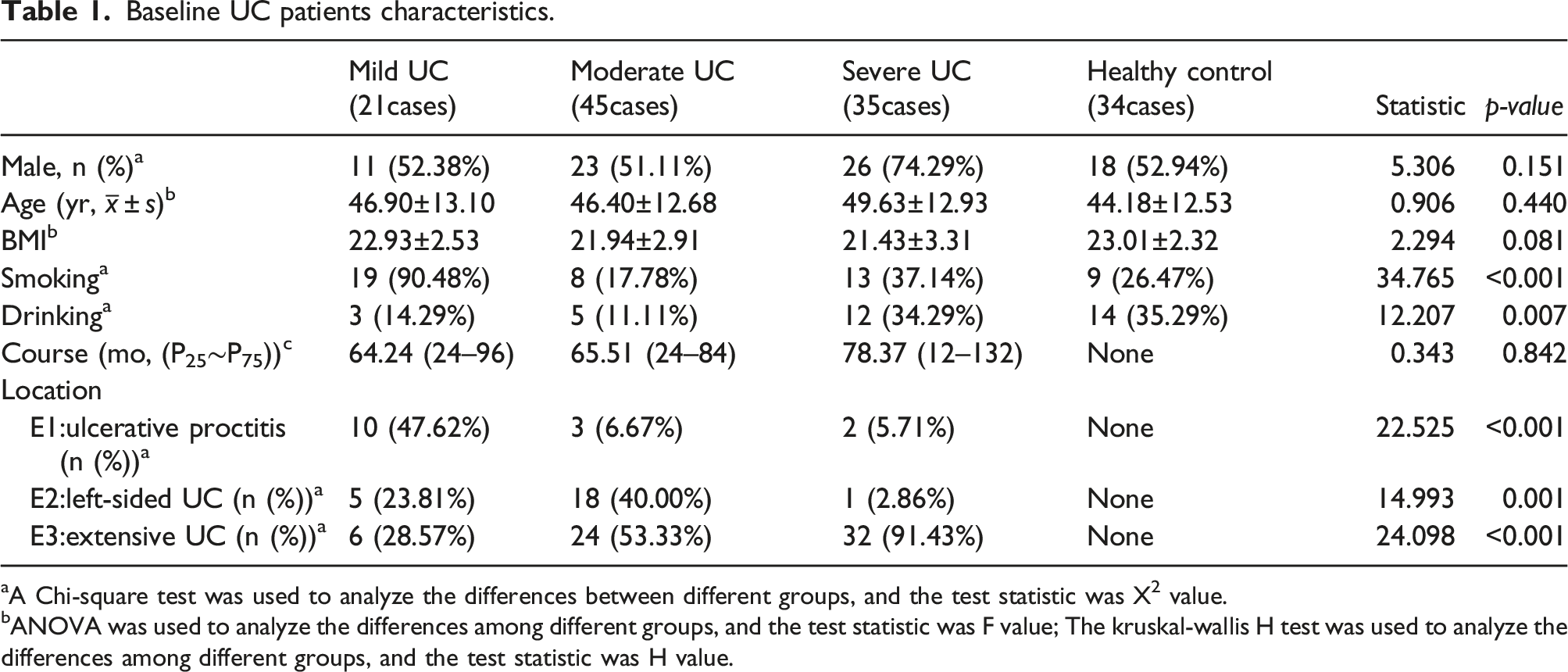
aA Chi-square test was used to analyze the differences between different groups, and the test statistic was X2 value.
bANOVA was used to analyze the differences among different groups, and the test statistic was F value; The kruskal-wallis H test was used to analyze the differences among different groups, and the test statistic was H value.
Monoclonal antibodies and flow cytometry
FITC-conjugated anti-CD4, PE-conjugated anti-CD25, Alexa Fluor 647 Mouse anti-Human CD127, Anti-Human IFN-γAPC, Anti-Human IL-4 PE, Anti-Human IL-17A PE. T helper (Th) cells (Th1, Th2 and Th17), and regulatory T cells (Tregs) were detected in 101 UC patients and 34 healthy controls. Meanwhile, a negative control group was set during the experiment. Stained cell suspension was used for the analysis of flow cytometry (FACSCanto, BD Biosciences).
Statistical analysis
Measurement data conforming to normal distribution were expressed as mean ± standard deviation. T-test or analysis of variance was used to compare data between groups. Measurement data with non-normal distribution were expressed as median with interquartile range (IQR) The Mann–Whitney U test was used for comparison between continuous variables of two independent groups, whereas the Kruskal-Wallis H test was used for comparison of multiple independent samples. The number of use cases and constituent ratio of count data were described and compared between groups by chi-square test. Receiver Operating Characteristic curve was used to analyze T lymphocyte subsets to predict UC. Spearman correlation analysis was used to analyze the correlation between modified Mayo score and T lymphocyte subsets. All statistical analyses were performed using SPSS version 23.0 software (IBM Corporation, USA). p < 0.05 was considered to be statistically significant.
Ethics
The study protocol was approved by research ethics committee of the Shanxi Province People’s Hospital. (Ethical Application Ref: 2021–18).
Results
Patient characteristics
Baseline characteristics of all UC patients are presented in Table 1. Among mild, moderate and severe UC groups, there was no significant difference in the basic clinical characteristics, whereas there were differences in the location, drinking and smoking.
Flow cytometry of treg cells was selected as a representative diagram
In this paper, take Treg cells in UC patients was used as an example.Flow cytometry was used to detect the proportion of UC peripheral blood Treg cells in T lymphocytes. Figure 1(a): CD3 + T lymphocytes were mainly screened, Figure 1(b): CD4 + T lymphocytes were mainly screened, Figure 1(c): Treg cells were mainly selected and the percentage of Treg cells in T cells is calculated by computer. Schematic diagrams of screened Treg cells shows in Figure 1(a–c). FSC-A: Forward Scatter Area; SSC-A: Side Scatter Area; FITC: Fluorescein isothiocyanate; APC: Allophycocyanin; PE: Phycoerythrin.
Comparison of lymphocyte subsets in peripheral blood between UC patients and healthy controls
The percentages of Th1 (24.49 ± 10.27%), Th2 (3.41 ± 2.07%), and Th17 cells (3.10 ± 1.94%) and the ratios of Th1/Th2 (10.14 ± 7.55), Th1/Treg (9.65 ± 6.19), Th2/Treg (1.27 ± 1.04) and Th17/Treg (1.18 ± 1.07) of the study group were higher than those of healthy controls (p < 0.05), while the percentage of Treg cells (3.21 ± 1.43%) in study group was lower than that in control group (p < 0.001) (Figure 2(a),(b)). UC group versus HC group, **<0.001; *<0.05
(Receiver Operating Characteristic, ROC) curve analysis of T lymphocyte subsets in predicting UC
ROC curve analysis of T lymphocyte subsets in predicting UC.

Analysis of lymphocyte subsets in UC patients with different disease activity
As compared to the mild-moderate UC group, the ratio of Th2/Treg (1.94 ± 1.31) and that of Th17/Treg (1.83 ± 1.39) were higher in the severe UC group. Relative to the mild UC group, the severe UC group had a higher percentage of Th17 cells (4.17 ± 2.36%) but a lower percentage of Treg cells (2.63 ± 1.39%) (p < 0.05). The percentage of Th1 cells and the ratio of Th1/Treg in moderate to severe UC group were higher than those in mild UC group (p < 0.05) (Figure 3(a),(b)). Mild UC versus Moderate UC versus Severe UC,**<0.001; *<0.05.
Correlation analysis between T lymphocyte subsets and Mayo score
Correlation analysis between Th1, Th2, Th17,Tregs and Mayo score.

Discussion
IBD is a recurrent chronic inflammatory bowel disease including UC and Crohn’ s disease. Its occurrence and development is generally considered to correlate strongly with the abnormalities of the autoimmune system. T lymphocyte subsets help the gastrointestinal tract maintain a delicate balance between tolerance to content and immunity to pathogens. The proportion of CD4+ and CD8+ T lymphocytes were increased in peripheral blood of IBD patients, and CD4+ T lymphocytes are considered to be the key factor mediating host protection and homeostasis. Nevertheless, overactivation of CD4+ T lymphocytes could lead to insufficient host defense against pathogens, thus resulting in chronic inflammation.9,10
Regulatory T cells typically express Forkheadbox protein 3, which are key in maintaining immune tolerance, especially in maintaining tolerance to symbiotic intestinal bacteria and food antigens. Zhou L 11 et al. found that Bifidobacterium infantis can alleviate intestinal epithelial injury and maintain intestinal immune tolerance by regulating characteristic proteins on the surface of Treg cells and upregulating the expression of anti-inflammatory factors such as interleukin-10 and transforming growth factor-β1. In our study, Th1, Th2, Treg and Th17 cells represented the major unbalanced T lymphocyte subsets. Tumor necrosis factor (TNF-α) and Interferon-γ (IFN-γ) are cytokines secreted by Th1 cells, which activate macrophages and CD8+ cytotoxic T lymphocytes, respectively, and thus promote the elimination of intracellular pathogens. 12 Th2 cells orchestrate protective type 2 immune responses, but also contribute to chronic inflammatory diseases and facilitate tissue repair. IL-4 is closely related to the formation and differentiation of Th2 cells, and its expression level in peripheral blood of UC patients is higher than that of normal controls. 13 Additionally, Th17 cells play a crucial role in the skin and intestinal mucosa as a barrier against bacteria and fungi, Th17 cells is an important driver of autoimmune diseases.The function of Th17 cells is primarily determined by their ability to express IL-17, in the expression of serum IL-17 in UC patients is significantly increased. 14 Salas et al. 15 found that Th17 cells that can produce interleukin-17A proliferate in the intestinal tract of UC patients, triggering and aggravating inflammatory reactions, which is consistent with our findings. The lymphoid subsets analysis of UC patients with varying degrees of disease activity showed that in moderate to severe UC patients, the level of Treg was significantly decreased, and the ability of Treg to maintain the body’s immune tolerance to autoantigens was also decreased. Furthermore, Himme et al. 16 found in their study that Tregs in inflammatory tissues are more prone to apoptosis, and their regulatory function in immune tolerance is further impaired. Therefore, in the inflammatory state, Treg cells are damaged in both number and function, and thus further affect the progression of inflammation. In our study, the imbalance of Th1, Th2, Th17 and Treg cells is more remarkable in severe patients, and the significance value of T lymphocyte subsets in the evaluation of UC disease needs to be further clarified. Our study analyzed the significance of immune cells in peripheral blood in UC. Some studies indicate that the disturbed dynamics of circulating IL-17A+ and IFN-γ+ T-cell pools may be involved in the extraintestinal autoimmune manifestations associated with celiac disease. 17 It demonstrated that andrographis paniculata have inhibitory effects on Th1/Th17 responses and the promoting effects on Th2 responses of andrographolide. 18 In addition, their study also included UC patients who were not formally treated at the stage of inflammatory activity, excluding those who used biologics, immunosuppressants and other drugs that may affect immune function.Those naïve patients will show the true character of UC T lymphocyte subsets, but the influence of therapeutic drugs on lymphocyte subsets still requires further exploration.In our study, blood examples of patients with ulcerative colitis were studied, the changes of peripheral blood lymphocytes can reflect the degree of intestinal lesions,and the relationship between intestinal lymphocytes and peripheral blood lymphocytes needs to be further explored.Some studies indicates that the infiltration of immune cells in mucosal tissues and the immune disorder mediated by CD4 + T cells are important pathological features of IBD.19,20 And the predominant gut-infiltrting CD4 + T cell populations in IBD are Th1 cells,Th2 cells,Th17 cells. 21 However,the numbers of immnue-suppressing cells is insufficient, such as Treg cells. 22 Combined with our study, the changes in the number of intestinal lymphocytes and peripheral lymphocytes were consistents,and the intestinal lymphocytes and peripheral blood lymphocytes were transformed dynamically under the condition of inflammation.
At present, research on the pathogenesis of UC and existing treatment modalities has made progress. According to the characteristics of chronic recurrence of UC disease, however, both the evaluation indicators of predicting the disease change and therapeutic efficacy still need to be improved. The Mayo score is an important indicator widely used to assess disease activity. In the study, Treg cells were negatively correlated with Mayo score, whereas Th17, Th17/Treg, Th1/Treg, and Th2/Treg were positively correlated with the modified Mayo score (p < 0.05). In addition, Th17/Treg had a good correlation with the modified Mayo score (r = 0.513, p < 0.001), and thus can be used as an index to observe the change in patients' condition.
However,in terms of research limitations, This is a single-center study with a limited number of samples,and the samples in this study are only blood samples. In the future, multi-center, large sample, blood samples and intestinal mucosal tissue should be studied simultaneously to further clarify the relationship between intestinal lymphocytes and peripheral lymphocytes.
In conclusion, the imbalance of T lymphocyte subsets, especially Th1, Th17 and Treg cells contribute to the immune dysfunction of UC patients.There is a close relationship between Th17/Treg and the degree of intestinal injury in UC patients. The detection of Th17 and Treg cells has good clinical significance in the diagnosis and evaluation of UC.
Conclusion
The dysregulation of Th1, Th2, Th17 and Tregs is a significant phenomena of immune disorder in UC, and these auxiliary indicators correlate with increased disease severity. The analysis of Th1, Th2, Th17 and Tregs possesses certain clinical significance in the prediction and evaluation of UC.
Supplemental Material
Supplemental Material - The significance of Th1,Th2,Th17and treg cells in the prediction and evaluation of ulcerative colitis
Supplemental Material for The significance of Th1,Th2,Th17and treg cells in the prediction and evaluation of ulcerative colitis by Yu Zhang, Wei Shi, GaiGai Cao, Jingru Li, Haijiao Wang, and Chonghua Hao in European Journal of Inflammation
Footnotes
Author contributions
YZ and WS carried out conception and design of the study. YZ contributed to acquisition of data. GC, JL, HW contributed to analysis of data. YZ wrote the manuscript. CH revised it critically for important intellectual content. All authors read and approved the final submitted manuscript.
Declaration of conflicting interests
The author(s) declared no potential conflicts of interest with respect to the research, authorship, and/or publication of this article.
Funding
The author(s) disclosed receipt of the following financial support for the research, authorship, and/or publication of this article: This work was supported by Health Commission of Shanxi Province (NO:2020032).
Ethical approval
Ethical approval for this study was obtained from * ETHICS COMMITTEE OF THE SHANXI PROVINCE PEOPLE’S HOSPITAL (APPROVAL NUMBER202118)*.
Informed consent
Written informed consent was obtained from all subjects before the study.

Supplemental Material
Supplemental material for this article is available online.
References
Supplementary Material
Please find the following supplemental material available below.
For Open Access articles published under a Creative Commons License, all supplemental material carries the same license as the article it is associated with.
For non-Open Access articles published, all supplemental material carries a non-exclusive license, and permission requests for re-use of supplemental material or any part of supplemental material shall be sent directly to the copyright owner as specified in the copyright notice associated with the article.
