



Abstract
In his 1992 book, The End of History and the Last Man, the philosopher Francis Fukuyama suggested that, with the fall of communism and the Berlin Wall, the ideological evolution of humanity was over and that liberal market capitalist democracies were triumphant. 1 In the 30-plus years since proclaiming the End of History, it is doubtful that many would agree with Fukuyama’s optimistic—or naïve—statement.
It may sometimes feel like we live in an era of “peak pharmacy” and the ideological evolution of our profession is complete. In a time when pharmacists are independently prescribing, undertaking physical assessments of patients, administering all manner of vaccines, and fully engaging as primary care clinicians in interprofessional teams, what room for more growth is left for the profession? Have we, as a profession, achieved all we can possibly achieve, with no real room or need for professional evolution or advancement?
It is sobering to reflect on our professional history and consider how the scopes of practice we now take for granted came about. In the 1980s and 1990s, thought leaders distinguished between pharmacists and clinical pharmacists. The latter were “advanced practice pharmacists”—patient-centred graduates of postbaccalaureate PharmD programs that were available prior to the advent of the current entry-to-practice PharmD programs. 2 Without these pharmacists, much of our current professional scope would not have been realized. These individuals were our pioneers, experimenting with scope of practice before the term was even coined. By expertly leveraging their knowledge and skills, they navigated complex systems, regulatory barriers, interprofessional egos, and education/skills gaps to meet the needs of their patients. They documented their work, learned from their mistakes, shared their experience and wisdom with the profession by teaching and publishing, and, in the process, set the foundation for the profession of pharmacy we know now.
Today, the importance of advanced practice pharmacists and their value to the profession may be losing prominence. Explaining advanced practice, even to other pharmacists, is increasingly difficult. Advanced pharmacy practice experience rotations, for example, are part of every PharmD student’s training. It may be tempting to say that the profession has arrived with limited need for further evolution. This End of History argument negates the reality of pending system and social crises, including climate change, misinformation/disinformation, and artificial intelligence. Indeed, history has not ended, and the need for the pharmacy profession to evolve is more urgent than ever. But what does the term advanced practice mean in today’s context? How can we foster our profession’s thought leaders of the future, and what do we want them to do? This commentary begins to explore these questions.
The term advanced pharmacy practice has no commonly accepted definition in Canada, but other jurisdictions have proposed frameworks. Most commonly, these frameworks describe 4 key components to advanced practice: clinical practice, leadership, research, and education.3-5 Of note, Bates et al. 4 differentiated between advanced and specialist scopes. Advanced practice is distinctly related to the level of performance and can be applied to any practice sector. In contrast, specialization can refer to a practice sector either broadly (e.g., community or hospital settings) or more specifically (e.g., geriatrics, oncology). 4 This distinction is also reflected in the United Kingdom’s Royal Pharmaceutical Society Advanced Pharmacy Framework, which states, “expert professional advancement was not simply judged by deeper or broader knowledge but was in part measured by a pharmacist’s ability to autonomously apply their expertise and make decisions in uncertain situations.” 6 The lack of a common understanding of advanced pharmacy practice can lead to disappointment and burnout. For example, as recently described by Cao et al., 7 pharmacy directors in British Columbia seeking to fill clinical pharmacy specialist positions would prefer to hire pharmacists with generalized advanced training to ensure staffing flexibility. This may be at odds with the expectations of advanced pharmacy practitioners who envision specializing within 1 aspect of practice and to teach and perform practice research or quality improvement through that lens.
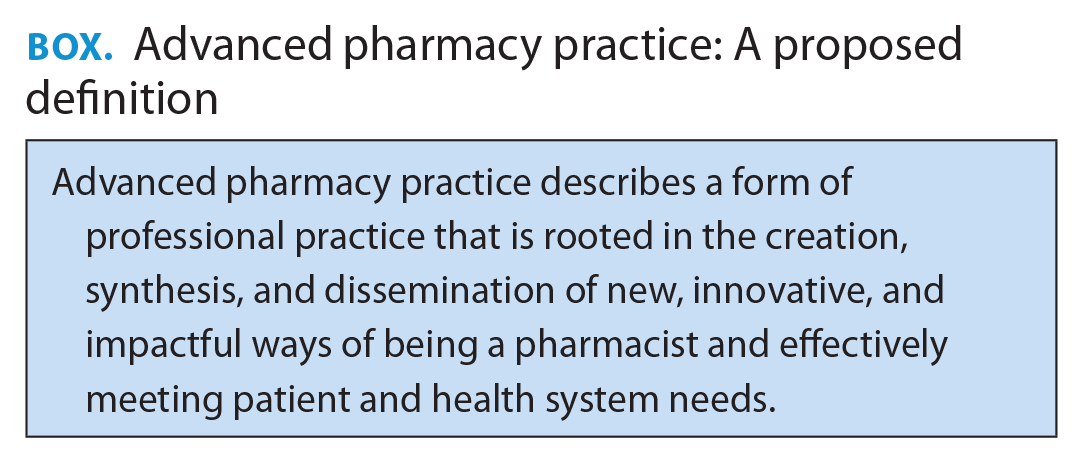
We propose that advanced pharmacy practice describes a form of professional practice that is rooted in the creation, synthesis, and dissemination of new, innovative, and impactful ways of being a pharmacist and effectively meeting patient and health system needs (see inset box). Further, we believe that these pharmacists will need encouragement and purposeful training so they can shape the future of pharmacy in Canada.
Advanced pharmacy practice: A proposed definition
Building capacity for advanced practice pharmacists ideally focuses on the 4 key domains of clinical practice, leadership, research, and education. While some pharmacists can gain education and further experience in these domains separately (e.g., implementation science, quality improvement, medication safety, clinical epidemiology), innovation in pharmacy practice may be well-served through pharmacy-centred education and pharmacy practice-centred experience. Wholistic training experiences in pharmacy that include both conceptual or theory-based knowledge and skills development allow for synergies among training experiences and ensure that pharmacy practice is a main thread throughout the pharmacist’s educational experience. Such programs also offer efficiencies for individuals interested in gaining experience across all 4 domains of advanced pharmacy practice in 1 program.
Developing advanced practice pharmacists is the responsibility of academia, health care institutions, and governments. Current options for advanced pharmacy training in Canada include the Canadian Pharmacy Residency Board-accredited Year 2 Pharmacy Residencies, the Professional Diploma in Specialized Pharmaceutical Care at l'Université Laval, and university graduate degree programs such as the MScPhm offered by the University of Toronto. However, to truly nurture and prepare budding advanced pharmacy practitioners, core educational outcomes for advanced practice pharmacy programs in Canada need to be defined so that pharmacists and employers across all sectors can better understand the value of these programs. Pharmacy managers and organizational leaders can benefit from incorporating expectations for advanced practice within career paths for pharmacists who complete advanced practice pharmacist education, creating the space to allow them to innovate, fail, succeed, teach, learn, document, and research, to the benefit of organizations individually and society as a whole. Without these supports, it will be challenging for pharmacy to maintain its role and expand opportunities for it to contribute to societal health.
Today, advanced pharmacy practitioners may not hold titles that explicitly acknowledge their advanced skill set. They may hold joint or combined appointments with academic and clinical organizations (e.g., hospital, primary care, community), conduct research to evaluate practice innovations, teach graduate and undergraduate students, frame pharmacy curricula, support and advance the practice of pharmacists, and directly improve the quality of health care systems. Advanced pharmacy practitioners may hold positions as clinician scientists, educators, practice leaders, and faculty. They may offer innovative health care services in community settings collaboratively with other health care professionals.
To strengthen its future, the Canadian pharmacy community needs to achieve consensus on a definition of advanced pharmacy practice and an understanding of how best to prepare pharmacists to become advanced pharmacy practitioners. These pharmacists will, for example, develop practice models that meet the impending realities of digital health care, artificial intelligence, pharmacogenomics, and proteomics. They will implement creative, patient-centred solutions around climate-conscious, ecologically sustainable pharmacy practice and will guide pharmacists as they tackle misinformation in their communities. The pharmacy profession needs to recommit to the ideal of advanced pharmacy practice and nurture pharmacists who are advanced pharmacy practitioners. We specifically call on Canadian Faculties of Pharmacies to offer preparative training and on health system leaders to create opportunities for advanced pharmacy practitioners to apply their skills so that they can, in turn, nurture and strengthen our profession. ■
Footnotes
Author Contributions:
All authors conceived of the commentary, drafted the manuscript, contributed to revisions, and approved the final version.
Funding:
None.
Declaration of Conflicts of Interest:
The authors declared no potential conflicts of interest with respect to the research, authorship, and/or publication of this article.
Ethics and Consent to Participate:
Not applicable.
