



Abstract
The second law, thermal, magnetic field, and concentration of viscous fluid across a permeable stretching surface are the focus of this study. The transverse and longitudinal velocities, temperature, and concentration with boundary conditions are computed numerically by applying Runge-Kutta 4th-order method. For this determination the system of governing equations are first converted to the first order ordinary linear equations and then solve by RK4 built-in function in MATHLAB SOFTWARE by taking step size
Keywords
Introduction
The research on the magnetohydrodynamic (MHD) viscoelastic fluids flow on continuously moving surfaces has diverse technological and industrial applications, including the manufacture of synthetic sheets, plastic sheets aerodynamic extrusion, and metallic plates cooling. Vyas and Soni 1 discussed MHD effects and Casson Nano fluid in a micro channel with temperature-dependent convection, entropy generation rate and radiations analysis, and slip effect have been analyzed. The impact of joint density focused and electro osmotic movement of Casson molten in parallel plates and radiation properties has been investigated by Ng. 2 The analysis of MHD and the convective slip velocity of Casson liquid and entropy effect in micro channel enclosure by porous media along with radiation effects have been explored by Eegunjobi and Makinde. 3 Zeeshan et al. 4 examined mass and heat diffusion in a dual fiber optic coating utilizing a WOW coating method.
The velocity of a Newtonian fluid’s laminar boundary layer flow generated by a flat elastic thin plate was investigated, and it was discovered that it is linearly linked to the distance from the thin plate’s stationary point. 5 A viscoelastic fluid flow on a stretched thin plate was also investigated.6,7 Dandapat and Gupta 8 and Vajravelu and Rollins 9 looked at heat transfer in these experiments, whereas Andersson 10 looked at viscoelastic fluid flow on a tensile surface under a uniform magnetic field. Since then, many authors have undertaken series investigations on the impact of viscoelastic fluids on heat transfer under various physical circumstances.10–17 A comparable solution for the transfer of heat and flow of viscoelastic boundary layer across an exponentially stretched surface was found by Khan and Sanjayanand. 18 Cortell 19 has examined the heat transmission and flow of viscoelastic fluids on stretched surfaces using a constant plate temperature and a specified plate temperature. With a non-uniform source of heat and viscous dissipation, Abel et al. 20 studied the heat transmission and flow of a viscoelastic boundary layer on a tensile surface while accounting for the surface’s specified temperature and heat flux. Despite the fact that the preceding research work addressed numerous problems including heat transfer as well as flow of viscoelastic fluid across stretched surfaces from the perspective of thermodynamic, it was limited to simply the first law analysis. When it comes to heat transmission and thermal design, the present-day trend is the analysis using second law of thermodynamics and associated notion of entropy generation minimization.
In all heat transport processes, the generation of entropy is directly linked to thermodynamic irreversibility. Entropy is generated by a variety of processes, including heat transmission and viscous dissipation.21,22 The dependence of optimal Reynolds number on duty cycle and Prandtl number was determined by analyzing the generation rate and expansion of entropy in a circular pipe with heat flow supplied to the wall.23,24 In circular pipes with isothermal boundary conditions, Sahin 25 explored the second law of viscous fluid. In addition, the same author claimed that the rate of entropy creation in a circular heated pipe is influenced by changing viscosity. Under isothermal boundary conditions, Sahin found the optimal air duct shape after conducting a comparative analysis of the rate of entropy generation in air ducts of various forms. Moreover, Sahin 26 numerically investigated the second law of heat transmission and flow in rectangular pipes.
Recently, the second law exploration has been applied to investigate the fundamental convective heat transfer problem as well as non-Newtonian flow via a network created by two plates in a row.27–29 In a liquid film sliding down a sloped heating surface, the generation of entropy was explored by Saouli and Aïboud-Saouli.
30
The generation of entropy in a film flow falling off of a sloping heating plate was explored by Aïboud-Saouli et al.
31
In addition, the entropy generation number’s dependence the electromagnetic field in mixed convection in the channel was investigated.
32
In the falling films and channels, Woods
33
and Megherbi et al.
34
have looked into the dependence of entropy generation on viscous dissipation and magnetic fields. Rasheed et al.
35
investigate the thermal heating and chemical reaction of magnetized nanofluid regarding convective boundary conditions. Similarly the hydromagnetic nanofluid over stretchable sheet with convective conditions has been studied by Rasheed et al.
36
Shevchuk
37
explored modeling of convective heat and mass transfer in rotating flow. This book provides a good overview of fundamentals and applications. The novel part of this work is to examine the thermodynamics of viscoelastic MHD flow on stretching surface with assign temperature regarding the influence of heat source/sink and with applied transverse magnetic field, which has not been done in the published literature to date. Therefore, in the limiting sense, the present work is compared with published work and found in excellent agreement. More exactly, in this work Runge-Kutta 4th-order method has been applied to investigate the fluid velocity, energy, and concentration distributions. These computations are shown in various plots and tables and discussed in details with physical discussion. For this persistence the system of controlling equations are first converted to the first order ordinary linear equations by similarity transformation, and then solve by RK4 built-in function in MATHLAB SOFTWARE by taking step size
Mathematical modeling
The second grade’s laminar, stable, magneto-convection, and electrically conducting boundary layer fluid flow is studied in the two-dimensions. This flow is induced by a stretched surface focus to sloping uniform magnetic pitch. The
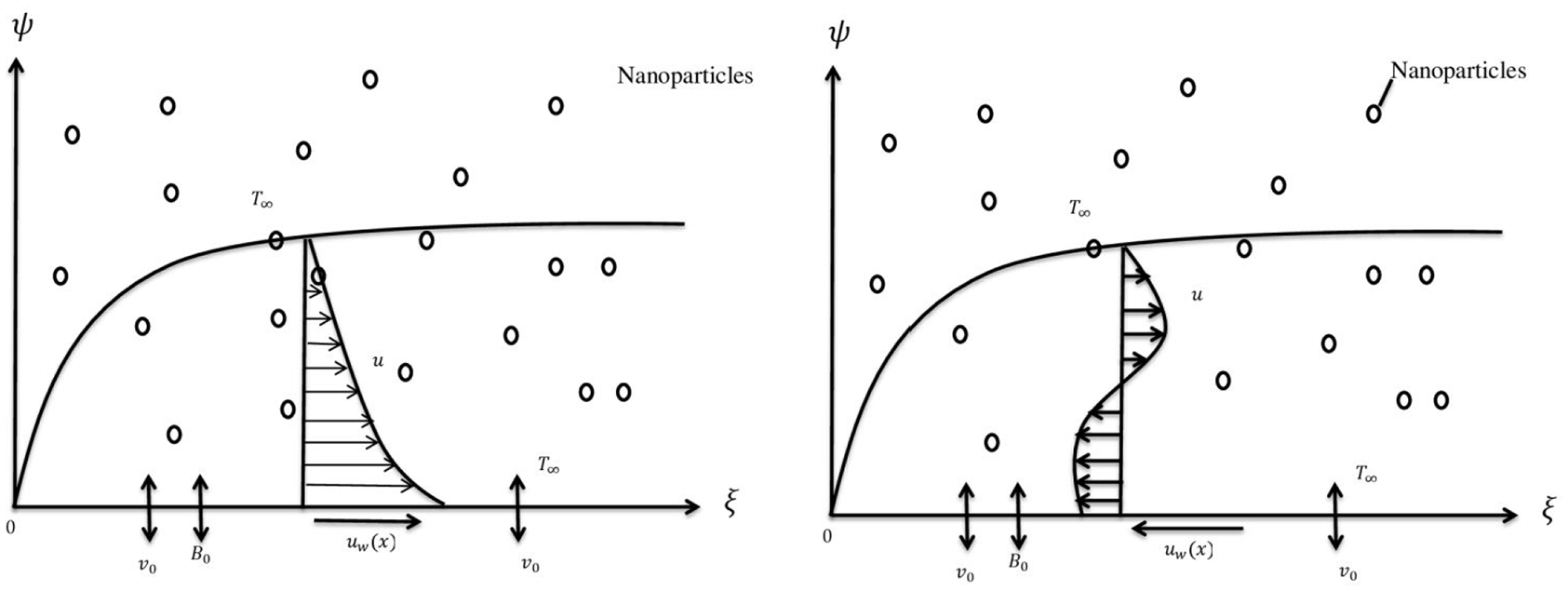
Geometry of the problem.
The governing equation of continuity under the approximations of usual boundary layer is23,25,27:

and the motion equation is23,25,27:

The energy equation related to the temperature of the heat sink or source in the flow direction is as follows23,25,27:

Here,

The velocity field’s valid conditions at boundary are23,25,27:

For the equation of energy, the thermal conditions are as follows:

and the following boundary conditions are appropriate for the diffusion equation (4)23,25,27:

Introducing the similarity transformation as follow

Utilizing equation (9) into equations
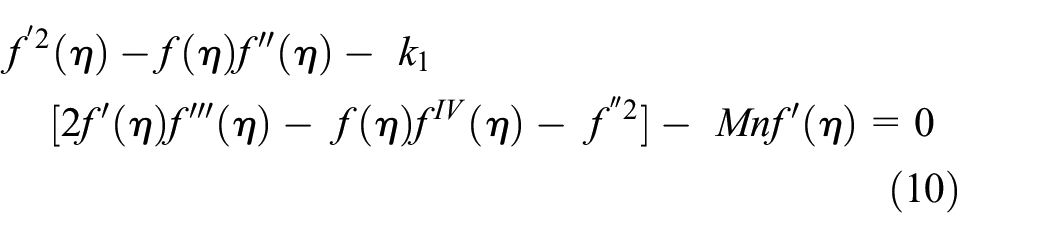


With boundary conditions




where,

Entropy generation
In the existence of applied magnetics, the rate of local volume generated by entropy is as follows31,32:
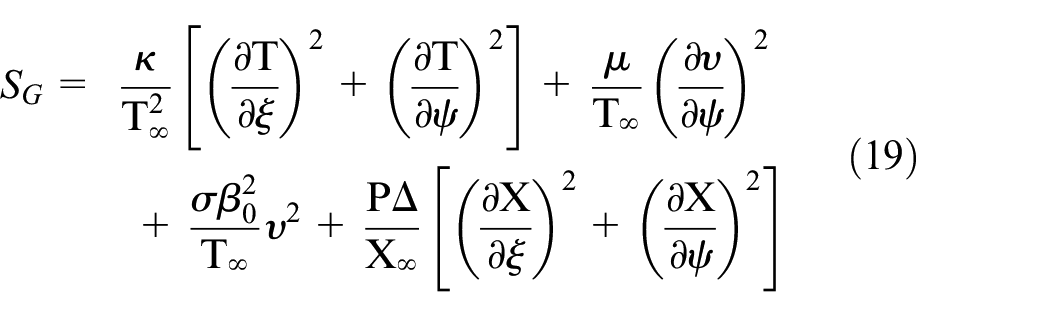
Equation (19) reveals the contribution of four sources of entropy generation. Heat transmission over temperature difference of a finite magnitude, viscous dissipation, magnetic field effect, and mass transfer over concentration difference of a finite magnitude are the sources of local entropy formation expressed at the right side of equation (19). For the entropy generation rate, a new number Ns is introduced for convenience. Ns is a non-dimensional number which is expressed by equation (20) as:

Where, SG and SG0 are the rates of local volume entropy generation and characteristic entropy generation, respectively. The rate of characteristic entropy generation, SG0 is given as:

The entropy generation number might be calculated using dimensionless velocity, temperature, and concentration formulas as follows:

where, Re, Br, Ha are the Reynolds, Brinkman, and Hartman numbers respectively. Furthermore, Σ and Ω are dimensionless concentration and temperature differences, respectively. On the other hand, ε is a constant parameter. The following relationships provide these parameters:

Results and discussion
Equations (10)–(18) along with Entropy generation rate given in equation (22) are analyzed mathematically by Runge-Kutta 4th-order method built-in-function in MATLAB SOFTWARE. We used Δη = 0.001 as that of the scale factor and 10−6 and δ = 2, as the resolution threshold during our computation which gives four decimal places accuracy. For the numerical solutions, the set of differential equations denoting velocity, heat, and volume friction profiles are converted to ordinary differential equations of first and then, resolved in the incidence of a uniform and crosswise magnetic field. For the validation of the numerical results, BVPh2 is also applied. From both methods excellent agreement is found which confirm our results as shown in Figure 2. Furthermore, the existing work is also compare with recently published article reported by Bejan
21
and was found to be in reasonable agreement as given in Table 1. The entropy generation has been calculated based on mathematical methods for temperature, velocity, and concentration. The lateral

For velocity, temperature, and concentrations profiles, the RK-4 and BVPh2 approaches are compared.
Assessment of the current work with available literature reported by Bejan. 23


Influence of M on the longitudinal/transverse velocities, respectively.
Figure 4 depict the viscoelastic parameter effect on lateral

Influence of k on the longitudinal/transverse velocities, respectively.
Figure 5 depicts the heat distribution

Influence of Pr and M on temperature, respectively.

Influence of

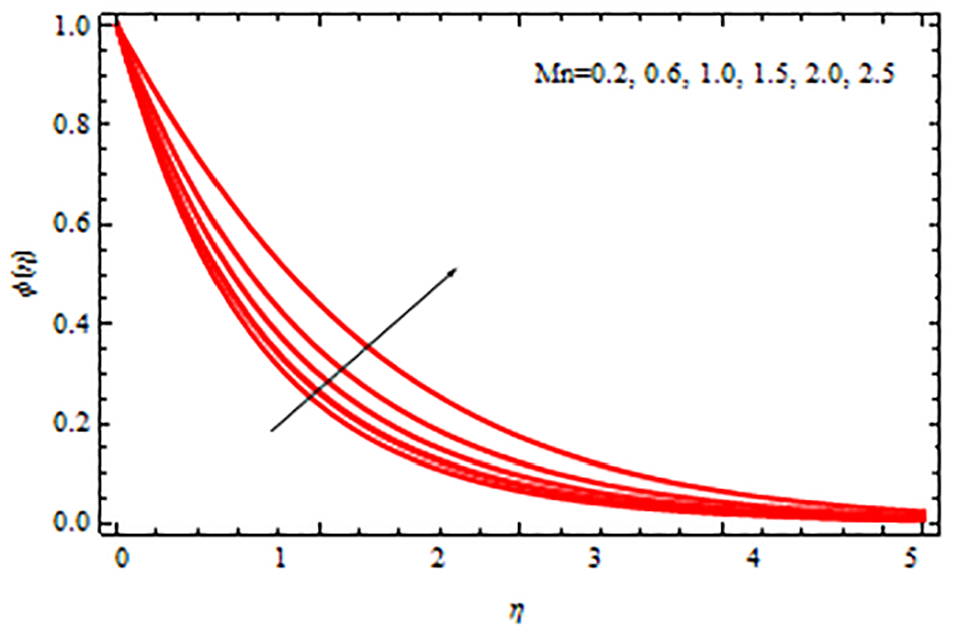
Influence of Mn on concentration/entropy, respectively.

Influence of Pr and Sc on entropy generation number.

Effect of Re and

Influence of H and
Influence of ε on entropy generation number.
Conclusion
An analytical technique is utilized to get the temperature, velocity, and concentration distributions that are being used to calculate the viscoelastic fluid’s entropy generation number on stretched sheet under the influence of normal magnetic field. On the longitudinal and normal velocities, the impact of magnetic and viscoelastic factors is explored. The longitudinal and transverse velocities are observed to decrease when the viscoelastic and magnetic parameters are increased. The influence of Prandtl number, magnetic, and heat source/sink factor on heat was also investigated, and it was discovered that temperature rose as magnetic parameters and heat source-sink parameters increased, but dropped as Prandtl number grew. At the same time, concentration rises as the magnetic parameters rise. Conversely, the concentration falls, as the Sc enhances. The magnetic field, Prandtl number, Schmidt number, Hartmann number, Reynolds number, dimensionless group, constant parameter as well as the ratio of the non-dimensional concentration variance to the non-dimensional temperature alteration, all enhance the Ns. Furthermore, the surface has been discovered to be a substantial source of irreversibility.
Footnotes
Appendix
Handling Editor: Chenhui Liang
Declaration of conflicting interests
The author declared no potential conflicts of interest with respect to the research, authorship, and/or publication of this article.
Funding
The author received no financial support for the research, authorship, and/or publication of this article.
