



Abstract
In this study, the boundary layer phenomena for stagnation point flow of water-based nanofluids is being observed with the upshot of MHD and convective heating on a nonlinear stretching surface. To develop a fundamental flow model, a boundary layer approximation is done, which signifies time-dependent momentum, energy, and concentration expressions. Through a proper transformation framework, the modeled boundary layer partial differential equations (PDEs) have been diminished to a dimensionless system of nonlinear ordinary differential equations (ODEs). With the assistance of a built-in algorithm in Mathematica software, the fundamental flow equations are analyzed numerically by imposing a shooting technique explicitly. A stability and convergence analysis were also unveiled, and the ongoing investigation was found to have converged. The effect of mathematical abstractions on velocity, energy, and concentration is plotted and discussed. The influence of skin-friction and Nusselt number on the sheet are debated for the various values of important parameters.
Introduction
Numerous magnetohydrodynamic (MHD) flow studies have been done due to its importance in numerous practical applications in modern industry, such as MHD power generators, the petroleum industry, liquid metals systems of fusion reactors, earth’s core motion, and so on. The MHD boundary layer flow of an electrically conducting fluid was first studied by Pavlov 1 with a stretched plane elastic surface in the presence of a uniform transverse magnetic field. Then, Chakrabarti and Gupta 2 extended this study to include the temperature distribution over a stretching sheet in the presence of a uniform suction. Later, this problem was extended further to a power-law fluid over a stretching sheet by Andersson et al., 3 recently to Eyring-Powell fluid by Sher Akbar et al. 4 and to a nanofluid by Ibrahim et al. 5 The latest study 6 reported the MHD flow over both stretched and shrinking sheets with the effect of radiation taken into consideration. They found that radiation decreases the heat transfer rate at the surface. The MHD flow of an electrically conducting fluid is important in modern metallurgy and metalworking processes, such as the process of fusing of metals in an electrical furnace by applying a magnetic field and the process of cooling of the first wall inside a nuclear reactor containment vessel where the hot plasma is isolated from the wall. 5 Choi 7 was the first to introduce the theory of nanofluid with its application to non-Newtonian fluids. The nanofluids that are commonly used are toluene, water, oil, etc. Choi 7 showed that the addition of a tiny number of nanoparticles into the liquid increased the thermal conductivity of the fluid. On the other hand, Nandy and Pop 8 have investigated the MHD nanofluid flow at a stagnation point in the presence of a magnetic field and thermal radiation. Sheikholeslami and Houman 9 studied the effect of Lorentz forces on nanofluid flow in a porous complex shaped enclosure by means of a non-equilibrium model using the control volume based finite element method (CVFEM). Stagnation point flow has various practical applications. These applications include the cooling of electronic devices, the cooling of nuclear reactors during emergency shutdown, and hydrodynamic processes in engineering applications. Again, the study of magnetohydrodynamic (MHD) flow of an electrically conducting fluid is of considerable interest in metallurgical and metalworking processes due to the fact that the rate of cooling can be controlled by the application of a magnetic field. Hydromagnetic stagnation point flow and heat transfer find applications in boundary layers along material handling conveyors, in aerodynamic extrusion of plastic sheets and in blood flow problems. Hiemenz 10 considered a two-dimensional stagnation flow problem on a stationary plate and used similarity transformations to reduce the Navier Stokes equations to nonlinear ordinary differential equations. Akbar et al 11 investigated radiation effects on MHD stagnation point flow of nanofluid toward a stretching surface with convective boundary condition. Bhatti et al. 12 studied a robust numerical method for solving stagnation point flow over a permeable shrinking sheet under the influence of MHD. Sheikholeslami and Houman 13 analyzed magnetic nanofluid flow and convective heat transfer in a porous cavity considering Brownian motion effects. explained the effects of slip on nonlinear convection in nanofluid flow on stretching surfaces. Stagnation electrical MHD nanofluid mixed convection with slip boundary on a stretching sheet was studied by Hsiao. 15 Heat transfer improvement and pressure drop during condensation of refrigerant-based nanofluid was studied experimentally by Sheikholeslami et al. 16 Khan et al. 17 studied convective heat flow features of stagnation point flow of MHD over a nonlinear stretching surface with slip velocity and variable heat reservoir source. Several other studies have addressed various aspects of nanofluids with stretching sheets.17–25 Gangaiah et al. 26 described the effects of thermal radiation and heat source/sink parameters on the mixed convective MHD flow of a Casson nanofluid with zero normal flux of nanoparticles over an exponentially stretching sheet along with convective boundary conditions. Ghozatloo et al. 27 studied the chemical vapor deposition (CVD) method at atmospheric pressure using synthesis of Graphene. Ramya et al. 28 studied the steady 2D flow of a viscous nanofluid in magnetohydrodynamic (MHD) flow and heat transfer characteristics for the boundary layer flow over a nonlinear stretching sheet are considered. Nadeem et al. discussed water-base hybrid nanofluid flow over an exponentially curved permeable surface. The hybrid nanofluid comprises two types of nanoparticles along with the base fluid, which gains a larger rate of heat transfer compared to simple nanofluid. Abbas et al. 31 carried out steady state flow of micropolar hybrid nanofluid over a stretched Riga plate with slip condition and radiation effect. Abbas et al. 32 explored MHD stagnation point flow and heat transfer due to hybrid nanofluid over a stretching cylinder with a uniform magnetic field.
The existing investigation aims to explore the MHD stagnation point flow of nanofluid toward a stretching surface. The effect of thermophoretic force, Brownian movement, and concentration of nanoparticles on the thermal boundary layer with heat transfer due to nanofluid. The governing boundary layer partial differential equations have been transformed into ODEs via similarity solutions. The nonlinear system has been tackled numerically through shooting technique. The consequences of pertinent constraints on flow fields have been analyzed through plotted graphs and tables.
Mathematical formulation
Consider a steady MHD two-dimensional boundary layer flow of a nanofluid over a stretching surface with the velocity

Flow pattern and Coordinates.
Governing equations



Extreme conditions are:
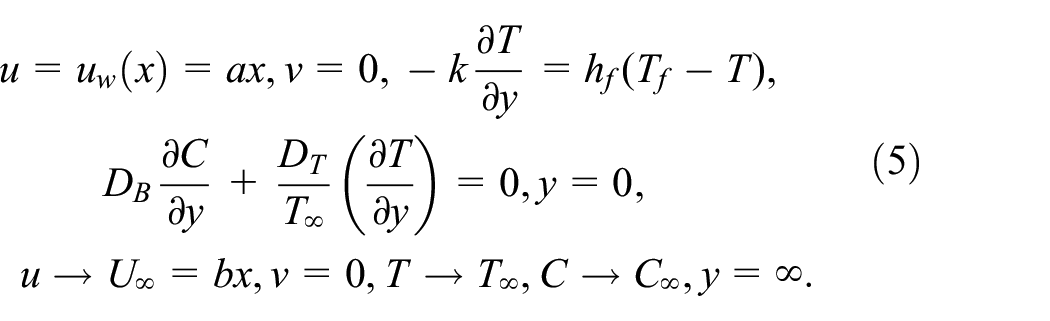
Where
Similarity transformation
Considering the transformation5,34 to diminish the system of (PDEs) to the system of (ODEs):

Stream function

The following system of ODEs is obtained by using equation (6) in equations (1)–(5):


the transforms extreme conditions are:

Variables appearing in equations (8)–(11) are defined and label as:

magnetic parameter, Brownian parameter, thermophoretic parameter, Biot number, velocity ratio parameter, Prandtl number, and Lewis number.
Expressions of engineering importance are


The drag force and heat transfer rate parameter can be labeled as:


Solution methodology
For numerical results the first order (ODEs) is recruited from equations (8)–(10) by introducing transformation variables. Let the transformations variables are defined as 9 :


The linear system of (ODEs) thus, generated by




We need seven initial conditions to solve these seven unknowns first order ODEs numerically. In this case,

We select a variable step size of

Schematic algorithm of numerical method.
Graphical results and analysis
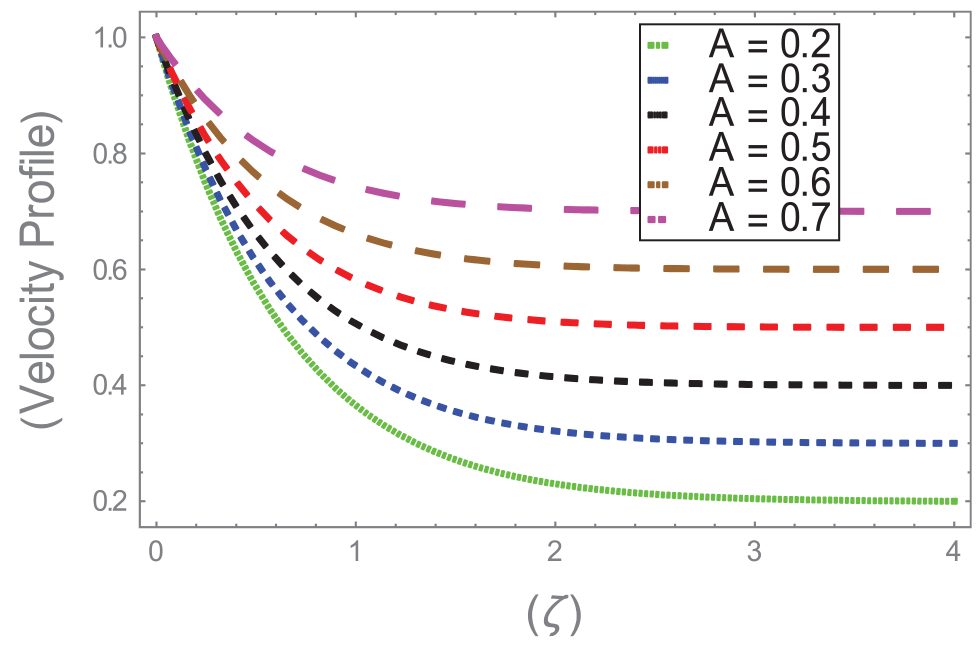
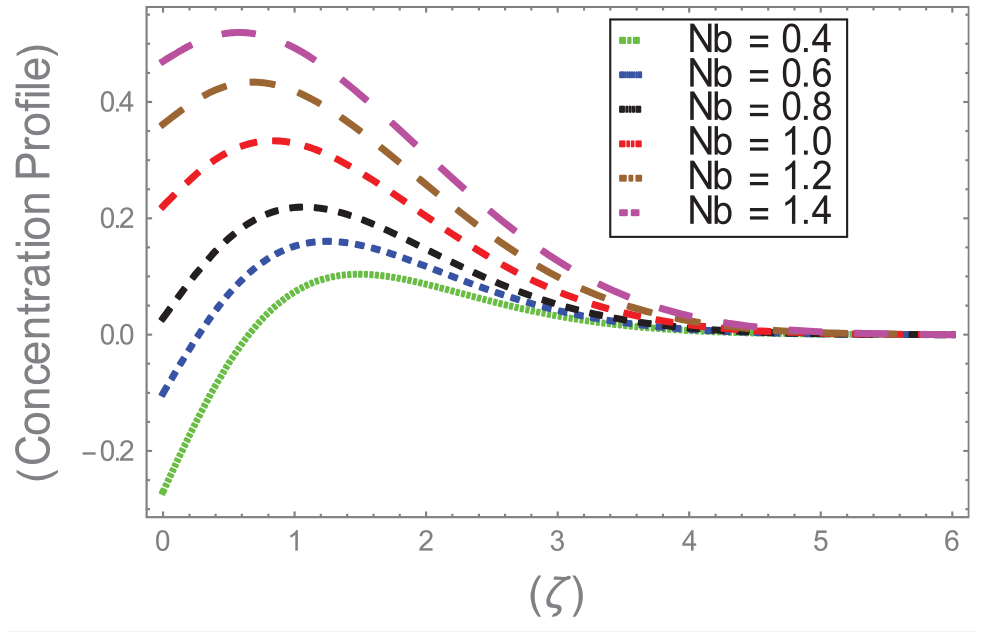
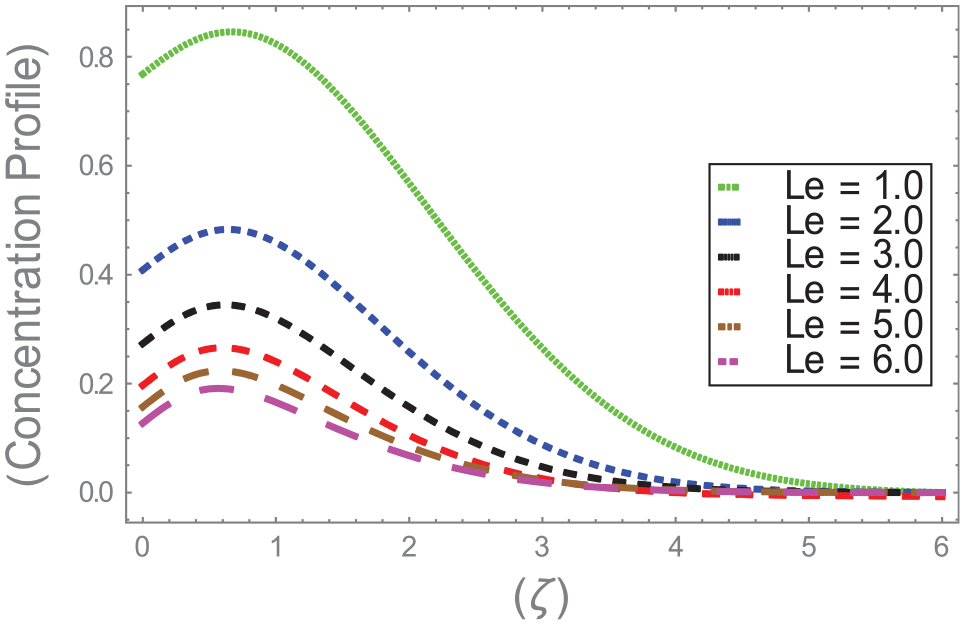
The dimensionless governing flow equations (8)–(10) subject to extreme conditions in equation (11) are solved via the shooting method. The diagram of numerous parameters, such as magnetic parameter, ratio parameter, Brownian parameter, thermophoretic parameter, Prandtl number, Biot number, and Lewis number on the velocity, energy, and concentration profile are plotted in Figures 3 to 16. Figures 3 and 4 explains

Consequence of
Consequence of

Consequence of

Consequence of

Consequence of

Consequence of
Consequence of
Consequence of

Consequence of

Consequence of

Consequence of

Consequence of

Consequence of

Consequence of
Numerical values of

Numerical values of

Closing remarks
A theoretical problem of magneto-hydrodynamics thermal boundary layer stagnation point flow of nanofluid over a stretching surface with effect of heat transfer and convective boundary conditions have been examined numerically. A similarity solution is presented which effects, magnetic, Brownian motion, thermophoretic force, and velocity ratio parameter. The governing equations were transmuted to nonlinear system of ODEs through suitable transformation techniques. A numerically solutions to nonlinear flow equations were obtained by shooting method. The precise findings of this study are summarized below:
As noticed that velocity profiles escalate with increment in velocity ration parameter when
The velocity and boundary layer thickness diminishes subject to increase in the magnetic field strength.
The thermal boundary layer curves develop with increment in thermophoretic parameter while reverse trends perceived for concentration profile.
The fluid temperature and relative thickness dwindles when velocity ratio parameter and Prandtl number is incremented.
An upsurge in magnetic parameter develops the surface drag force and diminishes with larger velocity ratio parameter.
The heat transfer rate increases with both Prandtl number and Brownian parameter, whereas drop through larger thermophoretic parameter.
Footnotes
Appendix
Handling Editor: James Baldwin
Declaration of conflicting interests
The author(s) declared no potential conflicts of interest with respect to the research, authorship, and/or publication of this article.
Funding
The author(s) received no financial support for the research, authorship, and/or publication of this article.
