




Abstract
Based on the fractal derivative, a robust viscoelastic element—fractal dashpot—is proposed to characterize the rheological behaviors of non-Newtonian fluid. The mechanical responses of the fractal dashpot are investigated with different strains and stresses, which are compared with the existing dashpot models, including the Newton dashpot and the Abel dashpot. The results show that as the derivative order is between 0 and 1, the viscoelastic behavior of the fractal dashpot is similar to that of the Abel dashpot. However, the fractal dashpot has a high computational efficiency compared with the Abel dashpot. On the other hand, the fractal dashpot can be reduced to the Newton dashpot when the derivative order equals to 1. As an extension of fractal dashpot, a fractal Bingham model is also introduced in this study. The accuracy of proposed fractal models is verified by the relevant rheological experimental data. Moreover, the obtained parameters can not only provide quantitative insights into both the viscoelasticity and the relative strength of rheopexy and thixotropy, but also quantitatively distinguish shear thinning and thickening phenomena.
Introduction
Unlike Newtonian fluid, non-Newtonian fluid exhibits complex rheological phenomena, such as creep, time-, and shear-dependent viscosity. It is usually called shear thinning when the apparent viscosity decreases with increased stress (shear rate), and otherwise is called shear thickening. 1 Some relevant rheological models and experimental researches can be found in the literature.2–4 The pseudoplastic material with a limiting yield stress is usually characterized by the Bingham model 5 and other generalized models.6,7 In addition, it is also widely observed in non-Newtonian fluid that viscosity decreases (thixotropic) or increases with time (rheopexy). Thixotropic 8 and rheopexy 9 behaviors have been extensively predicted through a variety of relevant models.10–12 But nevertheless, these rheological models involving a number of material parameters are restricted to specific materials or rheological situations and are difficult to be applied in other cases.
In the recent decades, fractional calculus is found to be an excellent mathematical instrument to characterize viscoelastic behaviors13–20 with fewer parameters. GWS Blair 21 proposed a viscoelastic model to connect the ideal Hookean and Newtonian components via the fractional derivative approach, called the Abel dashpot. 22 Based on the idea of the component model, some fractional viscoelastic models23,24 were also developed, including fractional Maxwell model 25 and fractional Kelvin model. 26 On the other hand, the fractional constitutive models have been introduced to describe the motion of non-Newtonian fluid.27,28 However, the global property of fractional calculus requires considerably huge computational costs and memory requirements in its numerical simulation. 29
Alternatively, fractal and local fractional derivatives as local operators were proposed to model complex behaviors of fractal materials.30–34 Based on fractal space–time transforms, the Hausdorff fractal derivative 30 was proposed to analyze the anomalous diffusion process. It has been successfully applied in anomalous diffusion,30,35,36 oscillation, 37 heat generation, 38 and viscoelastic models. 29 It is observed that the fractal derivative models are mathematically simpler and computationally much more efficient than the fractional derivative models.
In this article, applying the Hausdorff fractal derivative, a generalized rheological model is proposed and is called the fractal dashpot. This article is organized as follows. In section “Fractal derivative and operator,” the definitions of fractal and fractional derivative are given. Section “Fractal dashpot” introduces the fractal dashpot and examines the strain and stress responses. In addition, we investigate the main characteristics of the fractal dashpot compared with the Abel dashpot and the Newton dashpot. In section “Fractal component models,” a fractal Bingham model is suggested as an extension of the fractal dashpot. Section “Numerical results and discussion” applies the fractal model and the generalized models to fit experimental data. Finally, some conclusions are presented in section “Conclusion.”
Fractal derivative and operator
In this article, we employ the definition of Hausdorff fractal derivative defined by Chen. 30
Definition 1
Fractal derivative

where α is the order of fractal derivative, represented a fractal measure; t denotes the coordinate in time. We usually take a scale transform

The relation of fractal derivative and normal derivative can be expressed as follows

In a sense, the fractal derivative can be considered as a modification of the first derivative.
Definition 2
Fractional derivative in Caputo form 39 (other definitions and applications of fractional derivative can be seen in the literature40–43)
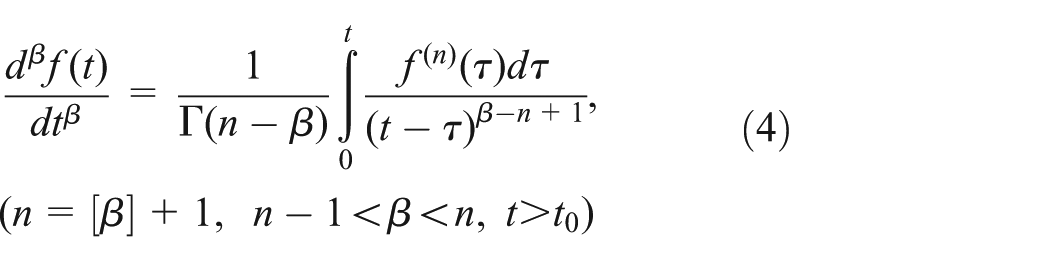
where β is the order of fractional derivative, and Γ(·) is Gamma function. When the derivative order β varies from 0 to 1, the fractional derivative can be simplified as

From the above two definitions, it can be seen that the fractal derivative is a local operator without convolution integral, which is quite different from the integral definition of the fractional derivative.
Fractal dashpot
The Newtonian fluid can be described by Newton’s law

where σ is the shear stress, ε is the shear strain, and µ is the shear viscosity. In the component system, component following this formula is called Newton dashpot. 44
In this article, we replace the normal derivative in the Newton dashpot with the above-mentioned fractal derivative, the constitutive relation of fractal dashpot can be obtained as

where η is the material parameter and α is the order of fractal dashpot.
Creep compliance and relaxation modulus
The creep compliance and relaxation modulus of Newton dashpot can be written as


where
Replacing t in (equations (8) and (9)) with tα, the creep compliance and relaxation modulus of the fractal dashpot can be obtained, which can be seen in Table 1. The main characteristics of Abel dashpot 22 are also presented in Table 1, which is a viscoelastic component based on fractional derivative.
The comparisons of Newton dashpot, Abel dashpot, and fractal dashpot.

Loading and unloading numerical experiments are conducted, as shown in Figure 1, where the stress keeps stable from time t1 = 1 to time t2 = 2 and then removing the stress. The results of creep and recovery for these three dashpots are shown in Figure 2.

The stress in the loading and unloading processes.

The creep and recovery curves of fractal dashpot, Newton dashpot, and Abel dashpot.
From Figure 2, we can see that at a small value of α, the strain of fractal dashpot changes quickly both on the loading and unloading processes, which exhibits the high elasticity of fractal dashpot. On the other hand, with the order α approaching to 1, the strain of fractal dashpot is close to that of Newton dashpot (a special case of fractal dashpot with order equals to 1), which shows the high viscosity of fractal dashpot. In addition, it can be seen that fractal dashpot and Abel dashpot are almost similar in viscoelastic property with respect to the creep and recovery processes.
The strain response under dynamic load
A dynamic load is set to further study the strain response characteristics of fractal dashpot. For simplicity, the dynamic load is set as a form of sinusoidal function

where

Similarly, the strain responses of Newton dashpot and Abel dashpot are presented as

and

For the sake of convenience, all the material parameters, amplitude, and frequency of stress are set as 1, that is,

The strain responses of fractal dashpot, Abel dashpot, and Newton dashpot under dynamic load at derivative order 0.9.

The strain responses of fractal dashpot, Abel dashpot, and Newton dashpot under dynamic load at derivative order 0.5.

The strain responses of fractal dashpot, Abel dashpot, and Newton dashpot under dynamic load at derivative order 0.1.
The CPU time for fractal dashpot and Abel dashpot (AMD A6-3420M, RAM 2.74 GB, 32 bit windows 7 and MATLAB 2010b).

The stress response of fractal dashpot under power-law strain rate
Let strain rate keep as a constant, that is,

For the sake of convenience, the material parameter and strain rate are set as 1, that is,

The stress response of fractal dashpot at constant strain rate.
The apparent viscosity 45 of non-Newtonian fluid is generally defined by the ratio of stress to strain rate. In this situation, the apparent viscosity can be written as

It is easy to find that the stress response under constant strain rate is a form of power-law function. From Figure 6, the stress is found to decrease with time when the derivative order is big than 1 and it keeps increasing when the order is less than 1. Apparent viscosity changes the same way as stress response, which means in this situation fractal dashpot is suitable to characterize the time-dependent viscosity for non-Newtonian fluid, including “rheopexy” 9 and “thixotropy” 8 phenomena.
Strain rate is set as a linear function of time

Figure 7 shows the stress response with strain rate (

The stress response of fractal dashpot with strain rate at time-linear strain rate.
From Figure 7, we can see that the stress is shown as a lower convex function when 0 < α < 1 and an upward convex function when α > 1. These variations of stress over shear rate agree with the shear thickening and shear thinning phenomena 1 for non-Newtonian fluid.
In general, the stress response of fractal dashpot under power-law strain rate (

Equation (17) can be used to characterize shear thicken phenomenon with
The stress response of fractal dashpot under dynamic strain
A dynamic strain is set to further study the stress response characteristics of fractal dashpot. Similarly, we set the strain as a sinusoidal function for simplicity

where

The stress responses of Abel dashpot and Newton dashpot are presented as

and

For the sake of convenience, all the material parameters, amplitude, and frequency of stress are set as 1, that is,

The stress responses of fractal dashpot, Abel dashpot, and Newton dashpot under dynamic strain at derivative order 0.7.

The stress responses of fractal dashpot, Abel dashpot, and Newton dashpot under dynamic strain at derivative order 0.5.
From Figures 8 and 9, it can be seen the stress amplitude of fractal dashpot increases with time, but decreases with the increased derivative order. On the other hand, the stress amplitudes of Abel dashpot and Newton dashpot show an independent relation with time and derivative orders. In addition, stress response of fractal dashpot has the same phase with Newton dashpot, which is different from that of Abel dashpot.
Fractal component models
In order to extend the use of fractal dashpot, it can be taken parallel and series combinations with spring-pot and Saint-Venant’s body. Based on the idea of the classical component system, these models can be called fractal component models.
By taking a combination of fractal dashpot in parallel with Saint-Venant’s body, the fractal Bingham model is introduced. The schematic diagram of fractal Bingham model is shown in Figure 10.

The schematic diagram of fractal Bingham model.
The constitutive relation of fractal Bingham model can be written as follows

where

Under power-law strain rate
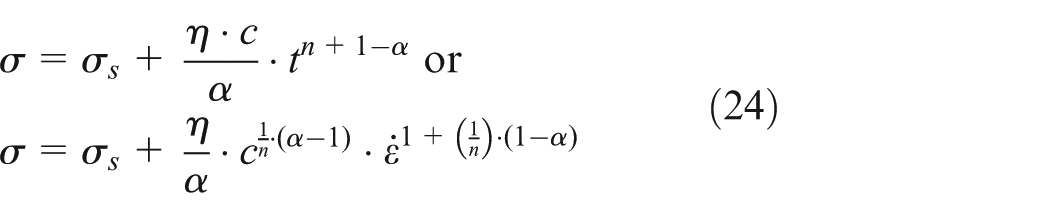
where n is a positive number as well as n ≧ 1.
Cai et al. 29 introduced fractal Maxwell model and fractal Kelvin model to characterize the creep phenomena for viscoelastic materials. The schematic diagram of fractal Maxwell model is shown in Figure 11. The constitutive relation is presented as 29

where E is the elastic modulus of spring. The creep modulus of the fractal Maxwell model is


The schematic diagram of fractal Maxwell model.
Numerical results and discussion
In this section, we apply some relevant experimental data to validating the practicability of fractal dashpot and its extended fractal component models.
Apply fractal dashpot and fractal Maxwell model into creep behaviors
Figures 12 and 13 have shown the creep experimental data of polymethyl methacrylate (PMMA) 46 and PMR-15 (one kind of polyimides) 47 as well as the simulation results of fractal dashpot. Here, a formula of relative error (Rerr) is introduced to analyze the accuracy of the proposed model

where

The creep experimental data of PMMA and the simulation results of fractal dashpot (a) as well as the relative error of strain (b).
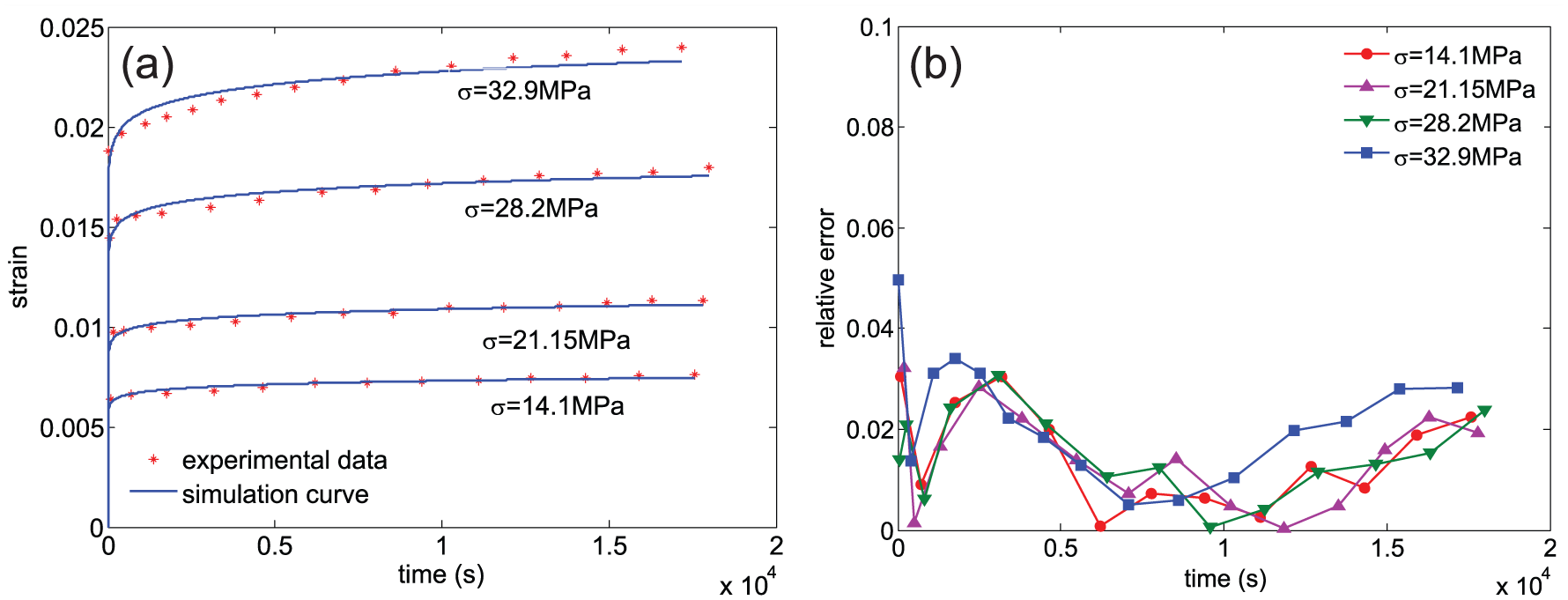
The tension creep experimental data of PMR-15 and simulation result of fractal dashpot (a) as well as the relative error of strain (b).
The parameters from fitting creep experimental data of PMMA by fractal dashpot.

PMMA: polymethyl methacrylate.
The parameters from fitting experimental data of PMR-15 by fractal dashpot.

Figure 14(a) shows the creep experimental data of polypropylene copolymer containing short glass fibers (PP-G) 48 and simulation results of fractal Maxwell model. And the best-fitting parameters are presented in Table 5. From Figure 14(b), fractal Maxwell model shows high accuracy. It can be seen from Table 5, the derivative order is bigger when the creep stress is larger except for the situation in σ = 32 MPa, which means the viscosity of PP-G is larger with increasing stress during creep. It is worth mentioning that PP-G shows an initial elastic phase during creep, which is very suitable to characterize by fractal Maxwell model.

The creep experimental data of PP-G and simulation results by fractal Maxwell model (a) as well as the relative error of strain (b).
The parameters from fitting creep experimental data by fractal Maxwell model.

Apply fractal dashpot into describing time-dependent viscosity
Figure 15(a) shows the stress response of poly-para-phenylene (PPP) 49 under different constant strain rates at 175 °C. It can be seen that stress of PPP increases with time (or strain) at specific strain rate, which reflects the increasing viscosity of PPP during the shear process, namely rheopexy. Applying fractal dashpot into fitting the experimental data, the simulation result and parameters can be found in Figure 15 and Table 6. From Figure 15(b), it can be seen that stress response of fractal dashpot has a good accuracy with experimental data.

The stress response of PPP at constant strain rate and simulation results by fractal dashpot (a) as well as relative error of stress (b).
The parameters from fitting constant-strain rate stress response by fractal dashpot.

We introduce a concept of the relative strength of rheopexy or thixotropy (r) by the ratio of change rates of apparent viscosity in two situations

If r > 1, it means that the rheopexy (or thixotropy) phenomenon in the first situation is more obvious than that in the second situation. If r < 1, we can conclude that the rheopexy (or thixotropy) in the second situation is more obvious. If r = 1, it means the rheopexy (or thixotropy) has the same strength in the two situations.
Using equation (27) to calculate the relative strength (r) of rheopexy at two situations:

r is a monotonic decreasing function of time, and r > 1 when t < 11.9971 s. It means that at the initial time, apparent viscosity increases more quickly under high strain rate. On the following time, apparent viscosity increases more quickly under low strain rate. It can be concluded that at the initial phase of the shear process, high strain rate is helpful in improving rheopexy of PPP. But with time going on, the lower strain rate makes the rheopexy stronger.
Figure 16(a) has shown the apparent viscosity experimental data 50 of waxy potato starch (WPS) at constant strain rates. Applying equation (15) to fitting these experimental data, the simulation results and obtained parameters can be found in Figure 16(a) and Table 7. The relative error of fitting curves and experimental data are also presented in Figure 16(b). The maximal relative error is less than 5 × 10⁻², which illustrates a high accuracy of fractal dashpot with experimental data. From Table 7, we can see that the derivative order is less than 1 at 50 strain rate and is larger than 1 at 300 strain rate, which means WPS exhibits a rheopexy at small strain rate while a thixotropy at large strain rate.

The viscosity experimental data of WPS at constant strain rate and simulation results by fractal dashpot (a) as well as the relative error of apparent viscosity (b).
The parameters from fitting viscosity experimental data by fractal dashpot.

Apply fractal Bingham model to simulating shear test of muddy clay
Yin et al.
51
conducted the pulling sphere test of muddy clay at different shear rate functions:

The stress-time experimental data at
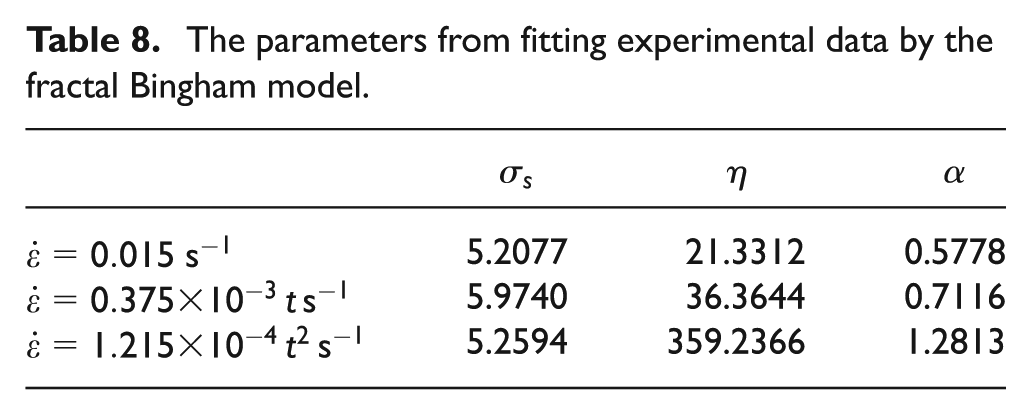
As shown in Figure 17(a), stress response at constant strain rate has yield stress and exhibits time-dependent viscosity. From Figure 17(b) and (c), it can be seen that the muddy clay behaves as shear thickening fluid with time-linear strain rate and a shear thinning property can be shown when the strain rate accelerates. This conclusion can also be deduced from the fitting parameters in Table 8, where the derivative order is less than 1 at linear strain rate and bigger than 1 at accelerating strain rate. It comfirms again that the fractal dashpot can describe shear thickening property with 0 < α < 1 and shear thinning phenomenon with 1 < α < 2. It is necessary to mention that compared with the fractional Bingham model, the fractal Bingham model has the same behavior in characterizing the shear-dependent viscosity for non-Newtonian fluid.
The parameters from fitting experimental data by the fractal Bingham model.
Conclusion
As a new viscoelastic component, the fractal dashpot was proposed in this article using the fractal derivative modeling approach. The creep compliance and relaxation modulus of the fractal dashpot were derived. Through a series of loading experiments, the fractal dashpot demonstrated similar viscoelastic characteristics to the Abel dashpot when the derivative order varies from 0 to 1, while the fractal dashpot has a clear advantage of computational efficiency over the Abel dashpot. The Newton dashpot was a special case of the fractal dashpot with derivative order equivalent to 1.
On the other hand, the fractal dashpot was found suitable to characterize the time- and shear-dependent viscosity of non-Newtonian fluid under constant and power-law strain rates. As an extension of the fractal dashpot, a fractal Bingham model was also introduced.
The proposed fractal models were validated with high accuracy compared with rheological experimental data of non-Newtonian fluid. The fitted derivative orders increased with the increasing stress during creep. This indicates that higher viscosities are achieved under the larger stress for these materials.
According to the derived relative strength of rheopexy of PPP material, high strain rate is helpful to improve the strength of rheopexy at the initial phase. With the evolution of time, low strain rate, however, is observed to enhance rheopexy. In addition, the muddy clay in this article exhibited an obvious plasticity and an increased viscosity over time at constant strain rate. It also behaved as shear thickening fluid at time-linear strain rate and shear thinning fluid at time-accelerated strain rate.
Footnotes
Academic Editor: Praveen Agarwal
Declaration of conflicting interests
The author(s) declared no potential conflicts of interest with respect to the research, authorship, and/or publication of this article.
Funding
The author(s) disclosed receipt of the following financial support for the research, authorship, and/or publication of this article: This work was supported by the National Natural Science Foundation Project of China (grant nos 11372097, 11402076, 11572111), the Natural Science Foundation Project for Jiangsu Province (grant no. BK20130841) and the 111 project under grant B12032.