



Abstract
A two-stage third-order numerical scheme is proposed for solving ordinary differential equations. The scheme is explicit and implicit type in two stages. First, the stability region of the scheme is found when it is applied to the linear equation. Further, the stability conditions of the scheme are found using a linearized homogenous set of differential equations. This set of equations is obtained by applying transformations on the governing equations of heat and mass transfer of incompressible, laminar, steady, two-dimensional, and non-Newtonian power-law fluid flows over a stretching sheet with effects of thermal radiations and chemical reaction. The proposed scheme with an iterative method is employed in two different forms called linearized and non-linearized. But it is found that the non-linearized approach performs better than the linearized one when residuals are compared through plots. Additionally, the proposed scheme is compared to the second-order central finite difference method for second-order non-linear differential equations and the Keller-Box/trapezoidal method for a linear differential equation. It is determined that the proposed scheme is more effective and computationally less expensive than the standard/classical finite difference methods. Moreover, the impact of magnetic parameter, radiation parameter, modified Prandtl and Schmidt numbers for power-law fluid, and chemical reaction rate parameter on velocity, temperature, and concentration profiles are displayed through graphs and discussed. The power-law fluid’s heat and mass transfer simulations are also carried out with varying flow behavior index, sheet velocity, and mass diffusivity. We hoped that this effort would serve as a guide for investigators tasked with resolving unresolved issues in the field of enclosures used in industry and engineering.
Introduction
Numerical methods are considered for solving especially those problems that cannot be solved exactly. The basic type of numerical methods can be classified into two categories. One category is based on using consecutive grid points for ordinary differential equations and consecutive time levels for partial differential equations for time discretizations. These methods can be constructed by using interpolation of polynomials in either an explicit or implicit manner, which are called multistep methods. The other category of numerical methods is based on the use of different stages. The family of Runge-Kutta methods falls into this category. These methods can either be constructed using Butcher’s tableau or the Taylor series are given in this work. In literature, some Runge-Kutta methods have been found which can be used to solve stiff equations. In Kennedy and Carpenter, 1 implicit-explicit fourth and fifth-order Runge-Kutta methods have been given, which used explicit, single diagonally implicit methods, and embedded method was used to control error. Both methods were tested for Van der Pol and Kaps’ problems, and the improvement over existing methods was shown. It was mentioned in Bouhamidi and Jbilou 2 that implicit Runge-Kutta methods are popular for solving stiff ordinary differential equations. Still, their main drawback is the computation cost for integrating non-linear systems in each stage. In Bouhamidi and Jbilou, 2 the effort was made to reduce the computation cost by transforming the linear system into Stein matrix equations, and this linear system arises in Newton’s method. In Cavaglieri and Bewley, 3 it was pointed out that implicit/explicit Runge-Kutta schemes were effective for time marching ordinary differential equations having non-stiff and stiff parts. These problems were discretized using implicit Runge-Kutta for the stiff part, which is often linear, and the use of the explicit RK method for the non-stiff part is often non-linear.
In Cavaglieri and Bewley, 3 eight implicit/explicit low storage Runge-Kutta schemes were developed and characterized with better stability than the existing only low-storage implicit/explicit Runge-Kutta scheme. Based on the work of Kennedy and Carpenter, 1 several general-purpose, optimal diagonally implicit Runge-Kutta methods have been presented. All methods were L-stable and stiffly accurate. If there could be the possibility, then many were internally L-stable on stages. An embedded method was also included for the facilitation of step size control. In Kennedy and Carpenter, 4 five new single diagonally implicit RK methods were presented in an explicit first stage. It was claimed that the presented sixth-order stage order two L stable 6(5) pair explicit first stage, single diagonally implicit RK method was the first of its kind. An approach was given in Kutniv et al. 5 to construct high-order step numerical methods for solving initial value problems on a finite domain. A transformation was given that reduced the problem on semi-infinite interval and then used the finite irregular grid on a semi-infinite interval. Runge-Kutta methods and Taylor series were developed. Special two-derivative Runge-Kutta type methods have been introduced in Lee et al. 6 for finding the solution of third-order ordinary differential equations, which involved the fourth derivative of the solution. B series theory and rooted tree theory were proposed for deriving order conditions for the special two derivative RK methods. For the effectiveness and accuracy of proposed methods, various test problems were given, and also comparison was made to existing methods. In Rainwater and Tokman, 7 exponential propagation iterative Runge-Kutta methods were extended to construct split exponential propagation RK integrators for the system of ODEs. It was demonstrated that the derivation of order conditions for the proposed integrators was followed from the bicolor trees-based B series. It was shown in Rainwater and Tokman 7 that the specific scheme could be custom-built to improve the computational efficiency of the problem. For more numerical methods, readers can see Chen et al. 8 , Figueroa et al., 9 Murua, 10 Qin and Zhu, 11 Simos, 12 You and Chen, 13 and references therein.
On the other hand, the literature has extensively discussed flows over a stretching sheet with different kinds of fluid. Not only Newtonian, some non-Newtonian, laminar incompressible fluid flows with heat transfer effects have also been explored in the existing literature. In most cases, the governing equations of the heat and mass transfer in fluid flow have been expressed mathematically in partial differential equations and then further reduced into ordinary differential equations. Some shooting methods, homotopy analysis methods, and Matlab solvers have been utilized to solve the boundary value problems. The effect of magnetic field on forced convective power-law fluid has been investigated in Ahmed and Iqbal. 14 This flow was studied in the annular sector duct. The control volume approach solved the reduced equations, and successive over-relaxation or strongly implicit procedures were adopted to solve resulting algebraic equations. The choice of the method was based on the flow behavior index. Laminar, electrically conducting, incompressible non-Newtonian power-law fluid has been studied in Shamshuddin et al. 15 over an exponentially stretching sheet, and power-law slip velocity was also considered. The spectral quasi-linearization method was adopted to solve the obtained set of non-linear ordinary differential equations. It was found from the plot of obtained results that temperature de-escalated by enhancing Hall current. In Prasad et al., 16 viscous, incompressible steady state, electrically conducting MHD power-law fluid flow passing through vertically stretching sheet was considered. The transformed set of boundary value problems were solved numerically using the Keller-Box method. The velocity and temperature profile behavior was discussed for parameters involved in the transformed set of non-linear ordinary differential equations. The MHD electrically conducting mixed convective fluid flow past a stretching surface has been studied 17 with heat absorption/generation effects. The set of ordinary differential equations has been tackled by the implicit finite-difference method for coupled non-similar flow. The solution depended on the magnetic parameter, power-law fluid index, modified Richardson number, the generalized Prandtl number, and heat generation and radiation parameters. The analysis of power-law fluid flow over radially stretching sheets has been analyzed 18 with heat transfer effects. The governing unsteady boundary layer equations in partial differential equations have been converted into non-linear ordinary differential equations using new similarity transformations. The system of equations was solved by the homotopy analysis method and shooting method. It was found that the thickness of the boundary layer for velocity and temperature was a decaying function of the unsteadiness parameter. More about power-law fluid, readers can see Abd El-Aziz and Saleem 19 , Prasad et al. 20 , Srinivasacharya and Swamy Reddy 21 , and references therein.
This work aims to present a two-stage numerical scheme for solving ordinary differential equations. The first stage of the scheme is explicit. In contrast, the second stage is implicit, and the scheme’s accuracy is achieved by comparing coefficients in Taylor series expansions. First, the scheme’s stability region is found when applied to the linear differential equation. Later on, the scheme is applied to non-linear boundary value problems obtained using transformations on the governing equations of heat and mass transfer of power-law fluid flow over the sheet. Finally, since equations are non-linear and are linearized by finding the Jacobian of the system and then using the Gauss-Seidel iterative procedure, the whole set of equations are solved and compared with the non-linear approach and existing standard finite difference methods.
For the construction of the numerical scheme, consider the following equation having the form

The first stage of the scheme is expressed as

Where

Stage (3) contains three unknown parameters


Substituting equation (2) into equation (3) results

Substituting equations (4) and (5) into (6) gives

Comparing coefficients of


Equations (8)–(10) are linear, containing three parameters

Thus, the second stage of the proposed scheme can be expressed as

This stage (12) of the proposed scheme is implicit, and since the terms of the Taylor series up to third order are compared, the resulting scheme is third-order accurate. Finally, the application of the scheme is given for two examples.
Example 1: Heat and mass transfer of power-law fluid flow
Consider a steady two-dimensional incompressible non-Newtonian power-law laminar fluid flow over the plate. Let the plate be placed in




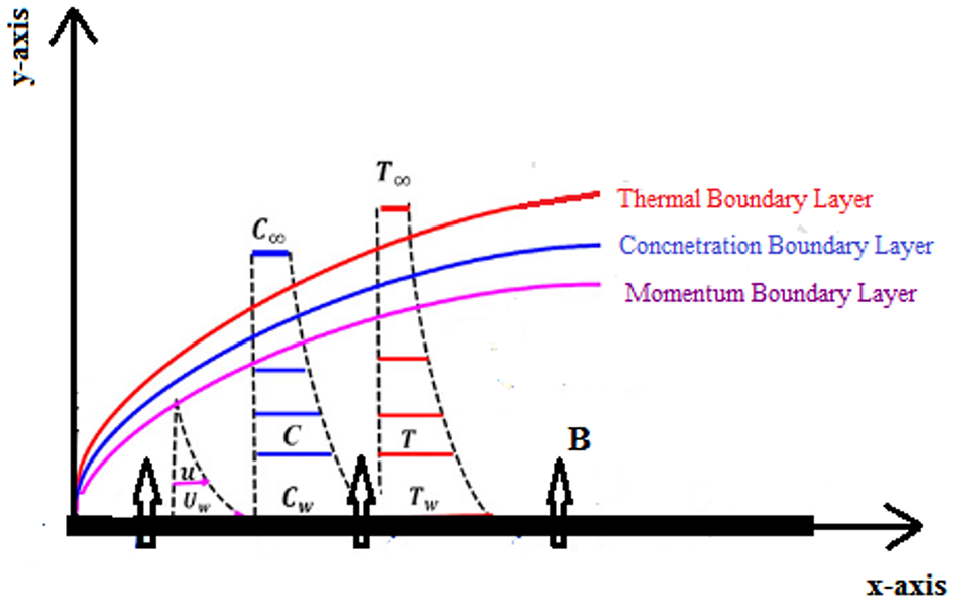
Geometry of the problem.
Subject to the boundary conditions

In literature, the linearized Roseland flux can be expressed as

Following transformations are considered that can be used to reduce the set of partial differential (13)–(17) into a set of ordinary differential equations

Substituting transformations (19) into equations (13)–(17) gives the set of ordinary differential equations given as



Subject to the boundary conditions

Where

where
The quantities of physical interest local Nusselt and Sherwood numbers are defined as

where

The non-dimensional forms of local Nusselt and Sherwood numbers are given as


Numerical solution
To solve equations (20)–(23), a proposed scheme of order three is employed. For this reason, the system of second and third-order ODEs are reduced into a system of first-order ODEs in the following manner.
Let

and

It implies

Also let


Let


Subject to the given and assumed initial conditions

Where
Since equations (28), (30), and (32) are non-linear ODEs and these are linearized by finding the Jacobian evaluated at the previous grid point. The system of equations (26)–(32) can be expressed as


and the Jacobian is expressed as

Where
Applying the first stage of the proposed scheme on (34) yields

and the second stage of the scheme is expressed as

For

where

and equation (38) can be expressed as

Stability analysis
The stability analysis of linear differential equations for the scalar case can be found in Appendix. In this section, the stability of the homogeneous equation (34) is given. The homogeneous equation is expressed as

Applying the first stage of the proposed scheme using the Gauss-Seidel iterative method yields equation (39) with

Where

Substituting transformations (41) into equation (38) with

Where
Substituting equation (42) into equation (43) and dividing both sides of the resulting equation by

And the amplification factor is expressed as

The stability condition can be expressed as

This implies

Using different step sizes by fixing
Results and discussions
The proposed numerical scheme has been applied to the linear ordinary differential equation given in the first example. Also, it is applied for solving the problem of heat and mass transfer of boundary layer flow. The proposed numerical scheme for the non-linear problem has been applied in two different directions. In one direction, the system of non-linear differential equations is linearized by finding the Jacobian of the whole system of first-order differential equations. The Jacobian is evaluated at the previous grid point. Then, the Gauss-Seidel iterative method is employed to solve the difference equation obtained by applying the proposed scheme. Because the proposed strategy applies to first-order differential equations, the shooting method is considered. Therefore, the scheme is based on three different approaches. The proposed scheme performs the discretization, then the Gauss-Seidel iterative method is considered, and for finding missing initial conditions, a shooting approach is considered. This whole approach requires two sets of initial guesses to get the solution of the required differential equations.
The second approach is non-linearized instead of linearized. In this non-linearized approach, required differential equations are discretized using the proposed scheme, and a modified iterative method is employed to solve the resulting non-linear difference equations. This approach is more accurate than the linearized one, which will be demonstrated in the residuals plots. Both discretizations and iterative methods converged to the accurate solution for the case of Newtonian fluid with

Comparison of proposed scheme using iterative procedures for the linearized and non-linearized system using

Comparison of proposed scheme using iterative procedures for the linearized and non-linearized system over independent variable
In this procedure, one extra numerical derivative is found, and the final residual is computed. The maximum number of iterations consumed by linearized and non-linearized approaches is the same. Figure 3 shows the residuals plots over the independent variable


Comparison of proposed and existing numerical methods over iterations using
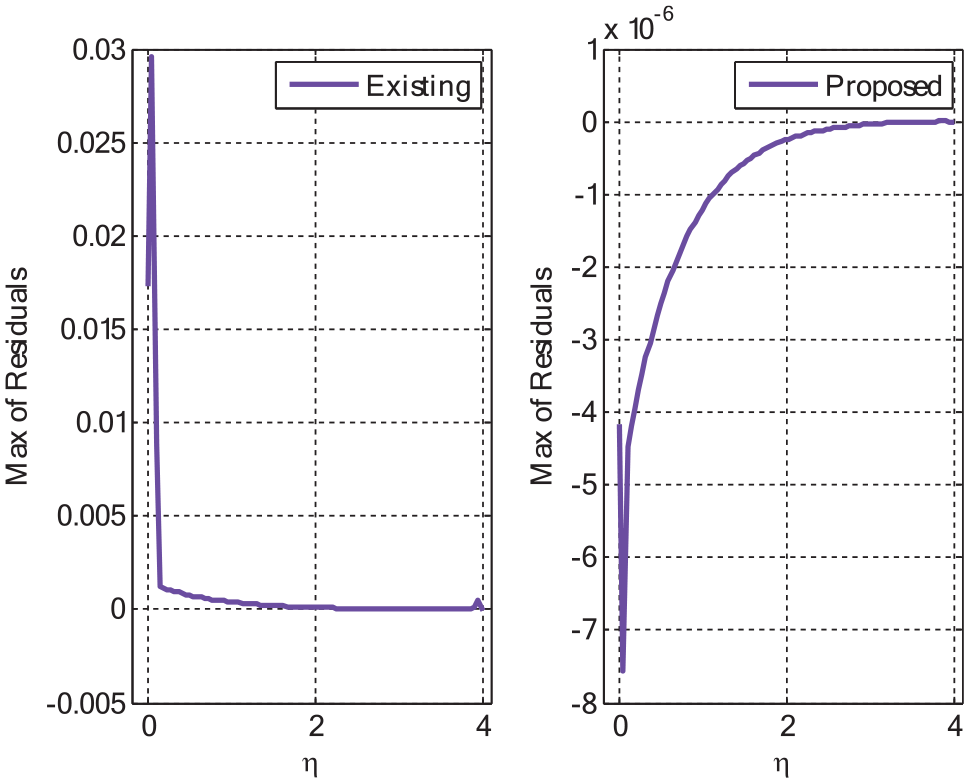
Comparison of proposed and existing numerical methods over independent variable
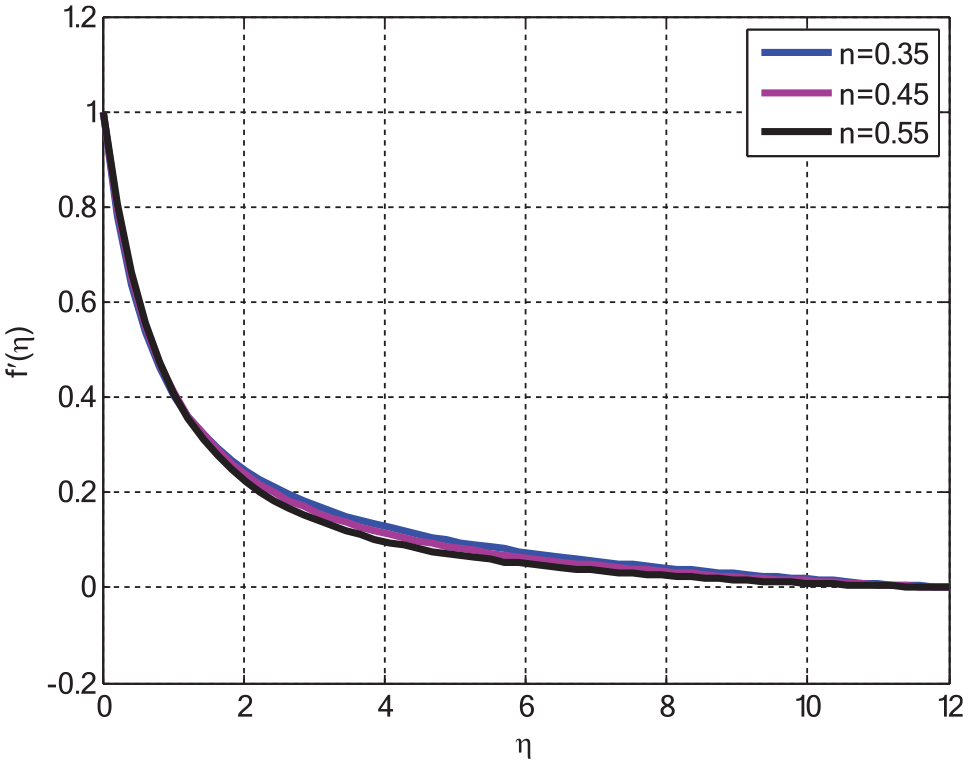
Velocity profile with the variation of

Temperature profile with the variation of

Concentration profile with the variation of

Velocity profile with the variation of magnetic parameter

Temperature profile with the variation of radiation parameter

Temperature profile with the variation of modified Prandtl number

Concentration profile with the variation of modified Schmidt number

Concentration profile with the variation of reaction rate parameter
Where
Table 1 shows numerical values for local Nusselt and local Sherwood numbers with different contained parameter values variations. For solving the considered model of non-Newtonian power-law fluid, the Matlab code found complex values with small imaginary parts. But code uses real parts of complex entries and ignored the imaginary parts. These complex values are found for the non-Newtonian case when
List of numerical values for local Nusselt and local Sherwood numbers.

The Matlab code ignored imaginary values.
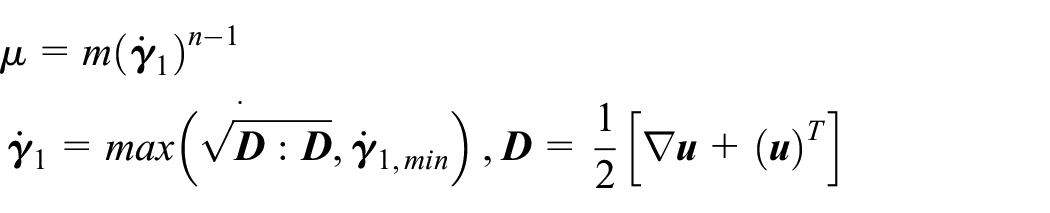
Figures 14 to 18 are drawn using software used for solving partial differential equations, and it uses the finite element method to solve the required equations. This software is used for solving a model of heat and mass transfer of power-law fluid with effects of reaction in concentration. The variable viscosity for power-law fluid is used as

(a) Velocity surface,

(a) Velocity surface,

(a) Velocity surface,

(a) Velocity surface,

Concentration surfaces using
The impact of flow behavior index
Conclusion
A numerical scheme has been given that can be used to solve first-order linear and non-linear ordinary differential equations. The scheme is third-order accurate, and by finding the stability function, a stability region is plotted using software Mathematica. The mathematical model in the form of partial differential equations for heat and mass transfer of chemically reactive MHD non-Newtonian power-law fluid flow over a stretching sheet with effects of radiations has been presented. Later on, these partial differential equations were converted into a set of non-linear ordinary differential equations using transformations. The non-linear system of equations was linearized by determining the Jacobian. The numerical approach was used to solve both linearized and non-linearized equations using a combination of iterative methods. The comparison showed that the presented numerical scheme was more effective and computationally less expensive than the standard/classical second-order central difference method. The presented numerical scheme can be applied further to solve different ordinary differential equations in science and engineering. Following the completion of this work, it is possible to propose additional applications for the current methodology.24–28 Additionally, the developed method is simple to implement and may be utilized to solve a broader class of differential equations encountered in practice and theory.
Footnotes
Appendix
Subject to the initial condition
The exact solution of equation (A1) is
The second stage of the proposed scheme is expressed as
Acknowledgements
The authors are thankful to the anonymous referee for their suggestions and helpful comments that improved this article. We are also grateful to Vice-Chancellor, Air University, Islamabad, for providing an excellent research environment and facilities. The second author also thanks Prince Sultan University for funding this research work
Handling Editor: Chenhui Liang
Author contributions
All the authors contributed equally to this research work.
Declaration of conflicting interests
The author(s) declared no potential conflicts of interest with respect to the research, authorship, and/or publication of this article.
Funding
The author(s) disclosed receipt of the following financial support for the research, authorship, and/or publication of this article: This research was funded by Prince Sultan University, grant number RG-DES-2017-01-17.

Code availability
A computational code for the proposed discrete model scheme may be made available to readers upon request for convenience.
Data availability statement
The manuscript included all required data and information for its implementation.