




Abstract
This study focuses on the application of ternary hybrid nanofluids (manganese zinc ferrite, copper, and silver) over a spinning disk, which has significant implications for thermal management, biomedical devices, aerospace, and industrial cooling systems. Due to the antibacterial and antifungicidal properties of silver (Ag) nanoparticles, this research also has potential applications in the food industry for sterilization and preservation. Motivated by these developments, this study investigates the Steady two-dimensional Ternary Hybrid Nanofluid Flow (STDTHNFF) problem, incorporating a nonlinear heat source-sink and Fourier heat flux model (HSFHFM) over a spinning disk. A key novelty of this work is the inclusion of a new heat source term, enhancing the thermal analysis by capturing additional energy variations. The study extensively analyzes the effects of heat sources, thermal radiation, the thermal relaxation parameter, and magnetohydrodynamic (MHD) effects, providing a more comprehensive understanding of fluid flow and heat transfer mechanisms in rotating systems. The governing coupled nonlinear partial differential equations (NLPDEs) are transformed into a dimensionless form using relevant similarity transformations. The Recurrent Neural Network-Levenberg-Marquardt Method (RNN-LMM) is employed for backpropagation, providing an efficient and accurate computational approach for solving the problem. A numerical stochastic approach is applied to evaluate training (TR), mean square errors (MSE), performance (PF), and data fitting (FT). Validation is conducted using error histograms (EH) and regression (RG) tests, ensuring high accuracy ranging from E-2 to E-7. The results demonstrate that the RNN-LMM approach effectively predicts flow characteristics with high accuracy. Graphs and numerical data reveal the influence of heat sources, thermal radiation, MHD effects, and thermal relaxation on flow behavior. The findings confirm that ternary hybrid nanofluids (THNF) enhance heat transfer rates, making them promising for industrial and engineering applications. The study highlights that heat sources significantly impact temperature distribution and heat transfer. The results of the RNN-LMM approach were compared with previous literature and found to closely align with published studies. Furthermore, these findings play a crucial role in improving thermal management systems and processes for advanced engineering and industrial applications.
Introduction
Fluids have a significant role in enhancing the rate of heat transfer in many engineering systems, including heat exchangers and fuel cells. To address this problem, we require specific fluids with high thermal conductivity because ordinary fluids have poor heat conductivity. Choi and Eastman introduced the word ‘nanofluid’ for the first time. 1 The primary characteristic of nanofluids is their increased heat conductivity compared to ordinary fluids, mostly because of the presence of metallic particles in the fluid that are on the nanometer scale. Whether using regular or nanofluid fluids, a considerable amount of study has been conducted on the subjects of fluid flow and heat transfer.2–7 Hybrid nanofluid (HNF) are suspensions of the two types of nanoparticles in a base liquid. Heat exchangers, auto cooling systems, cancer treatment, vehicle power generation, nano-drag delivery, chemical processes, machine tool coolants, nuclear power plants, car radiators, heat capacitors, microelectronics, heat pumps, and more are among the engineering and industrial applications of HNF. Owing to the numerous technological and industrial processes in which HNF are being applied, researchers and scientists are paying close attention to the flow issues related to HNF. The consequences of entropy generation were investigated by Shamshuddin et al. 8 using a HNF flow over a spinning surface. The Marangoni flow of an assorted nanofluid over a disk in response to thermal electromagnetic radiation was the subject of Abbas et al. 9 investigation. Abas et al. 10 investigated the flow of a second-order slip micropolar MHD HNF over a stretching surface, incorporating a uniform heat source and activation energy. They found that incorporating slip boundary conditions notably effects flow dynamics, leading to a decrease in skin friction by 4.9% and 10.4% as magnetic and material parameters increase, respectively, while a higher slip factor results in an 18.88% rise in skin friction. The electromagnetic flow of HNF over two disks was studied by Farooq et al. 11 They discovered that an increase in the magnetic parameter leads to a reduction in velocity components. Agrawal and Kaswan 12 investigated the influence of entropy generation on the flow of HNF over disks. They observed that HNF exhibit a notable improvement in heat transfer rates compared to standard nanofluids. Abas et al. 13 analyzed the passive control of MHD flow in a blood-based Casson HNF over a bidirectionally stretching surface with convective heating. Ragavi et al. 14 examined the MHD flow of a HNF with the Cattaneo–Christov heat flux model (CCHFM), emphasizing thermal performance and entropy analysis. They discovered that nanoparticle shape has a significant impact on the heat transfer and fluid flow characteristics of nanofluids. Wahid et al. 15 analyzed the radiative flow of a HNF over a moving convective surface with permeability and heat generation, employing a numerical and statistical approach. They discovered that gaining deeper insights into the thermal behavior of HNF under dynamic conditions offers valuable guidance for improving heat transfer in industrial settings. Several recent studies on HNF have been conducted by Mishra et al.,16,17 Rekha et al., 18 and Srivastava and Johari. 19
Ternary hybrid nano liquids consist of three different nanoparticle suspensions in the base liquid. Numerous experimental investigations have revealed that, when compared to regular fluids and nanoliquids, the ternary hybrid nanoliquid shows a greater rate of heat transmission. Consequently, THNF models became the focus of a lot of investigation. Ullah et al.
20
analyzed the influence of thermal radiation on THNF flow in the presence of activation energy through a numerical computational approach. They observed a 5% enhancement in skin friction as a result of increased magnetic and stretching parameter values at the lower disk. Additionally, ternary nanoparticles exhibited a 28% higher heat transfer rate compared to hybrid and single nanofluids. Li et al.
21
performed a computational analysis on the effective thermal transport of THNF flow over a stretching sheet, incorporating the CCHFM. They found that the CCHFM effectively enhances the thermal transport characteristics of THNF flow over a stretching sheet. Ullah et al.
22
numerically analyzed the heat and mass transfer characteristics of a three-dimensional (3D) thermally radiated bi-directional slip flow over a porous stretching surface. They discovered that greater magnetic factor values reduced the skin friction coefficient under both slip and no-slide scenarios. Hafeez et al.
23
have studied the THNF flow comprising titanium oxide, silicon dioxide, and aluminum oxide nanoparticles moving on a spinning disk. They found that the fluid elements’ rapidity decreases when a magnetic field is added. Ramzan et al.
24
looked at the consequences of several non-isothermal and non-isosolutal arrangements as well as THNF flows.
Artificial Intelligence (AI) and associated algorithms have been studied over the last few years in most industries, including scientific, engineering, financial, healthcare informatics, and social sciences. These technologies are used in fluid dynamics research; the AI network is tuned to reduce error by changing the bias and weight values during training. The more samples available, the better the network performs. There are three foremost learning paradigms in AI, Reinforcement learning, supervised learning, and unsupervised learning. The input vector and the target vector make up the training data for supervised learning. Throughout the learning process, the differences between the predicted and actual target vectors are compared. The network is adjusted based on the variance until the actual vector and the predicted vector coincide. In unsupervised learning, only the training data including the input vector is utilized. During training, the network uses the input patterns to learn new things and forms clusters. Over the past few years, the majority of scientists have been working on artificial neural networks (ANN) and RNN in various domains of mathematics. In the study of ANN applications for heat and entropy generation in a non-Newtonian fluid flowing between two spinning disks, Zhao et al. 43 have been involved. Ullah et al. 44 have investigated an ANN-based numerical approach to analyze the effects of Soret and Dufour phenomena on the MHD squeezing flow of Jeffrey fluid in a horizontally confined tunnel under thermal radiation. The smart computing of ANN-LMM for numerical handling of squeezing nanofluid flow between two plates is studied by Ullah et al. 45 Shoaib et al. 46 investigated the heat transfer behavior of Maxwell nanofluid flow across a vertical moving surface with MHD, employing a stochastic numerical technique based on ANN. Ullah et al. 47 investigated the numerical treatment of squeezing MHD Jeffrey fluid flow with Cattaneo-Christov heat flux (CCHF) in a rotating frame using the ANN-LMM. Akbar et al. 48 investigated MHD fluid flow in a thermally stratified medium confined between coaxial stretching rotating disks using ANN. A few recent studies have focused on models for nonlinear problems.49–51 We explain the AI process through the RNN-LMM framework to apply nonlinear backpropagation to the system of nonlinear ordinary differential equations (equations (13)–(16)). The technological aspects of the optimized computing policy are illustrated as follows:
Since they loop backward in time, RNN are a type of neural network that excels at handling large datasets.
The RNN uses the number of initial functional units for each time step. The internal state that each of these component pieces possesses is known as the hidden state.
This state information is updated at each time step to reflect the most recent understanding. The concealed state is a representation of the historical data that the unit processed previously and preserved at that particular time step.
To analyze the problem, a two-layer unique feedforward RNN is built and backpropagated using the LMM (equations (13)–(16)).
When implementing RNN for the estimated model, the MSE base distinction function is engaged into account (equations (13)–(16)).
To maximize the distinction functions at each epoch, the RNN with LMM apply backpropagation efficacy to make their option variable aware.
This study aims to utilize a nonlinear HSFHFM to investigate the STDTHNFF over a spinning disk. It examines the thermophysical properties of kerosene oil as a base fluid with ternary nanomaterials (Ag,
Governing equation
A steady two-dimensional flow of a THNF, composed of nanomaterials (




Geometry of present investigation.
In component form [31, 52], we have:



In the above equations,
Heat flux (q r ) is:

Where

The BCs are as follows 31 :

The suitable variables are:

The following are the dimensionless results obtained by applying similarity transformation to govern partial differential equations:


With:

The governing flow parameters are:

The essential engineering parameters are as follows:
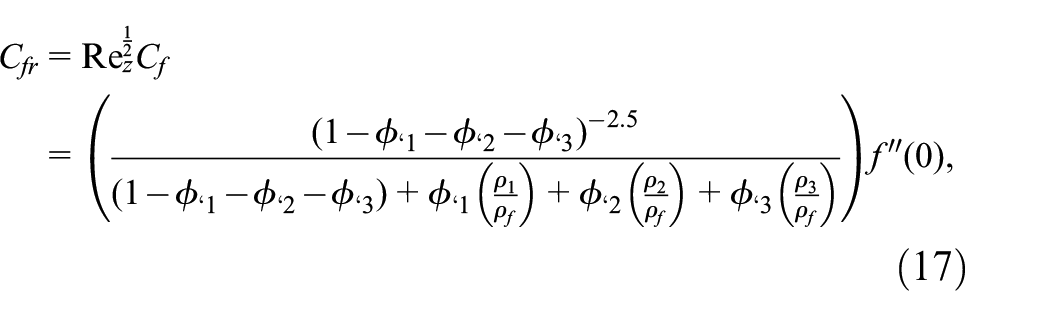


Where C
fr
is the dimensionless radial skin friction, C
gr
is the dimensionless tangential skin friction, and Nu
r
is the reduced Nusselt number, and
Numerical method
Recurrent neural networks (RNN)
A prime instance of a neural network that can readily manage big datasets is the RNN, which loops backward through each unit’s historical data. The RNN makes use of the number of start function components for the respective time step. The hidden state is an internal state that exists in every one of these components. The information from the past that the unit processed previously and stored at that particular time step is represented by the hidden state. To reflect the most recent knowledge, this state information is updated frequently at every time step. In RNN, the hidden state is updated by using the recurrence relation. One time step of input is supplied at a time ‘t’. The network’s inputs and the value of the previous state are then used to calculate the current state. The computed current state, denoted as h t will now be used as the prior state value at time t−1 for the subsequent time step. Thus, the recent state ‘h t ’ at time ‘t’ updates the preceding state ‘ht−1’ at the time period ‘t−1’. The output is computed for all the time steps. The ultimate current state is computed when each time step is finished. The final current state is used to calculate the recurrent network’s ultimate output. The difference between the calculated and actual outputs is then used to calculate the error value. Next, the weights are updated and this error is backpropagated through the network.
Network architecture
Multi-layer neural networks have been employed in network infrastructure for learning purposes since they may be used to learn nonlinear as well as various decision-making problems. The most common type of multilayer neural network training method is error back-propagation. As shown in Figure 2, the input, hidden, and output layers make up the neural network’s structure. At the input layer, neural network inputs are collected. One neuron is taken into consideration for each input data set, and the number of neurons is chosen based on the number of input parameters. It is simpler to train a neural network and use prior knowledge for new inputs because of its hidden component. The output layer, which establishes the network’s output values, is a neural network’s third component. The feed-forward network infrastructure is taken into account at the hidden layer, and the network’s transfer function is the sigmoid function. The architecture of the RNN-LMM based on 15 neurons with a sigmoid activation function is exposed in Figure 2. The orientation information set of RNN-LMM for problems is generated using 100 input grids within the intervals [0, 1].

Architecture RNN-LMM.
Learning process
Figure 3 presents the step-by-step workflow of the intended technique. The output of the RNN-LMM is generated using the Matlab toolbox for a two-layer feedforward network with back-propagation, as shown in Figure 4.

Overall functional flow chart.

Output of STDTHNFF with non-linear HSFHFM over a spinning disk using RNN-LMM.
Results and discussion
Performance graphs
The outcome of RNN-LMM for Case 1 of all scenarios in relation to PF and states is presented in Figure 5(a) to (h) and Figure 5, respectively, while EH and time series response are shown in Figure 6(a) to (h) and Figure 6, respectively. The RG analysis is provided in Figure 7 for all scenarios of Case 1 for STDTHNFF with non-linear HSFHFM over a spinning disk. Input error cross-correlation and error auto-correlation of ANN-LMM for Case 1 of all scenarios of STDTHNFF with non-linear HSFHFM over a spinning disk are presented in Figure 8(a) to (h) and 8, respectively. In Figure 5(a) to (h), For Case 1 under all limitations, the convergence of the MSE for training procedure is shown for STDTHNFF with non-linear HSFHFM over a spinning disk. The best network performance is achieved at 4.0989 E-12 at epoch 387, 5.1767 E-12 at epoch 1000, 9.703E-14 at epoch 215, 6.7139E-22 at epoch 74, 2.2798E-20 at epoch 68, 1.7652 E-6 at the epoch 1000, 4.800 E-18 at epoch 13, and 5.5773 E-12 at epoch 730. The gradient and step size Mu of back-propagation are approximately [9.9819E-8, 4.3531E-6, 9.4418E-8, 2.5054 E-9, 3.0756E-9, 0.013807, 8.5549E-8, and 9.964 E-8] and [E-8, E-7, E-8, E-10, E-10, 0.001, E-11, and E-8] respectively, as shown in Figure 5(a1) to (h1). The results display the accuracy and convergence of the PF of RNN-LMM for each case.

(a,a1 to h,h1): Predicted RNN-LMM, PF results of MSE and State transition dynamics for Case 1 of all STDTHNFF scenarios with non-linear HSFHFM over a rotating disk.

(a,a1 to h,h1): EH and approximate solution with error analysis of time series response of RNN-LMM for Case 1 across all scenario of STDTHNFF with non-linear HSFHFM over a spinning disk.

(a-h): RNN-LMM regression representation for Case 1 across all STDTHNFF scenarios involving non-linear HSFHFM across a rotating disk.

(a,a1 to h,h1): Input error cross correlation and error auto-correlation of RNN-LMM for Case 1 of all scenario of STDTHNFF with non-linear HSFHFM over a spinning disk.
Error graphs
Figure 6(a) to (h), Figure 8 show the error visualizations and Figure 6(a1) to (h1) show time series response error. Graphs from 6(a) to (h), display the error histogram plot while Figure 6(a1) to (h1) shows the error analysis plots. Consequently, the error value and error frequency are plotted on the vertical and horizontal axes, respectively. Using the prediction of the network based on the input data, output data, and TR method, the weights are adjusted to obtain the intended results. A negative deviation will appear on the EH graph when the output value is larger than the desired value. If the bars are longer in the neighborhood of the zero-error stripe, the network is likely well-trained. The RNN-LMM generated outcomes are compared with reference numerical results for Case 1 under all conditions, and the respective results are given beside the error dynamics for input between 0 and 1 with a step size of 0.01. The highest error attain for TR are less than 59 × E-5, 35 × E-5, 59 × E-6, 59 × E-10, 60 × E-10, 25 × E-3, 18 × E-9, and 52 × E-5 for case 1 of all scenarios. The error details are further calculated with EH for each input parameter, and outcomes are given in Figure 6(a) to (h), for Case 1 of all scenarios, respectively, of flow problem. The error distribution with orientation zero line has error around −3.5 × E-7, −3.8 × E-7, 3.82 × E-8, −2.1 × E-12, 3.63 × E-13, 1.71 × E-5, −1.9 × E-11, and −3.3 × E-7 for all scenarios of flow problem. Figure 8(a) to (h) and (a1) to (h1), show error input-correlations and error auto-correlation, respectively. In the Figure 8(a) to (h) show the input-correlation error between the input one and error one. The error is 1.2 × E-7, 1.3 × E-7, 0.6 × E-8, 8 × E-12, 6 × E-11, 0.8 × E-4, 10 × E-11, and 1 × E-7, respectively. In the subfigures 8(a1) to (h1) shows the correlation one. The error is analyzed is 23 × E-21, 5.1 × E-12, 1.8 × E-6, 7 × E-22, 24 × E-21, 1.8 × E-6, 5 × E-18, and 6 × E-12, respectively.
Regression graphs
Figure 7 represents the regression display. The independent and predicted values are represented, respectively, by the regression displays’ horizontal and vertical axes. All the circles represent the data on the line, and the lines are at 45-degree angle. Therefore, the data is correct. The y-intercept, slope, and regression values are central components. The exploration throughout RG is also studies using Correlation (R) training. The R-value is frequently close to 1, which acknowledges the RNN-LMM implementation for the model problem.
Velocity and temperature profiles
This section analyzes the behavior of the velocity components
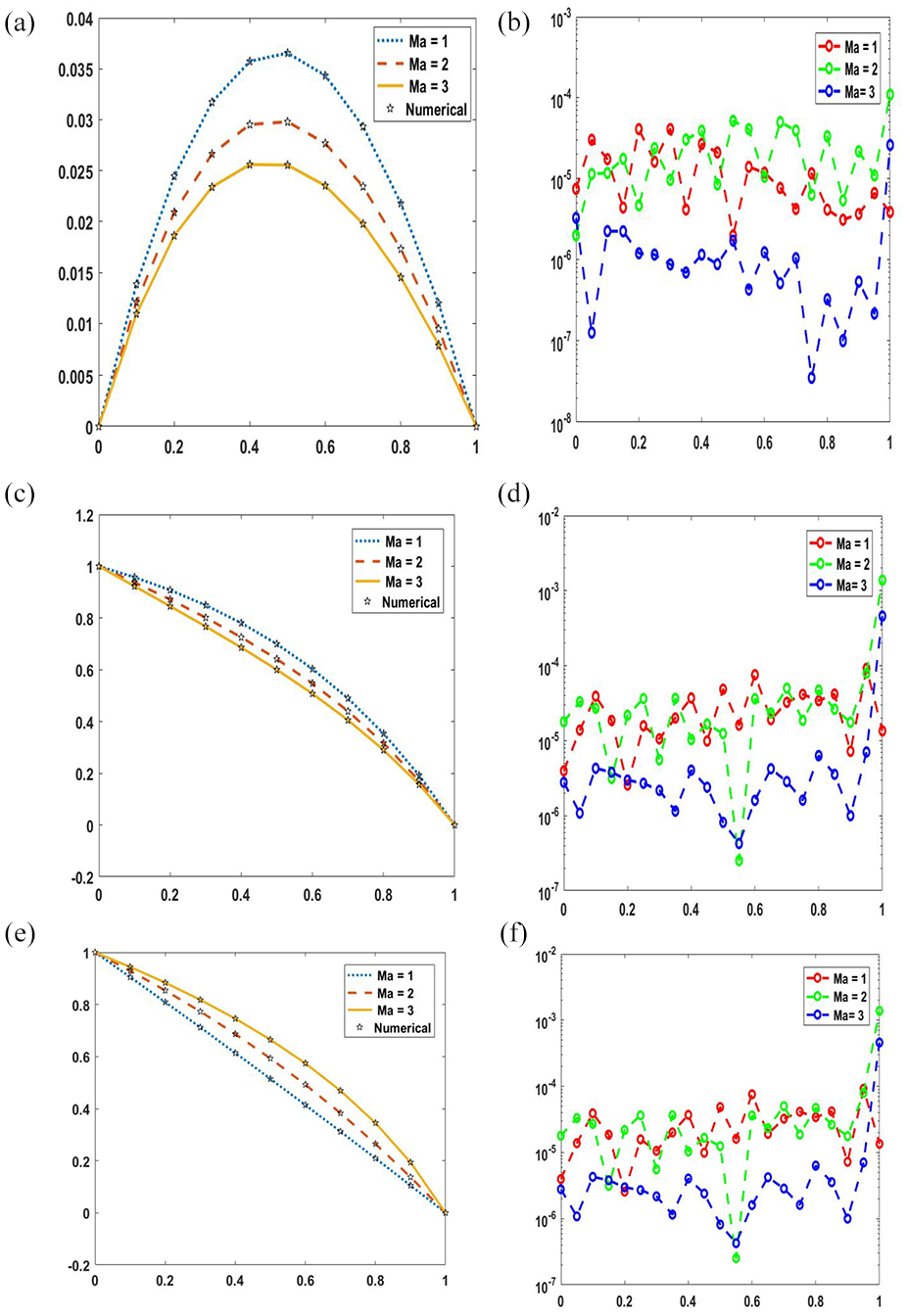
Assessment of proposed RNN-LMM for Case 1 of all scenario of STDTHNFF with non-linear HSFHFM over a spinning disk: (a) variation of the Ma in f′, (b) error display of the Ma in f′, (c) variation of the Ma in g, (d) error display of the Ma in g, (e) variation of the Ma in
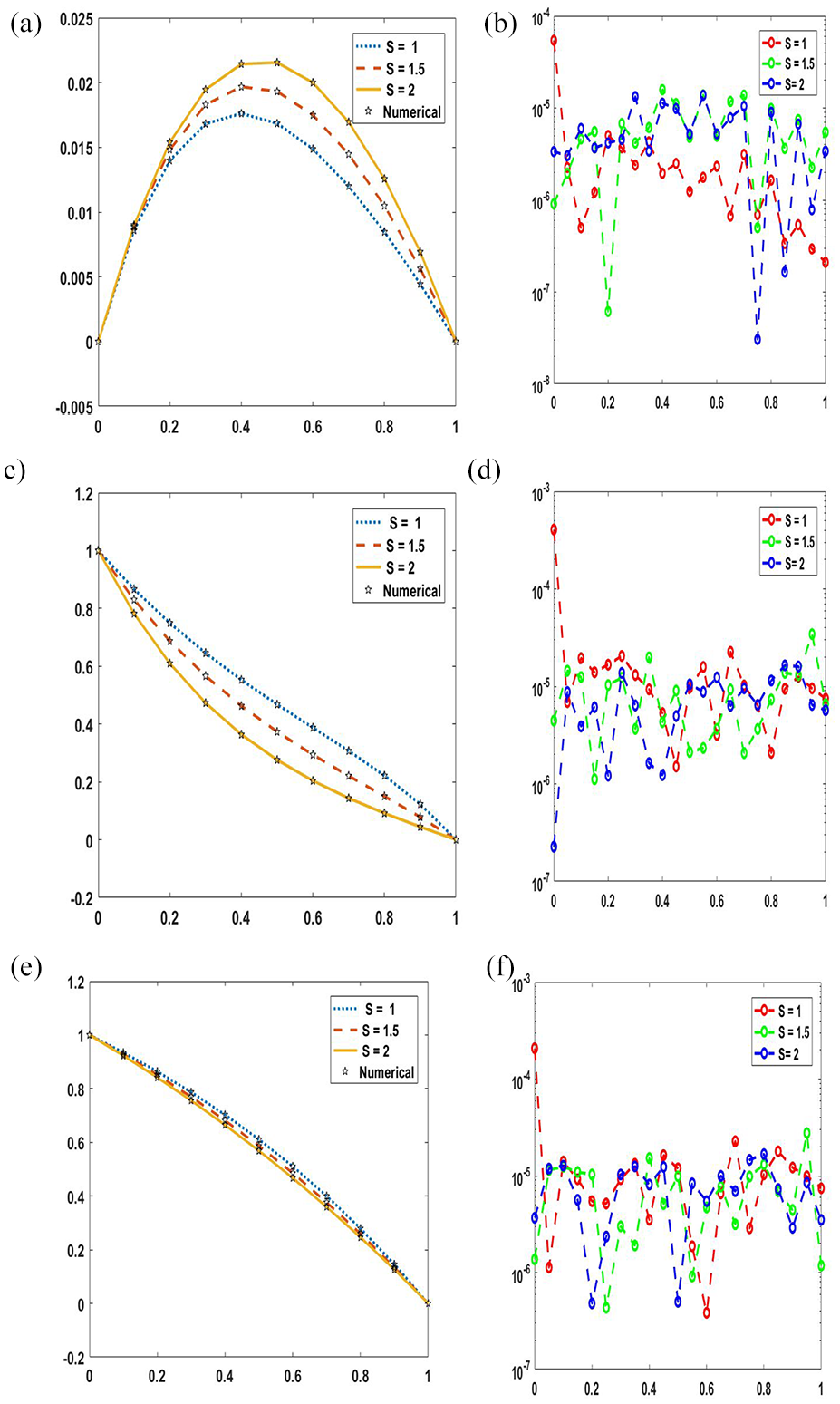
Assessment of proposed RNN-LMM for Case 1 of all scenario of STDTHNFF with non-linear HSFHFM over a spinning disk: (a) variation of the S in f′, (b) error display of the S inf′, (c) variation of the S in g, (d) error display of the S in g, (e) variation of the S in θ, and (f) error display of the S in θ.

Assessment of proposed RNN-LMM for Case 1 of all scenario of STDTHNFF with non-linear HSFHFM over a spinning disk: (a) variation of the ϕ3 in f′, (b) error display of the ϕ3 in f′, (c) variation of the ϕ3 in g, (d) error display of the ϕ3 in g, (e) deviation of the ϕ3 in θ, and (f) error display of the ϕ3 in θ.

Assessment of proposed RNN-LMM for Case 1 of all scenario of STDTHNFF with non-linear HSFHFM over a spinning disk: (a) deviation of the θ w in θ and (b) error display of the θ w in θ.

Assessment of proposed RNN-LMM for Case 1 of all scenario of STDTHNFF with non-linear HSFHFM over a spinning disk: (a) deviation of the Q T in θ and (b) error display of the Q T in θ.
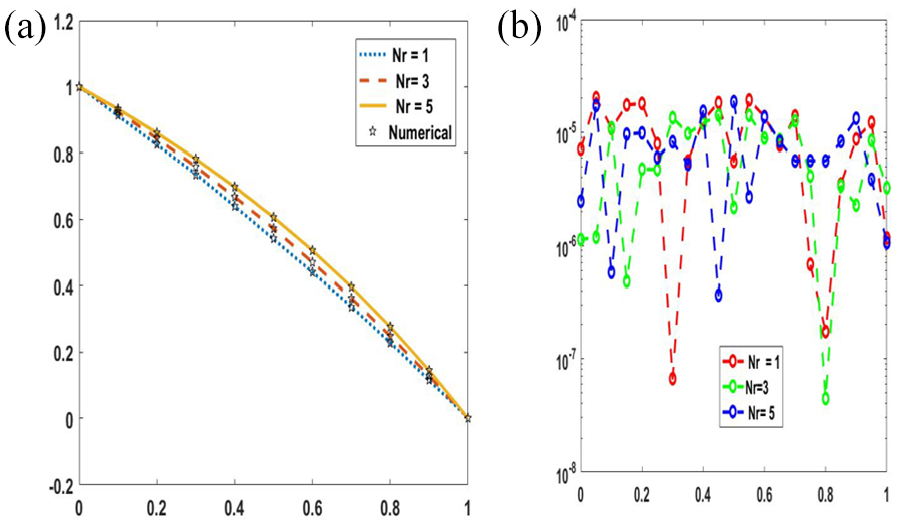
Assessment of proposed RNN-LMM for Case 1 of all scenario of STDTHNFF with non-linear HSFHFM over a spinning disk: (a) deviation of the Nr in θ and (b) error display of the Nr in θ.
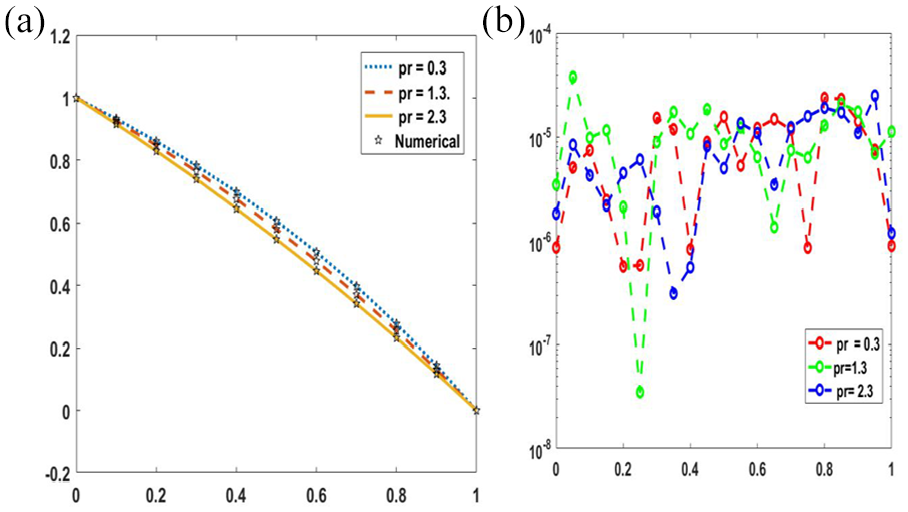
Assessment of proposed RNN-LMM for Case 1 of all scenario of STDTHNFF with non-linear HSFHFM over a spinning disk: (a) deviation of the Pr in θ and (b) error display of the Pr in θ.

Assessment of proposed RNN-LMM for Case 1 of all scenario of STDTHNFF with non-linear HSFHFM over a spinning disk: (a) deviation of the γ in θ and (b) error display of the γ in θ.
Absolute error (AE) in velocity and temperature profile
The results of RNN-LMM are derived for the velocity and temperature profiles
Skin friction and Nusselt number
Figure 17 demonstrates how various parameters affect skin friction and the Nusselt number. Figure 17(a) illustrates the impact of the nanoparticle volume fraction (

Representation of skin friction and the Nusselt number: (a) fluctuation in skin friction due to the effects of ϕ3 and Ma, (b) fluctuation in skin friction due to the effects of ϕ3 and Nr, (c) fluctuation in the Nusselt number caused by ϕ3 and Ma, and (d) fluctuation in the Nusselt number caused by Q T and Nr.
Tables analysis
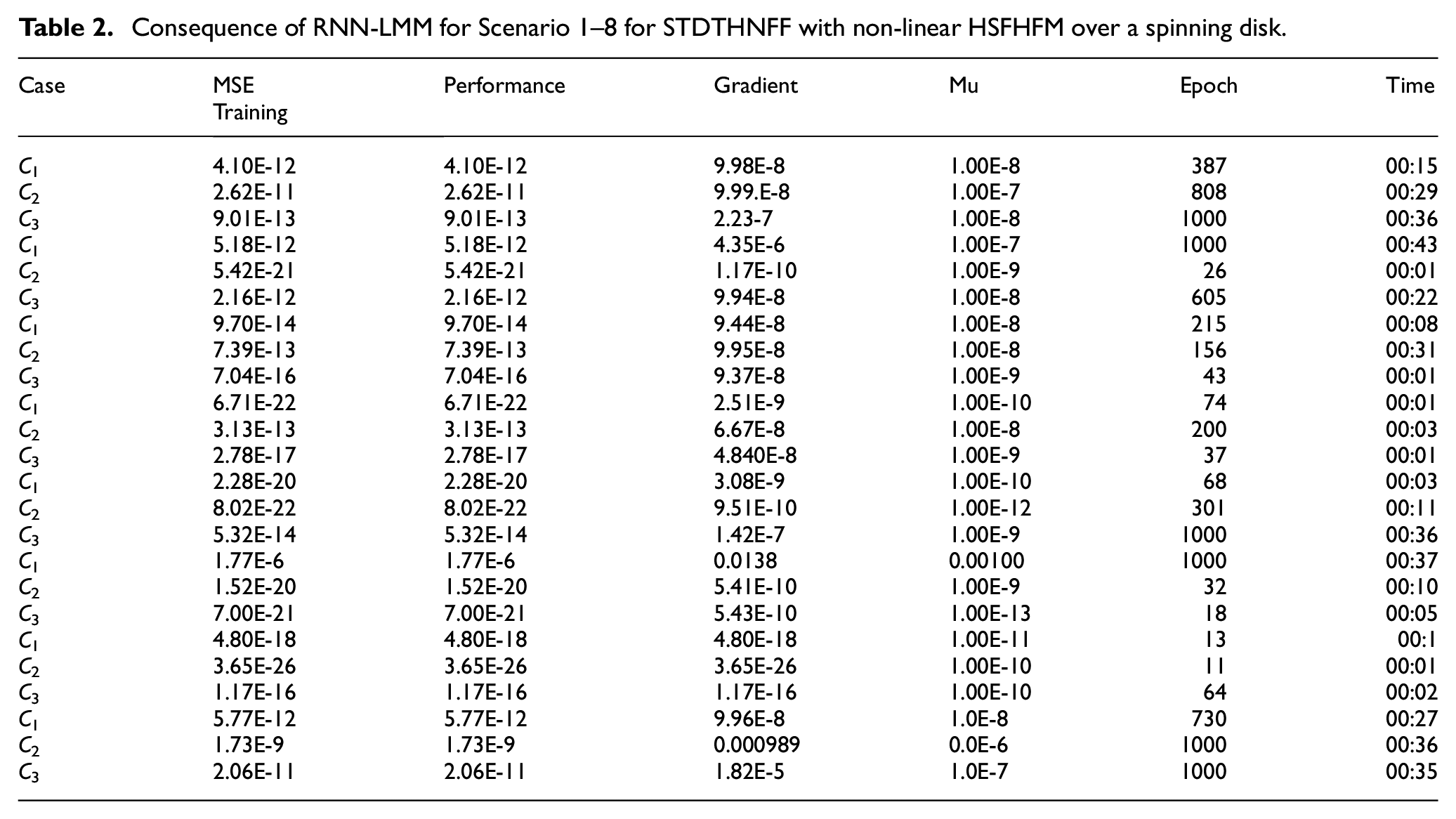
The table of RNN-LMM is executed for one to eight scenarios by deviation of
Explanation of every situation in addition to every case for STDTHNFF employing a spinning disk, a non-linear HSFHFM.

Consequence of RNN-LMM for Scenario 1–8 for STDTHNFF with non-linear HSFHFM over a spinning disk.
Thermophysical properties of base fluid-containing nanoparticles. 49

Thermophysical characteristics of nanofluid, HNF, and THNF.

Comparison of (

Comparison of (

Conclusions
We examined the effects of STDTHNFF with a non-linear heat source-sink and Fourier heat flux model over a rotating disk. The important consequences are as follows:
When the Ma and ϕ3 values rise, the
As the Ma value rises, the heat distribution profile increases, and the velocity profile decreases with increasing magnetic field values.
The temperature profile increases as the values of the ϕ3 increase.
The thermal profile declines with increasing Pr values and rises with higher amplitudes of the thermal radiation parameter and the heat source-sink parameter.
For the temperature ratio parameter, the temperature increase, and for the higher thermal relaxation parameter approximations, the temperature is decreases.
The values of the γ increases then the results temperature distribution profile
RNN-LMM does not require an initial guess or linearization techniques.
Due to its capability to minimize absolute error and enhance accuracy, RNN-LMM outperforms other approaches.
RNN-LMM is widely used for regression and data fitting problems, demonstrating strong agreement with experimental or numerical data.
Practical applications
The results of this study could be applied in several engineering and industrial sectors, including:
Heat transfer enhancement in industrial systems: The study investigates THNF, which could significantly improve heat transfer in various industrial applications such as cooling systems, heat exchangers, and thermal management devices.
Nanofluid-based cooling systems: The use of manganese zinc ferrite, copper, and silver nanocomposites could lead to advancements in nanofluid-based cooling systems, which are used in electronics, automotive, and renewable energy systems to enhance the performance of heat exchangers and coolants.
Energy and environmental applications: The findings may also be applied in renewable energy systems (e.g. solar thermal systems) and environmental technologies (e.g. water purification), where efficient heat management and antimicrobial properties are essential.
Medical applications: The antibacterial properties of silver nanoparticles could also have implications in medical applications, such as wound healing, sterilization, and drug delivery systems, making them a key material in biomedical research.
Limitations and future scope
The study is limited to a 2D nonlinear Fourier heat flux model. The model can be extended to 3D geometries to gain a more comprehensive understanding of the behavior of ternary hybrid nanofluids in complex, real-world systems.
The model assumes steady-state conditions. Future work could focus on extending the model to transient conditions, where both fluid flow and temperature vary with time, better reflecting real-world operational scenarios.
The current model was developed based on specific boundary conditions (a spinning disk), which may not fully capture diverse practical scenarios. In the future, the study could be extended by generalizing the boundary conditions across various applications to enhance its applicability to real-world problems.
Experimental validation of the ARNN-LMM framework is a key area for future research to enhance the reliability and practical applicability of the proposed intelligent computing approach.
Footnotes
Appendix
Notation

| (u, v, w) | Velocity components | ρ nf | Density of nanofluid |
| Coordinates system | ρ nf | Viscosity of nanofluid | |
| Uniform temperature of disk (K) | Heat capacity of nanofluid | ||
| T w | Temperature free stream (K) | K nf | Thermal conductivity of nanofluid |
| Ω | Angular velocity | ρ hnf | Density of HNF |
| B 0 | Magnetic field | ρ hnf | Viscosity of HNF |
| C f | Skin friction | Heat capacity of HNF | |
| Reynolds number | K hnf | Thermal conductivity of HNF | |
| Nu | Nusselt number | ρ thnf | Density of THNF |
| MSE | Mean square error | ρ thnf | Viscosity of THNF |
| RG | Regression | Heat capacity of THNF | |
| TR | Training | K thnf | Thermal conductivity of THNF |
| FT | Fitting | Nanoparticle volume fraction | |
| PF | Performance | Ag | Silver |
| EH | Error histograms | Cu | Copper |
| AI | Artificial Intelligence | Manganese zinc ferrite | |
| ANN | Artificial neural networks | q r | Radiative heat flux |
| RNN | Recurrent neural networks | Stephan-Boltzmann constant | |
| RNN-LMM | Recurrent neural networks with Levenberg-Marquardt method | k * | Mean absorption coefficient |
| NLPDEs | Nonlinear partial differential equations | σ thnf | Electric conductivity (Sm−1) |
| CCHF | Cattaneo-Christov heat flux | C g | Tangential skin friction |
| C f | Radial Skin friction | Nu | Nusselt number |
| CCHFM | Cattaneo-Christov heat flux model | Reynolds number |
Handling Editor: C.S.K. Raju

Funding
The author(s) received no financial support for the research, authorship, and/or publication of this article.
Declaration of conflicting interests
The author(s) declared no potential conflicts of interest with respect to the research, authorship, and/or publication of this article.