



Abstract
The most commonly used part in engineering fields is threaded fasteners. There are a lot of advantages of fasteners. One of them is that they can be easily disassembled and reused, but a bolted joint can loosen easily when a transversal load is applied. The clamp load of a bolted joint can also loosen slowly when subjected to repeated temperature changes. This paper presents an experimental investigation of the self-loosening of bolted joints under cyclical temperature variation. Experiments are carried out under several cyclical temperature changes with different bolt preloads. Rectangular threaded bolted joints with M12 × 1.75 bolts and nuts are tested in a specially designed testing apparatus. Material of bolt, nut, and plates is a stainless steel. The experimental results show that the high initial bolt preload may prevent the joint from self-loosening and the bolted joint has loosened significantly in the first cycle of temperature changes. From this investigation, the loosening of the bolted joint can be considered as a first stage self-loosening.
Introduction
Bolts and nuts are the most efficient and simplest parts among mechanical components. In mechanical engineering, there are many important bolted joints that can be subjected to cyclical thermal loads, like those in engines, turbines, etc. One of the main drawbacks of bolted joint is self-loosening. There are two main mechanisms in the self-loosening process of a bolted joint: external loads and cyclical temperature variation.
Many researchers have done investigations on self-loosening.1,2 For the first mechanism, Junker 3 proved that the value of preloaded fasteners decreases when relative motion takes place between the mating threads and the bearing surface of a threaded fastener. Yokoyama et al. 4 study the self-loosening phenomena of a bolted joint under rotational load by using a finite element model (FEM). The self-loosening of a bolted joint under dynamic axial load for coated and uncoated bolted joints is investigated by Liu et al. 5 Jiang et al. 6 have done an experimental study on the self-loosening of a bolted joint. Their results help to identify major factors governing self-loosening and explore the mechanisms controlling the second stage of self-loosening. Wi et al. 7 have investigated the self-loosening of a 3D printed bolt under transversal load.
When it comes to the second mechanism, there are two basic modes for the relative motions induced by expansion differences: (1) relative movements between clamped bodies induced by their expansion difference and (2) a slippage in the middle of the thread contact surfaces because of internal and external threads expanding differently. In addition, a key factor for self-loosening of a bolted joint is the friction coefficients between clamped parts and bolt head, nut as well as on contacts of threaded parts of bolt and nut. Filippi et al. 8 have done an investigation about contact hysteresis at high temperature. They have showed that when the temperature of structure increases, the friction coefficient on the contacts significantly decreases. Coman and Constantinescu 9 have done a research about the temperature effects on joint strength. Hou et al. 10 have made a mathematical model of radial expansion for the self-loosening of a rectangle-thread bolted joint under repeated temperature variations with some assumptions such as:
All material parameters in the bolded assemble for experiment are similar, but not the thermal expansion coefficients in the radial direction.
The relative movement progress caused by temperature variation can be represented as quasi-static.
The static and kinetic friction coefficients are equal.
The contact pressures in the contact pairs of the bearing and thread are similar.
However, real condition is totally different from the assumed condition of the reference. Therefore, this reference encourages to conduct experiment for bolted joint under cyclical temperature changes. An original research aims to develop the analytical model of self-loosening phenomena under cyclical temperature changes.
In this study, self-loosening phenomena for a bolted joint with different cyclical temperature variations are investigated experimentally. The amplitude of initial preload and temperature changes is discussed. And the results show that the loosening of the bolted joint under cyclical temperature changes can be considered as a first stage self-loosening.
Experiment
The two plates, bolt, and nut (M12 × 1.75) for the experiment are modeled in NX10 software (Figure 1). There are two holes with a diameter of 20 mm for inserting a cartridge heater in each plate and a single hole with 13-mm diameter for the bolt (Figure 1(a)). A test rig is designed to investigate self-loosening phenomena under repeated thermal load (Figure 2). The test rig consists of two plates (both plates are the same size and have a thickness of 30 mm, length of 250 mm, and width of 70 mm), bolt (the length of bolt is 85 mm), and nut specimens.

(a) 3D model of plate and (b) front view of bolt and nut.

Overall experiment set up.
To measure the tension change of the bolted joint, a load-washer compression load cell (Sensor model: LWO-20, Manufacturer: Transducer Techniques) with a height of 8.75 mm is used. A high-accuracy temperature sensor (K-type thermocouple with capacity up to 300°C) is installed as close as to the bolt to estimate the temperature of the structure. A laser sensor measures the angular displacement of the thin plate which is attached to the nut (Figure 2), and heater cartridges apply a desired temperature to the joint. The heater cartridges are inserted in the top plate and the bottom plate close to the bolt to supply enough thermal load from 20°C up to 60°C, 90°C, and 120°C.
Thermal analysis of the bolted joint is performed using ANSYS software to estimate the temperature variations of the whole structure and to find the best place for attaching the temperature sensor. The 300 W of heat sources from cartridge heaters are symmetrically applied to both plates to generate adequate temperature in the assembly. The result of the simulation shows that the lowest temperature of the bolt is 119.1°C at the end of the bolt, and the highest temperature of the bolted joint is 120°C. There is only a difference of 0.9°C in the temperature, which is sufficient for the tests (Figure 3). From the simulation result, the top surface of the top plate is selected for a thermocouple to measure the temperature of the structure.

Thermal analysis of bolted joint to give desired temperature and find best place for a thermocouple.
As aforementioned, a mathematical model of loosening under cyclical temperature changes of a rectangle-threaded bolt was studied in reference. 10 Based on the reference, the rectangle-threaded bolt and nut specimens were, therefore, modeled according to ISO965 standard and manufactured by use of rolled method for the test, as shown in Figure 4. The bolt, nut, and plates were made of stainless steel (SS400), and nine pairs of specimens were used for the experiment to analyze self-loosening phenomena. The material properties were listed in Table 1.

Rectangular threaded bolt and nut (M12 × 85 Grade 8.8).
Material properties of the bolted joint.

The test starts with an initial preload (5 kN) of the joint, and the preload changes is measured via the attached load cell. After measuring the initial temperature, the heating system is activated by power controllers to provide a desired temperature to the bolted joint. The preload of bolted joint is recorded as the temperature rises until it reaches to the desired temperature of 60°C, 90°C, and 120°C. The point to notice here is that each cycle of the experiment from 20°C up to 60°C temperature condition lasted about 120 min. For the rest temperature conditions from 20°C to 90°C and 120°C each cycle time is equal to approximately 130 and 150 min, respectively (for each cycle, heating process up to 60°C lasts 10 ± 3 min and cooling process takes 110 ± 5 min. Heating process is 12 ± 3 min and cooling process is 120 ± 5 min for 90°C. And heating process is 15 ± 3 min and cooling process is 135 ± 10 min for 120°C). The rotation angle of nut is also measured while the preload is being measured with the same time interval (see Figure 2). For that, bolt head is fixed by use of clamp bench which is fastened to a stationary base. The angle is calculated by measuring the displacement of the thin plate attached to the nut with the laser sensor as following equation (1) (Figure 5):

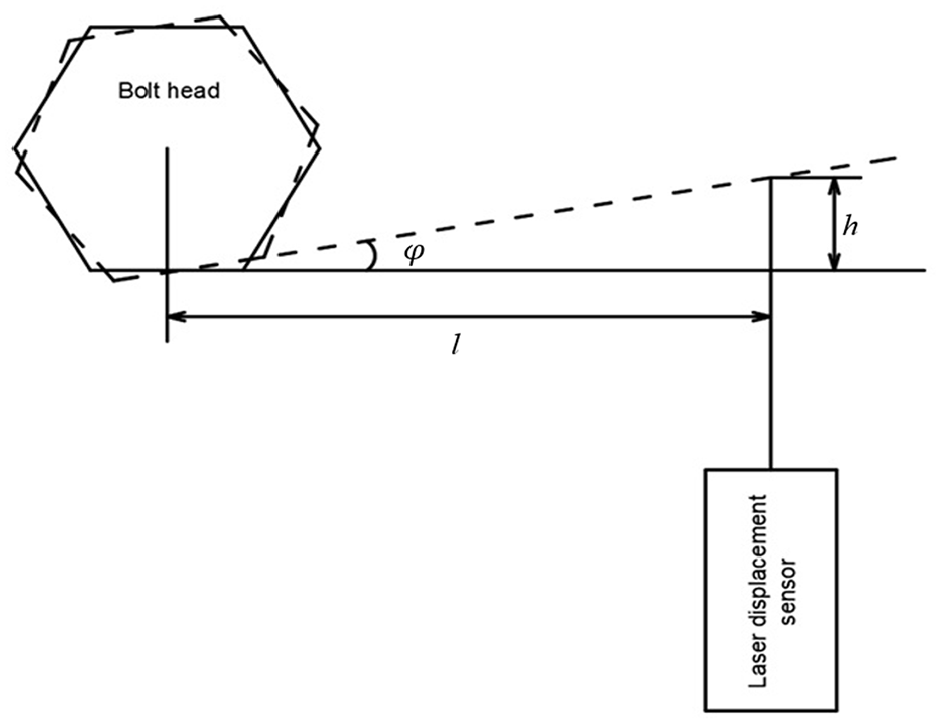
Method of measuring rotation angle.
The same test cycle is repeated three times for each test condition. The preload is increased to 15 kN with the 5 kN step, and the maximum temperature is also increased to 120°C. The preloads of the joint for the test are chosen in terms of the amplitude of the temperature changes based on the reference. 10 The preloads are applied by use of torque wrench (Manufacturer: Tohnichi, model: 450QL3, according to the specification of the torque wrench, the accuracy is ±3%) and 10.8, 21.5, and 32.5 Nm torques are given to set up the preloads, respectively. The average values of the test results are used to evaluate the loosening phenomenon of the bolted joint in results section.
Results and discussion
Figure 6 shows the bolt preload changes (5 kN) at 20°C–60°C. The bolt preload goes up sharply while the temperature of the joint increases. When the temperature reaches the peak point of 60°C, the bolt tension makes up 7.74 kN. In the cooling process, the preload drops dramatically to 4.5 kN at the end of the process. It means that the bolted joint has loosened for 0.5 kN after first thermal cycle. Following this, the preload starts increasing significantly in the heating process of the second cycle and reaches 7.6 kN when the temperature indicator shows 60°C. Afterwards, the cooling process of the second cycle starts again, and the preload goes down to 4.4 kN at the end of the second cycle. In other words, the loosening makes up 0.1 kN after the second thermal cycle. In the following cycles, the same scenario of loosening due to the temperature changes is observed. In other words, the bolt preload overcomes the huge loosening in the first cycle, while almost the same loosening is observed in the rest of the cycles. Therefore, the experiment is conducted for four temperature cycles. The point should be noted here is that there is a significantly difference between first cycle and the rest of the cycles in terms of loosening amount. First reason for it is that the amplitude of the temperature that can cause the joint to loosen gradually is lower than that of the rest of cycles. Since, in the following cycles, radial shear forces of the threated part may reach their limits later than that of the beginning cycle. 10 Second reason is that occurring of local plastic deformations and elastic deformations in the bolted joint can cause slackening of the joint and main part of this loosening corresponds to the beginning cycle. The preload can decrease more due to relaxation and embedding in the first cycle. 11

Experimental results of the preload (5 kN) change under cyclically temperature variation from 20°C up to 60°C.
The estimations of bolt preloads of the bolted joint with tensions of 5, 10, and 15 kN are compared when the cyclical temperature is from 20°C to 60°C. To make the comparison easy, the differences of the bolt preloads are given in a percentage that calculated obtained value divided by initial value and multiplied a hundred as in equation (2), as shown in Figure 7(a).

where

The comparison of experimental results of different bolt preloads under temperature from 20°C to (a) 60°C, (b) 90°C, and (c) 120°C conditions.
This experiment is also conducted in the rest of the temperature conditions (from 20°C to 90°C and from 20°C to 120°C). The results are plotted as depicted in Figure 7(b) and (c), respectively. From the graphs, the loosening amount due to the cyclical temperature changes of the joint increases while the amplitude of the temperature rises. In other words, it might be said that loosening phenomena is proportionally related to the difference of temperature changes for the bolted joint. In cyclical temperature conditions for a bolted joint, the first cycle plays a key role in the loosening phenomena.
Figure 8 shows the loosening amount of the bolted joint after each cyclical temperature changes for all conditions. When temperature changes are from 20°C to 60°C, the bolted joint with 5 kN preload loosens for 10% after the first cycle, while the bolted joint with 10 and 15 kN preload loosens for around 6% and 3% respectively. In the following cycles, loosening makes up about 2% for 5 and 10 kN preloads and approximately 1% for 15 kN preload (Figure 8(a)). When the amplitude of the temperature is increased up to 90°C, the increment is observed in the loosening of all preloads as expected. 10 and 15 kN preloads make up almost similar trend during the experiment (Figure 8(b)). It should be mentioned that the highest self-loosening is observed with a 5 kN bolt preload when the temperature is from 20°C to 120°C. The preload of the joint drops dramatically by 41% of its initial value after the first cycle. In the following cycles, the loosening of the joint decreases slowly by 8.5%, 5.5%, and 4% (see Figure 8(c)).

Self-loosening change of bolted joint with different preload temperature variation from 20°C to (a) 60°C, (b) 90°C, and (c) 120°C.
As mentioned above, the highest loosening is observed with 5 kN bolt preload, when the temperature changes are from 20°C to 120°C. Therefore, the rotation angle for this condition is plotted (Figure 9). From the graph, it can be clearly seen that the nut does not rotate until the temperature of the joint heated up to around 50°C. After that, the laser sensor detects a rotation of the nut in the opposite of the loosening direction due to the thermal expansion of the structure while the temperature reaches its highest value. In the cooling process, the nut starts to rotate significantly in the loosening direction. When the temperature decreases to 20°C, the nut rotates in the loosening direction around two times more than the rotation in the heating process. In other words, the rotation angle makes up approximately 50 × 10−5 degrees. In the following cycles, the same condition is observed, and the nut rotates about 15 × 10−5 degrees. Namely, the nut rotates more in the initial cycle than the rest of the cycles of temperature changes. This rotation angle is too small, and it might be because of thermal expansion on the joint. If the nut is assumed as not rotate, the loosening of the joint can be considered early stage of self-loosening. Furthermore, the loosening of the joint for all condition makes up below 30%. This result also proofs that the loosening of the joint under cyclical temperature changes is early stage of self-loosening. 5 kN bolt preload is an exception because this preload is not usually used for M12 × 1.75 standard bolts. In the experiment, 5 kN bolt preload is used to see how do bolt preload reduce if the amplitude of temperature changes is relatively high. The result of the 5 kN bolt preload under the highest temperature changes shows that if the amplitude of temperature variations is significantly high in relation to the initial preload of the joint, second stage of loosening might be occurred in the bolted joint.

Experimental result of rotation angle of bolted joint under cyclically temperature variation from 20°C up to 120°C.
Conclusion
In this paper, self-loosening of the bolted joint under cyclical temperature changes is investigated experimentally. The results show that the bolt can face more loosening in the first cycle of temperature changes than that of the rest of the cycles. The loosening amount of the bolt preload changes proportionally to the increment of temperature changes. From the results, loosening of the bolted joint under cyclical temperature changes can be considered as early-stage self-loosening. These results can be as reference in developing a mathematical model of the loosening of the bolted joint under cyclical temperature changes in the future study.
However, the effect of the friction coefficient between the bolt bearing and the plate surface can also be studied. Research work will be extended by doing a study on the effect of the friction coefficient on the self-loosening of bolted joints in the same conditions.
Footnotes
Handling Editor: James Baldwin
Declaration of conflicting interests
The author(s) declared no potential conflicts of interest with respect to the research, authorship, and/or publication of this article.
Funding
The author(s) disclosed receipt of the following financial support for the research, authorship, and/or publication of this article: This work was supported by the Korea Institute for Advancement of Technology (KIAT) grant and funded by the Korean Government (MOTIE) (P0012769, Human Resource Development Program for Industrial Innovation)
