



Abstract
The pre-research project aims to propose a method of optimizing tooth surface modification (TSM) fitting under thermoelastic lubrication (TEL) conditions to reveal the most popular and concerned mechanism issues in the field of mechanical engineering. This is an exploratory study, mainly considering the gear comprehensive error and TSM state of TEL contact interfaces are extremely harsh, which complicates simulation analysis and optimal design. TSM simulation has fitted numerically agreement with optimized results obtained experimentally, which means that they can, whether isolated or by using a multiscale coupling method, start to be adopted to revise, and verify meta-models for thermoelastic characteristics (TECs) under TEL problems. This subject involves the TSM fitting of the theoretical teeth surface superimposed structure, and performs 3D and diagonal modification optimization design, obtains the modified surface position and normal vectors, according to load teeth contact analysis (LTCA), a variety of optimized modification models are established and complex curved surfaces are analyzed to fit the actual gear teeth surface thermoelastic contact numerical simulation, which has been further demonstrated and expressed in the type experiment combined with actual key working conditions and multiple influencing parameters, which is of great significance to the development of modern gear transmission system.
Introduction
The TSM fitting optimization is related to the manufacturing and installation errors and the meshing impact caused by the thermoelastic deformation of alternating meshing. 1 It is an important factor affecting the coupling of dynamic thermoelastic characteristics (TECs) of gears. The uniform teeth surface pressure makes the teeth profile deformation run smoothly, reduces the vibration noise and then attenuates the impact, in order to improve the influence of thermoelastic deformation of teeth surface on gear transmission performance and improve the anti-scuffing bearing capacity of teeth surface, which should not be ignored in the analysis of gear vibration noise and description of meshing gears instantaneous contact interface lubrication.2–4
Considering the characteristics of gear transmission, there are many methods of TSM, and the influencing factors are complex. 5 Many scholars have noticed the traditional gear meshing theory to obtain the modified teeth surface by using the modification cutter are too theoretical, and have not considered the comprehensive error of the gear, the precise geometric parameters of the teeth surface, and the uncertain machining error, it is difficult to meet the requirements of high-precision, high-speed, and high-load design.6–8 TEL is the most complex and common reality online state. Figure 1 reveals the mixed lubrication state of the gear pair in the actual operating conditions during meshing time. Many TEL problems of alternate meshing gear teeth point and line contact belong to this research field.9–11

Actual state of meshing time-domain TEL.
Subject to the influence of pure elastic deformation between the contact surfaces of gear pairs, most previous scholars have revealed the time-varying law of lubricating oil film thickness along the meshing teeth surface along the finite length contact line. 12 However, the relative influences of lubricating oil viscosity-temperature -pressure on film thickness have not been highlighted. 13 A key characterization analysis model for Dowson elastic flow pressure oil film was shown in Figure 2.

Key characterization analysis model for elastic flow.
In the past few decades, a significant progress has been made in numerical methods, analytical solutions and experimental techniques. 14 TSM technology has been the most effective way to improve the gear teeth meshing performance and reduce vibration and noise of the gear transmission system (GTS), the TSM effect mechanism and modification parameter selection principles have become a consensus.15–17 Moreover, most of these research results are based on the assumption of the static state of GTS, and there are few studies on TEL considering the transient dynamic conditions of GTS meshing. There are two common problems in their research. One is that the precise teeth surface geometry conditions under different error conditions or TSM are not considered, and the actual meshing teeth surface and the theoretical conjugate teeth surface have a magnitude error, the other is to rely on modification tool to obtain the modified teeth surface is derived from the traditional meshing theory, which makes the modified teeth surface too theoretical, and its numerical analysis and uncertainty errors in the machining process are difficult to meet the design requirements of high precision, high speed, and high load bearing performance of modern gears.
The empirical simplified formula has been difficult to adapt to the technical requirements of high-index GTSs. Many scholars have carried out a lot of research work in the field of TSM and obtained results for reference.18–20 Related to the key characterization index of gear mesh stiffness density, the load transmission error (LTE) of the gear pair is further realized from two-dimensional teeth profile modification to three-dimensional TSM and static trajectory to dynamic target parameter process step.
A lot of research on TSM technology based on stiffness, load and stress distributions have been performed, some factors such as load size, working condition parameters, lubricating oil parameters, and cooling measures have been considered, which will affect the TECs (temperature field, thermoelastic deformation, thermal expansion, and thermoelastic stress) of GTS, which further increases the difficulty in accurately determining the modification curve, modification index, and maximum modification amount.
The significant TECs of temperature field of a heavy-duty and high-speed gear bodies have greatly affected the resistance to thermoelastic deformation of the GTS.21–23 The refinement design and optimization process of TSM considering the influence of gear temperature field is quite difficult, which becomes necessary for GTS to analyze the TECs of TSM.4,6,24 For high-speed and heavy-duty gears, teeth surface thermoelastic anti-scuffing damage is the main failure form of the GTS. 25 The instantaneous contact temperature rise of the meshing teeth surface is caused by transient overload of GTS, which leads to rapid overheating of teeth surface and thermoelastic anti-scuffing damage.26–28 The thermoelastic anti-scuffing load-bearing performance evaluation is the core content of deep optimization and meshing process verification of high-speed and heavy-duty gears. 29 In view of the relevant literature on gears thermoelastic anti-scuffing load-bearing performance, the research results show that the meshing gears hybrid lubrication characteristics are closely related to gears thermoelastic anti-scuffing load-bearing performance in time domain.
In the following investigation, the optimal design of three-dimensional/diagonal modifications and numerical fitting of modified surface are proposed. Adherence to theoretical teeth surface superposition mechanism, a modified surface fitting evolution has been realized and three dimensional/diagonal modification optimal design processes have been implemented. The gears comprehensive error and TSM status and precise teeth surface geometric parameters have been noted, and then the modified surface position and normal vectors have also been deduced, in view of the multiple TSM optimized meta-models, the thermoelastic contact numerical simulation of complex curved surface fitting the actual teeth surface is analyzed to reduce the transmission error and vibration noise in order to improve meshing gear teeth thermoelastic anti-scuffing load-bearing performance.
TSM fitting and position/normal vectors numerical calculation
In addition, the data of teeth profile and teeth profile can be collected uniformly along the teeth profile

where,

Diagonal modification area and modification amount.
Characterizations of k-order B-spline curves and surfaces
The concept of B-spline was put forward by Schoenberg, and the recursive definition of B-spline was proposed by De door and Cox respectively, which made the calculation of B-spline stable and simple.30–32 Assumed here, B-spline curve of order k has the following characteristics:
In the definition domain of
The convex hull characteristics of curve is defined as the union of control points of each curve segment
The number of intersections between
The larger the distance between
Geometric and affine invariant characteristics. Here, considering the non-uniform partition of k-order B-spline, its basis function is given

where,

Among them,
Then B-spline curves and surfaces are characterized as

Considering the uniform division of the parameter space
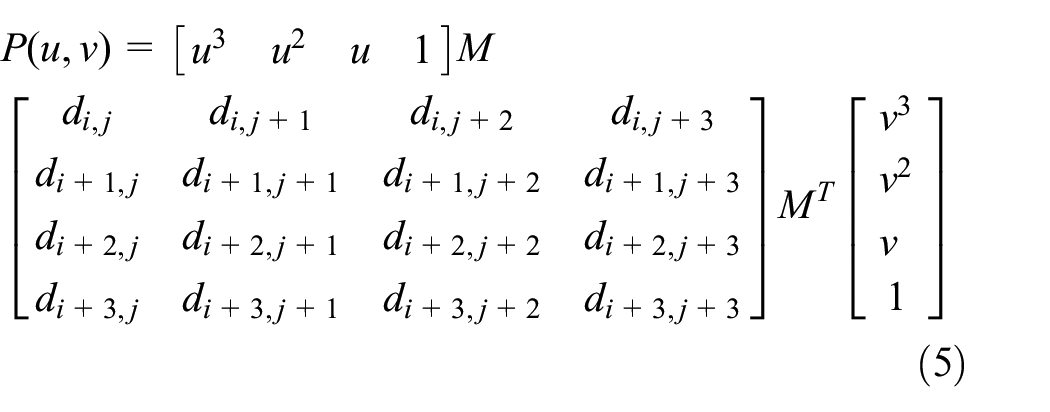

where
Determination of position/normal vectors of gear modification surface
In the actual modified surface, the analytic control points (or control points) are inversely obtained by fitting and adjusting the space value points for many times, and then the inverse calculation process of the difference between the two surfaces is obtained. N unordered value points are set

Set spatial value point
Considering the influence of gear manufacturing, installation error, load distribution between teeth and TSM, the alternative meshing teeth surface is non-conjugate.33–35 That is, any meshing position

where,

Normal vector of teeth surface considering comprehensive error of loading transmission.
Represented in Figure 4,

The parallel line

Set

When calculating the actual normal vector of teeth surface, it is necessary to fit the meshing data of teeth surface deviation, especially with large load and high precision. The gear surface deviation should not be more than 50 μm, and the fitting accuracy of gear modification surface should not be greater than 1.0 μm. Based on the cubic B-spline fitting teeth surface meshing deviation and node data, assuming that the meshing time domain is fixed fitting spline surface boundary and collecting spline data, and extending the rectangular grid boundary data to the whole teeth surface boundary, the analytic control matrix equation is inversely solved and the change is little compared with the adjacent boundary surface, so as to ensure the accuracy of teeth surface contact analysis.
Optimization analysis of TSM based on genetic algorithm
The optimization of modified teeth surface is an iterative process of solving nonlinear contact problem, which is also called the process of changing the state of modified teeth surface to improve the contact condition of gear meshing surface. 34 Set the gear pair modification optimization variable as its curve parameter, the LTCA numerical analysis result is the optimization objective function. This topic is based on genetic algorithms (GA) to simulate the genetic and evolutionary processes of organisms in the natural environment, and then searches for adaptive global optimization probabilities, reproduces and optimizes populations and converges to the most suitable environmental individuals. The GA process is shown in Figure 5, and its steps can be described.

Flow chart of genetic algorithm.
Step1. Select the objective function and determine the variable domain and coding accuracy to form the code. Step2. Perform crossover operations on individuals selected to enter the matching pool to form a new population. Step3. Select population individuals with a small probability to perform mutation operations to form a new population. Step4. Calculate individual fitness based on fitness function and select probability to form a new population of individuals. Step5. If the check conditions are met, the GA ends, and the individual with the highest current population fitness is the expected solution.
Considering that the B-spline surface uses non-parametric implicit representation of the smooth connection of multiple surfaces, the relationship between variables in the defined domain is described. If the slope of a point in the point set tends to be parallel to the axis of coordinates, the slope at this point is close to infinity. In view of the fact that curves and surfaces in a non-identical plane are mathematically expressed by parametric equation.
35
In the LTCA equation, the parameter
Based on the data of the rectangular grid, the control vertices are inversely calculated and kept unchanged. The four boundaries of the space

Analytical LTCA optimization of modified teeth surface.
The gear system transmits power and the meshing teeth bear load. The thermoelastic deformation of the teeth surface causes the distortion of the teeth profile and teeth direction, resulting in impact, vibration, and unbalanced load in the process of alternate meshing. Based on the mechanism of teeth profile modification and teeth alignment modification of involute gear, the time-varying law of thermoelastic deformation of alternate meshing contact interface with meshing position is considered, the distribution coefficient of transient contact dynamic load is shown in Figure 7.

Transient contact dynamic load distribution coefficient of gear pair in alternating meshing process with maximum profile modification.
The maximum value of contact dynamic load on the teeth during the alternate meshing process of gear pair is placed in the meshing in and meshing out transients in the single teeth meshing area, which are also shown in the Figure 7

where,
Taking into account the modification of involute teeth profile in the alternate meshing area of double teeth, the ideal modification curve is the change law of the modification amount increasing to the maximum value. The calculation formula of the modification curve is expressed as follows

where,
Gear parameters and teeth profile shape are affected by load distribution and contact pressure distribution between teeth and relative sliding of contact teeth to meshing teeth surface. Proper amount of addendum trimming along normal direction of driving and driven gear profile improves load contact pressure distribution between teeth, reduces relative sliding of meshing teeth surface, and optimizes contact temperature of teeth surface. 36 Taking into account the TECs of teeth surface (teeth contact deformation and bending deformation, shear deformation, and teeth root deformation, etc.), and considering the distribution of instantaneous contact dynamic load (teeth meshing stiffness) and the time-varying law of teeth contact dynamic stress and teeth root bending dynamic stress, an estimated empirical formula of the modified curve is as follows

where
Teeth profile and teeth alignment modification also affects the load distribution between teeth in meshing state. Several pairs of teeth are engaged in alternate meshing and share the load (contact ratio

Variation curves of load distribution factor (ζ) of spur gear considering different modification index (β).
It can be seen from Figure 8 that the load of unmodified gear changes suddenly at the meshing in end and meshing out end, and the load distribution coefficient of unmodified gear changes from 0 to 1, and the load distribution coefficient is increased from 0 to 1 after modification, the results show that the reduction of meshing impact, dynamic load, and instantaneous temperature rise is suitable for improving the thermoelastic anti-scuffing load-bearing performance of meshing gears. The load distribution coefficient curves of the spur gear are shown in Figure 9.

Load distribution curves of spur gear.
Considering the thermoelastic deformation of meshing teeth surface, the driven gear lags behind the driving gear in the gear transmission process to produce a rotation angle error. The fluctuation of the rotation angle error in any meshing cycle restricts the transmission stability of the gear system, that is, the smaller the angle error fluctuation; the more stable the gear system transmission. The variation law of rotation angle error (err/rad) of spur gear with different base pitch error (err) is revealed as shown in Figure 10.

Rotation angle error (err/rad) of spur gear considering different modification index (β).
Vibration acceleration RMS response curves of spur/helical gears along meshing line direction are shown in Figure 11, the operating conditions are set to 1500 Nm and 3000 r/mm. The above figures have been revealed and illustrated, the unmodified gear rotation angle error is mutated twice in one meshing cycle and the load fluctuates greatly. After the modification, the angle error does not change suddenly in one meshing cycle and the load fluctuation is small. When the modification index β = 1.0, the dynamic system error of the double-tooth meshing time domain is obviously convex, the modification index becomes smaller, the curve convex change is obvious, and the dynamic system error fluctuation range becomes larger. When the modification index β > 1.23, the dynamic system error change of double-tooth meshing time domain is obviously concave. The modification index becomes larger, the concave trend is obvious, and the dynamic system error change range becomes smaller. When the modification index β is 1.23, the angle error fluctuation is the minimum and the transmission is the most stable. Modified vibration acceleration RMS of spur/helical gears are reduced from 232.182/107.737 m/s2 in the unmodified state to 35.376/16.581 m/s2. Therefore, the modified system vibration acceleration RMS is greatly reduced and tends to be constant, which can be effectively improved the gear transmission system vibrates and reduces noise.
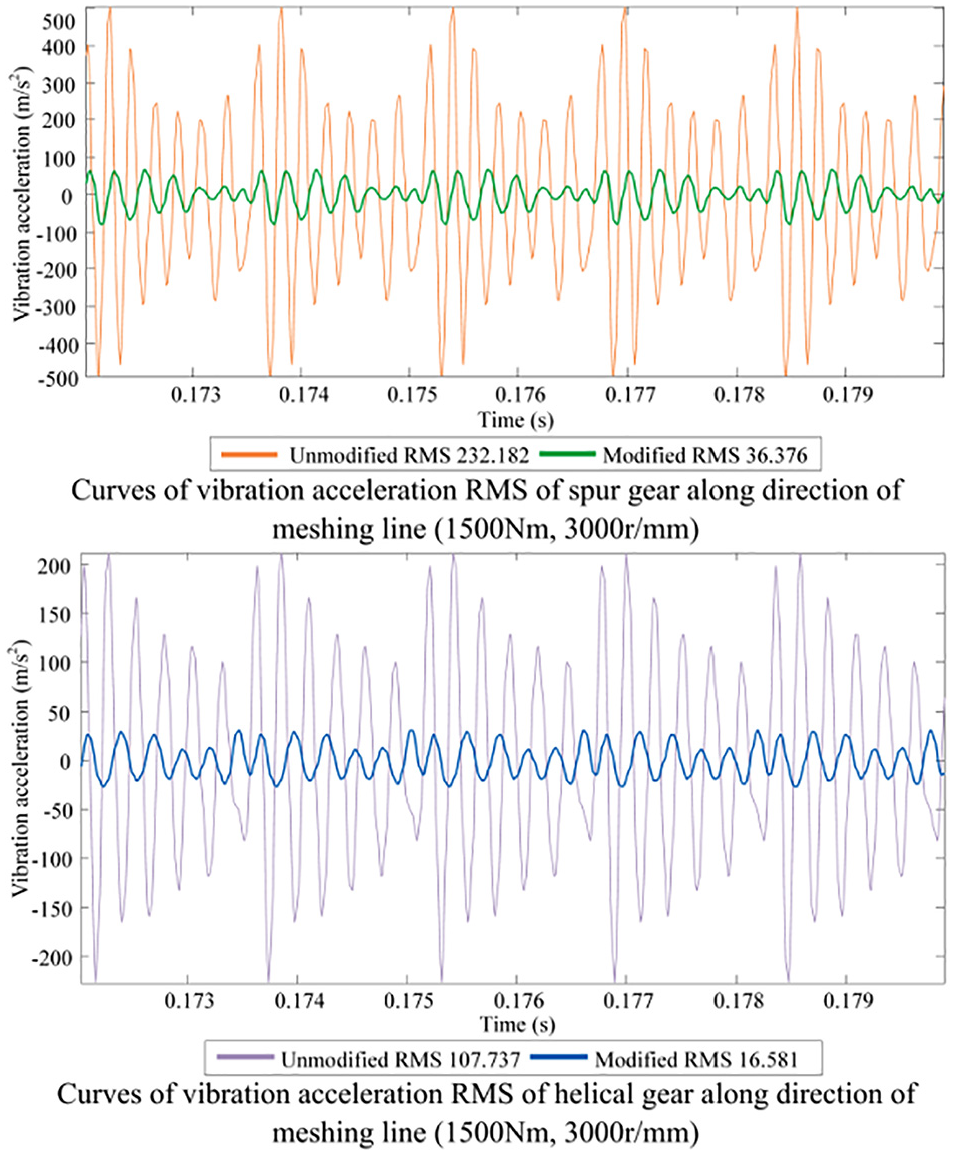
Vibration acceleration RMS response curves of spur/helical gears along meshing line direction (1500 Nm and 3000 r/mm).
Gear machining and installation errors lead to errors in determining the optimal modification amount, which is not the ideal modification amount. The variation law of load distribution coefficient (ζ) of spur gear with different base pitch error (err) is derived in Figure 12. When the base pitch error err >0, the length of single teeth meshing area increases and the length of double teeth meshing area decreases or even disappears; when the base pitch error (err < 0), the length of single and double teeth meshing area is constant, but the load fluctuates and changes abruptly.

Load distribution factor (ζ) of spur gear considering different basic pitch errors (err).
Considering different base pitch errors (err/rad) of spur gears, as shown in Figure 13, when the base pitch error (err > 0), the angular error (err/rad) is upward convex and wave distribution; when the base pitch error (err < 0), the angular error (err/rad) has mutation and causes vibration to produce dynamic load. Moreover, the fault-tolerant ability of alternate meshing in real-time all working conditions become weak.

Variation curves of rotation angle error (err/rad) of spur gear considering different basic pitch errors (err).
Influence analysis of TSM fitting optimization on temperature field
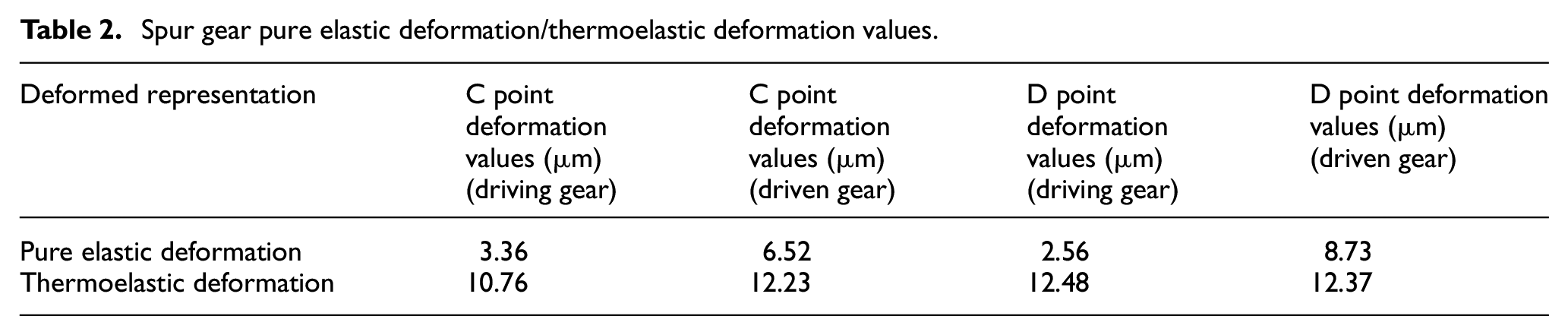
The TSM fitting optimization will cause redistribution of contact load and friction heat flux load on alternate meshing teeth surface, and then affect the temperature distribution of teeth body and instantaneous contact temperature of teeth surface. The structural parameters of single teeth spur gear are proposed in Table 1, and Table 2 describes the comprehensive parameters of TECs. Limited to top modification of the pinion and large gear when pinion is meshing, the thermoelastic comprehensive deformation is obtained based on the coupled finite element analysis of the TECs, and then the influence of gear body temperature field on its modification and deformation is analyzed. The lubricating oil temperature is set to 55°C.
TECs comprehensive deformation of spur gear.

Spur gear pure elastic deformation/thermoelastic deformation values.
For the dimensionless linear coordinate system (considering temperature or not), the position of meshing line is represented, and then the modification curve is determined. The equation of spur gear profile modification curve
It can be seen from Table 2 that the elastic deformation of driving gear and driven gear is 2.56 and 8.73 μm at point D of meshing position, and 3.36 and 6.52 μm of driven gear and driven gear respectively at point C of B2 meshing position. Considering the influence of temperature, that is, the teeth deformation is the comprehensive deformation of TECs.
The comprehensive deformation of the driving and driven gears is 12.48 and 12.37 μm at point D of B1 meshing position, and 10.76 and 12.23 μm respectively at point C of B2 meshing position.
The influence of temperature on teeth modification curve cannot be ignored, especially for high-speed and heavy-duty gear modification design. In Figure 14, based on the position of gear meshing starting point B1, the theoretical modification amount of driving gear top is
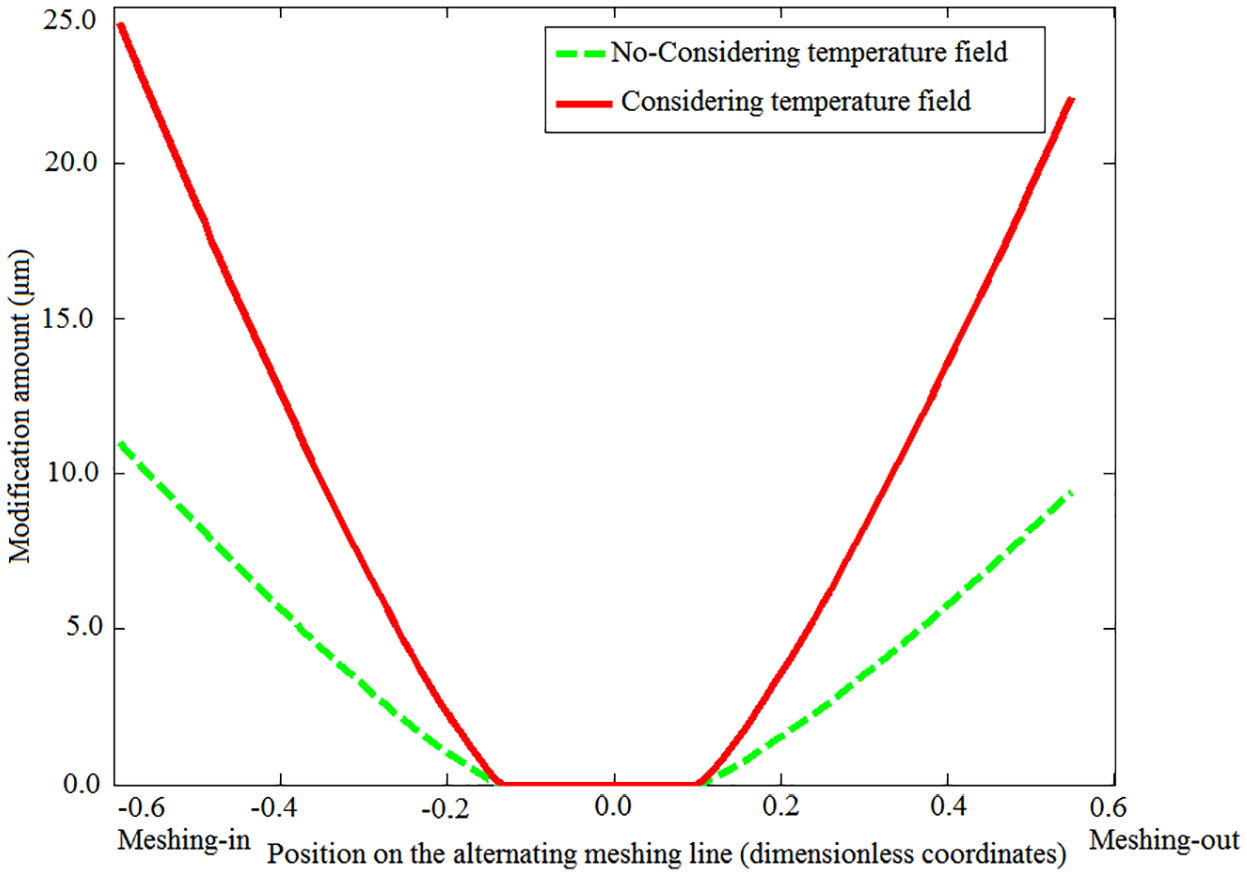
Ideal profile modification curve of spur gear (considering temperature or not).
Analysis of coupling influence of TSM fitting on its TECs
The gear teeth optimized for TSM fitting can further improve its thermoelastic coupling characteristics, in order to enhance the comprehensive performance of thermoelastic anti-scuffing load-bearing, in order to improve the GTS operating life and its stability, which can also reduce vibration and noise.
Analysis of coupling influence of spur gear modification fitting on its TECs
Two check conditions of Spur optimal modification (smooth meshing time domain) and improvement of load-bearing performance (anti-thermoelastic scuffing) are set to analyze the effect of TECs coupling, see Table 3.
Parameters of spur gear pairs.

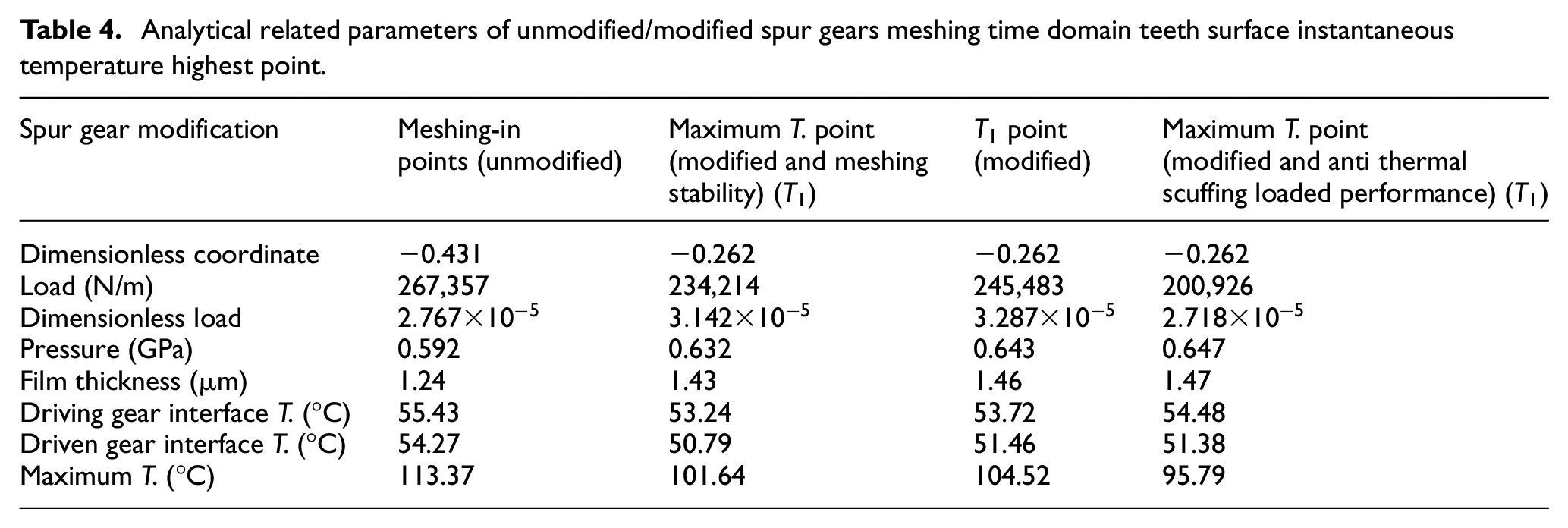
From the data in the above chart, the maximum value of the unmodified spur gear interface temperature and the teeth surface instantaneous temperature (high thermal T.) along the meshing line in time domain are greater than those of the modified spur gear, but the minimum film thickness is less than the modified. The minimum film thickness (minimum oil film thickness) is the main thermoelastic characteristic quantity for evaluating the anti-thermoelastic scuffing load-bearing performance, see Figure 15 and Table 4 above.

Analysis and comparison of spur gears temperature of unmodified/modified based on ISO standards (distributed along meshing line).
Analytical related parameters of unmodified/modified spur gears meshing time domain teeth surface instantaneous temperature highest point.
Analysis of coupling influence of helical gear modification fitting on its TECs
This section only considers the helical gear TSM as the optimal check condition. Table 5 indicates the parameters of helical gear pairs. According to the ISO standard, the temperature distribution trend of the unmodified helical gear along the meshing line is analyzed and compared, as shown in Figure 16.
Parameters of helical gear pairs.


Analysis and comparison of helical gears temperature of unmodified/modified based on ISO standards (distributed along meshing line).
The maximum instantaneous temperature of the unmodified helical gear teeth surface is located at the initial point of meshing time domain. The coordinates of the highest instantaneous temperature of the optimal modified helical gear teeth surface are −0.237 (dimensionless). The parameters related to the highest point of the teeth surface instantaneous temperature in the meshing time domain of unmodified helical gears are shown in Table 6.
Analytical related parameters of unmodified/modified helical gears meshing time domain teeth surface instantaneous temperature highest point.
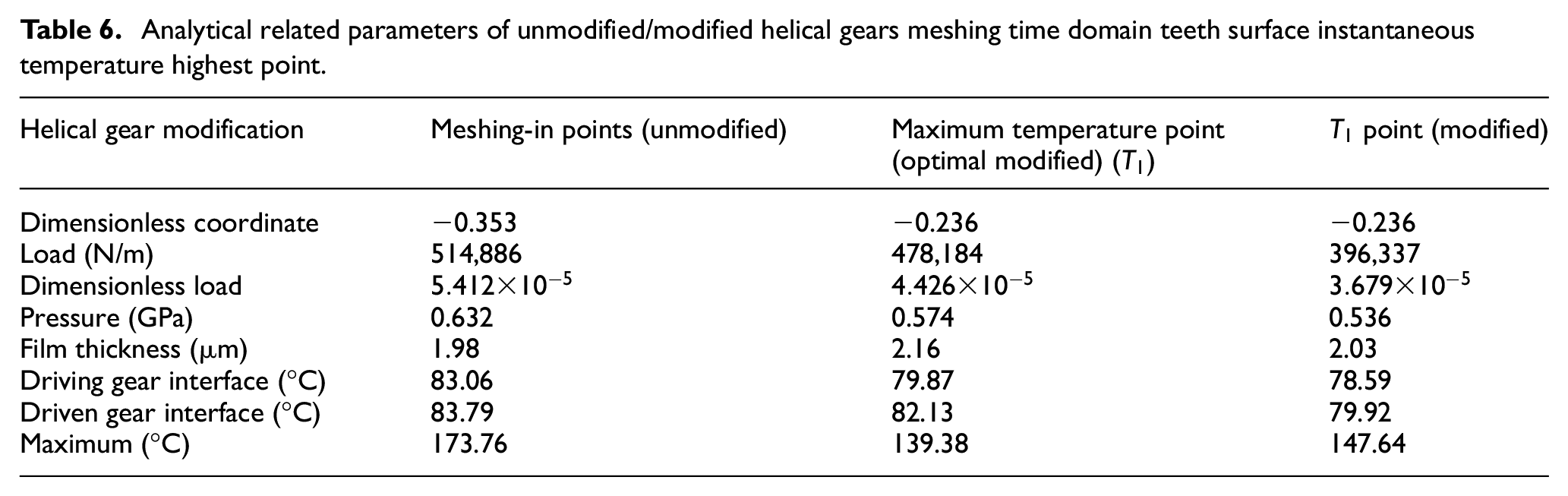
From the data in Figure 16 and Table 6, it can be seen that the optimal modified helical gear interface temperature along the meshing line in time domain and the maximum instantaneous teeth surface temperature (high thermal T.) are less than the unmodified values, and the film thickness is the minimum. The value is larger than that of the unmodified helical gear.
Type experiment of gear teeth interface temperature monitoring in meshing time domain
Bench test of meshing gear teeth interface temperature of closed power cycle transmission system
The meshing gear teeth interface temperature test bench of the closed power cycle transmission system (CPCTS) is constructed on the main test bench of the power flow cycle closed transmission gear pair and the thermoelectric coupling type temperature acquisition and monitoring control system is attached. The main test bench includes a supporting base, a running platform, a test host, an oil pump circulation system, an electrical control box, and auxiliary loading test sensing equipment.
The schematic diagram of structure layout of CPCTS interface temperature test bench and physical diagram of type working condition joint load test are shown in Figure 17.

Joint commissioning load test for structural layout and type working conditions.
Thermoelectric coupling type temperature acquisition/monitoring and control system
Taking into account the transient process of adapting to alternate meshing of gear pairs, the dynamic monitoring of instantaneous temperature of the CPCTS meshing gear teeth interface is based on thermoelectric coupling temperature acquisition and monitoring control system.), thermocouple temperature sensor, collector ring (collecting slip ring), collecting signal, monitoring signal and real-time recording, signal online processing, and display, as shown in Figure 18.

Thermoelectric coupled type temperature acquisition and monitoring control system.
The experimental analysis of the influence of speed-load factors on meshing gear teeth interface temperature
The effect of the speed-load interconnection on the surface temperature of the meshing gear teeth under time-varying conditions is explored, with a view to revealing the change and distribution of the teeth surface temperature of the alternate meshing gear under different speed and load conditions. The test uses a CPCTS teeth surface temperature test bench, based on standard tests. The load level is applied, and the test speed is set to 300, 550, and 800 rpm. The duration of the test is 20 min. Brand SAE85W/140 lubricating oil can obtain real-time data of interface temperature test in meshing time domain of speed-load interconnection factor, as shown in Tables 7 to 9.
CPCTS test bench level 2 test load data.

CPCTS test bench level 4 test load data.

CPCTS test bench level 6 test load data.

In view of the collection of real-time test data and subsequent records and post-analysis and processing through Matlab programming software are shown in Figures 19 to 21.
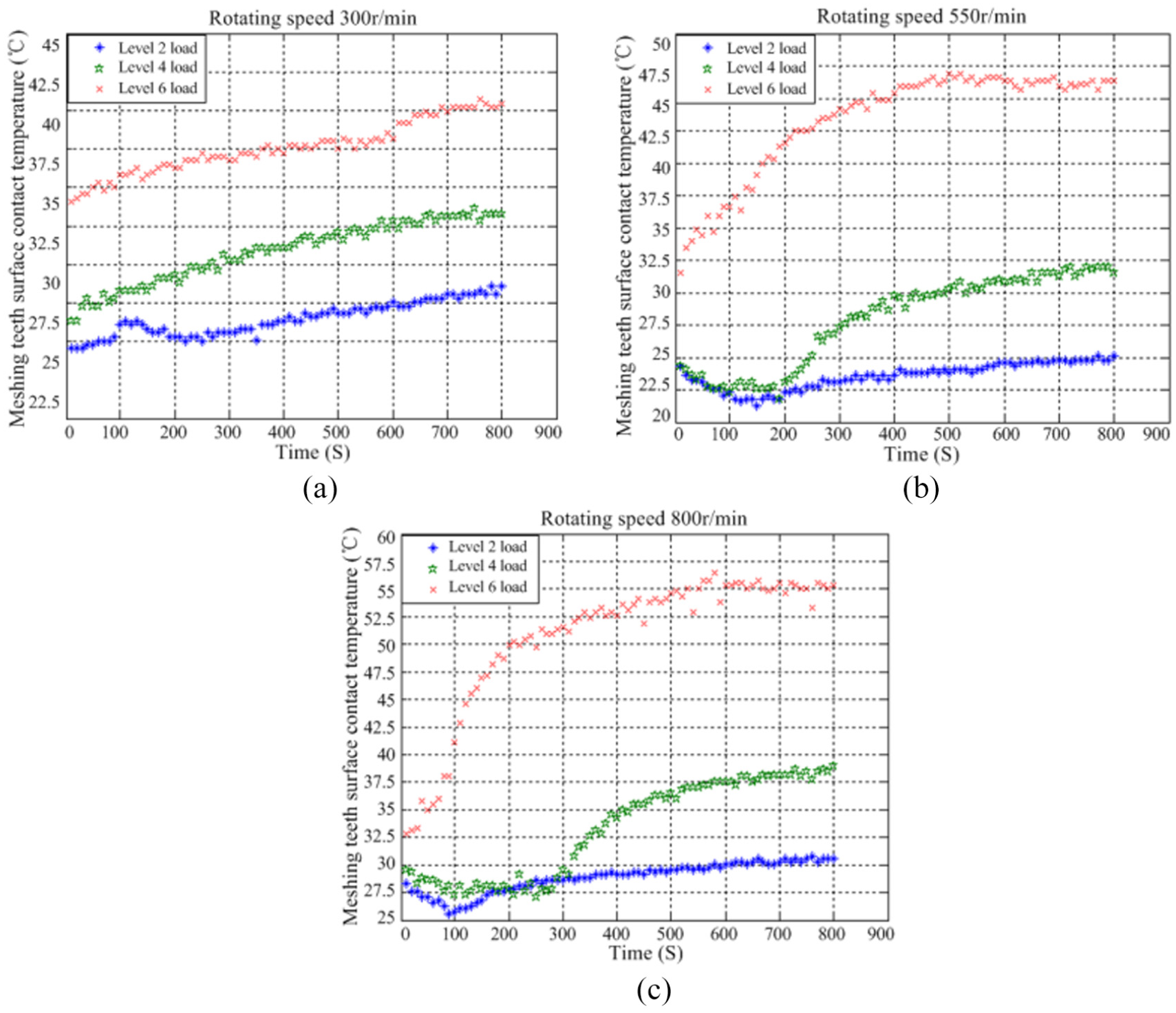
Teeth surface contact temperatures with different loads and same rotating speed: (a) temperatures with loads (300 rpm), (b) temperatures with loads (550 rpm), and (c) temperatures with loads (800 rpm).

Teeth surface contact temperatures with different speeds and same load: (a) temperatures with speeds (level 2), (b) temperatures with speeds (level 4), and (c) temperatures with speeds (level 6 load).

Teeth surface steady-state contact temperatures with different loads and speeds.
The results can be obtained by analyzing the test data of the above graphic table.
The surface meshing temperature of the gear teeth increases significantly when the load is high and the rotation speed is high. It can also be understood as: the greater the influence of the load-speed parameter interconnection, the higher the power transmission input causes the gear tooth surface temperature to rise rapidly.
Taking into account the continuous operation of the alternate meshing transient process and the accumulation and dissipation of the friction heat flow of the gear teeth, the contact temperature of the tooth surface is close to the steady state under the same load speed.
The dynamic cycle of periodic heat collection and heat dissipation results in short-term fluctuations in meshing gear teeth interface temperature.
Conclusions
For this pre-research topic, considering the gear comprehensive error, modification status, and accurate teeth surface geometric parameters, based on the theoretical teeth surface superposition, the TSM fitting is proposed, and the 3D and diagonal modification optimization design is revealed, and the position and normal vectors of the modified surface are derived. Based on LTCA, a variety of optimization modification models are established, and the complex surface is analyzed to fit the thermoelastic contact numerical simulation of actual teeth surface, it is expected to reduce the transmission error and vibration noise of GTS in order to improve the meshing gear teeth load-bearing performance. The results show that, compared with the previous analysis methods, the proposed analysis method is effective and simple.
The results show that there is no edge contact after three-dimensional topology modification, but the teeth tip edge contact cannot be avoided after diagonal modification. The multi load transmission error and load transmission error amplitude are significantly reduced after fitting optimization.
The modified teeth profile reduces the impact of meshing, the optimally fitted meshing-in and meshing-out ends do not bear load, and the alternate meshing area of the modified single tooth is increased.
In view of the three-dimensional topology modification, the teeth surface lubrication state is improved, and the accumulated amplitude of the instantaneous teeth surface temperature rise at the meshing-in and meshing-out ends is obviously reduced, but the accumulated amplitude of the instantaneous temperature rise of teeth surface near the node element is not easy to fall.
After modification, the load transmission error and meshing impact are reduced, and the root mean square of acceleration is also reduced. It shows that the multi-objective optimization analysis of TSM can significantly reduce the transmission error, meshing impact and vibration acceleration RMS, and further improve the alternate meshing performance of thermoelastic properties of gear teeth interface.
Based on the width/narrow and long and small helical teeth tip modification value is not greater than its optimal modification value and the large helical teeth tip modification value is greater than its optimal modification value, it can cause a large helical teeth tip circle radius to reduce and the actual length of the meshing line to decrease. The near area of point A presents a point that does not mesh alternately, and the near area gear temperature of point A is regarded as wide/narrow and large/small helical gear body temperature (teeth temperature).
The results show that the length of the addendum is larger than the optimal value of the addendum, when the top modification value of small helical gear is not less than its optimal value and the modification value of large and small helical gear is not greater than its optimal value, the radius of small helical gear top circle can be reduced and the actual length of meshing line can be shortened. The near field of point E also shows a point which does not participate in alternate meshing, and the temperature of near field gear at point E is regarded as the interface temperature of the gear teeth body.
Footnotes
Acknowledgements
The authors would like to thank the Northeast Forestry University (NEFU), Heilongjiang Institute of Technology (HLJIT), and the Harbin Institute of Technology (HIT) for their support.
Handling Editor: James Baldwin
Declaration of conflicting interests
The author(s) declared no potential conflicts of interest with respect to the research, authorship, and/or publication of this article.
Funding
The author(s) disclosed receipt of the following financial support for the research, authorship, and/or publication of this article: The research topic was supported by the Doctoral Research Startup Foundation Project of Heilongjiang Institute of Technology (Grant No. 2020BJ06, Yongmei Wang, HLJIT), the Natural Science Foundation Project of Heilongjiang Province (Grant No. LH2019E114, Baixue Fu, HLJIT), the Basic Scientific Research Business Expenses (Innovation Team Category) Project of Heilongjiang Institute of Engineering (Grant No. 2020CX02, Baixue Fu, HLJIT), and the Special Project for Double First-Class-Cultivation of Innovative Talents (Grant No. 000/41113102, Jiafu Ruan, NEFU).
