



Abstract
A modern development in the field of fluid dynamics emphasizes on nanofluids which maintain remarkable thermal conductivity properties and intensify the transport features of heat in fluids. The present communication provides an innovative idea of MHD (magneto-hydrodynamics) unsteady, incompressible nanoliquid flow due to the stretching rotating disk with the effect of Joule heating and dissipation. The engine oil is used as a carrier fluid for an immersed rotating disk. A special type of nanoliquid, which consists of cylindrical shape nano materials CNTs (Carbon Nanotubes), is being taken into an account. The CNTs are assembled of both single and multi-walled carbon nanotubes. Some other factors such as the effect of joule heating and viscus dispassion are also used in this investigation. The foremost set of PDEs (Partial Differential Equations) of our model is reformed to the dimensionless form via invoking suitable variables. The resultant set of equations is sketched out through RK-4 method. Furthermore, the velocity profile and energy distribution versus dimensionless flow factors have been sketched and discussed. Also, the outcomes of important engineering curiosity like Nusselt number and skin friction are depicted and interpreted by taking various model factors. Radial and transverse velocity fields, declines via
Keywords
Introduction
In recent years, researchers have drawn considerable attention to improving heat transfer in engineering and industrial uses. This is because, for instance, the performance of most equipment’s in this field depends significantly on the heat transport rate of electronic devices and heat exchangers. Heat transfer fluids like oil, ethylene glycol, and water limits the heat transfer rate since the thermal conductivity of these fluids are very low. As we know that the thermal performance of fluid may improve in a case of using solid particles. The merger of some solid (metallic, nonmetallic, carbon nanotubes, carbon nanorods) nanoparticles to upsurge thermal conductivity is considering a new and novel procedure. This merged fluid is called as nanofluid and the small solid or metal particles are called nanoparticles. Nanofluid can be the best possible exploited to be used in heat transmission accounting, industrial cooling applications, bio-medicine and paper production, chemical reactor even in nuclear sectors, fuel cells, domestic refrigerators, automobile thermal management, and many other fields. 1 It was Choi and Eastman, 2 who for the first time presented the idea of nanofluid, being used for the enhancement of thermal conductivities then other common liquids. The analytical results for transfer of heat through MHD flow in nanofluid was addressed by Turkyilmazoglu. 3 Khan et al. 4 reported the expression of nanofluid flow through swinging sheet. In this direction, several scientists5–8 have studied nanofluid flow from several aspects. But in the last few years, the heat transport in carbon-nanofluids has grown an extensive attention among the researchers in different sectors of technologies. Carbon Nanotubes are the simple chemical structure along with the composition of carbon atoms, rolled in cylindrical form. Carbon Nanotubes have superior prominent thermo-physical, chemical, and mechanical features, can be utilized easily as a nanoparticle in base fluid. They have unique advantages such as large surface area, tube shape, configuration, chemical stability, hardness, and their smallest dimension over other nanoparticles. Below is the list of analysis of Carbon Nanotubes nanofluid. Haq et al. 9 examined the numerical outcomes for conducting fluid and heat exchange due to carbon nanotubes merged in various based fluids over an extending sheet using numerical scheme. The influence of carbon nanotube water based nanoliquid (micropolar) on heat transport and MHD flow between two rotating disks using HAM technique was employed by Rehman et al. 10 Rehman et al. 10 reported the influence of magnetic field on non-Newtonian fluid containing CNTs. Mahanthesh et al. 11 studied the nanofluid flow under the impact of heat source, cross diffusion, and exponential space. The entropy generation between two rotating disks of CNTs nanofluid flow in the presence of thermal radiation and MHD was examined by Hosseinzadeh et al. 12 Chamka and Djezzar, 13 Reddy et al., 14 and Almeshaal et al. 15 have studied the CNTs Water nanofluid using various mathematical models for the enhancement of heat transfer analysis. Several other valuable scholars’ articles have been available in literature that can be mentioned to references16–18 for additional study.
The effect of the moving objects in a rotating system produces a force acting vertical to the direction of motion and the axis of rotation called the Coriolis force. The Coriolis force has a vital role in the fluid motion over a rotating disk. Gaspard-Gustave de Coriolis is the pioneer to investigate the consequences of the Coriolis force on the water wheels. The idea of rotation and its significance are mainly used in the automobile industry, rotating machinery, petroleum industry and medical equipment, and so on. Persson
19
presented the appropriate equation for the
For the last few decades, the theory of MHD is extremely appreciated for the various engineering and scientific purposes. It is actually the combination of fluid velocity with magnetic field. Such well-organized fact was first applied for different problems related to geophysics and astrophysics. In recent times, the MHD flow and heat exchange have achieved vital roles in agronomic engineering, industry of petroleum, and medical field. In this context, Davidson, 32 Steg and Sutton 33 presented several applications appearing in the various fields of medical and engineering as well due to which MHD has grown the consideration of scientist. Hayat et al., 34 Pal and Mondal 35 examined the impact of MHD and heat (source/sink) on 3D water based nanofluid flow. Interesting results of nanofluid flow through stretching surface in the presence of MHD and thermal radiation were communicated by Ramzan et al. 36 Furthermore, additional interesting and recent studies on MHD and RK-4 method can be seen in Arqub and Rashaideh, 37 Arqub, 38 and Momani et al. 39
Having inspired from the above mention perceptions, in this work we have represented the consequence of MHD on unsteady flow of nanofluids over a rotating frame. An advanced type of nanoliquid, which consists of cylindrical shape nano materials CNTs is being taken into an account. The CNTs are assembled of both single and multi-walled carbon nanotubes. Some other factors such as the effect of joule heating and viscous dispassion are also used in energy expression. In this study, our core purpose was to expose how the different flow features (velocity, temperature, and heat transport) are affected owing the inserting factors for CNTs nanofluid. Furthermore, the influences of different parameters in the nanofluid flow regimes presented statistically and graphically.
The novelty of the present work is pointed out by making extension of the published work of Turkyilmazoglu 24 as:
The recent work is based on the unsteadiness while the published work 24 is the steady case.
The magnetic field is added in the present work.
Turkyilmazoglu 24 is extended with the viscous dissipation.
In the present study the CNTs (Carbon Nanotubes)-Engine Oil nanofluid has been focused for the heat transfer enhancement applications.
Finally, to the best of authors, information, not any investigation as deliberated in this study have far been communicated and analysis on engine oil based CNTs nanofluids problems is very rare.
The main objective of the present work is to fill the gap in the literature, so we apply the numerical scheme. The transformed system of equations is tackled with the RK-4 method.40,41
Mathematical formulation
Statement of the problem
Let us presume the unsteady flow of Single Walled Carbon Nanotubes (SWCNTs-engine oil) and Multi Walled Carbon Nanotubes (SWCNTs-engine oil) nanofluid over an axisymmetric disk as shown in geometry. To formulate our work, we have considered some assumptions as
We have assumed that the disk rotates about its own axis through an angular velocity
Here
The
The pressure term is assumed to constant, so that its gradient vanishes.
Free stream and the disk surface temperature are specified through
We consider the Joule heating and dissipation in energy expression.
No chemical reaction and no slip occur among nanoparticles and base fluid.
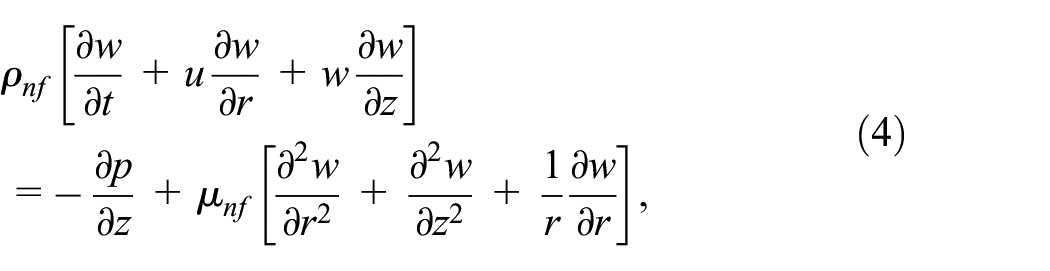
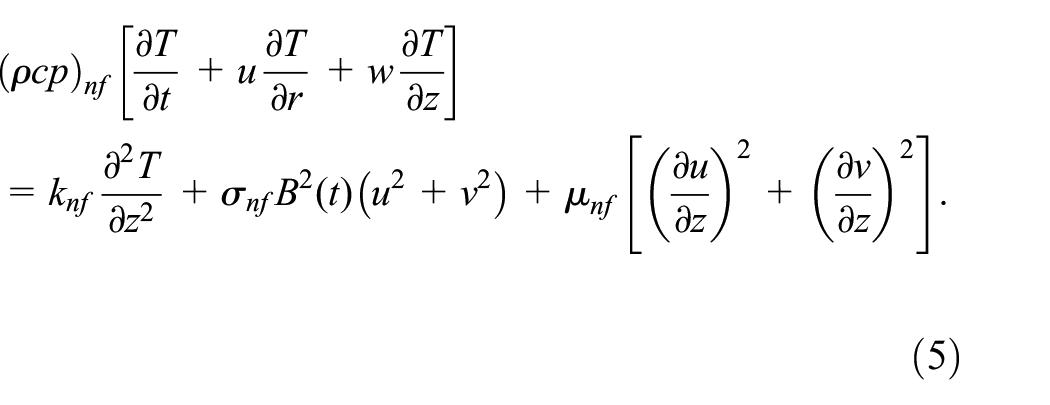
Under these assumptions, the law of conservation of mass, momentum, and energy takes the following form24,42–44:



Here
Thermo-physical properties
The several effective models of (Carbon nanotubes) CNTs nanofluid are described in the Table 1. Also, different thermo-physical information of both (SWCNTs and MWCNTs) small nano-size particles are listed in Table 2. Where “
Physical constraints. 45

The thermophysical properties.

The physical conditions
The unsteady initial and boundary conditions are:

The
Transformations
Where, we apply the Karman appropriate scaling approach to diminish our model in non-dimensional form

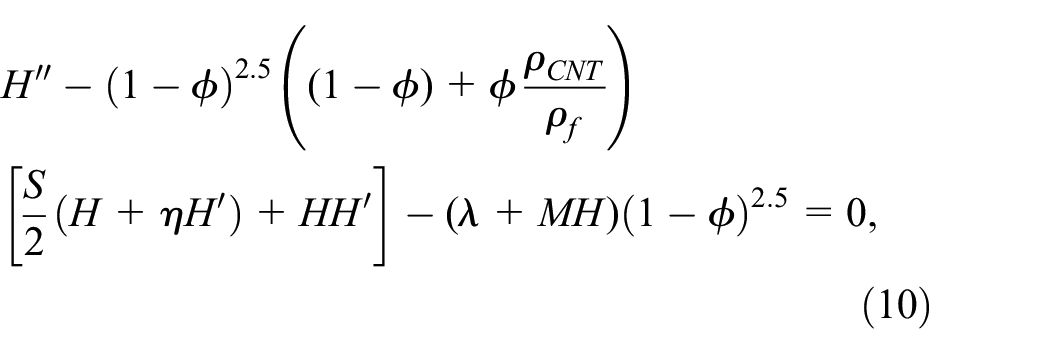
Now, with the help of these transformations as in equation (7), equations (1)–(5) are altered as:



The physical conditions after transformation are:

Where, the dimensionless factors of our investigations are:

Solution methodology
Solution by RK-4 method
In the RK4-method the higher order derivatives are reduced in the first order system of the differential equations. The variables are designated as:

The equations (8)–(11) are transformed into the first-order system and using the RK4-technique.
We converted the equations (7)–(11) into the system of first-order equations as:

Engineering curiosity
The drag force and heat transfer rates are defined as:

The radial stress is

Physical parameters of interest, including skin friction and heat transfer rates are reflected as:

Graphical results and discussions
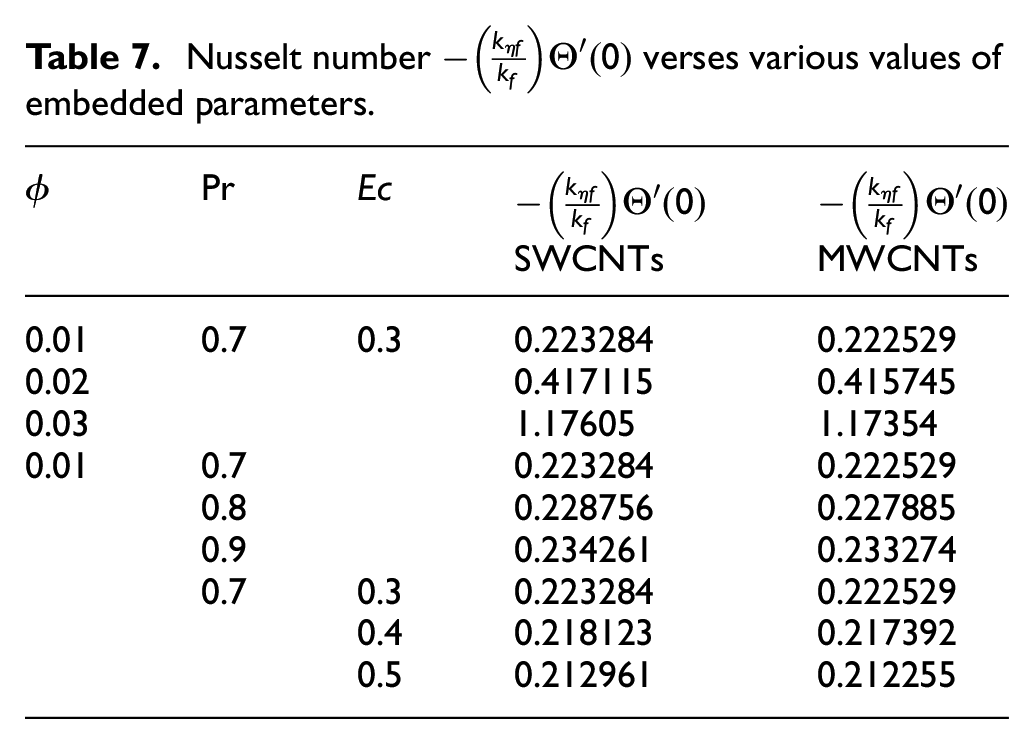
In this section, the physical trend of the engaged parameters on heat transport and nanofluid velocity has been investigated for both CNTs nanoparticles that is SWCNTs and MWCNTs. The outcomes of this analysis are exhibited comprehensively through tables and graphs for two types of CNTs recognized as single and multi-walled CNTs. Several models of CNTs nanofluids are described in Table 1. Also, thermo-physical information of both small nano-size particles are listed in Table 2. Various information of thermal conductivity values at different volume fraction are itemized in Table 3 for single and multi-walled CNTs. The present work has been compared with the existing literature Turkyilmazoglu
24
in Table 4 by eliminating the extension terms. The numerical results for surface drag force
The thermal conductivity values at different volume fraction. 45

Comparison of the present work with the existing literature when

Skin friction
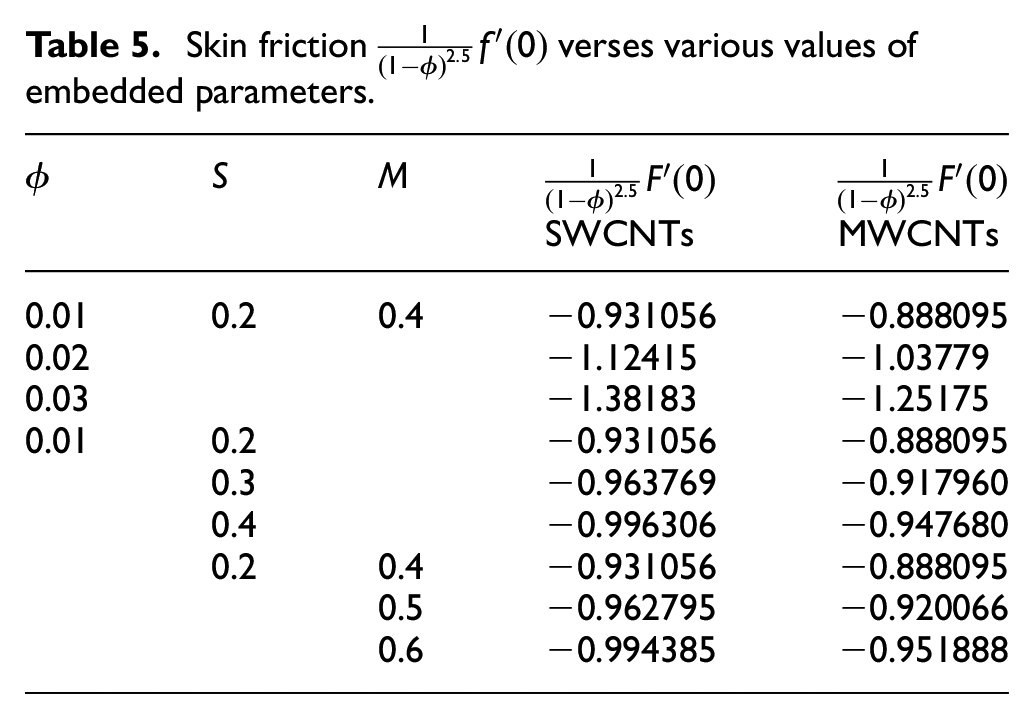
Skin friction

Nusselt number

Geometry of the problem.
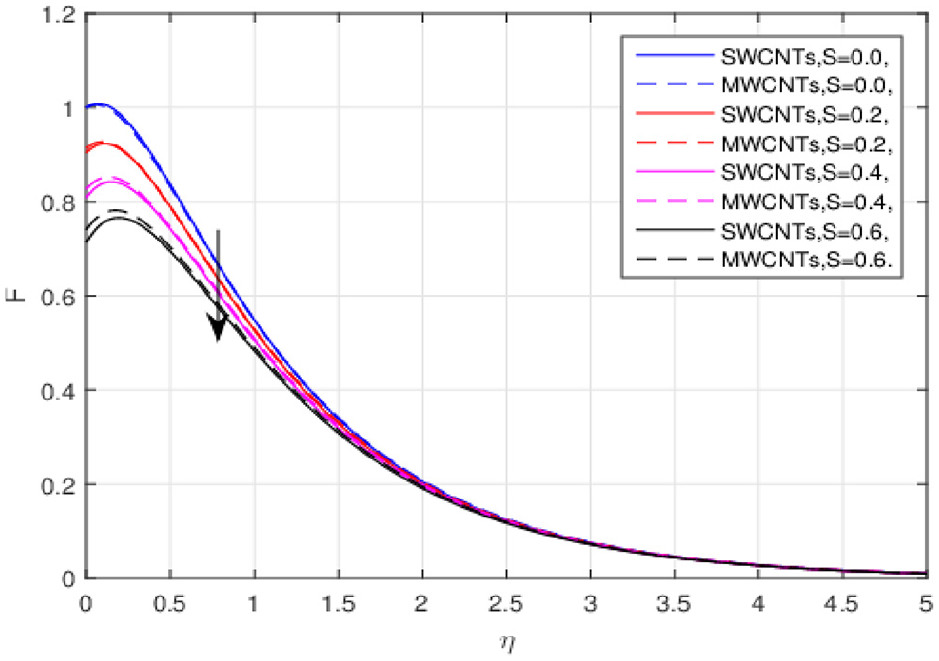
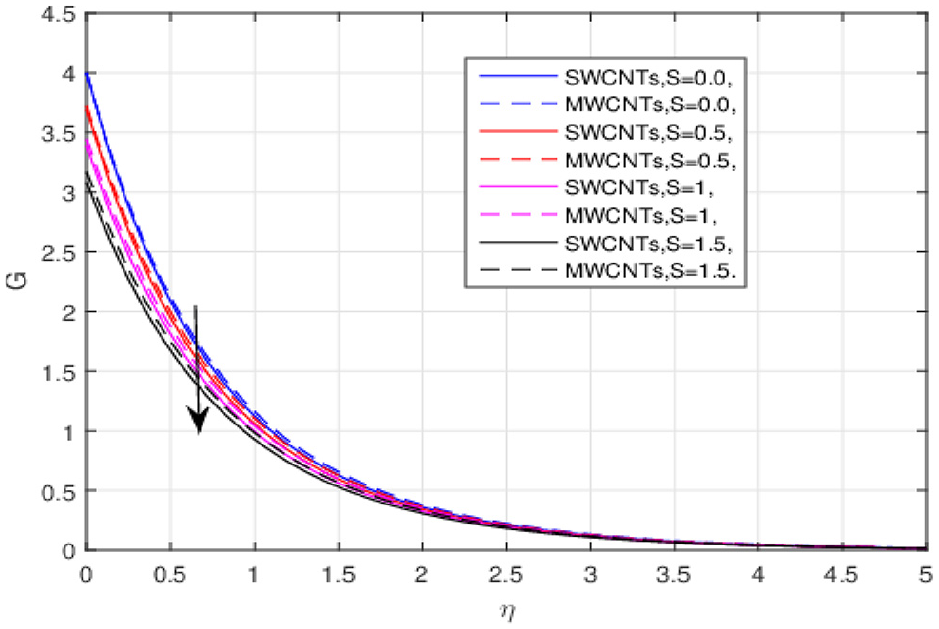
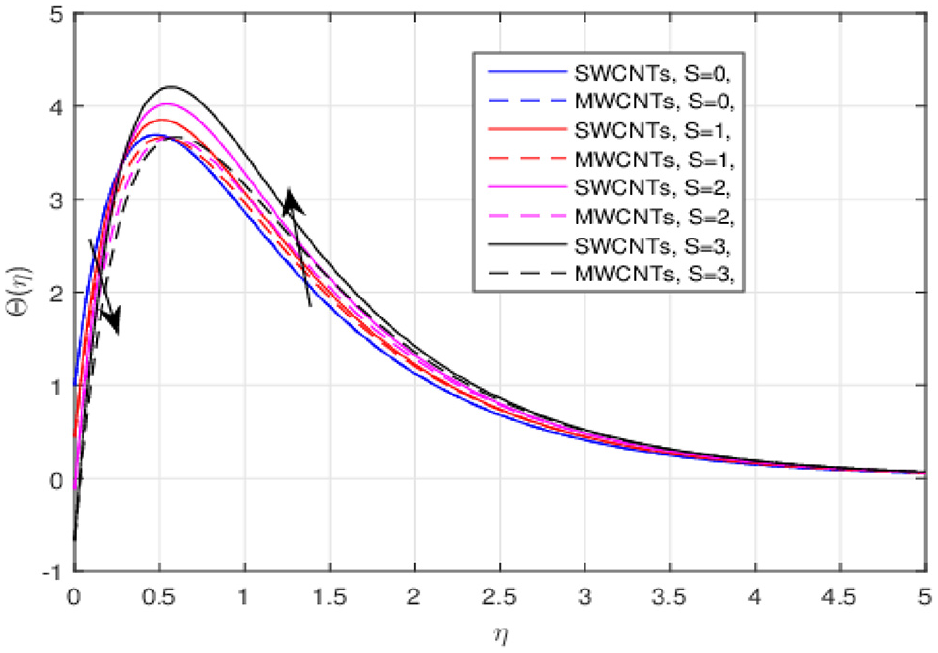
Figures 2 and 3 exposes that the radial velocity component (F) of nanofluid declines gradually as the value of M growing and the transverse component of velocity (G) reduces respectively for single and multi-walled CNTs-engine oil nanofluids. The basic fact of such reducing situation is the opposing force, which is generated by virtue of Lorentz force. It is observed that redial and transverse component of velocity decline more rapidly of multi walled CNTs as compared to multi walled CNTs. The influence of


The influence of M (magnetic factor) on temperature


Conclusion
A reformed unsteady flow model for engine oil composed by CNTs (carbon nanotubes) over a stretchable rotating disk with the effects of MHD, Joule heating and dissipation in energy expression is explored. The comparison of the SWCNTs and MWCNTs nanofluid under the impact of the physical constraints has mainly focused. The published work is extended using the concepts of the unsteadiness, CNTs, Engine oil, and viscous dissipation. The main impacts of the nanofluid flow factors on radial, transverse velocity, and temperature field are pointed out as:
Radial and transverse velocity fields, drops via
The larger estimation of
The greater
The recent study concluded that the impact of the physical constraints is comparatively strong using the SWCNTs. In fact, this is happening due to the strong thermos physical properties of the SWCNTs.
Footnotes
Appendix
Acknowledgements
The authors are like to acknowledge with gratitude, the financial, and moral support provided by the
Handling Editor: James Baldwin
Declaration of conflicting interests
The author(s) declared no potential conflicts of interest with respect to the research, authorship, and/or publication of this article.
Funding
The author(s) received no financial support for the research, authorship, and/or publication of this article.

Data availability statement
The data that support the findings of this study are available from the corresponding author upon reasonable request.