



Abstract
This work concerns a theoretical investigation on the effects of suction/injection, magnetic field, permeability of porous materials and viscous dissipation on an electrically conducting incompressible fluid passes through a vertical porous channel filled with porous materials. One of the plates moves in the flow direction while the other is stationary. The governing coupled flow equations have been solved analytically using Homotopy Perturbation Method (HPM). The influences of the flow parameters on velocity and temperature were plotted on graphs while numerical values for rate of heat transfer and shear stress on the heated and cold plates were presented in tables. Excellent agreements were found when compared with the previous works. It is noteworthy to mention that the hydrodynamic and thermodynamic distributions of the fluid increase with increase in viscous dissipation
Introduction
The study of fluid dynamics nowadays has received a great interest and concern due to its applications in science and engineering. These applications could be found in geothermal energy, gas turbines, plasma physics, petroleum industries, cooling of nuclear reactors, food processing industries, nuclear power plants, gas drainage, lubrication industries etc. Investigation on electrically conducting fluid in the presence of magnetic field: Magnetohydrodynamics (MHD), permeability, suction/injection, heat source/sink and viscous dissipation in different media is of great importance since fluid flow and heat transfer are inevitable transports either naturally or forcibly.
Jha and Ajibade 1 studied a transient case of a free convective flow of heat generating/absorbing fluid in a vertical channel. They showed that an increase in heat absorption led to increase in the rate of heat transfer on the moving plate and causes a decrease in the heat transfer on the stationary plate. Effects of chemical reaction and radiation absorption on an unsteady MHD natural convection flow through a semi infinite vertical channel in the presence of heat source and suction was studied by Ibrahim et al. 2 They concluded that the velocity profile decreases with increasing magnetic field. Asadolah et al. 3 investigated effect of magnetic field on fluid flow in a pipe. He has shown that the magnetic field reduces the axial flow velocity of the central stream of the pipe. Ajibade and Umar 4 studied effects of chemical reaction and radiation absorption on an unsteady magnetohydrodynamics free convection flow in a vertical channel which is filled with porous materials. They concluded that the velocity profile increases with increase in permeability parameter of the porous materials. Nadeem et al. 5 studied MHD flow of a three-dimensional casson fluid past a porous sheet. They found that the velocity profile decreases with increase in magnetic field and porosity parameters. Ajibade and Umar 6 studied combined effects of diffusion-thermo and chemical reaction on an unsteady magnetohydrodynamics fluid past through an inclined channel in the presence of heat and radiation absorption. They found that the velocity profile decreases with increase in magnetic field while it increases with increase in permeability of the porous materials. They also found that the fluid motion decreases with increase in heat absorption.
The internal mechanical energy generated as a result of continuous interaction of fluid particles which is irreversibly converted to kinetic energy is referred to as viscous dissipation. Gebhart
7
was the first researcher to investigate the effect of viscous dissipation on natural convection flow. He concluded that internally generated energy cannot be neglected in natural convection flow of high gravitational forces or a fluid of high Prandtl number. Recently, Dharmendar et al.
8
studied MHD flow of a nanofluid and heat transfer over an exponentially stretching porous sheet. They concluded that the temperature profile increases with an increase in viscous dissipation
Injection simply means administering a fluid into a system as in the case of blood transfusion while suction is the removal of fluid from a system. If the two happen at the same time, then the opposite sides of the plates are porous which allow coming in and out of the moving fluid. Suction/injection of fluid in channels has received a concern due to its application in science and engineering, food processing industries, cooling of electrical appliances, petroleum drilling industries etc. Jha et al. 16 analysed the effects of suction/injection and wall surface on natural convection flow in a vertical micro-porous channel. They concluded that increase in suction/injection led to decrease in velocity and temperature profiles. Uwanta and Hamza 17 numerically studied the effects of suction/injection on an unsteady convective flow of viscous reactive fluid past through a vertical porous channel while Falade et al. 18 found an exact solution of a Magnetohydrodynamics flow through a porous channel saturated with porous medium. The effects of suction/injection on a steady mixed convection flow through a vertical channel were investigated by Jha and Aina. 19 They found that suction/injection has effects on the micro-porous-channel surfaces. Jha et al. 20 studied a transient case of hydromagnetic-free convection flow in the presence of suction/injection and found that fluid velocity decreases with increase in suction/injection.
The aim of this research is to analyse the effects of viscous dissipation, suction/injection and magnetic field on a fluid passing through a porous channel. The applications of these fluid properties as they affect the hydrodynamic, thermodynamics, rate of heat transfer and shear stress between the porous plates and the fluids could be found in lubrication industries, food processing and food preserving industries, cooling of electric appliances, drilling of petroleum products, etc. When suction/injection, magnetic field, viscous dissipation are nullified and making the permeability of the porous materials so large, the work of Jha and Ajibade 1 has been recovered.
Mathematical analysis
We consider a fully developed Laminar flow of an incompressible viscous fluid passing through vertical parallel porous plates channel (see the Figure 1). The plates are porous giving rise to uniform suction with velocity


and the boundary conditions of the model are:


Schematic diagram of the problem.
The first, second, third and fourth terms of equation (1) are viscosity, suction/injection, magnetic/permeability and thermal buoyancy effects of the fluid respectively. The first, second, third and fourth terms of equation (2) are the thermal diffusivity, suction/injection, heat generation/absorption and viscous dissipation effects of the fluid respectively.
The dimensionless quantities used are:

Using the dimensionless quantities above, equations (1)–(2) are transformed in dimensionless form as:


And the boundary conditions are:

Where

Method of solution
Basic idea on homotopy perturbation method
The momentum and energy equations in the present work are coupled and nonlinear. To obtain a closed form solution of the model is not an easy task. Various solution methods have been derived for such problems ranging from perturbation methods, numerical solutions and several other approximate solution techniques. One of such approximate techniques which was proposed by He 21 is the homotopy perturbation method. The method is simple, effective and convenient to solve nonlinear and coupled boundary value problems. In addition, the limitation of small parameter that characterised the regular perturbation was overcame by the homotopy perturbation technique. He21–24 presented the new method by considering the nonlinear differential equation.
To solve the problem by the homotopy perturbation method, we construct the convex homotopy of the momentum and energy equations. Therefore, in the absence of initial approximation

such that

Substituting equation (9) into equation (8), we have

Comparing the coefficients of


⋮
The boundary conditions are transformed as

Similarly, since no initial approximation for equation (6). Therefore, it is transformed as

Substituting equation (9) into equation (16), we have
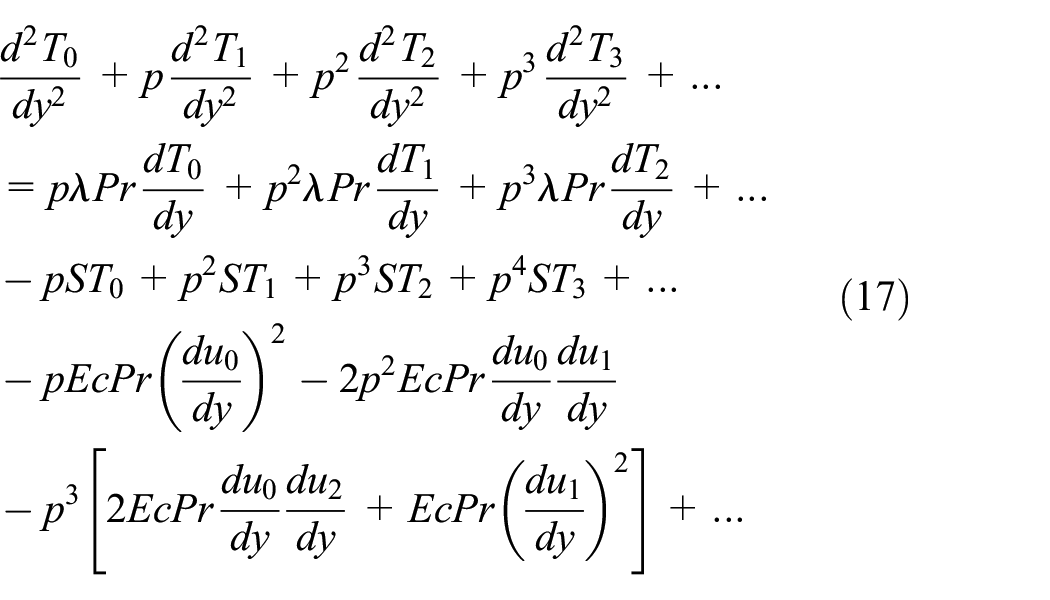
Comparing the coefficients of




⋮
The boundary conditions are transformed as

solving from above equations (11) and (18),


Applying the boundary conditions


Solving equations (12) and (19), we have


Applying the boundary conditions




Solving equations (13) and (20), we have


Applying the boundary conditions
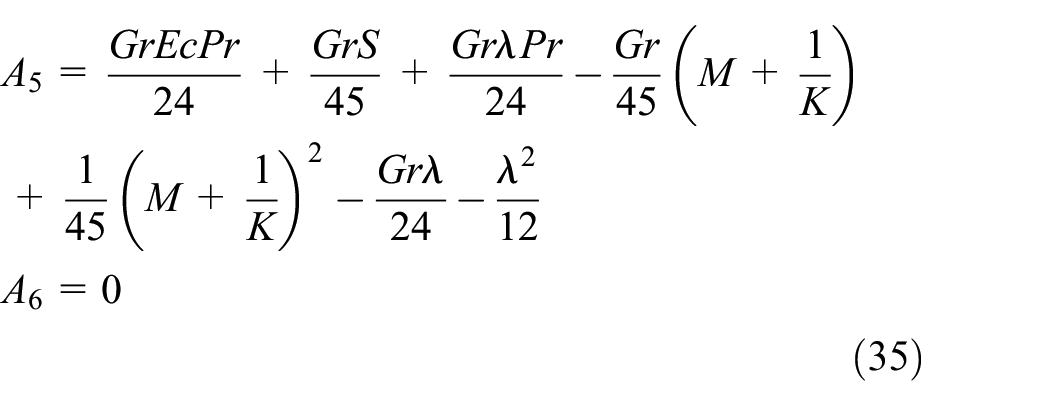
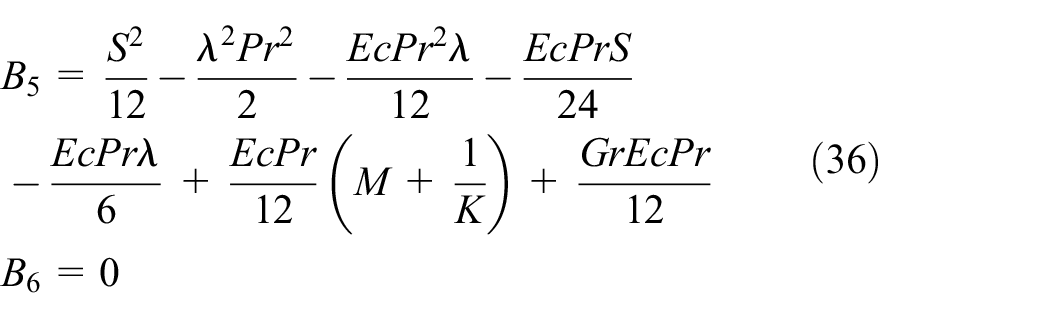
Therefore, the approximate solution of equations (5) and (6) are:


The physical quantities of interest are the skin friction and rate of heat transfer. Therefore the shear stress between the fluid at the heated and cold plate are given as:

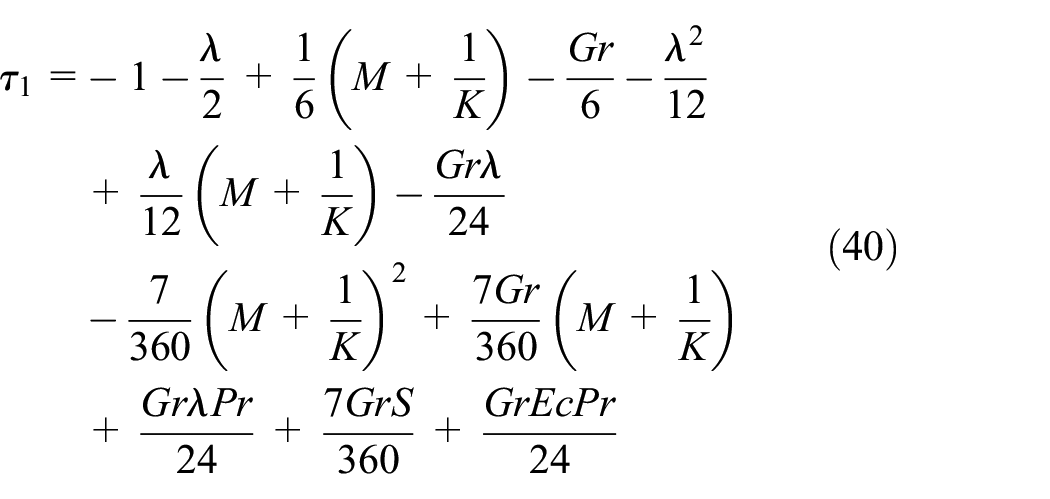
while the rate of heat transfers between the fluid and the heated and cold plate are given by:


Validation
The present work has been validated by comparing with the work of Jha and Ajibade 1 when the effects of viscous dissipation, channel plates porosity and transverse magnetic field are completely suppressed and the comparison which is presented in Table 1 is made possible when the permeability of the porous media is increased to the extent that its effect on the fluid flow is negligible. The table clearly shows an excellent agreement between the present problem and that of Jha and Ajibade. 1
Comparison between the present work and Jha and Ajibade. 1

Results and discussion
Effects of magnetic field, permeability parameter and suction/injection in the presence of viscous dissipation on an incompressible fluid passing through a vertical channel filled with porous materials were investigated. The working fluid is considered as air with
Figures 2 and 3 show the effects of
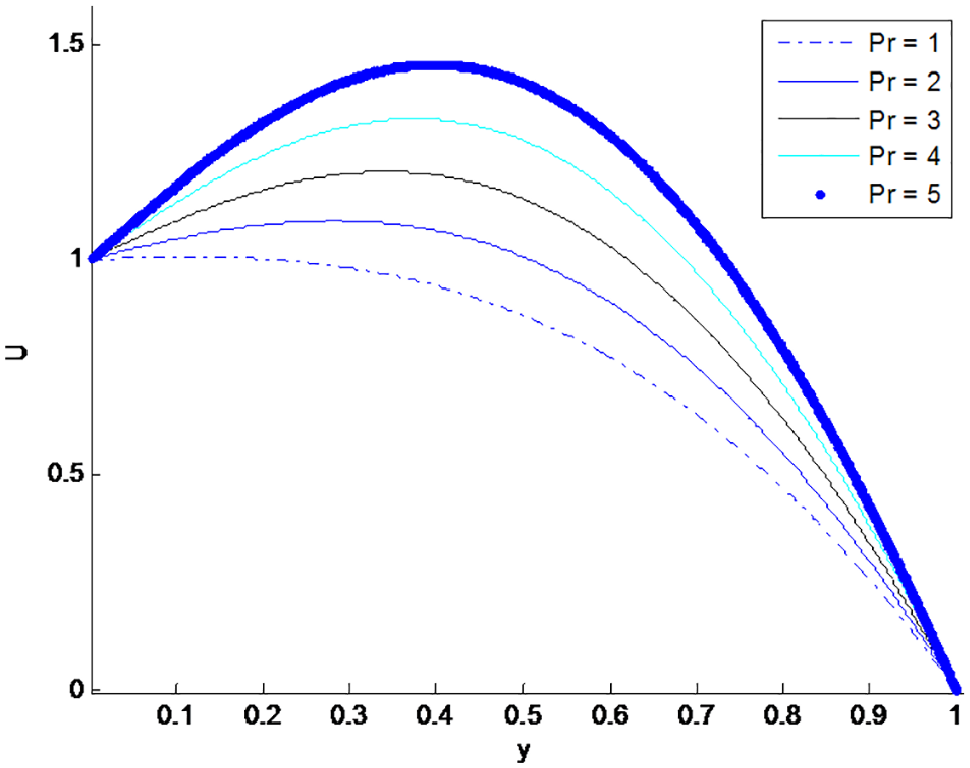
Velocity profile for different values of Prandtl number

Temperature profile for different values of Prandtl number
For different values of
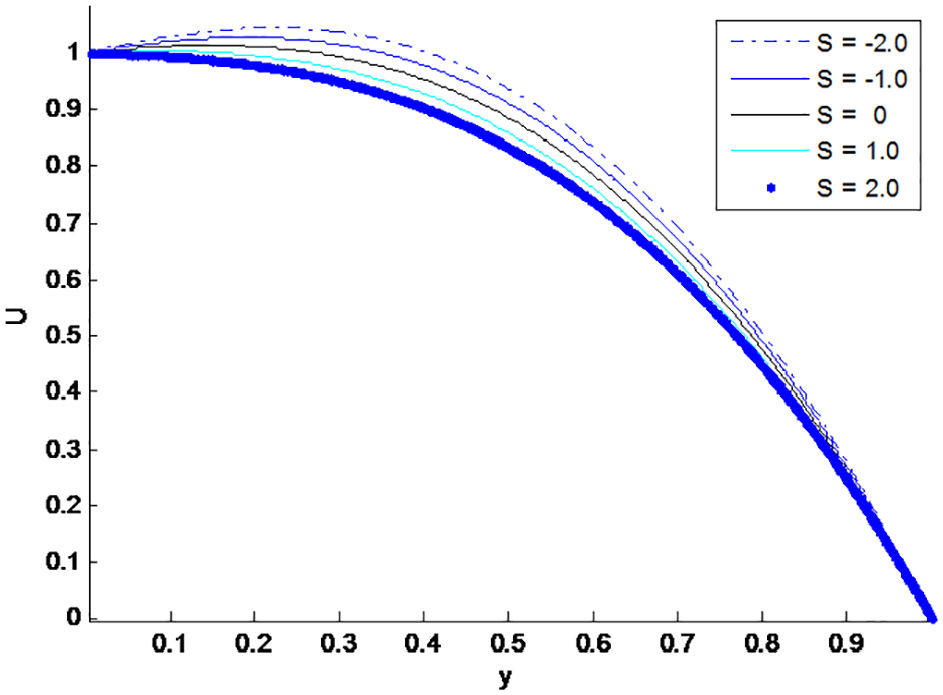
Velocity profile for different values of heat generating/absorbing parameter

Temperature profile for different values of heat generating/absorbing parameter
Figures 6 and 7 depict the velocity and temperature profiles respectively. Both Velocity and temperature profiles increase with increase in viscous dissipation

Velocity profile for different values of Eckert number
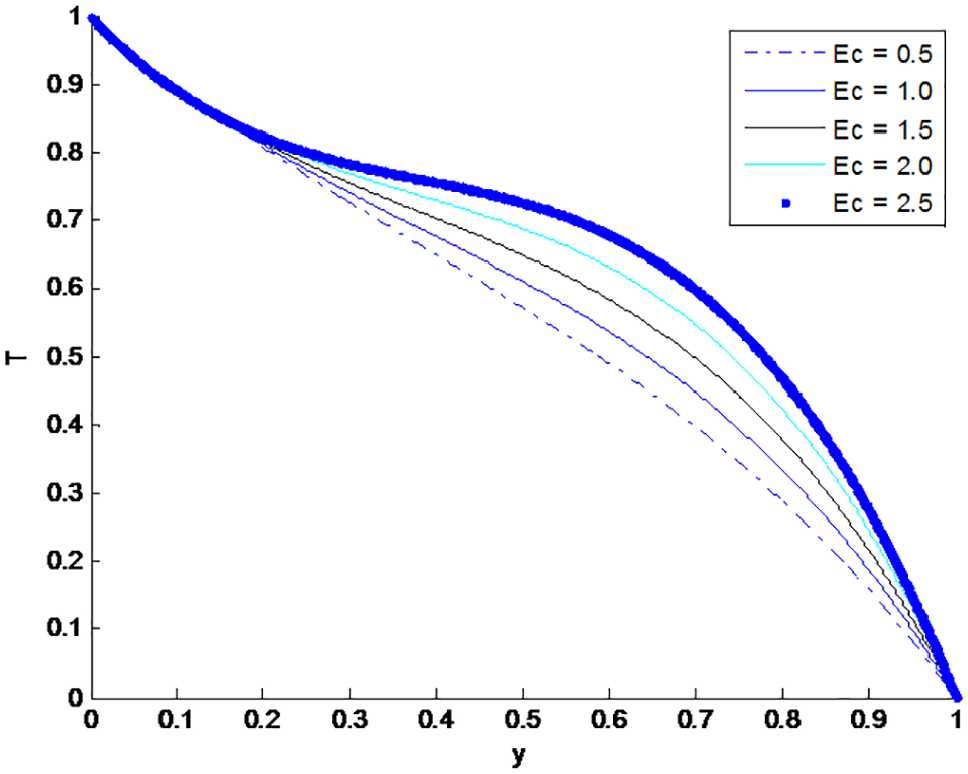
Temperature profile for different values of Eckert number
Figures 8 and 9 display the influences of

Velocity profile for different values of Grashof number
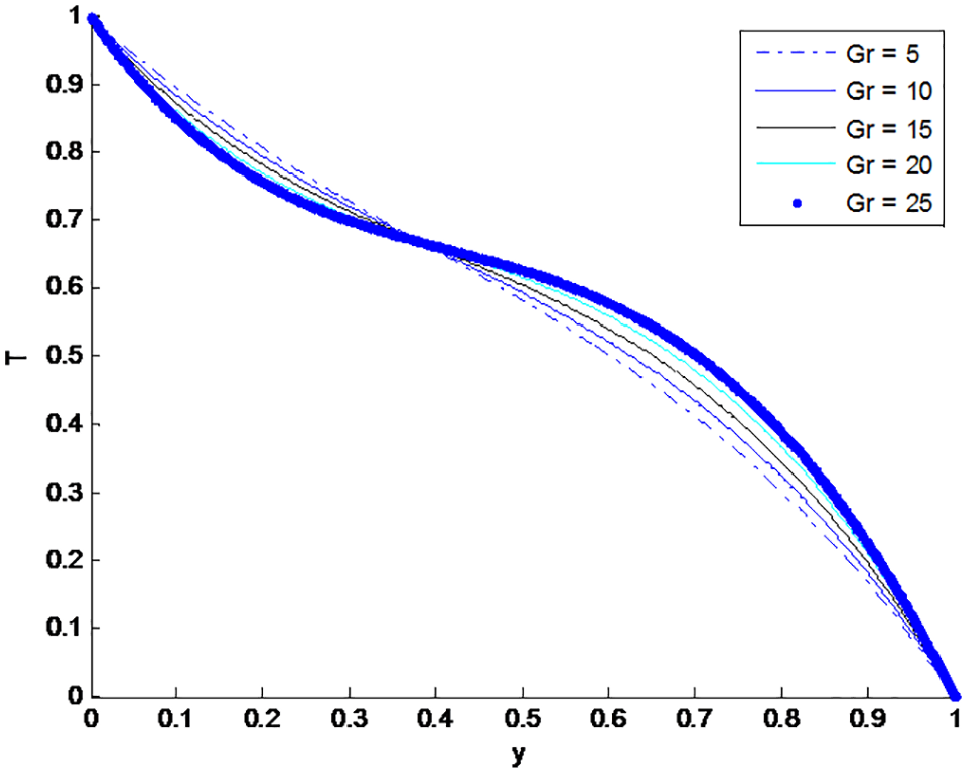
Temperature profile for different values of Grashof number
Figures 10 and 11 show the effects of suction/injection parameter

Velocity profile for different values of suction/injection

Temperature profile for different values of suction/injection
For different values of magnetic field parameter

Velocity profile for different values of magnetic field
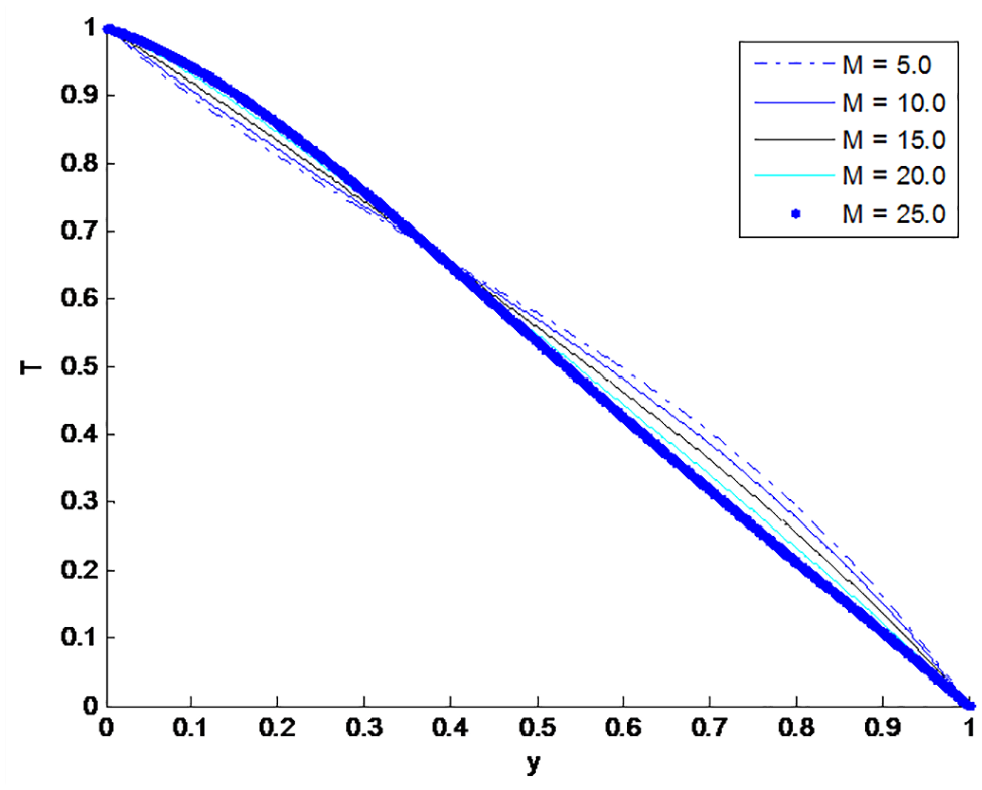
Temperature profile for different values of magnetic field
Figures 14 and 15 display the influences of the permeability of the porous material

Velocity profile for different values of permeability parameter

Temperature profile for different values of permeability parameter
Table 2 shows the shear stress between the fluid and the plates. It is found that the shear stresses on both the heated and cold plates decrease with increase in the magnetic field
Skin friction
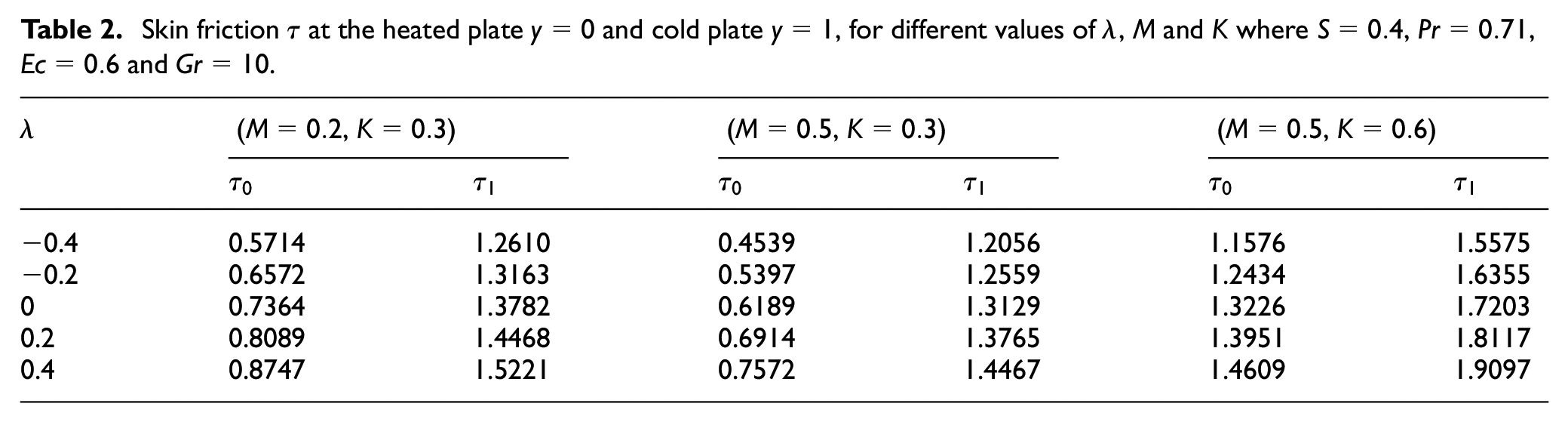
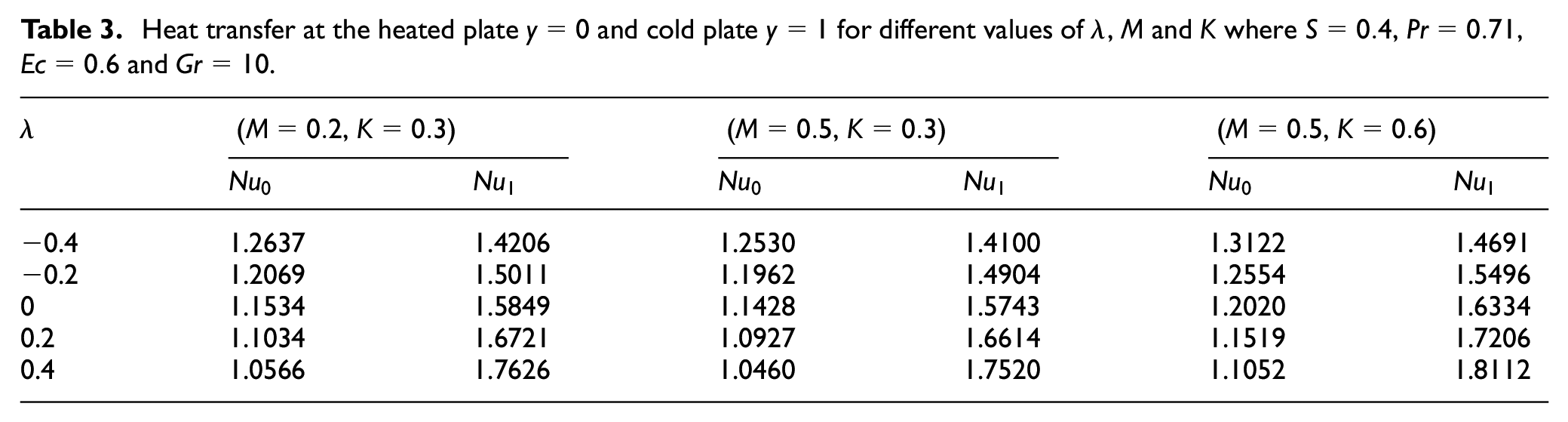
Table 3 displays the rate of heat transfer between the plates and the fluid. The rate of heat transfer on both the plates decreases with increase in magnetic field
Heat transfer at the heated plate
Conclusion
The present work theoretically investigated the effects of magnetic field, suction/injection and permeability of porous materials on a steady natural convection flow of a viscous incompressible heat generating/absorbing fluid passes through a porous vertical channel. The work concluded that the velocity and temperature profiles increase with increase in Prandtl number
Footnotes
Appendix
Acknowledgements
I acknowledge the contribution made by Prof. Abiodun O. Ajibade in this work to get published and no funding attached to this research.
Handling Editor: James Baldwin
Declaration of conflicting interests
The author(s) declared no potential conflicts of interest with respect to the research, authorship, and/or publication of this article.
Funding
The author(s) received no financial support for the research, authorship, and/or publication of this article.
