The main objective of this paper is to offer a comprehensive study regarding solar radiation and MHD effects on 3D boundary layer Jeffery fluid flow over a non-uniform stretched sheet along with variable thickness, porous medium and chemical reaction of first order are assumed. The system of equations representing temperature, velocity and concentration fields are converted into dimensionless form by introducing dimensionless variables. Thereafter, the aforesaid equations are solved with the help of BVP4C in MATLAB. The numerical results obtained through this scheme are more accurate when compared with those in the existing literature. In order to have a pictorial representation, the effects of material and flow parameters on velocity, temperature and concentration profiles are presented through graphs. Moreover, the numerical values of heat and mass transfer rate and skin friction coefficient are given in tabular form. It is evident from the acquired results, that the velocity offers two fold behavior for variable thickness parameter that is, n < 1 close and away from the non-uniform surface. It is also noted that the axial and transverse velocities show an increasing behavior for Deborah number while the fluid temperature and concentration shows opposite behavior at the same time.
The study of heat and mass transfer and boundary layer flow over a starching surface is an important field of research because of inclusive uses in different industry sectors, engineering and extracting metals processes. The transmission of heat is essential because the rate of cooling can be constrained and the final results of the required specifications can be obtained. A substantial number of the study was already conducted by evaluating stretching sheet.1–3 Due to non-linear correlation among stress and strain rate, Navier-Stokes equations (NSEs) are inadequate for analyzing non-Newtonian liquids; which is also why dissimilar rheological models being used with Navier-Stokes equations. Scientists and researchers are also investigating the attributes of non-Newtonian fluids. This enthusiasm comes from a number of applications, like fiber new tech, food items, cables sealant, drug companies, psychology, crystal growth, etc. The features of non – Newtonian liquids could not be assessed by a single constitutive relationship. The Jeffrey model is a rate type fluid which perceives relaxation and delay behaviors in time. Jeffrey model goes on to describe the linear viscoelastic behavior of the liquids widely used throughout the field of polymers.4,30 addressed the Jeffrey fluid hydromagnetic flow over a lateral stretched surface obligated in a permeable material. The impact of the slip in the vicinity of radiation and melting phase on Jeffrey flowing fluid was assessed by Das et al.5 While having taken Newtonian heating into consideration,6 highlighted certain key aspects of the Soret and Dufour implications on Jeffrey flow. The entropy generation aspects and heat exchange process for the Jeffrey fluid flow caused by the stretched surface were observed by Dalir.7 In the semi-infinite framework, Ghaffar et al.8 reviewed the radiative aspects of Jeffrey fluid flow over the vertical plate. Nadeem et al.9 deemed Jeffery fluid’s boundary layer flow over a sheet having exponential growth rate and analyzed the effect of predefined progressively heat flux and recommended speeding up the ambient temperature order, and deduced that such implications were closely related.10 explained blood flow through with a curved stenotic artery and assumed Jeffrey liquid blood. They found that even the structure and height of the stenosis was relative to the velocity with the phase shift effect. Hayat et al.11 noted the 3D flow of the Jeffery liquid through plain stretched plan. In particular case Jeffrey fluid model is reduced to classical Navier-Stokes relation when relaxation and retardation times are zero.
Throughout the metallurgical and chemical industrial sectors, including food production and plastic manufacturing, transmission of mass and heat on a stretching surface with a chemical reaction impact have a major role to play. Furthermore, problems of combined transmission of mass and heat in the absence of chemical reactions are significant in several applications and thus have gained much interest in the last few years. Conceivable applications are found in procedures like irrigation, transfer of temperature and relative humidity over agricultural areas and seedling oaks, crop damage done by freezing, water loss on the water body surface and transmission of energy in a wet cooling tower and in a swamp cooler. Investigators had also examined the impact of thermal radiation and chemical reactions on MHD flow via various channels. So many investigators are concentrated in analyzing flows with chemical reactions in the illumination of these evidence. For instance, Seddeek and Almushigeh12 tested the influence of radiation and variable viscosity on natural convective MHD and mass transport having chemical species past a stretched sheet. In the appearance of heat source/sink, Kandasamy et al.13 portrayed a cohort assessment of the Dufour and Soret impacts on free convective heat and mass transfer with thermophoresis and chemical reactions over a permeable flexing surface. In the light of pore materials and thermal radiation, Pal and Talukdar14 illustrated the cumulative influence of Joule’s heating and chemical reactions on unsteady MHD mixed convection with viscous dissipation over a vertical plate. Scientists have evaluated the effects of thermal radiation and chemical reaction on the MHD flow via distinct channels.2,15–17
In several technology and hydrological implementations, as with petroleum energy, thermal insulation, increase in oil restoration, packed-bed catalytic reactors, and power station cooling, MHD boundary layers are identified with transfer of heat and mass transport over non isothermal extending sheets. Numerous methodologies in chemical engineering, like metallurgical and polymer deformation, entail refrigerating the molten liquid in the refrigeration process. Using a magnet field effecting the system for producing heat/absorbing in the electromagnetic liquid dynamics has many potential applications, like most extracting metals processes including refrigeration of persistent stripes or filaments carried from a quiet fluid. To a significant extent, the assets of the end product influence the rate of cooling. The cooling rate and thus the required quality of the resulting item can be regulated by use of the highly charged liquids and by use of Ullah et al.18 magnetic fields. Extensive studies have been carried out in the presence of magnetic field4,19–21 on the flow, heat and mass transfer of highly charged liquids over quasi-infinite/infinite plates/stretching surfaces.
Inspired by the aforementioned literature survive, we clearly say that very few investigations were concentrated on three-dimensional non-Newtonian flows over a stretched surface. Additionally, number of published scientific work in this direction is being solved by utilizing different analytical methods, such as HAM and only the distinctive solutions are described. In spite of all the above published work, due attention is not being paid to study 3D steady incompressible MHD Jeffery fluid having chemical and radiation impacts over a non-uniform stretched surface embedded with porous medium. Thus in this assessment, we have focused on 3D viscous incompressible steady Jeffery MHD flow over an irregular surface along with chemical reaction and thermal radiation where the variable thickness surface is immersed with porous medium. We have introduced new non-dimensionless variables to transform the governing model into highly nonlinear ODEs and the resulting system of equations is solved with BVP4C that implements the three-stage Lobatto IIIa formula which gives fourth-order accurate solution. For an overview of the results achieved from governing model, the important fluid parameters for profiles are pictorially presented. Further, from engineering perspective the important drag coefficient, heat transfer and mass transfer rates are elaborated in tabular form. Finally, we have found that the achieved results are in good agreement with the existing literature and noticed that the Deborah number shows an increasing behavior for both velocities and the totally opposite trend is observed for the temperature and concentration profiles. The author believes that no such attempt is earlier made in this direction so this work will be a good contribution to literature and claimed to be up to date work.
The subject research article is divided in four different parts which are as follows. Two offers the proposed mathematical approach and the solution to those equations is thoroughly investigated. The findings and description of the developed problem are presented in section 3. Additionally the drag coefficient, heat and mass transfer rates are described and analyzed in tabular form 1 and 2. The important finding of the assessment are presented in 4.
Problem formulation
Three-dimensional MHD steady Jeffery fluid over a non-uniform surface immersed with a permeable medium is taken into account. A thin layer is sufficient to ignore the pressure differences along with the sheet. The characteristics of sheet are subjected to change against variation in the values of n. We have assumed that the sheet is placed on a three-dimensional surface where the x-axis is in upward direction to the plane, y-axis normal to x-axis and z-axis is normal to the x and y plan. A schematic demonstration of the physical model and coordinate system is portrayed in Figure 1. When there is no motion in the fluid at , the sheet is imprudently forced along x and y directions having velocities For the resistive force, the magnetic field may apply along vertically to the surface. We assume that the Reynolds number is sufficiently small to ignore the induced magnetic field. We applied solar radiation to the surface of the sheet and 1st order chemical reaction is considered. After all the above assumptions, we put our model in the governing form of boundary layer Jeffery fluid as follows.22 For the resistive force, the magnetic field may apply along vertically to the surface. We assume that the Reynolds number is sufficiently small to ignore the induced magnetic field. We applied solar radiation to the surface of the sheet and 1st order chemical reaction is considered. After all the above assumptions, we put our model in the governing form of boundary layer Jeffery fluid as follows.22
We have chosen for velocities in the direction of x, y and z, kinematic viscosity of fluid is Λ1 relates the period of relaxation to the duration of retardation, expresses retardation time, is density of the fluid, is magnetic field, is the permeability of the porous medium, depict temperature and thermal conductivity of fluid the specific heat at constant pressure, is electric conductivity, is the temperature distant from the surface, C is concentration within the boundary layer, is concentration far from the surface and D is the molecular diffusivity of the species concentration.
Physical configuration of the problem.
Boundary conditions
At time , the sheet is impulsively stretched at the velocity of along with x and y. Suitable boundary conditions for governing model are:23
Where
demonstrates Maxwell coefficient, thermal adaptation coefficient, specific heat ratio, constants, and reference and atmospheric liquid temperature.
Skin friction coefficient
The friction factor in boundary layer flows is an essential dimensional less variable. It explicitly states the fraction of the local dynamic pressure, which is felt as surface shear stress. Here the friction factor coefficients along directions x and y for our model are
Shear stresses along the wall in the directions of x and y are
Local Nusselt number
The Nusselt number is the ratio of convective to conductive heat transfer at the boundary. Convection includes both advection and diffusion. In this article the heat transfer rates are
Local Sherwood number
The Sherwood number (Sh) (also known as the Nusselt number for mass transfer) is a dimensionless number used in mass transfer operations. It signifies the convective mass transfer ratio to the diffusive mass transport rate defined as
Non-dimensionalization
So the problem (1)–(9) is solved in a dimensionless manner, the governing equations and boundary conditions must be non-dimensioned. We introduce the following nondimensional variables:
The model leads to the following form, while using aforementioned transformations
Along with following appropriate boundary conditions
stands for ratio of relaxation time to retardation time, is the local Deborah number, n is power law index, magnetic field parameter, refers to the porosity variable, stand for the thermal radiation, expresses the Prandtl number, represents the Schmidt number, chemical reaction parameter and wall thickness parameter. Mathematically we have
The drag coefficient, heat and mass transfer rate after transformation are as follows:
Here stands for Reynold’s number.
Discussion
Approximate solution of equations (11)–(14) have been decided to carry out under boundary conditions (15) by implementing the accurate and consistent fourth order BVP4C approach.24–28 Firstly, non-linear differential equations of higher order (11–14) are transformed into simultaneous linear differential equations of first order and then further converted it into problem of initial value. From this numerical computation method, the skin-friction coefficient, the Nusselt number, and the Sherwood number correlating to respectively are often straightened and their numerical values are displayed in the 1 and 2 in tabulated form. In order to evaluate the outcomes, numerical computation was determined using the method mentioned in the subsequent paragraph for different governing variables, notably relaxation time ratio to retardation time variable local Deborah number D, magnetic field parameter , permeability parameter , wall thickness parameter , thermal radiation parameter R, Prandtl number Pr, Schmidt number Sc, and chemical reaction parameter . The preceding predefined model parameters for simulations are implemented in this study:
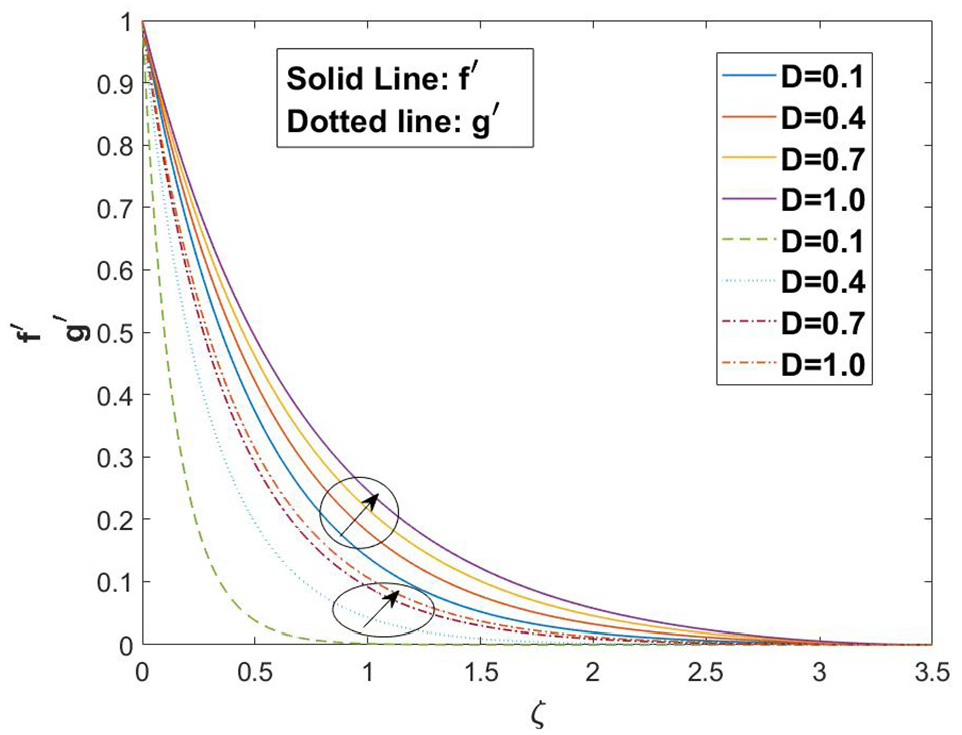
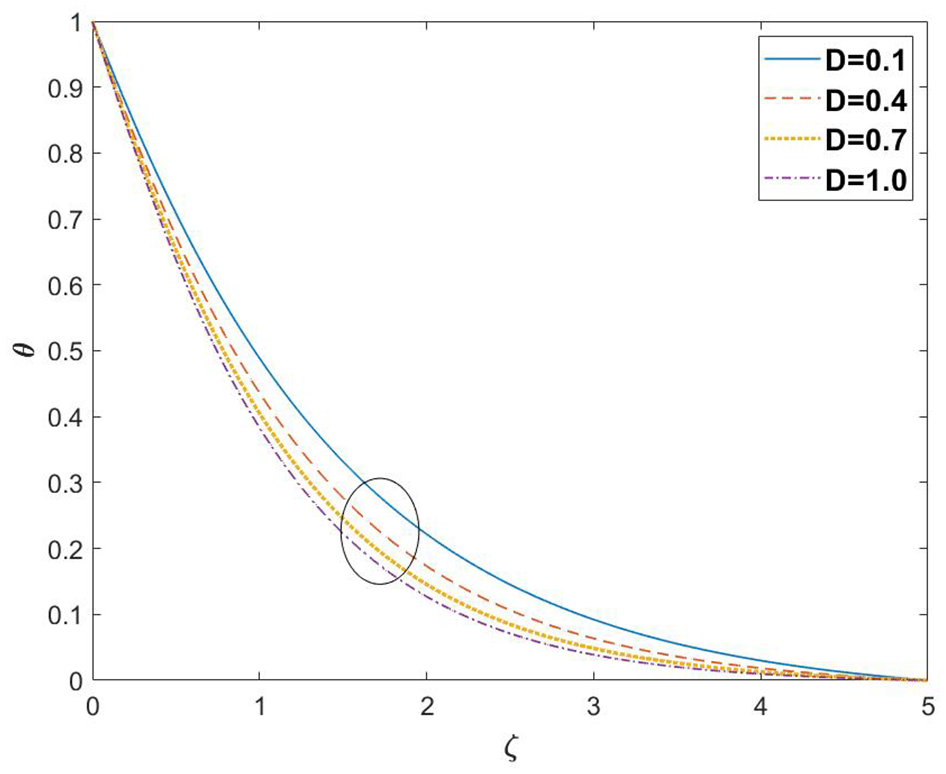
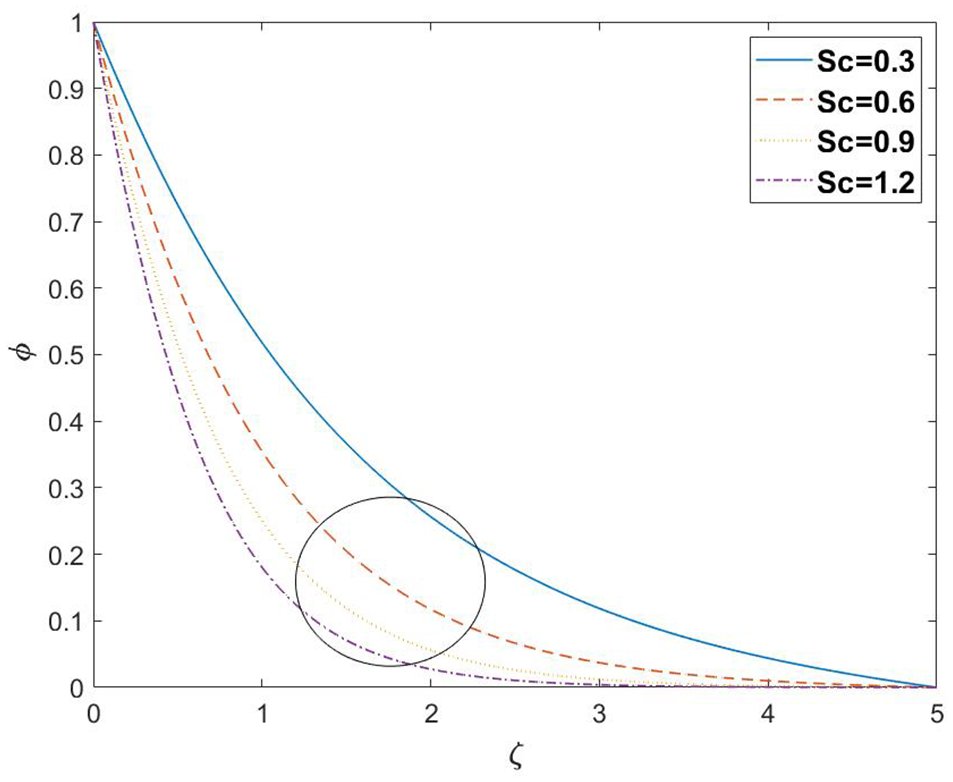
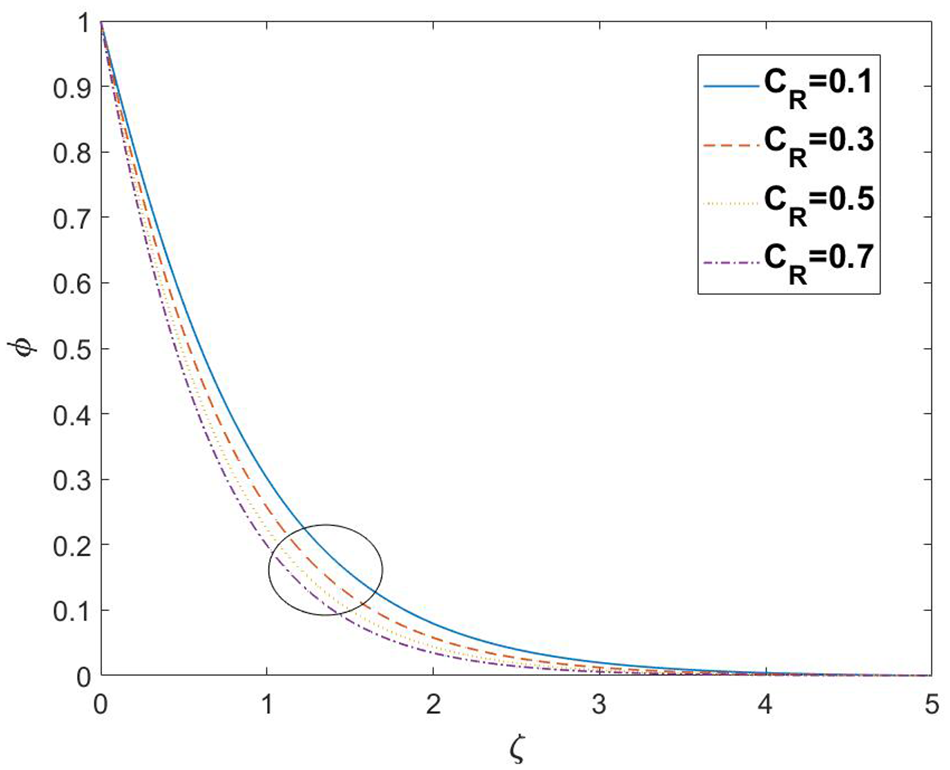
The impact of relaxation-to-retardation-time ratio on velocity field can be seen in Figure 2. We observed opposite to above outcomes, via a rise in the relaxation to retardation times ratio. This demonstrates the general basic characteristics of Λ1 that even a rise in tends to increase the relaxation time, that is, it requires longer effort for a disturbed system to preserve its original position. The friction force are rising and, as a consequence, the velocity profile is decreased. More friction is typically given to the liquid by continuing to increase in , which provides the flow of heat energy. Figure 3 illustrates that when alterations in wall thickness variable , are noticed for Whenever the wall-thickness variable raises, the velocity lessens. Physically the boundary layers close the stretching surface declines as we raise the values of Λ however, we notice the contrary tendency for the tangential velocity as the tangential velocity is far from the surface. Besides that, the rise in the wall thickness component will provoke the most disruption close the stretched sheet that will enhance the tangential velocity so the boundary layer is not greatly affected. The alteration of velocity profile with distinct values of magnetic parameter can be seen in Figure 4 MHD principal used as an assistant to regulate the boundary layer thickness. As anticipated, by rising value of tends to reduce the fluid velocity exceptionally. Besides that, the thickness of the boundary layer and decline in the primary free stream region could be seen. This occurred physically due to the obvious reason that drag forces exerted contrary to the fluid flow and the fluid velocity lessened. Figure 5 is attracted to illustrate the impact of on . From the graph we observed that the rising Deborah number values correlate to rises in retardation time, which leads to rises in velocities and we often witnessed that the thickness of the boundary layer of momentum increases with increase Deborah number. That’s because the relation between and retardation are proportional. So if we strengthen the Deborah number value, more adhesive attributes/retardation would be encountered in liquid flow, resulting in higher rate fluid motion. Figure 6 portrays the essence of non-uniform sheet velocity profiles for various power-law index values of n. The incline of the shear stress versus the shear rate curve would not be consistent for non-Newtonians even though we alter the shear rate with increase in the values of n, the flow rate tends to increase relate directly to the momentum boundary layer thickness reduces for a higher value of n. Figure 7 is delineated by fixing other variables seeing the impact of the porosity variable on the velocity profile. By raising the value of the velocity of the fluid decreases as seen in the graph. Physically, that’s also seeing as when the permeable medium’s smaller sized holes provoke a significant friction throughout the fluid movement. Because of this factor of friction both the fluid velocity declines. In Figure 8, the effectiveness of on temperature profile is analyzed. measures the ratio among time of relaxation and time of retardation. Rises of match relaxation time tends to increase. As a result, retardation time is mitigated as rises this tends to lead to fluid temperature rise. Figure (9) demonstrates the impact of on flow . When we start raising the temperature profile significantly reduces. As we realize, the retardation time for greater Deborah number values is higher. This helps to reduce the retardation time obtained by more friction to the liquid and thus the field. The effect of the porosity variable, as seen in Figure 10, on . It is mentioned that the temperature of the liquid rises via an enhanced porosity variable. It is because a rise in the variable of permeability broadens the gaps of the permeable layer because a rise in the variable of porosity emits and produces the inner heat energy to flow. Because of the same, the of the flow will hike. In Figure 11 the temperature profile lessens with a rise in the power law index values is featured. With continuing to increase , the profiles get smaller but the variance is small. The thermal boundary layer thickness tends to decrease for the maximum value of n. Figure 12 reflects the impact of on the to raise the significance for the temperature of significant decline interpret. Physically, increase in , triggers the heat transfer rate to enhance. Consequentially the thickness of the thermal boundary layer is reduced. In Figure 13, the dimensionless temperature allocation for various radiation variable values can be seen. It discloses that perhaps the greater radiation variable values lead to increase in the temperature pattern and the associated boundary layer thickness. In particular, the relatively large radiation variable values offer greater heat to the working liquid which represents an increase in the temperature field and thermal boundary layer thickness. It’s obvious to acknowledge here that we realized an enhancement in the nonuniform sheet temperature profiles which has a power index of . Figure 14 is taken to convey the impact of on . From figure we observed that the higher value of relates to rises of retardation time it leads to a reduction the concentration field. In Figure 15, the impact of Schmidt number on the concentration profiles can be seen. The Schmidt ratio is the number of the diffusivity of momentum to the diffusivity of the species. As the Schmidt number increases, the concentration tends to decrease and causes the impacts of concentration buoyant force to reduce, resulting in reduced in the concentration of fluids. Eventually, the concentration of liquid is decreased by increasing the chemical reaction parameter seen in Figure 16 of this phenomenon. In practice, the diffusivity of the flow varies response to difference in the resilience of the chemical reaction, which tends to cause the concentration of the fluid to drop.
Effect of .
Effect of .
Effect of .
Effect of .
Effect of .
Effect of .
Effect of
Effect of
Effect of
Effect of
Effect of
Effect of
Effect of .
Effect of
Effect of
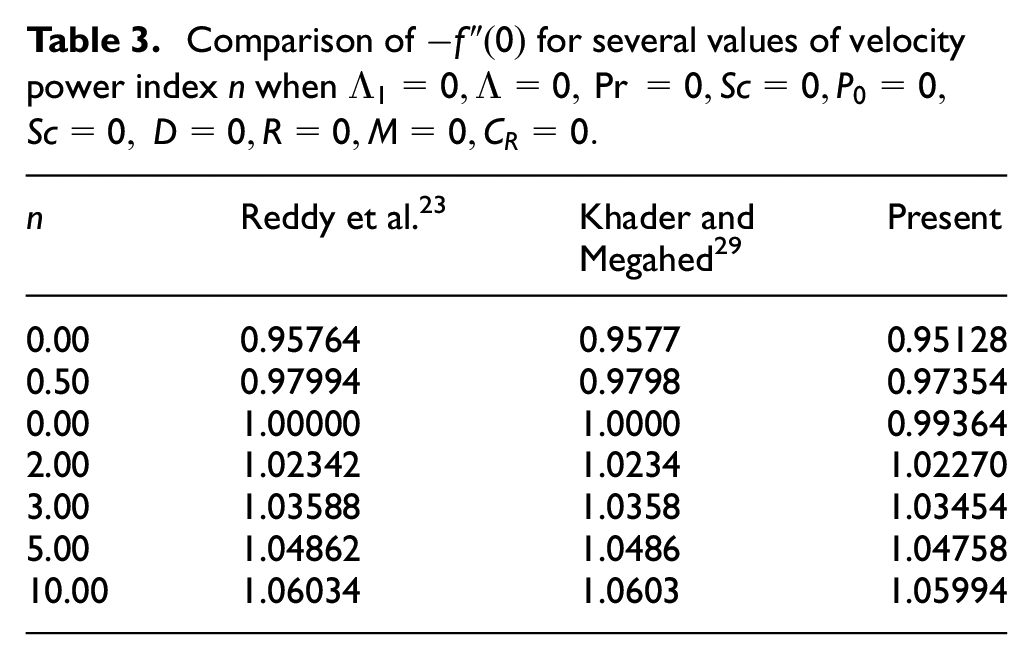
Tables 1 and 2 demonstrate the difference of friction factors, heat and mass transfer rate for distinctnon-dimensional variable values. From the table it is obvious that the increasing trend in the permeability variable values improves the rate of heat and mass transfer. However we found an excellent outcome which minimizes the friction coefficient for by continuing to enhance the permeability parameter. We have noticed that from the outcomes of the relaxation to retardation times variable that by enhancing the enhances the behavior of drag factor which influence the velocity of the liquid. The values display contradictory outcome to the aforementioned two cases. We also noticed from calculating both the skin friction along x and y. Significantly low friction effects observed on fluid in y direction as compared to the drag forces along x. From Table 2 it was demonstrated that with Deborah number the heat transfer rate enhanced and the contrary phenomenon occurred with an increase of . In practical sense, the liquid temperature decreased at high Deborah number, which implies that the heat transfers toward the surface and thus the heat transfer rate is enhanced. The mass transfer rate is increased by and minimized by . The heat transfer rate and the mass transfer rate significantly enhance with enhances. Lastly, in order to calculate the precision of the current numerical solutions, we compared our results with Reddy et al.23 and Khader and Megahed29 results for the limited case are shown in Table 3. It can be perceived that the results are found to be in tremendous agreement with that of previous studies.
Drag coefficient variance with Pr = 5.0, n = 0.2, Sc = 0.6
0.4
0.2
0.5
1.0
0.3
−1.37397
−4.83761
0.5
−1.28238
−4.51510
0.6
−1.20228
−4.23291
0.3
−1.43270
−4.68536
0.4
−1.49129
−4.59395
1.0
−1.62397
−5.14650
1.5
−1.97456
−5.61098
1.5
−1.54502
−5.04636
2.0
−1.69943
−5.24400
0.4
−1.39980
−5.28713
0.5
−1.42550
−5.73665
Variations of Nusselt and Sherwood numbers with Pr = 5.0, n = 0.2, Sc = 0.6,
0.4
1
0.5
1
0.3
1.4808
0.9131
0.5
1.4731
0.9115
0.6
1.4658
0.9100
2
1.0524
0.9131
3
0.8233
0.9131
1.0
1.4553
0.9077
1.5
1.4226
0.9010
1.5
1.4808
1.0573
2
1.4808
1.1813
0.4
1.5014
0.9162
0.5
1.5178
0.9190
Comparison of for several values of velocity power index when
This work is the extension of the Reddy et al.,23 where the combined effects of nonlinear thermal radiation, Arrhenius activation energy and heat generation/absorption on the steady magneto hydrodynamic flow of Eyring-Powell nanofluid flow over a slandering stretchable sheet with velocity, thermal and solutal slips. In the current research article, the impact of solar radiation on MHD 3D Jeffrey fluid flow over a non-uniform stretched sheet is evaluated in the porous medium with variable thickness and 1st order chemical reaction. The proposed problem has great significance in various industries like food processing, paper production, polymer industries, etc. BVP4C code in MATLAB is being utilized to solve the principle equations of the problem in consideration. The influence of significant parameters on heat and mass transfer rate along with drag coefficient is being described in tabular form. The foremost findings of this study are given below:
The fluid velocities are enhanced by Deborah number while fluid temperature and concentration are reduced simultaneously, however at the same time, totally opposite behavior is noted with .
The heat and mass transfer rate enhances by Deborah number.
The fluid velocities are increased by the power index parameter but temperature field is decreased at the same time.
An increasing trend is noticed in fluid temperature and thermal boundary layer thickness for and thermal radiation but generates totally opposite trend for the aforesaid quantities.
The wall thickness parameter reduces the local skin friction, however it is increased for
At the end, it is concluded from the numerical study carried out in this paper, that the proposed approach is a cogent approach to present the numerical results which outstandingly agree with the available substantial information for such a problem. Further, the results obtained conform the consistency and efficacy of the proposed method.
Footnotes
Handling Editor: James Baldwin
Author’s contributions
Both authors have contributed in writing and proof reading of the manuscript.
Declaration of conflicting interests
The author(s) declared no potential conflicts of interest with respect to the research, authorship, and/or publication of this article.
Funding
The author(s) received no financial support for the research, authorship, and/or publication of this article.
ORCID iDs
Mumtaz Khan
Qurat-ul-Ain Azim
References
1.
SandeepNSulochanaC. Dual solutions for unsteady mixed convection flow of mhd micropolar fluid over a stretching/shrinking sheet with non-uniform heat source/sink. Int J Eng Sci Technol2015; 18: 738–745.
2.
TurkyilmazogluM. Analytic heat and mass transfer of the mixed hydrodynamic/thermal slip mhd viscous flow over a stretching sheet. Int J Mech Sci2011; 53: 886–896.
3.
VajraveluKHadjinicolaouA. Convective heat transfer in an electrically conducting fluid at a stretching surface with uniform free stream. Int J Eng Sci1997; 35: 1237–1244.
4.
AhmedKIshakA. Magnetohydrodynamic (mhd) Jeffrey fluid over a stretching vertical surface in a porous medium. Propuls Power Res2017; 6: 269–276.
5.
DasKAcharyaNKundumPK. Radiative flow of mhd Jeffrey fluid past a stretching sheet with surface slip and melting heat transfer. Alex Eng J2015; 54: 815–821.
6.
KhanMIWaqasMHayatT. Soret and dufour effects in stretching flow of Jeffrey fluid subject to Newtonian heat and mass conditions. Results Phys2017; 7: 4183–4188.
7.
DalirN. Numerical study of entropy generation for forced convection flow and heat transfer of a Jeffrey fluid over a stretching sheet. Alex Eng J2014; 53: 769–778.
8.
GhaffarSAPrasadVRReddyEK. Computational study of Jeffrey’s non-Newtonian fluid past a semi infinite vertical plate with thermal radiation and heat generation/absorption. Ain Shams Eng J2017; 8: 277–294.
9.
NadeemSZaheerSFangT. Effects of thermal radiation on the boundary layer flow of a Jeffrey fluid over an exponentially stretching surface. Numer Algorithms2011; 57: 187–205.
10.
AkberNSNadeemSAliM. Jeffrey fluid model for blood flow through a tapered artery with a stenosis. J Mech Med Biol2011; 11: 529–545.
11.
HayatTAwaisMObaidatS. Three-dimensional flow of a Jeffery fluid over a linearly stretching sheet. Commun Nonlinear Sci Numer Simulat2012; 17: 699–707.
12.
SeddeekMAAlmushigehAA. Effects of radiation and variable viscosity on mhd free convective flow and mass transfer over a stretching sheet with chemical reaction. Appl Math Comput2010; 5: 181–197.
13.
KandasamyRHayatTObaidatS. Group theory transformation for soret and dufour effects on free convective heat and mass transfer with thermophoresis and chemical reaction over a porous stretching surface in the presence of heat source/sink. Nucl Eng Des2011; 241: 2155–2161.
14.
PalDTalukdarB. Combined effects of Joule heating and chemical reaction on unsteady magnetohydrodynamic mixed convection of a viscous dissipating fluid over a vertical plate in porous media with thermal radiation. Math Comput Model2011; 54: 3016–3036.
15.
FuYWangZZhangJ, et al. A blocking flow shop deteriorating scheduling problem via a hybrid chemical reaction optimization. Adv Mech Eng2017; 9. DOI: 10.1177/1687814017701371.
16.
AnjalideviSPKandasamyR. Effects of chemical reaction, heat and mass transfer on laminar flow along a semi infinite horizontal plate. Heat Mass Transfer1999; 35: 465–467.
17.
HayatTKhanMImtiazM, et al. Squeezing flow past a riga plate with chemical reaction and convective conditions. J Mol Liq2017; 225: 569–576.
18.
UllahSAkhtarKKhanNA, et al. Study of free convective unsteady magnetohydrodynamic flow of Oldroyd-B fluid in the presence of chemical reaction. Adv Mech Eng2020; 12. DOI: 10.1177/1687814020937518.
19.
AkbarTBatoolSNawazR, et al. Magnetohydrodynamics flow of nanofluid due to stretching/shrinking surface with slip effect. Adv Mech Eng2017; 9. DOI: 10.1177/1687814017740266.
20.
SaleemAQaiserANadeemS. Physiological flow of biomedical compressible fluids inside a ciliated symmetric channel. Adv Mech Eng2020; 12. DOI: 10.1177/1687814020938478.
21.
AleemMMuhammadIAAliA, et al. Heat transfer analysis of channel flow of mhd Jeffrey fluid subject to generalized boundary conditions. Eur Phys J Plus2020; 135. DOI: 10.1140/epjp/s13360-019-00071-6.
22.
GeethanKumarSVarmaSVKRajuSSK, et al. Three-dimensional conducting flow of radiative and chemically reactive Jeffrey fluid through porous medium over a stretching sheet with soret and heat source/sink effects. Results Eng2020. DOI: 10.1016/j.rineng.2020.100139.
23.
ReddySRRAnkiRBBhattacharyyaK. Effect of nonlinear thermal radiation on 3d magneto slip flow of Eyring-Powell nanofluid flow over a slendering sheet inspired through binary chemical reaction and arrhenius activation energy. Adv Powder Technol2019; 30: 3203–3213.
24.
SoidSKIshakAPopI. Mhd stagnation-point flow over a stretching/shrinking sheet in a micropolar fluid with a slip boundary. Sains Malays2018; 47: 2907–2916.
25.
JusohRNazarRPopI. Magnetohydrodynamic boundary layer flow and heat transfer of nanofluids past a bidirectional exponential permeable stretching/shrinking sheet with viscous dissipation effect. J Heat Trans2019; 141: 012406.
26.
KamalFZaimiKIshakA, et al. Stability analysis of mhd stagnation-point flow towards a permeable stretch-ing/shrinking sheet in a nanofluid with chemical reactions effect. Sains Malays2019; 48: 243–250.
27.
KhashiIArifinNMRashidiMM, et al. Magnetohydrodynamics (mhd) stagnation point flow past a shrinking/stretching surface with double stratification effect in a porous medium. J Therm Anal Calorim2019; 8: 1–14.
28.
KhashiIArifinNMNazarR, et al. A stability analysis for magnetohydrodynamics stagnation point flow with zero nanoparticles flux condition and anisotropic slip. Energies2019; 12: 1268.
29.
KhaderMMMegahedAM. Numerical solution for boundary layer flow due to a nonlinearly stretching sheet with variable thickness and slip velocity. Eur Phys J Plus2013; 128: 1–7.
30.
ZeeshanAMajeedA. Heat transfer analysis of Jeffery fluid flow over a stretching sheet with suction/injection and magnetic dipole effect. Alex Eng J2016; 55: 2171–2181.