




Abstract
Magnetohydrodynamic (MHD) flow of fluids with porous media has several applications in medical and industrial fields, including hyperthermia, wound treatment using magnetic field, cancer treatment, heat exchangers, catalytic reactions and distillation towers. In the present work, we explored the two-phase flow of MHD Jeffrey fluid in the presence of porous media through horizontal walls. The uniform liquid properties and magnetic field effects are also considered in this investigation. The heat and mass transfer effects on fluid flow with the addition of Hafnium metallic particles are evaluated. The governing nonlinear momentum and energy equations are found by using Jeffrey’s stress tensor. We discussed three types of flows, namely, Plane Poiseuille, Plane Couette, and Generalized Couette. The effects of all involved parameters on flow and temperature distributions are deliberated with graphs for all cases separately. The results interpreted that increase in values of Darcy number upsurges the velocity and temperature distributions. Radiation parameter declined the temperature of fluid while Brinkman number enhances temperature in all types of flow. Comparison of Newtonian and non-Newtonian fluid is also presented in this study, and we also validated our results by comparing them with the already existing literature results.
Introduction
Newtonian and non-Newtonian fluids’ study gains much attention from researchers from the last few decades because of their numerous applications in medical, engineering, and industrial processes. Most organic and inorganic substances, molten metals, and solutions of salts with low molecular mass exhibit Newtonian fluid features. The shear stresses and shear rates are proportional to each other in such types of substances. But many experiments revealed that this Newtonian postulate is not always accurate, and many substances like suspensions, emulsions, slurries, adhesives, polymeric melts, and dispersions do not show the linear relationship between stresses and strain. Such type of fluids is categorized as nonlinear or non-Newtonian fluids.1–4 The non-Newtonian fluids are further classified into three main branches, namely viscoelastic, time-dependent and time-independent. Jeffrey fluid is a famous non-Newtonian fluid that falls into the category of viscoelastic or rate type fluids. This fluid model explains the properties of the ratio between relaxation and retardation times. In the Jeffrey fluid model, the two parameters
The magnetohydrodynamic (MHD) flow of fluids has several applications in pharmaceutical and medical fields, including hyperthermia and wound treatment using a magnetic field, cancer treatment, and compressor.11–15 The electrically conducting fluids such as electrolytes, plasmas, molten metals, seawater are also investigated using MHD effects. Abbasi et al. 16 studied the MHD effects of Jeffrey nanofluid. They noticed that by increasing the values of Jeffrey fluid parameters, the temperature of fluid enhances. Bhatti et al. 17 examined the MHD flow of Jeffrey fluid and concluded that increment in magnetic field values causes a reduction in velocity of the liquid. The MHD flow of the Couple stress fluid was analyzed by Hayat et al. 18 They considered the peristaltic motion of fluid and calculated expressions for heat and flow of fluid. Some recent studies related to MHD effects on non-Newtonian fluids are cited in Refs.19–22
A porous media is a surface having pores (voids) filled with fluid. Porous materials are widely used in industries for filtration purposes, in heat exchangers and catalytic reactions, in ion exchange columns, distillation towers, and transpiration cooling.23–25 Ellahi et al. 26 examined Carreau fluid flow with the porous medium through a channel. They adopted the HAM method to solve the complex nonlinear problem. Mohanty et al. 27 investigated the flow and heat transfer of micropolar fluid flow with porous media. They discussed porous parameters and other involved parameters on flow, temperature, and concentration fields. Kothandapani and Prakash 28 analyzed the radiative and magnetic field effects on nanofluids containing porous media. Prasad et al. 29 explored the non-Newtonian tangent-hyperbolic fluid flow in the presence of the porous medium. They discuss the influence of pertinent parameters on flow and heat transfer rates. The effects of viscous dissipation and joule heating on Jeffrey fluid flow was studied by Ramesh. 30 He examined the Couette, Poiseuille, and Generalized Couette flows by taking slip conditions. Shehzad et al. 31 investigated the 3-D hydromagnetic flow of Jeffrey fluid and presented the effects of thermal radiation and heat generation. The analytical solution for heat and mass transfer of Jeffrey fluid was obtained by Turkyilmazoglu and Pop. 32 They evaluated the effects of various parameters on flow and temperature distributions. Kahshan et al. 33 studied the transmission of heat and mass of Jeffrey fluid flow through the porous walled channel. They used perturbation techniques to calculate the solution.
By considering the applications mentioned above, we analyzed the two-phase flow of Jeffrey fluid in the presence of the porous medium. We take the uniform liquid properties and magnetic field effects in this investigation through horizontal walls. The heat and mass transfer effects on fluid flow in the existence of Hafnium metallic particles are evaluated. The governing nonlinear momentum and energy equations are found by using Jeffrey’s stress tensor. We discussed three types of flows, namely, Plane Poiseuille, Plane Couette, and Generalized Couette. The effects of all involved parameters on flow and temperature distributions are deliberated with the help of graphs.
Mathematical analysis
Consider a two-phase MHD Jaffrey fluid in the presence of porous medium suspended with metallic Hafnium particles. The fluid is flowing between two horizontal walls, which are positioned at a distance
Fluid phase equations
Equations for continuity and linear momentum 39 are:


The extra stress tensor

The deformation tensor and substantial derivative


For the present case,

With the help of equations (4) and (5), equation (3) becomes,

Hence, from the above expression we have,
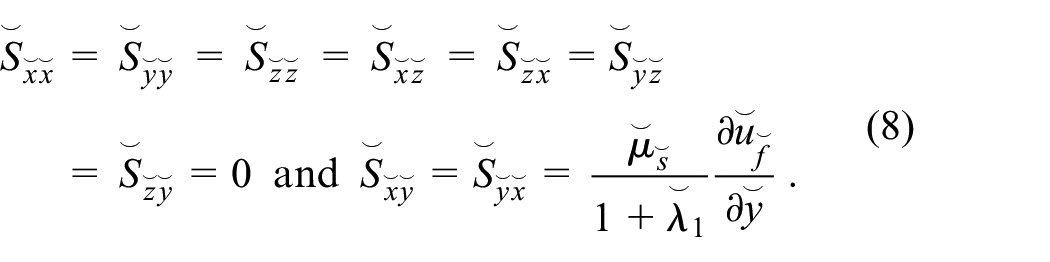
The current vector

Where,

By substituting values in equation (2), we get the following momentum equation:

Hence, the final expressions for continuity and linear momentum equations for the fluid phase are:


Particle phase equations
Equations for continuity and linear momentum13,35–38 for the present case are:


The above expression in simplified form can be written as

Hence, the final expressions for continuity and linear momentum equations for the particle phase are:


Energy equation
The energy equation for the existing problem can be given by

where

and

using equation (19-c) into (19-b), we get

After making appropriate simplifications, the dimensional energy equation takes the following form:

where,
Boundary conditions
The corresponding dimensional boundary conditions are:


Dimensionless continuity and momentum equations
The following similarity transformations are used to convert the dimensional equations into the non-dimensional form:

By substituting the above equation in equations (12) and (13), after neglecting asterisk for simplicity, we get dimensionless fluid phase continuity and momentum equations,


Where,
By substituting equation (23) in equations (17) and (18), after neglecting asterisk for simplicity, we get the following non-dimensional particle-phase continuity and momentum equations as


By placing equation (27) in equation (25), we have the final form of the dimensionless momentum equation as

Normalized energy equation

By substituting the above equation in equation (20), after neglecting asterisk for simplicity, we get a dimensionless energy equation as

where,
Normalized boundary conditions
With the help of dimensionless variables given in equations (23) and (29), after neglecting asterisk for simplicity, we have boundary conditions in dimensionless form as,


Method of solution
The exact solution of each flow phenomenon is obtained. The procedure of each case is defined in the next subsections.
Plane Poiseuille flow
Consider a two-phase MHD Jaffrey fluid flowing between two horizontal walls in the presence of the porous medium; both walls are placed at a distance

Plane Poiseuille flow.
In view of the above considerations, the momentum and energy equations can be written as


By solving equations (33-a) and (34-a) in the presence of boundary conditions defined in (33-b) and (34-b), we have the following exact solutions for flow and temperature of fluid:


Plane Couette flow
Suppose a two-phase MHD Jaffrey fluid is flowing between two horizontal walls in the presence of a porous medium, both plates are placed at a distance

Plane Couette flow.
In view of the above considerations, the momentum and energy equations can be written as




By solving equations (37-a) and (38-a) in the presence of boundary conditions defined in (37-b) and (38-b), we have the following exact solutions for flow and temperature of fluid:


Generalized Couette flow
Generalized Couette flow is similar to Couette flow, but in this case, the constant pressure is applied between plates (see Figure 3).

Generalized Couette flow.
Therefore, the linear momentum and energy equations for this case can be written as
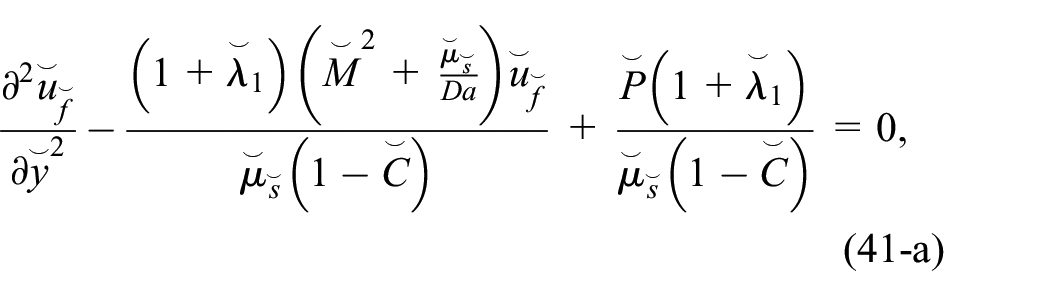


By solving equations (41-a) and (42-a) in the presence of boundary conditions defined in (41-b) and (42-b), we have the following exact solutions for flow and temperature of fluid:


Physical interpretation of results
In this section, we presented the results of this study with a physical discussion. For this purpose, Figures 5 to 19 are plotted to explore the effects of various involved parameters against flow and temperature fields. We discussed graphs for three cases separately, namely Plane Poiseuille flow, Plane Couette flow, and Generalized Couette flow. In these graphs, the transformation of colors from blue to green depicts the decreasing trend of involved parameters via the respective field. In contrast, inverse color transformation shows an increasing trend in the behavior of respective profiles. The comparison between Newtonian and non-Newtonian fluids are highlighted in Figure 4.

Comparison between Newtonian and Jeffrey fluid.
Plane Poiseuille flow
Figures 5 to 9 are arranged for the case of plane Poiseuille flow. Figure 5 displays the effects of the Hartmann number

Effect of Hartmann number on flow and temperature distributions for the case of plane Poiseuille flow.
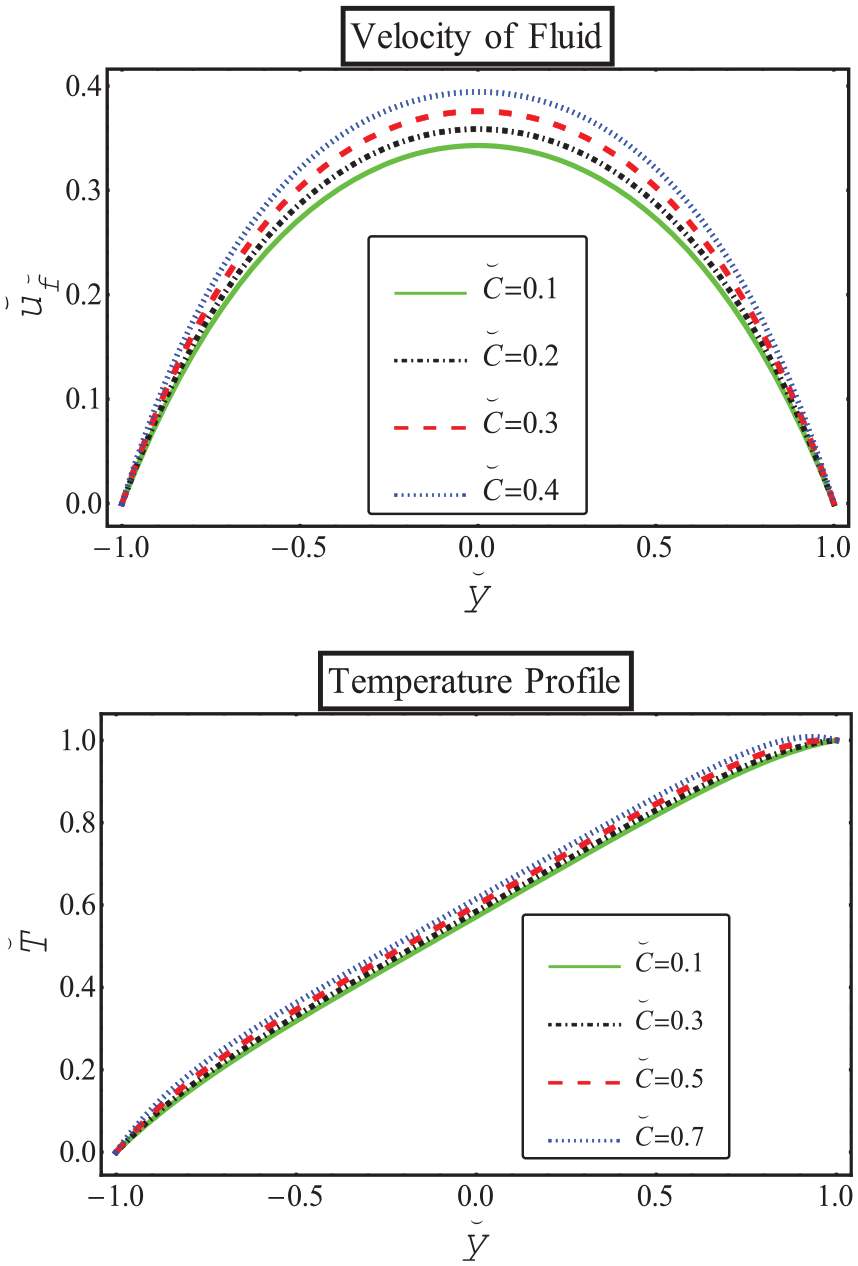
Effect of metallic particles concentration on flow and temperature distributions for the case of plane Poiseuille flow.
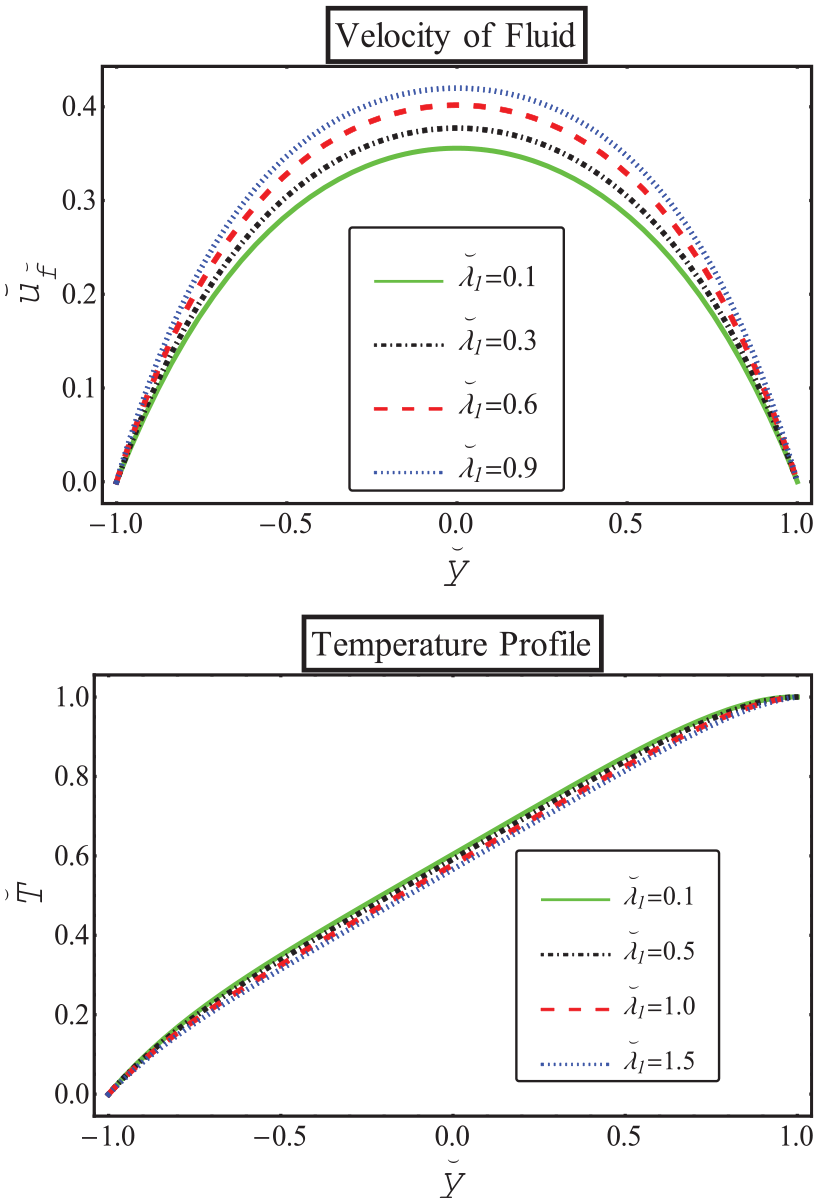
Effect of non-Newtonian parameter on flow and temperature distributions for the case of plane Poiseuille flow.

Effect of Darcy number on flow and temperature distributions for the case of plane Poiseuille flow.

Effect of radiation parameter and Brinkman number on temperature distribution for the case of plane Poiseuille flow.
Plane Couette flow
Figures 10 to 14 are arranged for the case of Couette flow. The effects on velocity and temperature versus Hartmann number displayed in Figure 10. It can be seen that velocity is decreasing the same as in the above case, but the temperature is slightly increasing near the right channel. This is due to the upper plate movement, which opposes the resistance offered due to Lorentz forces and hence temperature at this boundary upsurges. The variations in velocity and temperature fields via metallic particles concentration parameter is sketched in Figure 11. Here, a decrement in the velocity field is observed due to the upper plate’s movement, which exerts an additional drag force within particles of the fluid. This extra force collision between particles increases, which creates a hurdle in a smooth flow. But the temperature is slightly increased near the upper plate of the channel due to particles’ rapid motion. Figure 12 interprets that enhancement in Jeffrey fluid parameter values decrements in velocity and temperature of the fluid, which is maximum near the channel’s moving wall. Figure 13 is plotted to explore the effects of Darcy’s number on flow and temperature distributions. It is observed that increasing Darcy number values speed up the motion of fluid particles but temperature of fluid decreases near the right boundary of the channel. Figure 14 portrays the same temperature profile trend via radiation parameter and Brinkman number as discussed in the above case. But the maximum height of profile is observed near the right wall of the channel, which is in continuous motion in this case.
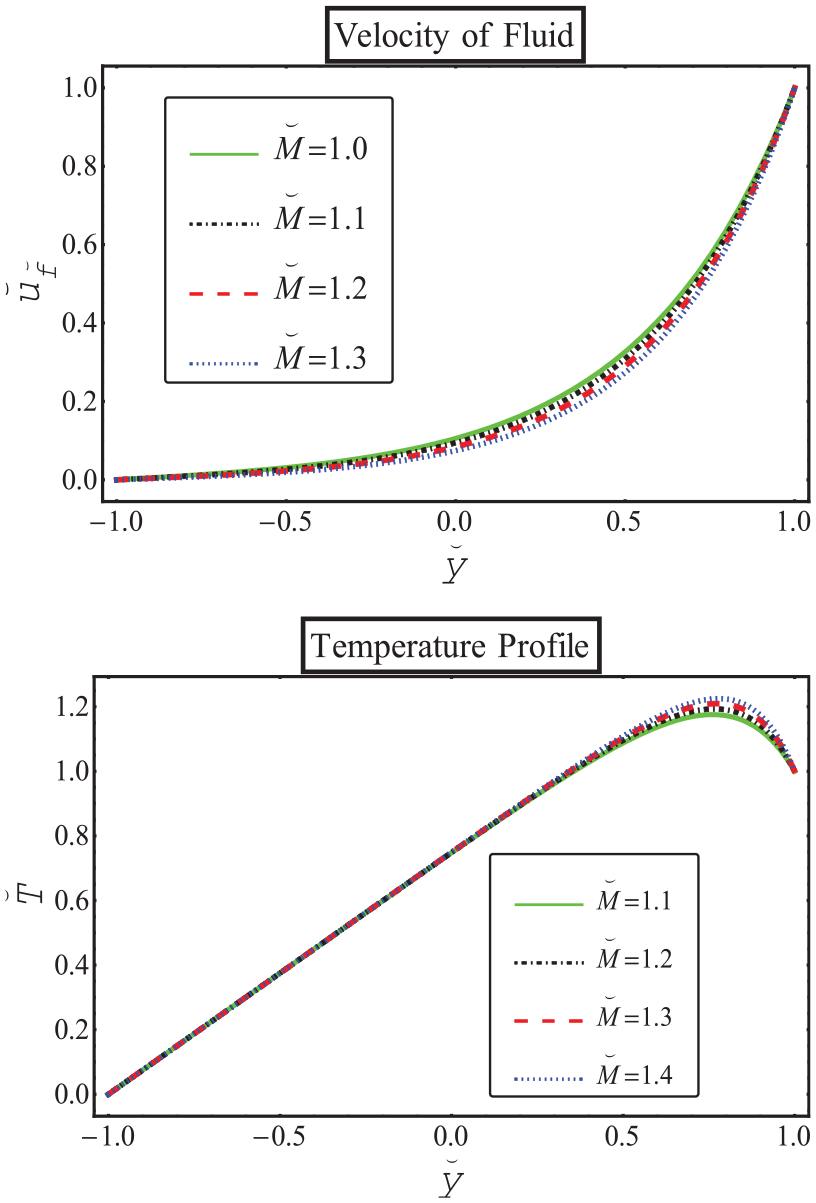
Effect of Hartmann number on flow and temperature distributions for the case of plane Couette flow.

Effect of metallic particles concentration on flow and temperature distributions for the case of plane Couette flow.

Effect of non-Newtonian parameter on flow and temperature distributions for the case of plane Couette flow.
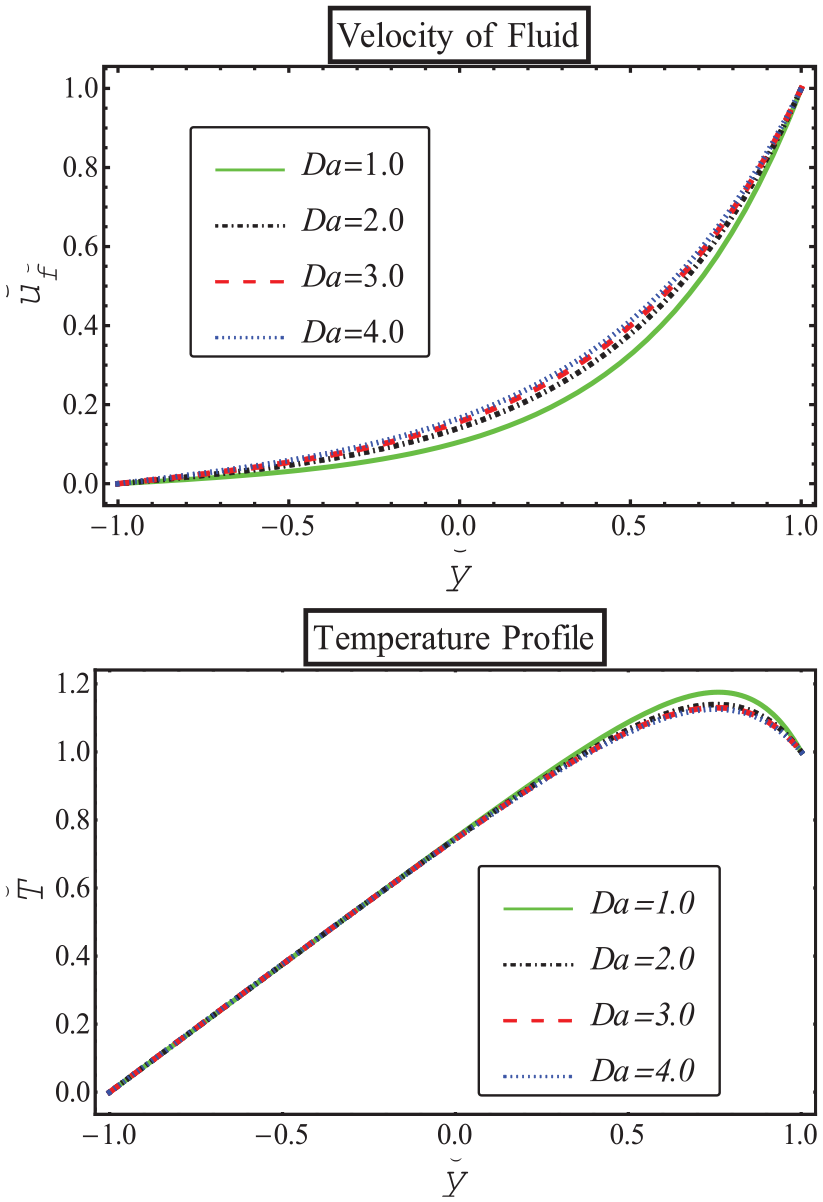
Effect of Darcy number on flow and temperature distributions for the case of plane Couette flow.

Effect of radiation parameter and Brinkman number on temperature distribution for the case of plane Couette flow.
Generalized Couette flow
Figures 15 to 19 are prepared for the case of Generalized Couette flow. Figure 15 depicted the same trend of velocity and temperature profiles versus Hartmann number as observed in the above cases. The effects of metallic particle concentration on flow and temperature, in this case, are similar to the plane Poiseuille flow case, both profiles accelerated (see Figure 16). It is observed that the non-Newtonian parameter speeds up particles’ motion, but temperature decreases in this case, which is shown in Figure 17. Figure 18 is constructed to explore the influence of Darcy’s number on flow and temperature distributions. The increase in values of Darcy number enlarges both velocity and temperature fields. The same effects were observed in the plane Poiseuille flow case. Figure 19 evaluated that the same trend is observed for the temperature of fluid against radiation parameter and Brinkman number as discussed in the above cases. The maximum height of the profile is observed near the moving wall, like in the plane Couette flow case.

Effect of Hartmann number on flow and temperature distributions for the case of Generalized Couette flow.

Effect of metallic particles concentration on flow and temperature distributions for the case of Generalized Couette flow.

Effect of non-Newtonian parameter on flow and temperature distributions for the case of Generalized Couette flow.
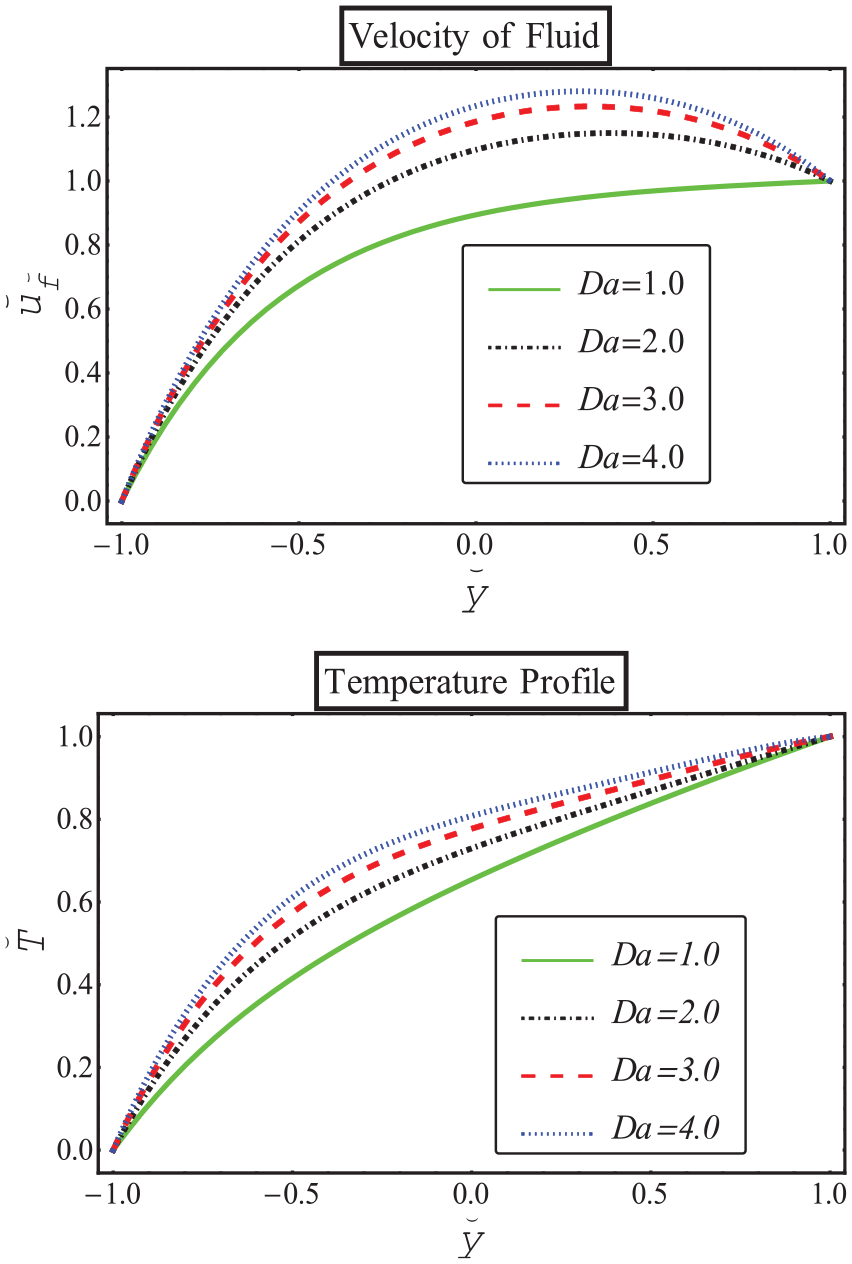
Effect of Darcy number on flow and temperature distributions for the case of Generalized Couette flow.

Effects of physical parameters on temperature distribution for the case of Generalized Couette flow.
Concluding remarks
In the current exploration, we examined the two-phase flow of Jeffrey fluid in the presence of the porous medium. The uniform liquid properties and magnetic field effects are considered in this investigation through horizontal walls. The heat and mass transfer effects on fluid flow in the existence of Hafnium metallic particles are evaluated. The governing nonlinear momentum and energy equations are found by using Jeffrey’s stress tensor. We discussed three types of flows, namely, Plane Poiseuille, Plane Couette, and Generalized Couette. The effects of all involved parameters on flow and temperature distributions are deliberated with the help of graphs.
The main findings of this investigation are:
➢ Hartmann number is decreasing function of velocity and temperature of the fluid.
➢ The flow and heat transfer can be increased by increasing the addition of metallic particle concentration.
➢ Radiation parameters produce a reduction in temperature field while Brinkman number inclined temperature for all types of flows.
➢ The Jeffrey fluid parameter show variations in behavior against velocity and temperature field for all considered flow phenomenon.
➢ Darcy number upsurges the flow and temperature distributions.
➢ The velocity field shows greater height for non-Newtonian fluid than Newtonian fluid.
➢ The results of this investigation are almost similar to the results reported in Ramesh. 30
Hence, the fluid velocity and temperature can be adjusted according to requirements by controlling all involved parameters’ values. This study will help to explore the heat transfer effects in the presence of porous medium for non-Newtonian fluid.
Future directions
This work can be extended in many directions, like by assuming different geometries of flow and considering variable viscosity or variable magnetic field. We can also extend this work by taking various fluids like Eyring Powell fluid, or any other non-Newtonian fluid.
Footnotes
Appendix
Handling Editor: James Baldwin
Declaration of conflicting interests
The author(s) declared no potential conflicts of interest with respect to the research, authorship, and/or publication of this article.
Funding
The author(s) received no financial support for the research, authorship, and/or publication of this article.
