The objective of this article is to investigate the impact of pseudoplaticity and dilatancy of fluid on peristaltic flow and heat transfer of non-Newtonian fluid in a non-uniform asymmetric channel. The mathematical-model incorporates the non-linear implicit stress deformation relation using the classical Reiner-Philippoff viscosity model, which is one of the very few non-Newtonian models exhibiting all the pseudoplastic, dilatant and Newtonian behaviors. The governing equations for the peristaltic flow and heat transfer of Reiner-Philippoff fluid are modeled using the low Reynolds-number and long wavelength approximation. Results of the study are presented graphically to discuss the impact of pseudoplaticity and dilatancy of fluid on the velocity, pressure gradient, bolus movement and temperature profile. The article is concluded with key observations that by increasing the value of the Reiner-Philippoff fluid parameter the velocity of fluid increase at the center of the channel and decreases near the boundaries of the channel. Effects of the shear stress parameter are opposite on pseudoplastic and dilatants fluid. By increasing the value of the shear stress parameter the velocity of the pseudoplastic fluid increases near the center of the channel, whereas the velocity of dilatants fluid decreases.
The Interest in study regarding peristaltic flow involving the non-Newtonian fluids has grown significantly since last few decades, particularly due to their applications in medical field and to investigate the behavior of blood in human body. The cardiovascular system maintains an adequate blood flow to all cells in the body. The flow of blood in the cardiovascular system depends upon the pumping mechanism of the heart. This mechanism induces the blood to flow in peristalsis nature. The occurrence of many diseases in cardiovascular system has been associated with blood flow behavior in the blood vessels.1 Many mathematical models for explaining the rheological behavior of blood have also been briefly developed.2–5 In early research, blood was treated as a Newtonian fluid.6 However, Thurston et al.7 described a basic rheological property of blood known as viscoelasticity, which defines blood as non-Newtonian fluid. These properties which compose human blood as non-Newtonian fluid depend on the elastic behavior of red blood cells. For study patterns of blood flow and the motion of red blood cells, see articles.8–10 On the other hand, there is not a single governing constitutive equation describing all the properties of the non-Newtonian fluids. Consequently, several models have been developed to briefly explain the characteristics of such fluids.11 Among all, Ellis-fluid model,12 Sisko-fluid model,13 Carreau-viscosity model,14 Ostwald-de-Waele model,15 cross-viscosity model,16 Carreau-Yasuda fluid model,17 Powell-Eyring fluid model18 and Reiner Philippoff fluid19 models are the most imperative models. All these models, except Reiner-Philippoff fluid model, have been discussed so many times by various mathematicians and physicists all over the world. These models have interesting and fascinating properties. The subsequent of all models discussed here is a time-independent three-parameter model, behaving like Newtonian fluids at extreme shear rates. Consequently, because of their dual nature, Reiner-Philippoff fluid has many applications in medical, engineering sciences and many other technologies. They behave between pseudoplastic (shear thinning) and dilatants (shear thickening) fluids corresponding to the variation of fluid parameter. Pseudoplastic fluids are those fluids which lose their viscosity as the shear rate increase. Blood plasma, polymer solutions, latex paint, paper pulp in water, syrup and molasses are the common examples of pseudoplastic fluids. The classic example is paint, which is thick in its pure form but becomes thin when burshed at a high strain rate. And dilatants (shear thickening) fluids are those fluids whose viscosity increases with applied shear stress. The examples of dilatants fluid include quicksand, corn flour, starch in water and potassium silicate in water.
The significance of heat transfer is noticeable in biological and mechanical processes. The efficiency of any mechanical or biological system becomes low day by day due to the heat produced by that type of processes. So it is necessary to study the heat transfer analysis of different non-Newtonian fluids. Different non-Newtonian models have been considered to solve various problems related to flow of physiological fluids. Ali et al.20 studied the time-dependent non-Newtonian nanopharmacodynamic transport phenomena in a tapered overlapping stenosed artery. Shafiq et al.21 studied the significance of double stratification in stagnation point flow of third grade fluid. Shamshuddin et al.22 examined the unsteady chemo-tribological squeezing flow of magnetized bioconvection lubricants. Ali et al.23 reported MHD analysis of Casson Carreau nanofluid. Rasool and Zhang24 and Rasool et al.25,26 investigated the heat and mass flux, entropy generation, MHD, thermal radiatin, binary chemical reaction and Soret-Dufour effects on Darcy-Forchheimer flow of nanofluids. Some recent and related studies on non-Newtonian fluids are also documented in articles.27–30
However, in published literature, overall an inadequate number of articles have been reported on the study of Reiner-Philippoff fluid and particularly, no articles can be found related to the peristaltic motion of Reiner-Philippoff fluid. Na19 initially discussed the boundary layer flow of Reiner-Philippoff fluid. Yam et al.,31 studied the boundary layer flow of Reiner-Philippoff fluid numerically. Ahmad32 investigated the study of boundary layer flow of Reiner-Philippoff based nanofluid over a non-linear stretching sheet. For bird eye view of the literature related to peristaltic flow of non-Newtonian fluid see the articles.33–40
In this article, peristaltic flow and heat transfer of non-Newtonian fluid using the, rarely discussed, Reiner-Philippoff model is analyzed. Reiner-Philippoff model aims at a proper description of the shear thinning and shear thickening behavior of fluid at both low and high shear rates. To the best of our knowledge no study related to the peristaltic flow of Reiner-Philippoff fluid is available in the literature. A complete modeling of the governing equations of the peristaltic flow of Reiner-Philippoff fluid is presented in the next section.
Mathematical modeling
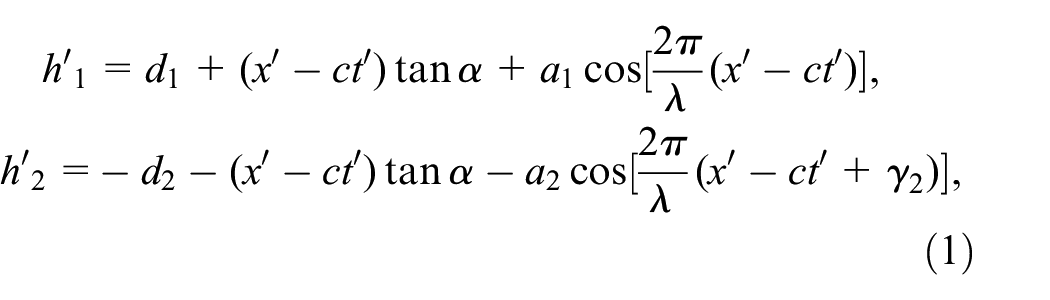
The present study investigates the behavior of incompressible Reiner Philippoff fluid in an asymmetric non-uniform channel of width . Flow inside the channel is induced by the sinusoidal waves like movement along the walls of asymmetric channel of wavelength travelling with a constant speed c. Cartesian coordinates for the problem are chosen so that the -axes is taken along the width of the channel and the -axes is normal to the -axis. See Figure 1 for geometrical illustration. Geometric configuration of the walls for the problem is:
where and indicates the geometry of the upper and lower walls with respect to and respectively, denotes the phase difference, is the time, and are the amplitudes of the waves corresponding to the lower and upper walls of the channel, c indicates the speed of peristaltic wave, is the width of the asymmetric channel and supersciript ’ is for dimensional quantities. For an incompressible Reiner Philippoff fluid the governing equations may be written as:
Physical sketch of the problem.
In above equations represents the density, is velocity vector, is specific heat, is for thermal conductivity of the fluid, represents the temperature of fluid, is viscous dissipation and is the Cauchy stress tensor given as:
where for Reiner-Philippoff fluid, the stress-strain relationship is given as:
and viscous dissipation is defined as:
Reiner-Philippoff model contains three adjustable positive parameters and . Here is the upper Newtonian limiting viscosity, is the zero shear viscosity, is the reference shear stress and in equation (5) denotes the shear stress. Using the following non-dimensional quantities:
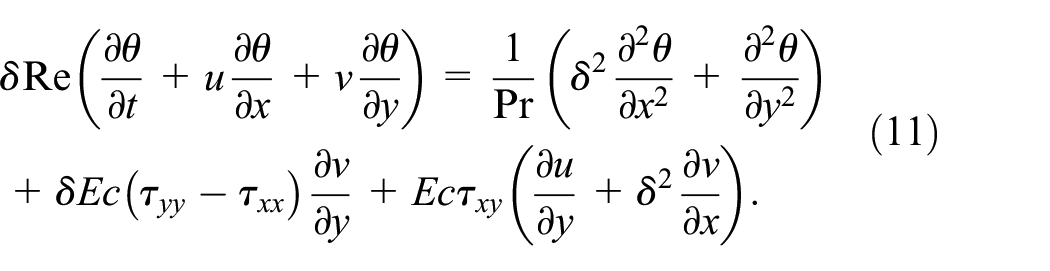
the continuity equation, components of momentum equation and energy equation in two-dimensional Cartesian coordinate system may be written as:
Using the low Reynolds number and long wavelength approximations, equations (9)–(11) reduces to:
In above equations . Now by using long wavelength approximation we have
and
Equation (21) is the explicit relation between shear stress and deformation for Reiner-Philippoff fluid. For this relation corresponds to Newtonian flow. Using the definition of stream function equation (8) satisfies identically and equations (14) and (21) becomes:
where and are Reiner Philippoff fluid and shear stress parameters. The dimensionless expressions for channel walls and are:
In equation (24), and is non-uniform channel parameter. If and denotes the dimension-free mean flow rates in the wave and laboratory frames then these flows connected by the following relation.41
where
The corresponding dimensionless boundary conditions for the flow are:
where is dimensionless mean flow rate.
Results and discussions
In this section we will discuss the impact of pseudoplaticity and dilatancy of Reiner-Philippoff fluid on peristaltic flow and heat transfer. Equation (13) implies that the pressure is independent of the variable y. Differentiating equation (12) with respect to y, we have,
which shows that is a linear function of y. Using this information, equations (22) and (23) subject to the boundary conditions (25) is solved analytically and the solution is discussed graphically in detail in rest of this section.
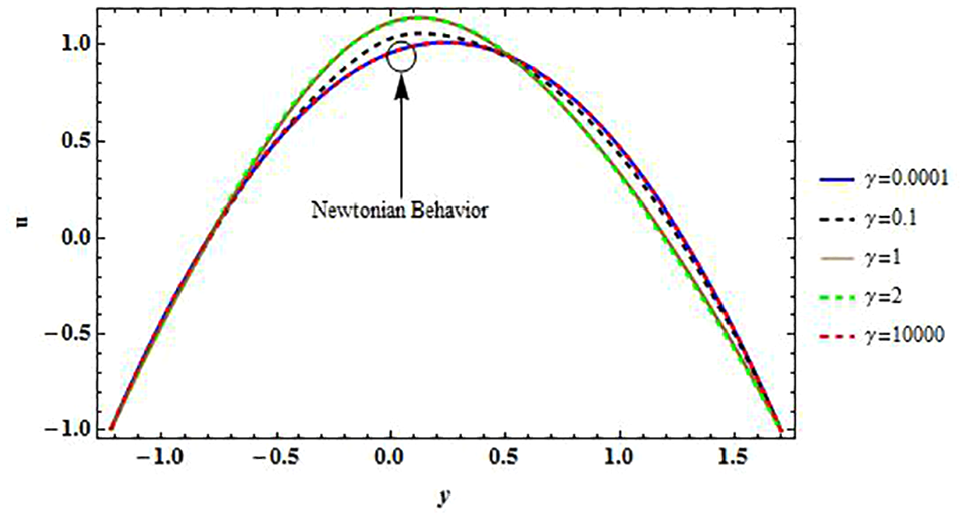
Reiner–Philippoff fluid acts as dilatants fluid for , as pseudoplastic for > 1 and as Newtonian fluid for . The variation of on velocity profile is plotted in Figure 2. The blue solid line represents the velocity profile for Newtonian fluid and it is observed that as the value of exceeds from the velocity of the fluid increases. As mentioned earlier that Reiner-Philippoff fluid behaves as pseudoplastic (thinning) fluid for . Therefore for the viscosity of the fluid decreases under shear strain which results in increase in velocity in the centre of the channel. For value of the Reiner-Philippoff model represents the dilatants (thickening) fluid. As decreases, the velocity of the fluid decreases near the lower wall and the velocity increase as we move from centre towards upper wall.
Effects of Reiner-Philippoff parameter on velocity profile. (, , , , , , , , , ).
Reiner-Philippoff model represents the Newtonian fluid for zero and large reference shear stress. The same behavior can be witnessed from Figures 3 and 4 that for and the behavior of fluid velocity is same. Further, Figures 3 and 4 illustrate the behavior of fluid velocity for different values of shear stress parameter when Reiner-Philippoff fluid acts as a pseudoplastic and dilatants fluid respectively. From Figure 3 it is observed that the velocity of pseudoplastic fluid increases with an increase in shear stress parameter . Figure 4 depicts that the velocity of dilatants fluid decreases with an increase in shear stress parameter and an opposite behavior is observed in close vicinity of upper wall. Equation (26) shows that the shear stress is a linear function of independent variable y of the form . In Figures 5 and 6 it is shown that the arbitrariness of the coefficient and constant do not have significant effect on the final results.
Effects of on velocity profile of pseudoplastic fluid (, , , , , , , , , ).
Effects of on velocity profile of dilatants fluid (, , , , , , , , , ).
Effects of arbitrary parameter on velocity profile (, , , , , , , , , ).
Effects of arbitrary parameter on velocity profile (, , , , , , , , , ).
In Figures 7 to 10 the effect of pseudoplaticity and dilatancy of fluid and non-uniformity of channel are discussed on the pressure gradient along the channel. These graphs predict the sinusoidal behavior of the pressure gradient. It is observed that the maximum of pressure gradient exit at the points where the channel width is minimum. Further the magnitude of maximum value of pressure gradient decreases as we move away from the origin. This phenomenon is due to non-uniform channel width, that is, the width of channel increase as we move away from origin. From Figure 7 it can be noticed that the pressure gradient increases with an increase the value of This increase in the pressure gradient of Reiner-Philippoff fluid is due to increase in the apparent viscosity of the fluid. Blue solid line is representing the behavior of pressure gradient for Newtonian fluid. Further, this increment in the pressure gradient is greater in the narrower part of the channel when we compare it with the wider part of the channel. In Figure 8 the effect of is discussed on the pressure gradient for dilatants fluid. It is observed that by increasing the value of shear stress parameter the value of pressure gradient decreases. It can also be seen that rate of change of pressure gradient with respect to decreases with an increase in . In Figure 9 the effect of is discussed on the pressure gradient of pseudoplastic fluid. The effect of shear stress parameter is quite opposite on dilatants fluid as compared with the pseudoplastic fluid. From figure it is observed that by increases the value of shear stress parameter the value of pressure gradient increases. In Figure 10 the effect of non-uniformity parameter is discussed on the pressure gradient profile. For (for uniform channel) the magnitude of each peak of pressure gradient, the pressure gradient at narrowest part is same. However, as the value of increases, that is, the width of channel increases the magnitude of every subsequent peak of pressure gradient is less than the previous peak due to increase in width of the channel.
Effects of on pressure gradient (, , , , , , , , ).
Effects of on pressure gradient for dilatants fluid (, , , , , , , , , ).
Effects of on pressure gradient for pseudoplastic fluid (, , , , , , , , , ).
Effects of on pressure gradient (, , , , , , , , , ).
Trapping is another interesting phenomena related to peristaltic flow. In general, in the wave frame the streamlines have the shape similar to the walls of the channel as the walls are stationary. However, in certain situations some streamlines may split to enclose a bolus of fluid particles in nearby streamlines. Once the fluid is trapped it remains trapped and moves as a bulk with the wave speed. The amount of trapped volume depends on physical parameters which are discussed below.
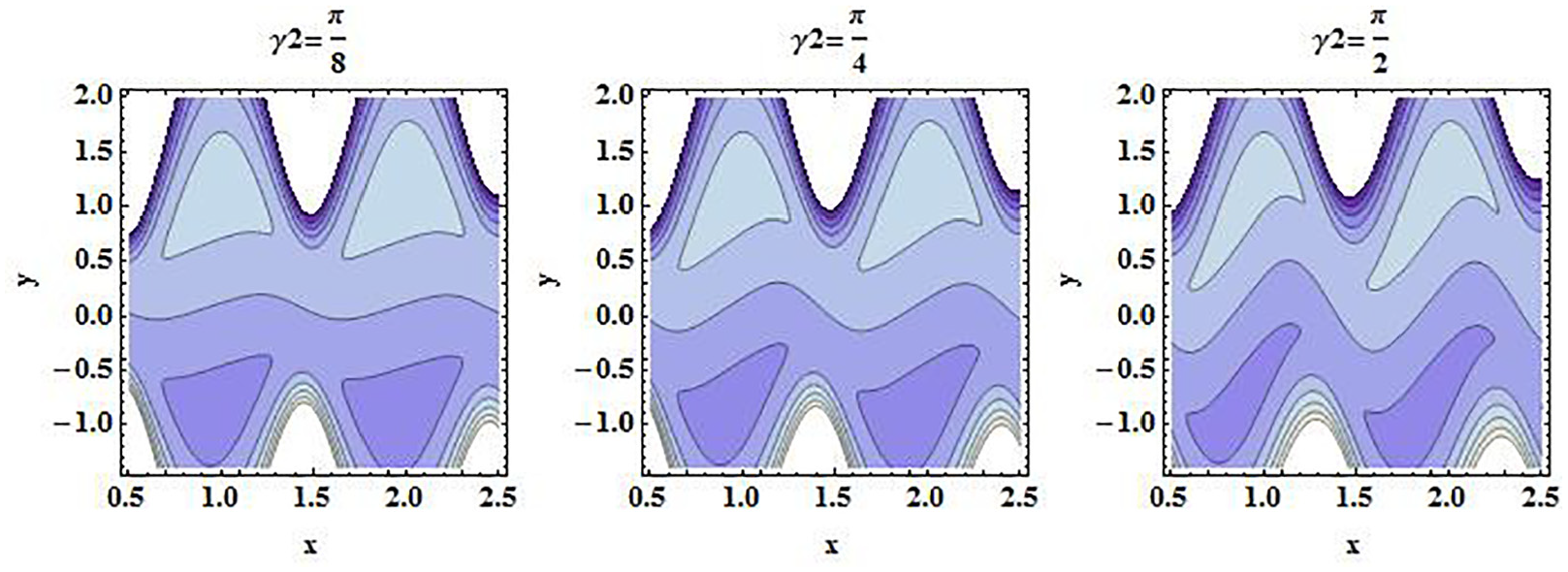
From Figure 11 it is observed that the size of the bolus increases with an increase in value of . That is, the trapped volume for pseudoplastic fluid is more than the dilatants fluid. Figure 12 indicates that as the phase difference of the channel increases the size of the bolus decreases. Figure 13 illustrates the time dependent behavior of peristaltic flow. In peristaltic flow the wave like movements propel the contents of channel forward. In Figure 13 it can be observed that bolus moves forward from left to right with the passage of time which verifies the basic property of peristaltic flow.
Effect of on streamlines (, , , , , , , , ).
Effect of phase difference on streamlines (, , , , , , , , ).
Effect of time on streamlines (,, , , , , , , ).
In Figures 14 to 16, the behavior of temperature profile of Reiner-Philippoff fluid is discussed. Figure 14 shows that by decreasing the dilatancy and increasing the pseudoplasticity of fluid the temperature of the fluid increases. Initially by increasing the value of the change in temperature profile is greater as compared to the successive changes in the temperature profiles. In Figures 15 and 16 the effect of shear stress parameter is studied on temperature profile when Reiner Philippoff fluid acts as pseudoplastic and dilatants fluid respectively. It is observed that temperature of pseudoplastic fluid increases with an increase in shear stress parameter . The temperature behavior of dilatants fluid is totally opposite to pseudoplastic fluid as Figure 16 depicts that the temperature of dilatants fluid decreases with an increase in shear stress parameter . Figure 17 is drawn to show the effect of Brinkman number on temperature profile. Brinkman number is the ratio between heat produced by viscous dissipation and heat transported by molecular conduction. The viscosity of the fluid will take energy from the motion of the fluid and transform it into internal energy of the fluid, referred to as dissipation. Increase in Brickman number referred to stronger dissipation effect resulting in increase in temperature of fluid.
Effects of Reiner-Philippoff parameter on temperature profile (, , , , , , , , , ).
Effects of on temperature profile of pseudoplastic fluid (, , , , , , , , , ).
Effects of on temperature profile of dilatants fluid (, , , , , , , , , ).
Effects of Brinkman number on temperature profile (, , , , , , , , , ).
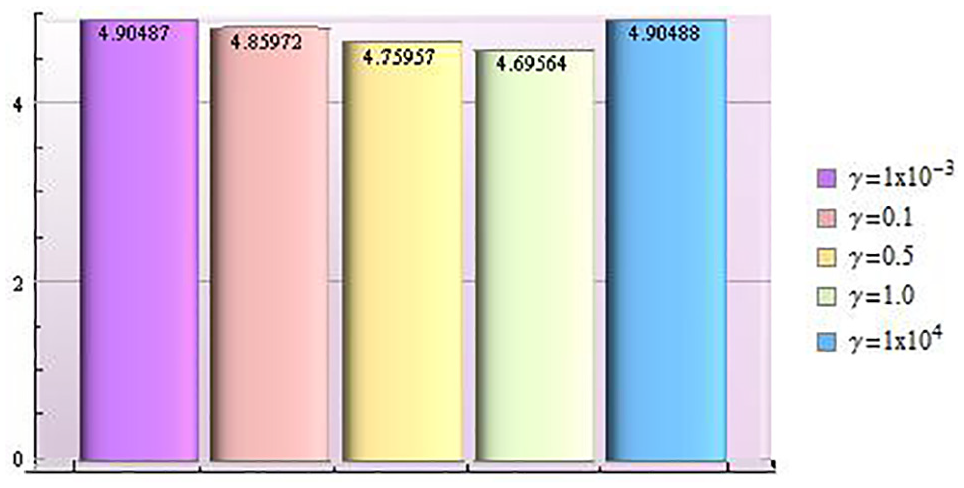
Finally we will discuss the effect of Reiner-Philippoff fluid on heat transfer rate in peristaltic flow. Figure 18 shows that by increasing the value of Reiner-Philippoff fluid parameter the heat transfer rate of the fluid decreases. So the heat transfer rate in dilatants fluid is greater than in the pseudoplastic fluid. Figures 19 and 20 depict that the rate of heat transfer of the pseudoplastic fluid decreases and for dilatants fluid it increases with an increasing in shear stress parameter . Also in both cases the rate of heat transfer is same at both extremes of shear stress parameter . Brinkman number also plays an important role in heat transfer which can be seen in Figure 21 that heat transfer rate increases quickly by increasing the value of Brinkman number.
Effects of on heat transfer rate at upper wall (, , , , , , , , , ).
Effects of on heat transfer rate at upper wall of pseudoplastic fluid (, , , , , , , , , , ).
Effects of on heat transfer rate at upper wall of dilatants fluid (, , , , , , , , , , ).
Effects of Brinkman number on heat transfer rate at upper wall (, , , , , , , , , , ).
Conclusion
Peristaltic flow and heat transfer of non-Newtonian fluid using the Reiner-Philippoff viscosity model is discussed in this article. The governing equations for the peristaltic flow and heat transfer in a non-uniform channel are modeled using the long wave length and low Reynolds number approximation. The results are presented graphically portraying the effects of non-Newtonian fluid and non-uniform channel on the velocity field, pressure gradient, stream lines, temperature and heat transfer at the surface. The significant results of this study are given below:
For the viscosity of the fluid decreases under shear strain which results in increase in velocity in the centre of the channel. For the Reiner-Philippoff model represents the dilatants (thickening) fluid. As decreases, the velocity of the fluid decreases near the lower wall and the velocity increase as we move from centre towards upper wall.
The velocity of pseudoplastic fluid increases with an increase in shear stress parameter and the velocity of dilatants fluid decreases with an increase in shear stress parameter and an opposite behavior is observed in close vicinity of upper wall.
The pressure gradient increases with an increase the value of due to increase in the apparent viscosity of the fluid. Further, this increment in the pressure gradient is greater in the narrower part of the channel as compared to wider part of the channel.
The effect of shear stress parameter is quite opposite on dilatants fluid as compared with the pseudoplastic fluid. By increasing the value of shear stress parameter the value of pressure gradient in pseudoplastic fluid increases.
The trapped volume for pseudoplastic fluid is greater than the dilatants fluid.
By decreasing the dilatancy and increasing the pseudoplasticity of fluid the temperature of the fluid increases.
It is observed that temperature of pseudoplastic fluid increases with an increase in shear stress parameter. The temperature behavior of dilatants fluid is totally opposite to pseudoplastic fluid.
The heat transfer rate in dilatants fluid is greater than in the pseudoplastic fluid.
Footnotes
Handling Editor: James Baldwin
Declaration of conflicting interests
The author(s) declared no potential conflicts of interest with respect to the research, authorship, and/or publication of this article.
Funding
The author(s) received no financial support for the research, authorship, and/or publication of this article.
ORCID iD
Adeel Ahmad
References
1.
MoayeriMSZendehbudiGR.Effects of elastic property of the wall on flow characteristics through arterial stenosis. J Biomech2003; 36: 525–535.
2.
BaiethHHamzaS. Comparative examination of constitutive equations for apparent viscosity of human blood. Egypt J Biophys Biomed Eng2006.
3.
PedrzzettiGZavattoLDomenichinF, et al. Pulstile flow inside moderately elastic arteries, its modeling and effects of elasticity. Comp Math Bio Mech Bio Eng2002; 5: 219–225.
4.
PontrelliG.Nonlinear problems in arterial flows. Nonlinear Anal2001; 47: 4905–4919.
5.
WalburnFJScnechDJ.A constitutive equation for whole human blood. Biorheology1976; 13: 201–211.
6.
LoweGDRumleyA.The relationship between blood viscosity and blood pressure in a random sample of the population aged 55 to 74 years. Eur Heart J1993; 597: 5–20.
7.
ThurstonGBHendersonNMJengM. Viscoelastic properties of blood on analoges. In: HowTV (ed.) Advances in hemodynamics and hemorheology. Greenwich, CT: Jai Press, Inc., 2004, pp.1–30.
8.
HsuRSecombTW.Motion of nonaxisymmetric red blood cells in cylindrical capillaries. J Biomech Eng1989; 111: 147–151.
9.
MooreJASteinmanDAPrakashS, et al. A numerical study of blood flow patterns in anatomically realistic and simplified end-to-side anastompses. J Biomech Eng1999; 121: 265–272.
10.
KennerTMoserMMohW.Arteriovenous difference of the blood density in the coronary circulation. J Biomech Eng1985; 107: 34–40.
11.
BirdRBArmstrongRCHassagerO.Dynamics of polymeric liquids. Volume 1: fluid Mechanics. Hoboken, NJ: John Wiley & Sons, Inc., 1987.
12.
MohanVVenkateswarluD.Creeping flow of an Ellis fluid past a Newtonian fluid sphere. Int J Multiph Flow1976; 2: 571–579.
13.
AliURehmanKAlshomraniAS, et al. Thermal and concentration aspects in Carreau viscosity model via wedge. Case Stud Therm Eng2018; 12: 126–133.
14.
AkyildizFTVajraveluKMohapatraRN, et al. Implicit differential equation arising in the steady flow of a sisko fluid. Appl Math Comput2009; 210: 189–196.
15.
VajraveluKPrasadKVRajuBT.Effects of variable fluid properties on the thin film flow of Ostwald-de Waele fluid over a stretching surface. J Hydrodynam2013; 25: 10–19.
16.
MannarswamyAMunson-McGeeSHAndersenPK.D-optimal designs for the Cross viscosity model applied to guar gum mixtures. J Food Eng2010; 97: 403–409.
17.
AbbasiFMHayatTAlsaediA.Numerical analysis for MHD peristaltic transport of Carreau-Yasuda fluid in a curved channel with Hall effects. J Magn Magn Mater2015; 382: 104–110.
18.
HinaSMustafaMHayatT, et al. Peristaltic flow of Powell-Eyring fluid in curved channel with heat transfer: a useful application in biomedicine. Comput Methods Programs Biomed2016; 135: 89–100.
19.
NaTY.Boundary layer flow of Reiner-Philippoff fluids. Int J Non Linear Mech1994; 29: 871–877.
20.
AliNZamanASajidM, et al. Numerical simulation of time-dependent non-Newtonian nanopharmacodynamic transport phenomena in a tapered overlapping stenosed artery. Nanosci Technol2018; 9: 247–282.
21.
ShafiqAKhanIRasoolG, et al. Significance of double stratification in stagnation point flow of third-grade fluid towards a radiative stretching cylinder. Mathematics2019; 7: 1103.
22.
ShamshuddinMDMishraSRKadirA, et al. Unsteady chemo-tribological squeezing flow of magnetized bioconvection lubricants: numerical study. J Nanofluid2019; 8: 407–419.
23.
AliBRasoolGHussainS, et al. Finite element study of magnetohydrodynamics (MHD) and activation energy in Darcy-Forchheimer rotating flow of Casson Carreau nanofluid. Processes2020; 8: 1185.
24.
RasoolGZhangT.Darcy-Forchheimer nanofluidic flow manifested with Cattaneo-Christov theory of heat and mass flux over non-linearly stretching surface. PLoS One2019; 14: e0221302.
25.
RasoolGShafiqAKhanI, et al. Entropy generation and consequences of MHD in Darcy-Forchheimer nanofluid flow bounded by non-linearly stretching surface. Symmetry2020; 12: 652.
26.
RasoolGShafiqABaleanuD.Consequences of Soret-Dufour effects, thermal radiation, and binary chemical reaction on Darcy-Forchhiemer flow of nanofluids. Symmetry2020; 12: 1421.
27.
FerdowsMMurtazaMGShamshuddinMD.Effect of internal heat generatin on free convective power-law variable temperature past a vertical plate considering exponential variable viscosity and thermal conductivity. J Egypt Math Soc2019; 27: 1–11.
28.
AnwarTTahirMKumamP, et al. Magnetohydrodynamic mixed convective peristaltic slip transport of carbon nanotubes dispersed in water through an inclined channel with Joule heating. Heat Transfer2020; 1–26.
29.
BegOAEspinozaDESKadirA, et al. Experimental study of improved rheology and lubricity of drilling fluids enhanced with nano-particles. Appl Nanosci2018; 8: 1069–1090.
30.
RasoolGZhangTShafiqA.Second grade nanofluid flow past a convectively heated vertical Riga plate. Phys Scr2019; 94: 125212.
31.
YamKSHerrisSDInghamDB, et al. Boundary-layer flow of Reiner-Philippoff fluids past a stretching wedge. Int J Non Linear Mech2009; 44: 1056–1062.
32.
AhmadA.Flow of Reiner Philippoff based nanofluid past a stretching sheet. J Mol Liq2016; 219: 643–646.
33.
ShitGCRanjitNKSinhaA.Adomian decomposition method for magnetohydrodynamic flow of blood induced by peristaltic waves. J Mech Med Biol2017; 17: 1750007.
34.
HayatTAhmedBAbbasiFM, et al. Mixed convective peristaltic flow of carbon nanotubes submerged in water using different thermal conductivity model. Comput Methods Programs Biomed2016; 135: 141–150.
35.
SaleemAQaiserANadeemS.Physiological flow of biomedical compressible fluids inside a ciliated symmetric channel. Adv Mech Eng2020; 12: 1–11.
36.
ShehzadSAAbbasiFMHayatT, et al. MHD mixed convective peristaltic motion of nanofluids with joule heating and thermophoresis effects. PloS One2014; 9: e111417.
37.
AbbasiFMHayatTAlsaadiF.Hydromagnetic peristaltic transport of water based nanofluids with slip effects through an asymmetric channel. Int J Mod Phys2015; B29: 155051.
38.
MaitiSMisraJC.Peristaltic transport of a couple stress fluid: some applications to hemodynamics. J Mech Med Biol2012; 12: 1250048.
39.
AbbasiFMHayatTAhmadB, et al. Slip effects on mixed convective peristaltic transport of copper-water nanofluids in an inclined channel. PloS One2014; 9: e105440.
40.
AbbasiFMHayatTAhmadB.Peristalsis of silver-water nanotubes in the presence of Hall and Ohmic heating effects: applications in drug delivery. J Mol Liq2015; 207: 248–255.
41.
AbbasiFMHayatTAhmadB.Impact of magnetic field on mixed convective peristaltic flow of water based nanofluids with Joule heating. Z Naturforsch2015; 70a: 125–132.