




Abstract
The natural convection along a vertical isothermal plate in a non-Newtonian power-law fluid is considered in this article. The problem has been treated in the past but only for the heat transfer case. The boundary layer equations are solved with the finite volume method. The problem is non-similar and is governed by the Prandtl number, the power-law index and the non-dimensional distance along the plate. Results are presented for non-dimensional distance up to 1000, Prandtl numbers from 1 up to 1000 and power-law index from 0.6 up to 1.5. Local Nusselt numbers, temperature profiles, skin friction and velocity profiles have been calculated and presented in tables and figures. The new results, combined with those existing in the literature, give a complete solution to this classical problem in the field of non-Newtonian power-law fluids.
Introduction
Natural convection with non-Newtonian fluids has received considerable attention because of its importance in industrial applications where processes with fluids such as molten plastics, slurries, paints and blood are common. In such cases, the fluid’s rheology significantly complicates the problem because the apparent viscosity at any location in the flow field becomes a function of the local shear rate, thus presenting a nonlinear problem. Consequently, a constitutive equation that is appropriate for the specific fluid under investigation must be used and models have been developed to describe various fluid behaviours. Examples include the power law (i.e. Ostwald–de Waele), modified power law (MPL) and extended modified power law (EMPL) models for pseudoplastic and dilatant fluids, the Carreau–Yasuda, Cross and Ellis models for pseudoplastic fluids and the Casson and Herschel–Bulkley models for viscoplastic fluids. 1 The Ostwald–de Waele power-law model is the oldest and most used. The investigation of natural convection of non-Newtonian power-law fluids started in 1960 with Acrivos 2 and continues in our days. See, for example, the recent work by Guha and Pradnan, 3 which concerns the natural convection over a horizontal plate. These authors also give a good review of natural convection of non-Newtonian power-law fluids. In a paper published in Journal of Heat Transfer, 4 the natural convection of a non-Newtonian, power-law fluid along a vertical isothermal plate was considered. In that paper, results only for the local and average Nusselt number were presented.
After an intensive investigation made in the literature, no subsequent work has been found containing results concerning temperature profiles and results concerning the velocity field (velocity profiles and wall shear stress). Therefore, it could be said that this classical problem in natural convection of non-Newtonian power-law fluids along a vertical plate remains incomplete. The purpose of this article is to fill the gap and present a complete solution.
The mathematical model
Consider the flow of a non-Newtonian power-law fluid along a vertical surface with u and v denoting, respectively, the velocity components in the x and y direction, where x is the coordinate along the surface and y is the coordinate perpendicular to x. The boundary layer equations over the plate are 4

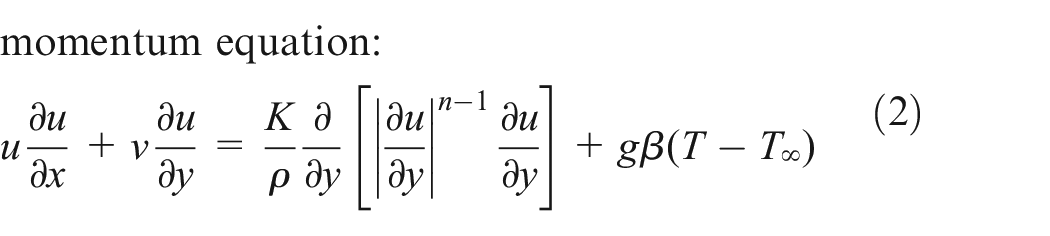

where ρ is the fluid density, K is the consistency coefficient which reduces to dynamic viscosity in a Newtonian fluid, n is the power-law index, T is the fluid temperature, g is the gravity acceleration and β is the thermal expansion coefficient The fluid is characterized as shear-thinning for


Equations (1)–(3) represent a two-dimensional parabolic problem. Such a flow has a predominant velocity in the streamwise coordinate which is the direction along the plate. In this type of flow convection always dominates the diffusion in the streamwise direction. Furthermore, no reverse flow is acceptable in the predominant direction. The solution of this problem in this work is obtained using a finite volume algorithm as described by Patankar. 5 In order to obtain complete form of velocity and temperature profiles at the same cross-section, a nonuniform lateral grid has been used. Δy is small values near the surface (dense grid points near the surface) and increases with y. A total of 500 lateral grid cells were used. It is known that the boundary layer thickness changes along x. For that reason, the calculation domain must always be at least equal to or wider than the boundary layer thickness. In each case, the goal was to have a calculation domain wider than the real boundary layer thickness. This has been done by trial and error. If the calculation domain was thin, the velocity and temperature profiles were truncated. In this case, a wider calculation domain was used in order to capture the entire velocity and temperature profiles. The parabolic (space marching) solution procedure is described analytically in the textbook of Patankar. 5 That solution procedure is implicit and unconditionally stable, 6 has been used extensively in the literature and has been included in fluid mechanics and heat transfer textbooks.6–8 The method is used successfully also by other researchers (see, e.g., the recent work by Capobianchi and Aziz 1 ).
Results and discussion
It is mentioned here that the problem is non-similar. This has been confirmed by Huang et al. 4 Non-similarity was also proved by Guha and Pradnan 3 for the corresponding problem over a horizontal plate. Therefore, the results depend on the axial distance ξ. In addition, the results depend on the transverse distance η and the Prandtl number defined as 4


where


The reference velocity is

The skin friction (wall shear stress) and the local Nusselt number are


In Table 1, results are presented for the local Nusselt number, skin friction, maximum velocity and point of maximum velocity for
Results for ξ = 1.

Results for ξ = 1000.

Influence of axial distance
In Figure 1, the variation of the local Nusselt number along the plate is shown for Pr = 10 and different values of the power-law index. This figure is equivalent to Figure 1 of Huang et al. 4 It is mentioned here that the results of Huang et al. 4 stop at ξ = 1, whereas the results of this work extend up to ξ = 1000. However, the trend is the same in both figures. The Nusselt number rises with ξ for shear-thickening fluids and reduces in shear-thinning fluids. As was expected, the Nusselt number is independent of ξ in Newtonian fluids because the natural convection flow in Newtonian fluids is similar (There is no dependence on ξ. This problem was treated for the first time in 1953 by Ostrach 9 ). Figure 2 shows the variation of skin friction along the plate. Now the skin friction increases in shear-thinning fluids, decreases in shear-thickening fluids and remains again constant in Newtonian fluids (same reasons as previously). The variation of non-dimensional maximum velocity is presented in Figure 3 where the same trend is valid with that of skin friction. The maximum velocity becomes higher in shear-thinning fluids and lower in shear-thickening fluids as ξ increases. From Figure 4, it is seen that the point of maximum velocity moves towards the plate in shear-thickening fluids and moves away from the plate in shear-thinning fluids as ξ gets higher values. Velocity profiles are illustrated in Figure 5 and the corresponding temperature profiles are shown in Figure 6. It is clear that an increase in ξ causes an increase in velocity in shear-thinning fluids and a reduction in shear-thickening fluids. A plateau appears near the maximum velocity in shear-thinning fluids and a sharp peak in shear-thickening fluids. These forms also appear in the velocity profiles of Guha and Pradnan. 3 The same behaviour appears in temperature. An increase in ξ causes a rise in temperature in shear-thinning fluids and a reduction in shear-thickening fluids.

Local Nusselt number for Pr = 10.

Skin friction for Pr = 10.

Maximum velocity for Pr = 10.

Position of maximum velocity for Pr = 10.

Velocity profiles for Pr = 10.

Temperature profiles for Pr = 10.
Influence of Pr
In Figures 7–10, the influence of Pr is shown on Nusselt number, skin friction, maximum velocity and point of maximum velocity for ξ = 1000. It is clear that, for all kinds of fluids, the Nusselt number increases with increasing Pr. In contrast, the skin friction, the maximum velocity and the distance of the maximum velocity from the plate all reduce with increasing Pr. Velocity and temperature profiles for Pr = 1, 10 and 100 are illustrated in Figures 11 and 12. As the Pr rises, the temperature profiles become thinner and the velocity reduces. The explanation is as follows: this is a natural convection problem, and for this flow, it is well known that an increase in Pr produces a thinner temperature profile and vice versa (p. 272).
10
The same behaviour appears here (Figure 12). When the Pr increases, the temperature decreases, the buoyant force reduces and the source term
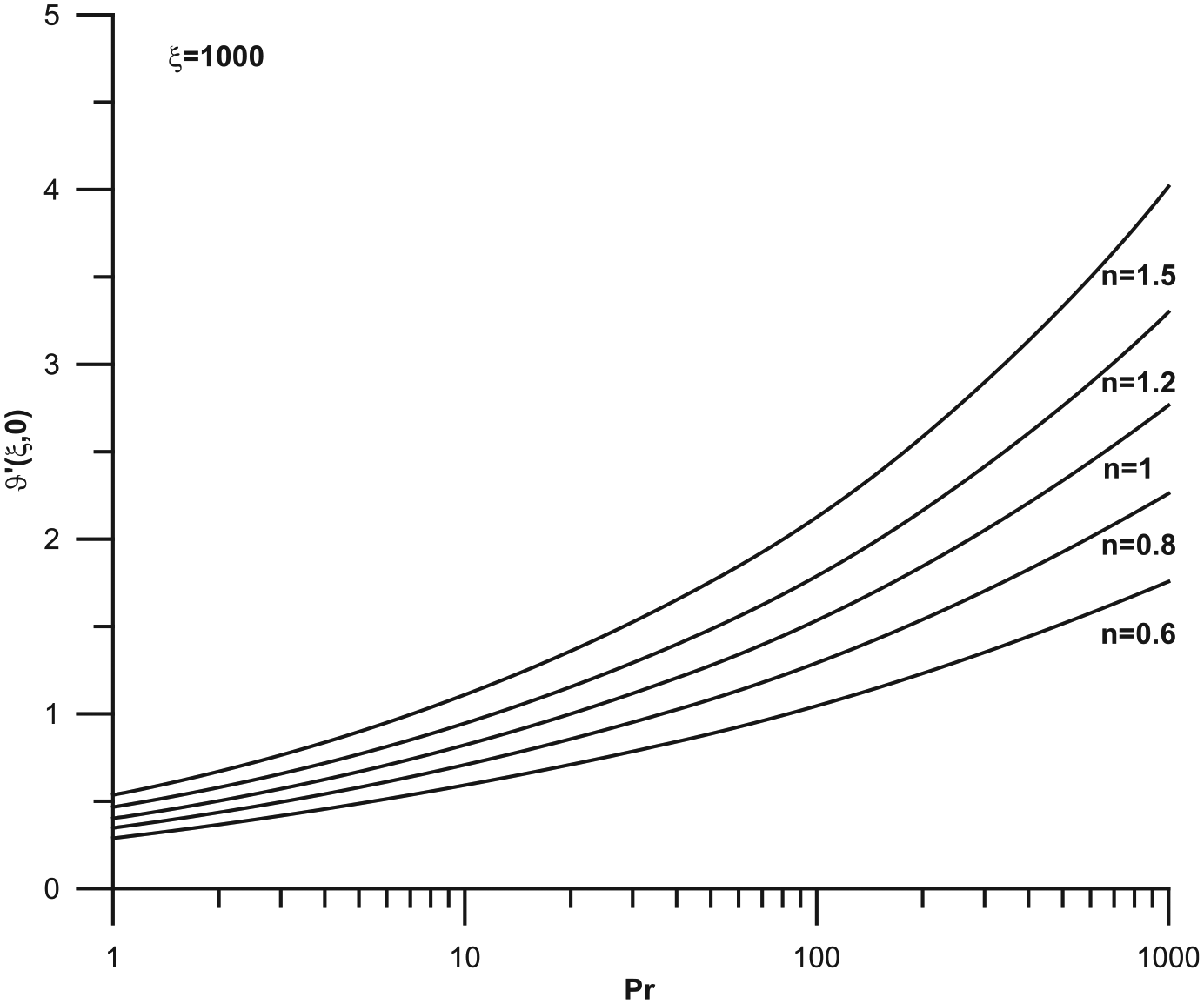
Local Nusselt number for ξ = 1000.

Skin friction for ξ = 1000.

Maximum velocity for ξ = 1000.
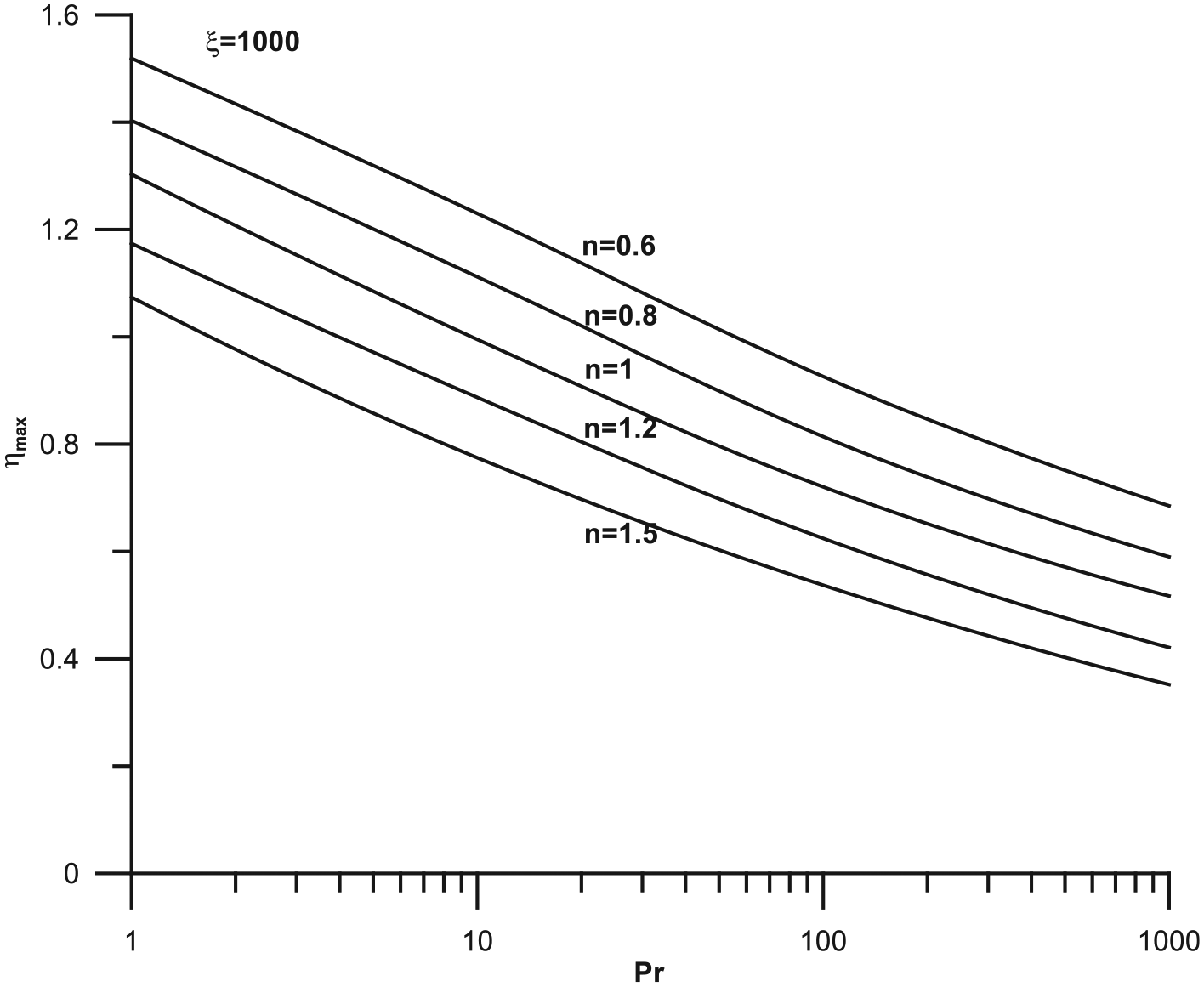
Position of maximum velocity for ξ = 1000.

Velocity profiles for ξ = 1.

Temperature profiles for ξ = 1.
Influence of the power-law index
Velocity and temperature profiles are shown in Figures 13 and 14 for Pr = 1, ξ = 1 and different values of the power-law index. As the power-law index rises, the velocity increases and the velocity boundary layer thickness becomes smaller. In contrast, the influence of power-law index on temperature profiles is not so important. The profiles become thinner with increasing n, but the variation is small.

Velocity profiles Pr = 1, ξ = 1 and different values of the power-law index.

Temperature profiles Pr = 1, ξ = 1 and different values of the power-law index.
In momentum equation (2), the term
Conclusion
The natural convection flow of a non-Newtonian power-law fluid over a vertical isothermal plate has been investigated in this article. It is advocated here that this is the first complete work concerning this classical non-Newtonian problem. The results are as follows:
The Nusselt number increases with ξ for shear-thickening fluids and declines in shear-thinning fluids. In addition, the temperature profiles become thinner in shear-thickening fluids and thicker in shear-thinning fluids with increasing ξ.
The skin friction, maximum velocity and position of maximum velocity all rise in shear-thinning fluids and reduce in shear-thickening fluids with increasing ξ. The velocity profiles become thinner in shear-thickening fluids and thicker in shear-thinning fluids with increasing ξ.
Higher values of Pr enhance the Nusselt number for all kinds of fluids and suppress the temperature profiles. In contrast, the skin friction, the maximum velocity and the distance of the maximum velocity all reduce with rising Pr.
As the fluid changes from shear thinning to shear thickening, the maximum velocity becomes sharper and the velocity and temperature profiles become thinner.
Footnotes
Appendix 1
Academic Editor: Chun-Liang Yeh
Declaration of conflicting interests
The author(s) declared no potential conflicts of interest with respect to the research, authorship and/or publication of this article.
Funding
The author(s) received no financial support for the research, authorship and/or publication of this article.