



Abstract
The comparative analysis of non-Newtonian nanofluids with Newtonian conditions are addressed in this research. Oldroyd-B and Casson fluids are adopted as the non-Newtonian fluids (NNF). The generation of flow is due to bidirectionally movement of magnetized surface. Radiation and chemical reactive processes are accounted in energy and mass transportation equations. Buongiorno’s theory of nanoparticles is developed for the nanofluids analysis. The basic formulas of fluid dynamics are incorporated to formulate the physical model. The assumption of boundary-layer is utilized for the simplification of mathematical model. The arising nonlinear model of three independent variables are converted into one independent variable model using similarity constraints. The simplified mathematical model is treated analytically through the implementation of homotopic approach. The convergence of this scheme is verified through numerical benchmark and graphic illustration. The results of versatile constraints on physical quantities are addressed numerically and graphically. The comparison of results with previous published outcomes is provided in limiting approach.
Introduction
NNFs are very useful in modern engineering and industrial product processes. These fluids are commonly appeared in our routine life. Examples of such materials are blood, tooth-pastes, shampoos, drilling muds, sugar solutions, honey, certain oils, lubricants, polymer solutions, syrups, soaps, and many more. These fluids have versatile physical behaviors. The physical nature of such materials cannot be reported through the single constitutive model. Various investigators have built the distinct constitutive model to predict the exact behavior of the material. The adopted NNF models are OBF and Casson fluid. 1 The OBF can express stress retardation and stress relaxation times behavior while the Casson fluid predicted the yield stress. Various investigations on OBF and Casson fluid are addressed in the literature under multiple conditions and distinct flow configurations. Tong et al. 2 implemented the technique of fractional calculus to address the helical OBF through circular and concentric cylinders. They built the exact solutions by employing the Hankel and Laplace transformations of fractional calculus. Time-dependent boundary-driven OBF flowing over an unsteady moving surface through the involvement of nanoparticles is described by Zhang et al. 3 They concluded that the velocity of non-Newtonian fluid is decay against the rising nanoparticles volume fraction. Shehzad et al. 4 executed the 3D (three-dimensional) magneto OBF generated by the radiated bidirectional stretched surface. They discussed the thermally radiated electrically conducted fluid under nanoparticles influences flowing over linear bidirectionally moving surface. Gupta and Gupta 5 reported the Pade-solutions of OBF with nanoparticles induced by magnetized bidirectional moving surface. They employed the DTM (differential transform method) Pade-approximations for the evaluation of the current problem. Ali et al. 6 addressed the 3D flow of OBF flowing over the exponential surface. The results of current research revealed that the retardation and stress relaxation influences have converse trends on the thermal and momentum behavior of the non-Newtonian fluid. Saha and Kundu 7 described the pressure-driven OBF flow in microchannel. They expressed the slip and electroosmotic conditions in this research. They expressed that the zeta potential caused an augmentation in the amplitude of flow velocity. The role of autocatalysis chemically reactive phenomenon on magnetized OBF near stagnation-point is illustrated by Khan et al. 8 This research revealed that the strong heterogenous reaction and homogenous reaction resulted in an improvement of catalyst concentration. Byko and Christov 9 discussed the non-Newtonian liquid-structure exchange of OBF through deformable channel. They provided the model to calculate the fluid viscoelasticity influences on pressure-drop relation and deformation of elastic channel wall. Givi and Sangeetha 10 addressed the nonlinear quadratic convected aspects of Casson fluid. They also executed the Hall current and suction influences in this attempt. They reported that the thermal profiles are weaker against the higher absorption constraint and Prandtl number. Banerjee et al. 11 analyzed the viscous heating interaction in energy transport Casson fluid through diverging channel. This research interpreted that the rheological nature of viscous heating and Casson fluid have influential role on the thermal distribution. Aghighi et al. 12 reported the double-diffusion in naturally convected Casson fluid flowing through an enclosure. They executed the analysis that the ratio of buoyancy affected the solutal and energy transportation in similar manner. Reddy et al. 13 distinguished the heat production and rotatory aspects of magnetized Casson fluid over oscillatory porous plate. This investigation revealed that the isothermal plate case has higher fluid features as comparative to the ramped surface temperature situation. Free-convected flow of magneto Casson liquid induced by the oscillation of vertical plate is demonstrated by Prameela et al. 14 They resulted that the Casson fluid and magnetic parameters reduced the fluid velocity significantly.
Nanofluid is a special branch of fluids which is developed by Choi and Eastman 15 They performed an experiment by adding the tin-size particles into ordinary carrier liquid and found that the inclusion of such solid particles augmented the thermal conductance of newly developed fluid remarkably. They termed these solid particles as nanoparticles. After that, Buongiorno 16 reported a study for convective heat transportation of nanofluids. He adopted the seven mechanism of nanoparticles include inertial effects, volume fraction, thermophoresis, particle agglomeration, nanoparticle size, Brownian movement, and magnus impact. He illustrated that the thermophoresis force and Brownian movement are the major aspects which enhanced the thermal efficacy of nanofluids dramatically. In modern era, the nanofluids are widely implicated in various industrial and engineering processes like renewable energy devices, missiles technology, heat exchangers, lubricants oils, cooling towers, air-conditioners, hybrid engines, chemical reactors, heat pumps, biomedical equipment, laser therapy, and many others. The Buongiorno’s model is executed by multiple investigators under various situations and fluid models. Turkyilmazoglu 17 presented research to analyze the dual and single phases nanofluids flowing through concentric annuli. He performed the inspection by the implementation of slip condition. Sardar et al. 18 addressed the Carreau nanofluid induced by the nonlinear shrinked surface. They adopted the Cattaneo-Christov energy diffusion theory to address the heat transmission features. The micro-nano fluid with bio-convected nanoparticles is executed by Shehzad et al. 19 Here, the fluid is flowing over the static porous disks. They revealed that the angular rotation can decay due to implication of magnetic field intensity. Abbasi et al. 20 provided the numeric solutions of bio-convected viscoelastic nanomaterial flowing over the convective rotatory disk. They addressed the analysis by the implication of zero mass diffusion and Robin’s conditions. Jafarimoghaddam et al. 21 presented the dual phases nanofluids analysis by using the elastic wall jet geometry. They established the similar-process to interpret the combination of nonlinear moving surface and wall jet flow. Bai et al. 22 reported the time-dependent magnetized slippery flow of OB nanofluids by adopting the Buongiorno model. This research revealed that the convection and radiation may augment the thermal performance of fluid. Sabir et al. 23 presented the Bayesian neural network scheme for Maxwell nanofluid through double-phases Buongiorno model. They utilized the stochastic computing approach to establish the model non-Newtonian nanofluid. Wang et al. 24 considered the Casson model to express the nature of activation energy in stretched nanomaterial flow. They concluded that 35% energy transportation rate is produced by the movement of couple stress-Casson nanofluid. They also revealed that the activated energy released 28% solutal transmission rate at stretched sheet. Khan et al. 25 addressed the hybrid nanomaterial flow under gyrotactic microorganisms and entropy production influences. They immersed the aluminum oxide and silver nanoparticles for the development of hybrid nanomaterial. Irreversible analysis of Maxwell nanomaterial flow over double disks is separated by Khan et al. 26 Thermally radiative chemically reactive bioconvected flow is considered in current research.
This proposal is based on the comparative inspection of OB and Casson fluids generated by the radiative bidirectionally moving surface. The magnetized fluid flowing through the chemically reactive porous space. Two-phase Buongiorno’s nanomaterial model is adopted for the inspection of nanoparticles features. The basic formulae of fluid dynamics are implemented for the development of boundary-driven equations. A suitable transformation is defined for the conversion of dimensional problems into dimensionless form. The converted problem is then tackled through the famous analytical scheme named homotopy analysis method (HAM).27–32 The convergent of the computed results is verified through plots and numeric benchmark. The results of distinct physical quantities are elaborated through graphs. The numeric values of Sherwood and Nusselt number against dissimilar parametric values are presented and addressed. The novelty of the conducted research is the utilization of Newtonian thermal and solutal conditions for non-Newtonian Casson-Oldroyd B nanofluids generated by the magnetized radiative bidirectional stretched sheet. The wall shear stress effects are ignored in the current study which is direction for future work. This work may be extended for various non-Newtonian fluids induced by exponential and nonlinear stretched surfaces. Further, this work can be modified for electromagnetic field, activation energy and non-Darcy porous medium effects.
Problem formulation
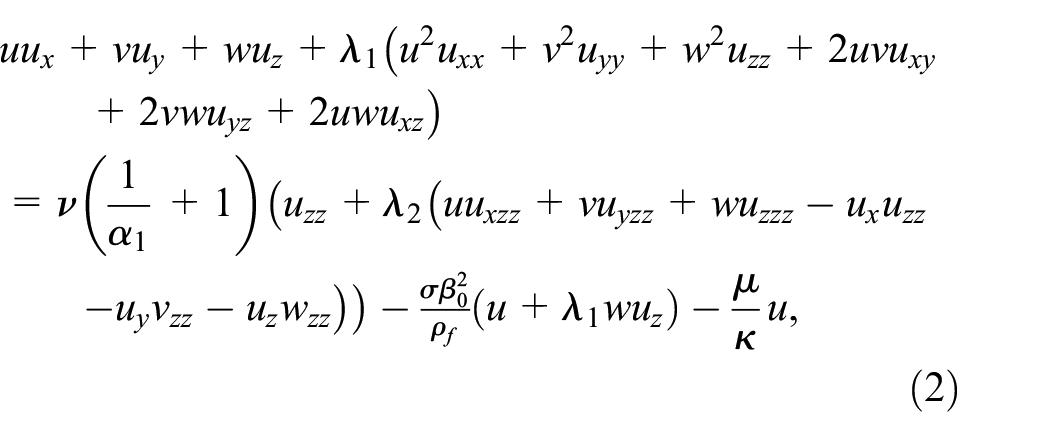
The time-independent three-dimensional NN nanofluids flowing over the bidirectional magnetized surface is adopted. The chemically reactive flow fills the porous medium. Energy and mass species relationships are accounted in the presence of radiative heat generation. The temperature difference between the fluid particles is small. Hence, Rosseland’s approximations are utilized for modeling of radiation term in heat transport equation. Casson and OB fluids are considered as non-Newtonian liquids. Buongiorno’s nanoliquid model is used for the nanoparticles analysis. The Newtonian heat and mass species conditions are employed at the boundaries of magnetized surface. The schematic representation of the flow coordinates is expressed in Figure 1. Following are the boundary-driven equations of the considered problem4,5,33:



Schematic representation of flow coordinates.
The velocity components are u, v and w along x, y, z-directions,
The boundary conditions for the present problems are:


Here, (a, b) are the positive constants has dimension time inverse and
The similar variables are introduced into the following fashion:

The above similarity transformations reduced the dimensional equations into the following non-dimensional model:
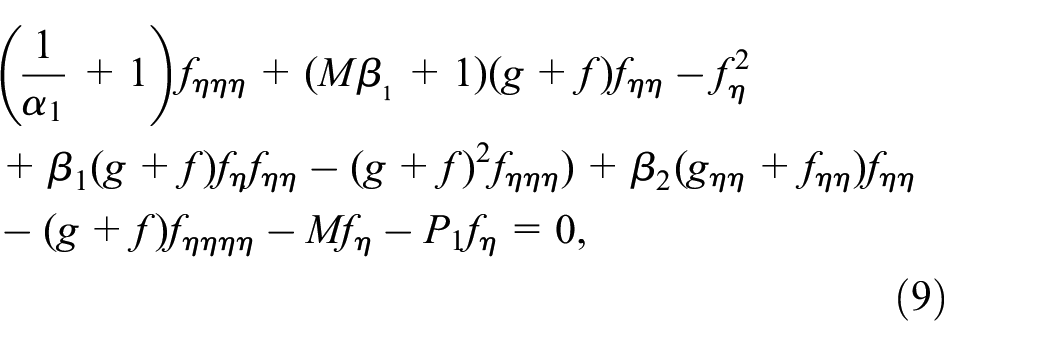
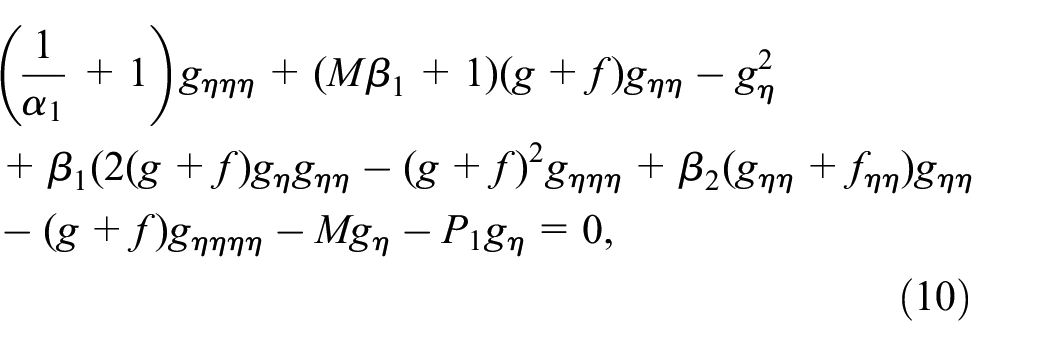


where


Solutions by homotopy analysis method
HAM has multiple advantages over other perturbed and non-perturbed methods. It is the scheme of series expansion which may not depend on smaller or larger parameters. It is implemented for both weakly and strongly nonlinear problems. It provides descent facility to adopt the base functions and auxiliary linear operators. HAM provides the simplest way to verify the convergence of solutions and is capable to combine with other methodologies for nonlinear problems like spectral techniques.
The initial guesses and auxiliary linear operators for HAM solutions are adopted in the following fashion:


The auxiliary operators justified the following properties:

Here,
Convergence analysis
HAM process is utilized to solve the non-linear differential equations. This process requires the convergent region to build the convergence solutions. This convergent region can be achieved by plotting

Profiles of
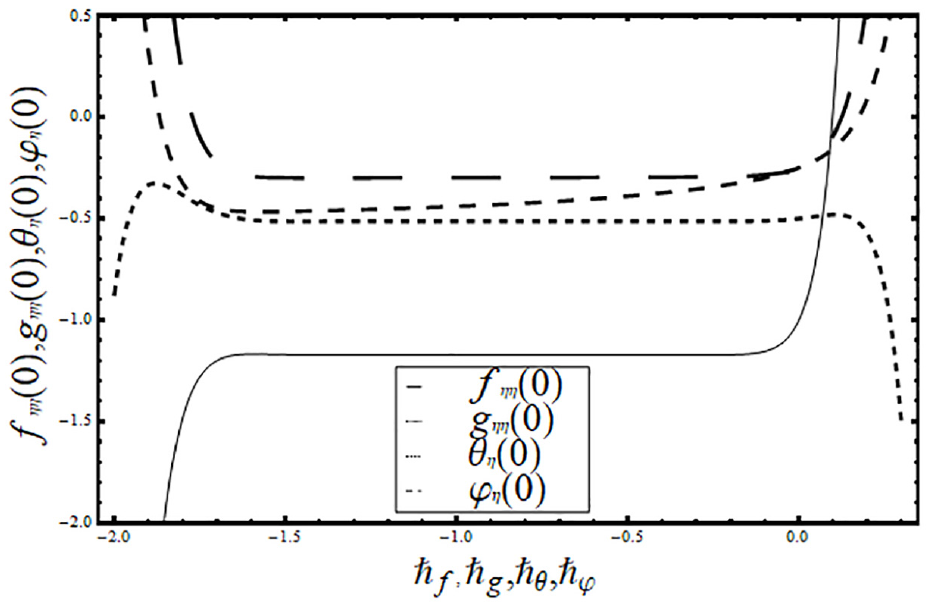
Profiles of
Numeric values of

Numeric values of

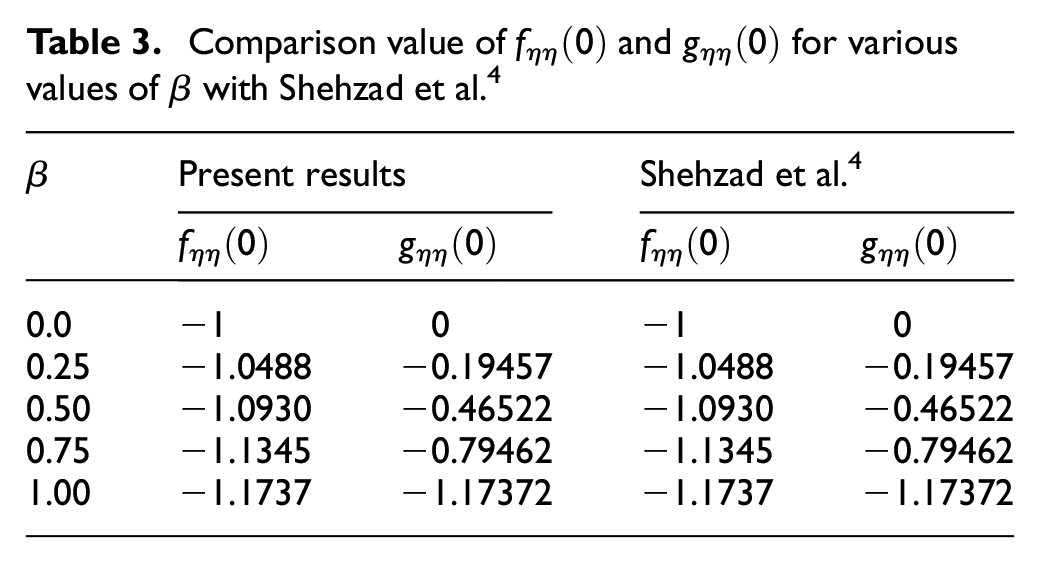
Comparison value of
Discussion
This section is developed to interpret the nature of various physical constraints on velocities

Profiles of

Profiles of

Profiles of

Profiles of
Figure 8 shows the behavior of

Profiles of

Profiles of

Profiles of
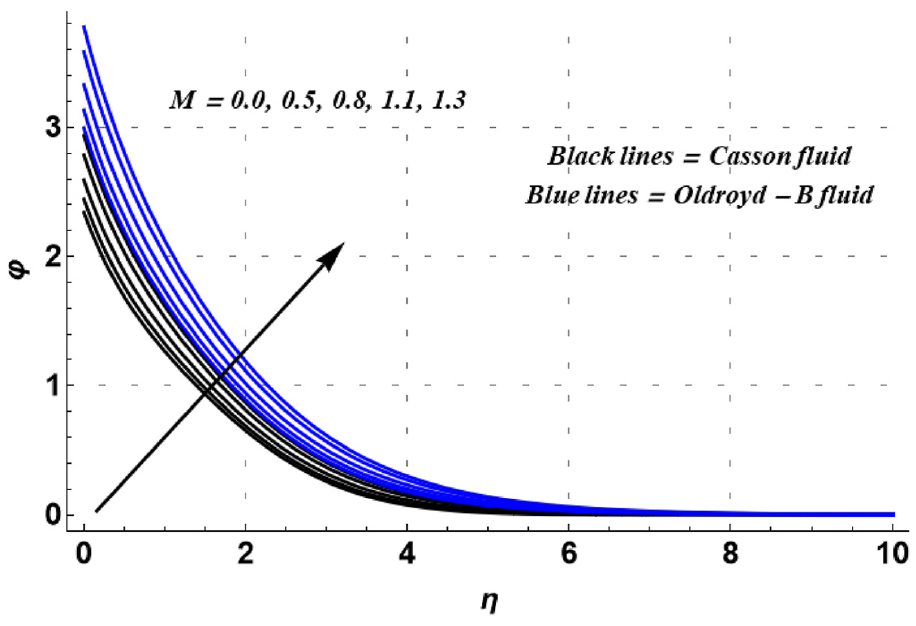
Profiles of
Figure 12 is plotted to show the nature of Prandtl number

Profiles of

Profiles of

Profiles of

Profiles of
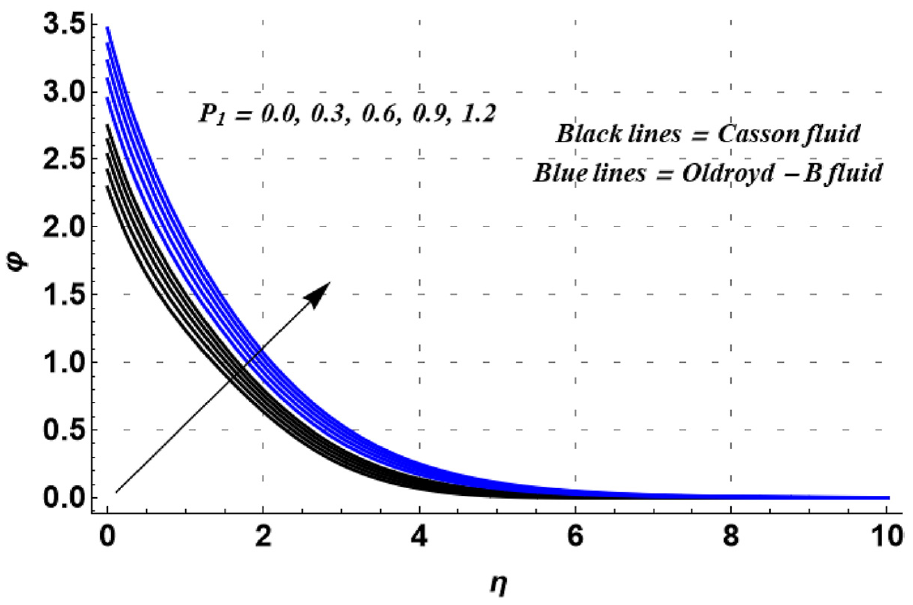
Profiles of
Figures 17 and 18 demonstrate the behavior of Brownian movement factor

Profiles of

Profiles of

Profiles of

Profiles of

Profiles of

Profiles of

Profiles of
Conclusions
The present research investigates the impact of Robin’s boundary conditions on the radiative magnetized flow of OBF and CF nanofluids. Bidirectional movement of the radiative surface leads to the rise of an electrically conducted flow. The main outcomes for OBF and CF are derived as follows:
The higher velocities are arisen for CF case as comparative to the velocities in case of OBF.
The ratio parameter shows opposite behavior of velocities for both CF and OBF cases. The velocity
Temperature shows similar behavior against dissimilar thermophoretic and Brownian movement parameters values. The temperature profiles in case of OBF are higher as comparative to the profiles of CF case.
Concentration expressed the opposite behavior against dissimilar thermophoretic and Brownian movement parameters values. It decreased against higher Brownian movement while augmented for larger values of thermophoretic constraint values.
The higher chemical reactive constraint corresponds to lower profiles of concentration. The higher profile of concentration is achieved in case of OBF.
An improvement in heat production parameter values corresponds to larger temperature profiles. Temperature distribution curves are higher for OBF case while lower for CF case against improving heat production constraint values.
The incremented radiative parameter values result higher temperature profiles. Lower thermal profiles are achieved in case of CF comparative to OBF case.
Velocities profiles are decreased as the magnetic constraint values are enhanced. Temperature and concentration distribution profiles are boosted against higher magnetic and porosity parameter values.
An improvement in Lewis number boosted the concentration profiles. The higher concentration profile is achieved in case of OBF as comparative to CF situation.
Footnotes
Appendix
Handling Editor: Chenhui Liang
Declaration of conflicting interests
The author(s) declared no potential conflicts of interest with respect to the research, authorship, and/or publication of this article.
Funding
The author(s) received no financial support for the research, authorship, and/or publication of this article.
