




Abstract
Castor biodiesel (CBD) was manufactured by slow pyrolysis of oil from highly yielded seeds with anhydrous sodium hydroxide catalyst. An experimental study of engine’s performance, emissions and combustion characteristics using biodiesel blended with gas oil in volumetric ratios of 0, 10, 25, 50, 75, and 100% at different loads was performed. Increase of CBD percentage in the blend led to a reduction in engine’s thermal efficiency, cylinder pressure, net heat release rate, and smoke emission. The exhaust gas temperature, specific fuel consumption, unburned hydrocarbon, CO, and nitrogen oxide emissions were increased with the increase of CBD ratio. Biodiesel showed the maximum increase in specific fuel consumption by 10% and the thermal efficiency was decreased by 10.5% about pure diesel. Smoke emissions were decreased for CBD100 by 12% about gas oil. The maximum increases in NOx, CO, HC emissions, and exhaust gas temperature for CBD 100 were 22, 34, 48, and 11%, respectively related to diesel oil. The maximum reductions in cylinder pressure and net heat release rate were 5 and 13% for CBD100 about gas oil, respectively. Biodiesel percentage of 10% showed near values of performance parameters and emissions to gas oil, so, it is recommended as the optimum percentage.
Introduction
Liquid fuels are used in power generation and transportation sectors. As the demand for these fuels is increased, the price of them is increased too. 1 The energy crisis becomes a great setback for Egypt economy. Depletion of fossil fuels at faster rate and global warming led to the urgency of finding a solution. Biofuel is one of these sources.2,3 Alternative biofuels obtained from nonedible vegetable oils have recently been gained by the researcher’s interests, 4 as biofuels are environment friendly. 5 In addition, using such biofuel as an alternative to gas oil provides new market opportunities for the agricultural producers and rural communities.6–8 The substitutes for diesel oil are sunflower, cottonseed, corn, olive, rapeseed, soybean, distilled opium poppy, Jatropha, Jojoba, and Karanja methyl esters.9–16 Moreover, biodiesel is considered a mature technology especially for the countries where biomass is available in large quantities. 6 The non-edible feedstock is favored as it can tolerate the climate conditions variations and the abundant availability of these plants. 14
Castor oil is a promising alternative fuel for petroleum diesel oil in Egypt, as the castor plant withstands the relatively hot weather,17,18 taking into consideration that the feedstock should be produced in a large scale with a lower cost.19,20 However, the higher viscosity of raw castor oil, which is greater than gas oil by several times, is the main obstacle to the direct use in combustion systems.21,22 Fuel system performance, fuel atomization and spray characteristics are affected by the fuel viscosity. The oil higher viscosity leads to the poor vaporization, larger droplets, and smaller injection spray angle. Moreover, the ricin oleic hydroxyl acid presence in the castor oil burdens its application as a fuel.20,23 Thus, lower engine performance and higher emissions will be produced 24 and a lower burning velocity will be obtained. 25 Therefore, several methods were used for vegetable oils processing such as transesterification, thermal cracking, pyrolysis, catalytic cracking and dilution of castor oil as mentioned by Azad et al. 26 Pyrolysis produced lower viscosity oil, lower ash and bio-mazut on the contrary of transesterification.14,19 Moreover, Pyrolysis is the renewable energy process which can produce not only a liquid biofuel, as an energy carrier, but also valuable chemicals.27–31 The investigation of the combustion characteristics will give the optimum combustion behavior of for higher engine performance, lower emissions and improved combustion characteristics.31,32 The different physical and chemical properties of biofuels widely affect the combustion characteristics.14,33
Many researches were conducted to measure the diesel engine performance running with different types of bio oils. Puhan et al. 34 and Godiganur et al. 35 studied the diesel engine performance fueled by Mahua biodiesel. The lower calorific value of Mahua oil methyl ester resulted in a higher brake specific fuel consumption (BSFC) compared to gas oil. HC emission reduction was 32% and the increase in nitrogen oxide (NOx) emission was of 11.6% related to crude diesel. Chauhan et al. 36 did tests on a C.I.E fueled by Jatropha biodiesel blended with gas oil at rated engine speed and load variation. They concluded that the engine required no modifications when running with Jatropha biodiesel. Also, Datta et al. 37 experimented Jatropha biodiesel, and its mixtures with diesel oil in diesel engine. The results revealed that fueling the engine with Jatropha biodiesel increased the BSFC and NOx emission while the BTE and carbon monoxide (CO) emissions were reduced. Banapurmath et al. 38 used Sesame, Honge and Jatropha oil methyl esters as fuels in diesel engines. BSFC values for all tested fuels were higher than pure diesel and BTE of Jatropha methyl ester blends were reduced compared to gas oil. Also, the exhaust gas temperature (EGT) was increased with the increase of Jatropha methyl ester ratio in the mixture. Lim et al. 39 evaluated the smoke opacity of Karanja oil biodiesel blended with gas oil at variable engine loads. Smoke emission was increased with the load increase. However, smoke emissions for biodiesel were lower than diesel oil in all operating conditions. Hazelnut kernel oil ethyl ester and its blends’s combustion characteristics had been experimentally studied by Gumus. 40 Better fuel- air mixing, higher volatility, and higher peak cylinder gas pressure for diesel fuel compared to biodiesel blends achieved the higher premixed combustion heat release. Dhar et al. 41 tested the influence of neem oil biodiesel/diesel blends on combustion characterization of diesel engine. For all tested blends, the cylinder pressure and heat release were increased for diesel oil about biodiesel mixtures as the quantity of the injected fuel increased in the premixed combustion phase. Wu et al. 42 tested the different types of catalytic-esterified bio-oils; ethyl propionate, ethyl formate and ethyl acetate, in diesel engine, all tested biofuel/diesel blends had lower BSEC compared to neat gas oil.
Hosamani and Katti 43 described experimentally the combustion of Simarouba and Jatropha oil biodiesel blends B00, B20, B40, and B60. The same trend of cylinder pressure variation for diesel oil and biodiesel mixtures was shown. Ethyl ester blends produced the higher maximum cylinder pressures. Hydrocarbons and carbon monoxide concentrations were decreased and NOx emissions were increased with the biodiesel volume ratio increase. It was recommended that injection should be advanced for biodiesel blends about gas oil. Aboelazayema et al. 44 produced castor biodiesel from transesterification of Egyptian castor oil with 97.82% yield. CO, CO2, and HC emissions were reduced significantly but NOx emissions were increased with the percentage of biodiesel increase in the blend. Mei et al. 45 provided the pyrolysis oil with resin as a catalyst. A comparison was detected for the oil before and after esterification. The upgraded esterified bio-oil reduced the peak cylinder pressure, BTE, EGT, HC, CO, and smoke emissions. The heat release was increased with a slightly reduction in NOx emissions. Generally, biodiesel caused the increase of NOx emissions about gas oil. Blending biodiesel with alcohols, biogas and gasoline reduced the NOx emissions.46,47
Many researchers have produced castor biodiesel using transesterification process. The properties of transesterification/castor-biodiesel depend on the fatty acid content of the feedstock and agree with biodiesel standards. It has been found that small percentages of transesterification/castor-biodiesel in diesel oil showed enhancement in engine performance and emissions.48,49 However, the brake specific fuel consumption of transesterification/castor-biodiesel was lower than that of diesel fuel. 50 Bueno et al. 51 tested different blends of castor biodiesel/diesel and proved that castor oil methyl ester has no impact on the thermal efficiency related to diesel fuel. However, the produced transesterification/castor-biodiesel led to an increase in NOx emissions. Moreover, As castor biodiesel has lower evaporation rate than diesel oil, Das et al. 52 found that the rate of pressure rise during rapid combustion phase of the transesterification/castor-biodiesel was faster and the combustion starts earlier about pure diesel.
All the above literature proved that the previous works have been concerned on producing castor biodiesel derived from other feed stocks by transesterification process and studying its effect on diesel engine emissions and performance. No previous works have been performed to test pyrolysis/castor-biodiesel as an alternative fuel. So, the authors concentrated on synthesizing pyrolysis/castor-biodiesel and studying its effect on engine’s emissions, combustion characteristics, and performance. Castor oil was selected as non-edible feedstock produced from highly oil yielded Egyptian seeds. The selected production process has a remarkable effect on the physical and chemical properties of the produced biodiesel. Castor biodiesel blends properties were evaluated according to ASTM standards. CBD was blended with gas oil in different volumetric percentages of 0, 10, 25, 50, 75, and 100% and were tested at engine load variation and rated speed of 1500 rpm. Performance parameters, emissions concentrations, and combustion characteristics were studies and compared to gas oil.
Materials and methods
Castor biodiesel production
Pyrolysis process was adjusted at temperature range from 200°C to 450°C. The pyrolysis test rig has a heating pyrex flask, three-way connector, thermostat, a water-cooled condenser and pyrex flask for the oil receiving. A 1 L of raw castor oil was put into the reactor with 1% by mass of anhydrous NaOH. The heater was turned on until the evaporation start at a temperature of 230°C. The oil evaporation continued until a temperature of 400°C. A water cooled condenser was used to condense the generated vapors from the reactor. After that, the condensed pyrolytic biofuel was collected in the flask and then was easily distinguished into two grades according to its color. Therefore, this synthesizing method was used due to the very high yield of CBD as 91.7% that have improved the physical properties.19,25,29 A schematic diagram of pyrolysis reactor shown in Figure 1. Photographic views of biodiesel blends samples are shown in Figure 2. Such CBD was blended with gas oil in different volumetric ratios of 0, 10, 25, 50, 75, and 100% termed as CBD00, CBD10, CBD25, CBD50, CBD75, and CBD100, respectively.

Schematic diagram of pyrolysis process.
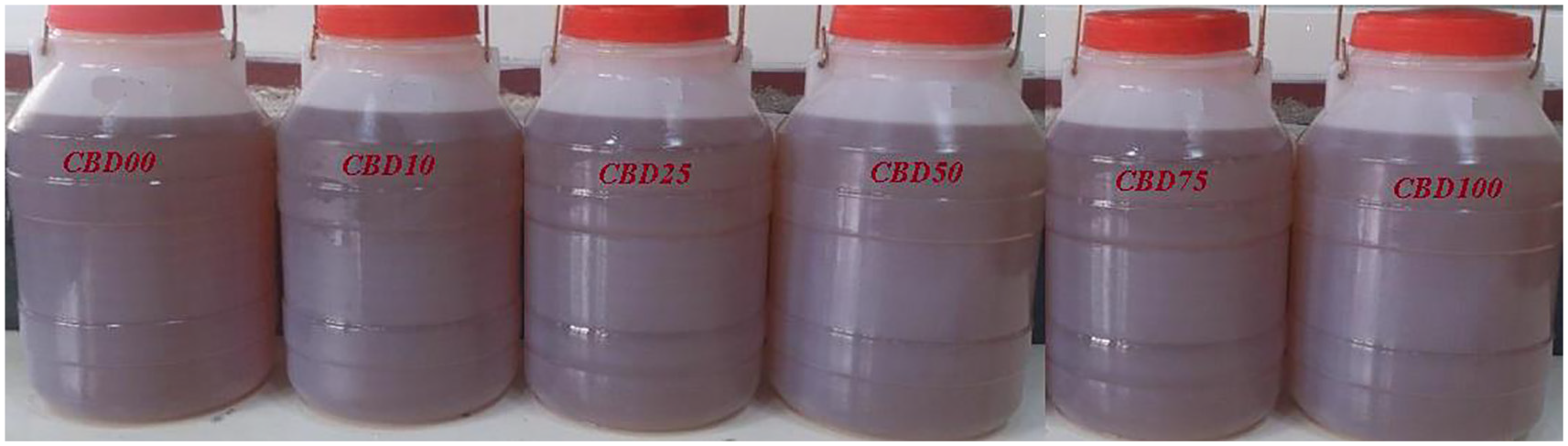
Photos of biodiesel blends samples.
The measured properties were agreed with the standard properties of gas oil, and presented in Table 1. The physical properties including density, flash point, kinematic viscosity, pour point, ash content, sulfur content, cetane number, copper strip corrosion, and calorific value of castor biodiesel (CBD) and gas oil were evaluated according to ASTM standards as stated by Knothe. 47 Conversely, the density of gas oil is lower than CBD by 3.53%. Thus, the close density values between biodiesel blends and diesel oil provides a complete physical mixing between the tested fuels with undetectable separation. 53
Characteristics of castor biodiesel blends versus gas oil standards.

CBD has lower viscosity than gas oil by about 10.7%. Thus, lower droplets size of the injected biodiesel has been obtained because of the viscosity decrease about diesel oil.54–56 The decrease in viscosity of the synthesized CBD compared to raw castor oil is due to the raw castor oil’s thermal cracking. 19 Castor biodiesel blends flash point temperatures are greater than 100°C, which are higher than pure diesel.56,57 The pour point of CBD is lower than standard diesel oil. The low pour points of biodiesel blends improved the cold start and cold environment of the diesel engine operation with castor pyrolysis oil. Sulfur and ash contents in the produced castor biodiesel were negligible compared to crude diesel. Sulfur content is unfavorable as it forms heavy, toxic, and high corrosive organic compounds. 58 The engine parts and fuel pump life time have been improved when fueled by castor biodiesel. The cyclic and aromatic compounds reduce the cetane number of CBD by 6.25% and increase the ignition delay in comparison to gas oil as stated by Abu-Elyazeed 29 Moreover, the burning velocity of castor biodiesel was lower by about 25%–30% than that of gas oil as proved by Ibrahim. 25 The copper Cu-strip corrosion test result of CBD was agreed with diesel oil standards. As the sulfur content in castor biodiesel is less than diesel oil and the Cu-strip corrosion of biodiesel is less than diesel fuel, these parameters maintain the diesel engine life for a long time in case of biodiesel operation. Also, the flash point of castor biodiesel is greater than gas oil, so, biodiesel is safe in handling and storage than fossil diesel. Finally, the calorific value of CBD was higher than gas oil by 5.02%.
An elemental analysis of raw castor oil, pyrolysis castor oil, and gas oil was performed and illustrated in Table 2. It can be seen that the carbon, hydrogen and oxygen contents of biodiesel are higher than those of gas oil. And as the lower heating value depends on the carbon, nitrogen and hydrogen contents in the fuel, therefore, the lower heating value of CBD is higher than diesel fuel. Moreover, the chemical composition of pure castor biodiesel manufactured by pyrolysis was analyzed by gas chromatography with mass spectroscopy. GC-MS analysis is shown in Table 3. The observed compounds were heptanal, ethoxy ethane, heptanoic acid, 1-octanol dimethyl, 10-undecenoic acid, 9-octadecenoic acid, and 1,3,5-triazine-2,4-diamine-6-chloro-n-ethyl. Heptanal was detected in castor biodiesel.
Elemental analysis of raw castor oil, pyrolysis castor oil, and gas oil.

GC-MS analysis of pure castor biodiesel.

Test engine
The experiments were carried out using a single-cylinder and air-cooled diesel engine. Table 4 stated the engine technical specifications and the experimental schematic diagram is shown in Figure 3.
Specifications of the test engine.


Schematic flow diagram of the test rig.
An AC generator (MECCALTE model: ECP3-1S/4) with a maximum electric output power of 10.2 kW was coupled to the engine and was equipped with a load controller to determine the engine output power. A proximity sensor (model: LM12-3004NA) was used to determine the top dead center (TDC) mark. The fuel flow rate was evaluated using calibrated glass pulp of 100 ml and stopwatch. The exhaust gas and intake air temperatures were recorded using a calibrated thermocouple (K type). In addition, the crankshaft rotational speed was measured using a speed tachometer (BERMI, model: BRI-5045). The injection timing was adjusted at 24 BTDC for all tested fuels. The pressure crank angle position history was recorded and stored using a Kistler 601A (0–250 bar and sensitivity of 16.5 pc/bar) piezo electric pressure transducer coupled with charge amplifier and data acquisition card (model Ni USB-6210) with a maximum sampling rate of 250 kHz. Gas oil was used in the engine starting and the engine was warmed up for ten minutes. Fuel line was switched on to run the selected tested fuels. The speed of the engine was adjusted at 1500 rpm. After reaching the steady state operation, all the tests were carried out for three times to obtain the mean value of the measured parameters. Engine emissions concentrations were evaluated by MRU DELTA 1600V exhaust gas analyzer. Such exhaust gas analyzer is facilitated by a membrane pump, different built-in electrochemical cells of O2 and CO, flame ionization detector for unburned hydrocarbon (UHC) emissions and chemiluminescent detector for NOx emissions. Moreover, the smoke emissions were recorded with OPA-100 model smoke meter. The engine was firstly run at no load to warm up the engine using gas oil at steady state condition for 10 min before the measurements to ensure its stability. Castor biodiesel blends as CBD00, CBD10, CBD25, CBD50, CBD75, and CBD100 were then tested. All measurements were performed at different engine loads and constant engine speed of 1500 rpm. The engine brake power and fuel consumption were measured at every load. The exhaust emissions concentrations (CO, HC, and NOx) and smoke were evaluated at different engine loads and rated speed of 1500 rpm. Table 5 showed the uncertainties of the measuring devices. Total uncertainty percentage was calculated as stated by Kline. 59 The total percentage uncertainty of the test =

Where:
uTexh: Exhaust gas temperature uncertainty.
ubp: Brake power uncertainty.
usfc: Specific fuel consumption uncertainty.
uN: Engine speed uncertainty.
uther: Thermal efficiency uncertainty.
uCO: CO emission uncertainty.
uHC: HC emission uncertainty.
uNOx: NOx emission uncertainty.
upcy: Cylinder pressure transducer uncertainty.
uTDC: TDC marking uncertainty.
The uncertainty of measuring instruments.

Results and discussions
Brake thermal efficiency
Figure 4 represents the influence of CBD addition to gas oil on the brake thermal efficiency (BTE) at rated speed of 1500 rpm and load variation. The results showed that the BTE increased with the engine load increase up to the maximum at third quarter of the engine load then decreased at full load for different blends of CBD with diesel oil. The resultant behavior was due to the increase amount of the injected fuel, which led to the increase of combustion efficiency with the engine load increase. It is believed that the smaller fuel’s droplet size, due to the lower viscosity of CBD, and the higher aromatic content influence on the fuel spray formation and the heat release which led to a reduction in the engine’s thermal efficiency. At full load, the high amount of injected fuel resulted in a more reduction in the combustion efficiency. Also, it was found that the BTE of the test engine fueled by the higher volumetric percentages of CBD with diesel oil were decreased. The thermal efficiency was decreased by 10.5% for CBD100 compared to gas oil at full load. Such behavior is because of the lower viscosity and cetane number despite the higher calorific value of CBD compared to gas oil, such behavior agrees with the results obtained by many researchers.34,38,39
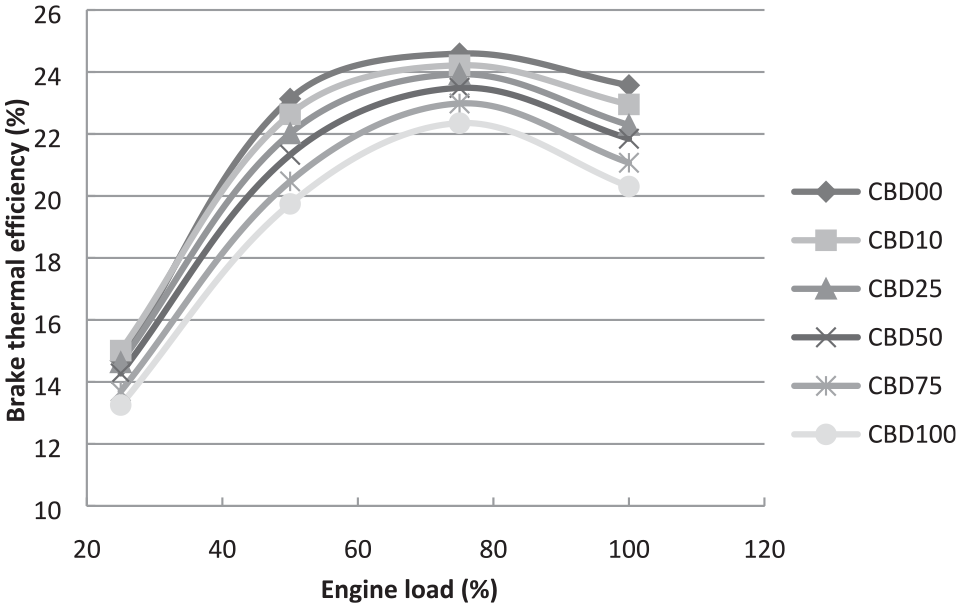
Brake thermal efficiency versus engine load for different blends of CBD with gas oil.
Brake specific fuel consumption
BSFC values versus the engine load variation at constant engine speed of 1500 rpm for different volume percentages of CBD with gas oil were indicated in Figure 5. As the engine load increases up to 75%, the BSFC of all test fuel decreases. However, increasing the engine load from 75% to full load led to an increase in BSFC values. In the same figure, a comparison was made at different engine loads between gas oil and different blends of biodiesel/gas oil. As the pyrolysis/castor-biodiesel’s properties affects directly on the BSFC in diesel engine, it can be seen that the BSFC values were increased by raising the volume ratio of CBD in the mixtures. BSFC value of CBD100 was increased by about 10% compared to neat gas oil at full load. Such behavior is due to the lower viscosity and cetane number despite the higher calorific value of CBD about gas oil in addition to the resulting smaller fuel’s droplet size and higher fuel’s aromatic content. Thus the resultant fuel spray formation problems resulted in a lower thermal efficiency than diesel oil, as mentioned earlier by Nabi et al. 60 and Li et al. 61

Brake specific fuel consumption at different engine loads of CBD with gas oil blends.
Exhaust gas temperature
Exhaust gas temperature values against the engine load for different mixtures of CBD with gas oil were shown in Figure 6. It can be seen that the EGT increased remarkably by increasing the engine load for all test blends. The increase in the EGT with engine load is due to the more consumed fuel to generate the extra loading. Also, it was found that the increase of CBD percentage in the mixture resulted in an increase in the EGT, that is may be stipulated to the higher heat loss during combustion and the associated reduction in the heat release of CBD in comparison to gas oil. The viscosity and thermal efficiency decrease associated with the CBD percentage increase about crude diesel.35,37,38 The increase in EGT for CBD100 about gas oil was 11%.

Influence of CBD blends with gas oil on exhaust gas temperatures at different loads.
Carbon monoxide
CO emissions variation with respect to the engine load for different blends of CBD with gas oil is plotted in Figure 7. As the fuel-air mixing process is remarkably influenced by the droplet size of the injected CBD fuel, the increase of CBD volume percentage may result in a lower droplet penetration. The results showed that the increase of engine load led to a reduction in CO emissions down to minimum values at the half engine load and increased in the full engine load condition for all test blends. This is due to the increase of the fuel amount associated with the engine load increase. At 100% of engine load, the increased injected fuel leads to a significant decrease in the combustion efficiency and higher CO emissions. At low and medium engine loads, the higher percentage of CBD with gas oil resulted in a slight increase of CO concentrations due to the premixed lean combustion with excess air role. However, at higher loads, the CO emissions of all blends of CBD with diesel oil are evidently lower than gas oil due to the oxygen content increase of CBD about crude diesel. The increase in CO emission for CBD100 about gas oil was 34% at 75% of engine load. Moreover, insufficient oxygen and lean mixture preparation at lower loads produced poor combustion and higher CO emission. At higher loads, rich mixture results in lower CO emissions. In addition, it is likely believed that such behavior was due to the increase of C/H ratio in CBD compared to gas oil as confirmed by these references.37,62

Effect of tested fuels on CO emissions at different engine loads.
Unburned hydrocarbon
UHC emissions values at different engine loads of CBD mixtures with gas oil were illustrated in Figure 8. UHC emission is considered as an important indicator for determining the efficiency of fuel combustion. The results showed that at higher engine loads, the UHC values were increased for all test fuels due to the direct proportional relationship between the amount of injected fuel and the engine load. Also, increasing the volumetric percentage of CBD produces higher UHC emissions at all loads. As the viscosity of CBD is low compared to that of gas oil, the spray tip penetration is decreased and the spray cone angle is increased. As a result, the momentum of the fuel’s droplet decreases and thus reduces its ability to penetrate the high pressure mixture. That results in a heterogeneous mixture. Moreover, the lower viscosity leads to more leakage in the fuel pump and thus has an adverse effect on the droplets breakup. The resultant increase in HC emission may be due to the heterogeneous fuel distribution in the mixture. Therefore, higher fuel consumption and rich mixture at higher load produced high unburned hydrocarbon. Presence of unbreakable unsaturated hydrocarbons in castor biodiesel leads to higher HC emissions. The increase in UHC emissions for CBD 100 about gas oil is 48%. It is believed that such behavior is attributed to the poor penetration of CBD droplets due to its lower viscosity compared to gas oil as well as its lower cetane number as mentioned by Banapurmath et al. 38

Unburned hydrocarbon emissions at different engine loads for different CBD blends with gas oil.
Nitrogen oxide
The effect of pyrolysis/castor-biodiesel on NOx emissions versus engine load is shown in Figure 9. NOx emissions are affected mainly by four factors including the oxygen concentration, cylinder combustion temperature, fuel nitrogen content, and combustion time.47,63 It was found that engine load increase led to the NOx emissions increase due to the increased amount of injected fuel for different blends of CBD with gas oil. The direct proportional relationship between the amount of injected fuel and the cylinder combustion temperature is thought to be responsible for this behavior. Also, the results showed that the higher volumetric blending ratio of CBD increased the NOx emissions at all loads due the higher oxygen percentages in blends. Higher exhaust gas temperature of biodiesel blends led to the increase of NOx emissions about diesel oil. The increase percentage in NOx emission for CBD100 about diesel oil was 22% due to the existence of nitrogen in air as well as the oxygen contents in CBD. Recirculating certain amount of exhaust gases and proper tuning of injection timing can improve the level of the produced NOx concentrations.63,64

Effect of CBD blends with gas oil on NOx emissions at different loads.
Smoke opacity
Figure 10 indicates the smoke concentrations values with respect to the engine loads for different blends of CBD with gas oil. Generally, the results show that higher engine loads resulted in higher smoke concentrations because of the injected fuel increase for different mixtures of CBD with gas oil. Also, it was found that using higher volumetric blending ratio of CBD decreased the smoke opacity. The decrease of smoke emission for CBD100 about diesel oil was 12% about pure diesel. Such deed is thought to be due to the oxygen content increase in CBD blends compared to gas oil.39,41 Also, the reduction in smoke opacity was shown due to the carbon residual oxidation in CBD biodiesel. 64
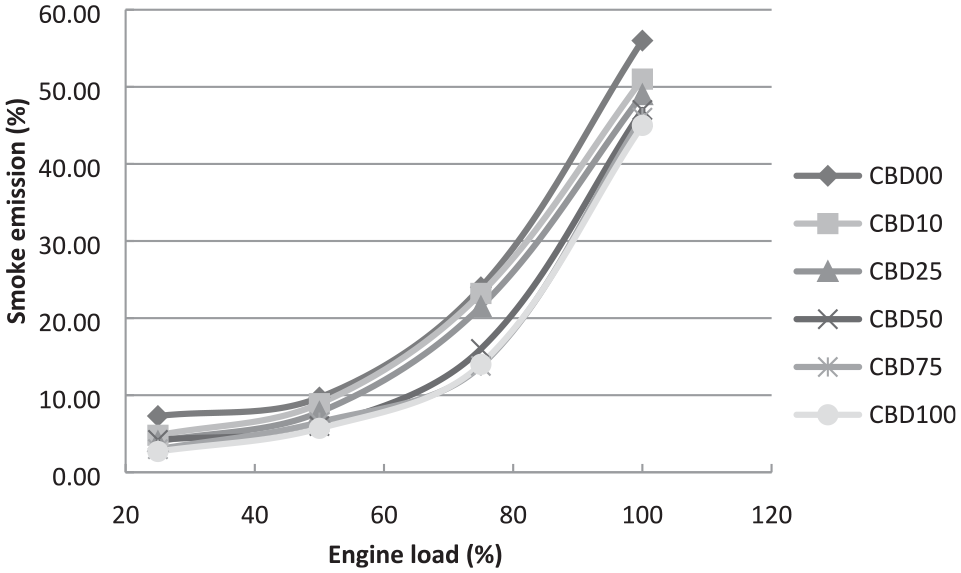
Smoke concentrations with the engine load variation for CBD mixtures with gas oil.
Combustion characteristics
The in-cylinder pressure history is the most valuable tool for giving sufficient information for the combustion analysis and to determine the net heat release rate. Figure 11(a) to (c) shows the average measured cylinder pressure-crank angle history for different blends of CBD with gas oil at different engine loads. The average cylinder pressure-crank angle histories followed the same behavior for different blends of CBD with gas oil. The peak cylinder pressure increased with the engine load increase due to the increasing amount of injected fuel which agreed with the results obtained previously. 40
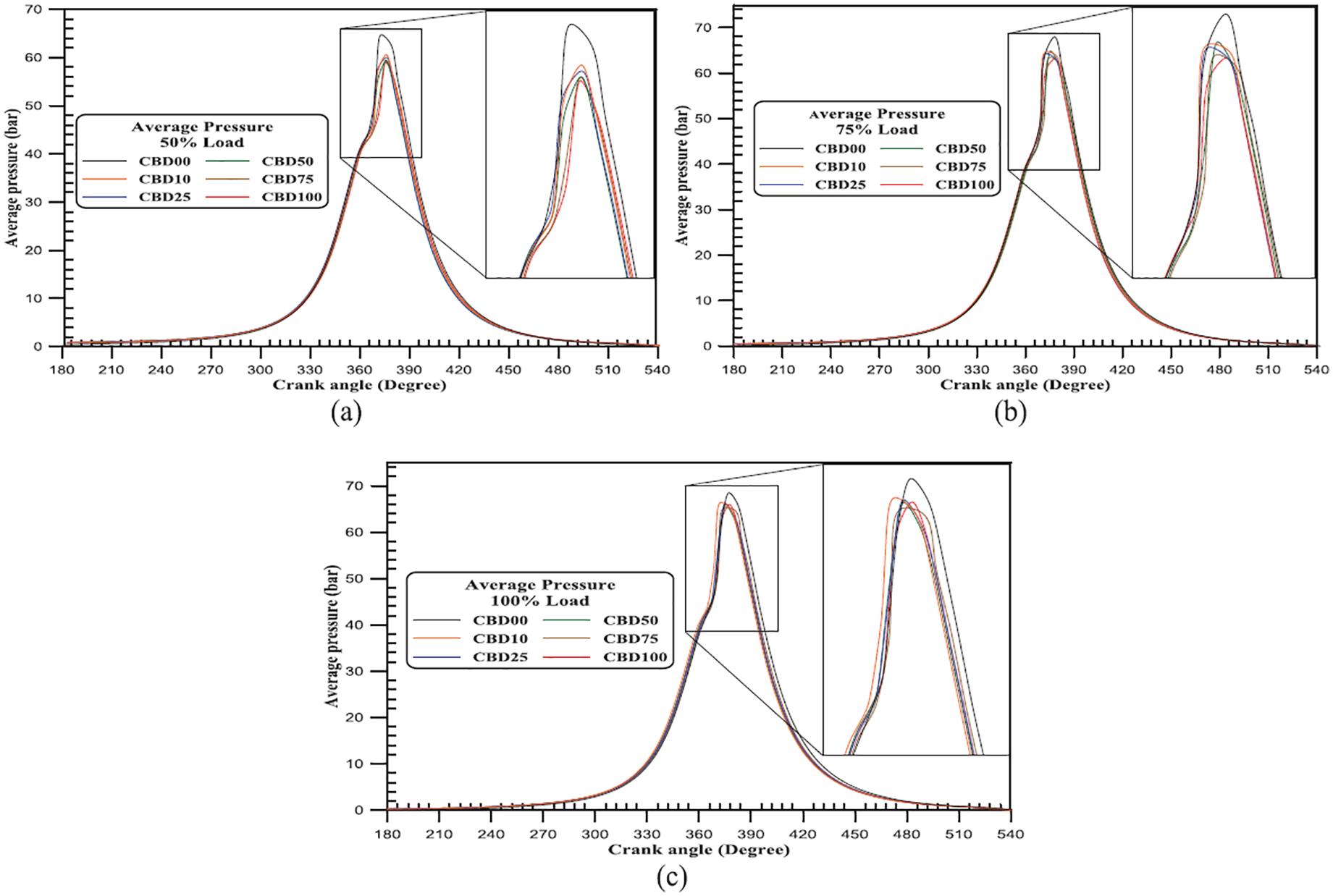
Average cylinder pressure-crank angle history for CBD blends with diesel oil at: (a) 50% load, (b) 75% load, and (c) 100% load.
It can be noticed that using higher volumetric ratios of CBD with gas oil decreased the average peak cylinder pressure about gas oil that may be to the lower burning velocity of such fuel as noticed earlier by Ibrahim. 25 Also, as the ignition delay of castor bio-diesel was noticed previously higher than that of diesel, 29 the present results elucidate that as the load increased, the peak cylinder pressure occurred later after top dead center relatively for different blends of CBD with gas oil. Lower cetane number and viscosity of biodiesel in addition to the poor penetration lead to increase the fuel consumption in diffusion phase compared to that in the premixed phase which results in reducing the average peak pressure of CBD.
The pressure related to crank angle was calculated as in equation (1):

Where: P is the cylinder pressure in bar and V is the output measured voltage in volts.
The pressure crank angle histories were collected for 100 consecutive combustion cycles. The recorded data were taken to a specially formulated MS-Excel program to calculate the average cylinder pressure-crank angle histories of each blend. Then a MATLAB program was developed to determine the net heat release. The average cylinder pressure values for CBD00, CBD10, CBD25, CBD50, CBD75, and CBD100 are 69, 68, 67.5, 67, 66, and 65 bar. Such NHRR at each crank angle was calculated using equation (2) as stated by Azad et al. 54
The peak cylinder pressure and heat release rate are affected by the specific heat ratio γ, which was calculated from equation (3) and was found to be 1.3 at a constant temperature of 350K as suggested by Sahoo and Das. 64 The mean gas cylinder temperature was then calculated from equation (4) 64 :


Where: dQnet/dθ is the net heat release rate (Joule/degree), V is the in-cylinder volume (m3), P is the cylinder gas pressure (bar), and θ is the crank angle (degree). Moreover, P (dV/dθ) is representing the rate of work done. Parameters such as Pr, Vr, Tr were calculated at inlet valve closed condition and their values are 1 bar, clearance volume and 350 K, respectively. 65
The net heat release rates values with crank angles for different blends of CBD with gas oil at engine loads of 50, 75, and 100% load were shown in Figure 12(a) to (c), respectively. The observed decline of heat release rate for different blends of CBD with gas oil was because of the accumulated vaporized fuel during ignition delay period. Then, such NHRR was increased to the positive after combustion initiation. The combustion stages of CBD were found identical to gas oil.

Net heat release rate (NHRR) for different blends of CBD with gas oil at: (a) 50% load, (b) 75% load, and (c) 100% load.
Therefore, the rapid burning of premixed fuel-air mixture is followed by the diffusion combustion after the ignition delay period. At diffusion combustion stage, fuel-air mixing velocity control in the burning rate. Such velocity is directly proportional to the penetration of fuel droplets. Thus, because of CBD lower viscosity in comparison to diesel oil, it was expected that higher blending ratios of CBD yielded will result in lower injected droplet size. Such behavior produced weak penetration with poor fuel-air mixing especially for higher blending ratio of CBD with gas oil. Thus, the higher volumetric percentage of CBD with gas oil decreased the peak value of cylinder pressure and net heat release rate at load variation. The difference in such peak values between CBD and gas oil was decreased by the engine load increase and ignition delay decrease. Moreover, the peak values of the net heat release rate of gas oil, CBD10, CBD25, CBD50, CBD75, and CBD100 were 52, 48.7, 47.1, 46.7, 45.5, and 45 J/Degree at full engine load, such behavior agreed with the reported results.40,64 However, NHRR during the late combustion stage for different blends of CBD with gas oil was marginally lower than diesel oil. This deed was due to the CBD content of oxygen that caused the combustion to continue to burn in the late combustion stage as noticed previously.45,65
Conclusion
BTE was decreased by the increase of CBD percentage in the mixture. The thermal efficiency decrease for CBD100 was 10.5% about diesel oil. Also, the BSFC increased by raising the volumetric blending ratio of CBD in the blend. The BSFC of CBD100 increased by about 10% compared to the neat gas oil. Higher blending ratio of CBD with crude diesel oil increased the EGT due to the CBD higher heat loss about pure diesel. The increase in EGT for CBD100 about gas oil was 11%.
Higher CBD percentages resulted in a slight increase of the carbon monoxide emissions due to the premixed lean combustion with excess air effect. But, at high loads, CO emissions of the different blends of CBD with gas oil are evidently lower than gas oil. Increasing CBD percentage with gas oil increased both UHC and NOx emissions at all loads but decreased the smoke opacity. The decrease in smoke emission for CBD100 about diesel oil was 12%. The increases in NOx, HC and exhaust gas temperature for CBD 100 about gas oil were 22, 48, and 11%, respectively in comparison to gas oil.
The average peak cylinder pressure was decreased by increasing CBD percentage in the blend at different engine loads. The maximum reduction of cylinder pressure was 5% for CBD100 about gas oil. The combustion stages of CBD were experienced identical behavior as gas oil. The net heat release rate during the late combustion stage for different mixtures of CBD with diesel oil was marginally lower than diesel oil. The maximum reduction of net heat release rate was 13% for CBD100 about gas oil.
The obtained results revealed that using CBD10 increased the specific fuel consumption, exhaust gas temperature, CO, HC, NOx and smoke emissions about diesel oil by 3, 4, 3.5, 15, 10, and 7%, respectively. And the reductions for thermal efficiency, cylinder pressure and net heat release rate were 2.5, 1.5, and 6.5% about gas oil, respectively. Therefore, biodiesel percentage of 10% showed the near values of performance parameters and emissions to diesel oil, so, it can be recommended as the optimum percentage. Improved physical and chemical properties of castor biodiesel encourage the use of it in diesel engine.
Footnotes
Appendix
Handling Editor: James Baldwin
Declaration of conflicting interests
The author(s) declared no potential conflicts of interest with respect to the research, authorship, and/or publication of this article.
Funding
The author(s) received no financial support for the research, authorship, and/or publication of this article.
