




Abstract
Experimental work was done to examine the impact of diesel fuel with alumina nanoparticles on combustion characteristics, emissions and performance of diesel engine. Alumina nanoparticles were mixed with crude diesel in various weight fractions of 20, 30, and 40 mg/L. The engine tests showed that nano alumina addition of 40 ppm to pure diesel led to thermal efficiency enhancement up to 5.5% related to the pure diesel fuel. The average specific fuel consumption decrease about neat diesel fuel was found to be 3.5%, 4.5%, and 5.5% at dosing levels of 20, 30, and 40 ppm, respectively at full load. Emissions of smoke, HC, CO, and NOX were found to get diminished by about 17%, 25%, 30%, and 33%, respectively with 40 ppm nano-additive about diesel operation. The smaller size of nanoparticles produce fuel stability enhancement and prevents the fuel atomization problems and the clogging in fuel injectors. The increase of alumina nanoparticle percentage in diesel fuel produced the increases in cylinder pressure, cylinder temperature, heat release rate but the decreases in ignition delay and combustion duration were shown. The concentration of 40 ppm alumina nanoparticle is recommended for achieving the optimum improvements in the engine’s combustion, performance and emission characteristics.
Introduction
The continuous growth of world energy demand, harmful engine emissions and fossil fuel depletion have prompted the search for alternative fuels and fuel-additives. Among the various alternatives which are believed to be useful for bringing down the energy and the environmental crisis are the nano-fuel additives. 1 Al2O3, TiO2, CeO2, Co3O4, and Fe2O3 nano-oxide additives are used to obtain the reduction in fuel consumption and exhaust emissions. Nano-metal oxide additives promote the combustion activation and thus improve the overall combustion process. Nowadays, the research in heat transfer improvement in thermal systems is increased. This is affected by the surface tension and liquid droplet shape. Addition of nanoparticles such as alumina, TiO2, and carbon nanotubes improves the heat transfer properties in cooling water and lubrication oil in vehicles. Inclusion of nanoparticles in base fuel improves the chemical properties of fuel. Addition of nano additives enhances the heat transfer, chemical reactivity and this leads to the improvement in engine performance and emissions reduction. Cerium oxide nanoparticles added to diesel oil shortens the ignition delay, improves the oxidation rate and reduces the exhaust emissions. The oxygen atoms in cobalt oxide particles (Co3O4) improve the combustion reaction. CO, NOx, and HC emissions were reduced. The metal reacting with water creates hydroxyl radicals and lowers the oxidation temperature. Nano-particles have some special characteristics like higher activity, higher surface area, and improved combustion. Aluminum particles produce the enhanced thermal behavior with the stored internal energy. Aluminum particles improve the combustion characteristics because of its higher heat of reaction as stated by Galfetti et al. 2
Aluminum nano-particles boost the burning rate of fuel-air mixture. Furthermore, it demonstrates the greater surface area to volume ratio between the oxidizer and fuel.3–5 Nano-alumina particles of size 40 nm mixed with diesel fuel at the rate of 1 g/L and 1.5 g/L produced the brake thermal efficiency improvement, HC and NOX emissions reductions about diesel fuel. Biodiesel blend B40 with 50 ppm alumina nanoparticles achieved the reduction in smoke emission of 52.8% at full load. The nanoparticles of alumina are dispersed with diesel fuel in weight fractions of 25 ppm to 75 ppm. Many researchers have reported that, blending of nanoparticle shortens the ignition delay and increases the atomization that in turn, will reduce NOx emission and increase the thermal efficiency. 6
Gurusala and Selvan 7 conducted the tests by adding alumina nanoparticles to biodiesel blends. The decrease in harmful emissions and brake thermal efficiency increase were shown compared to neat biodiesel. A hot plate ignition probability test was used to examine the ignition properties of aluminum oxide nanoparticles added to diesel fuel. 8 The addition of nanoparticles achieved the improvement in heat transfer properties and droplet ignition about pure diesel. Nanoparticles added to fuel showed the rapid oxidation, shortened ignition delay and complete combustion. 9 Performance and emissions were studied to show the effect of adding aluminum, iron and boron nanoparticles in base diesel fuel by Mehta et al. 10 There were improved combustion rate and reduced ignition delay. Brake thermal efficiency increases by 4%, 9%, and 2% for iron, aluminum and boron about diesel fuel, respectively. Specific fuel consumption was reduced by 7% when the engine fueled with aluminum related to diesel fuel. While for iron and boron, it is almost the same as gas oil at higher loads. CO and HC pollutants reductions were 25% and 8% when the engine fueled with nano-aluminum, respectively about diesel fuel. The rise in NOX emission compared to pure diesel oil was because of the increment in cylinder combustion temperature, as explained by Tyagi et al. 11
Nano-fuel additives reduced the ignition delay. Moreover, the cylinder pressure was reduced at higher engine loads and the specific fuel consumption was decreased with aluminum nanoparticles addition about neat diesel fuel. HC and CO emissions were reduced for alumina-doped nano-fuel at higher engine loads. Aluminum and alumina nanoparticles added to diesel fuel lead to the improvement in ignition delay. 12 Heat transfer properties of pure diesel can be increased by the dispersion of nanoparticles in pure diesel and therefore the ignition delay can be improved. Usage of nano-additives is aimed to augment the combustion characteristics of the diesel fuel. Nano-oxides particles like aluminum oxide (Al2O3) were found to have catalytic effect. Nano-particles increase the radiative mass transfer of the fuel and minimize the ignition delay. Performance of diesel engine can be improved with the reduction of harmful emissions like NOx at lower concentrations of the nano-materials added.13,14
Alumina nanoparticles concentrations of 30, 50, and 100 mg/L were blended with diesel-butanol B20 to show the effect on combustion characteristics and emission. The heat release rate and cylinder pressure were increased by 13 and 6%, respectively, about B20 blend. The thermal efficiency was increased by 4.7% compared to B20. Inclusion of 100 mg/L of nanoparticles to the base fuel led to the decreases in HC, CO, and NOx emissions by 37.46%, 42.71%, and 12.37%, respectively related to fuel mixture. Concentration of 100 mg/L of nanoparticles achieved the improvements in performance and emissions. 15 Alumina nanoparticle blended with B20 poultry litter biodiesel increased the thermal efficiency. Nano alumina reduced the because of its catalytic reactivity compared to Biodiesel mixture. Low concentrations of alumina up to 30 mg/L achieved the enhancement in engine performance and emissions reduction. 16 Alumina nanoparticles were added at dosing levels of 10, 20, and 30 ppm, respectively to the ternary fuel 20% Jatropha biodiesel, 70% diesel, and 10% ethanol. Concentration of 20 ppm nano additive increased the thermal efficiency by 7.8% and decreased the CO, HC, and NOx emissions by 5.69%, 9.39%, and 11.24 % compared to the base fuel. 17
All the above literature studied that nano alumina addition has the positive impact on the performance, combustion characteristics and emissions of diesel engine. Few studies handled the effect of alumina of smaller size associated with the lower concentrations on CI engine. The aim of the paper is to show the effect of small average size (10 nm) alumina nanoparticles with lower concentrations of 20, 30, and 40 ppm added to diesel fuel on engine combustion and emissions. The nanoparticles smaller size leads to the improvement in fuel stability, suspension preventing, clogging reduction, and other problems related to fuel atomization in fuel injectors. Other references investigate the effect of higher concentrations of nano-alumina added to crude diesel on engine emissions, performance and combustion characteristics. Combustion duration and cylinder temperature were not considered in the literature but were recovered in our study. Thermal efficiency, Exhaust gas temperature, specific fuel consumption, and air-fuel ratios were investigated. HC, NOx, CO, and smoke emissions also were evaluated in detail. Combustion characteristics of nano alumina have effects on the cylinder pressure and the heat release.
Materials and methods
Nanoparticles properties
Alumina nano-particles are approximately spherical in the nature with a diameter averaging about 10 nm with 99% purity and its specifications are given in Table 1. The chemical and mechanical properties were evaluated by the average size of the nano-particles. Scanning Electron Microscopy (SEM) characterizes the shape, surface, size, and distribution of nanoparticles. The morphology of nano-particles and its uniform distribution were determined by Transmission Electron Microscope (TEM). The SEM and TEM analysis were carried out in National Research Centre, Egypt. Typical TEM and SEM images obtained are depicted in Figures 1 and 2, separately.
Specifications of alumina nanoparticles.

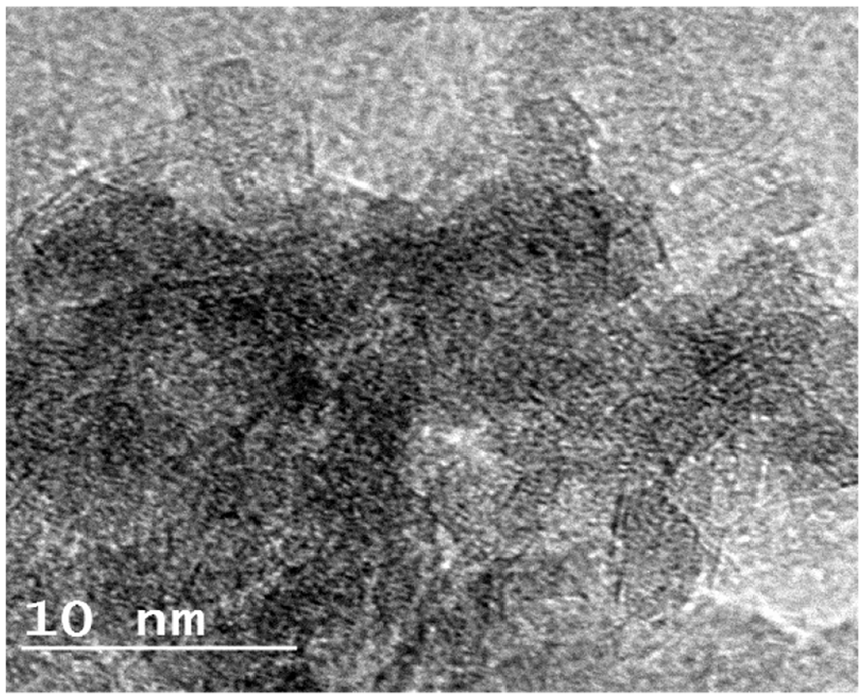
TEM image of alumina nanoparticles.

SEM image of alumina nanoparticles.
Fuel blends preparation
For the present study, mixing of nano-alumina with diesel fuel is a vital step. Dispersion of nano-particles in diesel fuel was ensured in such a way to reduce the clinker phenomenon. The higher cylinder temperature of diesel engine led to the particles stick together to form circular clusters and fuel nozzle clog. Density, viscosity and calorific value of diesel oil are 3.2 cSt at 40°C, 835 kg/m3 and 42.5 MJ/kg, respectively. There were substantial changes in the fuel properties by the addition of Al2O3 due to the viscosity reduction. Fuel properties were improved by adding aluminum nanoparticles. Addition of nanoparticles led to the increase in its calorific value. Positive effects on physical properties of the fuel from nano-additive addition were indicated. Nanoparticle of size ranging from 1 to 100 nm were suspended in the base fuel, which enhances its thermo-physical properties. The used additive is aluminum oxide nanoparticles of size 10 ± 2 nm. Aluminum oxide nanoparticle dosing levels were evaluated by its mass in the base fuel and its range from 20 to 40 ppm by using a precision electronic balance. A diesel fuel sample of 1 L and 20 mg of aluminum oxide nanoparticles were added separately to get a dosing level of 20 ppm, and so on to obtain the various concentrations. An ultrasonicator of capacity 160 W, set at frequency of 40 kHz produced a uniform suspension of the nanoparticles blended with diesel oil at a fixed agitation time of 30 min. Ultrasonication technique is utilized for the dispersion of nanoparticles in the base fuel and prevents the agglomeration of nanoparticles. The size of the nanoparticle is considered in the utilizing of nano-metal additives in the fuel improvement. Nano-particles diesel oil blends are symbolized as Diesel + 20 NAO, Diesel + 30 NAO, and Diesel + 40 NAO indicating the nanoparticle contents of 20, 30, and 40 ppm in the diesel fuel, respectively. Tween80 and Span80 surfactants were used for the alumina nanoparticles dispersion in diesel fuel for stability improvement by different characterization techniques, such as, sedimentation, TEM and UV-Vis spectroscopy. Under static condition, mixture stability was observed by using a sample of the blending test fuel in a long tube. The test fuels were subjected to stability test and found to be stable for 30 days without any phase separation for an agitation time of 30 min. Figure 3 showed the photographic images of the stable nano-fluids of nanoparticles dispersion in diesel fuel having 30 ppm volume fraction for different stability time durations for 1 month older. Figure 4 showed the TEM images and UV-Vis spectroscopy of the nanoparticles dispersed in diesel fuel having 30 ppm for 30 days. TEM images confirmed the dispersion stability of alumina nanoparticles in diesel fuel as base fluid for prepared samples, (which are further confirmed from the UV-Vis spectroscopy). UV-Vis spectrum was used to evaluate the nano-fluid stability. Absorption was plotted against the wavelength of nanoparticle. It was found that, maximum absorbency was occurred in the wavelength of 222 nm. By increasing the wavelength, UV absorption got increased until the maximum wavelength of 222 nm, after which there was a decrease in absorption. The small scale of nanoparticles made diffusion faster relative to the reaction rates. Fast heterogeneous reaction was achieved and the particle was consumed in a heterogeneous fashion. TEM analysis of alumina nanoparticles showed the crystal structure with little aggregate formation and agglomeration in the diesel oil. TEM analysis shows the dispersion of nanoparticles in diesel oil (see Table 1).
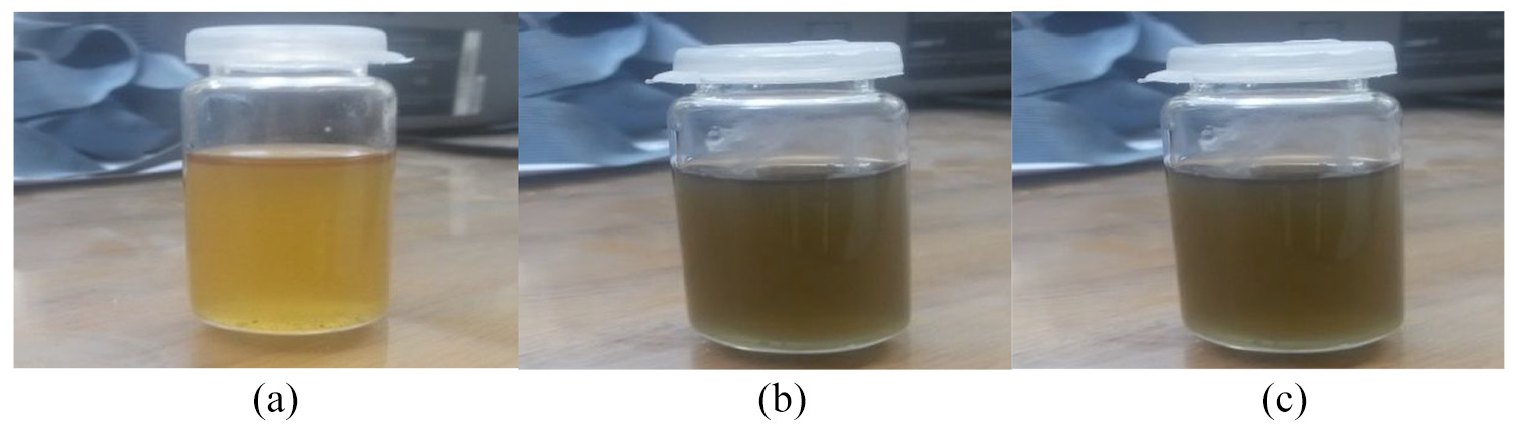
Stability images of alumina nanoparticles with 30 ppm volume fraction: (a) diesel fuel, (b) prepared sample, and (c) after 30 days.

TEM micrographs and UV-Vis spectroscopy of 10±2 nm nano-particles of 30 ppm volume fraction with 30 days stability time: (a) TEM image and (b) wavelength variation.
The nano additive size has an influence on the reaction rate constant. The reaction rate constant and activation energy were increased when the nanoparticles size decrease. The particle size of nanomaterials has a significant effect on the oxidation reaction kinetics. BET surface area of alumina is greater than 150 m2/g. The increases in surface areas are greater than 3, 4.5, and 6 m2 for nanoparticles concentrations of 20, 30, and 40 mg/L, respectively. Nano-particles addition causes larger wear of the cylinder, particularly with larger sized particles. The nanoparticles small size led to the stability enhancement of fuel suspensions, prevented the atomization problems and clogging in fuel injectors. However, smaller sized nan-particles do not have marked effect on the engine wear. The small size of alumina nanoparticles and high dispersion minimize the wear and friction in high pressure fuel system. Friction reduction properties were enhanced by using Al2O3 nanoparticles up to a certain level. After 75 ppm nano-Al2O3 concentration, more nanoparticles gets accumulated and resulted in more wear and tear on the surfaces. There were improvements in the tribological properties of the fuel. Addition of nano-Al2O3 resulted in smoother surfaces and reduction in wear rate of the piston ring was reported by many researches.18–20 Addition of alumina nanoparticles led to the increase of critical surface temperature which led to the high heat transfer rate and lower evaporation time. The thermal conductivity of nanoparticles was improved. Increase of surface area to volume ratio led to the surface tension and heat transfer coefficient increase. 10
Experimental setup and methodology
Engine setup
In the current experiments, a single cylinder DEUTZ diesel engine of output power 5.775 kW rated at a rated speed of 1500 rpm was used. This engine was modified for research purpose. Detailed specifications of the engine setup are mentioned in Table 2. The fuel injection has a reciprocating fuel pump with a single injector. The length of injector nozzle is 57 mm with inner diameter of 3.5 mm. The fuel injector opening pressure is 210 bar with ignition advance angle of 24° BTDC. The experimental set up schematic diagram was shown in Figure 5. AC generator was connected to the engine for determining the output power. A sharp-edged orifice mounted on an air box was connected to the inlet of the engine for measuring the air flow rate. The U-tube manometer was employed to measure the drop of pressure across the orifice. K-type thermocouples were used to measure the temperatures of intake air and exhaust gas. A tachometer was used to evaluate the engine speed. Fuel systems of diesel oil and the introduction of nanoparticles were mounted on the engine setup. Consumption time measurement of fixed fuel volume of 20 mL was used for the fuel consumption recording. A piezoelectric pressure transducer with water cooling (Type: Kistler, Model 601A) measures the cylinder pressure values up to 250 bar. It has an accuracy of 1.118% and sensitivity of 16.5 pc/bar. The pressure transducer is connected with a charge amplifier (Type: Nexus, Model (2692-A-0S4)). The transducer flush installed in the cylinder head minimized the lag in pressure signal and resonance. A LM12-3004NA proximity switch was fixed on the engine shaft to determine the piston top dead center position (TDC). The in-cylinder pressure data were averaged over 120 consecutive engine cycles. Data acquisition card (NI-USB-6210) adapted with LABVIEW® software was used for the high-speed data acquiring and analysis. MRU DELTA 1600-V gas analyzer and OPA 100 smoke meter were operated for exhaust gas and smoke emissions measurements, respectively. The accuracy and reproducibility of the instrument was ±1% of full-scale reading. NOx and O2 were measured by electrochemical sensors but CO and HC emissions were measured by infrared sensors. The engine load was varied from 0 to 100% at 1500 rpm rated speed. During each experiment, the performance, emission and combustion characteristics measurements were triplicated. Diesel engine was warmed up for ten minutes. After reaching the steady state operation, all the tests were carried out for three times to obtain the mean value of the measured parameters.
Engine specifications.


Schematic diagram of the experimental setup.
Experimental error analysis
All sensor and devices were calibrated prior to the measurements. Under steady state condition, the measurements were done three times. The uncertainties in thermal efficiency, HC, NOx, smoke and CO emissions were ±1.5%, ±1 ppm, ±1 ppm, ±1.5%, and ±0.01 % Vol., respectively. Exhaust gas temperature, output power, engine speed, specific fuel consumption and engine speed showed the maximal uncertainties in measurements as 0.2%, 0.85%, 0.15%, and 2.2%, respectively. The maximum uncertainties in top dead center marking (TDC) and cylinder pressure measurements are 1% and 0.2%, respectively. The uncertainty of a result R computed from n measured values (x1, x2, x3…xn) can be expressed as Kline. The whole experiment total uncertainty is obtained as ±3.33%.

Total percentage uncertainty of the present experiment,

Results and discussions
Brake thermal efficiency BTE
Figure 6 illustrates the effect on BTE by the nano-particles blended with neat diesel at load variation. There are improvements in thermal efficiencies by adding nano-particles about the neat diesel operation at full load. Al2O3 additive minimizes the physical ignition delay, the fuel evaporation time, the enhancement in fuel properties and combustion about pure diesel. Presence of nano-particles caused the enhanced burning characteristics and fuel air mixing improvement. Very fine secondary fuel droplets were produced. These droplets were evaporated quickly. The secondary droplets formation in the combustion chamber improves the fuel-air mixing under the effect of nano additives addition. Nano-particles have the higher surface reactivity area that contributes for the better chemical reactivity. Basha and Anand 14 and Aalam et al. 21 noticed that nano-additives produced the higher brake thermal efficiency about diesel fuel and increased with the dosing level increase of Al2O3 nano-particles. Addition of nano-alumina led to the evaporation rate increase, ignition delay reduction and sufficient combustion in addition to the enhancement in the fuel calorific value. The increase of surface area to volume ratio was shown under the effect of nanoparticles. The maximum improvement in brake thermal efficiency was obtained as 5.5% at 40 ppm dosing level at full load. The percentage increase is between 3.5% and 4.5% at dosing levels of 20 and 30 ppm/L of fuel, respectively in comparison to the diesel fuel. Extra costs of nano-particles plus nano-fuel preparations per liter of fuel were 1, 1.5, and 2 dollars for Diesel + 20 NAO, Diesel + 30 NAO, and Diesel + 40 NAO, respectively. However, the enhancement of the thermal efficiency of diesel engines by 3.5%, 4.5%, and 5.5% for Diesel + 20 NAO, Diesel + 30 NAO, and Diesel + 40 NAO, respectively will pay back the additional fuel cost involved. These results are quite agreeable with that quoted by many other authors.6,14,21
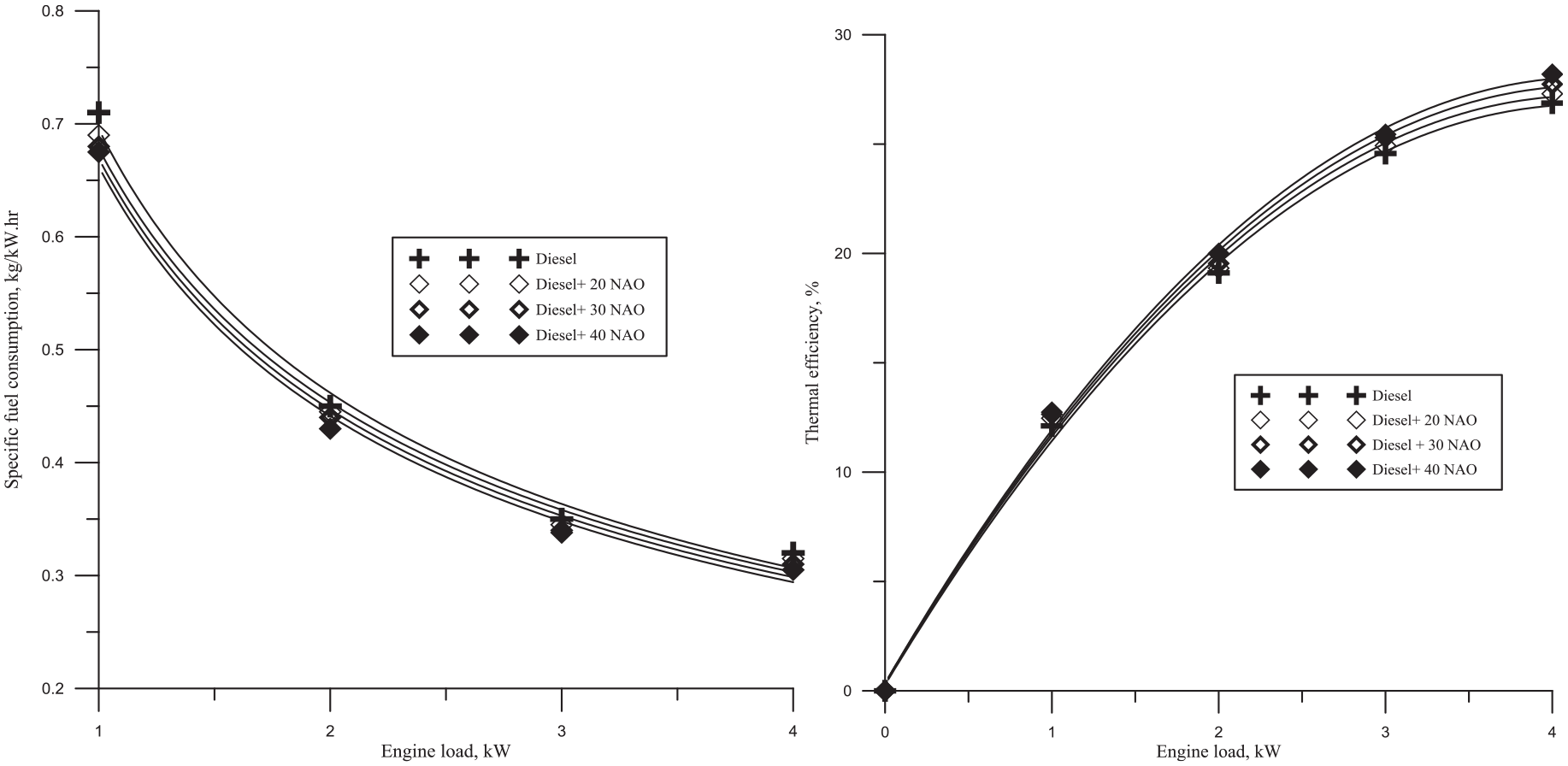
Brake thermal efficiency and specific fuel consumption with engine brake power.
Brake specific fuel consumption BSFC
BSFC values at the load variation using different nanoparticles blends are given in Figure 6. The engine load increase led to the specific fuel consumption decrease. All nano-additives used in the experiment had the less specific fuel consumptions compared to crude diesel at higher engine loads. The addition of nanoparticles increases the spray cone angle, fuel droplet propagation and improves the dispersion of injected fuel inside the combustion chamber as stated by Saraee et al. 22 The fuel cohesion decrease, easier fuel breakup, creating smaller droplets and exposing more fuel surface for oxidization were shown. Lower fuel injection and fuel viscosity decrease by the nanoparticles addition led to the cohesion force reduction between diesel fuel molecules. The decline in BSFC was ascribed to the favorable effect of nanoparticles on the fuel physical properties and the reduction of ignition delay. Venkatesan 6 and Aalam et al. 23 noted the enhancement in the combustion efficiency and thus less amount of fuel is necessary for the specific power output. Alumina nanoparticles oxidize the carbon deposits leading to the fuel consumption reduction owing to the catalytic effect, surface area to volume ratio enhancement, and the combustion characteristics improvement. Specific fuel consumption at full load decreases when compared to diesel fuel were found to be 3.5%, 4.5%, and 5.5% at dosing levels of 20, 30, and 40 ppm, respectively. This aspect has been studied well and reported by many researchers.6,14,21,22
Exhaust gas temperature
Effect of different nanoparticles blends on the exhaust gas temperatures at various engine loads is evaluated in Figure 7. At higher engine loads, all nano-additives used in the experiment had less exhaust gas temperatures in comparison to crude diesel. The reason is due to the increased oxygen content provided by the nano-blends which improves the combustion and better homogenization of nanoparticles in diesel fuel. The oxygen buffer in nanoparticles enhances the heat release rate. Reduction of ignition delay period, improved cylinder combustion characteristics were associated with the nanoparticle addition to diesel fuel. Increase of nanoparticle aluminum dose in diesel fuel reduces the radiation losses and exhaust gas temperature. Increase of catalytic reactivity and heat transfer rate were due to the addition of alumina. In comparison to neat diesel, dosing levels of 20, 30, and 40 ppm Al2O3 nanoparticles showed the maximum reductions in the exhaust gas temperatures by 3%, 10%, and 13%, respectively at full load. This is agreed by many other researchers working on nano-fuel additives.14,21,23

Variation of exhaust gas temperature and air-fuel ratio with engine brake power: (a) exhaust gas temperature and (b) Air-fuel ratio.
Air-fuel ratio
The tested fuels air-fuel ratios at various engine output power were described in Figure 7. The air-fuel ratio change depends on the mass of injected fuel per cycle in diesel engine due to the constant supplied air inside the engine cylinder. The increase in engine load led to the injected fuel increase per cycle and air-fuel ratio decrease. The rise in alumina nanoparticles percentages about diesel fuel was related to the reductions in the fuel consumption and air-fuel ratio is found to be increased. Addition of nanoparticles led to the increase of catalytic reactivity and fuel consumption decrease. At full load, Al2O3 nanoparticle additives at dosing levels of 20, 30, and 40 ppm showed the maximum increases in the air-fuel ratios to the extent of 65%, 20%, and 30%, respectively compared to neat diesel fuel.14,21
NOX emissions
Nitrogen oxide emissions were investigated related to the engine load variation and presented in Figure 8. In general, Al2O3 nanoparticles within diesel oil reduced the NOx emissions in comparison to neat diesel. NOx emissions were declined with the nanoparticles percentage dosing level increase, due to the oxygenated additives and combustion improvement. Catalytic effect of nanoparticles tends to improve the heat transfer rate in combustion chamber. NOx formation is influenced by the oxygen content, cylinder temperature and reaction time involved. The ignition delay reductions of Al2O3 blends lead to the reductions of adiabatic flame temperatures, early combustion and hence NOx emissions. Addition of alumina nanoparticles enhanced the catalytic activity, air- fuel mixing and the scavenged nitric oxide radical. The average decreases in NOx emissions at full load were 10%, 20%, and 30% corresponding to the dosing levels of 20, 30, and 40 ppm (respectively) in comparison to the diesel fuel.14,21,24

NOx emissions and smoke opacity with engine brake power: (a) NOx emission and (b) smoke opacity.
Smoke opacity
Effect of nanoparticles on the smoke opacity emissions are presented in Figure 8. Engine load increase is found to increase the smoke opacity. The rise in concentration of Al2O3 nano-particles in diesel fuel blends led to the decrease in the smoke emission. The associated higher fuel burnt in the diffusion stage and more oxygen content led to the drop in smoke emission. The drop in smoke emission was the result of reduced ignition delay. Nano-Al2O3 makes the improvement in the diffusive combustion characteristics. Addition of nanoparticles improved the evaporation and ignition characteristics. The average reductions in smoke opacity emissions at full load were 9%, 13%, and 17% with the alumina nanoparticles dosing levels of 20, 30, and 40 ppm (respectively), in comparison to neat diesel fuel.8,14,21
CO emissions
Figure 9 shows the CO emissions at engine load variation with additive doses of alumina nanoparticles in diesel fuel. Inclusion of alumina nanoparticle additives decreased the CO emission as a result of the higher chemical reactivity, higher surface contact area, ignition delay shortening and improved combustion characteristics. Increase of oxygen percentage in nano-alumina improve the combustion process which leads to the less fuel rich zone formation and CO emission reduction. Reduction of CO emission with the nanoparticle addition is possibly to the fuel-lean combustion and the enhancement of atomization rate. Nano-particles addition decreased the fuel composition homogeneity and cause more fuel injection breakup. The lower produced CO emissions when nanoparticles blended to pure diesel were due to the uniform dispersion and complete combustion of nanoparticles.14,23,25 At full load, the average reductions in CO emissions were 4.5%, 15%, and 25% at aluminum oxide nanoparticles of 20, 30, and 40 ppm doses, respectively compared to diesel fuel. The exhaust treatment of nanoparticles was not done. Al2O3 nanoparticle dissociates to Al2O and O at higher cylinder temperatures. The molecule Al2O is very unstable at higher temperatures and further disposes to 2Al and ½O2. This oxygen molecule reacts with CO to get converted to CO2. Element Al is produced in the exhaust from the dissociation of nano additive and can be trapped in the tail pipe emission. 17

Variations of carbon monoxide and hydrocarbon emissions with brake engine power: (a) CO emissions and (b) HC emissions.
HC emissions
Unburned hydrocarbon emissions from zero to full load were shown in Figure 9. Hydrocarbon pollutants were lower for alumina with diesel fuel about the base diesel fuel. HC emissions were decreased when Al2O3 nanoparticles content was increased in the diesel oil owing to the existence of excess oxygen for the oxidation of hydrocarbons. Parameters like improved surface to volume ratio, higher catalytic activity, improper fuel- air mixture led to the improvement in combustion and lower HC emissions. The secondary atomization and hydrocarbon oxidation, were shown under the impact of nanoadditives. Nano-alumina reduces the carbon combustion activation, enhances HC oxidation and enable complete combustion, as reported in many references.14,21,26 During our experiments, the dosing levels of 20, 30, and 40 ppm Al2O3 nanoparticles additives to diesel fuel showed average decreases in the HC emissions by 11%, 22%, and 33%, respectively about diesel oil.
Cylinder pressure
Cylinder pressure influences the quality of combustion inside the engine cylinder. In the premixed combustion stage, the higher fuel burned led to the greater peak cylinder pressure and maximum rate of pressure rise. Figure 10 describes the effect of piston position on the cylinder pressure at 100% of load range for nanoparticles contents of 20, 30, and 40 ppm for all fuels. At full load, the peak cylinder pressures for nanoparticle with diesel fuel mixtures were higher in comparison to crude diesel. The increase of alumina nanoparticle percentage in diesel fuel produced the slight increase due to the improved rapid combustion. The decreases in ignition delay period and heat release rate associated with the blending with nano-additive owing to the improved mixing of air-fuel and pre-flame combustion. The addition of aluminum oxide to neat diesel accelerates the early initiation of combustion due to the alumina nanoparticles catalytic effect, improved reaction rate, ignition delay period reduction. All these causes led to the improvement in the combustion characteristics as reported by many authors in the literature.27–30 The cylinder peak pressure for diesel fuel is 71.22 MPa which was attained at a crank angle of 5° after TDC. In case of diesel fuel blended with 20 ppm of alumina (Diesel + 20 NAO), the cylinder peak pressure obtained was 71.7 MPa, at a crank angle of 2° after TDC. While for diesel fuel blended with 30 ppm of alumina (Diesel + 30 NAO), the cylinder peak pressure obtained was 73.6 MPa, at a crank angle of 2° after TDC. Further, for the case of diesel fuel blended with 40 ppm of alumina (Diesel + 40 NAO), the cylinder peak pressure still increases to 74.7 MPa, at a crank angle of 2° after TDC. Better combustion (as nanoparticle content increases) led to cylinder peak pressure increase and advancement of cylinder peak pressure.

Cylinder pressures at different piston positions at full load.
The proximity switch was calibrated with respect to the TDC. The TDC location relative to the proximity position has been sensed by a linear displacement sensor. The injector was removed and the flywheel was rotated until the displacement sensor was deviated and to know exactly the position of TDC. The proximity reading at TDC was confirmed by repeating this procedure many times. The cylinder pressure sensor was linked to a charge amplifier. The charge amplifier and proximity switch were connected with a data acquisition card which was supported by a personal computer. The sampling rate and the number of samples are represented in the following equations:


Effects of nanoparticle doses of 20, 30, and 40 ppm on peak cylinder pressure from zero to full load are shown in Figure 11. The increase in peak cylinder pressures and higher heat release were related to the increase of engine load because of the increase in injected fuel. Higher heat release rate and corresponding higher cylinder pressure were observed for alumina nanoparticles blended diesel fuel, as mentioned in many references.31–33 This is due to the fuel atomization enhancement, rapid evaporation and improvement of the combustion phase for nanoparticle blended fuels, while comparing to that of neat diesel fuel.

Variation of peak cylinder pressure and ignition delay period with brake power: (a) Peak cylinder pressure and (b) ignition delay period.
Ignition delay
The time interval between the fuel injection start and the combustion beginning is called ignition delay period. Start of combustion can be detected experimentally and represented as the zero value of HRR and with zero cumulative heat release. Alumina nanoparticles addition found to be reducing the ignition delay because of the combustion improvement of air-fuel mixture having increased the surface area to volume ratio. The ignition delay period variations for nanoparticles doses of 20, 30, and 40 ppm are indicated in Figure 11. The addition of aluminum oxide to diesel lessens the ignition delay and premixed burn fraction due to the catalytic effect of alumina nanoparticles and causes the enhancement in combustion characteristics as given in the many literature.34–38 Dosing levels of 20, 30, and 40 ppm of Al2O3 nanoparticles to diesel fuel displayed the average drop in the ignition delay to the extent of 11%, 25%, and 37%, respectively about crude diesel at full load.
Heat release rate (HRR)
Figure 12 indicated the heat release rate values with respect to crank angle corresponding to nanoparticle dose levels of 20, 30, and 40 ppm at full load conditions. Blending of nanoparticles improves the combustion activation and promotes the complete combustion. The enhancements in fuel jet injection momentum and fuel penetration rate were shown due to the effect of nanoparticles blending.28–30 Nano-alumina achieved the more uniformity in air-fuel mixture distribution and higher HRR. HRR increase with the inclusion of nano-Al2O3 about the neat diesel fuel, which shall be due to the accelerated combustion and shortened ignition delay as stated by references.35–39 The values of HRR were 40.2, 41.05, 41.6, and 42.21 J/Degree, for Diesel, Diesel + 20 NAO, Diesel + 30 NAO, and Diesel + 40 NAO, respectively at full load.

Heat release rate at different engine crank angles at full load.
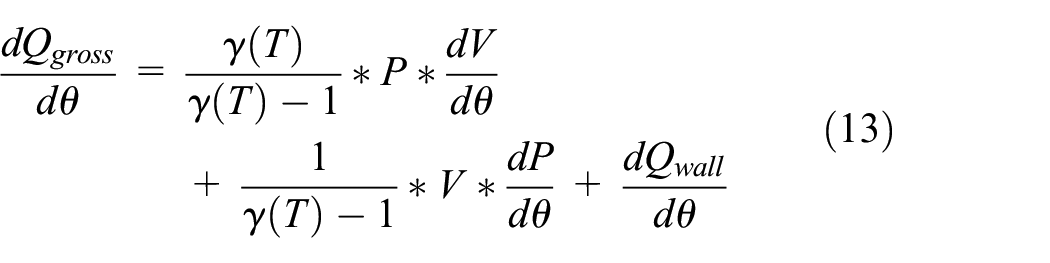
The net HRR was estimated using the following equation:


The rate of cylinder volume (dV/dθ) and the change in cylinder pressure (dP/dθ) versus crank angle (θ) are calculated as follows:


Cylinder temperature
Effect of the nano-alumina additives with diesel fuel on the cylinder temperatures at different engine brake power were displayed in Figure 13. Addition of nano-additive led to the shorter of ignition delay period and heat release rate increase due to improved air-fuel mixing. Addition of nano-alumina advances the initiation of combustion. Further, improved reaction rate and fuel-air mixing improvement are obtained with the nano-additives addition. All these lead to the overall combustion characteristics enhancement. Addition of nano-Al2O3 into the diesel oil led to the combustion start advancement and the peak cylinder pressure increase. Dispersion of nano-Al2O3 into diesel oil produced the higher surface to volume ratio, improved the thermal conductivity and droplets evaporation rate enhancement. Al2O3 additives to diesel oil decreased the ignition delay and the peak cylinder pressure reaches a higher value. The HRR enhancement with nano-additives led to the increase of cylinder temperature. Peak cylinder temperatures obtained at full load for Diesel, Diesel + 20 NAO, Diesel + 30 NAO, and Diesel + 40 NAO, respectively are 1470, 1510, 1570, and 1620 K.
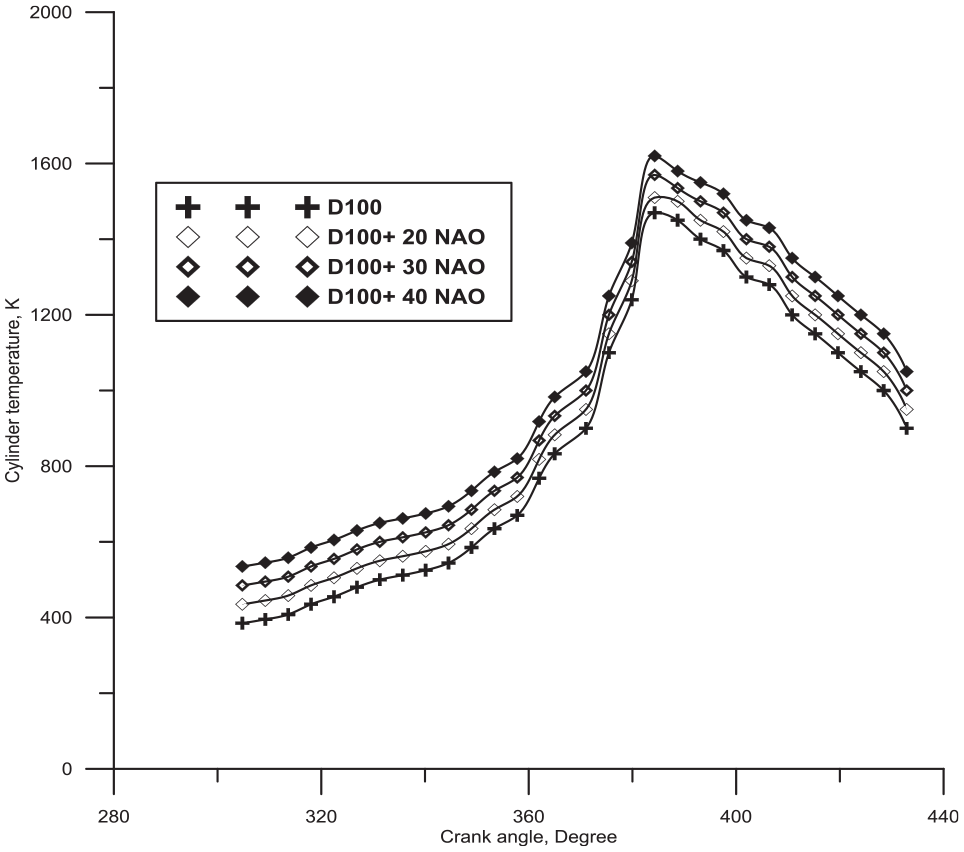
Cylinder temperature with crank angle at full load for palm biodiesel blends.
Mass fraction burned (MFB)
MFB can be represented by the Wiebe function related to the engine crank angle in order to characterize the combustion process characterized by S shaped curve increases from zero at combustion beginning and finally reaches unity at the end of combustion. MFB is associated to the injected fuel mass in the combustion process. The movement of flame front through the fuel is until completely burning at the combustion start. Figure 14 showed the gross HRR with crank angle variations with nano-additives at full load. The combustion zone may be separated into the burnt and unburned areas. The mass fraction burned variations with respect to the crank angle for the diesel fuel with Al2O3 nano-additives at full load was presented in Figure 15. The evaporation rate increase, the fuel-air mixture improvement and the reduced ignition delay decreased the combustion duration and accelerated the combustion start. The governing equations applicable with respect to this connection are presented here (equations (10)–(14)). The parameter (m) appearing in equation (11) is calculated for different additives to diesel oil in Table 3.




Gross heat release rate with crank angle at full load for nano-additives.
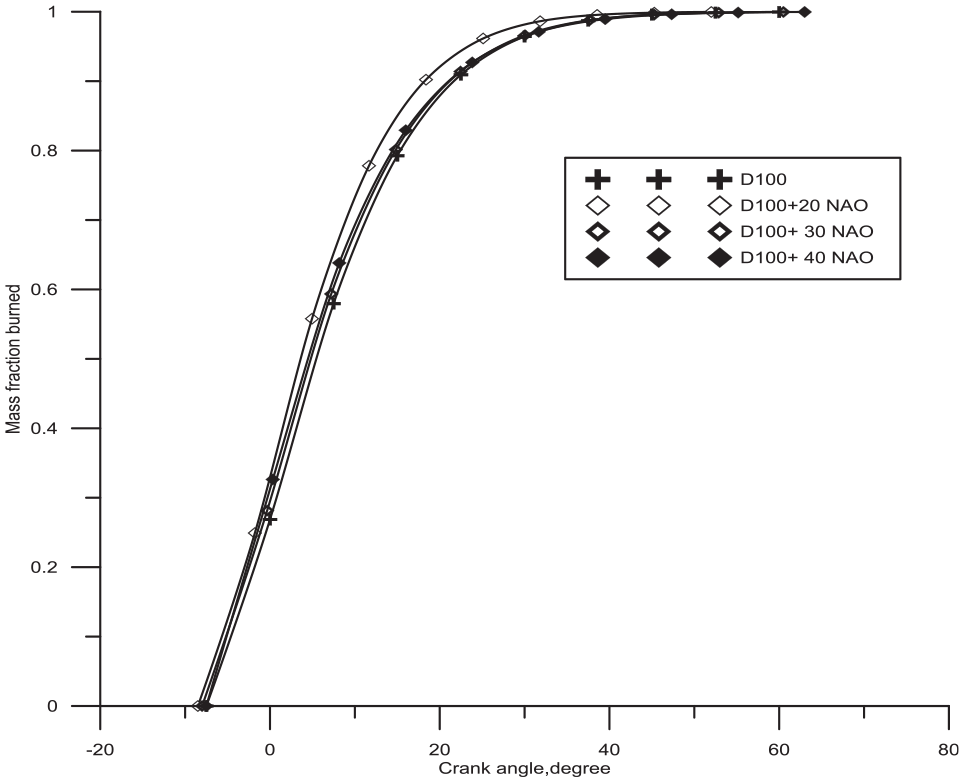
Mass fraction burned for nano-additives to diesel oil.
Calculation of mass fraction burned.

Combustion duration
Combustion durations obtained corresponding to the different engine loads with nano-additives in diesel oil is shown in Figure 16. The combustion duration is found to be increasing with the brake power increase on account of the higher fuel injected at increased engine loads. The combustion beginning and the combustion duration reduction associated with the enrichment of Al2O3 nanoparticles to crude diesel. This effect shall be because of the evaporation rate increase, fuel-air mixing improvement, catalytic reactivity and ignition delay reduction. Combustion duration values at full load for neat diesel oil is 74°CA, while its corresponding values are 70°, 66°, and 61°CA for Diesel + 20 NAO, Diesel + 30 NAO, and Diesel + 40 NAO, respectively.

Combustion durations with engine load for diesel oil with nano-additives.
Conclusion
The influence of multi nano additives upon the performance and emissions of CI engine burning Jatropha biodiesel was shown in a comparative study. 40 The experiments were done to show the impact of alumina nanoparticles as additives to diesel fuel. Alumina nanoparticle concentrations of 20, 30, and 40 ppm were experimented under standard laboratory conditions. The effect of nanoparticle presence in the pure diesel on the combustion characteristics, performance and emissions of a diesel engine were studied in detail. The following conclusions were reached from the present experimental analysis:
➢ However, the enhancement of the thermal efficiency of diesel engines by 3.5%, 4.5%, and 5.5% for Diesel + 20 NAO, Diesel + 30 NAO, and Diesel + 40 NAO, respectively. Specific fuel consumption at full load decreases when compared to diesel fuel were found to be 3.5%, 4.5%, and 5.5% at dosing levels of 20, 30, and 40 ppm, respectively.
➢ Increase in air-fuel ratios in comparison to diesel fuel was indicated for all doses of alumina nanoparticle additives in the diesel fuel. Catalytic effect of nanoparticle additives led to lower levels of exhaust gas temperature in comparison to neat diesel fuel.
➢ At the Al2O3 dosage level of 20 ppm, average reductions in NOx, CO, and HC were 10%, 4.5%, and 11%, respectively, and as the dosage Al2O3 level increases, emission reduction continues to decrease according to our experimental observation.
➢ Smoke emission of diesel engine decreases with the inclusion of alumina nanoparticles by an average extend of 9%, 13%, and 17% at the dosing levels of 20, 30, and 40 ppm, respectively.
➢ Nano-alumina addition to diesel fuel achieved increases in cylinder pressure and heat release rate in comparison to the neat diesel fuel indicating nanoparticles are effective in engine performance and combustion characteristics improvement. Blending of aluminum oxide to neat diesel reduces the ignition delay and premixed burn fraction due to the improved reaction rate.
➢ Also, it is observed that nanoparticle addition in diesel helps in reducing harmful exhaust pollutants and improving of the engine performance and combustion characteristics. .Altogether it can be concluded that, fuel borne nano-metal catalyst usage will enhance the combustion characteristics and engine performance while harmful exhaust emissions get reduced. The small size of nanoparticles (size ∼10 ± 2 nm) shall lead to the improvement in the stability of fuel suspensions, prevent the fuel atomization and clogging problems in fuel injectors.
Footnotes
Appendix
Handling Editor: James Baldwin
Declaration of conflicting interests
The author(s) declared no potential conflicts of interest with respect to the research, authorship, and/or publication of this article.
Funding
The author(s) received no financial support for the research, authorship, and/or publication of this article.
