




Abstract
Pyrolysis of castor oil with anhydrous sodium hydroxide as a catalyst was performed to produce Catalytic Castor pyrolytic oil (CCPO). The physical and chemical properties of the pyrolytic and gas oils were recorded according to ASTM standards. Gas oil was blended with castor pyrolytic oil at different volumetric ratios of 0%, 25%, 75%, and 100% as CCPO00, CCPO25, CCPO75, and CCPO100, respectively. Coefficient of variation (COV) of combustion parameters proved to be a profound method of assessing combustion characteristics and engine performance. COV of combustion parameters (IMEP, Pmax, and dP/dΘmax) for gas oil blends with pyrolysis oil were measured. Recorded pressure crank angle traces of 150 consecutive cycles were used for COV’s determination. A single cylinder diesel engine equipped with calibrated measuring techniques was used at different engine loads. Higher volumetric blending ratios of pyrolytic oil with diesel oil increased the COV’s within an acceptable range of engine operating conditions. Minor modifications might be valuable for engines fueled by pyrolysis oil blends to obtain smoother, lower noise operation, and combustion stability.
Introduction
Nowadays, there is an increase of worldwide demand for electrical power and transportation which depends mostly on fossil fuels. The fossil fuel demand is expected to increase exponentially in the forthcoming periods which imply a consequent future problem of energy supplies called the world’s energy crisis. 1 There are several proposed solutions to overcome such problem; one of the promising solutions is to use renewable energy resources. 2 Biofuel is considered one of these proposed resources. Furthermore, biofuels from non-edible vegetable oils have recently gained augmented researchers emphasize. Many reasons justify that; because of fossil fuels depletion problem, Egypt is not an oil producing country any more, and biofuels being more environment friendly. 3 In addition, using such oils as a fueling solution provides opportunities for the agricultural producers and rural communities with low cost. 4 These oils and their esters have been evaluated as substitutes for diesel fuel, such as raw sunflower, cotton seed, corn, olive, rapeseed, soybean, rapeseed oil, Jatropha, and Jojoba oils.5–12 Castor oil appears to be a promising competitor for diesel fuel as a promising scope for cultivation in the relatively hot Egyptian weather.11,13,14
Several methods for converting vegetable oil into biofuel have been frequently investigated. Such methods are thermal cracking, pyrolysis, transesterification, catalytic cracking, and dilution.15,16 Pyrolysis produces lower viscosity fuel and low grade fuel in contrary to transesterification.11,15,17,18 Pyrolysis is one of the most recent energy processes owing to its advantages as a liquid bio-oil commodity that can be conveniently stored and transported as an energy carrier.19,20
Investigations of combustion characteristics include standard parameters for the optimal combustion behavior of biofuels while retaining better engine performance and stability. 21 The combustion characteristics have been affected by the physical and chemical properties of biofuels.11,22 Thus, biofuels with higher hydrogen contents produced lower cycle to cycle variations and burning rates because of the higher flame speed obtained, as mentioned by Attai et al. 4 Thus, cyclic variation has two distinctive natures as deterministic, stochastic and this would simply contribute to address and classify the combustion variations.23,24 The cyclic variability was revealed by observing the cylinder pressure development for several cycles. The obvious characteristic of cycle to cycle pressure variation is remarked as the fluctuation of peak cylinder pressure that varies in both magnitude and position as measured from top dead center (TDC). Hence, plotting the pressure profile of 50 to 200 cycles indicates the cyclic variations. 25 The pressure data of 150 consecutive cycles has been recorded for a single cylinder research engine known as LUPOE1-D (acronym for Leeds University Ported Optical Engine—Disc chamber). 26 Such data showed that there were considerable amounts of variations especially during the combustion period. The small variations in the factors affecting cycle cylinder pressure causes significant amounts of changes in the engine output power. There was no consensus regarding the number of cycles that should be considered to obtain the average cycle. 25 For research purposes, instantaneous pressure related parameters were more useful than the indicated mean effective pressure (IMEP) as a measure of cyclic variability but their use was complicated due to the fact that cylinder pressure is affected by combustion. Ozdor et al. 23 classified the factors affecting cyclic combustion variations (CCV’s) into four types according to their impact on the working process as follows: the mixing process in the cylinder, circulation of intake air, the components of mixtures and characteristics of ignition. Pundir et al. 27 indicated that when the intake charge is most uniform, the coefficient of variation of the maximum pressure (COVPmax) will be minimal as approaching to stoichiometric condition. The equivalence ratio variations will inevitably affect CCV’s. Moreover, Attai et al. 4 found that the coefficient of variation is mainly affected by the percentage of biofuel in the tested fuel, in addition to the design of the combustion chamber. Consequently, studying the cyclic variations of maximum cylinder pressure, indicated mean effective pressure and the maximum rate of pressure rise are sufficient to judge the combustion quality.21,28,29 In this regard, minimizing the COV of engine parameters would result in improved combustion characteristics and engine performance.
The maximum pressure rise rate (MPRR) increased with the increase of bioethanol ratio in blends at full load. COVPmax and the COVMPRR values increased with the bioethanol percentage increase. Fuel properties have an effect on COV with the engine load. The combustion process and cycle-by-cycle variation analysis of 200 subsequent engine cycles were studied. COVIMEP was investigated for engine operation cycles. The increase of alcohol percentage has an effect on the combustion stability.30–34
Castor trees are available greatly in Egypt. Castor seeds contain higher yield of oil which is inedible and has no effect on the food security. This study focuses on the using of raw castor oil as a feedstock. The used pyrolysis process converted the raw castor oil, with anhydrous sodium hydroxide catalyst, to pyrolytic oil (CCPO100). Then, different physical and chemical properties of pyrolysis and diesel oil blends were measured according to ASTM standards. The measured properties were used to indicate the ability of the produced pyrolytic oil to satisfy diesel standards and also evaluate it as an alternative fuel to diesel engines. However, COV’s of the combustion parameters as COVIMEP, COVPmax, and COV(dP/dΘ)max of diesel engine fueled by different blends of gas oil with CCPO100 were measured. To prepare the test fuels, blending was done on volumetric basis in ratios 0%, 25%, 75%, and 100%.
Materials and methods
Production of castor pyrolysis oil
Oil bath heater, heating pyrex flask, three way connector, temperature controller (thermometer), cold water condenser and pyrolytic oil receiving pyrex flask are the components of the pyrolysis test bench. The pyrolysis test bench was adjusted at temperature ranges from 200°C to 450°C as mentioned by Abu-Elyazeed. 19 Catalysts, such as Al2O3, KOH, NaOH, Na2CO3, and NaOH combined with ZSM-5 of 1% by weight were used. Catalyst weight of 1% of NaOH was chosen to achieve the maximum energy saving and maximum yield of castor pyrolysis oil. A quantity of one liter castor oil was fed directly to the reactor with 1 wt% anhydrous sodium hydroxide (NaOH), as recommended by Abdelfattah et al. 15 After the start of oil evaporation at a temperature of 230°C, the heater was turned on. The oil evaporation continued until at a temperature of 400°C. The water cooled condenser was used to condense the vapors generated from the reactor. After that, the condensed pyrolytic oil was collected in the receiving flask. After attending the required temperature, the pyrolytic vapor has been visualized after about 180 min, while the total experiment duration was 240 min. The pyrolytic yielded biofuel named as CCPO100. Pyrolysis method was used due to its very high total yield of 91.7% that has superior physical properties as investigated by Abdelfattah et al. 15 Figure 1 shows the pyrolysis reactor components.

Schematic diagram of the pyrolysis reactor.
Experimental test rig
The experimental procedures were run using a single cylinder, four stroke diesel engine of constant compression ratio and rated at a speed of 1500 rpm. The technical specifications of such engine were illustrated in Table 1, and a schematic diagram of the experiment setup was shown in Figure 2. An AC generator (model Meccalte 380/50 ECP 3-1S/4) with a maximum electric power output of 5.2 kW was coupled to the engine. The generator was equipped with a load controller and other auxiliaries to evaluate the engine output power. Also a proximity sensor (model: LM12-3004NA) was used to determine the top dead center (TDC). The crankshaft rotational speed was measured using a speed tachometer (BERMI, model: BRI-5045).
Specifications of the test engine.


Schematic diagram of the test rig.
The pressure crank position traces were recorded and stored using a Kistler 601A piezo pressure transducer. A charge amplifier was connected to the electric pressure transducer. A data acquisition system (model Ni USB-6210) with a maximum sampling rate of 250 kHz was used to acquire the measuring data from the sensors. The piezo electric pressure transducer was calibrated by using a dead weight tester. The calibration equation is presented below.

where P is the cylinder pressure in bars and V is the measured voltage in volts.
The average values and standard deviation for maximum pressure Pmax, maximum pressure rise rate (dP/dΘ)max and the indicated mean effective pressure (IMEP) were calculated using MATLAB code. Hence, the coefficient of variation of maximum pressure (COVPmax), maximum pressure rise rate COV(dP/dΘ)max and indicated mean effective pressure (COVIMEP) were calculated. The coefficient of variance is used to measure of the variability of samples. The coefficient of variation is calculated according to the following equation 33 :

where COV is the coefficient of variation, S is the standard deviation, and M is the samples mean.
Results and discussion
Castor pyrolysis oil characterization
The physical properties of castor pyrolytic and gas oils were recorded according to ASTM standards as stated by Knothe. 35 Gas oil was obtained from Misr petroleum company, Cairo, Egypt. Gas oil is a classification of diesel oil; this fuel was taken as a base fuel for combustion characteristics comparison. The properties presented in Table 2 are: kinematic viscosity, density, calorific value, flash point, pour point, sulfur content, ash content, carbon residue, cetane number and cupper strip corrosion. These physical properties matched well with diesel fuel standards as stated in literature.15,30 The density of gas oil was lower than that of CCPO100 by 3.53%. The near values of pyrolytic and diesel oils densities led to the complete physical mixing between them with an undetectable separation. 18 The kinematic viscosity of gas oil is higher than that of CCPO100 by 10.7%. Thus, lower droplet size of injected oil is expected due to the lower value of viscosity.17,35–39 The radical decrease in viscosity of pyrolysis oil compared to raw castor oil could be due to the thermal cracking of long castor oil chemical chains. 15 Castor pyrolytic oil flash point was <100, which exceed the minimum value of diesel standards. The higher flash point led to lower hazard during storing and transporting as mentioned by El-Mahallawy and Habik 38 and Dunn and Knothe. 39 The pour point of CCPO is lower than the minimum value of diesel standard which leads to a good cold start and enhances cold climate operation. The sulfur and ash contents in the produced castor pyrolytic oil was measured and not detected. Accordingly, the life time of all engine parts is thought to be higher when fueled by castor pyrolytic oil. The carbon residue of such pyrolytic oil is higher than that of diesel oil standards as well, that could be attributed to the storing conditions. The cetane number of the CCPO100 is lower compared to gas oil by 6.25%, which could be due to the appearance of aromatic and cyclic comounds. 15 Such lower cetane number increases the ignition delay period and result in reduced IMEP and Pmax. 19 Finally, the lower heating value of pyrolytic oil is higher than that of gas oil by 5.02%, that imply better specific fuel consumption of CCPO100 than gas oil.
Physical and chemical characteristics of castor pyrolysis and diesel oils.

Influence of oil blend on cylinder pressure
The pressure crank angle traces were collected for 150 consecutive combustion cycles. Figure 3 shows the typical data of pressure crank traces for oil blends at 75% of engine load. The recorded data were taken to MS Excel sheets and MATLAB code designed to calculate the indicated mean effective pressure, maximum pressure and maximum pressure rise rate (dP/dΘ)max by using Rassweiler and Withrow (R–W) model. 40 It can be noticed that the cylinder peak pressures of oil mixtures were lower than that of gas oil and slightly decreased with the increase of oil percentage in blends. As higher amount of burned fuel in premixed combustion leads to a higher pressure rise rate and high peak cylinder pressure and less accumulated fuel in the premixed combustion phase leads to the slow combustion and lower peak cylinder pressure. The authors believe that lower cetane number and viscosity of pyrolytic oil produce smaller droplets of the injected fuel which leads to a reduction in the combustion efficiency. Also, higher aromatic and cyclic compounds of pyrolytic oil reduce the cylinder pressure about diesel oil. These findings agree with the findings of many researchers including.15,30,33,41

Cylinder pressure–crank angle data of pyrolysis oil blends at 75% of engine load.
Influence of oil blend on indicated mean effective pressure
The relation between the averaged IMEP for the studied cycles versus engine load conditions at a rated engine speed of 1500 rpm are presented in Figure 4. It can be noticed that increasing the engine load leads to an increase in the IMEP of all used blends due to the increased amount of injected fuel. Also, higher CCPO volumetric ratios decreased the resulted IMEP at all loads due to the lower cetane number of pyrolytic oil compared to diesel oil. Higher aromatic and cyclic content of oil blends decreases the combustion efficiency, output work and mean effective pressure compared to diesel oil. Moreover, the lower viscosity of pyrolysis oil about diesel oil produces lower IMEP. These results are confirmed with those found by Turkcan, 30 Yasin et al., 34 and Rakopoulos et al. 42
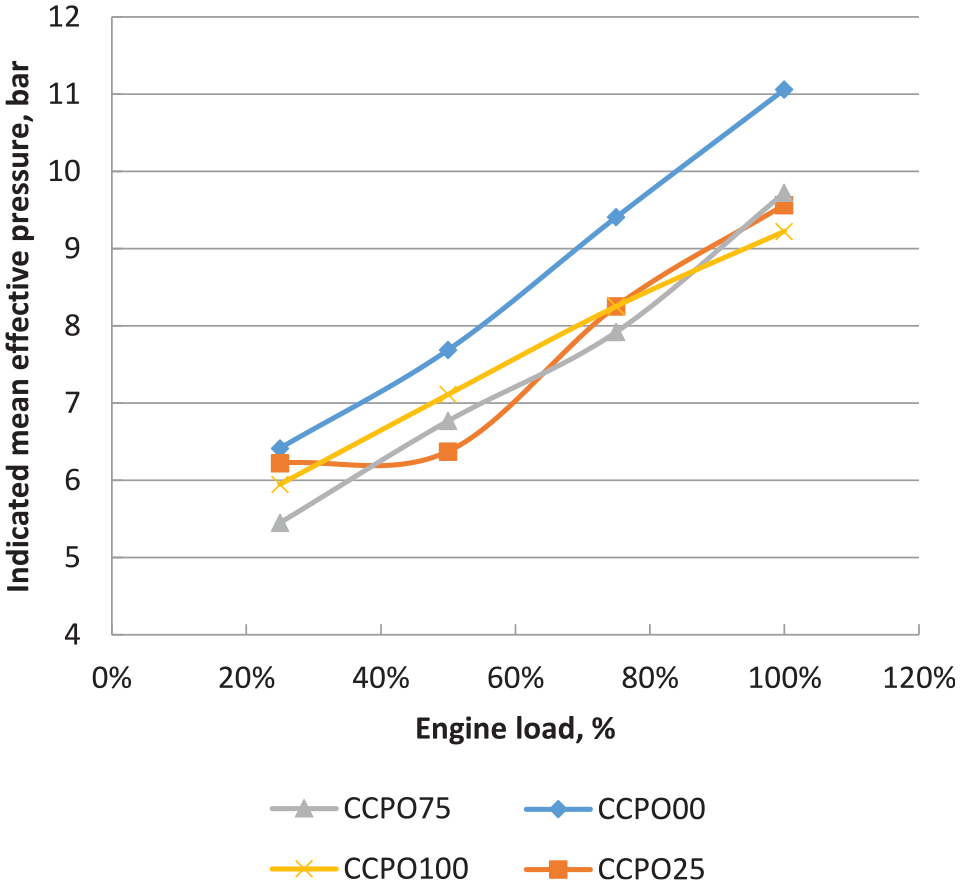
Average IMEP versus engine load for different mixtures of CCPO100 and gas oil.
Influence of oil blend on maximum cylinder pressure
The relations between the averaged maximum pressure values of the studied cycles for each blend at different load conditions are presented in Figure 5. At higher engine loads, the average maximum pressure increased due to the increase of the injected fuel for all used blends. Also, the averaged maximum pressure is decreased by increasing the volumetric blending content of CCPO for all used blends at all load conditions due to the lower cetane number of the produced pyrolytic oil compared to gas oil. Lower pyrolytic oil viscosity produces lower combustion efficiency and peak cylinder pressure about pure diesel. The findings agree with literature.15,30,33

Average Pmax versus engine load for different mixtures of pyrolysis and gas oils.
Influence of oil blend on maximum cylinder pressure rise rate
The rate of pressure rise is considered an important parameter that describes the fuel burning rate as mentioned by Pham et al. 21 The average (dP/dΘ)max versus engine load at a constant engine speed of 1500 rpm are presented in Figure 6. At higher engine loads, the average maximum pressure rise rate increased due to the increase of the injected fuel. Also, the average maximum pressure rise rate decreased by increasing the volumetric blending content of CCPO at all engine loads. Thus it is expected that engines fueled by pyrolytic oil blends produce lower heat release and cylinder pressure than gas oil. The lower cetane number and viscosity of pyrolytic oil have remarkable effects on injected fuel in premixed combustion stage and consequently on the heat release rate. The pressure rise rate is related to the engine combustion noise of the engine. Increasing the cylinder pressure rise rate leads to noise increase. The diesel engine fueled by pyrolytic oil blends produces lower noise than gas oil. These results agree with literature.15,34,42

Cylinder pressure rise rate versus engine load for different blends of CCPO100 and gas oil.
Influence of oil blend on coefficient of variation for IMEP
Cycle-to-cycle variations are caused by the in equal injected fuel which affects the combustion stability. The common negative aspect of the conventional diesel engine (drivability problems) was shown when the COVIMEP exceeds 10%. 27 Figure 7 illustrates the calculated COVIMEP at different engine loads for the used test blends of CCPO with gas oil. At higher engine loads, the COVIMEP reduced for all blends of pyrolytic oil and gas oil. The combustion becomes more controllable at higher engine loads because of the greater amount of the injected fuel; consequently the combustion process becomes more repeatable. 42 However, the reduction percentage of COVIMEP of CCPO100 is 33.9% at the whole range of engine load. While the reduction percentage at the whole load range for CCPO00 is 41.67%. The higher volumetric percentage of pyrolytic oil slightly increased the COVIMEP at the whole load range due to the lower viscosity of this oil compared to CCPO00. So, the size of the injected droplets becomes smaller in the case of CCPO100 which results in less controllable and repeatable combustion. Finally, COVIMEP of all blends are lower than 10 at engine load greater than 25%. Thus, engines fueled by blends of CCPO with gas oil are expected to run smoothly with unnoticeable drivability problems. The network decrease leads to the decrease of cylinder pressure and COVIMEP increase. The higher oxygen content in oil blends produces the work output decrease and higher COVIMEP. These findings agree with those obtained by Turkcan 30 , Ali et al., 41 and Rakopoulos et al. 42

COVIMEP versus engine load for different blends of pyrolytic and gas oils.
Influence of oil blend on coefficient of variation for Pmax
The acceptable limit of the COVPmax < 10 as mentioned by Yasin et al. 40 and Allenby et al. 43 Figure 8 represents the relations between COVPmax of pyrolytic castor/gas oil blends versus engine load. At higher engine loads, the COVPmax decreased due to the increase of the injected fuel that yielded more controllable and repeatable combustion for all blends of CCPO with gas oil. But, at lower engine load of 25%, the COVPmax for CCPO25, CCPO75, and CCPO100 are lower than that of gas oil due to the higher aromatic contents in pyrolytic oil as mentioned by Abdelfattah et al. 15 and Abu-Elyazeed. 19 Also, higher volumetric blending ratio leads to an increase in COVPmax at engine load higher than 50%. The whole values of COVPmax < 2.5 for all used blends at all engine loads. Thus, the engine fueled by such blends of gas and pyrolytic castor oils can run with low yielded noise. Improper fuel-air mixing properties decreases the power output, cylinder pressure and increased COVIMEP simultaneously. The fuel properties affect the engine combustion characteristics. The oil percentage increase results in lower viscosity and cetane number of the blend, all these lead to higher COVPmax values about diesel oil. These results agree with the review.15,30,33

COVPmax versus engine load for different blends of gas and pyrolytic castor oil.
Influence of oil blend on COV of (dP/d
)max
It is worth to mention that value of 20% is the acceptable margin of COV(dP/dΘ)max, according to Allenby et al. 43 COV(dP/dΘ)max values of the used blends of pyrolytic oil with gas oil at all engine loads are plotted in Figure 9. Such figure depicts lower COV(dP/dΘ)max values at both lower and higher engine loads but revealed higher values at part load conditions for all blends. The COV(dP/dΘ)max of pyrolytic oil is slightly higher than that of CCPO00 at all engine loads. This is consistent with the fact that CCPO100 has higher proportion of premixed combustion among all blends due to its slightly higher density, lower viscosity, and cetane number.41,44–46 But, the COV(dP/dΘ)max of both CCPO25 and CCPO75 are lower than those of gas oil at lower and intermediate engine load conditions but are slightly higher at full load condition. Whereas, the values of COV(dP/dΘ)max for all blends of pyrolytic oil with gas oil are lower than the acceptable COV(dP/dΘ)max limit of 20. Thus, engines fueled by blends of the produced oil with gas oil can run with stable thermal loading. Cyclic variations decrease with the engine load increase after 50% of engine load. Stable and regular combustion are shown at higher engine loads due to the lower cylinder pressure. Higher heat energy and improved oxidation rate lead to the complete combustion at high loads. Residual gases and unburned fuel molecules have been reduced and results in reduction of cyclic variations. Higher density and lower cetane number of oil blends and their changes with the oil percentage lead to an increase in COV(dP/dΘ)max. These results agree with literature.33,42,43

COV(dp/dΘ)max versus engine load for different blends of pyrolytic oil and fossil diesel.
Conclusion
The following conclusions may be drawn from this study as:
The tested physical and chemical properties of the obtained castor pyrolytic oil blends conform with ASTM standards. The cetane number of CCPO100 is lower than gas oil by 6.25% due to the appearance of aromatic and organic compounds. Lower cetane number of pyrolytic oil increases the ignition delay period and results in lower IMEP and Pmax. However, the calorific value of CCPO100 is higher than gas oil by 5.02%. Thus, it is expected that specific fuel consumptions of such oil blends are lower than gas oil.
Increasing engine load leads to an increase in the average IMEP, Pmax, and pressure rise rate PRRmax for all used blends due to the increased amount of injected fuel. Contrarily, it reduces the COVIMEP, COVPmax of pyrolytic oil blends, consequently combustion process becomes more repeatable and controllable.
Higher pyrolytic oil volumetric blending ratios in the tested fuels slightly decreases the average IMEP, Pmax, and PRRmax values at all engine loads. Thus it is expected that engines fueled by CCPO100 and gas oil blends produce lower noise and lower heat release rate than gas oil. At the same, it involved an increase in the COVIMEP and the COVPmax at the whole range of engine load. As well, for engine loads greater than 25%, the COVIMEP of all blends of pyrolytic castor oil are less than 10. It is also noticed that the whole values of COVPmax < 2.5 and these engines fueled by such blends can operate with undetectable drivability problems and low yielded noise.
The COV(dP/dΘ)max reduces at both lower and higher engine load conditions while it has higher values at part load conditions for all used blends. The COV(dP/dΘ)max of CCPO100 is slightly higher than pure diesel at all engine loads. While for both CCPO25 and CCPO75, it recorded lower values than gas oil unless at full load condition. Whereas, all values are within the acceptable COV(dP/dΘ)max limits of 20 which would result in stable thermal loading.
The produced pyrolytic oil blends could be considered a competent alternative for diesel engines.
Footnotes
Appendix
Acknowledgements
This research was performed to partial fulfill the requirements of the project of foundation of “Center of Excellency for Research & Development of Bio-Fuel Technology” (CER&DBT). Such project (CEP1-039-HEL) was funded by both the Egyptian Ministry of Higher Education – Projects Management Unit – management of supporting excellence and Helwan University.
Handling Editor: James Baldwin
Declaration of conflicting interests
The author(s) declared no potential conflicts of interest with respect to the research, authorship, and/or publication of this article.
Funding
The author(s) received no financial support for the research, authorship, and/or publication of this article.
