




Abstract
This article elucidates a non-planar trifurcated wave scattering problem by considering incident wave through multiple regions of the underlying waveguide. The scattered field potentials in respective duct regions are obtained via mode-matching technique (MMT) thereby dealing with the non-planar surfaces and step discontinuities positively. The scattering effects are determined by allowing the incident wave from each region explicitly and then simultaneously. The distribution of energies subject to different choices of regions for incidents are presented to analyze the effects of varying regions of incidents. It is mentioned that obtained solutions are thoroughly validated thereby displaying the scattering characteristics graphically.
Introduction
Reduction of noise produced during industrial and mechanical processes has grabbed considerable attention from researchers in the field of structural acoustics, applied mathematics and engineering. Mechanical devices like combustion engines, modified silencers and fans etc. are primarily responsible for the production of noise which propagates through a network of ducts/channels to the surroundings. These channels can be modeled in terms of Helmholtz or Laplace equations. The elimination of this unwanted noise is a necessary and natural phenomenon. For this purpose, much care is taken in designing these devices. A variety of techniques have been utilized to deal with the propagation of waves which resulted in minimizing the amount of noise to a considerable level. Modern devices like heating, ventilation and air-conditioning (HVAC) systems, silencers and combustion engines etc. are designed in a way to contribute minimum noise to the surroundings. In this context the current study can be taken as an attempt to provide an effective tool to control unwanted noise.
In the absence of geometrical discontinuity, the Wiener-Hopf technique can simply be employed to obtain a solution of the boundary value problem. For example, this technique has been employed by a number of researchers.1–4 However, with the inclusion of geometrical discontinuity the Wiener-Hopf method proves to be inappropriate for the solution of such problems. Consequently, one is forced to adopt an alternate method, like MMT to tackle such complex nature problems.
In case, when the boundaries of a waveguide are represented by sound-hard/soft or impedance type boundary conditions the problem is categorized as Sturm-Liouville (SL). Usual orthogonality relations can easily recover the unknown scattering coefficients. On the other hand, when the waveguide is described by high order boundary conditions (flexible surfaces) the resulting eigen system, being non-Sturm-Liouville (SL) in nature, requires specific orthogonality relation to provide a complete solution of the considered problem. Lawrie and Abrahams 5 have developed an orthogonality relation for waveguide described by higher order boundary conditions. Jan and Porter 6 has considered a two-dimensional uniform rectangular waveguide with a meta material cavity attached to one wall. The meta material cavity consists of micro-structures in the form of vertically arranged sound-hard channels. It has been shown that the cavity is an excellent absorber over a wide range of frequencies. The bifurcated, trifurcated and pentafurcated waveguide problems have been investigated with planar boundaries by many researchers, for example.7–16 A variety of techniques have been employed by various researchers to cope with the problems relating to the minimization of unwanted sound, for example refer to Williams et al. 17 Wang and Huang. 18 Hassan et al. has investigated a pentafurcated waveguide with soft-hard boundaries. Duan and Kirby 19 has employed the finite element method to study acoustic radiations from circular, cylindrical ducts.
Keeping in view the aforementioned studies, this article is designed to analyze the effects of incident wave from different regions of the inlet duct. The article is divided in the following sections. Section 2 includes formulation of the problem in terms of MMT. Section 3 provides mathematical expressions for the unknown amplitudes when the incident wave is introduced from different regions. Power expressions and numerical results in the form of graphs are presented in section 4 and 5, respectively.
Problem description
Consider a two-dimensional rectangular trifurcated waveguide consisting of ducts of different materials and widths. Both the walls of the interior region,

Assuming harmonic time dependence


A trifurcated waveguide configuration.
In dimensionless form, the rigid and impedance boundary conditions in the regions

and

respectively. In regions

where the dimensionless parameters

respectively. The quantities in the above equation

Here

and

The subscript “
Mode matching solution
Here, a detailed description of the derivation of the eigenfunction expansion in different sections of the trifurcated waveguide is provided. The section is further subdivided on the basis of the region from which the incident wave is introduced. These are discussed in detail in the following.
Incidence through region
In this case, the plane incident wave is introduced into the trifurcated duct through the plate-bounded region



and

where

The first term of equation (10) indicates the incident wave whereas the coefficients

These roots possess certain properties as listed in detail by Nawaz and Lawrie.
20
The eigenfunctions of the elastic plate-bounded regions

where the prime denotes the differentiation of the corresponding eigenfunction w.r.t. y. The quantity

The unknown complex amplitudes

where

and

To obtain a similar expression for
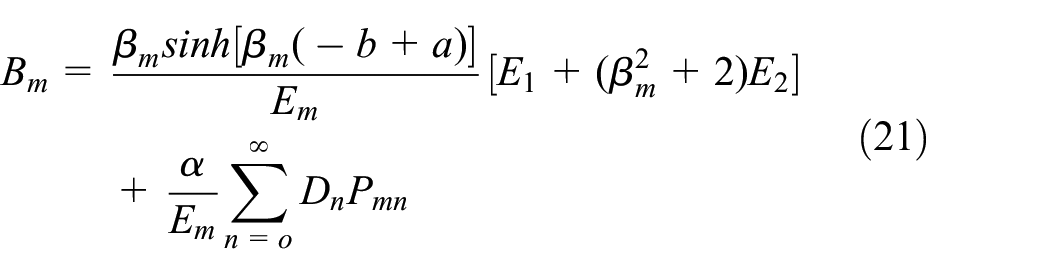
where


and

A Similar procedure is adopted to determine

where


and

Finally, the transmitted coefficients

where

and

The unknown constants

and

The values of the unknown constants

The multiplication of equation (21) by

Using equations (33) and (34) reduce the above equation to

where

In a similar manner, the unknown

by virtue of equations (32) and (34) the above equation reduces to

where

Incidence through region
In order to investigate the effects of changing the region of incidence we introduce the incident wave from the region

where the first term of equation (41) represents the incident field. The incident power is scaled at unity by taking
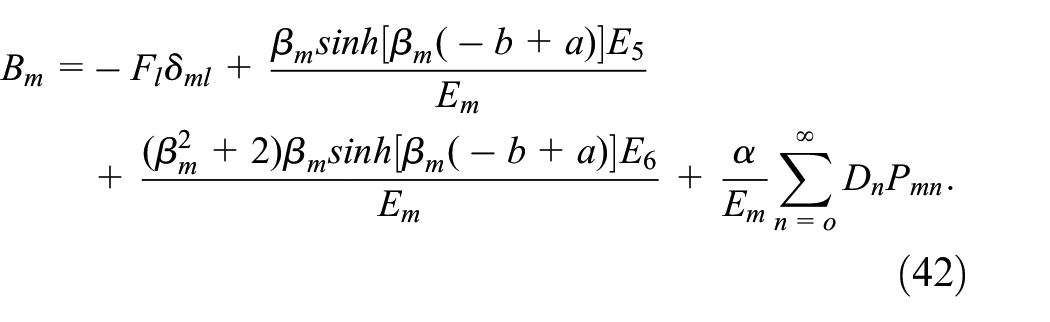
where

By comparing equations (33) and (43) together with (42) we get
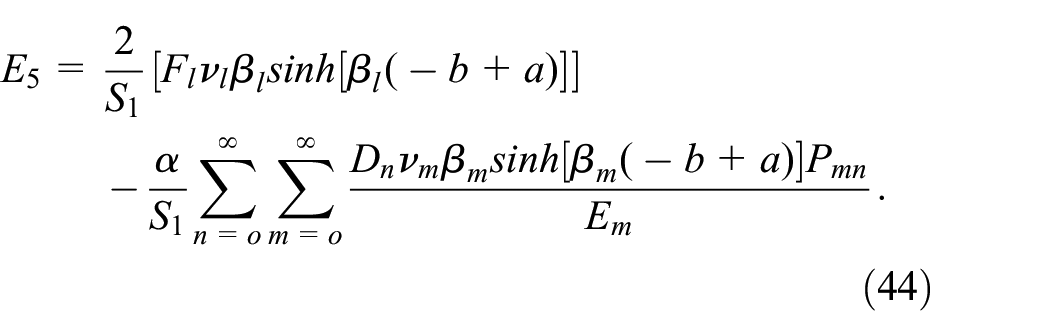
The values of

Incidence through region
When the incident wave enters the trifurcated waveguide from the left side of the interface

The velocity potentials in the regions

where

Comparing equations (32) and (48) yields
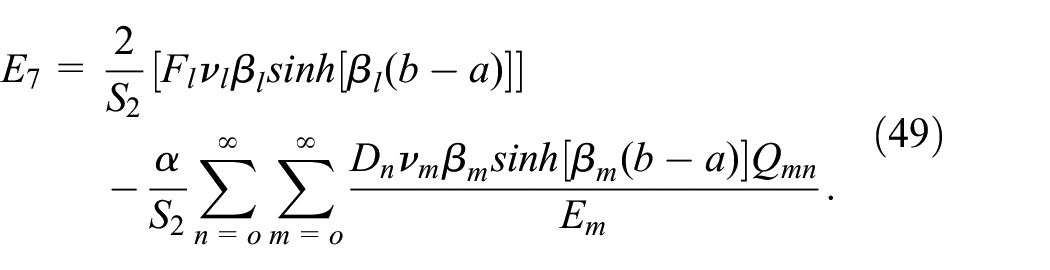
The value of

Incidence through region
,
, and
As in the case of incidence through regions

Power or energy flux expression
The power fluxes in different regions of the waveguide are calculated in this section. The energy fluxes due to fluid and structure are given by

and

where the (*) represents the complex conjugate throughout. Using the above expressions, the incident power is found to be


and

When the incident wave enters the duct through the region



and

It is to be noted that the scattering powers remain the same when the region of incidence is changed from


and

Numerical results and discussions
Here, in this section, we will truncate the algebraic linear infinite system of equations in (54) –(65) to N terms. This results in a system of

Power distribution against frequency

Power distribution against frequency

Power distribution against frequency
In Figures 5 and 6, the incident wave is introduced in the waveguide through the region

Power distribution against frequency

Power distribution against frequency

Power distribution against frequency

Power distribution against frequency
For convergence purpose, Figure 9(a) and (b) are sketched for scattered powers and their sum versus the truncation number N. It is observed that the scattering components converge appropriately whereas overall sum remains unity. This certainly confirms the accuracy of algebra together with satisfaction of power balance and all structural conditions. Figures 10 and 11 are plotted to validate the solution obtained by MMT for the trifurcated waveguide. It can be seen that the non-dimensional components of pressure and velocity excellently match in the corresponding region of the interface. Though ability of the mode-matching method to handle the underlying problem is not the primary focus, yet a low-frequency approximation is formulated to see how well mode-matching performs in low frequency regime. It is evident from Figure 12, that the results of mode-matching and low frequency approaches contrast well for fundamental mode which corresponds to the fundamental solution and, as such, can and will propagate at low frequencies.

Power distribution against number of terms (N) with incidence through region
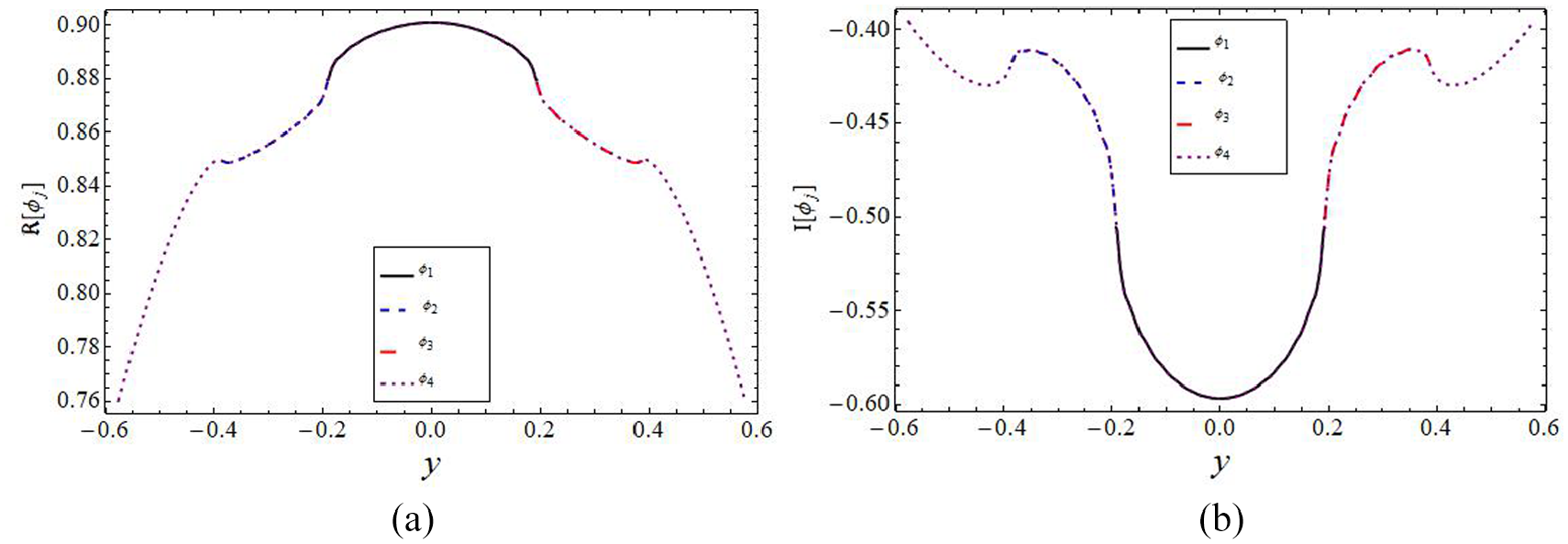
Validation of solution for non-dimensional real and imaginary pressures at interface, when N = 80,

Validation of solution for non-dimensional real and imaginary velocities at interface, when N = 80,

Comparison of mode-matching and low-frequency solutions in case of fundamental mode incident.
It is worthwhile to note that power distribution pattern in case of pin-jointed edges is quite similar to that of clamped edges. Therefore, the results for pin-jointed edges are not presented. A comparative description of the power propagating in different duct regions of the trifurcated duct is presented in tabular form for different incidence regions (Table 1).
Discontinuous trifurcated waveguide, when

Conclusion
Acoustic scattering in a trifurcated waveguide where the inlet and outlet ducts were described by the elastic plate and impedance boundary conditions was investigated with the help of MMT. The incident wave was allowed to enter the waveguide through the regions
Footnotes
Handling Editor: James Baldwin
Declaration of conflicting interests
The author(s) declared no potential conflicts of interest with respect to the research, authorship, and/or publication of this article.
Funding
The author(s) received no financial support for the research, authorship, and/or publication of this article.
