Theoretical and numerical investigation of the fluctuating mixed convection of hybrid nanofluid flow over a vertical Riga wedge is considered in this analysis. Two kinds of solid nanoparticles with base fluid at vertical Riga wedge is studied. Thermal and velocity slip impacts on vertical Riga wedge are investigated in the current study. We discussed both the unsteady and steady cases. The water has low thermal conductivity. We added the nanoparticle and which increases the thermal conductivity of the base fluid. This phenomena increase the heat transfer rate at the surface Riga plate. Partial differential equations are reduced into an ordinary differential equation by means of dimensionless similarity variables. The resulting ordinary differential equations are further solved through numerical and perturbation methods. Thickness of momentum boundary layer is reduced because of the solid nanoparticle rises in all cases of , , and. Our results are more agreeing with the decay results of Bachok et al. and Yacob et al. when rest of the physical parameters dimensions.
Heat transfer and boundary layer flow at vertical wedge have been considered much attention in recent days because of various physical applications of metallurgical and engineering, namely: plastic and metal extrusion, hot rolling, manufacturing of the fiberglass, crystal growing, wire drawing, manufacturing of paper and continuous casting. In the early time, Crane1 pioneered boundary layer flow caused by stretching the surface. Carragher and Crane2 highlighted that the temperature difference between the ambient fluid and surface was proportional to the power of the distance from the fixed point. The conduct of Newtonian nanofluids could be valuable in assessing the chance of heat transfer improvement in different procedures of these industries. Wu3 studied the boundary layer flow of water entry of twin wedges numerically. Micropolar fluid flow at convective stretching sheet discussed by Haq et al.4 Ramesh5 explored the results of slip effects with convective condition of peristaltic flow in a porous medium. Ramesh6 investigated the effects of inclined MHD in the inclined asymmetric channel. Gireesha et al.7 investigated the hall impacts with MHD nanofluid and also worked on irregular heat consumption/generation. Gireesha et al.8 discussed the impacts of hall and thermal radiation impacts at porous medium in the presence of suspension of fluid particles. Mahanthesh9 explored the influence of dusty liquid with hall effects at the stretching sheet. Gireesha et al.10 analyzed the hall effects on nanomaterial fluid at linear stretching sheet under the hall effects. Gireesha et al.11 examined the dusty fluid flow with hall impacts under the nonlinear radiation at the stretching plate. Shalini and Mahanthesh12 explained the nanomaterial dusty fluid with Rayleigh-Benard convection without/with Coriolis force. Recently, few investigators have discussed the behavior of fluid at various stretching surfaces under various assumptions at sheet see Ramesh et al.,13 Mahanthesh et al.14 and Wakif et al.15
Within the past few a protracted time, researchers have confronted a substantial issue of thermal efficiency in numerous engineering and industrial applications. Advance technology such as microfluidics, optical, chemical synthesis, high speed microelectronics, transportation, microsystems including electrical components and mechanical bears high thermal loads. In such days, cooling specific systems is a key problem. The rate of heat transfer is typically enhanced by adding the region accessible for heat transfer. A further approach is to use a thermally effective fluid, which is typically distributed inside traditional heat transfer fluids, such as water, propylene glycol, ethylene glycol, etc. Heat transfer is most important in these days due to an energy crisis in the whole world. Choi and Eastman16 was the first person who worked on nanofluid. He used the nanoparticle with base fluid like water, oil, and ethylene glycol. Before this idea, several authors analyzed the heat transfer rate enhancement. But Choi and Eastman16 achieved heat transfer rate more than two times as compared to conventional flow because low thermal conductivity. Lee et al.17 used the oxide nanoparticle. The properties of the nanofluid discussed by Das et al.18 They additionally brought a physically and chemically method for synthesizing nanofluids and also defined the methods for making a stable suspension of nanoparticles with the base fluids. They also analyzed the stagnation point flow at the convective stretching sheet. Mixed convection of nanomaterial fluid flow at porous wedge explored by Ellahi et al.19 Most interesting research has done by few authors on nanofluid in Ellahi et al.,19 Usman et al.,20 Sheikholeslami et al.,21 Ramesh and colleague,22,23 Zeeshan et al.,24 Liu et al.25
Hybrid nanofluid more important role in the heat transfer enhancement because of their lots of applications namely, biomedical, aselectronic cooling, defense, generator cooling, automobile radiators, nuclear system cooling, lubrication, coolant inmachining, welding, thermal storage, solar heating, cooling and heating in buildings, drug reduction and biomedical etc. At the mechanical level, there are positive highlights like chemical soundness and tall thermal efficiency, which empowers them to perform efficiently as compared to nanofluids. Furthermore, hybrid words were introduced by Suresh et al.26 He claimed that two different kinds of particles are used with fluid. He proved that the heat transfer rate enhancement was two times more than nanofluid. The experimental results of hybrid nanofluid explored by Suresh et al.26 and Labib et al.27 The turbulent flow of hybrid nanofluid analyzed at a low volume concentration by Sundar et al.28 Stagnation point flow of hybrid nanomaterial fluid flow explored by Nadeem et al.29 Slip effects of hybrid nanomaterial fluid flow at cylinder analyzed by Nadeem and Abbas.30 Several scientists are being researched the heat transfer of hybrid nanofluid for different physical assumptions reported in Nadeem and colleagues,31,32 Mahanthesh and colleagues,14,33 Nehad et al.34
Mixed convection of hybrid nanofluid flow dusty fluid over a vertical Riga wedge plate is considered. Mathematical model has been constructed on the assumptions of fluid flow. The partial differential equations have been converted into systems of ordinary differential equations using the suitable similarity transformations. Nonlinear ordinary differential equations are solved through perturbation scheme and numerically through BVP4C method. The solutions are deliberated for numerous physical parameters.
Mathematical formulations
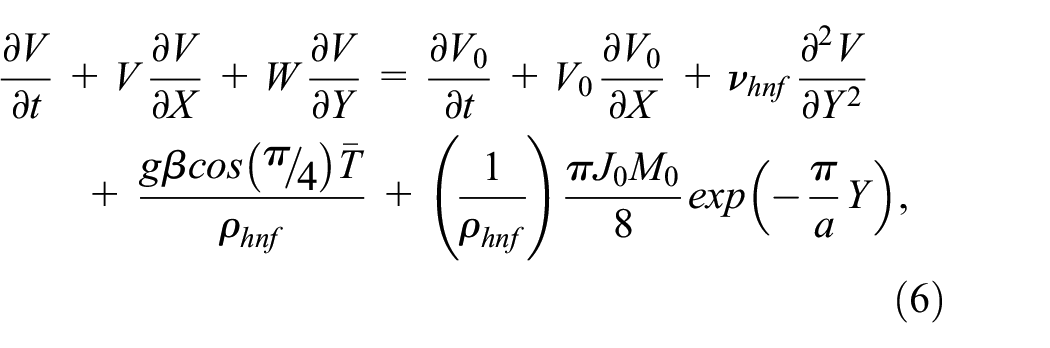
Consider the mixed convection fluctuating flow of hybrid nanofluid over a vertical Riga wedge in the presence of solid nanoparticle. The coordinate system and flow configuration reveals in Figure 1. The thermal and momentum boundary layer thickness is represented by and . It is considered that both the free stream and surface temperature present small amplitude oscillations in time about steady, non-zero free stream velocity and mean temperature. The electro-magneto-hydrodynamic applied on the vertical wedge see Wakif et al.15 Under the assumption and usual boundary layer approximation, the following mathematical system has been considered as below
Unsteady flow of hybrid nanofluid over wedge.
Where, the boundary conditions are as following
The coefficient of the volumetric expression for temperature expresses as , be the fre stream velocity, V and W be the of the fluid, , , and is the density, viscosity, thermal conductivity and heat capacity of hybrid nanofluid. Under these conditions, we combine the energy equations (3) and (6), momentum equations (2) and (5) for the two phases which we expressed as
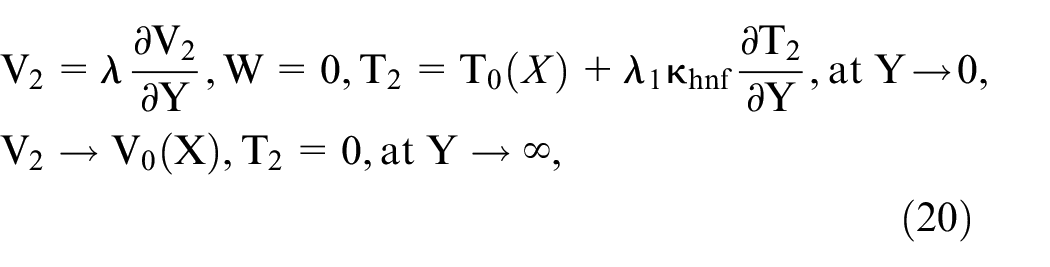
Corresponding boundary conditions are
Where
The mean surface temperature and mean velocity represent as and , is the amplitude of oscillation which is while the frequency of oscillation is
Solution procedure
On the behalf of the boundary conditions given in equation (9), we deliberate solutions of the equations (6–8) in the following form
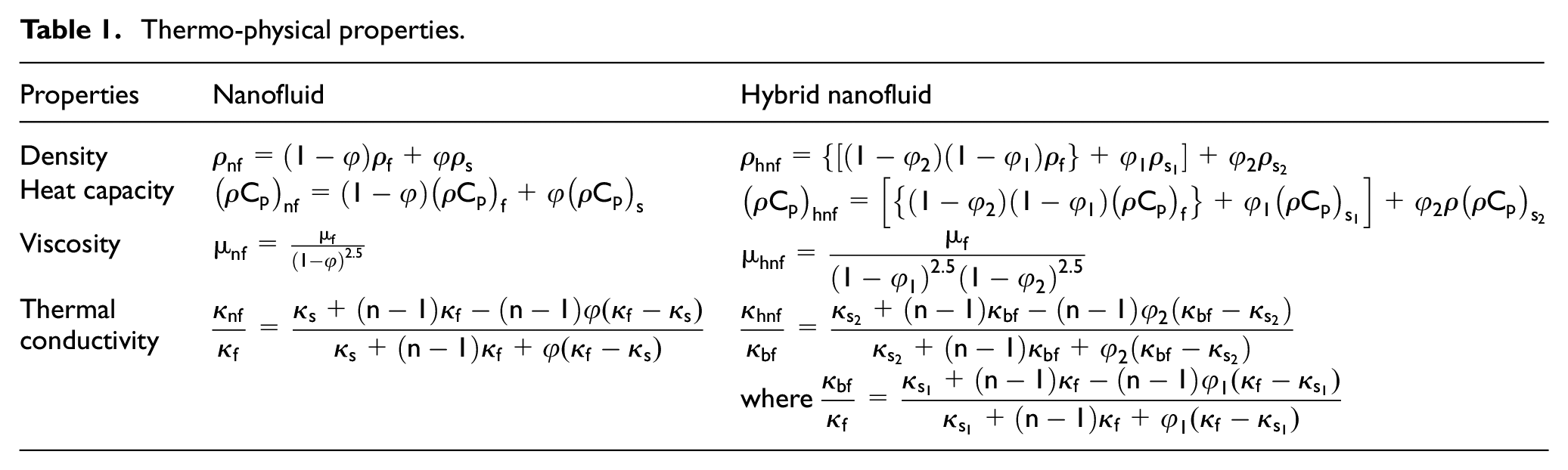
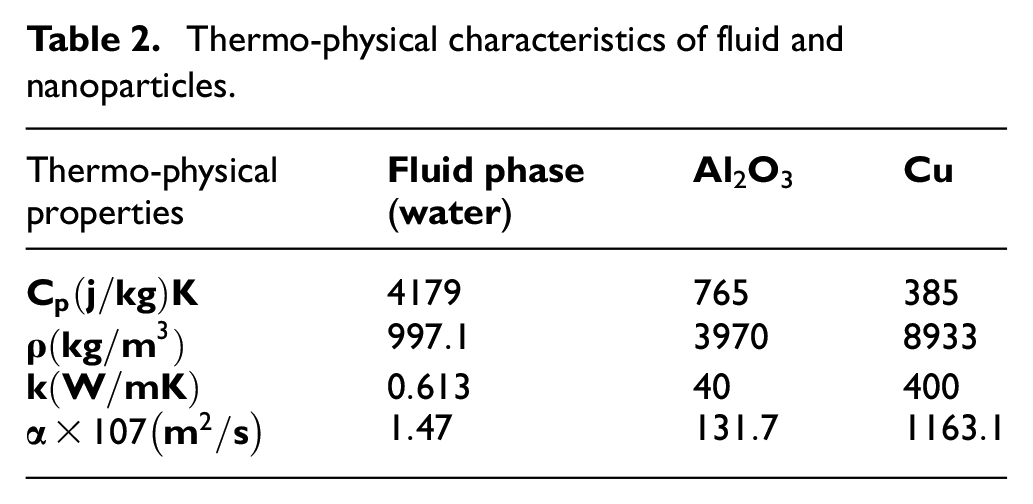
Where , are the fluctuating parts and , are the velocity components. , and , are the real and fluctuating part of the temperature function . The predictable solution functions are the real parts of the functions known in equation (10). The thermophysical properties are presented in Tables 1 and 2. After applying the equation (10) in equations (6–9) and getting the terms and conditions to , we obtained succeeding equations
Thermo-physical properties.
Properties
Nanofluid
Hybrid nanofluid
Density
Heat capacity
Viscosity
Thermalconductivity
where
Thermo-physical characteristics of fluid and nanoparticles.
Thermo-physicalproperties
Fluid phase(water)
Al2O3
40
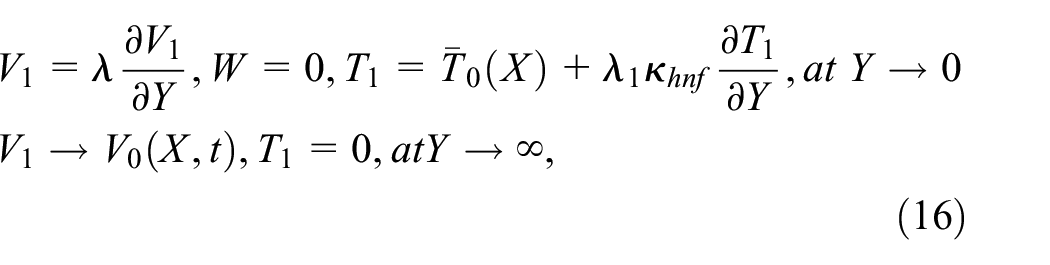
With the boundary conditions are
And
Relevant boundary conditions are
Now we consider functions and like as and while and are the constants. We introduced the similarity following transformations are
Where and are the stream function which satisfy the equations (11) and (15) correspondingly. The similarity and local frequency variables are and . By applying the similarity transformation equation (23) on equations (20–22), we get the dimensionless form
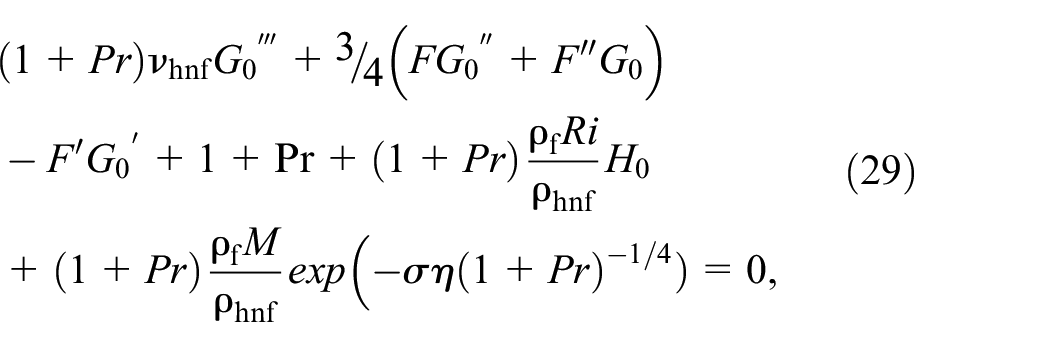
The steady part of the flow presented as follows
Respected boundary conditions
Perturbation solutions for small
To gain the impacts of mixed convection near the leading edge, the results based on the series ‘finite numbers of terms are only valid for the small frequency range’. So
Putting these values in equations (25–26), than equating the coefficients of
Respected boundary conditions are
Relevant boundary conditions are
Relevant boundary conditions are
Result and discussions
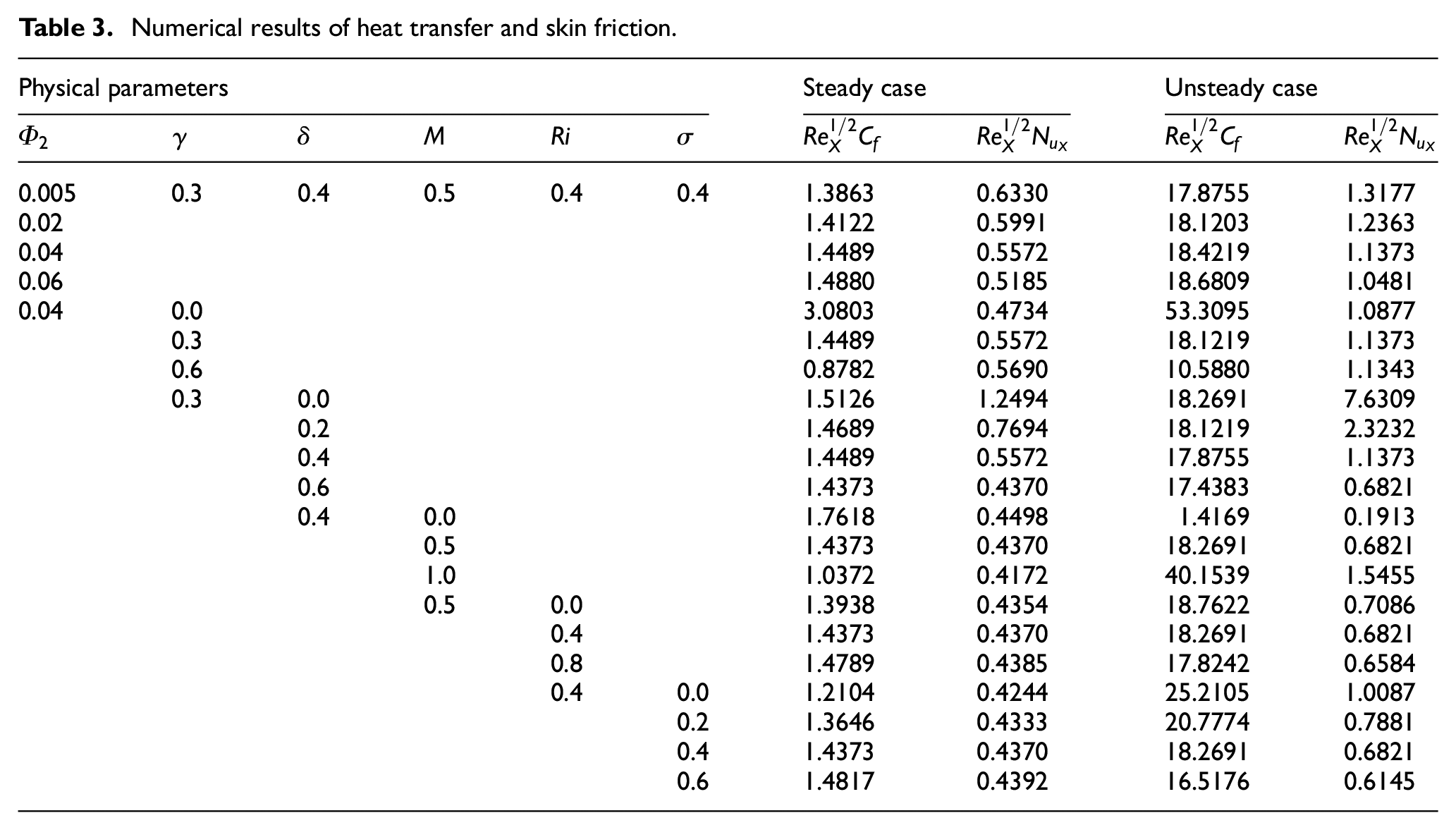
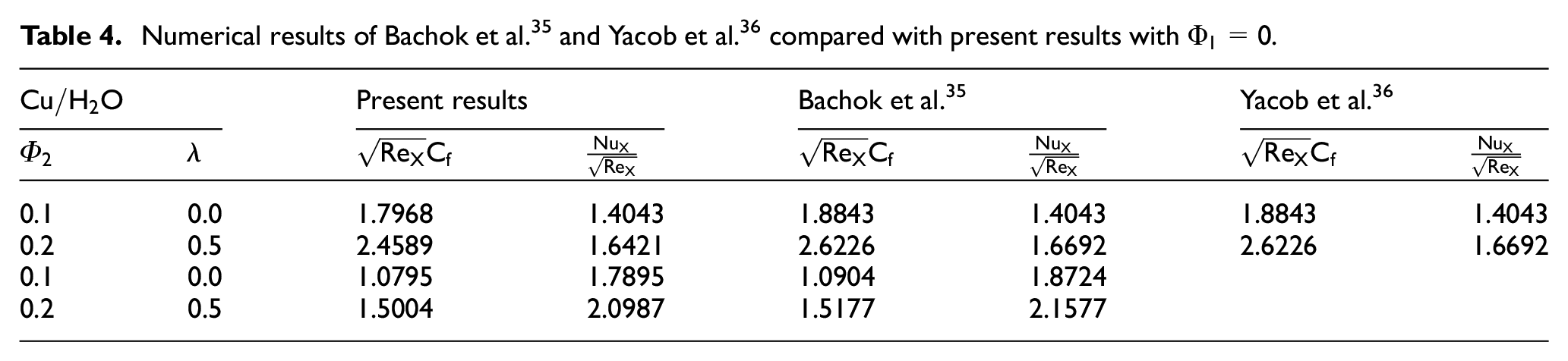
The influence of the physical parameters on the heat transfer and skin fraction is presented in Table 3. The skin fraction improved because of improving the solid nanoparticle. Heat transfer rate declines as well as solid nanoparticle enhances which reveals in Table 3. The heat transfer rate (Unsteady flow) achieve much higher than that of the (Steady flow) in case of the and . Skin friction reduces when the slip parameter rises. The thickness of momentum is reduced by cause of the enhancing velocity slip parameter. While the heat transfer improved with improving the velocity slip parameter. Because thickness of thermal boundary rises by cause of velocity slip enhances. Incase of , variation of the modified Hartman number on the skin friction and heat transfer revealed in Table 3. Skin friction reduces when the modified Hartman number rises. The thickness of momentum is reduced by cause of the enhancing modified Hartman number but opposite results are achieved for the . While the heat transfer reduced with improving the modified Hartman number because thickness of thermal boundary declines by cause of velocity slip enhances but opposite results are achieved for the . In case of , variation of the Richardson number on the skin friction and heat transfer revealed in Table 3. Skin friction improves when the Richardson number rises. The thickness of momentum is improves by cause of the enhancing Richardson number but opposite results are achieved for the . In case of , the heat transfer improved with improving the Richardson number because thickness of thermal boundary improves by cause of velocity slip enhances but opposite results are achieved for the . In case of , variation of the dimensionless number on the skin friction and heat transfer revealed in Table 3. Skin friction improves when the dimensionless number rises. The thickness of momentum improves by cause of the enhancing dimensionless number, but opposite results are achieved for the . In case of , the heat transfer improved with improving the dimensionless number because thickness of thermal boundary improves by cause of velocity slip enhances but opposite results are achieved for the . Impacts of the physical parameters on the modified Hartman number, thermal slip, velocity slip and solid nanoparticle on temperature gradient highlighted in Figures 2–5 for the various cases , , and . Figure 2 reveals the variation of thermal thickness and thermal slip. Results are achieved that thermal thickness reduced by cause of improving the thermal slip parameter for all cases of , , and . But in case of the thermal thickness reduced , and respecticly, as the values of enhances at the surface of Riga vertical wedge. Table 4 presents the comparative results of decay literature.
Numerical results of heat transfer and skin friction.
Physical parameters
Steady case
Unsteady case
0.005
0.3
0.4
0.5
0.4
0.4
1.3863
0.6330
17.8755
1.3177
0.02
1.4122
0.5991
18.1203
1.2363
0.04
1.4489
0.5572
18.4219
1.1373
0.06
1.4880
0.5185
18.6809
1.0481
0.04
0.0
3.0803
0.4734
53.3095
1.0877
0.3
1.4489
0.5572
18.1219
1.1373
0.6
0.8782
0.5690
10.5880
1.1343
0.3
0.0
1.5126
1.2494
18.2691
7.6309
0.2
1.4689
0.7694
18.1219
2.3232
0.4
1.4489
0.5572
17.8755
1.1373
0.6
1.4373
0.4370
17.4383
0.6821
0.4
0.0
1.7618
0.4498
1.4169
0.1913
0.5
1.4373
0.4370
18.2691
0.6821
1.0
1.0372
0.4172
40.1539
1.5455
0.5
0.0
1.3938
0.4354
18.7622
0.7086
0.4
1.4373
0.4370
18.2691
0.6821
0.8
1.4789
0.4385
17.8242
0.6584
0.4
0.0
1.2104
0.4244
25.2105
1.0087
0.2
1.3646
0.4333
20.7774
0.7881
0.4
1.4373
0.4370
18.2691
0.6821
0.6
1.4817
0.4392
16.5176
0.6145
Variation of thermal slip on temperature profile.
Variation of solid nanoparticles on temperature profile.
Variation of modified Hartman number on temperature profile.
Variation of solid nanoparticles on temperature profile.
Numerical results of Bachok et al.35 and Yacob et al.36 compared with present results with .
Figure 3 reveals the variation of thermal thickness and solid nanoparticle concentration . Results are achieved that thermal thickness rised by cause of improving the solid nanoparticle for all cases of , , and because thermal thickness increases due to enhancing the thermal conductivity of the fluid increases. When the solid nanoparticles added in the base fluid which enhances the thermal conductivity. But in case of the thermal thickness improved , and respecticly, as the values of enhances at the surface of Riga vertical wedge. Figure 4 reveals the variation of thermal thickness and modified Hartman number. Results are achieved that thermal thickness rised by cause of improving the modified Hartman number for all cases of , , and . But in case of the thermal thickness improved , and respecticly, as the values of enhances at the surface of Riga vertical wedge. This phenomena exist due to Lorentz forces which explained physically. The electromagnetic forces worked as opposite along to the motion of fluid as drag-like forces which successful extents are rotting exponentially along the y axis. Figure 5 reveals the variation of thermal thickness and velocity slip. Results are achieved that thermal thickness reduced by cause of improving the velocity slip parameter for all cases of , , and . But in case of the thermal thickness reduced , and respecticly, as the values of enhances at the surface of Riga vertical wedge. Impacts of the physical parameters on the modified Hartman number, thermal slip, velocity slip and solid nanoparticle on the velocity distribution highlighted in Figures 6–9 for the various cases , , and. Variation of the thermal slip and velocity profile presented in Figure 6. Thickness of momentum reduced by cause of the thermal slip rises in all cases of , , and. Momentum thickness decreases by cause of enhancing the values of . Variation of the velocity slip and velocity profile presented in Figure 7. Thickness of momentum improved by cause of the velocity slip rises in all cases of ., , and . Momentum thickness decreases by cause of enhancing the values of . Variation of the solid nanoparticle and velocity profile presented in Figure 8. Thickness of momentum reduced by cause of the solid nanoparticle rises in all cases of ., , and . because thermal thickness increases due to enhancing the thermal conductivity of the fluid increases. Momentum thickness decreases by cause of enhancing the values of . Variation of the modified Hartman number and velocity profile presented in Figure 9. Thickness of momentum improved by cause of the modified Hartman number rises in all cases of , , and . Momentum thickness decreases by cause of enhancing the values of .
Variation of thermal slip on velocity profile.
Variation of velocity slip on velocity profile.
Variation of modified Hartman number on velocity profile.
Variation of solid nanoparticles on velocity profile.
Final remarks
We considered the mixed convection fluctuating flow of hybrid nanofluid over a vertical Riga wedge. Major effects of the physical parameters on the temperature, velocity, heat transfer and skin friction on the Riga vertical wedge are highlighted as below:
The thickness of momentum is reduced by cause of the enhancing velocity slip parameter while the heat transfer improved with improving the velocity slip parameter.
In case of , the heat transfer improved with improving the Richardson number because thickness of thermal boundary improves by cause of velocity slip enhances but opposite results are achieved for the .
Momentum thickness decreases by cause of enhancing the values of (, and ).
Thickness of momentum reduced by cause of the solid nanoparticle rises in all cases of , , and .
Our results are more agreeing with the decay results of Bachok et al.35 and Yacob et al.36 when and rest of the physical parameters dimensions.
Footnotes
Appendix
Handling Editor: James Baldwin
Declaration of conflicting interests
The author(s) declared no potential conflicts of interest with respect to the research, authorship, and/or publication of this article.
Funding
The author(s) received no financial support for the research, authorship, and/or publication of this article.
ORCID iD
Nadeem Abbas
References
1.
CraneLJ. Flow past a stretching plate. Zeitschrift für angewandte Mathematik und Physik1970; 21: 645–647.
2.
CarragherPCraneLJ. Heat transfer on a continuous stretching sheet. Zeitschrift für angewandte Mathematik und Physik1982; 62: 564–565.
3.
WuGX. Numerical simulation of water entry of twin wedges. J Fluids Struct2006; 22: 99–108.
4.
HaqRUNadeemSAkbarNS, et al. Buoyancy and radiation effect on stagnation point flow of micropolar nanofluid along a vertically convective stretching surface. IEEE Trans Nanotechnol2015; 14: 42–50.
5.
RameshK. Effects of slip and convective conditions on the peristaltic flow of couple stress fluid in an asymmetric channel through porous medium. Comput Methods Programs Biomed2016; 135: 1–14.
6.
RameshK. Influence of heat and mass transfer on peristaltic flow of a couple stress fluid through porous medium in the presence of inclined magnetic field in an inclined asymmetric channel. J Mol Liq2016; 219: 256–271.
7.
GireeshaBJMahantheshBGorlaRSR, et al. Thermal radiation and Hall effects on boundary layer flow past a non-isothermal stretching surface embedded in porous medium with non-uniform heat source/sink and fluid-particle suspension. Heat Mass Transf2016; 52: 897–911.
8.
GireeshaBJMahantheshBKrupalakshmiKL. Hall effect on two-phase radiated flow of magneto-dusty-nanoliquid with irregular heat generation/consumption. Results Phys2017; 7: 4340–4348.
9.
MahantheshB. Hall effect on two-phase laminar boundary layer flow of dusty liquid due to stretching of an elastic flat sheet. Mapana J Sci2017; 16: 13–26.
10.
GireeshaBJMahantheshBThammannaGT, et al. Hall effects on dusty nanofluid two-phase transient flow past a stretching sheet using KVL model. J Mol Liq2018; 256: 139–147.
11.
GireeshaBJMahantheshBMakindeOD, et al. Effects of Hall current on transient flow of dusty fluid with nonlinear radiation past a convectively heated stretching plate. Defect Diffus Forum2018; 387: 352–363.
12.
ShaliniGMahantheshB. Rayleigh-Benard convection in a dusty Newtonian nanofluid with and without coriolis force. J Nanofluids2018; 7: 1240–1246.
13.
RameshKTripathiDBégOA, et al. Slip and hall current effects on Jeffrey fluid suspension flow in a peristaltic hydromagnetic blood micropump. Iranian J Sci Technol Trans Mech Eng2019; 43: 675–692.
14.
MahantheshBShashikumarNSGireeshaBJ, et al. Effectiveness of Hall current and exponential heat source on unsteady heat transport of dusty TiO2-EO nanoliquid with nonlinear radiative heat. J Comput Des Eng2019; 6: 551–561.
15.
WakifAChamkhaAAnimasaunIL, et al. Novel physical insights into the thermodynamic irreversibilities within dissipative EMHD fluid flows past over a moving horizontal riga plate in the coexistence of wall suction and joule heating effects: a comprehensive numerical investigation. Arab J Sci Eng. Epub ahead of print 25 July 2020. DOI: 10.1007/s13369-020-04757-3.
16.
ChoiSUEastmanJA. Enhancing thermal conductivity of fluids with nanoparticles (No. ANL/MSD/CP-84938; CONF-951135-29). Lemont, IL: Argonne National Laboratory, 1995.
17.
LeeSChoiSSLiSA, et al. Measuring thermal conductivity of fluids containing oxide nanoparticles. J Heat Transfer1999; 121: 280–289.
18.
DasSKChoiSUYuW, et al. Nanofluids: science and technology. US: John Wiley & Sons, 2007.
19.
EllahiRHassanMZeeshanA. Aggregation effects on water base Al2O3—nanofluid over permeable wedge in mixed convection. Asia Pac J Chem Eng2016; 11: 179–186.
20.
UsmanMHamidMZubairT, et al. Cu-Al2O3/Water hybrid nanofluid through a permeable surface in the presence of nonlinear radiation and variable thermal conductivity via LSM. Int J Heat Mass Transf2018; 126: 1347–1356.
21.
SheikholeslamiMLiZShamlooeiM. Nanofluid MHD natural convection through a porous complex shaped cavity considering thermal radiation. Phys Lett A2018; 382: 1615–1632.
22.
RameshK. Effects of viscous dissipation and Joule heating on the Couette and Poiseuille flows of a Jeffrey fluid with slip boundary conditions. Propul Power Res2018; 7: 329–341.
23.
RameshKTripathiDBégOA. Cilia-assisted hydromagnetic pumping of biorheological couple stress fluids. Propul Power Res2019; 8: 221–233.
24.
ZeeshanAShehzadNAbbasT, et al. Effects of radiative electro-magnetohydrodynamics diminishing internal energy of pressure-driven flow of titanium dioxide-water nanofluid due to entropy generation. Entropy2019; 21: 236.
25.
LiuHAnimasaunILShahNA, et al. Further discussion on the significance of quartic autocatalysis on the dynamics of water conveying 47 nm alumina and 29 nm cupric nanoparticles. Arab J Sci Eng2020; 45: 5977–6004.
26.
SureshSVenkitarajKPSelvakumarP, et al. Effect of Al2O3–Cu/water hybrid nanofluid in heat transfer. Exp Therm Fluid Sci2012; 38: 54–60.
27.
LabibMNNineMJAfriantoH, et al. Numerical investigation on effect of base fluids and hybrid nanofluid in forced convective heat transfer. Int J Therm Sci2013; 71: 163–171.
28.
SundarLSSousaACSinghMK. Heat transfer enhancement of low volume concentration of carbon nanotube-Fe3O4/water hybrid nanofluids in a tube with twisted tape inserts under turbulent flow. J Therm Sci Eng Appl2015; 7: 021015.
29.
NadeemSAbbasNKhanAU. Characteristics of three dimensional stagnation point flow of Hybrid nanofluid past a circular cylinder. Results Phys2018; 8: 829–835.
30.
NadeemSAbbasN. On both MHD and slip effect in Micropolar Hybrid nanofluid past a circular cylinder under stagnation point region. Can J Phys2018; 97: 392–399.
NadeemSHayatTKhanAU. Numerical study on 3D rotating hybrid SWCNT-MWCNT flow over a convectively heated stretching surface with heat generation/absorption. Phys Scr2019; 94: 075202.
33.
MahantheshBShehzadSAAmbreenT, et al. Significance of Joule heating and viscous heating on heat transport of MoS2–Ag hybrid nanofluid past an isothermal wedge. J Therm Anal Calorim. Epub ahead of print 23 March 2020. DOI: 10.1007/s10973-020-09578-y.
34.
NehadASAnimasaunILWakifA, et al. Significance of suction and dual stretching on the dynamics of various hybrid nanofluids: comparative analysis between type I and type II models. Phys Scr2020; 95: 095205.
35.
BachokNIshakAPopI. Stagnation-point flow over a stretching/shrinking sheet in a nanofluid. Nanoscale Res Lett2011; 6: 623.
36.
YacobNAIshakAPopI. Falkner–Skan problem for a static or moving wedge in nanofluids. Int J Therm Sci2011; 50: 133–139.