



Abstract
Scientists are primarily interested in artificial neural networks because of their wide range of modeling and analytical applications. Data networks are often developed using artificial neural networks, one of the taught learning algorithms, which optimizes the error between real and predicted values. Because they can handle enormous information and represent complicated systems, artificial neural networks have a wide range of applications across many areas. The objective of the present work is to investigates the continuous, incompressible hybrid nanofluid motion through a nonlinear extending sheet with the impact of the magnetic field, activation energy, heat radiation, Maxwell velocity slip, and Smoluchowski thermal slip. The Runge-Kutta-Fehlberg 4th 5th order and shooting technique are employed to solve the governing equations once they have been transformed into ordinary differential equations, utilizing the proper similarity variables. The consequence of non-dimensional parameters concerning their profiles is examined using graphs. And the primary results are, the velocity profile falls as the Maxwell velocity slip parameter rises. As the Smoluchowski temperature parameter increases, the temperature profile will drop as the radiation parameter enhances, the temperature profile rises as well, as the reaction rate parameter increases, the concentration falls, and the concentration profile rises as the activation energy parameter is improved. The actual and predicted data for the power index, magnetic field parameter, activation energy parameter, Radiation parameter, and reaction rate for all ranges of values are similar when applying a wavelet neural network.
Keywords
Introduction
The accuracy and efficacy of research in the field of nanofluids (NFs) have been significantly enhanced by the emergence of artificial intelligence as a transformative instrument. The complex character of NFs under changing flow and thermal conditions may be precisely described by artificial intelligence through the use of neural networks. NFs systems often exhibit nonlinear and multi-parameter interactions that are difficult for traditional analytical techniques to handle. Thermal conductivity, viscosity, and the rate of heat transfer may be more accurately estimated by researchers by employing artificial intelligence-driven methods like deep learning and optimization strategies. These predictive abilities are particularly helpful for increasing the efficiency of NFs for uses like advanced manufacturing, cooling mechanisms, and solar energy collectors. Ali et al. 1 probed the computational simulation of magnetohydrodynamic (MHD) Tangent Hyperbolic Fluid through a vertically extending surface using an artificial neural network. Casson fluid flows through an unstable radially extending sheet with the influence of Soret and Dufour and was modeled using artificial neural networks studied by Srinivasacharya and Kumar. 2 Khan and Ahmed Khan 3 probed the consequences of a machine-learning technique using artificial neural networks for the computational evaluation of tri-hybrid NFs circulation produced via an extended sheet. Kavitha et al. 4 evaluated the computational modeling of HMT utilizing an artificial neural network via a porous stretched sheet. Rehman et al. 5 explored an artificial neural network technique to model and estimate heat transmission performance in bioconvection flow across a circular cylinder.
Over the previous years, NFs challenges have rapidly grown in scope. It has shown to be an attractive heat transfer fluid despite some disparity in the reported results and a lack of insight into the process of heat transmission in NFs. Choi and Eastman 6 invented the idea of NFs, which are particles composed of nanoparticles and a base liquid. With diameters essentially less than 100 nm, nanoparticles have thermal conductivities that are often an order of magnitude greater than those of the basic liquids. Hybrid NFs are mixtures of various nanoparticles in base fluids. There are now more advanced kinds of NFs, such as “hybrid NFs,” which have higher heat conductivity than NFs. Electronic cooling process, welding, lubrication, storage of thermal energy, solar heating, cooling and heating in buildings, biomedical research, drug diminution, space aircraft, and ships are just a few of the many applications for hybrid NFs. Anjum et al. 7 probed the computational investigation of a rotating hybrid NFs circulation via an extended sheet with nonlinear thermal radiation and heat generation/absorption effects. Munir and Turabi 8 evaluated the consequences of a hybrid nanofluid and a heated wavy wall on natural convection in a triangle enclosure with a cold cylinder embedded under an inclined magnetic field. Imran et al. 9 probed the transmission of heat estimation in a hybrid NFs flowing curvilinearly through an extended surface with the influence of nonlinear heat radiation. Sireesha et al. 10 analyzed the transmission of heat with the motion of ternary, hybrid, and nanofluids across a three-dimensional stretched sheet in a variety of configurations, including spherical, platelet, and cylindrical. Sunitha et al. 11 probed the numerical analysis of ternary hybrid NFs Circulation via Convergent/Divergent Channels under Pollutant Concentration. Yasmin 12 examined MHD rotatory hybrid NFs circulation across an extended sheet with gyrotactic microorganisms using numerical analysis of heat and mass transport.
The study of fluid behavior in an electrically conductive environment is the focus of the field of MHD. The investigation of MHD movement in an electrically conducting fluid is important for metallurgy and the metalworking industry operations. Due to its numerous uses in engineering issues including MHD generators, nuclear power plants, plasma investigations, and geothermal energy extraction, this type of flow problem has attracted a lot of researchers. Munir et al. 13 examined the impact of the uniform/non-uniform temperature walls for the analysis of the thermal enhancement and flow dynamics in lid-driven staggered cavities. Turabi et al. 14 probed double-diffusive natural convection and entropy production in an asymmetrical cavity with a Casson hybrid nanofluid flow via two embedded circular cylinders. Choudhary et al. 15 probed the influences of gyrostatic microbes and heat radiation on time-dependent hybrid NFs across a non-linear extended sheet with the consequence of a magnetic field and porous medium. Ahmad et al. 16 studied the analysis of the magnetohydrodynamics double-diffusive natural convection in a cavity with non-uniform heated walls. Williamson MHD micropolar fluid circulation via a non-linearly extended sheet with irregular heat production/absorption was probed by Mishra et al. 17 Sarma et al. 18 examined how the magnetohydrodynamics, microorganisms, activation energy, Cattaneo-Christov mass, and heat flux affected the motion of Williamson fluid via an extended lubrication surface with partial sliding. Ahmed et al. 19 probed the consequence of irregular radiation in oblique stagnation point circulation of non-Newtonian fluids through a symmetrically extending surface with the influence of a magnetic field.
Thermal radiation is an electromagnetic radiation that is created when matter’s particles move thermally. As with electric burners and room heaters, these radiations truly travel as electromagnetic waves. Knowledge of the radiative transfer of heat becomes crucial for the design of the relevant equipment since numerous procedures in emerging engineering fields take place at high temperatures. Examples of these technical fields include nuclear energy plants, gas turbine engines, and several propulsion systems for satellites, spacecraft, missiles, and airplanes. It is quite difficult to investigate how radiation affects different kinds of flows. Several scientists have investigated the consequences of heat radiation on radiated fluids’ boundary layer through a non-linear extending sheet in recent years. Gamaoun et al. 20 studied the effects of heat radiation and varying density of NFs heat transmission over a stretched sheet in a magnetic field by employing the Keller Box method. Gangadhar et al. 21 scrutinized how convective boundary conditions, viscous dissipation, binary chemical processes, and heat radiation affected the three-dimensional flow of Williamson fluid via the Riga plate. Madhukesh et al. 22 probed the influence of heat radiation on the aggregation of magnetized nanoparticles across a Riga plate in NFs circulation. Alrehili 23 evaluated the motion of a Carreau NFs fluid across a nonlinearly stretched sheet in addition to heat radiation. Rupa Lavanya et al. 24 studied the influence of thermal radiation and chemical reaction in an Oldroyd-B liquid flow via a rotating disc with space- and temperature related heat rise. Pandey et al. 25 evaluated irregular radiation and non-linear mixed convection in a Newtonian circulation on a vertical sheet that is non-linearly extending. Gangadhar et al. 26 examined the homogeneous-heterogeneous chemical reaction to nonlinear heat radiation of Maxwell-fluid flow via spiraling discs by using regularized machine learning and numerical techniques.
The activation energy (A-E) is the smallest quantity of energy required by reacting chemicals to forecast a chemical reaction. The difference in type concentration in a mixture causes the mass transmission phenomena. From areas of high concentration to areas of lower concentration, the kinds that can change the concentration in a mixture flow. The chemical engineering sector, the manufacturing of food, fluid mechanics, petroleum emulsions, and geothermal reservoirs these are all benefit greatly from the A-E. Maxwell NFs circulation across a permeable extending sheet with Arrhenius A-E, and yield boundary conditions (BCs) was researched by Jawad et al. 27 Micropolar NFs circulation over an extending sheet with A-E, magnetic field, porous medium, heat radiation, and Hall current was numerically analyzed by Shamshuddin et al. 28 The characteristics of tri-hybrid NFs motion through a thin extending sheet that involves melting heat transport and non-uniform heat production are analyzed by Abbas et al. 29 Ramesh et al. 30 assessed the A-E and heat source/sink of magnetized NFs circulation via a lubricated surface. Muhammad and Haider 31 probed the Reiner-Rivlin NF’s unsteady motion across a stretched sheet using a binary chemical process and Arrhenius A-E.
Maxwell provided the concept for the most basic explanation of velocity slip phenomena, which depends on the creep component and the velocity gradient operating normally to the surface. Smoluchowski subsequently introduces the idea of temperature slip phenomena. Smoluchowski asserts that the heat flow behaves normally about the surface. Smoluchowski temperature slip and Maxwell velocity slip have applications in aerodynamics and sophisticated systems for cooling. Khan et al. 32 probed Agrawal NFs flow with Maxwell velocity slip BCs and Smoluchowski temperature approaches a stagnation point across a moving disk. Khan et al. 33 examined the efficacy of Smoluchowski thermal slip and Maxwell velocity boundaries when an irregular heat source is present. Sarkar and Mandal 34 evaluated the impact of the porous medium, Smoluchowski temperature, and Maxwell velocity slip on quadratic radiative Casson hybrid NFs circulation across an exponentially extending Riga surface. Khan et al. 35 examined the Smoluchowski temperature and Maxwell velocity slip BCs for the motion of NFs via a permeable moveable disk caused by renewable solar radiation. The consequences of Maxwell velocity slip and Smoluchowski temperature on magneto-radiative tri-hybrid NFs circulation across shrinking surfaces were probed by Mandal. 36
The ability of non-linear stretching sheets to simulate surface stretching phenomena makes them essential in many different industries. In conjunction with the influence of heat radiation, magnetic fields, and slip BCs, these systems help forecast and enhance performance in the following areas: bioengineering, medical devices (drug delivery and circulation simulation), metallurgical processes (casting, metallic material rolling, cooling, and electromagnetic control), technologies for cooling (nuclear power plants and microelectronics), and the extrusion process of polymer (fiber rotating and film casting).
Studying the consequences of A-E, Smoluchowski thermal slip, and Maxwell velocity slip on hybrid NFs flow via a non-linear extending sheet is the main objective of the investigation. To the best of the information, this work has not yet been looked into. The present study examined the influences of magnetic field, A-E, heat radiation, Maxwell velocity slip, and Smoluchowski thermal slip on the steady, incompressible hybrid NFs flow through a non-linear stretching sheet to fulfill this research gap. The RKF-45 and shooting technique are employed to solve the governing equations once they have been transformed into ordinary differential equations using the proper similarity variables. With the use of graphs, the important non-dimension parameters are examined. The utilization of artificial neural network techniques (Wavelet neural networks) is also presented in the current work.
Mathematical analysis of the flow problem
Consider the steady, 2D, incompressible hybrid NFs circulation across a non-linear stretching sheet in addition to A-E, thermal radiation, and magnetic fields into account. And also considered the Maxwell velocity slip and Smoluchowski temperature slip BCs. Here,

Geometry of the flow problem.
Governing equations are (see Ali et al., 37 Rana and Bhargava, 38 Khan et al. 39 ),




The relevant BCs are as follows (see Hady et al. 40 ):

From the equation (5) at
The radiative heat flux
And,
Here,
Suitable similarity transformations are

Equation (1) is identically satisfied, and is the simplified version of equations (2)–(4) following



Reduced BCs are,

The thermophysical characteristics of Hybrid NFs are (see Khan et al. 39 ),

Where,
Here,

From the equations (7) to (10), non-dimension parameters are,

Engineering coefficients
The Sherwood number

Where,
The following is equation (13) in its simplified form,
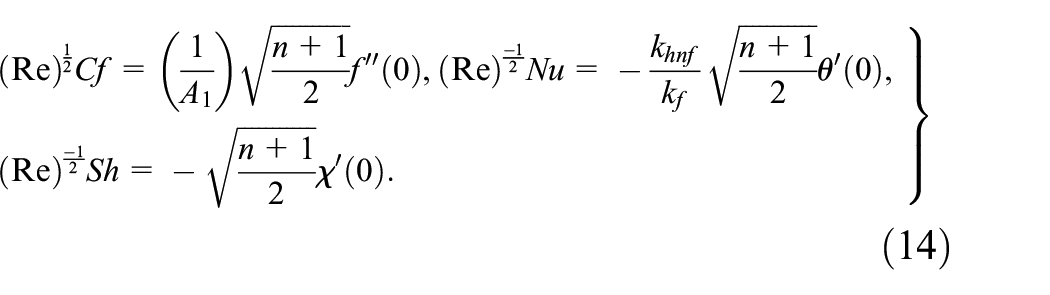
Here, Reynold’s number is
Numerical technique
RKF-45 order method is employed to solve the BCs (10) and the consequent equations (7)–(9). However, the solutions to these equations are higher-order equations. It is essential to create additional variables in the first order to solve the equations and ensure stability and accuracy.
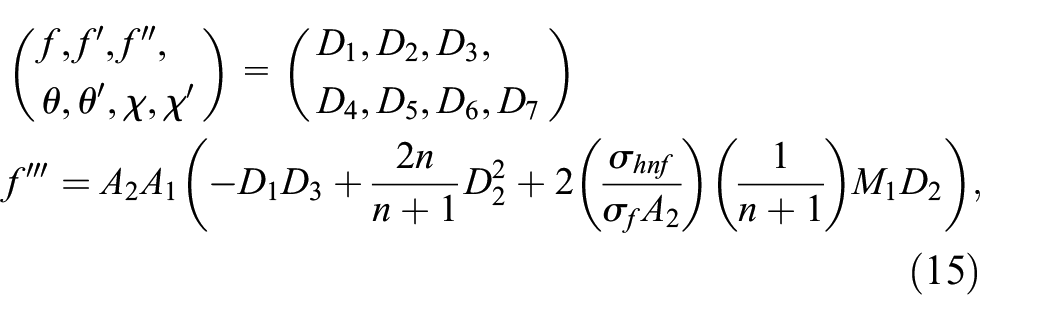


With,

The Runge-Kutta-Felhberg-45 method is utilized to solve computationally the transformed equations (15)–(17) and BCs (18). The shooting approach is used for obtaining the unknowns in the BCs (18). Additionally, the step size and error tolerance are 0.0001 and 10-6, respectively. Average computation time for obtaining the solution is about 0.457 s on Intel i7 processor, 16 GB RAM. A comparison of the numerical values of
The validation of values of


Results and discussion
The steady, incompressible, hybrid NFs flow via a non-linear stretching sheet with the consequences of a magnetic field, thermal radiation, and A-E was numerically solved in the present investigation. Additionally, the BCs for Smoluchowski thermal slip and Maxwell velocity slip were taken into account. Graph estimation is utilized to determine the primary parameters influencing the flow system.
Figure 3 illustrates the way the

Impact of
Figure 4 demonstrates how the velocity profile is impacted by the Maxwell velocity slip parameter. A higher value of the Maxwell velocity slip parameter results in a lower velocity profile. Physically, the velocity drops as the Maxwell velocity slip parameter increases. This is happening because a lower velocity gradient at the boundary results from the slip condition, which allows the fluid to circulate with greater freedom at the interface.

Impact of Maxwell velocity slip parameter
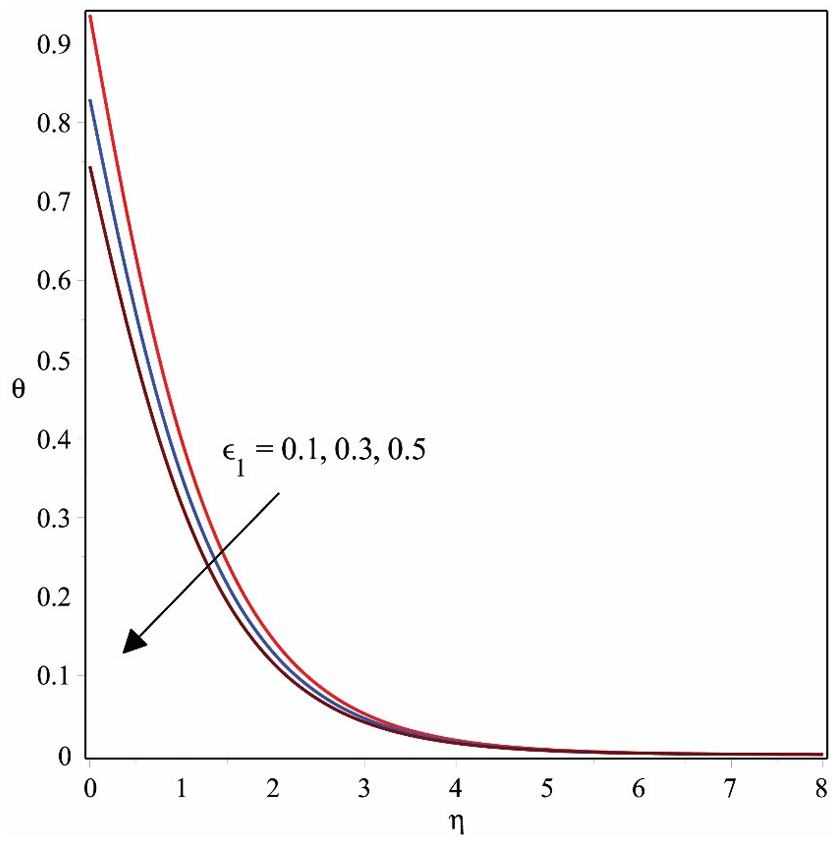
The consequence of the Smoluchowski temperature parameter on the temperature profile is seen in Figure 5. As the Smoluchowski temperature parameter escalates, the temperature profile is going to decrease. Physically, the Smoluchowski temperature slip condition may have an impact on the fluid’s overall temperature distribution. As moves away from the boundary, the temperature tends to drop more quickly, a phenomenon known as the depreciation of the temperature profile. This is due to the temperature slip condition reduction of the boundary’s effective temperature gradient, which lowers the heat flow.
Impact of Smoluchowski temperature parameter
The consequence of the radiation parameter on the temperature profile can be observed in Figure 6. As the

Impact of radiation parameter
The concentration curve for different

Impact of Schmidt number
The influence of the reaction rate parameter on the

Impact of reaction rate parameter
The impacts of the temperature difference parameter on the

Impact of temperature difference parameter
Figure 10 shows the consequence of the A-E parameter on

Impact of A-E parameter
Application of artificial neural network (ANN): Wavelet neural networks
Combining wavelet analysis for multi-resolution signal decomposition with artificial neural networks for nonlinear modeling, wavelet neural networks provide improved performance in heat transfer, fluid dynamics, and related fields. Wavelet functions enhance feature extraction, computational efficiency, and prediction accuracy in a variety of applications by incorporating them into neural network layers and utilizing multi-resolution analysis. An input layer, a wavelet layer, and an output layer form a standard Wavelet neural network. The Wavelet Neural Networks’ geometry is displayed in Figure 11.

Geometry of the wavelet neural networks.
The correlation outputs of
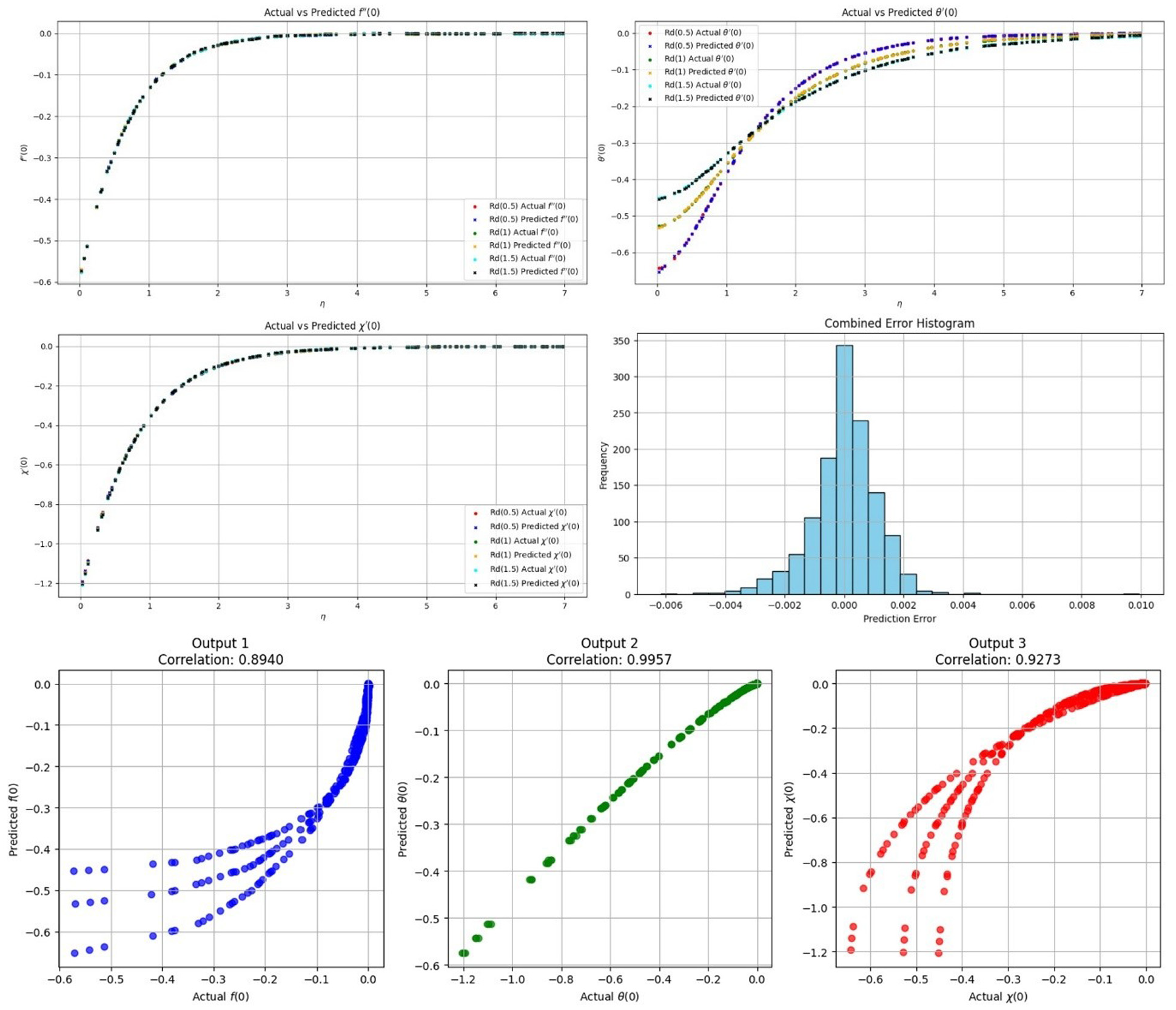
Graphical representation of predicted and actual data of

Graphical representation of predicted and actual data of
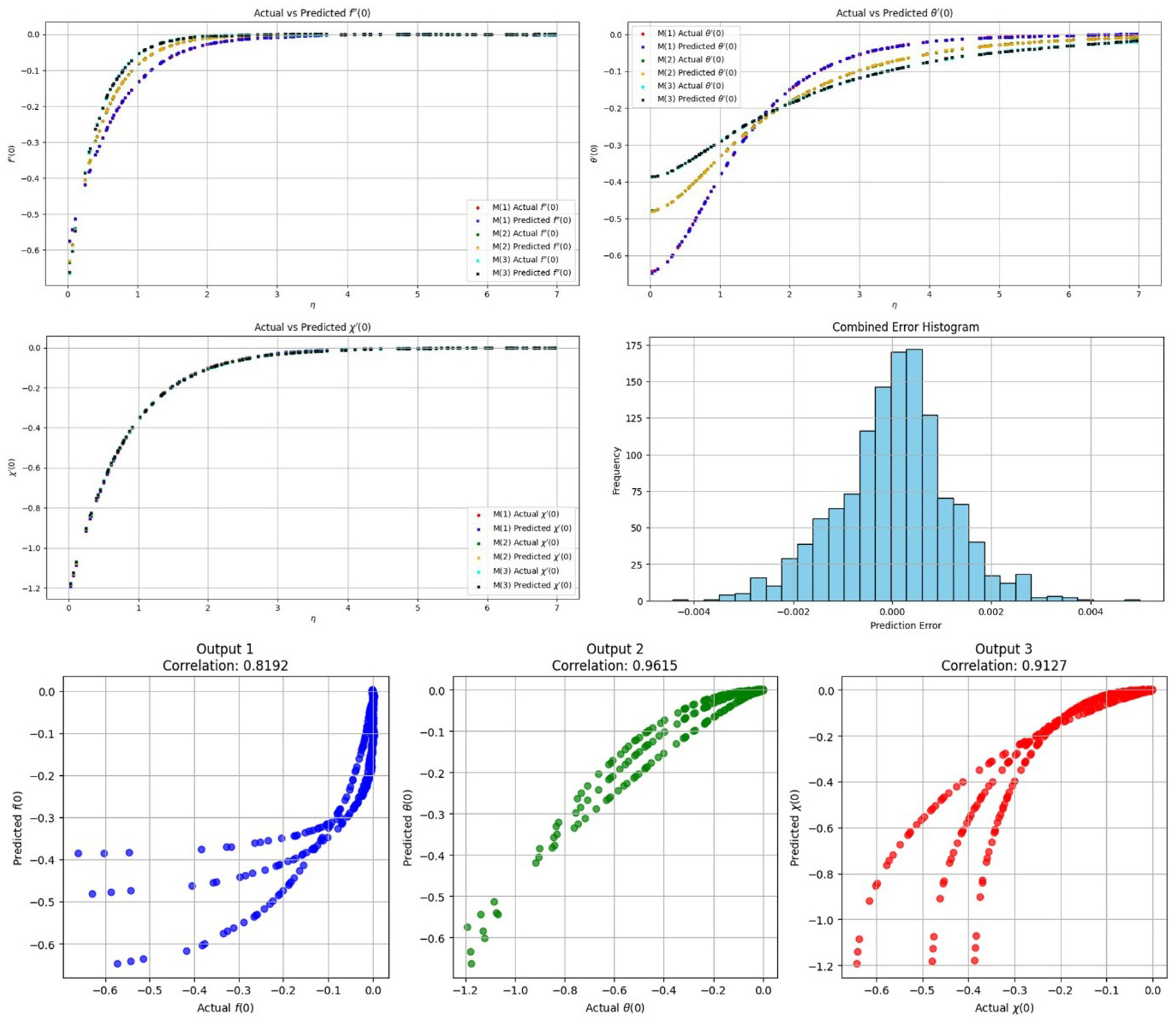
Graphical representation of predicted and actual data of

Graphical representation of predicted and actual data of
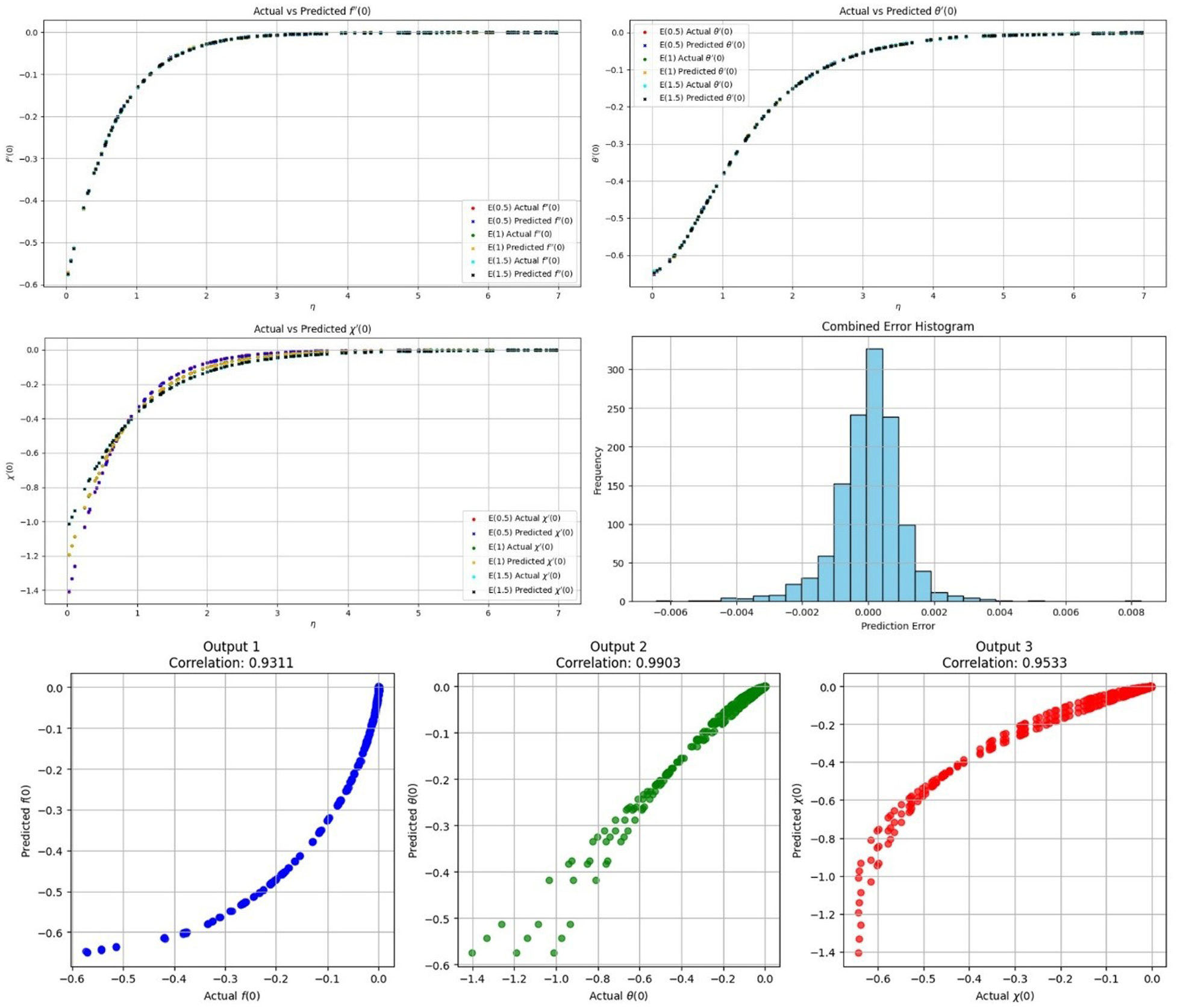
Graphical representation of predicted and actual data of
Conclusion
The current study assumes that the hybrid NFs flow is via a non-linear extending sheet and is described by incompressible and steady behavior with the consequences of activation energy, magnetic field, heat radiation, Maxwell velocity slip, and Smoluchowski thermal slip. Ordinary differential equations obtained from the system’s reducing partial differential equations are then calculated employing the RKF-45 and Shooting technique. Graphical representations of the impacts of several dimensionless characteristics on their profiles are provided. Among the investigation’s significant conclusions are,
➢ The actual and predicted data for the power index, magnetic field parameter, activation energy parameter, Radiation parameter, and reaction rate are similar for all ranges of values when applying a wavelet neural network.
➢ As the magnetic field parameter rises, the velocity profile will fall.
➢ The velocity profile reduces as the Maxwell velocity slip parameter rises.
➢ The temperature profile will drop as the Smoluchowski temperature parameter escalates.
➢ The temperature profile grows with the increment in radiation parameter.
➢ The concentration profile diminishes as the temperature difference parameter is enhanced.
➢ Concentration decreases as the reaction rate parameter rises.
➢ Enhancing the activation energy parameter leads the concentration profile to increase.
There are numerous real-world uses for hybrid nanofluid flow across a non-linear expanding sheet with the consequences of activation energy, Smoluchowski thermal slip, and Maxwell velocity slip in a variety of domains. Includes manufacturing sectors, energy, and transportation. Optimized heat transmission, improved material processing, and increased control at small scales are all made possible by designing systems with consideration for these boundary phenomena. These outcomes are becoming more and more important in technological advancements.
This work is limited to analyzing the influence of thermal radiation, magnetic field, activation energy, and Maxwell and Smoluchowski thermal slip in hybrid nanofluid flow via a non-linear stretching sheet. The current study can be developed by looking into distinct momentum, temperature, and concentration effects along with different boundary constraints, different kinds of nanofluids (both Newtonian and non-Newtonian), different kinds of nanoparticles, various thermofluids models, different kinds of computational techniques, and artificial neural networks.
Footnotes
Appendix
Acknowledgements
Princess Nourah bint Abdulrahman University Researchers Supporting Project number (PNURSP2025R908), Princess Nourah bint Abdulrahman University, Riyadh, Saudi Arabia.
Handling Editor: Oluwole Makinde

Author contributions
K.V; N.N: Conceptualization, Methodology, Software, Formal analysis, Validation, Writing – original draft. R.K; N.P: Writing – original draft, Data curation, Investigation, Visualization, Validation. U.K: Conceptualization, Writing – original draft, Writing – review & editing, Supervision, Resources. J.A.B; J.K.M: Validation, Investigation, Writing – review & editing, Formal analysis; Project administration; Funding acquisition, software.
Funding
The authors disclosed receipt of the following financial support for the research, authorship, and/or publication of this article: The authors extend their appreciation to the support received from Princess Nourah bint Abdulrahman University Researchers Supporting Project number (PNURSP2025R908), Princess Nourah bint Abdulrahman University, Riyadh, Saudi Arabia.
Declaration of conflicting interests
The authors declared no potential conflicts of interest with respect to the research, authorship, and/or publication of this article.
Data availability statement
The datasets used and/or analyzed during the current study are available from the corresponding author upon reasonable request.