




Abstract
The stratification phenomena have great importance in fishery management, insufficiency of dissolved oxygen in the lower parts of lakes, rivers and ponds, and phytoplankton populations. Thus the present article examines vital role of stratification phenomena in Powell-Eyring fluid flow due to inclined sheet which is stretched in a linear way. Collaboration of Cattaneo-Christov heat and mass flux model instead of Fourier Law of heat conduction is also accounted. Interpretation of heat transport is carried out with heat generation/absorption. Thermal stratification supports heat transport. Chemical reaction and solutal stratification also helped out mass transport. Non-linear governing equations with partial derivatives are converted into ordinary differential equation with the help of similarity transformations. Homotopic method is applied to solve arising dimensionless governing equations. Pertinent parameters and their physical behavior are displayed graphically. Drag force coefficient is also examined graphically. In culmination, substantial parameters of radiation and heat generation/absorption raised the temperature field while thermal relaxation time and solutal relaxation time parameters lower the temperature and concentration fields, respectively.
Keywords
Introduction
There are very useful applications of heat transfer phenomena like heat conduction in tissues and drugs, cooling in nuclear reactor etc. In the past emphasis has been given on the use of Fourier Law of heat conduction for heat exchange and Fick’s law for mass diffusion although the anomaly occurred in these laws is ignored. Law of heat conduction yields parabolic equation which means that any incipient transition is felt instantly all around the whole object. To overcome this bug Cattaneo introduced a thermal relaxation time factor in which propagated thermal waves are made to transfer heat at low speed. Later on Christov gave more improvement to this law. Farooq et al. 1 have considered squeezed flow in a porous medium to analyze Cattaneo-Christov model. Dogonchi and Ganji 2 considered nanofluid MHD flow to analyze Cattaneo-Christov heat flux between parallel plates. Hayat et al. 3 used heat and mass diffusivity theory of Cattaneo-Christov model in 3D nanofluid flow. Hashim and Khan 4 have discussed the flow of Carreau fluid over a slandering sheet by considering the Cattaneo-Christov model. Hayat et al. 5 explained stretching flow in the presence of stratification and Cattaneo-Christov heat flux. Ijaz and Ayub 6 discussed the modified model of fluxes in stratified flow of Walter-B fluid with activation energy. Shah et al. 7 described the modified heat flux features in stagnation flow deformed by Riga sheet considering mixed convection. Khan et al. 8 explored the stagnation flow of Carreau liquid under the Cattaneo-Christov theory.
In engineering and industrial applications non-Newtonian fluid possesses practical and fundamental importance. Non-Newtonian fluids play significant role in nuclear slurries, plasma, paper coating, polymers, mercury, etc., these fluids have non-linear relationship between shear stress and strain rate. Food products, inks, glues, soaps, shampoos, paints, etc., are other few examples of non-Newtonian fluids. In 1944, Powell and Eyring 9 two scientists introduced a non-Newtonian fluid model which is derived from kinetic theory of gases instead of empirical formula and one of the advantages of Powell-Eyring fluid model is, it acts like a viscous fluid at high shear rate. Hayat et al. 10 have applied non-Fourier heat flux theory on Powell-Eyring fluid flow. Hayat and Nadeem 11 considered exponentially stretching sheet over Powell-Eyring fluid flow. Rehman et al. 12 considered inclined stretching cylinder for the analysis of Powell-Eyring fluid flow with heat generation/absorption. Upadhay and Raju 13 utilized heat and mass fluxes conditions in the flow of Powell-Eyring fluid. Hayat et al. 14 used variable thermal conductivity in Powell-Eyring fluid flow. Jayachandra Babu et al. 15 have considered porous medium to analyze Eyring-Powell nanofluid flow induced by a cone. Ogunseye and Sibanda 16 investigated Eyring-Powell fluid flow deformed by a catalytic surface due to paraboloid revolution. Seyedi et al. 17 discussed the Darcian flow of Powell-Eyring nanoliquid with entropy generation. Waqas et al. 18 depicted the chemically reactive flow of hydromagneto Powell-Eyring fluid caused by stretching phenomenon. Abegunrin et al. 19 explored the radiative and magnetic dipole features in Powell-Eyring nanoliquid with activation energy.
Convection, conduction and radiation are three sources of the heat transference. The collective fundamental of mixed convection and thermal radiation has great importance in science and technology especially in medical science. Radiations are used in the treatment of cancer, to kill bacteria and viruses, in microwave oven, to sterilize food stuffs and electromagnetic radiation in cell phone is some of the applications of radiation. Sulochana et al. 20 analyzed fluid flow due to rotating cone in the presence of radiation. Ahmad et al. 21 exposed radiation and chemical reaction properties in Sutterby fluid flow. Hayat et al. 22 addressed Carreau fluid to check the thermal radiation influence in the presence of chemical reaction. Soomro et al. 23 analyzed radiation effects on nanofluid flow with heat absorption/generation. Akbar et al. 24 elaborated the effects of radiation on nanofluid flow with stagnation point. Qayyum et al. 25 have given analysis of thermal radiation in third grade fluid flow with Newtonian conditions. Bhatti et al. 26 explained the irreversibility in radiative nanofluid flow caused by stretching surface. Ramzan et al. 27 disclosed the radiation phenomenon in MHD stratified CNT nanofluid flow. Khan et al. 28 discussed the radiative flow of non-Newtonian nanofluid with magnetic dipole effect.
Five novel aspects are there in our present research. Firstly Powell-Eyring fluid flow is applied by inclined stretching sheet. Secondly, we analyzed heat and mass transfer via modified Fourier’s and Fick’s laws namely Cattaneo-Christov model along with dual stratification (nonlinear). Thirdly heat transfer is also helped out with radiation. Fourthly Heat and mass transfer is carried out with chemical reaction and heat generation/absorption. Fifthly to find out solution of convergent series homotopic analysis method29–33 is used and arising dominating parameters are discussed by plots. Features of skin friction are also elaborated through graph.
Thermal radiation plays a very dominant role in the heat transfer especially when heat transfer through convection is very low. Its applications exist in space vehicles, satellites, missiles, aircrafts, nuclear plants, gas turbines, manufacturing designs, etc. In the abovementioned studies, no one has attempted the study of radiative Powell-Eyring fluid on two dimensional flows with nonlinear stratification over stretchable inclined surface with the combination of Cattaneo-Christov model. Presence of heat absorption/generation and first order chemical reaction can also be visualized here. Hence to fill this breach is our main theme.
Mathematical modeling
We consider Powell-Eyring fluid (steady and incompressible) flow persuaded by linearly stretchable sheet which makes an angle



with the boundary conditions

In above expressions

(a) Flow geometry. h-curves for
Implementing the transformations

Equation (1) becomes zero identically, whereas equations (2)–(4) are as follows:

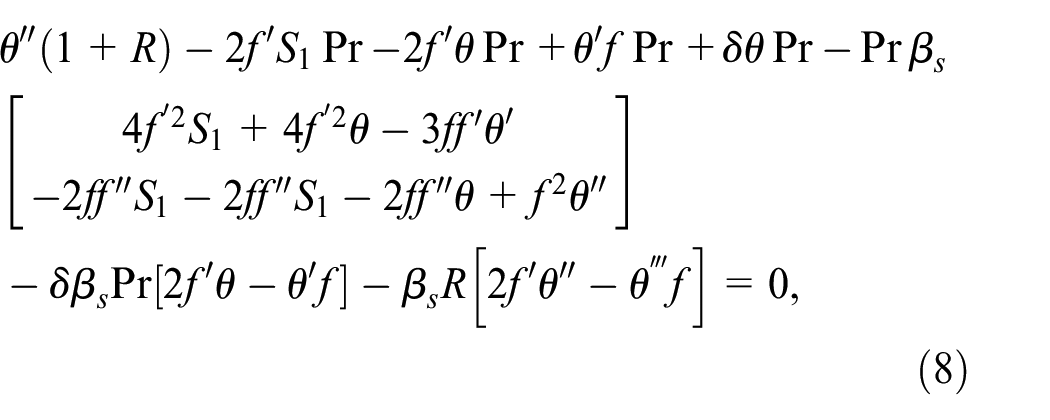

The corresponding dimensionless boundary conditions

where

Surface drag force is as follows:

where wall shear stress is,

above equation after using equations (6), (13), and (12) reduced to

Reynolds number is represented by
Homotopic solutions
To find out the solutions of governing equations we have adopted homotopy analysis method introduced by Liao.32,33 It has many advantages over other methods. Firstly it provides liberty to select initial guesses and linear operators. Secondly non-linear equations (weak or strong) frequently can be solved by this method. Thirdly it is independent of small or large parameters. The initial guesses are:



Supporting linear operators are:

which satisfy the specified properties



where
Zeroth-order problems


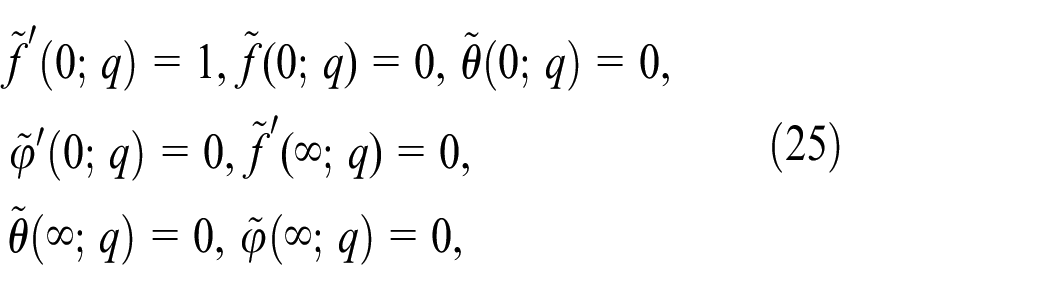


Auxiliary parameters
th order problems





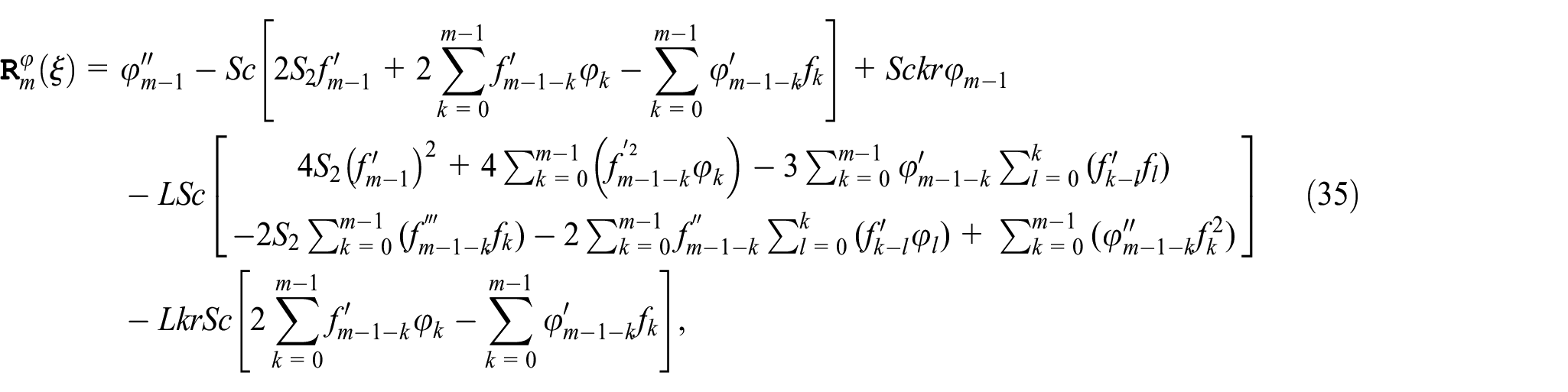

For


and



The appropriate solutions



Convergence analysis
To find the convergent series solution we’ve adopted
Discussion
Function of velocity, concentration, and temperature distributions are in elaborated this section. Figure 2 demonstrates the reaction of thermal buoyancy parameter

Analysis of

Analysis of

Analysis of
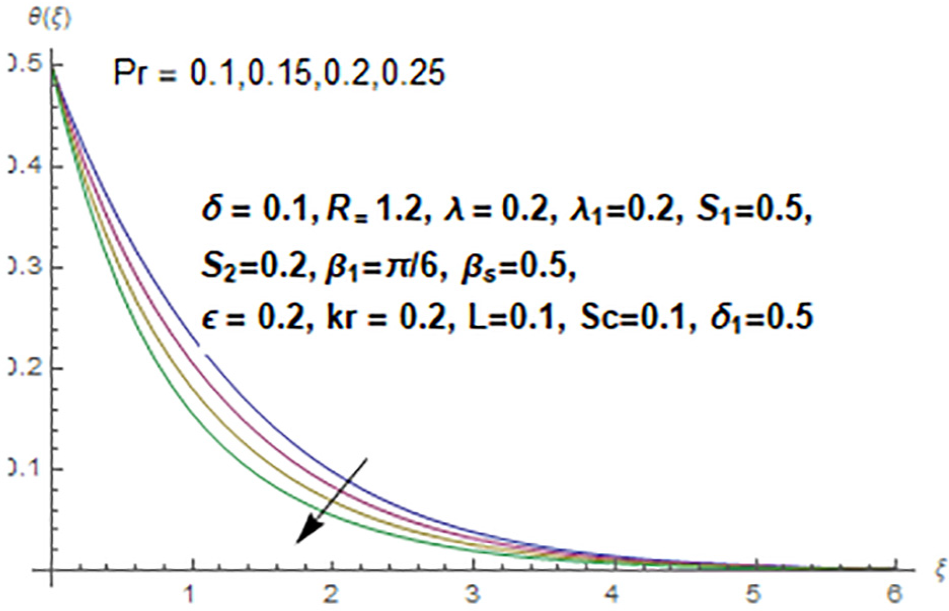
Analysis of

Analysis of

Analysis of

Analysis of
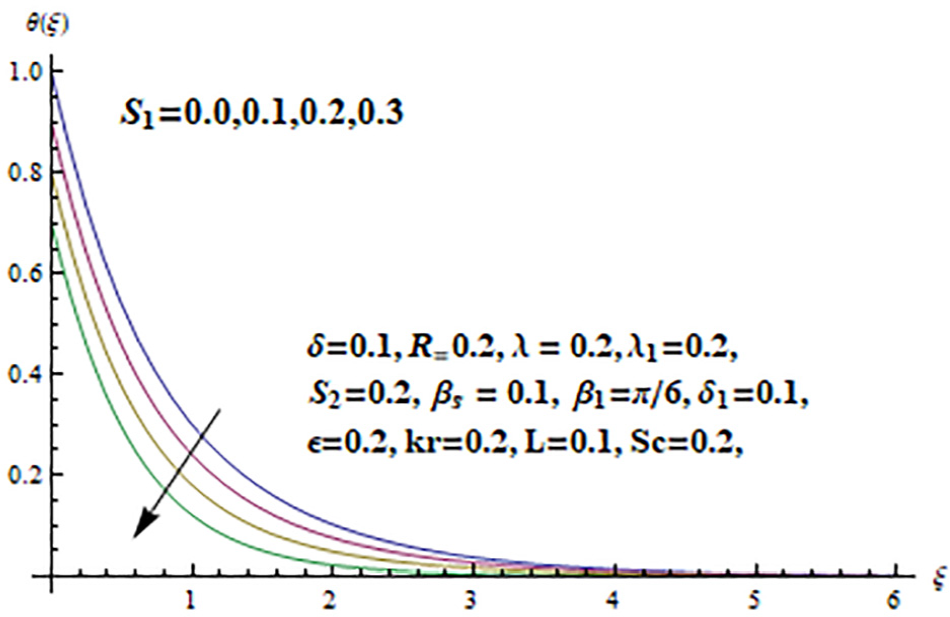
Analysis of
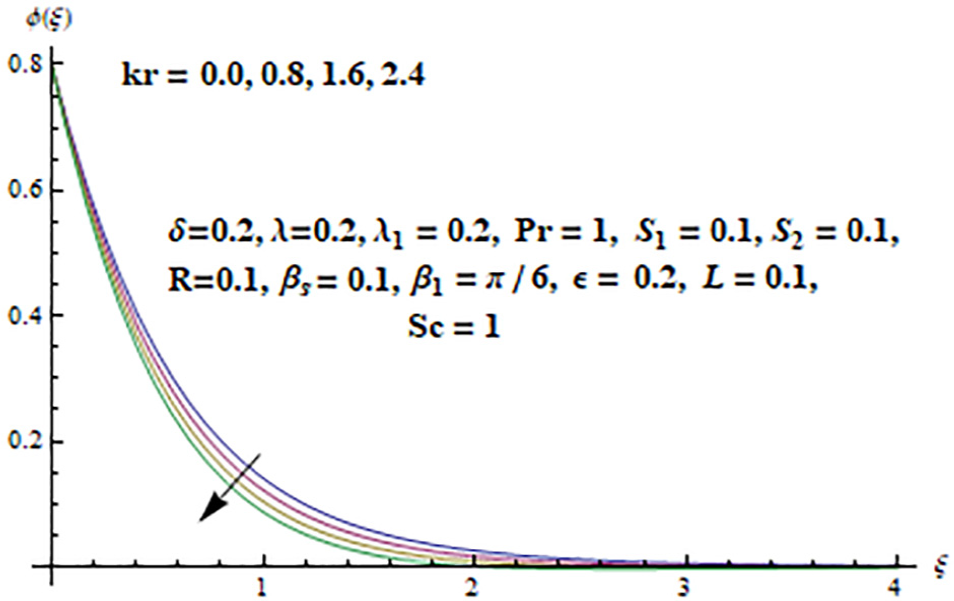
Analysis of

Analysis of
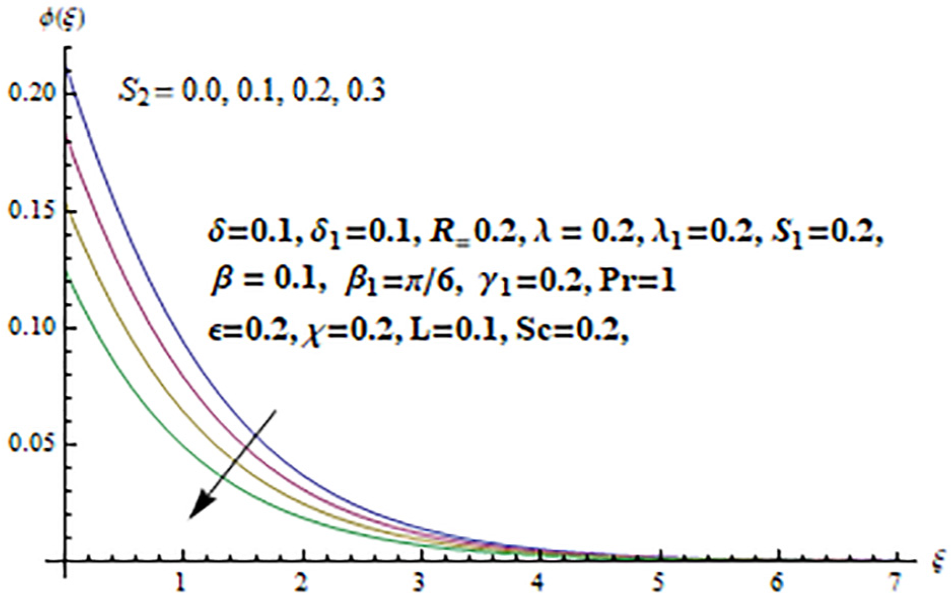
Analysis of

Analysis of

Analysis of

Streams lines.
Summary
In current investigation phenomena of radiation and quadratic stratification with heat generation/absorption in Powell-Eyring fluid flow deformed by inclined sheet is described. With Cattaneo-Christov heat and mass flux conditions whole problem is analyzed and declared. The salient features are:
Angle of inclination executes gain in velocity field because of higher rate of transfer of heat.
Radiation parameter concludes raise in temperature field due to higher heat flux on surface.
Heat generation/absorption results increased temperature profile because of heat generation.
Thermal relaxation time parameter results decrement in temperature field.
Increment of solutal relaxation time parameter declares decrement of concentration field.
Thermal and solutal stratified parameters accordingly lessen the temperature and concentration fields.
Chemical reaction parameter lowers the concentration field.
Footnotes
Appendix 1
Handling Editor: James Baldwin
Author’s note
Muhammad Farooq is now affiliated with Department of Pure and Applied Mathematics, University of Haripur, Haripur, KPK, Pakistan.
Declaration of conflicting interests
The author(s) declared no potential conflicts of interest with respect to the research, authorship, and/or publication of this article.
Funding
The author(s) received no financial support for the research, authorship, and/or publication of this article.
