In real life applications, summer and winter stratifications prevent the fluid from mixing. This phenomenon has great impact on the phytoplankton (algae) populations, fisheries management and water supply quality, deficiency of dissolved oxygen in the lower region of ponds, lakes and rivers. Thus, our main moto in this article is to highlight the features of mixed convection in Powell–Eyring fluid deformed by an inclined stretchable sheet. Characteristics of heat transfer are exposed via thermal stratification. The solutal stratification and chemical reaction of first order are accounted to elaborate the nature of mass transfer. The coupled non-linear equations with ordinary derivatives are acquired after utilizing suitable transformation. The homotopic approach is adopted to accomplish the convergent series solution. Analysis of various emerging parameters on the fluid’s temperature, velocity and concentration fields is elaborated through graphs. Surface drag, Sherwood and Nusselt numbers are studied through graphical data corresponding to numerous parameters. In conclusion, dominant solutal and thermal stratified parameters are responsible for reduction of concentration and temperature fields, respectively, which enables us to prevent the formation of fluid layers with different density regions.
In recent past, non-Newtonian fluids have attracted the researchers and engineers due to its diverse nature. These fluids are comprehensive and have more practical significance. Due to wide spread applications of these fluid, researchers and investigators utilize many constitutive equations in the literature. Some industrial materials such as melts, mud’s, condensed milk, emulsions, soaps, shampoos, molten plastics, food stuffs, paste, and polymeric liquids, nuclear fuel slurries, plasma and mercury, paper coating are the examples of these fluids. Among non-Newtonian fluid models, Powell–Eyring fluid model is one which is capable of predicting the shear thickening and shear thinning phenomena. Different physical aspects of flows of such fluids in the light of practical applications have been examined by researchers. Rahimi et al.1 has studied Eyring-Powell fluid flow over a stretching sheet. Hayat et al.2 examined the magnetohydrodynamic Powell–Eyring nanoliquid over a non-linear thicked stretchable sheet. Qayyum et al.3 examined the behaviour of Powell–Eyring magneto-nanomaterial flow characterized via Newtonian heating and convection. Khan et al.4 studied the mixed convection and magnetic field effects on Powell–Eyring nanoliquid flow over an inclined surface. Hayat et al.5 presented stratification effects on chemically reactive flow of Powell–Eyring fluid by implementing non-Fourier heat flux.
Stratification belongs to variation of density field, which appears due to variation of temperature and concentration differences. In other words, double stratification occurs when variation in densities occurs due to change in temperature and concentration of the fluid flow. The variation in the density of atmosphere can effect the motion of air and water. Stratification is a significant research area and so many scientists used this phenomena in pertaining heat and mass transport processes. In this direction, Ahmad et al.6 disclosed dual stratification in mixed convection radiative flow of sutterby fluid with chemical reaction. Rehman et al.7 have explained stratification phenomena in chemically reactive fluid flow with ohmic heating. Hayat et al.8 exposed features of thermal conductivity on dual stratified fluid flow deformed by stretchable surface. Kandasamy et al.9 depicted magnetohydrodynamic flow of dual stratified nanoliquid past through a plate having pores. Rehman et al.10 addressed the properties of heat source (or sink) on convective flow of Powell–Eyring fluid through inclined shrinking cylinder with double stratification.
Features of chemical reaction have various applications in the field of engineering and technology such applications involve in a glass manufacturing industry, food processing, polymer processing and chemical industries. Moreover, in this regard, most studies are accounted to emphasize for exposing the effect of warming (or cooling) over mobile surfaces and often experience in various processes. Sulochana et al.11 discussed the effects of chemical reaction on mixed convection radiative flow of Casson nanoliquid through porous inclined plate. Hayat et al.12 described chemically reactive non-Newtonian fluid flowing numerical procedure. Hayat et al.13 explored the features of modified Fourier law in dual stratified flow with variable fluid property and chemical reaction. Hayat et al.14 exposed the chemically reactive Powell–Eyring fluid flow using Cattaneo–Christov model. Hayat et al.15 disclosed the effect of mixed convection on chemically reactive fluid flow through stretchable surface in stagnation point region.
Stratification has great importance in our daily life as mixing efficiency of fluid particles is especially important in oceangraphy, management of fisheries, rivers, lakes and ponds. Researchers paid their attention to explore the features of Newtonian and non-Newtonian fluids with prescribed surface temperature, Newtonian heating and convective boundary conditions. However, in view of the above applications of stratification phenomenon in real life, we elaborate convective heat and mass transfer at the boundary with thermal and solutal stratification phenomena. These phenomena cannot be neglected at the surface and inside the boundary layer. Hence, our main theme is to fill this gap with non-Newtonian (Powell–Eyring) fluid. Characteristics of mass and heat are explored via double stratification and chemical reaction. Homotopic technique16–20 is implemented to solve the obtained non-linear coupled ordinary differential equations. Effects of different physical parameters of interest are discussed in detail through graphs. Features of skin friction, Sherwood and Nusselt numbers are elaborated comprehensively through graphs.
Mathematical modelling
We consider steady and incompressible fluid flow of Powell–Eyring deformed by linearly stretchable sheet. Sheet makes an angle of inclination with the horizontal. Due to inclined sheet, mixed convection phenomena is considered. Convective heat and mass transfer conditions are implemented to elaborate the features of combined mass and heat phenomena. Variable temperature and concentration are implemented within the heated fluid and surrounding fluid in order to account the thermal and solutal stratifications. Destructive and constructive chemical reactions are incorporated to elaborate the behaviour of mass transfer. The constitutive governing equations for the flow after boundary layer approximations are21
with the boundary conditions
where
In equations (2)–(6), u and v respectively denote velocity components in x- and y-directions, represents stretching velocity, is free stream velocity, represents fluid kinematic viscosity, represents density, the heated fluid temperature of fluid, the variable ambient fluid temperature, g is the gravitational acceleration, the variable concentration of heated fluid, the variable ambient concentration, the coefficient of thermal expansion, and are material parameters, represents angle of inclination, the coefficient of mass expansion, chemical reaction coefficient, is specific heat of the fluid, and are the heat and mass transfer coefficients, D is diffusion species coefficient, and represent reference temperature and concentration, respectively, k represents thermal conductivity, , and represent dimensional constants.
We define
Equation (1) reduces to identically zero, whereas other governing equations are as follows
The corresponding dimensionless boundary conditions
where Sc represents Schmidt number, Prandtl number is represented by , and represent the dimensionless material parameters, kr represents chemical reaction parameter, is thermal Biot number, is solutal Biot number, is thermal buoyancy parameter, is solutal buoyancy parameter, and represent solutal and thermal stratified parameter, respectively, and is an angle of inclination. These quantities can be expressed as follows
Surface drag force, local Nusselt and Sherwood number are as follows
Homotopy analysis method was developed by Liao,22,23 which is utilized to obtain analytical solutions of non-linear ordinary and partial differential equations. This technique is useful for solving weak and strong non-linear mathematical problems. It is preferred because (1) it ensures the series convergence, (2) it is independent of small and large parameters and (3) it provides great freedom to choose the base function and linear operator. The initiatory guesses and supporting linear operators are
which satisfy the specified properties
where are the optional constants.
Zeroth-order problems
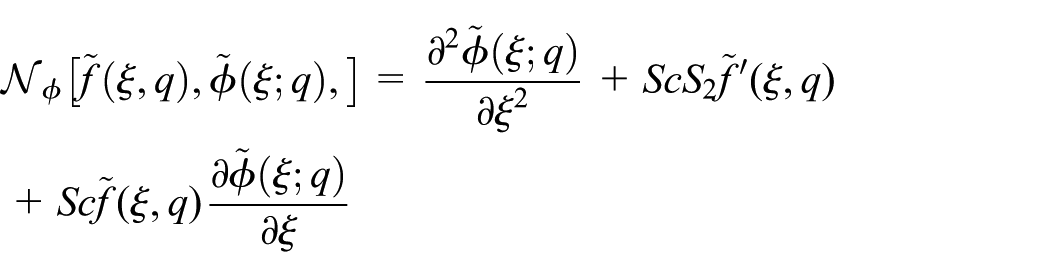
embedding parameter is represented by q which belongs to [0,1] while auxiliary parameters are denoted by and having non-zero values.
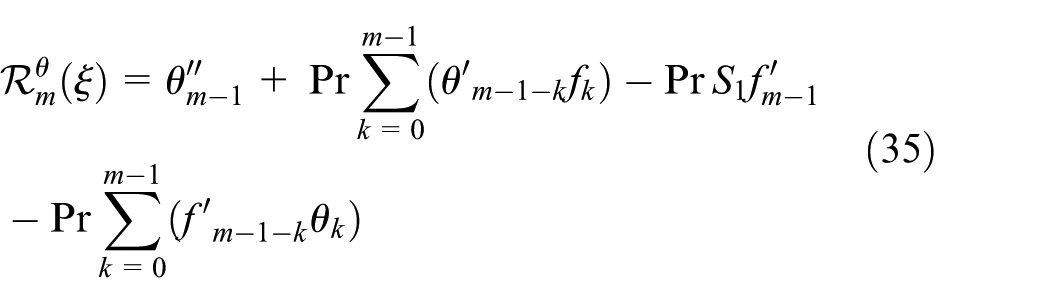
mth-order problems
For and , one can write
and with variation of q from 0 to 1 solution starts from initial approximations , and and approaches to final solutions. Using Taylor’s series and using , we have
The appropriate solutions and of equations (38)–(40) corresponding to are
Convergence analysis
Homotopy analysis method facilitates us to adopt and confine the region where the homotopic series solution converges. The region in which curves are parallel to h axis is termed as convergence region. Thus, we have constructed (see Figure 1). It is clear from the figure that allowable ranges of , and are and .
curves for
Discussion
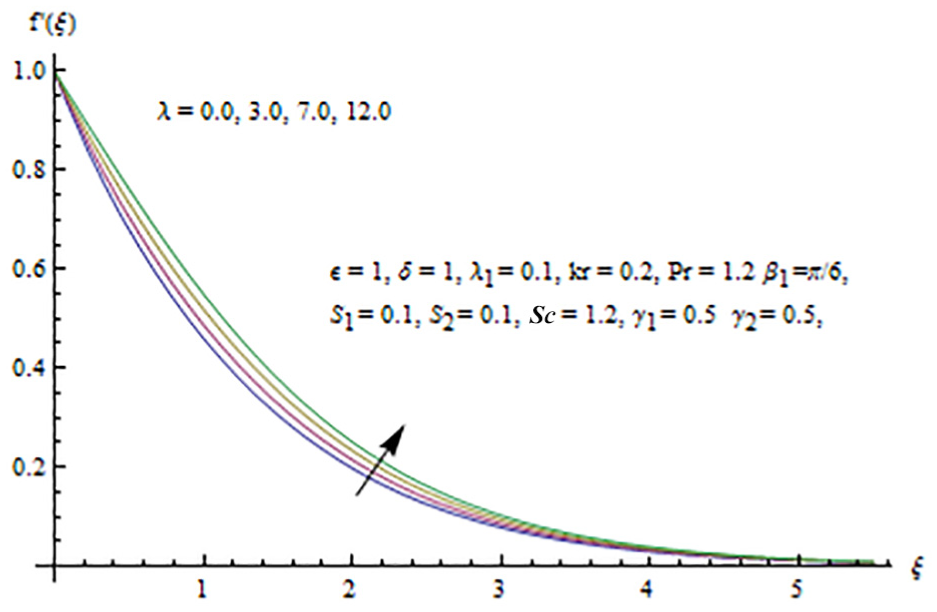
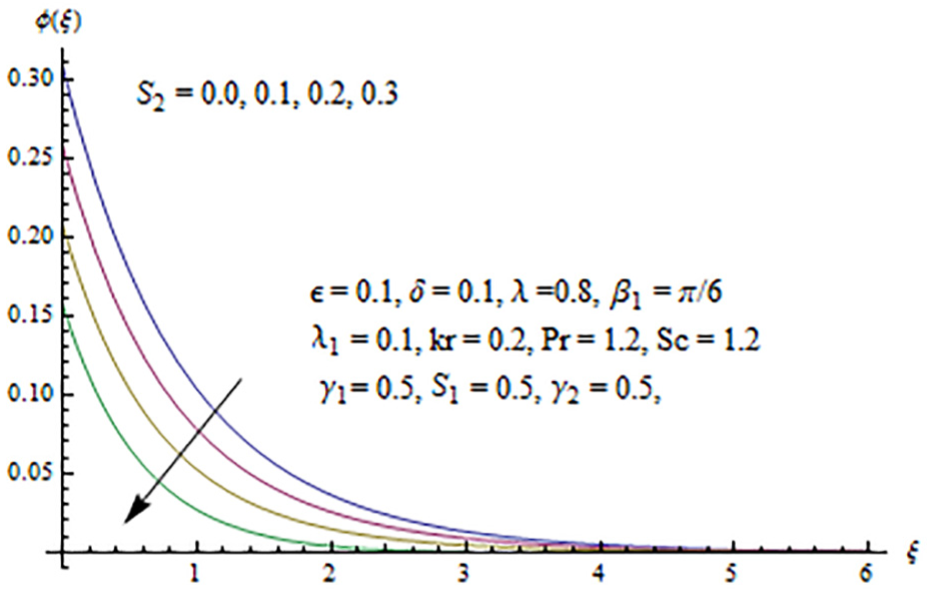
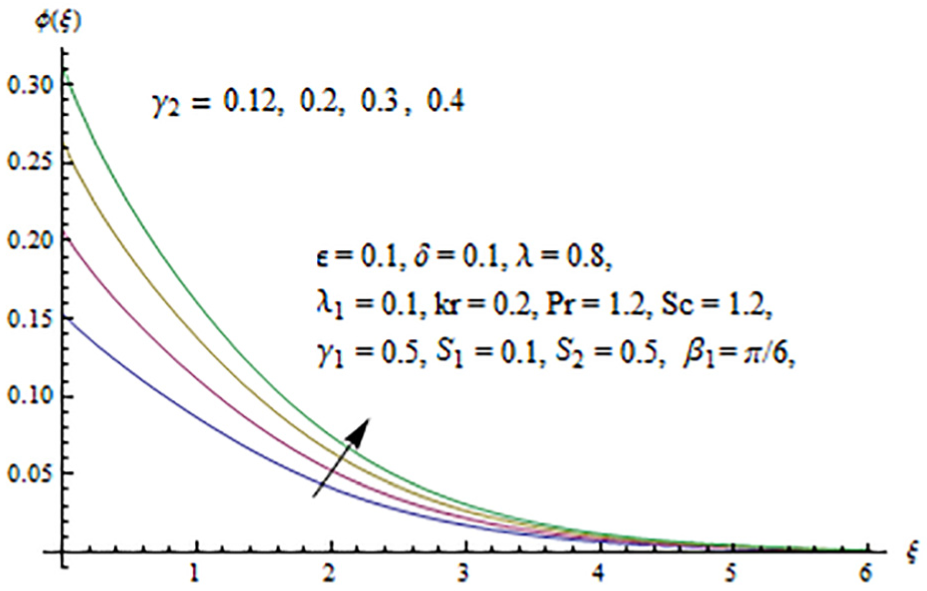
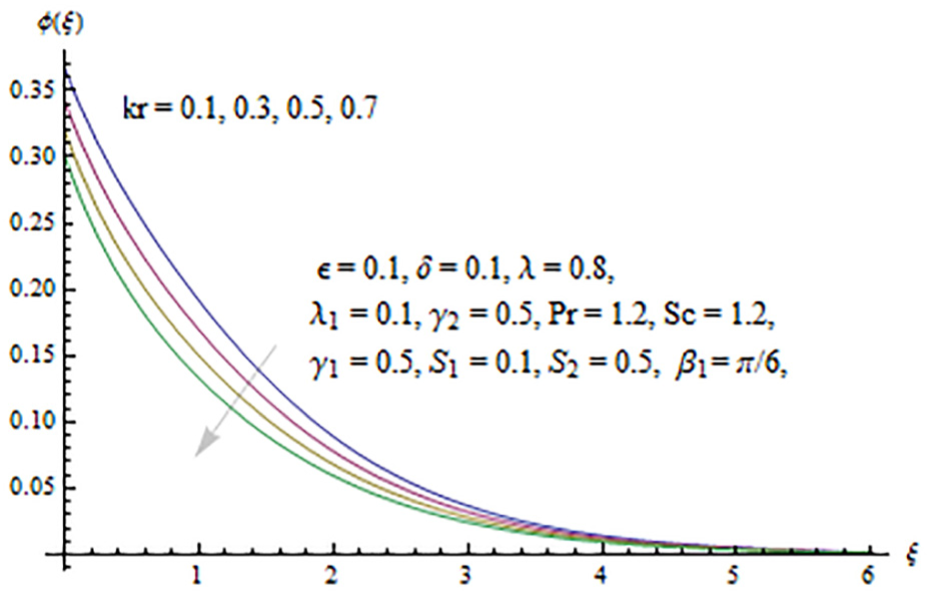
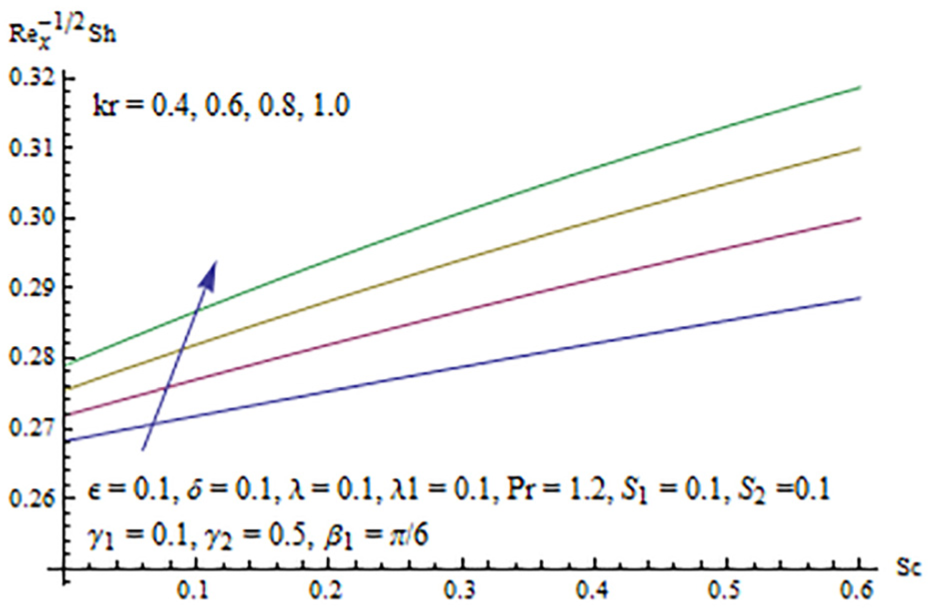
This section illustrates the behaviour of velocity, concentration and temperature distributions. Figure 2 reflects the effect of thermal buoyancy parameter () on horizontal velocity field. Velocity grows for higher thermal buoyancy parameter . Physically, dominant values of thermal buoyancy parameter result in enhancement in gravitational and buoyancy force which assists the fluid motion. Higher velocity exists at the surface of sheet. Figure 3 illustrates the behaviour of material fluid parameter on the horizontal velocity component. The fluid velocity raises with an increase of material fluid parameter . Larger values of material fluid parameter decline the viscous force of the fluid and plate, which provides more fluid deformation. Thus, velocity field enhances. The behaviour of velocity component corresponding to variation in angle of inclination is illustrated in Figure 4. Dominant values of result in enhancement of velocity field. Infact, increasing enhances the buoyancy forces due to dominant gravitational force. Hence, velocity distribution enhances. Figure 5 exhibits the features of Prandtl number on temperature field. Temperature field decays for larger Prandtl number. Physically, it justifies that enlarge Prandtl number is corresponding to low thermal diffusivity which causes the reduction in temperature. Figure 6 shows the decreasing trend of temperature distribution and associated boundary layer for dominant stratification parameters . Physically, temperature differences decay between fluid at surface and ambient fluid. Hence, low temperature is observed. Figure 7 describes the response of thermal Biot number on temperature profile. With increase in thermal Biot number, heat transfer increases and as a result, temperature of the fluid grows. Variation in concentration field due to Schmidt number is depicted in Figure 8. Concentration field reflects decreasing behaviour for larger Schmidt number. Higher value of Schmidt number leads to low mass diffusion and as a result, concentration distribution reduces. Figure 9 demonstrates solutal stratification parameter on concentration distribution. Dominant solutal stratified parameter is responsible for lower concentration. Infact larger reduces the concentration difference between concentration outside the boundary layer and at surface. Hence, concentration field decays. Characteristics of Solutal Biot number on concentration profile are demonstrated in Figure 10. Larger solutal Biot number leads to higher concentration field. Physically with increment in solutal Biot number, mass transfer coefficient enhances which consequently enhances the concentration distribution. Figure 11 describes the influence of concentration field corresponding to chemical reaction (destructive) parameter . It demonstrates that higher chemical reaction parameter decays the concentration field. Physically higher destructive chemical reaction parameter results in enhancement of destructive reaction rate which consequently decays the reactant of the species. Thus, concentration field decays. Figure 12 represents behaviour of and solutal buoyancy parameter on skin friction . It is noted that skin friction coefficient increases with increment in and Dominant results in decrement of viscosity of the fluid which produces less resistance to the fluid at the surface of the wall. Therefore, skin friction grows. Furthermore, higher values of enhances the rate of mass transfer which is due to an increase in the magnitude of solutal buoyancy force. Thus, skin friction enhances. Nusselt number is depicted in Figure 13. It is revealed that Nusselt number increases with and . By thermal Biot number, heat transfer rate from the plate to the fluid enhances which results in enhancement of Nusselt number. It is noted that by increasing temperature difference enhances between the plate and ambient fluid. Thus, Nusselt number grows. Figure 14 illustrates the features of Schmidt number Sc and chemical reaction parameter on Sherwood number . It is noted that Schmidt number Sc shows increasing trend for higher kr and Sc.
Analysis of on .
Analysis of on .
Analysis of on .
Analysis of on .
Analysis of on .
Analysis of on .
Analysis of Sc on .
Analysis of on .
Analysis of on .
Analysis of kr on .
Analysis of and Cf.
Response of and on Nu.
Response of Sc and kr on Sh.
Summary
In present analysis, phenomena of thermal and solutal stratifications in Powell–Eyring fluid flow over an inclined plate with convective heat and mass conditions are analysed and elaborated. The important points are summarized as follows:
Dominant angle of inclination results in enhancement of velocity field due to higher rate of heat transfer.
Thermal buoyancy parameter results rapid enhancement of velocity field of fluid.
Thermal and solutal Biot number are responsible for higher temperature and concentration fields, respectively.
Thermal and solutal stratified parameter significantly reduces the temperature and concentration fields, respectively.
It is hoped that this study serves as a stimulus in the mathematical modelling of stratification phenomena in practical life applications, such as to control fisheries management and water supply quality, deficiency of dissolved oxygen in the lower region of ponds, lakes and rivers.
Footnotes
Appendix 1
Handling Editor: Bo Yu
Declaration of conflicting interests
The author(s) declared no potential conflicts of interest with respect to the research, authorship and/or publication of this article.
Funding
The author(s) received no financial support for the research, authorship and/or publication of this article.
ORCID iD
Iffat Jabeen
References
1.
RahimiJGanjiDDKhakiMet al. Solution of the boundary layer flow of an Eyring-Powell non-Newtonian fluid over a linear stretching sheet by collocation method. Alexandria Eng J2017; 56: 621–627.
2.
HayatTUllahIAlsaediAet al. MHD flow of Powell–Eyring nanofluid over a non-linear stretching sheet with variable thickness. Result Phys2017; 7: 189–196.
3.
QayyumSHayatTShehzadASet al. Nonlinear convective flow of Powell–Eyring magneto nanofluid with Newtonian heating. Result Phys2017; 7: 2933–2940.
4.
KhanIFatimaSMalikMYet al. Exponentially varying viscosity of magnetohydrodynamic mixed convection Eyring-Powell nanofluid flow over an inclined surface. Result Phys2018; 8: 1194–1203.
5.
HayatTZubairMWaqasMet al. On doubly stratified chemically reactive flow of Powell–Eyring liquid subject to non-Fourier heat flux theory. Result Phys2017; 7: 99–106.
6.
AhmadSFarooqMJavedMet al. Double stratification effects in chemically reactive squeezed Sutterby fluid flow with thermal radiation and mixed convection. Result Phys2018; 8: 1250–1259.
7.
RehmanKKhanAAMalikMYet al. Combined effects of Joule heating and chemical reaction on non-Newtonian fluid in double stratified medium: a numerical study. Result Phys2017; 7: 3487–3496.
8.
HayatTQayyumSAlsaediAet al. Mechanism of double stratification and magnetic field over a slandering stretching surface with thermal conductivity. Result Phys2018; 8: 819–828.
9.
KandasamyRDharmalingamRPrabhuKKS. Thermal and solutal stratification on MHD nanofluid flow over a porous vertical plate. Alexandria Eng J2018; 57: 121–130.
10.
RehmanKMalikMYSalahuddinTet al. Dual stratified mixed convection flow of Eyring-Powell fluid over an inclined stretching cylinder with heat generation/absorption effect. AIP Adv2016; 6: 075112.
11.
SulochanaCAshwinkumarGPSandeepN.Effect of frictional heating on mixed convection flow of chemically reacting radiative Casson nanofluid over an inclined porous plate. Alexandria Eng J2018; 57: 2573–2584.
12.
HayatTKhanMIWaqasMet al. Mathematical modeling of non-Newtonian fluid with chemical aspects: a new formulation and results by numerical technique. Colloid Surf A Physicochem Eng Asp2017; 518: 263–272.
13.
HayatTZubairMWaqasMet al. Impact of variable thermal conductivity in doubly stratified chemically reactive flow subject to non-Fourier heat flux theory. J Mol Liquid2017; 234: 444–451.
14.
HayatTNadeemS.Flow of 3D Eyring-Powell fluid by utilizing Cattaneo-Christov heat flux model and chemical processes over an exponentially stretching surface. Result Phys2018; 8: 397–403.
15.
HayatTQayyumSWaqasMet al. Influence of thermal radiation and chemical reaction in mixed convection stagnation point flow of Carreau fluid. Result Phys2017; 7: 4058–4064.
16.
NadeemSMuhammadN.Impact of stratification and Cattaneo-Christov heat flux in the flow saturated with porous medium. J Mol Liquid2016; 224: 423–430.
17.
FarooqMAhmadSJavedMet al. Analysis of Cattaneo-Christov heat and mass fluxes in the squeezed flow embedded in porous medium with variable mass diffusivity. Result Phys2017; 7: 3788–3796.
18.
NadeemSAhmadSMuhammadNet al. Chemically reactive species in the flow of a Maxwell fluid. Result Phys2017; 7: 2607–2613.
19.
AhmadSFarooqMJavedMet al. Slip analysis of squeezing flow using doubly stratified fluid. Result Phys2018; 9: 527–533.
20.
ShahzadAAliRHussainMet al. Unsteady axisymmetric flow and heat transfer over time-dependent radially stretching sheet. Alexandria Eng J2017; 56: 35–41.
21.
AdesanyaSOOgunseyeHAJangilicS.Unsteady squeezing flow of a radiative Eyring-Powell fluid channel flow with chemical reactions. Int J Therm Sci2018; 125: 440–447.