Analysis regarding nanofluid is proved to be effective in the enhancement of heat transport features. Thus, the heat transfer problems involving nanofluid has gained much significance in biomedical procedures, such as drug targeting system, treatment of cancer, biotherapy, blood diagnostic and coagulation systems, and many others. Keeping this usefulness in mind, the current attempt is presented to analyze the features of viscous dissipation in hydromagnetic nanofluid flow through stretchable surface. Thermophoresis and Brownian diffusion phenomena are implemented to demonstrate the transportation of nanoparticles. Modified diffusive theory is accounted to address the transportation of heat and mass. Suitable transformations are used to get system of dimensionless governing equations. Approximate solutions are constructed by homotopic technique. Graphical behaviors of velocity, temperature, and particles concentration are described through different parameters. Skin friction is also studied explicitly. It is found that some extra effects of Brownian and thermophoresis diffusions are appeared by implementing modified theory of fluxes. Non-dimensional thermal relaxation time parameter causes reduction in temperature distribution while decrement concentration field is observed for higher non-dimensional solutal relaxation time parameter.
The saturation of nanoparticles into base fluids develops the nanofluids. The nanofluids acts as effective coolant media in diverse industrial and technological devices in view of the fact that they have well-established characteristics of improving heat transfer rates. Therefore, flow of nanomaterials is very useful in different processes such as heat exchanger, cooling of electronic devices, hybrid power engine, and fuel cells. Nanofluids are also very significant in biomedical treatments such as in cancer therapy, magnetic nanoparticles are used. Magnetic particles, such as polystyrene, amino, carboxyl, polystyrene cross-linked particles, and epoxy and aldehyde magnetic particles, are used for burning cancer cells, in controllable deployment of particle degradation, in biological tags for quantifiable recognition, in development of chemical and biosensors, etc. Choi1 inaugurated the work considering the types of fluids. After that, many researchers deliberated the idea of flow with heat transfer phenomenon with various other nanofluids. Ibrahim2 disclosed the aspect of melting in hydromagnetic stagnant nanomaterial flow through stretched plate. Balla et al.3 exhibited heat transport features in magnetohydrodynamic (MHD) nanoliquid flow via inclined porous cavity. Mixed convection impacts on the flow of stagnation nanofluid over a vertically held stretchable plate are discussed by Othman et al.4 Hydromagnetic flow of radiative nanoliquid caused by stretched sheet is reported by Ganga et al.5 Yin et al.6 studied the heat transport characteristics in nanoliquid flow deformed by rotating stretchable disk. Dogonchi and Ganji7 discussed the characteristics of modified fluxes in radiative nanofluid flow between parallel surfaces considering magnetic effects. Reddy et al.8 explored the MHD radiative nanofluid flow through inclined porous sheet considering heat generation (or absorption). Their investigations motivated few other researchers to work on nanofluids in different conditions.9–17
Difference of temperature among two distinct types of bodies causes heat transfer phenomenon. Transportation of heat and mass plays an impactful role in crystals growth, formation of polyethylene and papers, cooling of metallic sheet in the cooling bath, cooling of nuclear reactors, castings of metals, latent heat storage, and biomedical aspects includes drug targeting, conduction of heat in tissues, and many others. Fourier18 and later on Fick19 were initiated to explore the transfer processes of heat and mass, respectively. Their work shows that both energy and concentration profiles are parabolic in nature. Afterward, modification is made by Cattaneo20 in Fourier’s law in order to add thermal relaxation time factor so that the heat is transferred in the thermal wave form with finite speed. Subsequently, Christov21 modified Cattaneo’s work by considering Oldroyd’s upper-convected derivative model. Stretching flow through a sheet with varying thicknesses considering Cattaneo and Christov theory is discussed by Hayat et al.22,23 They also discussed the Burgers nanofluid flow considering Cattaneo and Christov dual diffusive models. Nadeem et al.24 disclosed the characteristics of modified fluxes in viscoelastic fluid with Newtonian heating. Hayat et al.25 reported thermally stratified flow via non-Fourier heat flux over a stretchable sheet. Influence of modified heat flux in stratified flow through porous media is illustrated by Nadeem and Muhammad.26 Anjum et al.27 exposed the properties of second-grade flow due to Riga plate. Sui et al.28 explored the combined impacts of velocity slip and Cattaneo–Christove double diffusion in the Maxwell nanomaterial past through stretchable sheet. Characteristics of variable physical properties via modified Fourier’ law in Burgers liquid flow is described by Waqas et al.29 Rana and Nawaz30 investigated the heat transport features of Sutterby nanofluid flow using modified heat flux. Few recent analyses on Cattaneo–Christov model can be found in the literature.31–35
From the literature survey, it is revealed that most of the studies considering nanofluid flow with Cattaneo–Christov double diffusive model are not corrected mathematically and physically. Because some extra terms related to Brownian motion and thermophoresis effects appear under the theory of Cattaneo–Christov, which are missing in the literature. Here, our main focus is to cover such analysis in order to optimize the mathematical data with real situations. Moreover, viscous dissipation phenomenon is incorporated with Cattaneo–Christov model for the first time. The study of MHD nanofluid flow with the phenomena of Brownian diffusion and thermophoresis is also performed. First, the problem is modeled using similarity transformations and then the analytical solutions of reduced flow equations through homotopic technique are obtained.36–40 The figures are sketched to depict the behavior of resulting non-dimensional expressions. The values of drag force (skin friction coefficient) are acquired for involved non-dimensional parameters.
Problem formulation
Consider two-dimensional and steady-state flow of nanofluid passing through a sheet. Stretching sheet with linear velocity is considered. The axes and are considered along the stretched wall and vertical to it. The strength of magnetic field is implemented so that the magnetic Reynolds number is assumed to be small. The expressions of energy and concentration are modeled utilizing non-conventional fluxes model. Temperature is supposed to be unchanged at the wall surface and ambient fluid. The principles of mass, momentum, energy, and concentration yield34
Here, and represent the velocity components in and directions, respectively; and depict the heat capacity of nanoparticles and nanofluid, respectively; and represent the kinematic viscosity and fluid density, respectively; represents the electrical conductivity of fluid; and its ambient temperature represent the upper wall and fluid temperatures, respectively; represents the concentration; and and represent Brownian diffusion and thermophoresis coefficients, respectively.
The heat and mass fluxes models of Cattaneo–Christov are mathematically given by35
where and denote the thermal and solutal relaxation time, respectively, and and denote the heat flux and mass flux, respectively.
In case of steady and incompressible flow, Cattaneo–Christov fluid model for thermal and solutal fluxes is described as
Here, represents the mass diffusivity and represents the thermal conductivity.
Implementing expressions (7) and (8) in expressions (3) and (4) and after utilizing boundary layer approximation, governing equations become
corresponding to the conditions at boundary
Here, and represent the wall and ambient fluid temperatures, respectively; and represent the wall and ambient fluid concentrations, respectively; and represents the ratio of capacity of nanoparticles and nanofluid.
Using non-dimensional variables
Continuity equation vanishes identically, whereas other governing equations are
Here, is the Hartman number; and are the thermal and solutal relaxation time parameters, respectively; is the Prandtl number; is the Lewis number; and are the thermophoresis and Brownian diffusion parameters, respectively; and is the Eckert number and are mathematically defined as follows
Mathematical expression for skin friction is
Non-dimensional form is given as
Here, is the Reynolds number.
Homotopic solutions
The homotopic technique is established on the basic concept of topology known as homotopy. This method was first developed by Liao36 in 1992, in order to determine the solutions of highly non-linear equations. It has prominent features as compared to other methods, that is (1) it is independent of large or small parameters, (2) it ensures the convergence of homotopic solutions, and (3) it gives us considerable freedom in order to choose the linear operators and base functions. To initiate with this method, it is significant to have linear operators and initial guesses, which are given below
with
Here, denotes the arbitrary constants.
Zeroth-order problem
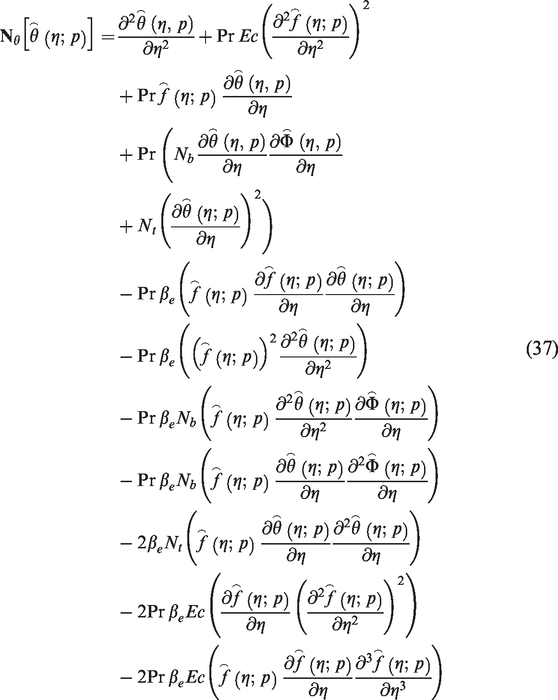
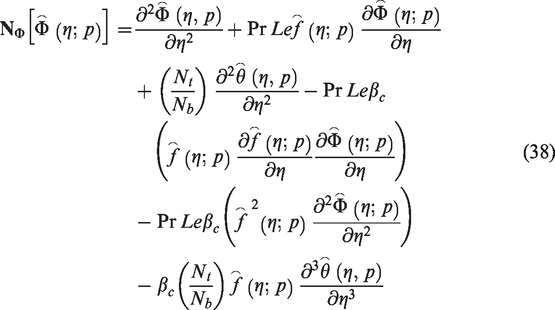
Non-linear operators are
where is the embedding parameter and , and are the non-zero auxiliary parameters.
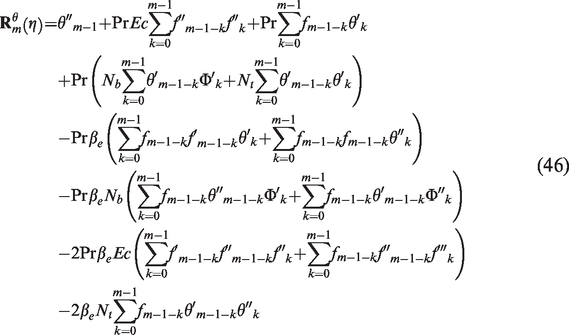
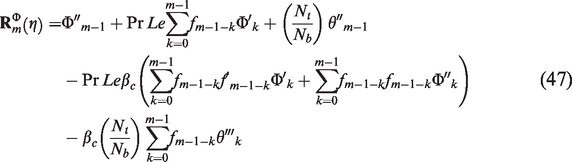
mth-order problem
For and , we can write
and with the variation of from to , , and vary from the initial solutions , , and to final solutions , and , respectively. By Taylor’s series, we have
The value of auxiliary parameter is selected so properly that the series converge at , that is
In general, analytical solutions are
in which are special solutions.
Convergence analysis
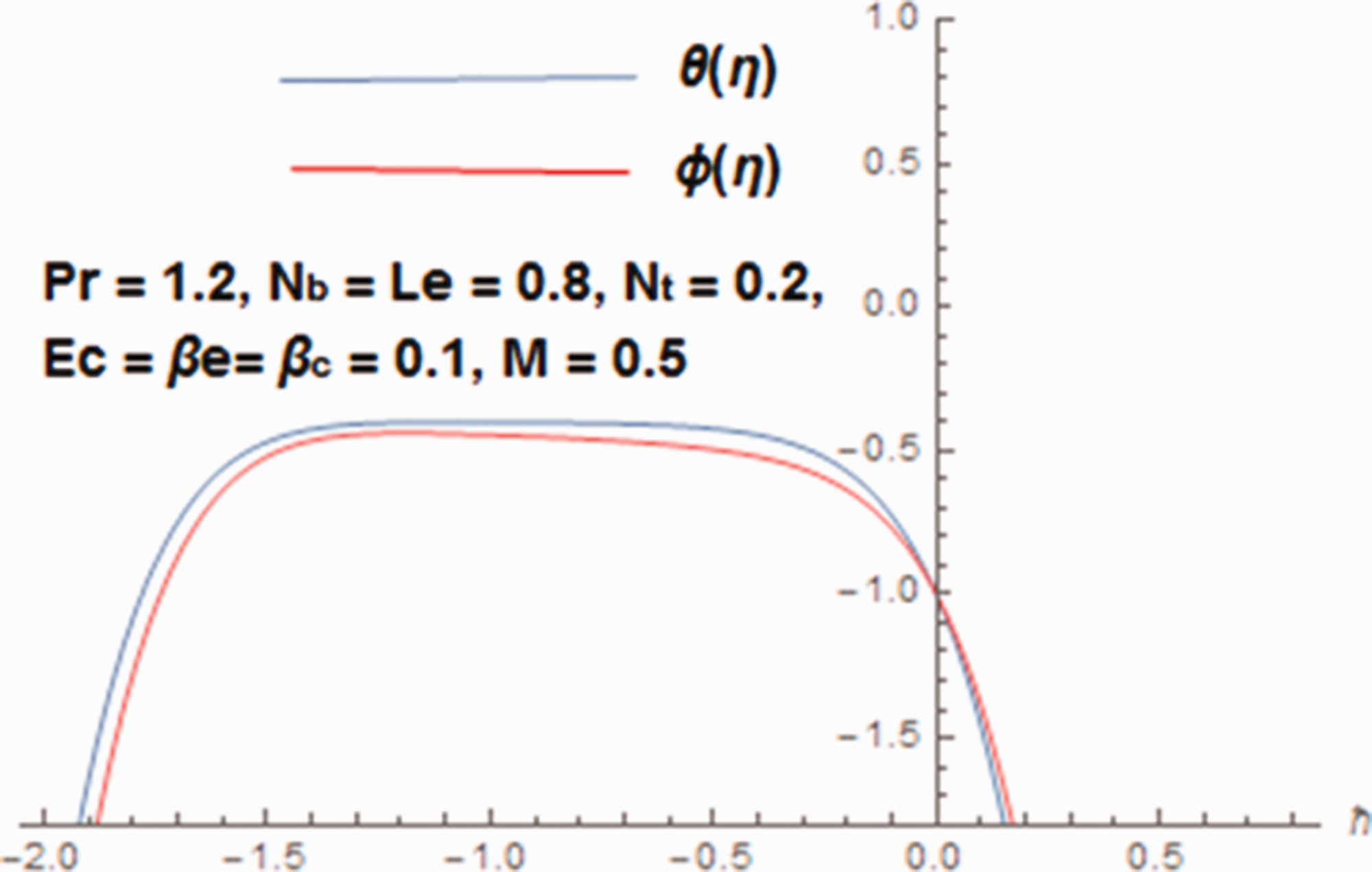
Homotopic analysis method (HAM) ensures the convergence of iterative solutions which relies over an auxiliary parameters , and . The relevant -curves are sketched in Figures 1–3 for the flow, heat, and mass equations. The allowable ranges of , , and are , and , respectively. Furthermore, Table 1 depicts the convergence of series solution. It is revealed that 17th order of approximation is sufficient for series solution convergence.
Convergence table for , and
Order of approximation
1
1.0500
0.5588
0.6716
4
1.0990
0.3732
0.5538
8
1.1110
0.3508
0.5201
10
1.1130
0.3477
0.5107
12
1.1140
0.3464
0.5089
15
1.1140
0.3462
0.5037
17
1.1140
0.3462
0.5037
Physical interpretation of the problem.
-curve for .
-curve for and .
Discussion
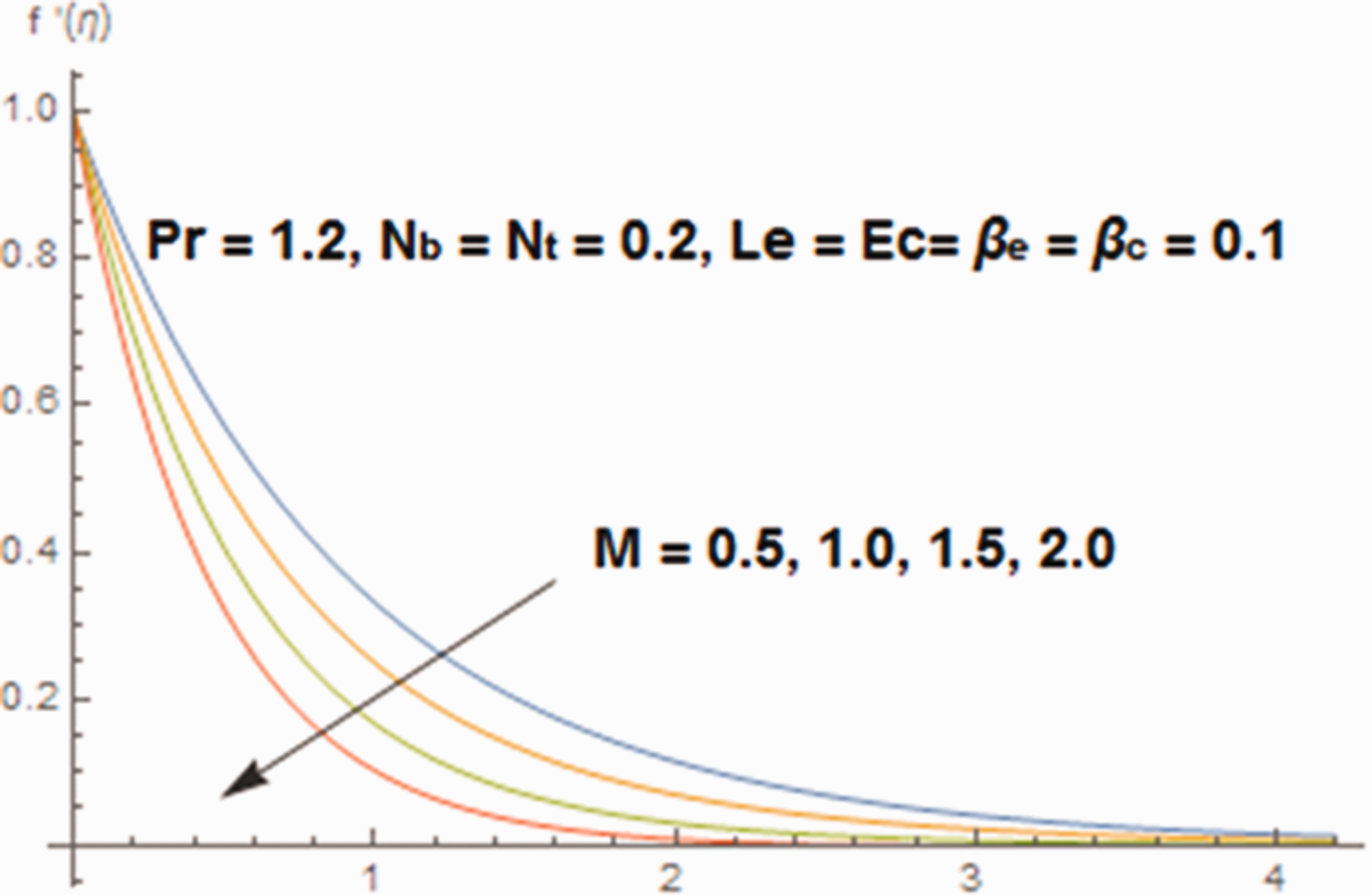
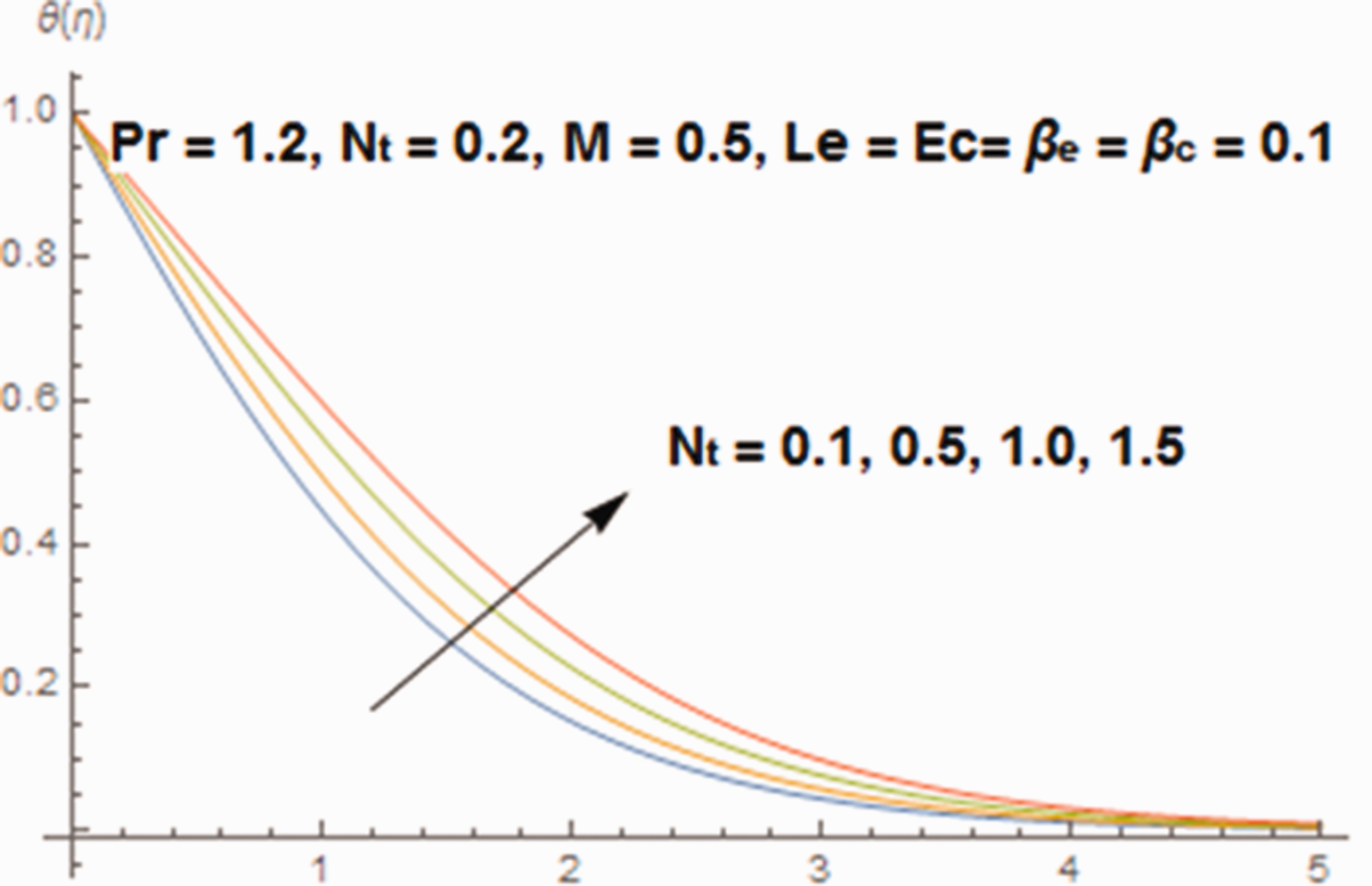
The aim of this portion is to report the graphical demonstration for diverse parameters on flow velocity, nanofluid temperature, and particles concentration. Figure 4 illustrates the velocity distribution corresponding to Hartman number Decaying behavior is analyzed for velocity field for escalating Hartman number . Physically, Lorentz force increments due to higher Hartman number which resists the fluid motion and consequently velocity decays. Figure 5 represents the features of Hartman number on temperature field. Dominating behavior is noted for larger Hartman number . Physically, more heat produces due to the resistive force (Lorentz force). Therefore, temperature field increases. Figure 6 reflects the characteristics of temperature field corresponding to Prandtl number (Pr). Decaying behavior of temperature field is observed for higher (Pr). For lower Prandtl number, thermal boundary layer thickness dominates. Dominant Prandtl number illustrates decrement in thermal diffusivity which is responsible for small temperature distribution. Description of Eckert number on temperature profile is given in Figure 7. Increment in temperature profile is noted for increased Eckert number Physically, increment in Eckert number generates more heat in the fluid due to high friction forces between fluid particles. Therefore, temperature distribution intensifies. Figure 8 reflects the features of Brownian diffusive parameter on fluid temperature. Here, we noted that temperature field increases for increased Brownian diffusive parameter Because collisions of the particles enhance and consequently, kinetic energy will be increased. Therefore, temperature field rises. Figure 9 describes the behavior of Brownian diffusive parameter on fluids concentration. The concentration field is decaying function of Brownian parameter In fact, when Brownian parameter increases, the collisions between fluid particles enhance and ensure lower mass transport phenomenon from heated sheet toward the cold fluid. Therefore, concentration field shows decreasing behavior. Behavior of thermophoresis diffusive parameter is described in Figure 10 for temperature field. Temperature rises for thermophoretic phenomenon because particles are pushed to cold region from heated plate, therefore, temperature field increases. Figure 11 reflects the behavior of thermophoresis diffusive parameter on fluid concentration. For dominant thermophoresis parameter, less nanoparticles are shifted from hot surface to cold surface. Hence, concentration distribution increases. Figure 12 explains the impact of on temperature profile. From Figure 12, it can be perceived that by increasing parameter temperature profile shows decreasing behavior, since is the thermal relaxation parameter and represents in terms of thermal relaxation time. So by increasing thermal relaxation time for fluid particle also increases and particles will take more time for heat transfer that is why decreasing behavior is shown by temperature field. Figure 13 shows the behavior of on concentration field. From Figure 13, it can be predicted that by increasing parameter concentration profile shows a decreasing behavior, since is solutal relaxation parameter and represents in terms of solutal relaxation time. So, by increasing solutal relaxation time for fluid particle also increases and particles will take more time for mass transfer that is why concentration profile shows a decreasing behavior. Behavior of Lewis number on fluid concentration is given in Figure 14. It is perceived that concentration distribution declines with dominant Lewis number . Physically, Lewis number and Brownian motion coefficient have inverse relation. So, the increase in Lewis number causes low Brownian coefficient which helps in reducing the concentration distribution. Table 2 depicts the behavior of skin friction coefficient for diverse values of Hartman number . Decrement in skin friction coefficient is noticed. As Hartman number increases, resistance between particles of fluid increases and as a consequence, skin friction decreases. To validate the present results, Table 3 displays the comparison of different values of skin friction with previously published work of Mabood and Mastroberardino41 for diverse values of . It is revealed that the outcome gives favorable agreement.
Description of on .
Description of on .
Description of on .
Description of on .
Description of on .
Description of on .
Description of on .
Description of on .
Description of on .
Description of on .
Description of on
Skin friction for diverse values of Hartman number M, when , , and .
0.0
1.0000
0.2
–1.0188
0.4
–1.0742
0.6
–1.1632
Comparison of skin friction with other method for various values of .
Mabood and Mastroberardino41
This study
0
1.0000
1.0000
1
–1.41421
–1.41422
5
–2.44948
–2.44949
10
–3.31662
–3.31662
Concluding remarks
In this article, we discuss the characteristics of Cattaneo–Christov heat and mass fluxes in nanoliquid, considering Brownian motion, magnetic effect, and the thermophoresis effect. It is noticed that some extra impacts of thermophoresis phenomenon and Brownian motion will appear due to Cattaneo–Christov heat and mass fluxes. The main surveying points are as follows:
Velocity profile become smaller corresponding to higher Hartman number .
Brownian motion and thermophoresis parameters result in increment of temperature field.
Brownian parameter is the decreasing function for concentration field, whereas concentration increases for thermophoresis parameter.
Lewis number reduces the concentration field.
Thermal and solutal relaxation time parameters ( and ) are the decreasing functions for temperature and the concentration profiles, respectively.
Skin friction coefficient enhanced when Hartman number increased.
It is desired that this study contributes as a boost for sculpting more advanced MHD nanofluid flows notably in cooling of microchips, nuclear reactors, fuels, extraction of geothermal power, microactuation process, and biomedicines. This article may be used in nanodrug delivery, hyperthermia, cancer therapeutics, nano-cryosurgery, magnetic cell separation, and magnetic resonance imaging.
Footnotes
Handling Editor: James Baldwin
Declaration of conflicting interests
The author(s) declared no potential conflicts of interest with respect to the research, authorship, and/or publication of this article.
Funding
The author(s) received no financial support for the research, authorship, and/or publication of this article.
ORCID iDs
Sadaf Masood
Shakeel Ahmad
References
1.
ChoiSUS.Enhancing thermal conductivity of fluids with nanoparticles. In: Proceedings of the ASME international mechanical engineering congress and exposition, San Francisco, CA, 12–17 November 1995, pp.99–105. New York: ASME.
2.
IbrahimW.Magnetohydrodynamic (MHD) boundary layer stagnation point flow and heat transfer of a nanofluid past a stretching sheet with melting. Propul Power Res2017;
6: 214–222.
3.
BallaCSKishanNGorlaRSR, et al.
MHD boundary layer flow and heat transfer in an inclined porous square cavity filled with nanofluids. AIN Shams Eng J2017;
8: 237–254.
4.
OthmanNAYacobNABachokN, et al.
Mixed convection boundary-layer stagnation point flow past a vertical stretching/shrinking surface in a nanofluid. Appl Therm Eng2017;
115: 1412–1417.
5.
GangaBAnsariSMYGaneshNV, et al.
Hydromagnetic flow and radiative heat transfer of nanofluid past a vertical plate. J Taibah Univ Sci2017;
11: 1200–1213.
6.
YinCZhengLZhangC, et al.
Flow and heat transfer of nanofluids over a rotating disk with uniform stretching rate in the radial direction. Propul Power Res2017;
6: 25–30.
7.
DogonchiASGanjiDD.Impact of Cattaneo–Christov heat flux on MHD nanofluid flow and heat transfer between parallel plates considering thermal radiation effect. J Taiwan Inst Chem E2017;
80: 52–63.
8.
ReddyPSChamkhaAJMudhafA.MHD heat and mass transfer flow of a nanofluid over an inclined vertical porous plate with radiation and heat generation/absorption. Adv Powder Technol2017;
28: 1008–1017.
9.
ShahZDawarAKumamP, et al.
Impact of nonlinear thermal radiation on MHD nanofluid thin film flow over a horizontally rotating disk. Appl Sci2018;
9: 1533.
10.
VoDDShahZSheikholeslamiM, et al.
Numerical investigation of MHD nanomaterial convective migration and heat transfer within a sinusoidal porous cavity. Phys Scr2019;
94: e115225.
11.
AmeenIShahZIslamS, et al.
Hall and ion-slip effect on CNTS nanofluid over a porous extending surface through heat generation and absorption. Entropy2019;
21: 801.
12.
AliAAliYKumamP, et al.
Flow of a nanofluid and heat transfer in channel with contracting/expanding walls. IEEE Access2019;
7: 102427–102436.
13.
JawadMShahZKhanA, et al.
Entropy generation and heat transfer analysis in MHD unsteady rotating flow for aqueous suspensions of carbon nanotubes with nonlinear thermal radiation and viscous dissipation effect. Entropy2019;
21: 492.
14.
KumamPShahZDawarA, et al.
Entropy generation in MHD radiative flow of CNTs Casson nanofluid in rotating channels with heat source/sink. Math Probl Eng2019;
2019: e9158093.
15.
DawarAShahZKumamP, et al.
Influence of MHD on thermal behavior of Darcy-Forchheimer nanofluid thin film flow over a nonlinear stretching disc. Coatings2019;
9: 446.
16.
DawarAShahZKhanW, et al.
Unsteady squeezing flow of magnetohydrodynamic carbon nanotube nanofluid in rotating channels with entropy generation and viscous dissipation. Adv Mech Eng2019;
11: 1687814018823100.
17.
DawarAShahZKhanW, et al.
An optimal analysis for Darcy–Forchheimer 3-D Williamson nanofluid flow over a stretching surface with convective conditions. Adv Mech Eng2019;
11: 1–15.
18.
FourierJBJ.Théorie analytique de la chaleur.
Paris:
Firmin-Didot, 1822.
19.
FickA.Ueber diffusion. Ann Phys1855;
170: 59–86.
20.
CattaneoC.Sulla conduzione del calore. Atti Semin Mat Fis Univ Modena Reggio Emilia1948;
3: 83–101.
21.
ChristovCI.On frame indifferent formulation of the Maxwell-Cattaneo model of finite-speed heat conduction. Mech Res Commun2009;
36: 481–486.
22.
HayatTFarooqMAlsaediA, et al.
Impact of Cattaneo–Christov heat flux in the flow over a stretching sheet with variable thickness. AIP Adv2015;
5: 087159.
23.
HayatTAzizAMuhammadT, et al.
On model for flow of Burgers nanofluid with Cattaneo–Christov double diffusion. Chin J Phys2017;
55: 916–929.
24.
NadeemSAhmadSMuhammadN.Cattaneo–Christov flux in the flow of a viscoelastic fluid in the presence of Newtonian heating. J Mol Liq2017;
237: 180–184.
25.
HayatTKhanMIFarooqM, et al.
Thermally stratified stretching flow with Cattaneo–Christov heat flux. Int J Heat Mass Tran2017;
106: 289–294.
26.
NadeemSMuhammadN.Impact of stratification and Cattaneo–Christov heat flux in the flow saturated with porous medium. J Mol Liq2016;
224: 423–430.
27.
AnjumAMirNAFarooqM, et al.
Physical aspects of heat generation/absorption in the second grade fluid flow due to Riga plate. Application of Cattaneo–Christov approach. Results Phys2018;
7: 955–960.
28.
SuiJZhengLZhangX.Boundary layer heat and mass transfer with Cattaneo–Christov double-diffusion in upper-convected Maxwell nanofluid past a stretching sheet with slip velocity. Int J Therm Sci2016;
104: 461–468.
29.
WaqasMHayatTFarooqM, et al.
Cattaneo–Christov heat flux model for flow of variable thermal conductivity generalized Burgers fluid. J Mol Liq2016;
220: 642–648.
30.
RanaSNawazM.Investigation of enhancement of heat transfer in Sutterby nanofluid using Koo-Kleinstreuer and Li (KKL) correlations and Cattaneo–Christov heat flux model. Phys Scr2019;
94: 115213.
31.
ShahZDawarAAlzahraniEO, et al.
Hall effect on couple stress 3D nanofluid flow over an exponentially stretched surface with Cattaneo–Christov heat flux model. IEEE Access2019;
7: 64844–64855.
32.
AhmadMWKumamPShahZ, et al.
Darcy–Forchheimer MHD couple stress 3D nanofluid over an exponentially stretching sheet through Cattaneo–Christov convective heat flux with zero nanoparticles mass flux conditions. Entropy2019;
21: 867.
33.
ShahZAlzahraniEODawarA, et al.
Influence of Cattaneo–Christov model on Darcy-Forchheimer flow of micropolar ferrofluid over a stretching/shrinking sheet. Int Commun Heat Mass Tran2020;
110: 104385.
34.
MaboodFKhanWAMd IsmailAI.MHD boundary layer flow and heat transfer of nanofluids over a nonlinear stretching sheet: a numerical study. J Magn Magn Mater2015;
374: 569–576.
35.
HayatTHaiderFMuhammadT, et al.
An optimal study for Darcy-Forchheimer flow with generalized Fourier’s and Fick’s laws. Results Phys2017;
7: 2878–2885.
36.
LiaoSJ.Homotopy analysis method in nonlinear differential equations.
Berlin:
Springer, 2012.
37.
HayatTAliSAwaisM, et al.
Newtonian heating in stagnation point flow of Burgers fluid. Appl Math Mech: Engl2015;
36: 61–68.
38.
HayatTAliSAwaisM, et al.
Joule heating effects in MHD flow of Burgers fluid. Heat Transf Res2016;
47: 1083–1092.
39.
FarooqMAhmadSJavedM, et al.
Analysis of Cattaneo–Christov heat and mass fluxes in the squeezed flow embedded in porous medium with variable mass diffusivity. Results Phys2017;
7: 3788–3796.
40.
MasoodSFarooqMAhmadS, et al.
Investigation of viscous dissipation in the nanofluid flow with Forchheimer porous medium: modern transportation of heat and mass. Eur Phys J Plus2019;
134: 178.
41.
MaboodFMastroberardinoA.Melting heat transfer on MHD convective flow of a nanofluid over a stretching sheet with viscous dissipation and second order slip. J Taiwan Inst Chem E2015;
57: 62–68.