




Abstract
In this article, a free convection flow of
Introduction
In the recent years, the fractional calculus has become an emerging tool in all fields of science. As compared to classical calculus, non integers derivatives play a more significant role in all scientific inquires. The functions of fractional order calculus in several fields of science and technology, like diffusion, electrochemistry, and viscoelasticity, combustion process, geophysics, fractional filters, fractional wavelets, fractional neutron point kinetic model, flow of magnetic particles in blood, formation of suspension in medicine, microelectronics are elaborated. 1 The solutions of non-integer order differential equations are found to describe the real-life situations better compared to the solutions coming from the corresponding integer order differential equations. Various fractional operators have been used efficiently in heat and mass transport phenomenons in dynamics of many fluids. Shah et al. 2 studied the electro-osmotic flow of Oldroyd-B fluid in micro channel and reveal the dual behavior of fluid velocity subject to Caputo-Fabrizio fractional parameter for large and small values of time. Al-Mdallal et al. 3 solved model of Walter’s B fluid with the Caputo-Farizio fractional derivative without kernel. Sheikh et al. 4 have been made a generalization of Casson fluid model and presented a compression among effects of Atangana-Baleanu and Caputo-Fabrizio. Imran et al. 5 also gave a comparative study for fractional derivatives of singular and non singular kernal utilizing unsteady differential type fluid flow subject to Newtonian heating. Azhar et al. 6 discussed free convection flow of fractional nanofluid over vertical flat plate with constant heat flux and heat generation. Kashif et al.7–9 discussed the different numerical and analytical model of memristor, rotating gas flow, and RL and RC electrical circuits with different fractional approaches namely fractal fractional operators, Atangana-Baleanu, and Caputo-Fabrizio aproaches.
The intermingling of nanosized particle in base fluid like water and oil make the nanofluid. Since last two decades, the Nanofluid science has been serving and enhancing the performance of many heat transport processes in engineering and industrial sectors. Moreover, the new extension in nanotechnology is the invention of hybrid nanofluid. Basically this new product formed by mixing two or more substances of different physical and chemical properties like heat flux and thermal conductivity of substance have been exaggeratedly changed by hybrid nanofliud. Due to this high performance in thermal conductivity, nanofluid got an attention of many researchers.
Das et al. 10 gave a numerical study that how nanofluids are efficient in thermal conduction and illustrated the affects of several factors like particle size, different base fluids, types of nanoparticles, solid volume fraction, temperature, pH etc. Xian et al. 11 presented an experimental study for performance of hybrid nanofluid in heat transfer in automobile radiator system. The hybrid nanofluids an amazing outcome of current advancement in heat transfer capabilities of conventional fluids. Babar et al. 12 gave a brief comparison between the nano and hybrid nanofluids and concluded that water-based nanofluids show the better performance for ethylene glycol-based nanofluids. Farhana et al. 13 analyzed the flow of nano and hybrid nanofluid in tube of solar collector for three different designed models. Uysal et al. 14 discussed the heat transfer due to conduction with entropy generation for a hybrid nanofluid flow through a minichannel and have been concluded that for a small addition of hybrid nanoparticle to pure water there is considerable increase in heat transfer coefficient and flux at boundary. Hayat et al. 15 presented a comparison among the simple and hybrid nanofluids and found that even in the existence of heat source, chemical reaction, and radiations, the heat flux of Hybrid nanofluid is higher than the conventional nanofluid. Many other researchers validated the better performance of hybrid nanofluid by theoretical and experimental studies in heat transport problems for different situations and geometries using fractional calculus.16–24 Ahokposi et al. 25 presented fractional flow with Mittag-Leffler law for ground water. Farooq et al. 26 have discussed the motion of hybrid nanofluid flow in a circular stretched disc under the influence of radiation, entropy generation and viscous dissipation. Hussanan et al. 27 investigated a convectional heat transfer for nanofluid flow of micropolar fluid along with the mixture of water, kerosene, and engine oil. Aminossadati et al. 28 have discussed a free conventional cooling process of localized heat source at the bottom of an enclosure filled by a nanofluid. Bhattad et al. 29 worked on model and presented an experimental study of hybrid nanofluid flow with heat transfer and pressure drop over a flate plate heat exchanger. Gul et al. 30 discussed Koo and Kleinstreuer model and elaborated the effects of heat generation and radiation upon an magnetohydrodynamic (MHD) flow of nanofluids induced by mix convection through a vertical channel. Ahmed et al. 31 depicted the effects of radiation and chemical reaction on nanofluid flow through couple of Riga plates. Khan et al. 32 considered a Casson nanofluid and discussed the unsteady flow of Casson nanofluid over a vertical plate with isothermal conditions for Newtonian heating and have been directed the effects of heat generation. Asif et al. 33 examined the motion of Brinkman type fluid in an open rectangular channel. In 34 Fetecau studied unsteady flow of an Oldroyd-B fluid generating by a constantly accelerating plate between two side walls. Sajad et al. 35 discussed the applied thermodynamics concepts for magnetohydrodynamic Brinkman fluid flow in porous medium.
Brinkman type fluid model utilized by Saqib et al.
36
presents a generalization of free convection flow of
Mathematical statement of physical model
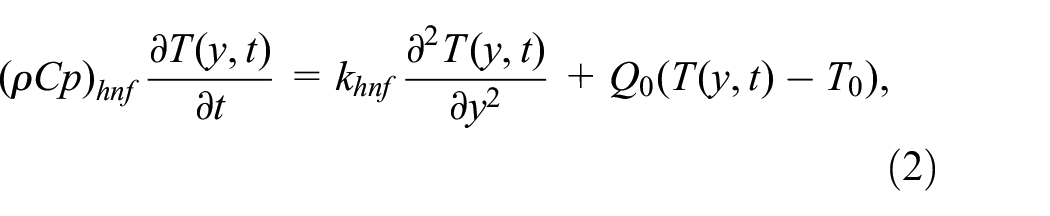
Consider a fractional Maxwell hybrid nanofluid presented in two infinite vertical parallel plates separated by a distance

with associated initial and boundary conditions


where

where

Physical model.
Numerical values of thermophysical properties of base fluid and nanoparticles.

The Caputo-Fabrizio fractional derivative and Laplace transform
The Caputo-Fabrizio fractional operator is defined by 5
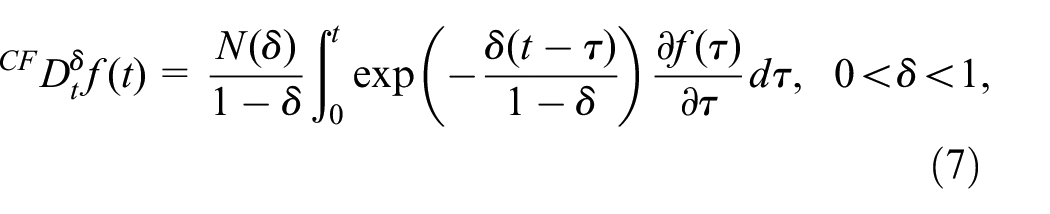
which is the convolution product of the functions
In this paper, the following Laplace transform of Caputo-Fabrizio fractional operator will be utilized

such that

Modeling with Caputo-Fabrizio time fractional derivative
The dimensional model is renovated to a dimensionless model to lessen the involved parameters and unit free system by inserting the following non-dimensional variables

Equation (1) leads to the following dimensionless form, after utilizing the dimensionless relations given in equation (10):

where

are the Grashof number, and the relaxation parameter respectively, while

are the constant parameters appearing in mathematical calculations.
Thermal balance equation is:

where
The generalized fractional Fouriers law suggested by Hristov 37 and Henry et al. 38 through Caputo-Fabrizio fractional derivative:
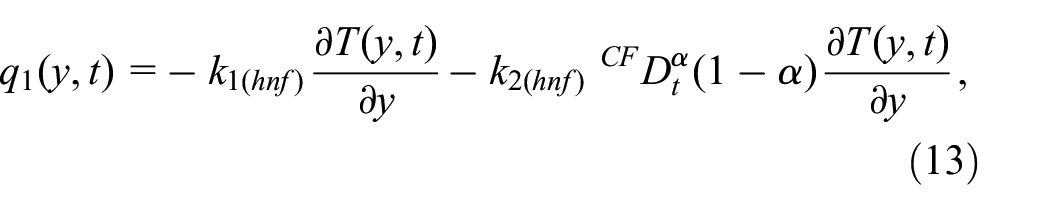
where
Using equation (13) in equation (12) and making the result the respective result dimensionless by using the relations from equation (10):

where
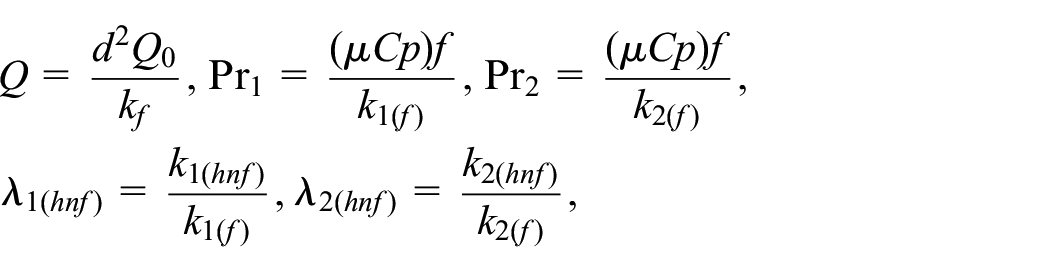

with non-dimensional initial and boundary conditions:


Solution of the problem
To solve equations (11) and (14), the Laplace transform method will be used and closed form solutions will be developed for the velocity and temperature respectively subject to the corresponding initial and boundary conditions from equations (15) to (17).
Solutions of the temperature field
Applying the Laplace transform to equation (14), keeping in mind the Laplace transform of Caputo-Fabrizio fractional operator defined in equation (8), and using the corresponding initial condition from equation (15) yield the following transformed energy balance:

and after further simplification of equation (18), we have:

Equation (19) satisfies the following transformed boundary conditions:

where
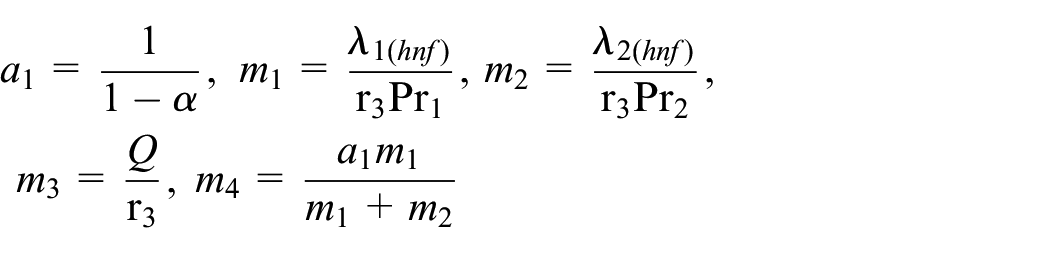
The transformed solution of equation (19), using the corresponding boundary conditions from equation (20) is given by:

In summation notation

The inversion of Laplace transform is made numerically with the help of Stehfest’s and Tzou’s algorithms.39,40
Solution of momentum equation
Taking the Laplace transform on equation (11), we obtain:

which can simplify as

after further simplification

where

Equation (25) satisfies the following transformed conditions

The solution of equation (25) subject to condition (26) is:

where

the summation form of above equation (27) is

Since equation (29) is very complex and not possible to obtain the inverse Laplace transform. Therefore, inverse Laplace transform is obtained numerically.
Results and discussion
In this paper, the fractional model of Maxwell hyrid nanofluid is considered and a generalized free convection flow between parallel plates is presented as shown in Figure 1. Momentum balance along with energy balance are fractionalized by introducing the Caputo-Fabrizio definition of time fractional operator. Generalized fractional partial differential equation for momentum and energy balance are solved for velocity and temperature by Laplace transform method. Results for velocity and temperature are presented in graphs to depict the influence of flow and material parameters like Prendlt Pr and Grashof Gr numbers, fractional parameter
In Figure 2(a) and (b), the subjectivity of fractional parameter
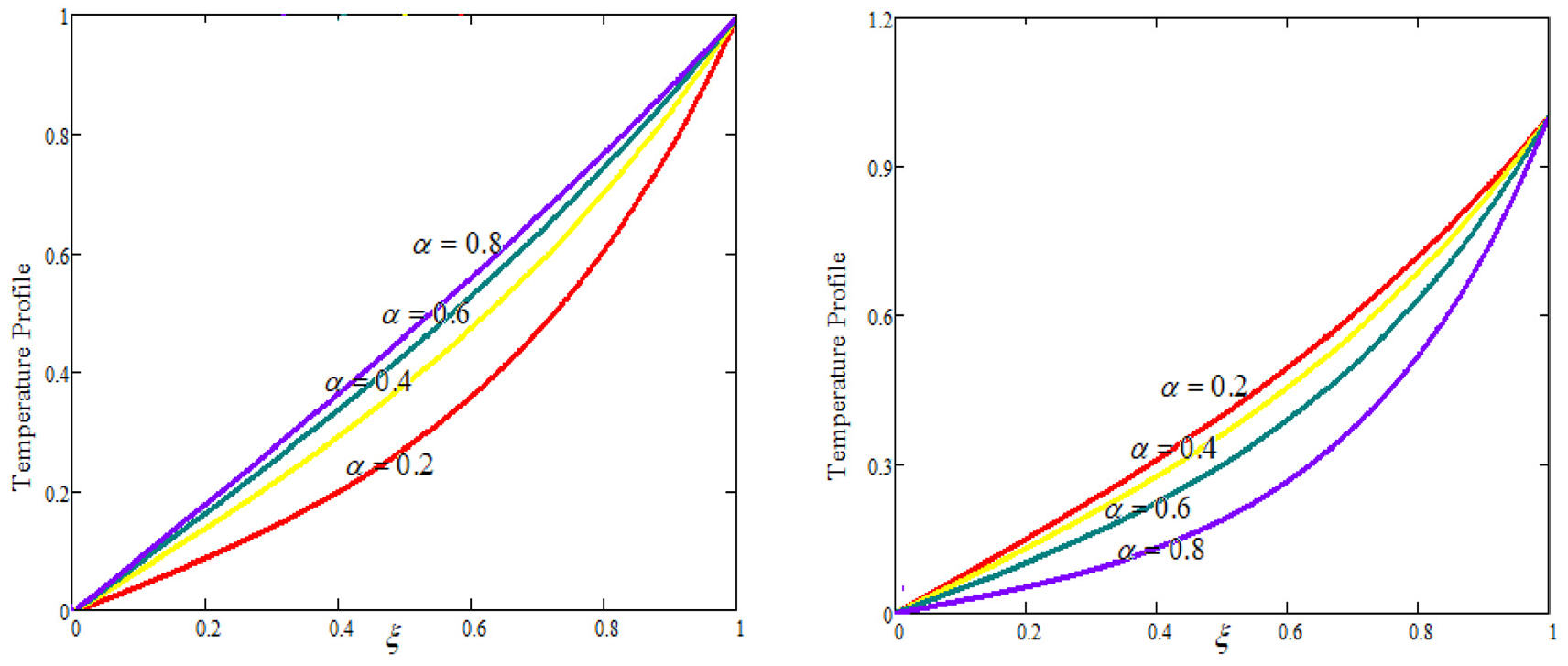
Temperature Profile due
Figure 3(a) and (b) are plotted to see the influence of

Temperature profile due
Figure 4(a) and (b) are drawn to see the impact of fractional parameter

Velocity profile due
Figure 5(a) shows the influence of Gr on velocity fields. As the thermal Grashof number is responsible for heat transfer in convection problems. Physically, in heat transfer problems heating corresponds to the positive values of Gr, while negative values are for cooling. It is clear from Figure 2 that trend in velocity profiles is increasing for positive values of Gr. It is due to the fact that larger values of Gr means greater buoyancy forces hence ultimately convection increases the velocity profiles. But for negative values of Gr, velocity behaves in opposite manner due to cooling effect of plate. Figure 5(b) shows the influence of heat absorption parameter Q. In heat transfer problem, convection can be enhanced by adding heat source in energy equation. By assigning bigger values to Q means some of the heat observed from the system which effects the intermolecular forces and make them weak, as a consequence velocity increases.
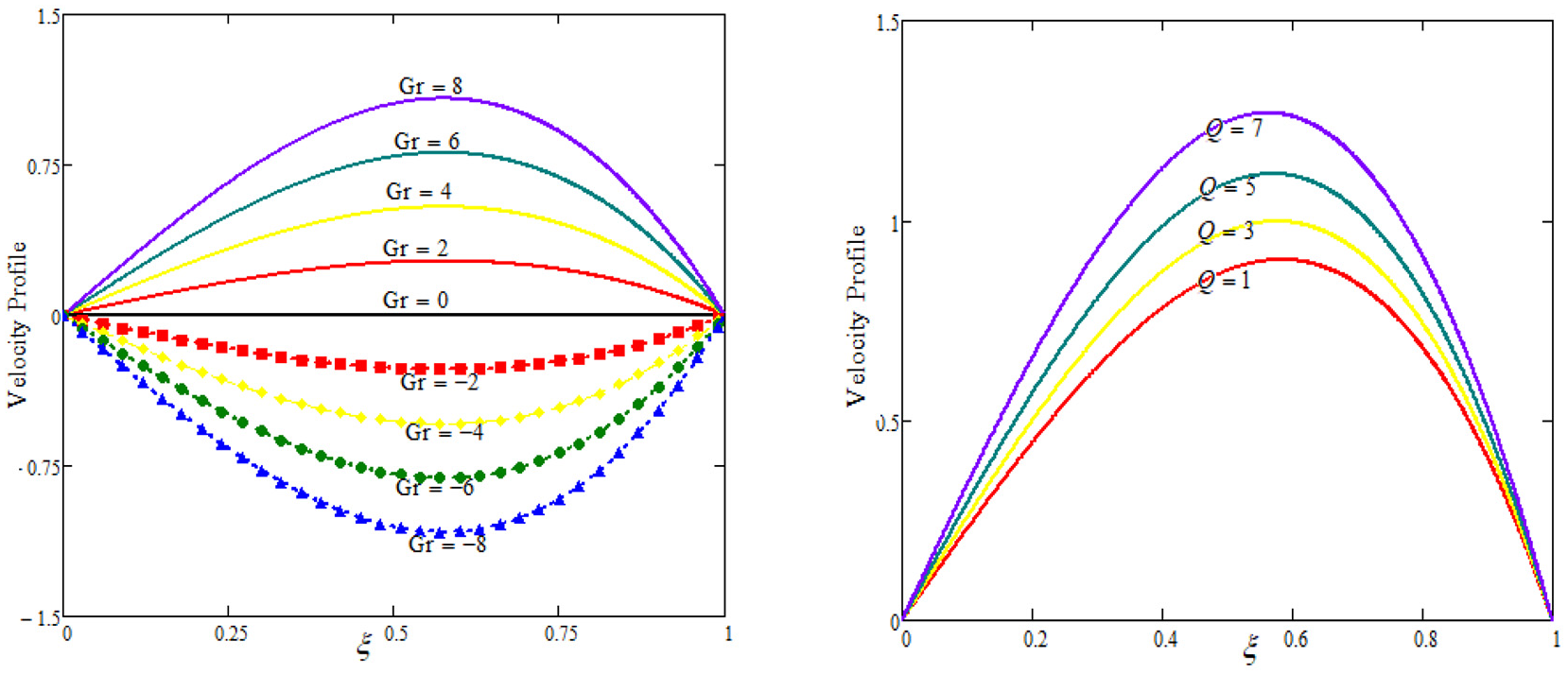
Velocity profile due Gr and Q variation.
The effect of

Velocity profile due Pr and
In Figure 7(a), effect of volume fraction of nanofluid is shown. The velocity for the hybrid nanofluid decreases with an increasing values of

Velocity profile due
In Figure 8(a), a comparison between the profiles of the Brinkman and Maxwell fluids is made. By assuming the fixed values to the Brinkman and Maxwell parameters respectively, we found that Maxwell heat transfer model has high values of velocity in comparison with Brinkman model. Further, to check the validation of the present results by letting
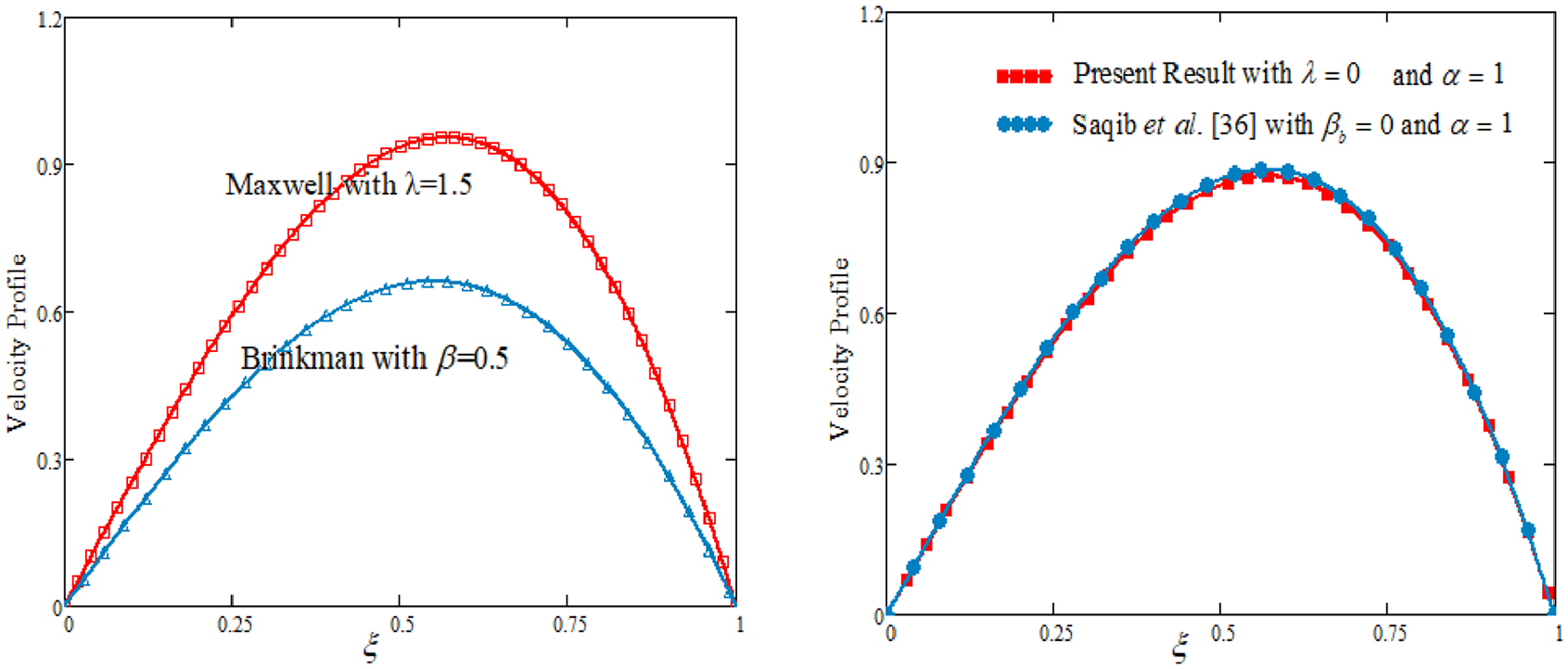
Comperisions amung the Maxwell, Brinkman, and ordinary fluids.
Figure 9(a) and (b) are sketched to see the validity of inversion algorithms namely Stehfest and Tzou’s algorithms, that are applied to obtain the numerical solutions of velocity and temperature fields. The coinciding curves of velocity profiles in Figure 9(a) and conceding curves of temperature profile in Figure 9(b) indicate the validation of inversion algorithms.

Validity of the inversion algorithms for velocity and temperature profiles.
Conclusion
A generalization is made for free convection flow of Maxwell nanofluid by introducing the definition of Caputo-Fabrizio of fractional order derivatives. Fluid motion in two vertical parallel plates is discussed. The explicit expressions for velocity and temperature are derived by applying Laplace transform. The effects of involved parameter on velocity profile are studied by plotting various graphs. Followings are the remarkable extractions of this research study:
Nanofluid velocity is an increasing function of Gr, Q, and
For increasing values of Pr and
Fluid velocity exhibits the dual behavior due to
Footnotes
Appendix
Handling Editor: James Baldwin
Declaration of conflicting interests
The author(s) declared no potential conflicts of interest with respect to the research, authorship, and/or publication of this article.
Funding
The author(s) received no financial support for the research, authorship, and/or publication of this article.
