



Abstract
This paper aims to inspect the mixed convective ciliary transport of ternary hybrid nanofluid through a curved channel having ciliated walls. Titanium oxide, Alumina oxide, and Silicon dioxide nanoparticles are taken for the current problem with blood as a base fluid. Due to the complexity of the flow regime, curvilinear coordinates are utilized to modulate resultant equations for two-dimensional flow under the consideration of heat source/sink effects. The attributes of ciliary structures are revealed by the dominance of viscous impacts over inertial impacts utilizing the long-wavelength approximation. The impacts of several interesting parameters on the flow fields are scrutinized via graphs. It can be examined that liquid velocity is enhanced by enhancing the cilia length parameter. The considered nanomaterials have remarkable applications in maintaining the heat transfer rate in blood flow through arteries.
Introduction
Motile cilia project from the unidirectional microscopic cell which seems like hair is important in the biological process. The phenomena are supposed to produce fluid transportation in most of the living things known as cilia beating. The back-and-forth movement of liquids in biological systems by motile cilia phenomena known as metachronal waves. Cilia movements play an essential function in the human body, for example, the reproductive system, breathing, blood flow, sustenance, and digestive system.1,2 In recent years, the mathematical modeling of cilia has fascinated the interest of numerous researchers due to tiny biosensors, drug systems, and actuators based on cilia. Theoretical study of Newtonian fluid with a ciliary motion MHD flow in a curved channel was investigated by Siddiqui et al. 3 The two dimensional flow of a viscous fluid in the presence of nanoparticles is observed in a curved channel with ciliated walls under lubrication approximation theory was discussed by Nadeem and Sadaf. 4 Maiti and Pandey 5 discussed the role of cilia motion in the transport of fluid through the ductus efferent of the male reproductive tract. Cilia-driven laminar flow of an incompressible viscoelastic fluid in a divergent channel was conducted by Javid et al. 6 Imran et al. 7 studied the electroosmotic flow behavior of a Williamson fluid model that involves integrating the effects of heat transfer within a microchannel featuring cilia-like structures on its walls. The flow properties with heat and mass transfer of multilayered flow of two immiscible fluids flowing due to ciliary beating in a channel under lubrication approximation theory were reported by Huang et al. 8 The mixed convective movement of a non-Newtonian Casson fluid is being investigated in the context of metachronal waves generated by biomimetic cilia within a curved channel was explored by Shakib Arslan et al. 9 Ijaz and Sadaf 10 examined the electrically conducting non-Newtonian fluid exhibiting viscous dissipation effects along ciliated boundaries. This fluid flows within an axisymmetric tube under the influence of electroosmosis. Understanding the implication of cilia actuation in biology and engineering fields, some interesting findings are given in the literature.11–14
Nanofluids deliver a more effective mechanism for improving heat transport performance than regular fluids. Technologically it was developed to improve the heat transfer efficiency for industrial and engineering designs. 15 In real-world applications, a technical fact is that regular base liquids such as oil, ethylene glycol, alcohol, and water do not have enough capacity to improve the heat transportation rate. This situation was appropriately resolved by adding very small particles to the regular fluid. Choi and Eastman 16 suggested that assorting nanoparticles in base fluids can improve their thermal properties more effectively. The nanofluid is a mixture of suspended nano-measured fragments in regular fluids, and the dispersion of these nano-sized pieces in base fluids generates nanofluids. Even with all of the difficulties in using different fluids as heat transfer mechanisms, more fluid types are still looking for characteristics that facilitate heat transfer. Therefore, an advanced type of nanofluid known as “ternary hybrid nanofluid” which has higher thermal performance than conventional nanofluids has been investigated. Ternary hybrid nanofluids are generated by dispersing different kinds of nanoparticles into working fluids (base fluid). In a nanofluid, different-sized nanoparticles are often dispersed to create an organized structure of molecules of a liquid around the nanoparticles, improving thermal conductivity and meeting industrial demands for significant cooling. In the past few years, numerous experimental methods of ternary composite nano liquids have been sophisticated to be able to achieve excellent superior thermophysical properties and heat transfer features of ternary hybrid nanofluid. As a further advantage, those fluids liquids conveniently meet the massive modern developing industries’ cooling requirements, where single and bi-hybrid nanomaterials are hampered. For example, Munawar and Saleem 17 discussed the theoretical thermal analysis of mixed convective transport of radiated magnetoternary fluid through an electroosmotic pump. Manjunatha et al. 18 inspected the mathematical investigation of electrical conducting heat phenomena in tri nanofluid flowing past a stretching sheet. Recently, Abbas et al. 19 reported the mixed convective peristaltic transport of ternary hybrid nanofluids between two sinusoidally deforming lubricated curved concentric tubes. Some important studies regarding nanofluid flow over various geometries can be seen through Refs.17,20–22
The transport of heat phenomena is a significant topic of the modern research era due to its numerous uses in applied science and engineering industries. For example, cooling is required to dissipate heat from electronic devices, petrochemicals, industrial processes, phase change materials (PCM), cooling and heating systems in buildings, textiles, vehicles and avionics, food and other factories, etc. Abbas and Rafiq 23 examined the heat and mass transfer phenomena on the peristaltic transport of hyperbolic tangent fluid in a tapered conduit and observed that fluid velocity declines with an enhancement of Darcy’s number, whereas its diminutions with an increase of Weissenberg’s number. Irfan et al. 24 analyzed the mechanism of heat transfer in the peristaltic motion of a Casson nanofluid through an asymmetric channel with considerations for velocity and thermal slip effects. The peristaltic flow with double diffusion convection of electrically conducting Prandtl nanofluid in a non-uniform channel under the influence of thermal radiation and viscous dissipation was reported by Akram et al. 25 Heat transfer phenomena inside a non-uniform channel in the context of electrically conducting peristaltic flow of the Jeffrey model were explored by Abd-Alla et al. 26 Some interesting mathematical models in the regime of heat transfer are reported in Refs.27–30
According to a review of the prior literature, several research studies have been carried out on the heat transmission of flowing the mono and bi composites hybrid nanofluid. Nevertheless, there is currently no accurate investigation has been conducted on the heat transmission and cilia flow of a ternary nanofluid in a curved channel having ciliated walls. Therefore, the current study highlights the role of mixed convective on cilia transport of ternary hybrid nanofluid through a curved channel. Further, the influence of the heat source/sink will be incorporated into the model to acquire the more effective heat transfer results of the ternary nanofluid model. The modified hybrid nanofluid is molded with the interaction of three distinct types of nanoparticles namely Titanium dioxide, alumina, and silicon dioxide with blood as a base fluid. The governed equations are simplified with the hypothesis of lubrication theory. The impacts of numerous involved parameters emerging in the solutions are carefully scrutinized and elaborated with the help of graphs. The findings of the results could be applied in various industrial and biomedical fields, particularly in the drug delivery systems and micro transport phenomena. Such studies also help in designing smart artificial cilia for the swimming of sperm and the movement of mucus.
Mathematical formulation
Consider the two-dimensional mixed convective flow of blood-based ternary hybrid nanoparticles


Problem geometry.
This equation can also serve as a representation of the flexible boundary of the flow channel. Here,
Based upon different patterns of cilia motion observed by Satir, 1 the cilia tips can be considered to move in elliptical paths such that the horizontal positions of the cilia tips can be written as:

where,

Invoking equations (1) and (2) into equation (3), we achieve

In the above formulation of velocity components, we are capable of differentiating between the cilia’s forceful effective stroke and the subsequent, less impactful recovery stroke by approximately accounting for the shortening of the cilia. The governing equations of tri-hybrid nanofluid in a curvilinear system are given by 4 :

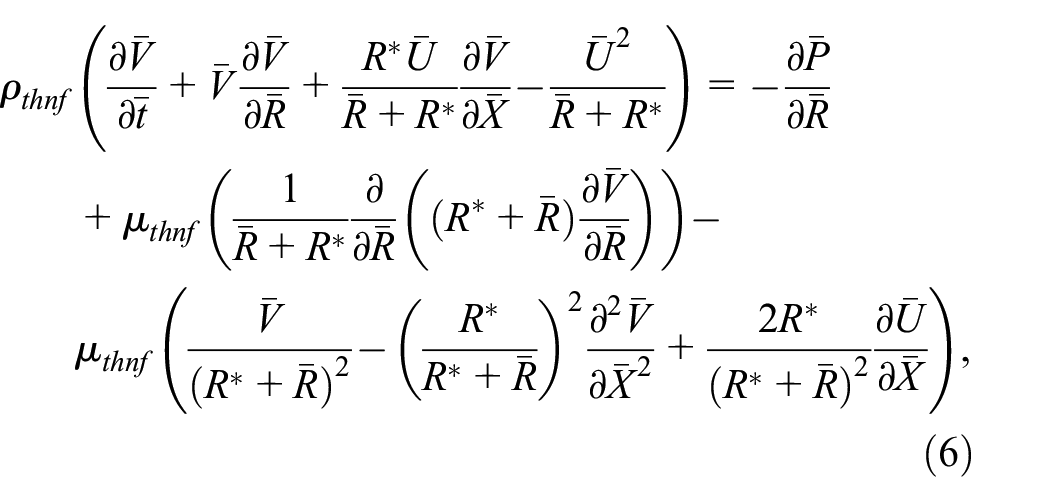


where
The associated boundary conditions are

The tri hybrid nanofluid characteristics of





Where
Thermophysical model significance of tri-hybrid nanofluid

Transformations between moving and fixed frames are

The dimensionless quantities are:

Lubrication theory is a mathematical framework used to analyze the behavior of fluid flows within thin gaps or layers. It is commonly applied to situations where the dimensions of the flow region in one direction are much smaller than in the other directions. In these scenarios, the fluid flow can be considered dominant in one direction, leading to simplifications in the governing equations. Numerous researchers have adopted these assumptions for cilia flows, as evidenced in Refs.13,25,27,28 Considering the significance of these assumptions, and employing equations (15) and (16) along with the low Reynolds number and long wavelength assumptions, equation (5) becomes identically zero and equations (6)–(8) finally yield:


with

Solution methodology
The closed-form solution of equation (19) with boundary conditions is given as

After a few simplifications, the solution of equation (18) once again will be obtained integration technique with appropriate boundary conditions given in equation (20) through Mathematica software 11.0.

where

The expression for volume flow rate is given as

The expression for pressure gradient is obtained by using equation (23) and given as:

Where


Here

Stream functions are determined from the expressions

The skin friction coefficient and the Nusselt number are defined as

Graphical interpretation and discussion
In this section, the computed solutions for velocity, temperature, pressure rise, stream functions, skin friction, and Nusselt number are displayed graphically for rising values of emerging meaningful parameters by considering three distinct types of nanoparticles namely Titanium dioxide, alumina, and silicon dioxide with blood as a base fluid. For the computational analysis in this study, the subsequent parameter values are employed:
The effects of the heat source/sink parameter

Variation in the temperature distribution
Figure 3(a) to (d) describes the impact of the Grashof number
Variation in the velocity distribution
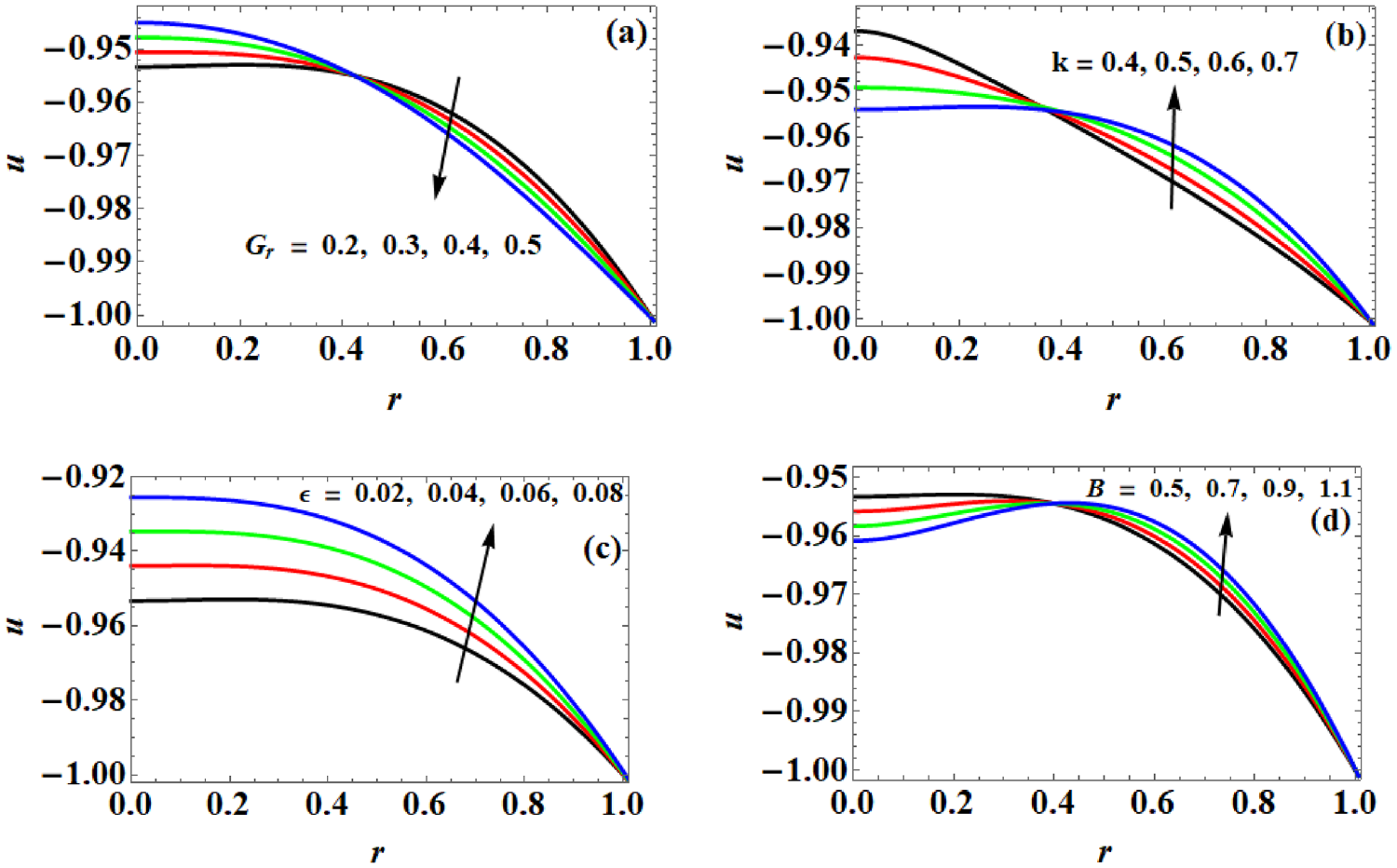
The impacts of the curvature parameter
Variation in pressure rise
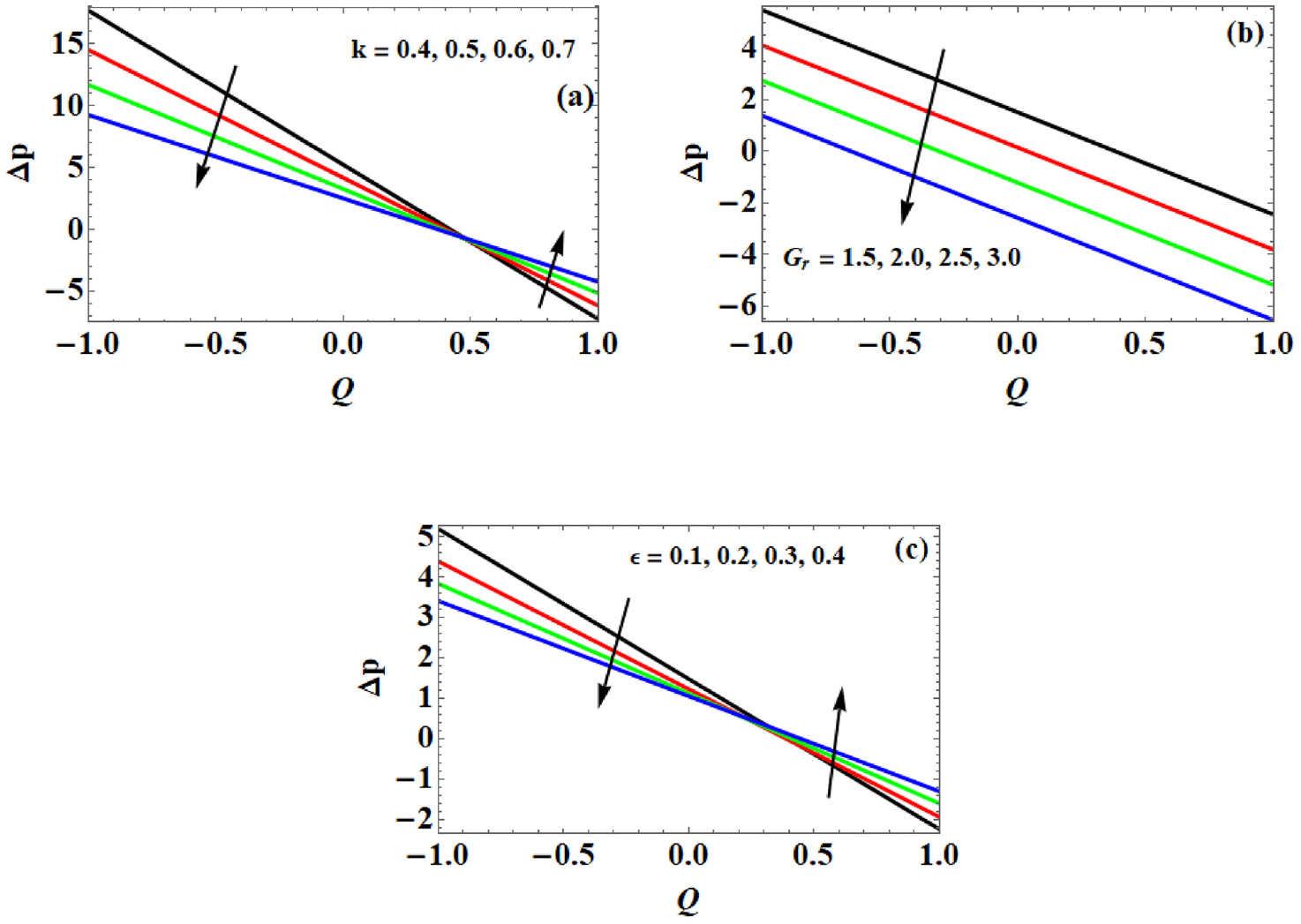
The influence of different constraints on the pressure gradient

Variation in pressure gradient for (a) curvature parameter, (b) Grashof number and (c) cilia length parameter with
Figure 6(a) and (b) is designed to see the comparison of nanofluid, hybrid nanofluid, and ternary nanofluid with base fluid on the temperature and velocity profiles. It can be seen that the fluid temperature and velocity are higher for ternary hybrid nanoparticles compared to nanofluid and hybrid nanofluid when

Comparison of mono/bi hybrid/ternary nanofluid for
In cilia flow problems trapping is another important characteristic of the fluid. In this phenomenon, the circulating boluses appear near boundary walls under certain physical conditions. Their transportation relies on the structure of peristaltic waves since they move in the same direction and speed as peristaltic waves do. The formation of trapping regions and streamlines are observed for numerous values of involved physical parameters in Figure 7(a) and (b). Streamlines for different values of heat source/sink parameter

Variation in streamlines for

Variation in streamlines for

Variation in streamlines for

Streamlines for (a) nanofluid, (b) hybrid nanofluid and (c) tri-hybrid nanofluid with the other parameters are
Figure 11 illustrates the deviation in the Nusselt number

Variation in Nusselt number
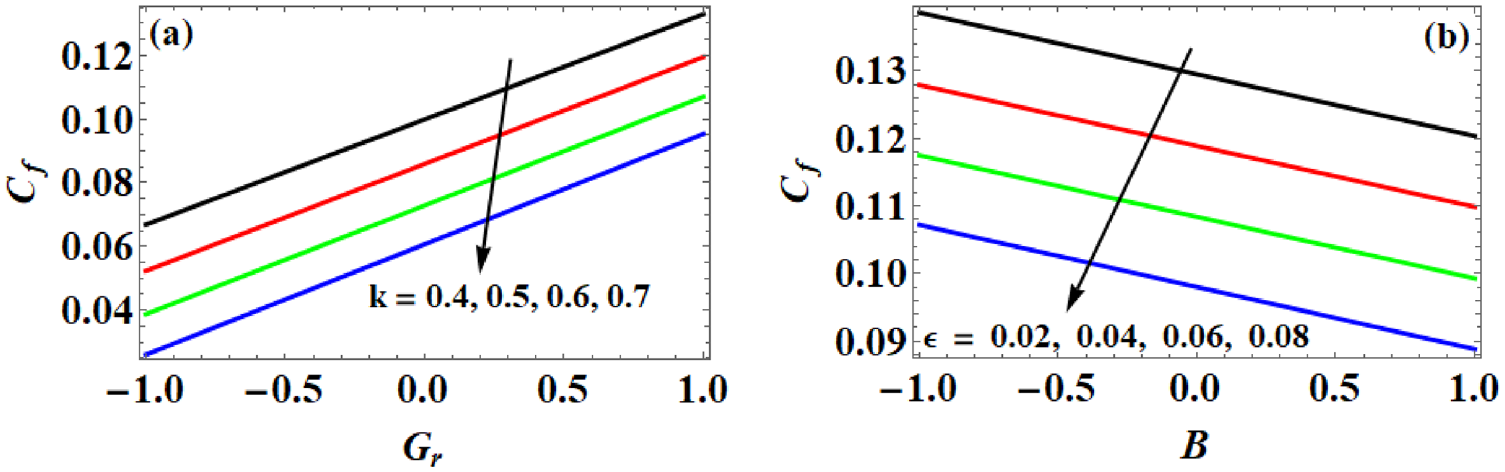
Variation in the skin friction
Validation
The objective of this section is to authenticate the accuracy of our findings. To validate the obtained results, a comparison of the limiting case of the present investigation for the velocity profile in the absence of bi-hybrid nanofluid and tri-hybrid nanofluid parameters with the results reported by Nadeem and Sadaf 4 (see Figure 13). This graph indicates that both results are in good agreement.

Comparison of the limiting case of the present study with the results of Nadeem and Sadaf. 4
Conclusions
The current study discussed the cilia transport of mixed convective ternary nanofluid in a curved channel under lubrication approximation theory. The exact solutions are attained for axial velocity, pressure gradient, stream function, pressure rise, and fluid temperature. The suspension of nanomaterials
The fluid temperature rises with the enhancement of heat source/sink and curvature parameters. The heat sink/source effects are considered to maintain the homogeneous temperature to improve blood circulation inside the human body.
The momentum profile decreases for the Grashof number and increases for the curvature and cilia length parameters.
Pressure rise enhances the retrograde pumping and declines in the augmented pumping area by enhancing the curvature parameter.
The pressure gradient decreases for increasing values of curvature parameter and Grashof number.
The tri-hybrid nanofluid is scrutinized to be more thermally proficient than the bi-hybrid and simple nanofluid.
It observed that the regularity of trapped boluses is disturbed by the values of the Grashof number and curvature parameter.
Footnotes
Appendix
Acknowledgements
We are thankful to the reviewers for their encouraging comments and constructive suggestions to improve the quality of the manuscript.
Handling Editor: Chenhui Liang
Declaration of conflicting interests
The author(s) declared no potential conflicts of interest with respect to the research, authorship, and/or publication of this article.
Funding
The author(s) received no financial support for the research, authorship, and/or publication of this article.
