




Abstract
Lube oils are the viscous petroleum products used in automobiles to reduce the friction. The eventual fate of lube oil is either incineration or dumping off into ground, but these resources cannot be disposed off easily due to their libellous effects on environment. This article aims to study the regeneration of deteriorated oil and impact of regenerated oil on engine performance and engine emissions. The effectuality of regeneration is studied by comparing the results of the key parameters (specific gravity, viscosity, total acid number, flash point and ash contents) of regenerated oil with that of non-deteriorated and deteriorated oil. Engine performance and emissions for regenerated oil were compared with non-deteriorated and deteriorated oil. The brake power and torque increased by 4.1% and 4.6%, respectively, following the regeneration process. After re-refining of lube oil, specific gravity, flash point, kinematic viscosity, ash content and total acid number improved by 6.75%, 2.66%, 15.6%, 1.7% and 10.64%, respectively. In case of deteriorated oil, HC, NOx and CO increased by 23.6%, 42.2% and 11.8%, respectively. But after regeneration of oil, these emissions decreased as compared with deteriorated oil. It can be reasoned out that regeneration mends oil properties and has positive impact over engine performance and emissions.
Keywords
Introduction
When two bodies are in contact either in state of rest or in motion, there is always an opposing frictional force between them. This frictional force may lead to serious wear, tear and even breakage of components in automobile engines. 1 In order to enhance engine efficiency and reduce fuel consumption as well as emissions, the frictional losses between lubricated surfaces should be minimized. It is reported that 20% to 30% of frictional losses take place at piston-ring assembly, which emphasized that the significance of tribological performance should be noticed.2,3 The engine performance and durability can be improved by reduction in oil consumption, friction power losses and emissions. Therefore, mechanical power losses between lubricated surfaces become an attractive area of research in improving performance of internal combustion (IC) engines.4,5 In order to protect rubbing surfaces, petroleum products like engine oils are widely used in IC engines. Other than this, it also transfers heat from engine to surroundings and acts as coolant. During its performance, it faces temperature changes which lead to oil aging and when foreign particles like dust and metal chips are added, it loses its properties. The enormous research is conducted on inclusion of different additives in lube oil for efficient operations of an engine, reduction of friction, prevention from engine wear and reduction of high temperature between moving surfaces. 6 The mentioned activities with increased utilization time are responsible for loss in lubricant properties. 6 In this respect, used (deteriorated) oil must be evacuated and replaced with fresh oil. However, disposal of deteriorated lube oil is the main and serious issue as it can pose detrimental effect on human, plant, animal and aquatic life. Deteriorated oil is more poisonous, toxic and harmful than non-deteriorated oil. Generally, used oil is incinerated and dumped into landfills which may have serious impact over environmental conditions 7 because of hydrocarbons, heavy metals, polychlorinated biphenyls (PCBs) and other halogen compounds. 8
In order to counter such threat, waste lube oil is regenerated to turn it to usable product so that the quantity of lube oil being disposed off improperly can be lowered. The regeneration of used lube oils is a physicochemical conversion process which comprised of the removal of mechanical and oxidation contaminants from the oil. These contaminants might be engine sludge or products of oxidation from chamber, wearing or interactions between the engine oils and fuels. Moisture inside the crankcase and fuel tanks by natural breathing constitutes a contaminant of lube oil. 8 Regeneration does not only produce valuable resources but also provide extra consumption loop to oil life. It was pointed out in the world environment conference that the incredible increase in the petroleum waste should be reduced. The total global population has now become more than 7 billion and it is necessary to reduce petroleum waste in order to save life of billions of people. 9 The possible effective remedy for the lube oil waste is to collect and convert it to reusable forms. 10 Another major focus for this study is the fact that fossil fuels are now having limited resources around the globe which is an alarming situation for human race and they are bound to find techniques for recycling or alternate sustainable resources.11,12 In the era of advancement, the green environment is the focal point in automotive industries. 13 Almost 85% of the global energy production is ascertained mainly by the combustion process. 14 Combustion is basically a series of auto-ignition events with negligible propagation of flame. This combustion characteristic favours the gasoline engine to operate at lower temperature and lower NOx emissions. 15 Regeneration methods can significantly help to control pollution and pressure on petroleum resources. Different regeneration methods known are acid treatment, distillation method, activated charcoal method and solvent extraction.16–19 Abdulkareem et al. 20 revealed that acid treatment was the most effective technique to change the characteristics of the treated oil close to the non-deteriorated sample. It is a simple method which requires lower cost for oil treatment. 21
The importance of lube oil in an IC engine has its own fountain of knowledge. Gasoline engines operate at lower temperature; however, during recent years they have been attracting significant attention because of their potential to achieve higher thermal efficiency like diesel in order to lower NOx emissions and soot particles in contrast with diesel engines. 22 Similarly, alternative fuels gained significant attention in order to achieve clean burning and sustainable environment in terms of emissions. 23 However, effects of these fuels and modern technologies have not been discussed extensively. Usman and Hayat 24 used LPG as an alternative fuel in a bike engine for comparing the results of performance, emissions and lubrication. They concluded that the deterioration of lube oils due to gasoline and LPG fuels has increased the values for emissions (HC, NOx, CO2, CO). Similarly, they 25 used CNG and Hi-octane gasoline in spark-ignition (SI) engine which causes the deterioration of oil leading to higher pollutants. The lube oil prevents 20% frictional losses, hence its quality is the direct indicator for the fuel economy and overall efficiency. 26 Many researchers highlighted the crucial role of lubricating film thickness and the methods to decrease the friction and increase the life of oil film in IC engines.2,27–30 It has been successfully shown that re-refining of used motor oil is possible in many ways. 31 The objectives of this study are the reuse of lube oil by acid treatment method and comparing the properties of used, fresh and regenerated oil. This research work also focuses on analysing the effect of regenerated oil on engine performance and emissions. It will help in finding the new ways and applications of extra consumption loop in waste management and will ensure the sustainability of eco system. Almost all previous research related to regeneration of lube oil included comparative change in the physicochemical properties of lube oil. However, in the current work, the additional work to the previous research is that both performance and emission characteristics are evaluated for fresh, deteriorated and regenerated lube oil in order to highlight the effectiveness of regenerated oil. The current research would also motivate conversion of used lube oil to cheap heating fuel for boilers, furnaces and heat exchangers. A few of the important lube oil characteristics are given as follows.
Properties of lubricant
Flash point is the minimum temperature at which the vapours of the lube oil instantly combusts once provided with an ignition source. The increased value of flash point indicates the evaporation of lower mass compounds and increase in ash contents (a parameter to assess the purity) of lube oil. Moreover, higher ash contents tend to raise the viscosity, that is, resistance to oil flow and specific gravity of lube oil, whereas mixing of unburned fuel with the oil decreases the viscosity and flash point value. 32 Another important property of lube oil is its total acid number (TAN), which needs to be monitored repeatedly for the safe operation of engine. TAN is proportional to the oxidation of the lube oil and responsible for changing its chemical composition and also its physicochemical properties. 33 Acidic compounds produced in the oils may result in the corrosion of metals.
Methodology
The overall methodology is focused on two main sections: test preparation and test plan.
Test preparation
For the experimental work, the lube oil used was PSO CARIENT 20W-50 (properties shown in Table 1). For regeneration of deteriorated oil by acid treatment method, apparatus including magnetic stirrer, conical flask, conical funnel, tripod stand, pH indicator, filter paper and measuring cylinder were utilized. The main chemical agents for the treatment were phosphoric acid (up to 95%), potassium hydroxide and liquid bleaching agent.
Engine oil properties (20W-50).

TAN: total acid number; ASTM: American Society for Testing and Materials.
Regarding performance and emissions analyses, the test bed consisted on LOMBARDINI SI Engine (Model: IM-359), THEPRA digital dynamometer, EMS-5002 exhaust gas analyser, hygrometer and thermocouples as shown in Figure 1 was employed. Furthermore, accuracy of measurements is displayed in Table 2. The fuel employed for the study was gasoline (G-97) (properties shown in Table 3). A calibrated transparent cylinder, with a resolution of 1% of complete reading, was used to measure G-97 flow rate into the engine cylinder to calculate brake-specific fuel consumption (BSFC).
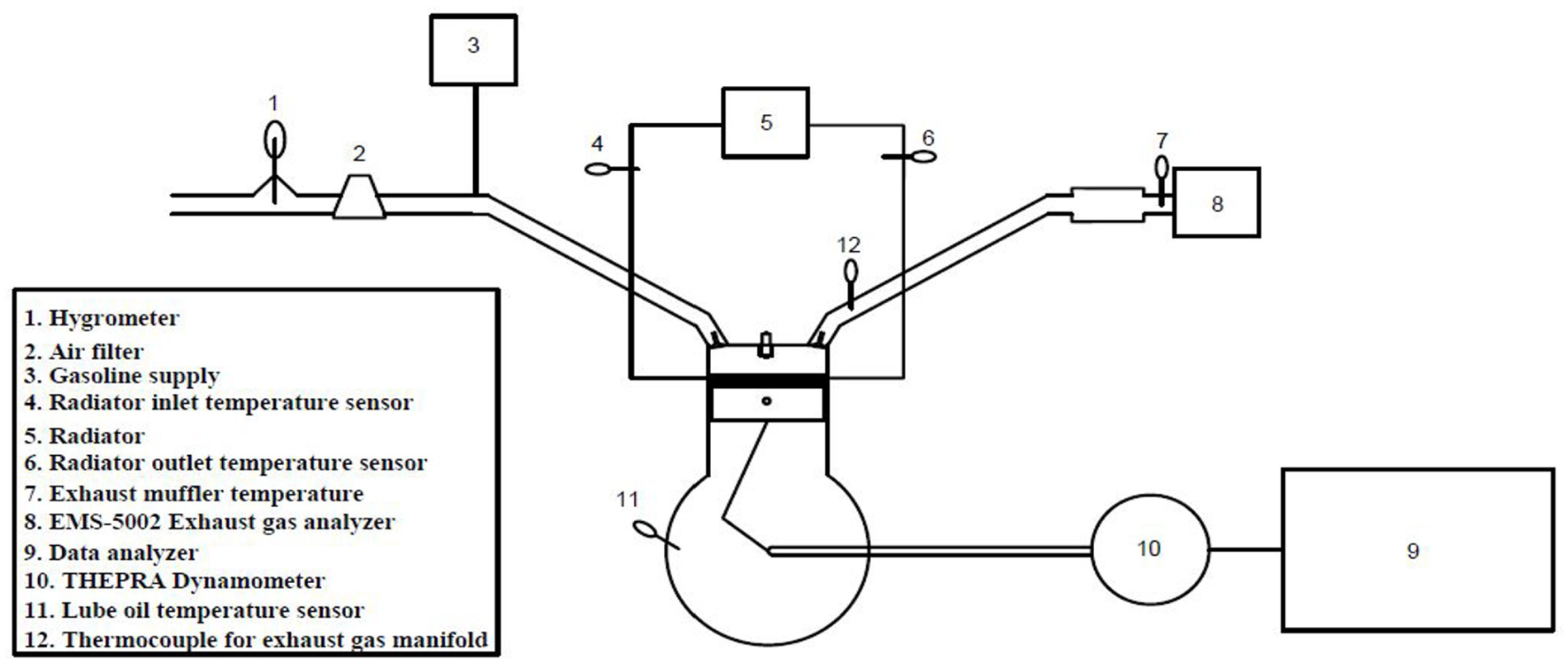
Schematic diagram of experimental setup.
Accuracy table.

Properties of G-97.

Test plan
Engine performance analysis was carried out for non-deteriorated oil using digital dynamometer. The test engine throttle was kept constant (75%) and speed was altered by varying the load on the engine for range of speed. BSFC was measured by recording time required to consume 20 mL of the gasoline at different speeds. For emission analysis, engine speed was kept constant for percentages of load range. Emissions were quantified utilizing EMS-5002 apparatus. Later, the oil was run in the engine for 100 h as recommended by the manufacturer. Subsequently, performance and emission tests were performed for the used (deteriorated) oil under same external conditions. After successful running and analysis, a sample of deteriorated oil was extracted and tested according to the ASTM standards as shown in Table 1. The physicochemical properties like specific gravity, kinematic viscosity, flash point, ash contents, viscosity index and TAN of deteriorated lube oil were determined.
In the experimentation, the deteriorated lube oil was regenerated using MEINKEN technology due to its simplicity, lower initial investment and lower operating cost. 34 First, deteriorated oil was allowed to settle for 24 h. This allowed sedimentation of dirt, metal chips and other heavy materials mixed in oil. After 24 h, oil was filtered, and 300 mL of deteriorated oil was heated up to 45°C using magnetic stirrer with continuous stirring in the glass beaker to remove water and light hydrocarbons. At 45°C, 30 mL of phosphoric acid was added to beaker and stirred for 10–15 min continuously to remove other phosphide and nitrogen compounds. Afterwards it was allowed to settle for 24 h. On next day, upper layer of oil was decanted, and lower layer was disposed as it constituted acidic sludge and heavy particles. In the very next step, acidic oil was treated with 12 mL of liquid bleach for 15–20 min. Next, the treated oil was neutralized by potassium hydroxide. The pH of the oil was recorded continuously and laterally it was made neutral. After neutralization process, oil was allowed to settle down for 24 h. On next day, the treated oil was filtered with filter cloth (see Figure 2) and samples were tested against relevant ASTM standards (see Table 1). For the regenerated oil, performance and emission analyses were carried out repeating the same procedure used for non-deteriorated and deteriorated oil.

Regeneration procedure.
Results and discussion
Overall methodology enabled us to compare the resulting values of key properties of non-deteriorated, deteriorated and regenerated oil and impact of each oil on engine performance and emissions to dictate the flexibility, performance and effectiveness of regeneration procedure.
Lube oil properties
Some of the key parameters that dictate the performance of engine oil are specific gravity, flash point, TAN, kinematic viscosity, ash content and physical colour. Keeping in view these properties, the effectiveness of regeneration can be easily comprehended. Figure 3 shows the comparative results of the key parameters for non-deteriorated, deteriorated and regenerated lube oil. The x-axis refers to the standard parameters of non-deteriorated oil previously mentioned in Table 1.
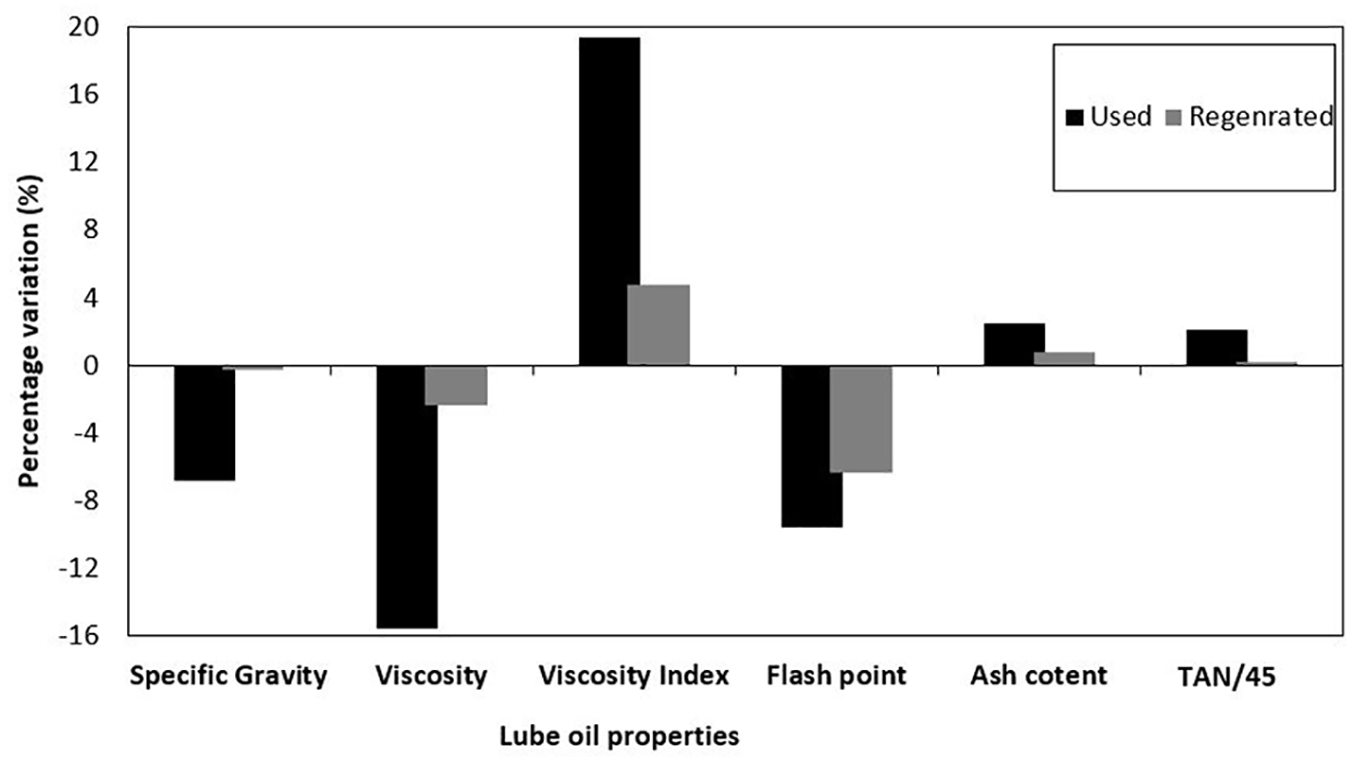
Percentage comparison of lube oil properties.
It can be easily interpreted that deterioration of oil leads to reduction in specific gravity, that is, 0.844. This decline in the specific gravity can be accredited to the thinning of oil film due to mixing with fuel and elevated temperatures in the cylinder. The increase in the value of specific gravity by acid treatment was 6.75% (0.901) which was adequately closer to the standard value of 0.906. Kinematic viscosity reduced in used oil from 10.53 to 8.89 cSt and improved up to 15.6% (10.28 cSt) by regeneration process. The decreased value of kinematic viscosity can be attributed to the increased oxidation, decay of additives and dilution of oil during the advocated running hours.24,25,35 The flash point result for used oil showed the reduction of 8.8% (228.91) from 251°C (non-deteriorated oil). This decline can be attributed to the fuel contamination during the engine working as due to higher temperature larger molecules break down to smaller molecules. Regenerated oil successfully recovered the value up to 2.66% (235°C) which showed potential to be used again in the engine. The flash point of lube oil should be high so that lube oil continues its operations adequately even in higher temperature. Non-deteriorated oil has no ash contents in it; however, due to combustion products the ash content appeared into the oil mainly because of wear and tear inside the engine. The used oil showed 2.5% ash content which was greatly reduced to 0.8%. It was also found that TAN increased to 2.35 mg/g KOH due to oxidation of the used lubricating oil. The oxidation reactions responsible for formation of oxides then react with other compounds to produce acids. These acids increase the acid number of oils.24,25,36,37 It was observed that there was 10.64% reduction in TAN for regenerated oil by neutralization process and also by bleaching agents so the TAN reduced to 2.1 mg/g KOH.
Significant studies have been carried out for regeneration procedures; however, extensive efforts are required to ascertain the impact of regenerated oil on engine performance and emissions. The next two sections describe the very output of the current study for sustainable environment.
Engine performance
Figure 4 represents torque variations for non-deteriorated, deteriorated and regenerated oil. For the fresh oil (PSO 20W-50), the maximum torque was recorded as 14.1 Nm at 2600 r/min. After successfully executing its function, it was reduced to 12.7 Nm at the same speed. This can be explained by the degradation of the properties of oil. For regenerated oil (treated with phosphoric acid), torque was found as 13.5 Nm at the same speed. The average torques over the speed range for non-deteriorated, deteriorated and regenerated oil were 11.9, 10.7 and 11.4 Nm, respectively, that showed 4.6% increase due to improvement in properties after re-refining process. It can be inferred that the deterioration leads to loss in the oil properties and, consequently, increase in frictional losses caused reduction in brake torque.24,35,38

Brake torque variations for three different lube oils.
Figure 5 represents the brake power variations for each different oil conditions. Similar trend was observed for the lube oils in case of brake power. For non-deteriorated oil, the maximum power was recorded as 4.3 kW. It was decreased for the deteriorated oil to 3.9 kW. The improvement of 3.4% (4 kW) was observed for regenerated oil in comparison with deteriorated oil. Moreover, the average brake power was decreased at constant throttle position due to deterioration of lube oil. 24 It can be observed that the brake power increased up to a specific r/min and then it decreased. It can be explained by the higher power losses at higher r/min. With the deteriorated oil, the brake power was minimum at the maximum r/min, that is, 3.2 kW at 3200 r/min as compared to non-deteriorated and regenerated oil. The results indicated that there was an average decrement of 9.1% in BP for deteriorated oil and the regenerated oil regained the value with an average increase of 4.1% in brake power as compared to used oil. In the IC engine, the motion of piston produces power. This power producing element is to face frictional resistance during its motion which dissipates some of its energy because it has to do work against that frictional resistance. The lesser the frictional effects are, the more power is produced. The reduction in kinematic viscosity due to fuel dilution causes loss of lube oil film thickness. Consequently, mating parts expose to each other which directly enhances frictional losses. For regenerated oil, kinematic viscosity, specific gravity and TAN number improved and were considerably better than that of deteriorated oil. Hence, engine working, with regenerated oil in service, reduced the frictional loss, that is, improved brake torque and power.

Brake power variations for three different lube oils.
BSFC determines the fuel consumed by engine for production of unit kilowatt energy. The increased friction in case of deteriorated oil demands more fuel for producing a unit power. Figure 6 represents the variations of BSFC for various oils. At lower and higher r/min, the fuel demand is higher due to excess heat loss through relatively colder cylinder walls and higher frictional irreversibilities respectively. 39 The average increase in the BSFC value was 11.2% after the deterioration of lube oil. The regeneration enabled the reuse of oil in the engine and the average BSFC decreased by 6.4% as compared to used oil. Regenerated oil shows better results for BSFC as compared to deteriorated oil due to its improved lubricating properties. The engine operating with deteriorated oil faces higher frictional resistance and effectively requires greater amount of fuel to produce unit power. However, in case of regenerated oil, the improvement in viscosity, flash point value and higher oil sticking to the walls, that is, improvement in specific gravity, produce less frictional resistance. Therefore, less amount of fuel is required to produce unit power.

BSFC variations for three different lube oils.
Engine emissions
Effectiveness of regenerated oil in engine cylinder can be solidly established by comparing engine emissions for fresh (non-deteriorated), used (deteriorated) and regenerated lube oil.
Hydrocarbon emissions for three types of oils are shown in Figure 7. The test engine running on used oil emitted highest HC emission contents in comparison with fresh and regenerated oil. HC emissions showed an increasing trend for the deteriorated oil with 142 ppm as the highest value. The raise in HC emissions could be because of the excess absorption/desorption of G-97 by the deteriorated lube oil.40–42 Re-refining recovers the potential of the oil as the average values were decreased by 9.9%.

HC emission variations for three different lube oils.
Figure 8 shows the emissions results for carbon dioxide (CO2). With the increasing demand of power, fuel consumption increases and due to excess combustion, CO2 values are higher at greater torque percentages. The trends of CO2 emissions show that at higher torque, emission levels for acid-treated oil lie in between the fresh and used oils values. The test engine running on fresh oil showed maximum CO2 emission contents among all oils. It can be explained by the lesser fuel dilution and better combustion of G-97 inside engine.

Carbon dioxide emission variations for three different lube oils.
Nitrogen does not take part in combustion reaction at ordinary temperature but at higher temperature it reacts to from nitrogen oxides.12,43,44 It is clear from Figure 9 that NOx emissions for regenerated oil remain in-between used and fresh oil. Generally, at higher load percentages, rise in BP results in elevated temperatures causing higher NOx emission in the exhaust gas. The high friction between mating parts in case of deteriorated lube oil produces higher temperature which hastens the production of NOx as compared to deteriorated and regenerated lube oil.24,25 The considerable recovered properties of oil by acid treatment depicted 18.7% reduction in average NOx emissions.

NOx emission variations for three different lube oils.
CO emission generally increases with the increase in torque values. It can be well explained by the higher inertia of engine moving parts which subsequently decreases the time for proper mixing of fuel and air molecules. Therefore, relatively larger fraction of fuel particles exits from the combustion chamber after incomplete reaction with oxygen. The main reason for the formation of carbon monoxide is the incomplete combustion of fuel in engine cylinder.12,43,45 It is evident from Figure 10 that the average CO emissions for deteriorated oil are higher than the non-deteriorated oil. After acid treatment, 4.9% relative decrease in the CO emissions was observed in comparison with used oil.

Carbon monoxide emission variations for three different lube oils.
Conclusion
We live in the environment and protection of the environment is equally important to us as we cherish here. Nowadays, the most important and worth-reacting issue is environment protection and pollution. This includes air pollution as well as the water pollution. One gallon of the used oil can contaminate 1 million gallons of drinking water. In this experimental study, the acid treatment method yielded a regenerated oil which was used again and a comparative analysis has been conducted by using fresh, used and acid-treated oil in 4-stroke SI engine. The following conclusions can be drawn:
Keeping the fresh oil as standard, the deteriorated oil reduced the specific gravity and flash point by 6.8% and 8.76% respectively. After re-refining these lube oil properties were improved by 6.75% and 2.66% respectively. The kinematic viscosity of used lube oil reduced by 15.7% due to dilution of lube oil but after regeneration process, the kinematic viscosity improved by 15.6%. Ash content and TAN were observed to be increased by 2.5% and 39%, respectively, for deteriorated lube oil. After regeneration, the ash content improved by 1.7% and 10.64%, respectively.
On average the reduction in torque for deteriorated oil was 9.9% and the re-refining improved this deviation to 4.7%. Percentage decrement of 9.1% in average brake power was recorded for used oil and after treatment it was improved by 4.1%. Similarly, BSFC for deteriorated oil was increased by 11.2% and regeneration lessened the deviation to 4%.
The average values for HC, NOx and CO in deteriorated oil emission analysis were increased by 23.6%, 42.2% and 11.8%, respectively. In case of regenerated oil, the emissions were well controlled and evident for the reusage of lube oil. The deviations were reinforced to 11.3%, 15.5% and 6.6%, respectively.
Keeping in view above conclusions and discussion it can be inferred that the incineration and dumping off the used oil in landfills have negative impact over life but if the same oil is regenerated and used in the engine it will nearly recover the brake power, brake torque and emission criteria. Regeneration can provide an extra consumption loop to oil life cycle that will somehow solve the issues of deteriorated oil, thereby saving nature and capital cost too.
Footnotes
Handling Editor: James Baldwin
Declaration of conflicting interests
The author(s) declared no potential conflicts of interest with respect to the research, authorship and/or publication of this article.
Funding
The author(s) received no financial support for the research, authorship and/or publication of this article.
