



Abstract
This article is concerned with the study of free convective unsteady magnetohydrodynamic flow of the incompressible Oldroyd-B fluid along with chemical reaction. The fluid flows on a vertical plate that is impulsively brought in motion in the presence of a constant magnetic field which is applied transversely on the fluid. The structure has been modeled in the form of governing differential equations, which are then nondimensionalized and solved using a numerical technique, that is, Crank–Nicolson’s scheme to obtain solutions for velocity field, temperature distribution, and concentration profile. These solutions satisfy the governing equations as well as all initial and boundary conditions. The obtained solutions are new, and previous literature lacks such derivations. Some previous solutions can be recovered as limiting cases of our general solutions. The effects of thermophysical parameters, such as Reynolds number, Prandtl number, thermal Grashof number, modified Grashof number, Darcy number, Schmidt number, dissipation function, magnetic field, radiation–conduction, chemical reaction parameter, relaxation and retardation times on the velocity field, temperature, and concentration of fluid, are also examined and discussed graphically.
Keywords
Introduction
The concept of fluid flow is always around us either in the form of air surrounding us or water in rivers. The air is not still as well as water is not at rest in rivers. Air and water are always moving, but this fact was unknown either they are moving themselves or some forces are involved. When fluid mechanics was not developed, people did not know the actual reason of fluid flow.1,2 Fluid can be divided into many categories. The easiest subdivision is Newtonian and non-Newtonian fluids. Air and water are Newtonian fluids, while honey, starch, ketchup, toothpaste, plasma, and so on are non-Newtonian fluids. The non-Newtonian fluids can be further classified as of rate, integral, and differential types. The non-Newtonian rate type fluids have a special characteristic that they are viscoelastic in nature. They do not have linear viscosity, and they resist deformation due to their elasticity. In the last few years, the importance of viscoelastic fluids has increased a lot because they have many uses in engineering, geophysics, astrophysics, soil sciences, food processing, groundwater hydrology, limnology, oceanography, and so forth.3−5 Oldroyd-B fluid, presented by JG Oldroyd, 6 being an important subclass of non-Newtonian rate type viscoelastic fluids has been widely used by many researchers7−11 because of its important industrial applications. Oldroyd-B fluid stores energy like linearized elastic solids. This model can be considered as an extension of upper-convected Maxwell model and is equal to fluid filled with spring dumbbells and elastic bead.12,13
The unsteady magnetohydrodynamic (MHD) flow of viscoelastic Oldroyd-B fluids has auspicious usages in many technological and industrial processes. These usages comprise glass blowing, filaments, metal extrusion, metal spinning, artificial fibers, plasma flow, blood flow in vessels, food processing, and numerous industrial applications for the flow of different pasts and viscous foods of many kinds. Solving these nonlinear models in the presence of unsteadiness and chemical reactions is not easy. However, due to their applications as well as their exciting mathematical equations governing the flows; research activities on the topic of viscoelastic fluids in the presence of MHD and chemical reactions have enhanced significantly in the previous few decades and it is one of the thrust areas of latest research.14−18
In recent years, various efforts have been made to study the MHD convective flow of chemically reacting non-Newtonian fluids both analytically and numerically. For example, Shamshuddin et al. 19 carried out a numerical study of chemically reacting micropolar fluid passing through a permeable stretching sheet. They also analyzed the MHD unsteady free convection flow of chemically reacting Casson fluid on an inclined porous plate. 20 Magnetoconvective mass and heat transfer from the inclined surface has been numerically studied by Anwar Bég et al. 21 They also developed a mathematical model for nonlinear hydromagnetic, forced convection, steady flow of electroconductive magnetic nanopolymer. 22 Kataria and Mittal23,24 examined the temperature, mass, and velocity of the gravity-driven convective nanofluid flow passing on an oscillating vertical plate along with magnetic field and radiation. They also investigated the natural convective flow of Casson nanofluid passing on the oscillating vertical plate with ramped and isothermal wall temperature along with the magnetic field. 25
The impact of thermophysical parameters on different fluid flows has gained an outstanding position in the field of research, particularly in engineering, applied mathematics, and industry-associated research problems. The effects of these parameters are very much important in many industrial operations, for example, extrusion of plastics in the manufacturing of Nylon, textile industries, and refinement of crude oil, and thus become the center of importance and research for many scientists in recent decades.26−28 Sheikholeslami and colleagues29−31 studied the influence of numerous thermophysical parameters on the MHD flow of nanofluid through a porous medium. The impact of radiative flux, heat absorption, and gravity field on convection heat transfer has been examined in two-phase flow by Chamkha. 32 There is a scarcity of the literature about the influence of thermophysical parameters on the unsteady flow of Oldroyd-B fluids, but some interesting studies regarding the influence of several thermophysical parameters on the flow of viscous fluids are, for instance, the papers by Oyelami et al., 33 Soundalgekar, 34 and Palani and Srikanth. 35
All previous studies prove that the impact of thermophysical parameters on the flow of fluids, one way or the other, is very important depending on the problem type and boundary conditions. By using the idea of Oyelami et al., 33 we aim to explore new results regarding the impact of these parameters on the unsteady flow of Oldroyed-B fluid. Our objective is to solve highly nonlinear governing differential equations of the model using Crank–Nicolson’s (implicit finite difference) method. This scheme is selected, because it is highly accurate, unconditionally stable, and has fast convergence. The implicit finite difference method is one of the methods, which are used to increase the accuracy and efficiency of numerical solutions of partial differential equations (PDEs). The efforts to calculate more accurate solution by using limited grid sizes have drawn the attention of many researchers, and interest in using the finite difference scheme has been growing for the solution of PDEs.35−37 Proceeding numerically, we compute velocity, temperature, and concentration profiles for the unsteady free convective flow of an incompressible Oldroyd-B fluid. These results, which are new in the literature, give the complete pattern of flow and have widespread applications in many industrial fields. Furthermore, similar results for Maxwell and Newtonian fluids can be attained as limiting cases of our derived general results. Finally, the impact of appropriate dimensionless thermophysical parameters on velocity, temperature, and concentration profiles, as well as a comparison among models, is discussed and revealed by graphical illustrations.
Basic equations
Rheological equations of state for an incompressible Oldroyd-B fluid model are given as38,39

where

where the superposed


where

where
Physical model of the problem
Consider two-dimensional unsteady free convective laminar flow of an incompressible, radiating, electrically conducting Oldroyd-B fluid passing through a semi-infinite impulsively started vertical plate in the presence of chemical reaction. Suppose that the fluid is gray, nonscattering, absorbing–emitting, and viscous. The x-axis is chosen in the upward direction vertically along the plate, while the y-axis is placed orthogonal at the leading edge of the plate, which is taken as the origin of the x-axis, as shown in Figure 1. It is assumed that initially, the concentration of species and surrounding temperature at both free stream and plate are the same (i.e. at

Geometry of the problem.
Mathematical modeling of the problem
Using the Boussinesq approximation, basic equations (2)−(5) governing the flow of incompressible Oldroyd-B fluid model transformed to the following set of equations17,33,39

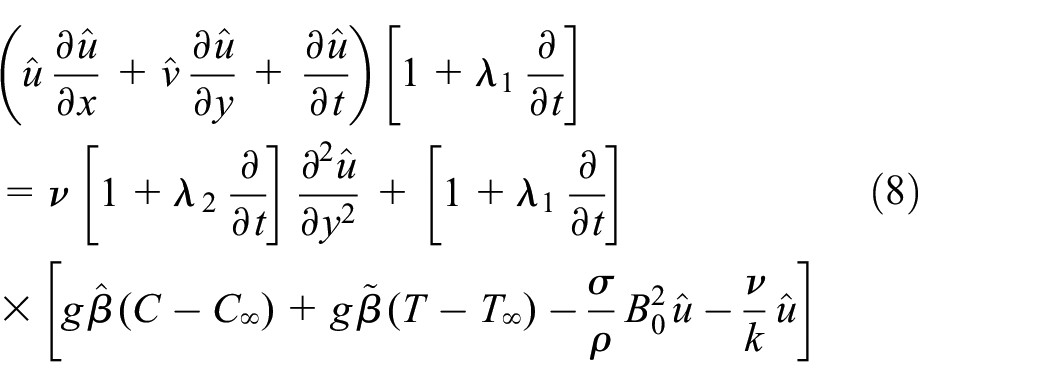


where




To simplify the radiative flux

Substituting equation (11) in equation (6), we have

By putting the value of

Dimensionless quantities
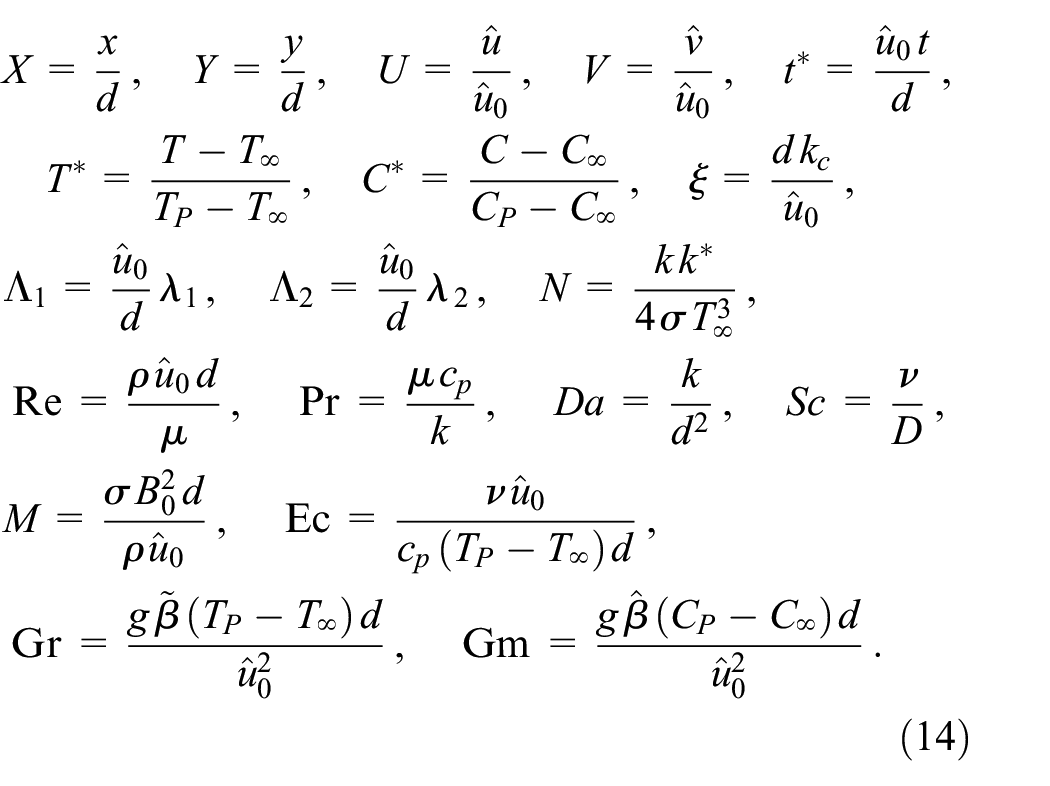
Now declaring the following nondimensional parameters with reference to the length of the plate
Dimensionless equations
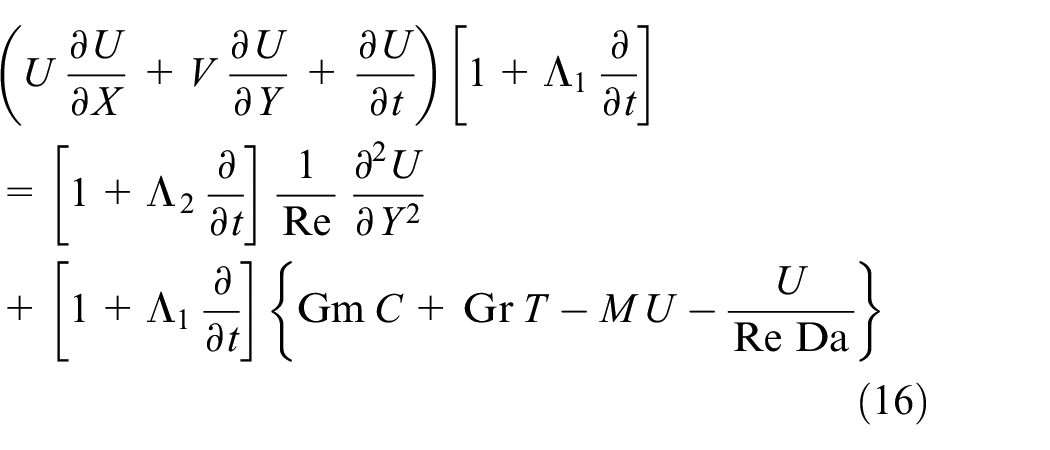
Putting the nondimensional parameters and quantities from equation (14) into equations (7), (8), (10), and (13), and boundary conditions, the updated dimensionless equations with associated boundary conditions after removing the superscript “*” for simplicity, are33,39



Dimensionless boundary conditions
Dimensionless initial and boundary conditions associated with differential equations (15)−(18) are given as33,35,39


Numerical solutions
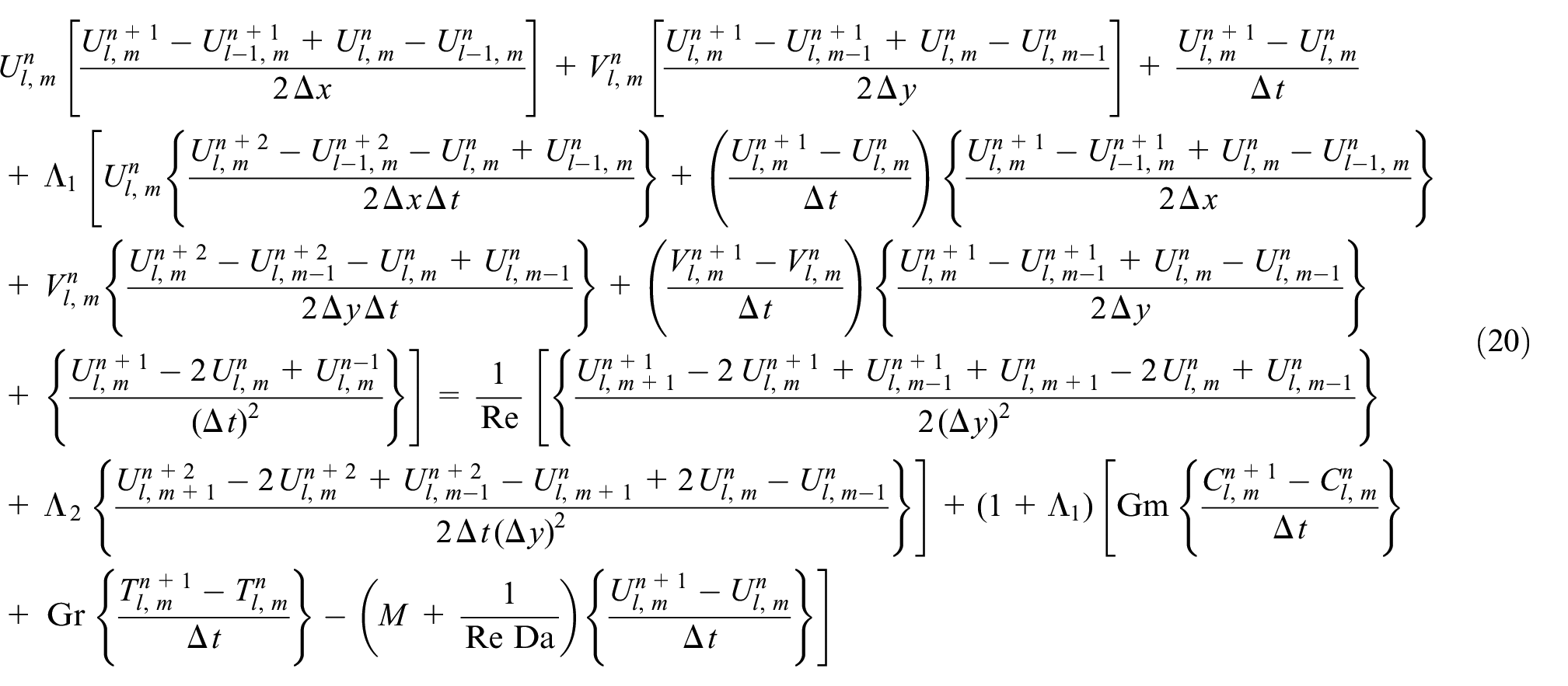
Now, we implement the implicit finite-difference Crank–Nicolson scheme to determine numerical solutions of dimensionless equations (15)−(18) using dimensionless boundary conditions. The corresponding implicit finite difference equations are33,39



For discretization of equations, the coordinates of mesh points are defined as

where

where the subscripts l and m are associated with x and y on the X- and Y-axis, respectively, while the superscript
The solutions are derived in the manner that first we compute values of

which becomes zero as the values of
Limiting cases
As limiting cases, alike results for models of Maxwell and Newtonian fluids can be acquired from our general results for the unsteady flow of Oldroyd-B fluid:
Graphical results and discussion
In this section, we present the effects of different thermophysical parameters, on velocity, temperature, and concentration profiles. The physical and thermal parameters are all dimensionless numbers, which are Reynolds number, Grashof number, conduction–radiation parameter, modified Grashof number, Darcy number, magnetic field, Eckert number, Schmidt number, chemical reaction parameter, and Prandtl number. For graphical illustrations, we present the contribution of pertinent parameters by varying one parameter and keeping all others fixed. The fixed values of parameters are: Ec (Eckert number) = 0.001, Gm (modified Grashof number) = 10.0, Pr (Prandtl number) = 0.1, Da (Darcy number) = 0.1, Sc (Schmidt number) = 0.5, Re (Reynolds number) = 1.0, M (magnetic field) = 10.0, Gr (thermal Grashof number) = 10.0, N (conduction–radiation) = 3.0,
Figures 2 and 3 illustrate that an increase in the value of magnetic field
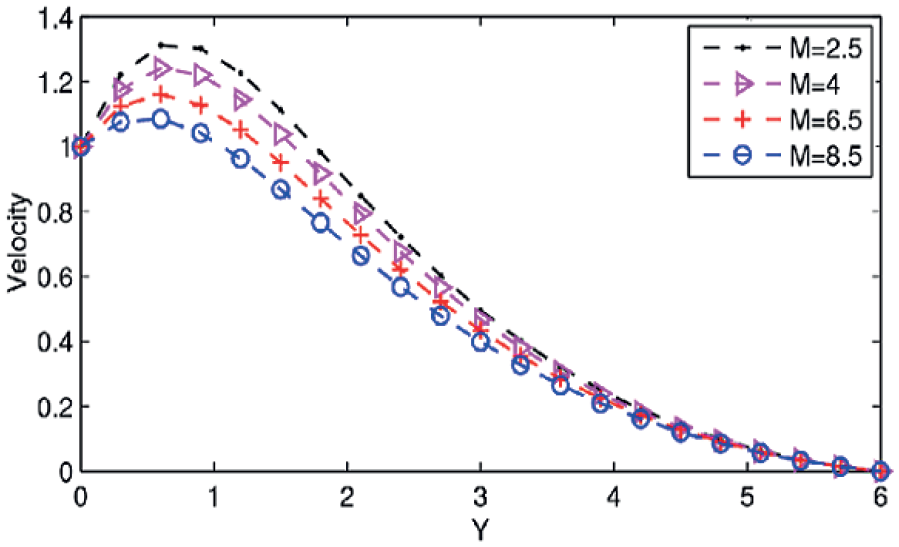
Effect of

Effect of
Figures 4−6 show that an increasse in the value of

Impact of
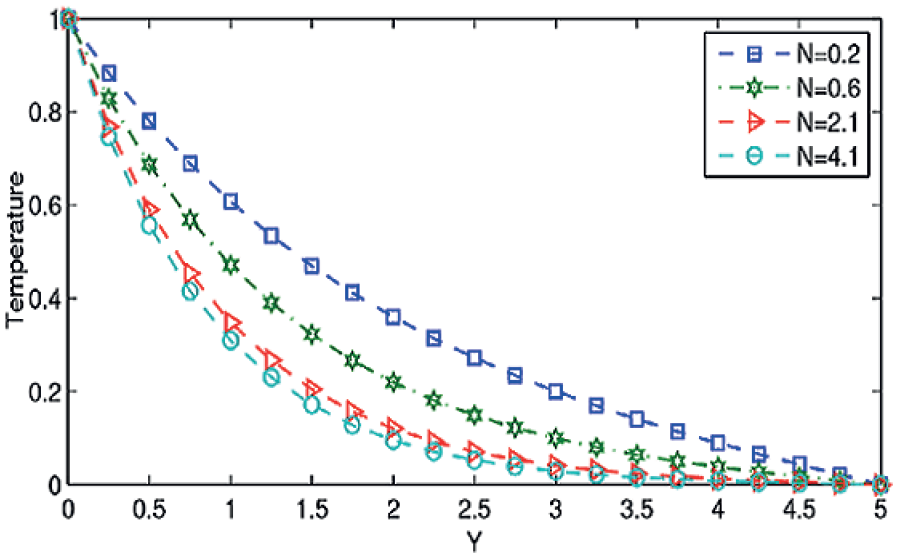
Impact of
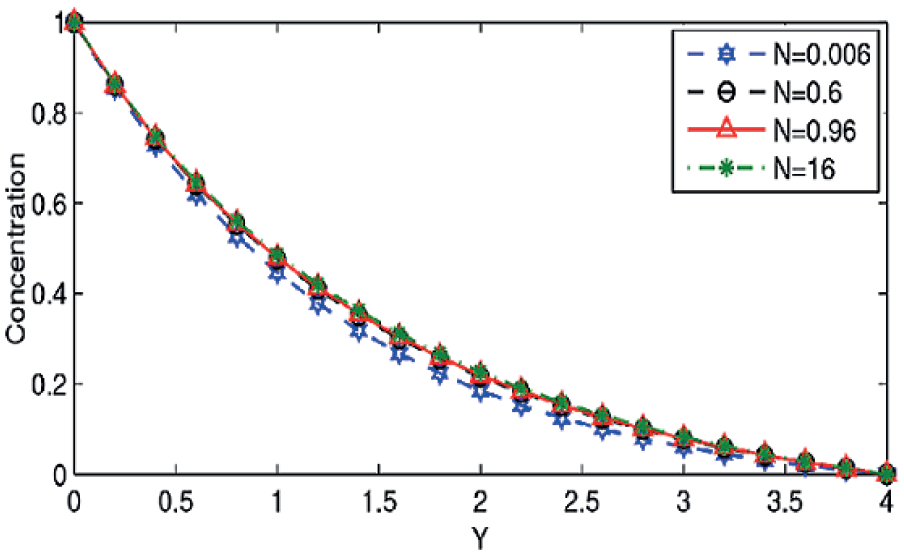
Impact of
Figures 7 and 8 demonstrate the effect of Gr (thermal Grashof number) on velocity and concentration profiles, respectively. Since an increase in the value of Gr causes an increase in buoyancy forces, the velocity profile increases while the concentration profile declines with an increase in the value of Gr.
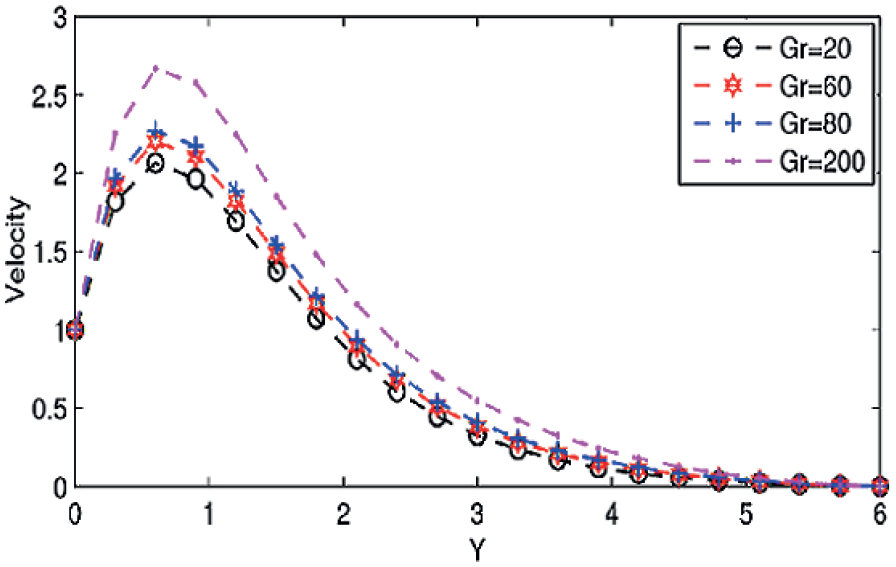
Effect of Gr (thermal Grashof number) on velocity, when

Effect of Gr (thermal Grashof number) on concentration, when
Figures 9 and 10 show the impact of Pr (Prandtl number) on velocity and temperature. Since the Prandtl number indicates the ratio of kinematic viscosity to thermal diffusivity, an increase in the value of Pr causes an increase of fluid’s kinematic viscosity, which results in a decrease in velocity and temperature.

Effect of Pr (Prandtl number) on velocity, when

Effect of Pr (Prandtl number) on temperature, when
Figures 11 and 12 show that an increase in the value of Eckert number (Ec) causes a decrease in velocity and temperature profiles, because the Eckert number deals with the relation between the enthalpy difference of boundary layer fluid and kinetic energy difference.

Influence of Ec (Eckert number) on velocity, when

Influence of Ec (Eckert number) on temperature, when
Figures 13 and 14 illustrate the impact of Darcy number (Dr) on velocity and concentration. Since an increase in the value of Darcy number causes an increase of convection heat transfer, it results in an increase in velocity while a decrease in concentration.

Impact of Da (Darcy number) on velocity, when

Impact of Da (Darcy number) on concentration, when
Figures 15 and 16 show that when the value of Gm increases, the velocity profile increases while the concentration profile decreases.

Impact of Gm (modified Grashof number) on velocity, when

Impact of Gm (modified Grashof number) on concentration, when
Figures 17−19 display the impact of Sc (Schmidt number) on velocity, temperature, and concentration. Since a larger value of Sc predicts the smaller value of mass diffusivity than momentum diffusivity, an increase in the value of Sc results in a decrease in velocity and concentration while an increase in temperature.

Influence of Sc (Schmidt number) on velocity, when

Influence of Sc (Schmidt number) on temperature, when

Influence of Sc (Schmidt number) on concentration, when
Figures 20−22 illustrate the influence of Reynolds number (Re) on the velocity, temperature, and concentration, respectively. It can be seen that velocity, temperature, and concentration profiles decrease with an increase in the value of Re.

Influence of Re (Reynolds number) on velocity, when

Influence of Re (Reynolds number) on temperature, when

Influence of Re (Reynolds number) on concentration, when
Figures 23 and 24 exhibit the impact of
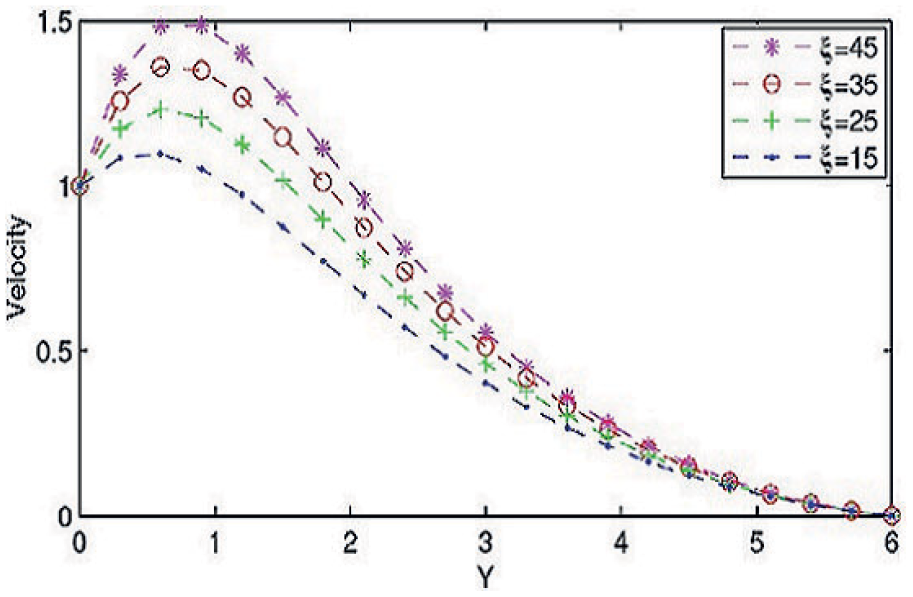
Effect of
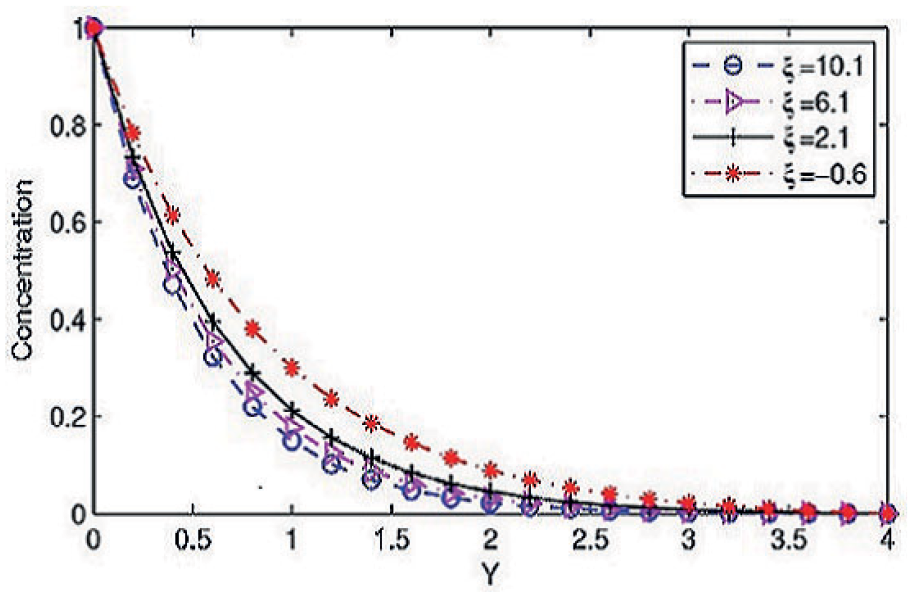
Effect of
Figures 25−27 show that when

Effect of
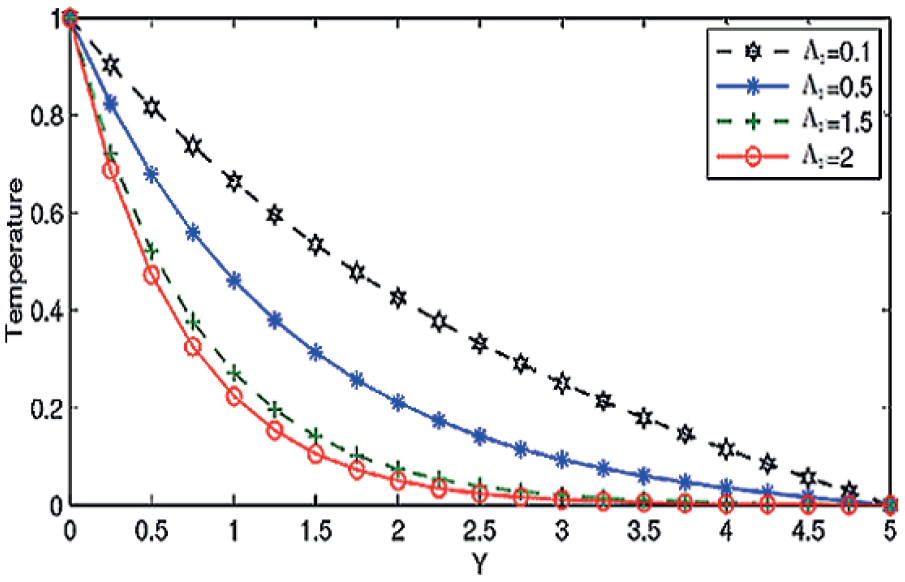
Effect of
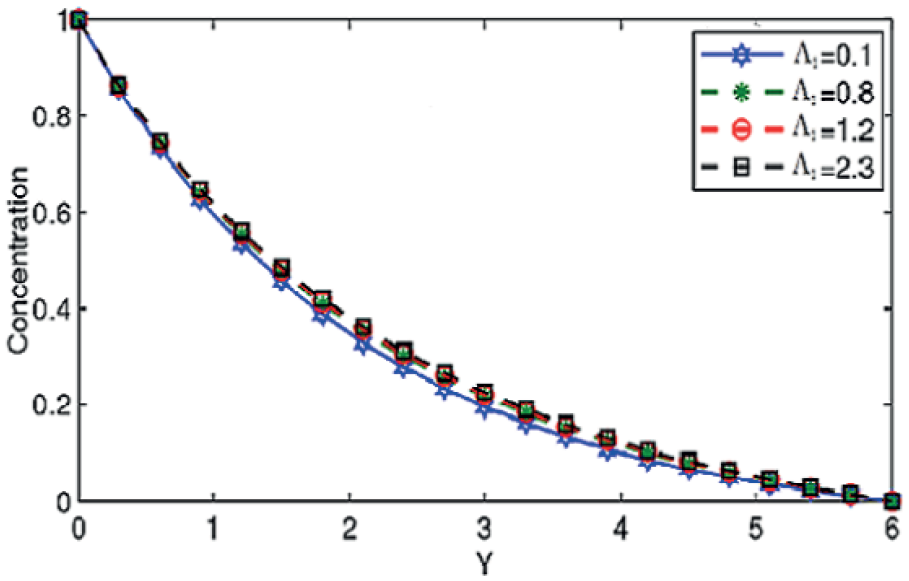
Effect of
Figures 28 and 29 illustrate that when

Effect of
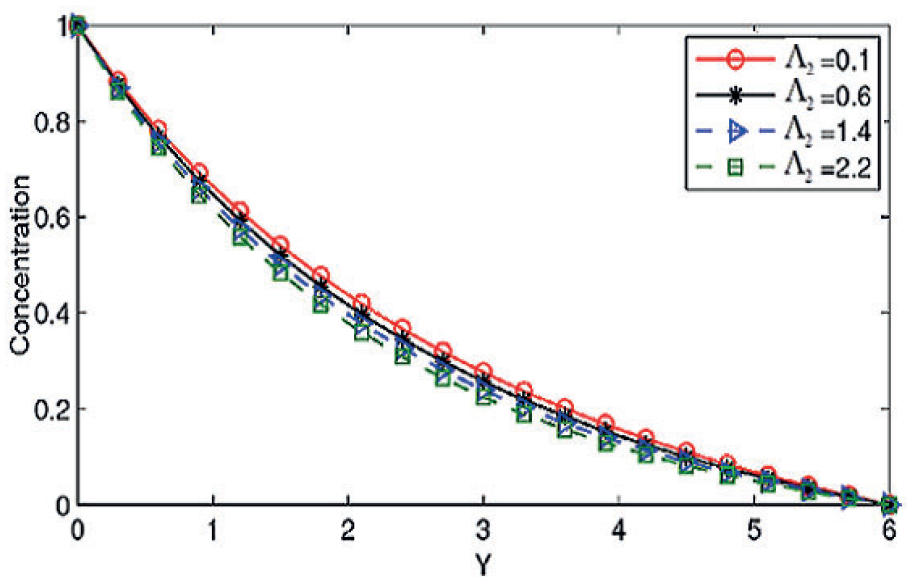
Effect of
Figures 30−32 illustrate a comparison of velocity, temperature, and concentration profiles of three models, namely, Oldroyd-B, Maxwell, and Newtonian fluids. It is clear that velocity and temperature profiles of the fluid of Oldroyd-B type are the smallest, while the fluids of Maxwell and Newtonian types have larger and the largest velocity and temperature profiles respectively. However, the concentration profile of Oldroyd-B fluid is large, while the concentration profiles of Maxwell and Newtonian fluids are small.

Comparison of velocity profiles.
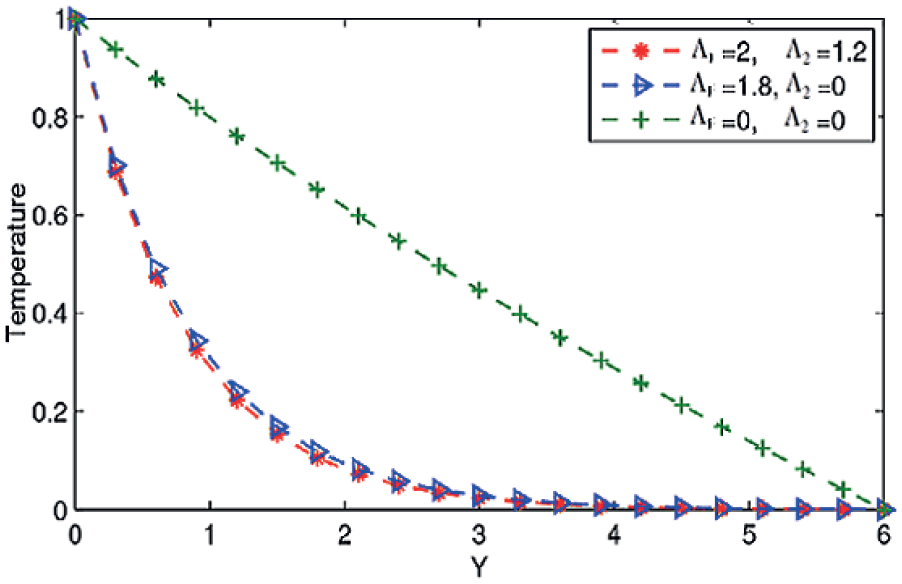
Comparison of temperature profiles.

Comparison of concentration profiles.
Conclusion
In this article, a theoretical study of free convective two-dimensional unsteady flow of electrically conducting incompressible nonscattering Oldroyd-B fluid passing through a vertical plate in the presence of chemical reaction is presented. The model is developed in terms of governing PDEs, subjected to suitable initial and boundary conditions. Numerical solutions for velocity, temperature, and concentration have been derived by applying Crank–Necolson’s finite difference method which is the most reliable, effective, and efficient method for solutions of such type of problems. These solutions, which are not previously reported in the literature, are most appropriate and natural tool to describe the multifaceted behavior of Oldroyed-B fluids, and are essential because of their real-world applications in engineering and scientific experimentations. The derived results will also constitute a foundation for further investigation concerning future development in fluid dynamics and other related fields of research. Moreover, as limiting cases, the equivalent solutions for Maxwell and Newtonian fluids can be recovered from our general solutions. Furthermore, the acquired results are sketched graphically, and the influence of numerous nondimensional thermophysical parameters on profiles of velocity, concentration, and temperature is discussed thoroughly.
Footnotes
Appendix 1
Acknowledgements
The authors are thankful to the editor and anonymous reviewers for their careful assessment and valuable suggestions, which significantly improved the initial version of this paper.
Handling Editor: James Baldwin
Declaration of conflicting interests
The author(s) declared no potential conflicts of interest with respect to the research, authorship, and/or publication of this article.
Funding
The author(s) received no financial support for the research, authorship, and/or publication of this article.
