




Abstract
This article presents a numerical study to investigate boundary-layer heat transfer fluid associated with a moving flat body in cooperation of variable plate and streaming-free velocity along the boundary surface in the laminar flow. The thermal conductivity is supposed to vary linearly with temperature. Similarity transformations are applied to render the governing partial differential equations for mass, momentum and energy into a system of ordinary differential equations to reveal the possible existence of dual solutions. MATLAB package has been used to solve the boundary value problem numerically. We present the effects of various parameters such as velocity ratio, thermal conductivity and variable viscosity on velocity and temperature distribution. The analysis of the results concerning Skin friction and Nusselt number near the wall is also presented. It is focused on the detection and description of the dual solutions. The study reveals that the undertaken problem admits dual solutions in particular range of values of different physical parameters. It can be seen that for the first branch solution, the fluid velocity decreases near the sheet, but it increases far away from the sheet for velocity ratio parameter, whereas the opposite effect is induced for second branch solution. Skin friction coefficient and rate of heat transfer increase due to increase in thermal conductivity parameter.
Introduction
Studies on boundary-layer flow over continuously moving surfaces are important due to their several applications in manufacturing processes such as glass-fibre production, the aerodynamic extrusion of plastic sheets, metal extrusion, materials-handling conveyors, and paper production.
The problem of a liquid over flat surface in uniform free stream was first elucidated by Blasius. This was done by introducing a new independent variable called the similarity variable. The similarity variable has been applied to solve thermal boundary layer for constant surface temperature along the plate. Steady free-convective and energy (heat) transfer through isothermal body was studied by Mahanti and Gaur 1 with a view to visualizing the effects of variable viscosity and conductivity properties. Magnetohydrodynamics (MHD) natural convection along with convective boundary surface condition past a flat surface has been reported by Rashidi et al. 2
The boundary-layer flow and heat transfer over a continuous flat plate/surface moving in parallel or in reverse to the free stream was discussed by many researchers. The study of boundary-layer flow on a constant speed moving plate was first studied by Sakiadis. 3 Abel et al. 4 analysed the MHD, thermal radiation and buoyancy effects on a moving stretching surface. Elbashbeshy and Bazid 5 reported the boundary-layer flow over a moving plate with the effect of force convection and temperature-dependent viscosity. Jhankal 6 presented the two-dimensional MHD flow and heat transfer along an infinite porous continuous moving plate. The aim of this article is to study the combined effects of heat generation and chemical reaction on MHD natural convection flow over a moving plate embedded in a porous medium. Khan et al. 7 studied the combined effects of heat generation and chemical reaction on MHD natural convection flow over a moving plate embedded in a porous medium. Sandeep and Sugunamma 8 analysed the effects of radiation and rotation on unsteady hydromagnetic free convection flow of a viscous incompressible electrically conducting fluid past an impulsively moving vertical plate in a porous medium. Flow of an incompressible viscous fluid past a continuously moving semi-infinite plate is studied by Soundalgekar et al., 9 and they considered the variable viscosity and variable temperature. The effect of temperature dependent viscosity on a laminar mixed convection boundary-layer flow and heat transfer on continuous moving vertical surface is studied by Mohamed and Ali. 10 Pop et al. 11 studied the flow and heat transfer problems, including the variation of fluid viscosity with temperature. Pantokratoras 12 analysed the boundary-layer flow along an isothermal, continuously moving plate, which is studied taking into account the variation of fluid viscosity with temperature.
Hassanien et al. 13 presented the boundary-layer flow and heat transfer of an incompressible micropolar fluid over a plane moving surface in parallel or in reverse to the free stream and they considered the boundary condition is isothermal. Salleh et al. 14 analysed the boundary-layer flow and heat transfer over a stretching sheet with Newtonian heating. Lin and Hung 15 studied the flow and heat transfer of a plane surface moving in parallel and in reverse to the free stream.
The mathematical analysis of the dual solutions of the boundary-layer flow over the moving surfaces has a practical impact in the engineering scenario. It gives the possibility to determine the most realistic, stable, and physically acceptable solutions. Ahmed et al. 16 analysed the dual solution of steady-state, boundary-layer flow of a power law fluid along a moving flat plate in the presence of the thermal radiation, viscous dissipation, and internal heat generation or absorption. Afzal et al. 17 presented the dual solutions of the boundary-layer velocity and temperature distributions. Mukhopadhyay and Golra 18 generalized the dual solutions of boundary-layer flow of fluid along a moving surface with power law temperature. Furthermore, Mukhopadhyay 19 also analysed the dual solution of boundary-layer flow of a moving fluid over a moving permeable surface in the presence of prescribed surface temperature and thermal radiation. Deswita et al. 20 reported the dual solutions for the power law fluid flow with suction and injection effects and neglected the heat transfer effects.
Our aim is to derive systematically the similarity transformation under similarity requirement for the governing equations, and then, we have transformed highly non-linear partial differential equations (PDEs) fluid flow of boundary-layer theory into ordinary differential equations (ODEs) by introducing the group of transformation. The reduced non-linear problem is numerically sketched by using bvp4c in MATLAB computational algorithm. The study reveals that there exist dual solutions in specific range of the vital parameters involved and that one of the two solutions is stable and physically realistic.
Model and transformations
We assume boundary-layer flow of a steady, two-dimensional, incompressible liquid past a moving flat surface. Density of the liquid is taken to be ρ. We consider a Cartesian coordinate system
Under the boundary-layer and the Boussinesq approximations, the governing equations for this physical problem are as follows21,22



where
We assume as in Sharma and Singh,
23
Subject to the constraints


The following transformation is applied to the system of governing equations

Thus, the reduced form of our considered problem equations takes the form


Subject to the constraints

where
Numerical technique
Now we solve the set of non-linear ordinary differential equations (7) and (8) with boundary conditions (9) numerically by using bvp4c function technique in MATLAB package. We consider
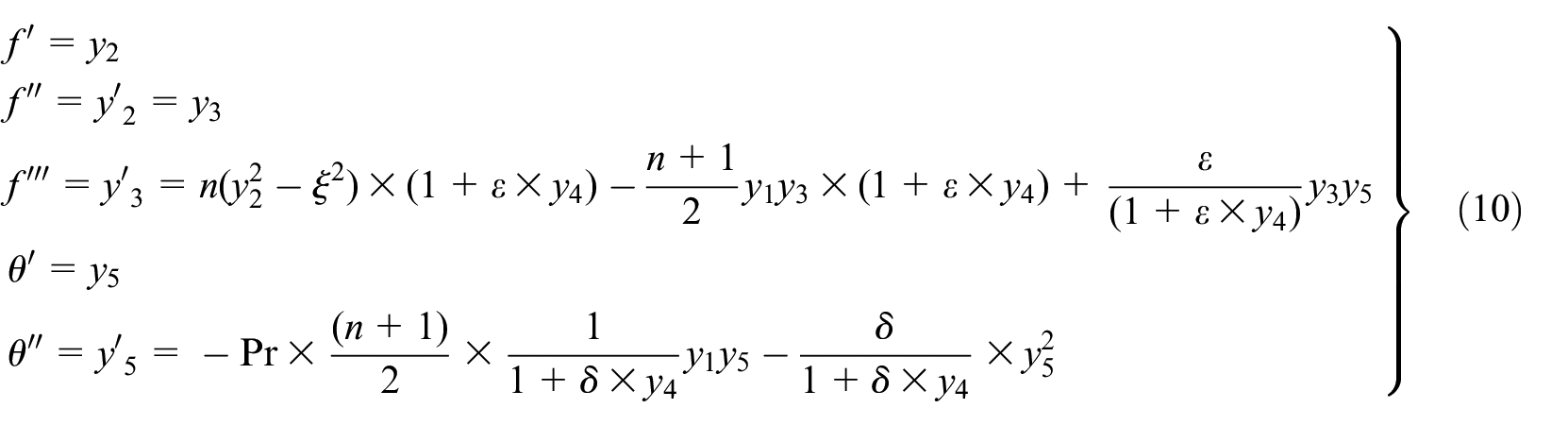
along with the initial boundary conditions

Equations (10) and (11) are integrated numerically as an initial value problem to a given terminal point. All these simplifications are made by using bvp4c function available in MATLAB software.
Results and discussion
The coupled systems subject to boundary conditions were solved numerically by using the bvp4c in MATLAB package for different values of
The choice of
In order to test the accuracy of the present results, we have compared the obtained results with those of Hassanien et al. 13 and Salleh et al. 14 when we neglect the effects of some parameters. This comparison is shown in Table 1 and we notice an excellent agreement with those of Hassanien et al. 13 and Salleh et al. 14 This observation serves as a confirmation of the accuracy of the results that are performed in this communication.
Comparison results for

In this section, we analysed the dual solutions of the boundary-layer velocity and temperature profiles. Dual solution refers to two different solutions that are obtained under the same condition by assuming several values of missing initial guesses. One of these two solutions is called the upper or first-branch solution and other one is called the lower or second-branch solution. In the following figures, let us specify that the solid lines represent the first or upper branch solution, while dotted lines represent the second or lower branch solution (Figure 1).

Schematic diagram of the problem.
Figures 2 and 3 exhibit the effect of free-stream velocity ratio parameter

Velocity profile for various values of
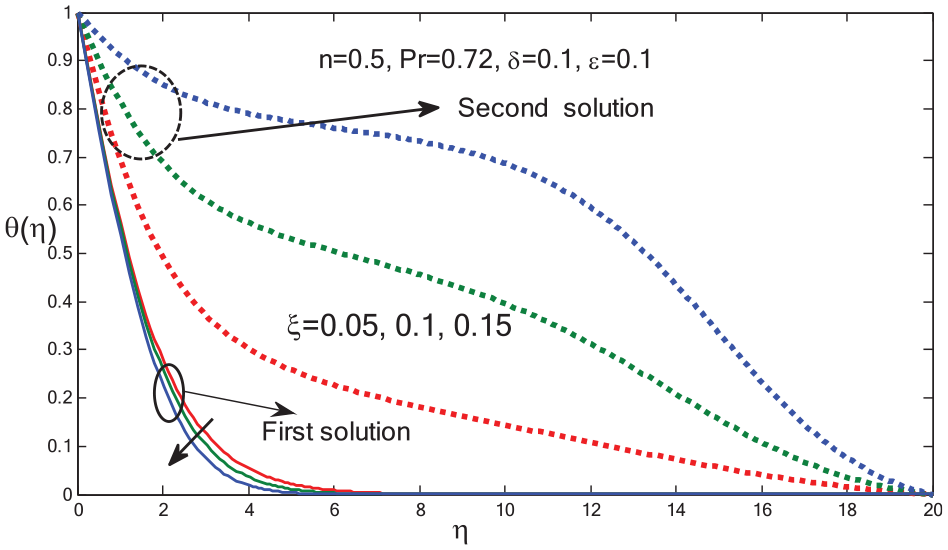
Temperature profile for various values of
The discrepancy of skin friction coefficient and rate of heat transfer with free-stream velocity ratio parameter
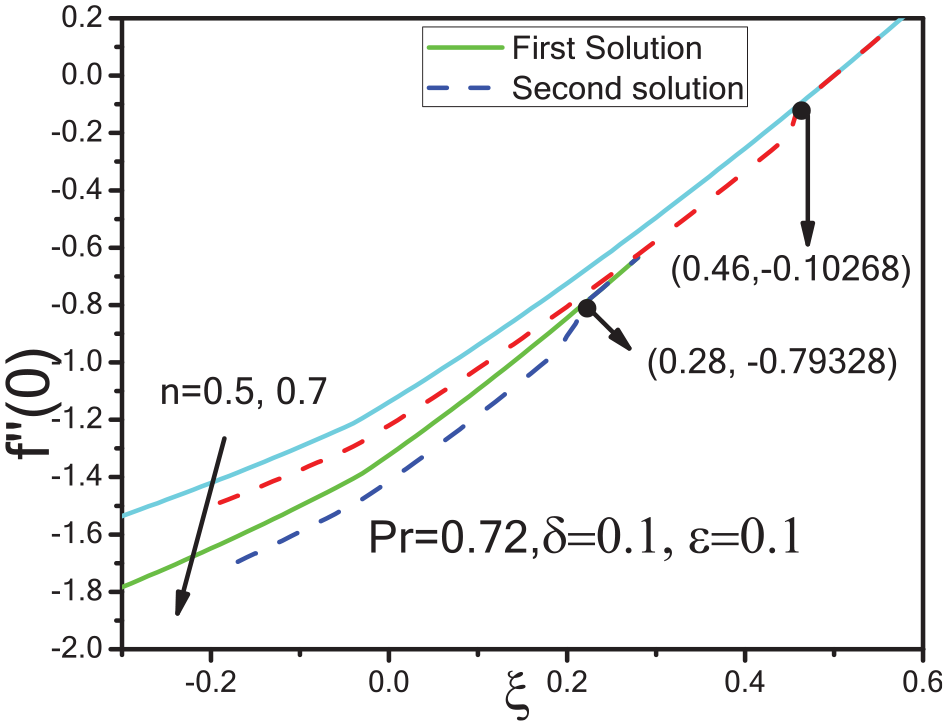
Variation of skin friction coefficient with

Variation of rate of heat transfer coefficient with
According to the value of free-stream velocity ratio parameter, the following observation can possibly occur:
When
In the present analysis, we found that the dual solutions exist for a certain value of governing parameters. For velocity power index parameter
Figures 6 and 7 show the variation in the skin friction coefficient and rate of heat transfer with free-stream velocity ratio parameter

Variation of skin friction coefficient with

variation of rate of heat transfer with
Variation of rate of heat transfer rate
Furthermore, Figure 8 displays the variation of rate of heat transfer coefficient with

Variation of rate of heat transfer with
Conclusion
The effect of variable viscosity and thermal conductivity with velocity power index parameter on the boundary-layer flow on a moving plate with free-stream velocity is analysed. Using suitable similarity analysis, the transformed non-dimensional boundary value problem has been solved with MATLAB symbolic software using shooting quadrature. The analysis reveals that the dual solution exists for some specific value of governing parameter. The current simulations have shown that
Fluid velocity decreases near the sheet but it increases far away from the sheet by enhancing velocity ratio parameter in the case of first branch of solution, whereas the opposite effect is induced with velocity ratio parameter for second-branch solution.
Fluid temperature reduces with the rise of velocity ratio parameter in the case of first solution. On the contrary, opposite behaviour is observed for the second solution.
Increasing the free-stream velocity ratio is found to consistently increase the Skin friction coefficient and rate of heat transfer near the surface wall.
A sustained decrease is generated in the skin friction coefficient and rate of heat transfer near the surface wall with an increase in velocity power index parameter.
The rise of the viscosity parameter had resulted in the reduction of the skin friction coefficient and rate of heat transfer at the surface wall.
Due to increase in thermal conductivity parameter, skin friction coefficient and rate of heat transfer also increase.
Similarity solution range of skin friction and rate of heat transfer coefficient drops with free-stream velocity ratio parameter with an increase in viscosity and thermal conductivity parameter.
Footnotes
Handling Editor: James Baldwin
Declaration of conflicting interests
The author(s) declared no potential conflicts of interest with respect to the research, authorship, and/or publication of this article.
Funding
The author(s) received no financial support for the research, authorship, and/or publication of this article.
