




Abstract
Gear pump is the key component in hydraulic drive system, and it is very significant to fault diagnosis for gear pump. The combination of sparsity empirical wavelet transform and adaptive dynamic least squares support vector machine is proposed for fault diagnosis of gear pump in this article. Sparsity empirical wavelet transform is used to obtain the features of the vibrational signal of gear pump, the sparsity function is potential to make empirical wavelet transform adaptive, and adaptive dynamic least squares support vector machine is used to recognize the state of gear pump. The experimental results show that the diagnosis accuracies of sparsity empirical wavelet transform and adaptive dynamic least squares support vector machine are better than those of the empirical wavelet transform and adaptive dynamic least squares support vector machine method or the empirical wavelet transform and least squares support vector machine method.
Keywords
Introduction
Gear pump is the key component in hydraulic drive system, and it is very significant to fault diagnosis for gear pump. There are lots of machine learning methods applied in fault diagnosis and crack prediction,1–7 which have important contributions in fault diagnosis and crack prediction. At present, artificial neural networks, support vector machine (SVM), and least squares support vector machine (LSSVM) have been successfully applied to fault diagnosis for mechanical systems. Dhamande et al. 8 presented the detection method of combined gear-bearing fault in single stage spur gear box using artificial neural networks. Bordoloi and Tiwari 9 applied SVM for multi-fault classification of gears. Su et al. 10 applied LSSVM for multi-fault diagnosis of rotating machinery. Compared with artificial neural networks, SVM and LSSVM can efficiently solve the problems of over-fitting, local minima, and so on,11–14 and compared with SVM, LSSVM can greatly simplify the training process by transforming the quadratic programming problem in SVM to a linear problem.15–19 Adaptive dynamic least squares support vector machine (ADLSSVM) is a novel intelligent learning method, which has a great potential in fault diagnosis for gear pump. In addition, the feature extraction of the vibrational signal of gear pump is the key for the accurate diagnosis of gear pump. Empirical wavelet transform (EWT) is a new signal decomposition method,20–23 and recently EWT has been applied to extract the features of rotary machines.24,25 Wang et al. 26 applied EWT to extract industrial bearing fault features. Kong et al. 25 applied EWT for fault diagnosis of wind turbine planetary ring gear. However, Fourier segments required in EWT are strongly dependent on the local maxima of the amplitudes of the Fourier spectrum of a signal.27–29 Thus, sparsity EWT is proposed to automatically establish Fourier segments required in EWT, among which the sparsity function is used to quantify the squared envelope of a signal which is processed by a band-pass filter, and make EWT adaptive.
Therefore, the combination of sparsity empirical wavelet transform and adaptive dynamic least squares support vector machine (EWT-ADLSSVM) is proposed for fault diagnosis of gear pump in this article. Sparsity EWT is used to obtain the features of the vibrational signal of gear pump, and ADLSSVM is used to recognize the state of gear pump. The four states of gear pump including normal state, wear and tear, pitting fault, and snaggletooth fault are employed in this experiment, among which normal state is denoted as “Class 1,” wear and tear is denoted as “Class 2,” pitting fault is denoted as “Class 3,” and snaggletooth fault is denoted as “Class 4.” The experimental results show that only one case is incorrectly classified using the proposed sparsity empirical wavelet transform and adaptive dynamic least squares support vector machine (SEWT-ADLSSVM) method, five cases are incorrectly classified using the EWT-ADLSSVM method, and eight cases are incorrectly classified using the empirical wavelet transform and least squares support vector machine (EWT-LSSVM) method.
EWT
EWT is a method to adaptively extract different modes of non-stationary signals by building adaptive wavelets. In EWT, the parameter


In order to obtain approximation coefficient, the approximation coefficients
The reconstruction signal is obtained by the following equation
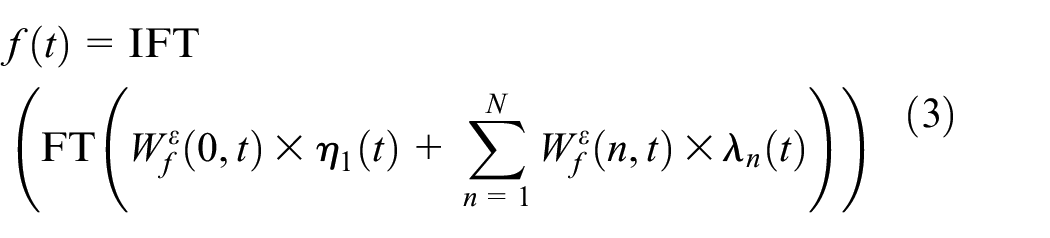
Sparsity EWT
In order to extract repetitive transients caused by single and multiple bearing defects, sparsity EWT is proposed in this article. Compared with traditional EWT, sparsity EWT has the advantages as follows:
The ratio of
The sparsity function is potential to make EWT adaptive, and the sparsity EWT is conducted for features extraction of the vibration signal of gear pump.
In sparsity EWT, the Fourier spectra of the wavelets can be given as follows
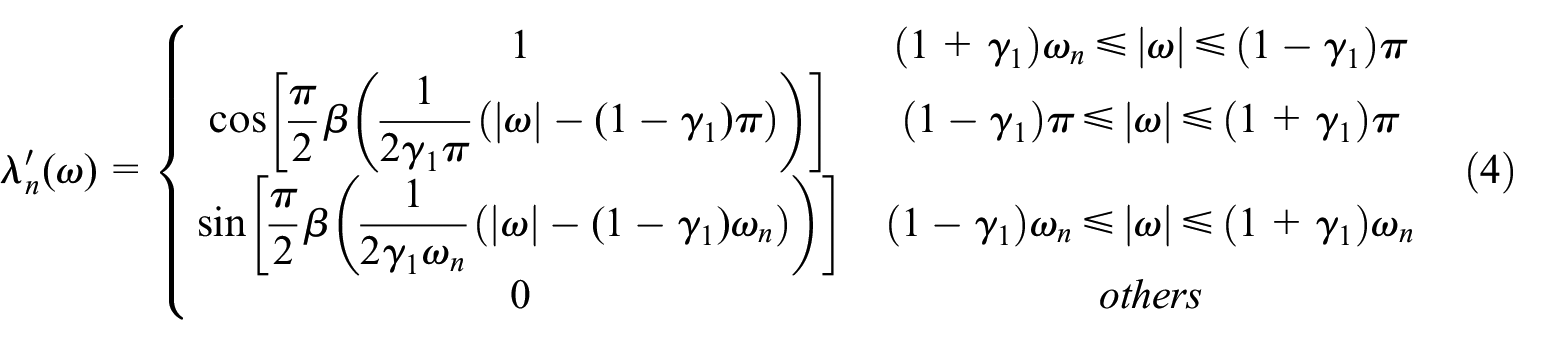

where
Figure 1 shows the decomposition of the vibrational signal of gear pump based on SEWT. As shown in Figure 1, the 20 decomposition signals of the vibrational signal of gear pump based on SEWT are obtained, the decomposition signal based on SEWT is defined as SEWDS. Thus, the 20 decomposition signals of the vibrational signal of gear pump are, respectively, defined as SEWDS1–SEWDS20. The features of the vibrational signal of gear pump are obtained by calculating the energy entropy of the decomposition signals of the vibrational signal of gear pump based on SEWT.
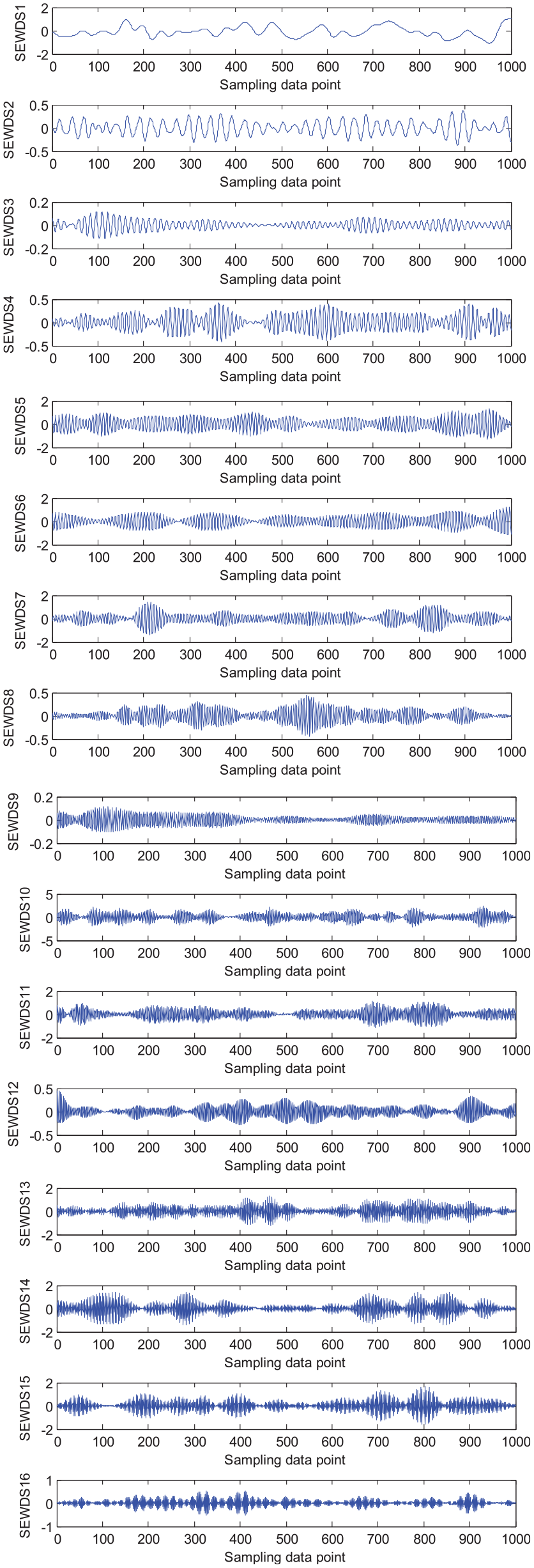
The decomposition of the vibrational signal of gear pump based on SEWT.
Figure 2(a) shows the feature values of the vibrational signal of gear pump of normal state based on EWT, and Figure 2(b) shows the feature values of the vibrational signal of gear pump of wear and tear based on EWT. Figure 3(a) shows the feature values of the vibrational signal of gear pump of normal state based on SEWT, and Figure 3(b) shows the feature values of the vibrational signal of gear pump of wear and tear based on SEWT.

(a) The feature values of the vibrational signal of gear pump of normal state based on EWT; (b) the feature values of the vibrational signal of gear pump of wear and tear based on EWT.
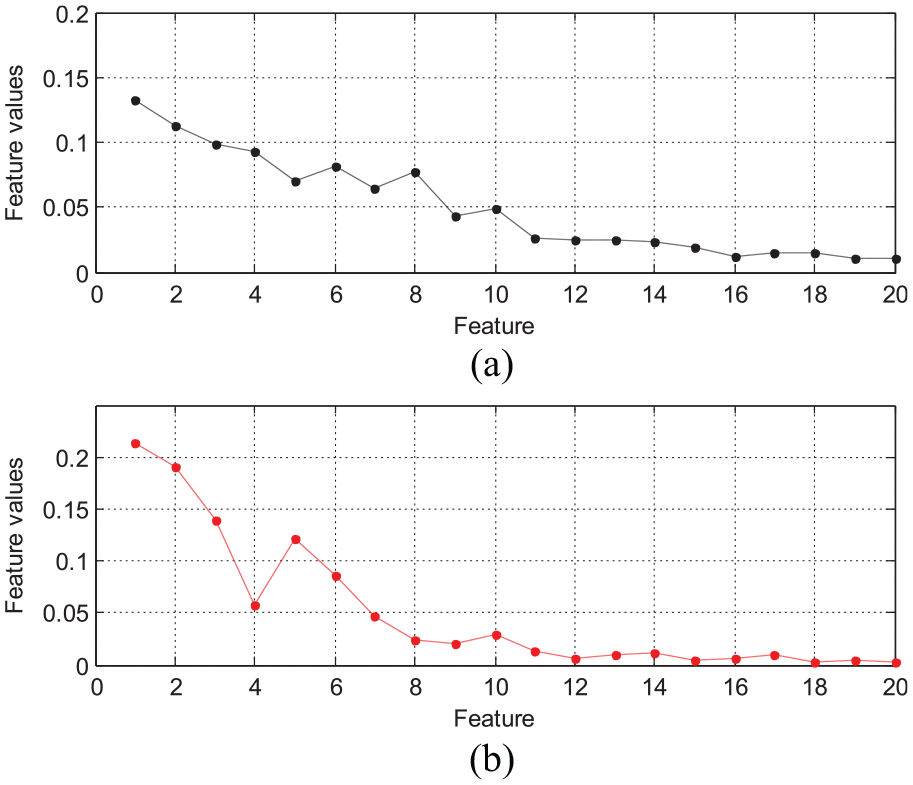
(a) The feature values of the vibrational signal of gear pump of normal state based on SEWT; (b) the feature values of the vibrational signal of gear pump of wear and tear based on SEWT.
As shown in Figures 2 and 3, there are more obvious distinctions between the feature values of the vibrational signal of gear pump of normal state and the feature values of the vibrational signal of gear pump of wear and tear using SEWT than those using EWT.
ADLSSVM
LSSVM is a special version of SVM, and Vapnik’s SVM classifier formulation is transformed into the following LSSVM formulation


where
The Lagrangian function is constructed by the following formula

where
By partially differentiating the Lagrangian function

and eliminating

In ADLSSVM, “

Let

Finally, the ADLSSVM classifier is obtained by the following formula

Experimental study
The vibrational signal of shell of gear pump has been measured with acceleration sensor. Three main faults of gear pump are wear and tear, pitting fault, and snaggletooth fault. Therefore, the four states of gear pump including normal state, wear and tear, pitting fault, and snaggletooth fault are employed in this experiment, among which normal state is denoted as “Class 1,” wear and tear is denoted as “Class 2,” pitting fault is denoted as “Class 3,” and snaggletooth fault is denoted as “Class 4.” A total of 100 testing samples including 25 samples denoting Class 1, 25 samples denoting Class 2, 25 samples denoting Class 3, and 25 samples denoting Class 4 are used as the testing samples.
In SEWT-ADLSSVM, the radial basis function (RBF) is used as kernel parameter of ADLSSVM, and kernel parameter is set to 1. In addition, penalty parameter C of ADLSSVM is set to 100. Fault diagnosis results for gear pump using SEWT-ADLSSVM are shown in Figure 4, and it can be seen that only one case is incorrectly classified using the proposed EWT-ADLSSVM method. Fault diagnosis results for gear pump using the EWT-ADLSSVM method are shown in Figure 5, and it can be seen that five cases are incorrectly classified using the EWT-ADLSSVM method. Fault diagnosis results for gear pump using EWT-LSSVM are shown in Figure 6, and it can be seen that eight cases are incorrectly classified using the EWT-LSSVM method. As shown in Table 1, the diagnosis accuracy of SEWT-ADLSSVM is 99%, the diagnosis accuracy of EWT-ADLSSVM is 95%, and the diagnosis accuracy of EWT-LSSVM is 92%, and it can be seen that the diagnosis accuracies of SEWT-ADLSSVM are better than those of the EWT-ADLSSVM method or the EWT-LSSVM method.

Fault diagnosis results for gear pump using SEWT-ADLSSVM.

Fault diagnosis results for gear pump using EWT-ADLSSVM.
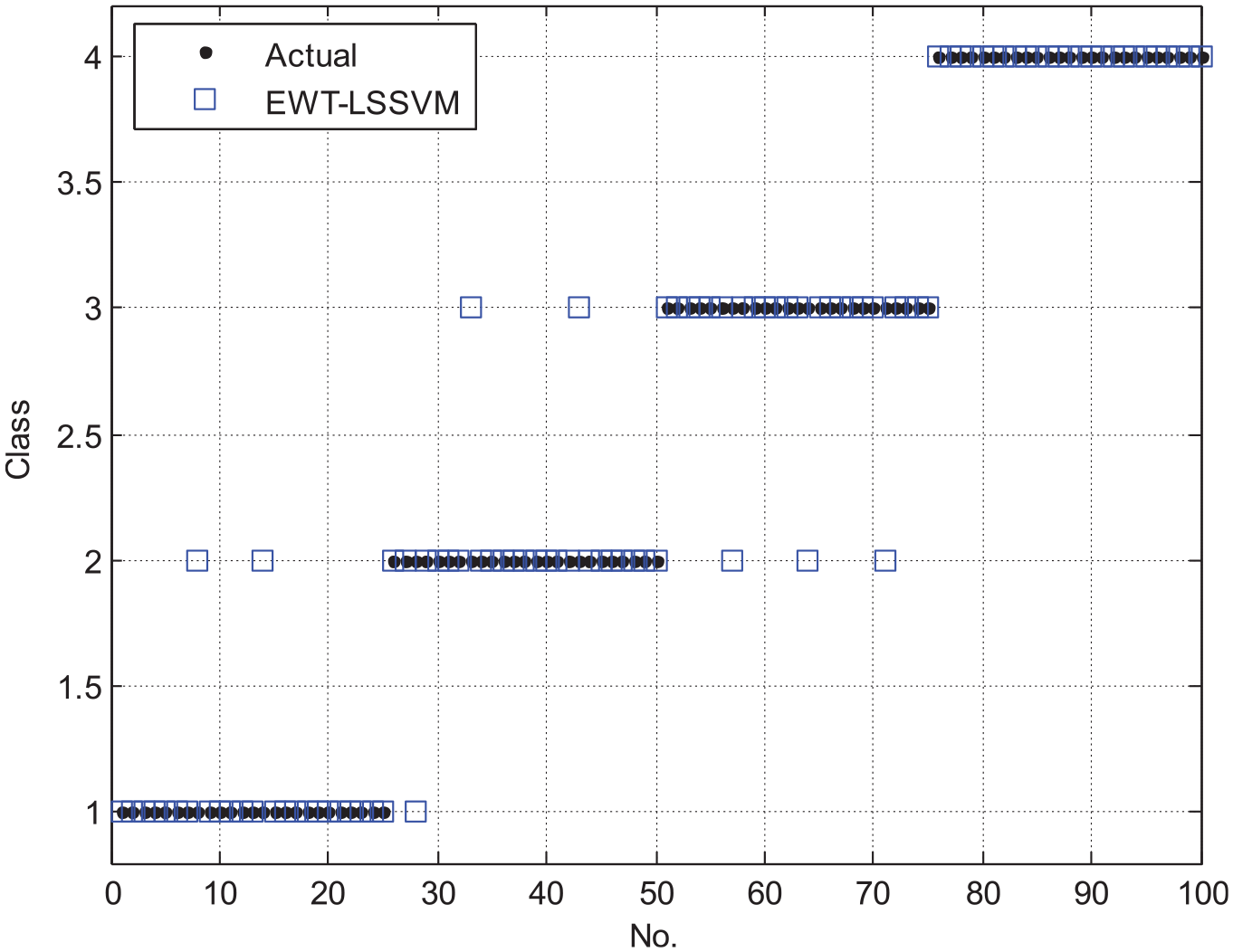
Fault diagnosis results for gear pump using EWT-LSSVM.
The comparison of the diagnosis accuracies among SEWT-ADLSSVM, EWT-ADLSSVM, and EWT-LSSVM.

SEWT-ADLSSVM: sparsity empirical wavelet transform and adaptive dynamic least squares support vector machine; EWT-ADLSSVM: empirical wavelet transform and adaptive dynamic least squares support vector machine; EWT-LSSVM: empirical wavelet transform and least squares support vector machine.
Conclusion
The combination of sparsity EWT-ADLSSVM is proposed for fault diagnosis of gear pump in this article. Sparsity EWT is used to obtain the features of the vibrational signal of gear pump, which is proposed to automatically establish Fourier segments required in EWT. ADLSSVM is used to recognize the state of gear pump, which has a better generalization ability than LSSVM. The experimental results show that the diagnosis accuracy of SEWT-ADLSSVM is 99%, the diagnosis accuracy of EWT-ADLSSVM is 95%, and the diagnosis accuracy of EWT-LSSVM is 92%, and it can be seen that the diagnosis accuracies of SEWT-ADLSSVM are better than those of the EWT-ADLSSVM method or the EWT-LSSVM method.
Footnotes
Handling Editor: James Baldwin
Data availability
The data used to support the findings of this study are available from the corresponding author upon request.
Declaration of conflicting interests
The author(s) declared no potential conflicts of interest with respect to the research, authorship, and/or publication of this article.
Funding
The author(s) disclosed receipt of the following financial support for the research, authorship, and/or publication of this article: This article is supported by “Zhejiang Public Welfare Technology Application Research Project (GG19F040002)” and “Intelligent Manufacturing and Industrial Big Data Technology Application Innovation Team (QZCX1801).”
