




Abstract
The aim of this article is to develop an accurate and fast analytical method for heat and mass transfer model in a cooling tower energy system. Some algebraic explicit analytical solutions of the one-dimensional differential equation sets describing the coupled heat and mass transfer process in a cooling tower are derived. The explicit solutions have not yet been published before. The explicit equations of heat and mass transfer are expressed in elementary functions. By solving these differential equations in a cooling tower, the temperature distribution of liquid and gas, the moisture content in the air can be obtained in each section over the vertical height of the tower. A comparison of analytical and experimental results was given in this article, and good agreements were shown for the typical cases studied. The analytical solutions can serve as a benchmark to check the results of numerical calculation.
Introduction
A cooling tower is an essential device used for heat dissipation in the industrial process 1 (as shown in Figure 1). In practical applications, prediction of performance behavior of cooling towers by fast and accurate calculating methods plays an important role in the effective design and operation. The cooling process can be expressed by physical—mathematical models and basic partial differential equation sets. But it is very difficult or even impossible to obtain the analytical solutions for these differential equation sets for arbitrary initial and boundary conditions. Therefore, most solutions are numerical ones for specific conditions. Because of the nonlinear relationship between the various factors, almost all the researchers use the numerical method to simulate the performance of the cooling tower.

Schematic of a counter-flow wet cooling tower.
Cooling towers have been used for a longtime. It is well known that most of the natural phenomena are inherently non-linear including these heat and mass transfer problems. Until now, cooling tower system has been studied numerically and experimentally by a number of researchers.
The one-dimensional heat and mass transfer model based on the Merkel theory,2–4 effectiveness–number of transfer unit (ε-NTU) theory, 5 and Poppe theory 6 are widely applied in design calculation and performance analysis of wet cooling towers. One-dimensional models only consider the heat and mass transfer in the vertical direction, and ignore the pressure drop in the tower. The assumption simplifies the calculation and provides a great convenience for the calculation of the performance of the cooling tower. Kloppers and Kröger 7 analyzed the one-dimensional Merkel model, e-NTU model, and Poppe model. It pointed out that the Poppe model is relatively accurate, and the Merkel model and the e-NTU model only consider the changing of two parameters: water temperature and air enthalpy.
The two-dimensional model considers that the air flowing is in a two-dimensional axisymmetric state in the tower. The governing equations of air and water are solved based on the numerical method 8 so as to analyze the radial variation of air temperature and cooling water temperature. Caytan 9 uses the finite difference method to solve the two-dimensional partial differential equation of the air and water flow in the wet cooling tower. Majumdar et al. 10 treated the circulating water as one-dimensional flow, and air as two-dimensional steady flow. The two-phase gas–water heat transfer intensity and two-dimensional distribution of airflow were calculated and analyzed. The literatures11–14 conducted two-dimensional analyses on two-phase heat and mass transfer in counter-flow wet cooling towers.
Radosavljevic 15 and Radosavljevic and Spalding 16 conducted two-dimensional axisymmetric and three-dimensional (3D) numerical models based on the algebraic turbulent model. They analyzed the air flow inside and outside the wet cooling tower; however, heat and mass transfer coefficient in the water distribution area, the filling area and rain zone are selected by empirical formula. Based on the finite element theory, the 3D numerical calculation program of wet cooling tower is developed in Razafindrakoto and Denis 17 and Fournier and Boyer, 18 and the influence of the environmental and the meteorological conditions on the cooling performance of the wet cooling tower is analyzed. Al-Waked and Behnia 19 carried out the 3D numerical calculation of natural ventilation counterflow cooling tower based on the computational fluid dynamics (CFD) general software Fluent, and the influence of ambient side wind is analyzed. Based on 3D numerical calculation, the influence sensitivity of the side wind on various filling of cooling tower is studied based on 3D numerical calculation by Dreyer et al. 20 In view of the complexity of the calculation, the 3D numerical calculation mostly analyzes the influence of the environmental side wind on the performance of the cooling tower.
As mentioned above, a large amount of literature on cooling towers has been reported. Many researchers have done a lot of work on the performance of cooling tower through experimental tests and numerical simulation. But the experimental study needs the right place and a large amount of test funds. It takes a lot of time, manpower, and material resources. Almost all theoretical studies are based on various numerical techniques. With the development of computer technology, numerical simulation research method is favored by people, but it needs to be verified for the correctness. This is the reason why the first objective of this work is to elaborate an exact solution to predict the cooling behavior of the cooling tower system. Analytical solutions for basic equations have significant meaning and irreplaceable function. An analytical solution is useful to predict the performance of cooling tower systems. The exact solution obtained can be used as a reference to validate the numerical simulations and other approximate methods. It will be helpful to get fast and accurate evaluation of model equations to develop advanced control strategies. The analytical solution can be very intuitive to express the physical law and working process of the cooling tower, but it is a common method for research of cooling tower working process. This makes the solution of the set of equations challenging, often calling for a numerical solution.
In this article, based on the shortcomings of the traditional model of heat and mass transfer in wet cooling towers, the analytical solution of heat and mass transfer in wet cooling towers is completed. Until now, there have been no precise analytical solutions for cooling towers. In this article, an analytical solution to the ordinary differential equations under different conditions are solved based on proper simplification, and the solutions of the heat and mass transfer equations will be obtained by the elementary function. The explicit analytical solutions were derived for the coupled partial differential equation set describing cooling process in cooling towers. Therefore, some algebraic explicit analytical solutions of basic one-dimensional cooling process equation set are derived and given in this article to enrich the cooling tower research.
Physical model and basic equation set
In the cooling tower, hot water rejects waste heat to the air through the evaporation of water and the contact heat rejection. After absorbing heat, the air temperature and humidity increase, the density decreases. The heat transfer between water and air has two main forms, namely, the convective heat transfer and convective mass transfer (i.e. evaporation). When the low temperature air flows through the surface of the higher temperature water, the water will transfer the heat to the air in the form of convection. In the cooling tower, the droplet diameter and the thickness of the liquid film are very small. Generally, the internal thermal resistance is ignored, and the internal temperature is assumed to be the same. As can be seen from the above, the temperature difference is the driving force of convective heat transfer. For the convective mass transfer, the single film theory of water evaporation indicates that when air contacts with water, there is a thin air film surrounding the water droplet. As shown in Figure 2, the air film is considered to be saturated, and its temperature is equal to the water temperature. The vaporized water molecules first enter the saturated air layer, then the molecules in the saturated air layer continue to diffuse into the air, and the water vaporizes continuously into the saturated air layer. The speed of evaporation depends mainly on the diffusion rate, because the evaporation of water to the saturated air layer can be completed instantaneously, and the speed of diffusion depends on the difference between the vapor pressure of the saturated air layer and the atmosphere.

A schematic diagram of the heat transfer of the saturated vapor layer.
In order to take into account both of the accuracy and convenience of the model, the following assumptions are used in the model of coupled heat and mass transfer in a cooling tower:
It is assumed that there is a layer of saturated air film on the surface of the water film, and the temperature of the air film is equal to the temperature of water, and the relative humidity is 1, as shown in Figure 2.
When the water temperature is constant, the moisture content and enthalpy of the saturated air film are all in a stable state.
Lewis number reflecting the relationship between the heat transfer coefficient and the mass transfer coefficient is 1, that is
For a cooling tower, it is assumed that the cross-sectional area is A and the height is L, as shown in Figure 3.

A control segment of cooling tower.
The mass transfer at the air–water interface due to the difference in vapor concentration in the discrete height dl is

where
The sensible heat transmitted from the saturated air at the air–water interface to the main air in the discrete height is

where
The latent heat transmitted by the saturated air from the gas water interface to the mainstream air in the discrete height is

where i specific enthalpy,
The total heat transmitted to the air is

The heat loss of water in the cooling tower

where
Analytical approach
Because the basic equations of the heat and mass transfer in the cooling tower is three-variable ordinary differential equations, it is difficult to be solved by the usual method. In this article, the exact solution of the air and water state in each section of the cooling tower based on some assumptions is obtained, which provides a theoretical basis for future research.
Methodology for the exact solution of the heat and mass transfer equations
It can be obtained from equations (2)–(5)

where

According to the assumption of Lewis relationship
Boundary conditions:
Substituting equation (13) into equation (9-b) and (9-c) yields


The coefficient determinant of the unknown quantity on the right side of equation (14) is

The solution of equation (8) is discussed according to formula (10):
As
(a) As
Through mathematical operations yields

(b) As
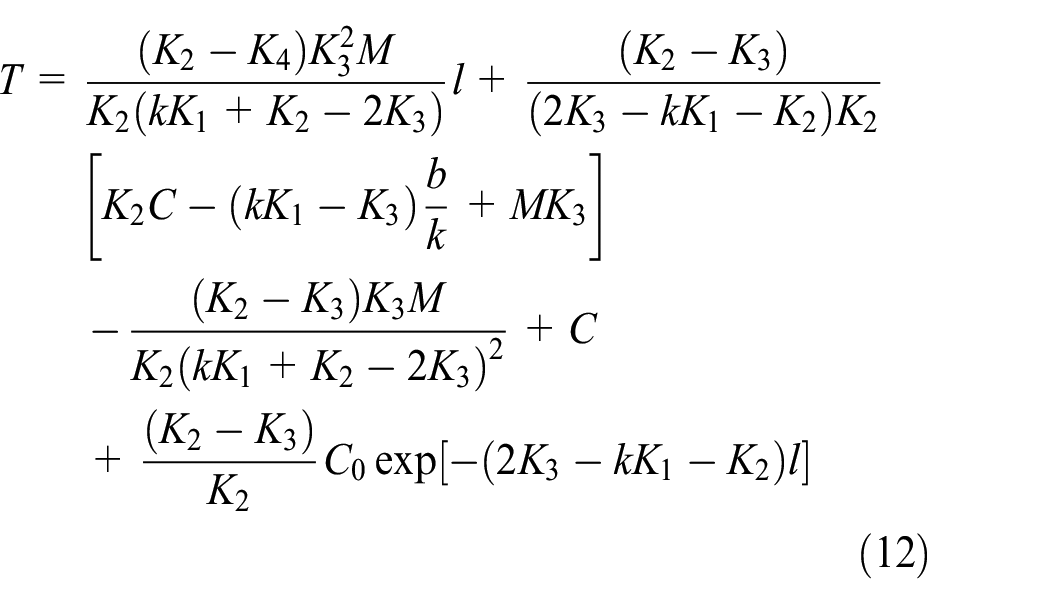
2. As
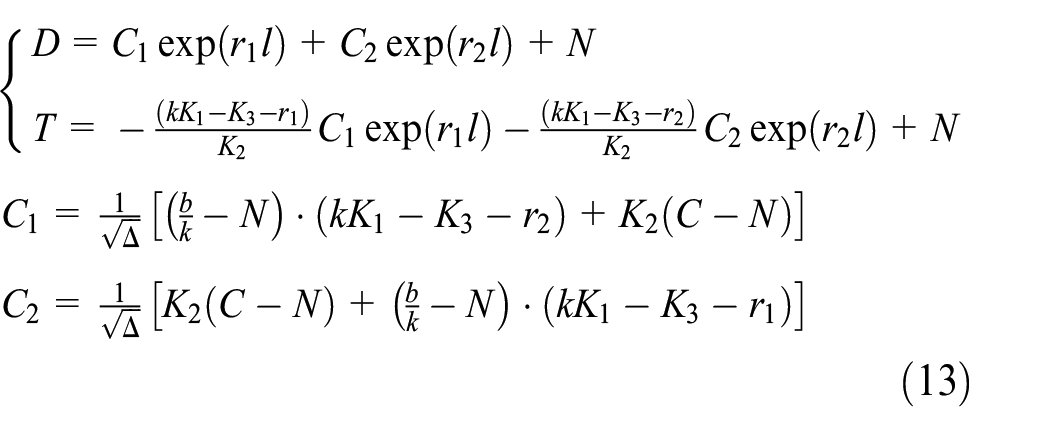
Results and discussion
Milosavljevic and Heikkilae 21 tested the performance of the cooling tower. Different filling materials are used at the top and at the bottom of the cooling tower. The filling heights are 0.6 and 1.8 m, respectively. Since the information detail about the bottom filling is not given in the article, we will only compare the experimental results at the top with the analytical solution. Table 1 gives the measurement data from Milosavljevic and Heikkilae. 21
Experimental data at industrial cooling tower. 21
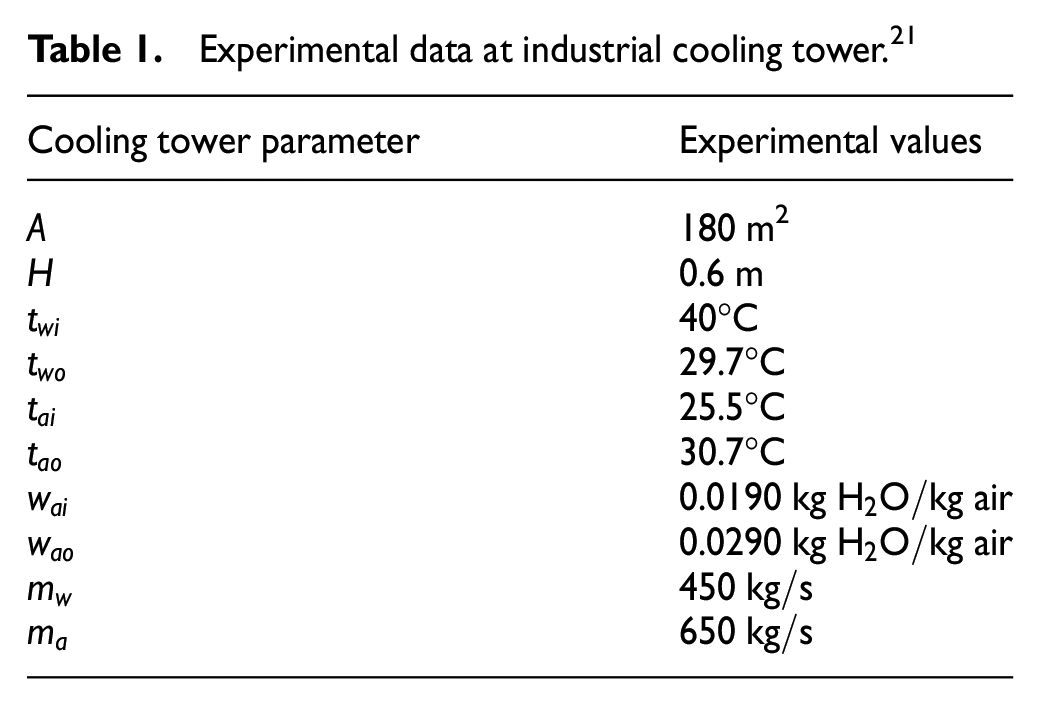
The comparison was made under typical operating condition investigated experimentally in Milosavljevic and Heikkilae. 21 The basic parameters are shown in Table 1. The performance and outlet parameters of the cooling tower are predicted by the analytical method in this article. Results comparisons are presented in Table 2, where relative errors for the outlet parameters were defined as the differences between the analytical and experimental data to the overall changes of the corresponding variables. The parameters profiles obtained by different methods are demonstrated in the figures. Figures 4–6 show the profiles of air humidity, air temperature, and water temperature along the tower, respectively.
Comparison of analytical results with experimental data.


Experimental and analytical comparison of humidity profiles along the cooling tower.

Experimental and analytical comparison of air temperature profiles along the cooling tower.

Experimental and analytical comparison of water temperature profiles along the cooling tower.
From Table 2, it is easy to find that the relative errors by the analytical method are generally less than 10% except for two cases in water temperature. In the cases that the inlet water temperatures are high, the errors in the linearization of air saturation humidity at the water surface is great. This leads to increased relative errors by the analytical model.
Based on the above discussion and comparison, the following conclusion can be obtained: the outlet parameters and parameter distributions of cooling towers calculated by means of the analytical solution of this article are in good agreement with the experimental results. In the typical case, most of the average and maximum relative errors are far less than 10%. Because the analytical model only needs several steps to calculate the correlation coefficient and constant to get the accurate analysis result, the model can directly and quickly calculate the changing rules of liquid, gas, interface temperature, and moisture content in the air along the vertical height of the tower. Therefore, the validity and practicability of the analytical model are obtained.
Analysis on heat transfer process
Figure 7 shows the temperature distributions of air, water, and temperature difference in the cooling tower. From 0.6 to 0 m away from the bottom of the cooling tower, the air temperature is lower than the cooling water temperature, and the temperature difference of heat transfer in the cooling tower decreases gradually. The temperature difference of heat transfer is in the range of 4.4°C–11.2°C. From the point of view of heat transfer, the lower the air temperature, the greater the difference of heat transfer temperature in the tower, the more conducive to the reduction of cooling water temperature.
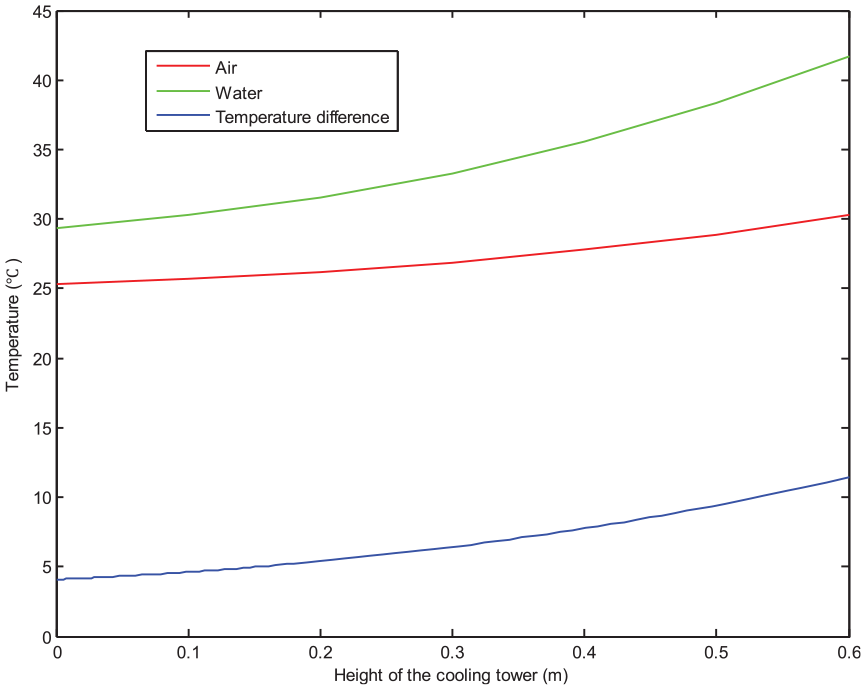
Temperature difference of heat transfer process along the tower height.
Analysis on mass transfer process
Figure 8 shows the distribution of the partial pressure distribution and the mass transfer driving force in the cooling tower. From 0 to 0.6 m away from the bottom of the cooling tower, the partial pressure of water vapor in the air is lower than the saturated vapor pressure of water, and the mass transfer driving force in the cooling tower is in the range of 0.624–0.927 kPa, which decreases gradually. From the mass transfer point of view, the lower the air humidity, the greater the mass transfer driving force, the more conducive to evaporative cooling of cooling water.
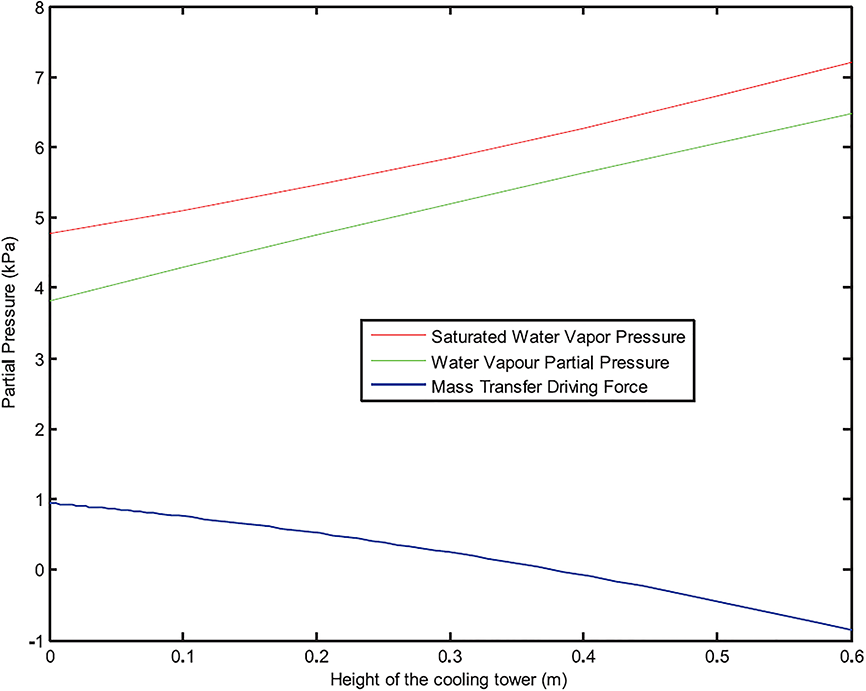
Mass transfer driving force along the height of the tower.
Conclusion
The explicit solutions have not yet been published before. This article has developed accurate and fast analytical method for heat and mass transfer model in a cooling tower. Some algebraic explicit analytical solutions of the one-dimensional differential equation sets describing heat and mass transfer process in a cooling tower are derived. The explicit equations of heat and mass transfer are expressed in elementary functions. The model can directly and quickly calculate the changing rules of liquid, gas, interface temperature, and moisture content in the air along the vertical height of the tower. Simple analytical equations can be used to calculate cooling tower performance without any numerical integrations. The comparison of the analytical results with the experimental data shows that there is a good agreement between them. Moreover, the analysis on heat and mass transfer driving force along the cooling tower has been given. This article provided a quick and accurate method in rating and design calculations of cooling tower performance.
Footnotes
Handling Editor: James Baldwin
Declaration of conflicting interests
The author(s) declared no potential conflicts of interest with respect to the research, authorship, and/or publication of this article.
Funding
The author(s) disclosed receipt of the following financial support for the research, authorship, and/or publication of this article: This paper is supported by National Natural Science Foundation of China (grant nos 51806128 and 51879154), Shandong Provincial Natural Science Foundation of China (grant nos ZR2018LE011 and ZR2019MEE007), and SDUT and Zhangdian District Integration Development Project (no. 118239). These supports are gratefully acknowledged.
