




Abstract
This article deals with the numerical study of two-phase shallow flow model describing the mixture of fluid and solid granular particles. The model under investigation consists of coupled mass and momentum equations for solid granular material and fluid particles through non-conservative momentum exchange terms. The non-conservativity of model equations poses major challenges for any numerical scheme, such as well balancing, positivity preservation, accurate approximation of non-conservative terms, and achievement of steady-state conditions. Thus, in order to approximate the present model an accurate, well-balanced, robust, and efficient numerical scheme is required. For this purpose, in this article, Runge–Kutta discontinuous Galerkin method is applied successfully for the first time to solve the model equations. Several test problems are also carried out to check the performance and accuracy of our proposed numerical method. To compare the results, the same model is solved by staggered central Nessyahu–Tadmor scheme. A good comparison is found between two schemes, but the results obtained by Runge–Kutta discontinuous Galerkin scheme are found superior over the central Nessyahu–Tadmor scheme.
Keywords
Introduction
Shallow water flows are characterized by such type of flows in which vertical scale length is considered much smaller than the horizontal scale length. The equations for the shallow flow model can be derived on the basis of basic equations of fluid mechanics by considering incompressible and inviscid fluid. The interaction between the solid granular particles and interstitial fluid appears in the form of rheological behavior of moving mixture of solid grains and fluid. Fluids play a prominent role in the mobility of avalanche flows of solid granular particles. The flow mobility and deformation process are affected by rheological behavior of fluid. 1 Debris flows are example of shallow water flows, and these flows are basically the slurry flows and saturated by water.2–4 The examples of the debris flows include heavy rainfall, volcanic flows, rock avalanches, mud slides, and landslides.
In this article, two-phase granular flow model describes the flow containing a mixture of granular material and fluid particles. The model contains two mass and two momentum equations which are coupled with each other for both phases. 4 These equations are connected by non-conservative differential terms.5–9 Due to the very minute difference between the phase velocities and real eigenstructure, the two-phase shallow flow (TPSF) model is assumed to be hyperbolic, and the model equations are applicable to geophysical flows. In these flows, the inter-phase forces try to move the mixture to maintain kinematic equilibrium. First of all, a Godunov-type finite volume scheme using Roe-type solvers was employed to solve the granular flow models,6,9 but this method had some disadvantages such as non-preservation of positivity of flow depth and solid volume fraction and unphysical solutions. Hence, this scheme was not suitable for open or free surface flows because it violates the fundamental property of any numerical scheme. 7 After that, a finite volume scheme based on Riemann solver is applied to address the same model. In the recent literature, some other finite volume schemes have also been applied to investigate the TPSF models. These schemes include central upwind scheme, central Nessyahu–Tadmor (NT) scheme, space–time conservation element and solution element (CESE) scheme, kinetic flux vector splitting (KFVS) scheme, and weighted essentially non-oscillatory (WENO) scheme.10–14
Discontinuous Galerkin (DG) methods were initially formulated by Cockburn and Shu for non-linear hyperbolic systems. They belong to the class of finite element methods (FEMs) which has several advantages over finite difference methods (FDMs). These methods inherit the geometric flexibility of FEMs and finite volume method (FVMs), retain conservation properties of FVMs, and possess high-order accuracy. DG methods also satisfy the total variation bounded (TVB) property that guarantees the positivity of the scheme.15–18 In these methods, a simple treatment of B.Cs is adopted to obtain high-order accuracy. In addition, DG methods allow discontinues approximations and produce block-diagonal mass matrices which can be easily converted through algorithms of low computational cost.
In this article, a TVB Runge–Kutta discontinuous Galerkin (RK-DG) method is extended for the first time and applied successfully for solving the TPSF model.16–18 In the current scheme, DG method deals with space coordinates and converts the given system of coupled partial differential equations (PDEs) into a system of ordinary differential equations (ODEs). The resulting system of ODEs is solved using non-linearly stable and high-order Runge–Kutta method. For validation of the numerical results obtained from the proposed numerical scheme, a staggered central NT scheme is employed to solve the same model equations. A good agreement is found between the results of both schemes, but the results obtained from the RK-DG scheme are dominant over the central scheme results. 19
This article is organized as follows. Section “Incompressible two-phase flow model” is devoted to the introduction of the one-dimensional incompressible two-phase granular flow model. The RK-DG method is presented in section “DG method.” Various numerical case studies are carried out in section “Test problems for TPSF model.” Finally, concluding remarks are given in section “Conclusion.”
Incompressible two-phase flow model
In this section, we consider TPSF model5–7 which describes the dynamics of shallow thin layer of mixture of the solid granular material and fluid over a smooth horizontal surface. The granular and fluid components of the mixture are assumed to be incompressible with specific densities

Here, we are considering the one-dimensional flow only, solid and fluid velocities along the x-direction are represented by

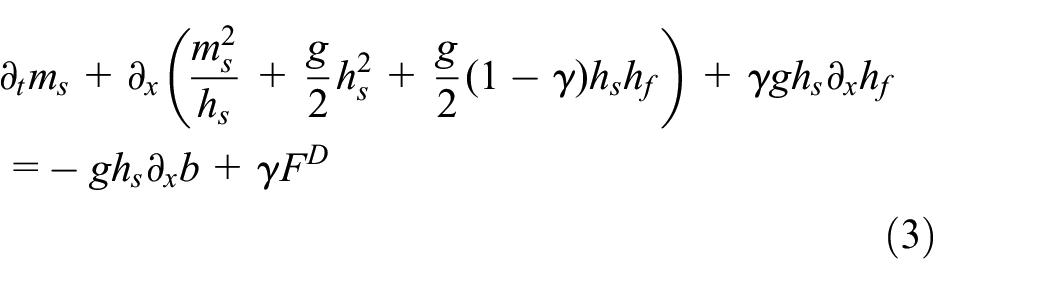


Here, g denotes the gravitational constant,

Source terms in term of inter-phase drag force

where

where conserved variables are defined as

and the fluxes as
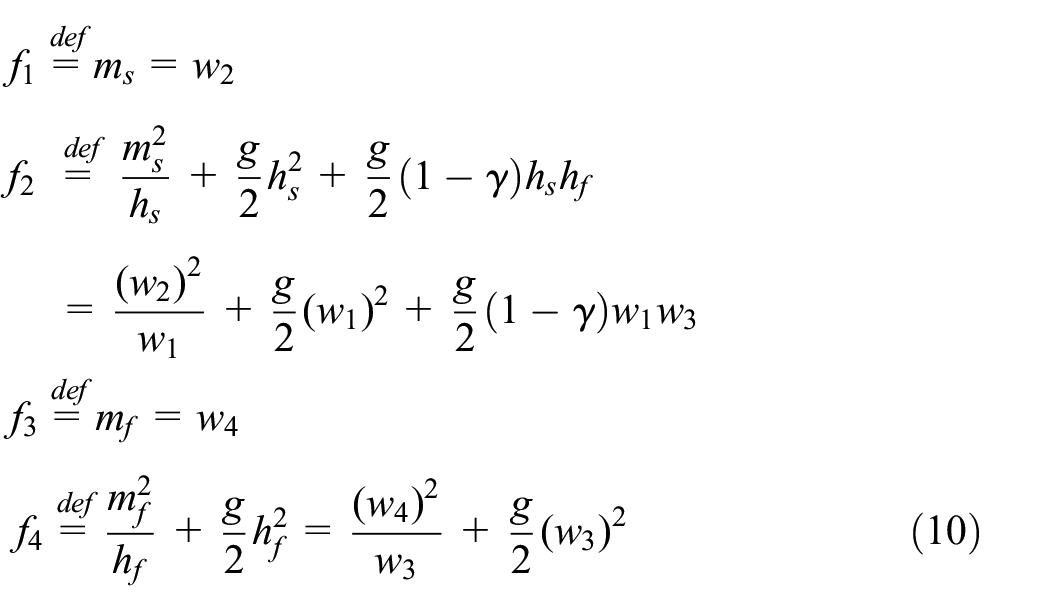
Moreover, the source terms are expressed as

The conservative and non-conservative fluxes of the system are

where

In the above equation,

where

The set of values which are admissible for this model is

in terms of

Steady states for the model
The steady-state conditions for the model (8) are


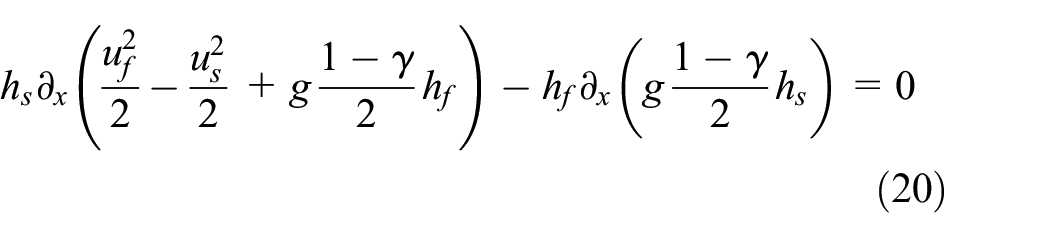
From the above conditions, it simplifies to

Eigenvalues and hyperbolicity of the model
In general, explicit expressions for the eigenvalues of the jacobian matrix of incompressible two-phase shallow granular flow model cannot be found straightforwardly. But, in particular cases, eigenvalues can be calculated from the Jacobian matrix:
Case I: when solid and fluid velocities are taken as equal, that is,

where
Case II: when

Case III: when
DG method
In this section, the one-dimensional incompressible two-phase flow model is considered. In one space dimension, two-phase model in equation (8) reduces to

where


Here,
For the numerical treatment of the model (8), a TVB RK-DG scheme16,17 is implemented for the discretization of space coordinate only. The derivatives of time coordinate are discretized using TVB Runge–Kutta method.
In order to discretize the spatial domain

where

One way to apply equation (26) is to choose Legendre polynomials,

For each

where

It can be easily proved that

Since the above Legendre polynomials are used as local basis functions, the smooth function

Here


Using the above definitions, the weak formulation in equation (27) simplifies to

It remains to choose the appropriate numerical flux function
1. The Lax–Friedrichs flux


2. The Local Lax–Friedrichs flux


The Gauss–Lobatto quadrature formula of 10th order was used to approximate numerically integral terms coming on the right-hand side of equation (35). To achieve local maximum principle with respect to the means, some limiting procedure is needed. For that purpose, it is required to modify the interface values

where

Next,


where

Then, equation (40) modifies to

and equation (32) is replaced by

This limiter corresponds to adding the minimum amount of numerical diffusion while preserving the stability of the scheme. The DG method in addition to the above-explained slope limiter has proved to be stable. 25
But, in this scheme, we used the WENO limiter 26 to eliminate oscillations and enforce the stability. In this way, first identify “troubled cells,” namely, those cells that need to be reconstructed. A troubled cell is defined as if one of the minmod functions given in equations (42) and (43) gets active (returns other than the first argument) and is marked for further reconstructions. For the troubled cells, we would like to reconstruct the polynomial solution while retaining its cell average.
Finally, a Runge–Kutta method is implemented that maintains the TVB property needed to solve the resulting system of ODE. Let us rewrite equation (35) in a concise form as

Then, the r-order TVB Runge–Kutta method can be used to approximate equation (47)

were based on the boundary conditions

For the second-order TVB Runge–Kutta method, the coefficient are given as15,16

While, for the third-order TVB Runge–Kutta method, the coefficient are given as

In order to guarantee numerical convergence and stability of the DG scheme, the time step is taken according to the following Courant–Friedrichs–Lewy (CFL) condition16,23

where
Test problems for TPSF model
In this section, we present some numerical case studies to analyze the performance of our proposed RK-DG method for the proposed model. In all the test problems, we set
Problem 1: simple Riemann problem
This Riemann problem was considered in Qamar et al. 5 and Pelanti et al. 6 The left and right states of the initial data are given as


The computational domain
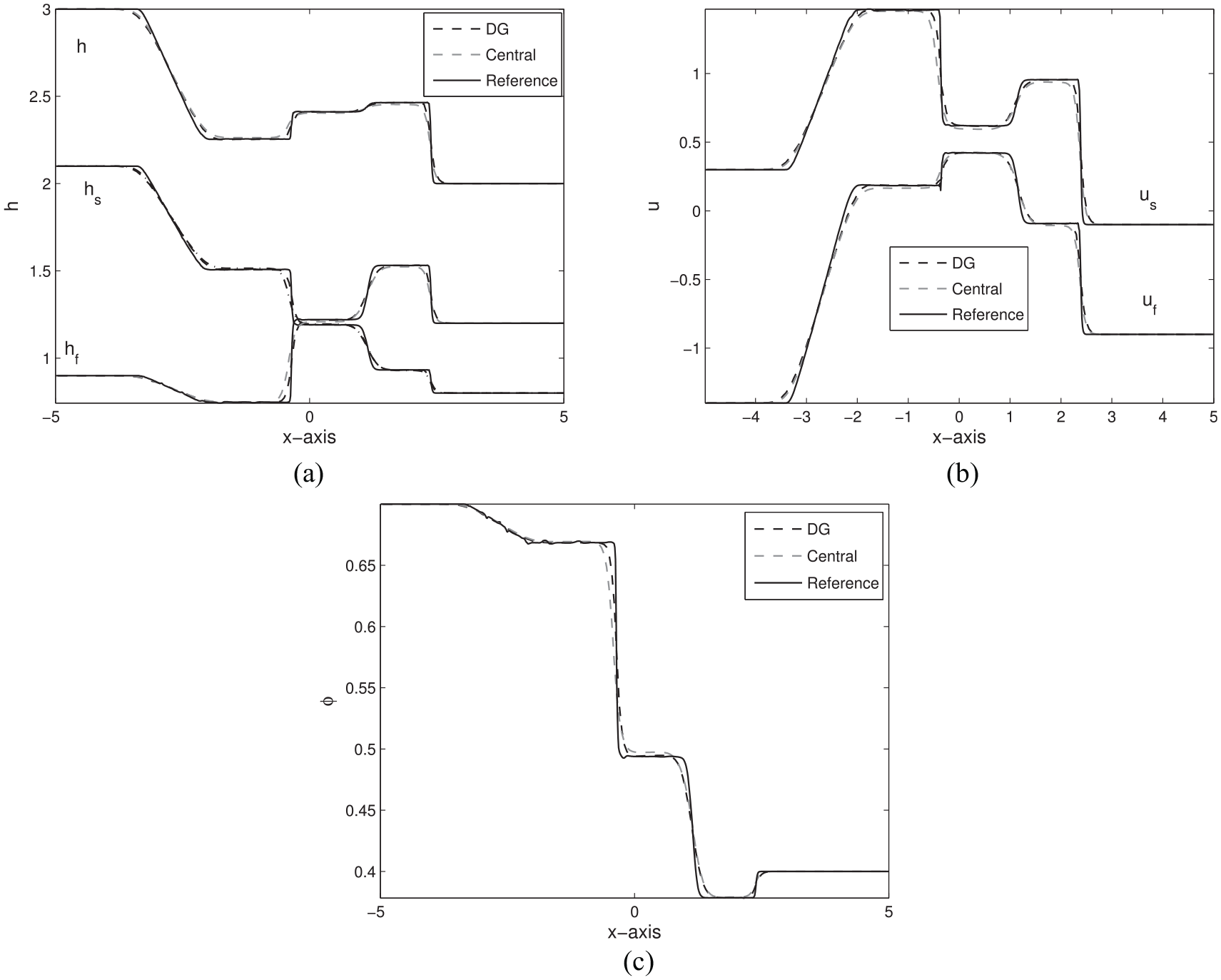
Problem 1: simple Riemann problem. Comparison of DG and central NT schemes at time
Problem 1: comparison of L1-errors.

DG: discontinuous Galerkin.

Problem 1: convergence study of DG and central NT schemes. Comparison of L1-errors in height, solid volume fraction, solid velocity, and fluid velocity in both schemes at different grid points.
Problem 2: rarefaction of the fluid constituent into vacuum
This problem was also considered in Qamar et al.
5
and Pelanti et al.
6
Here, we consider the flow for


The bottom is flat, that is,

Problem 2: rarefaction of the fluid constituents into vacuum (Dam break problem). Comparison of DG and central NT schemes at time
Problem 3: spreading of a granular mass
This numerical experiment was also taken from Qamar et al.
5
and Pelanti et al.
6
In this experiment, the granular mass is spread over a horizontal surface. Initially,

In this case, the bottom is flat, that is,

Problem 3: spreading of granular mass with no drag forces. Comparison of DG and central NT schemes at time
Problem 4: dry bed generation
This problem is concerned with the generation of dry bed zone. In this problem, three further cases of the Riemann problem are discussed. In all the three cases, the solutions consist of two opposite moving rarefaction waves, and a dry bed region is generated. The initial data for the three test problems are given in Table 2.
Problem 4: initial data for test cases of dry bed formation.

In all the three test problems, initially the interface is located at
In our model, no inter-phase drag forces are considered. As both fluids are separate at

Problem 4a: dry bed generation. Comparison of DG and central NT schemes at time

Problem 4b: dry bed generation. Comparison of DG and central NT schemes at time
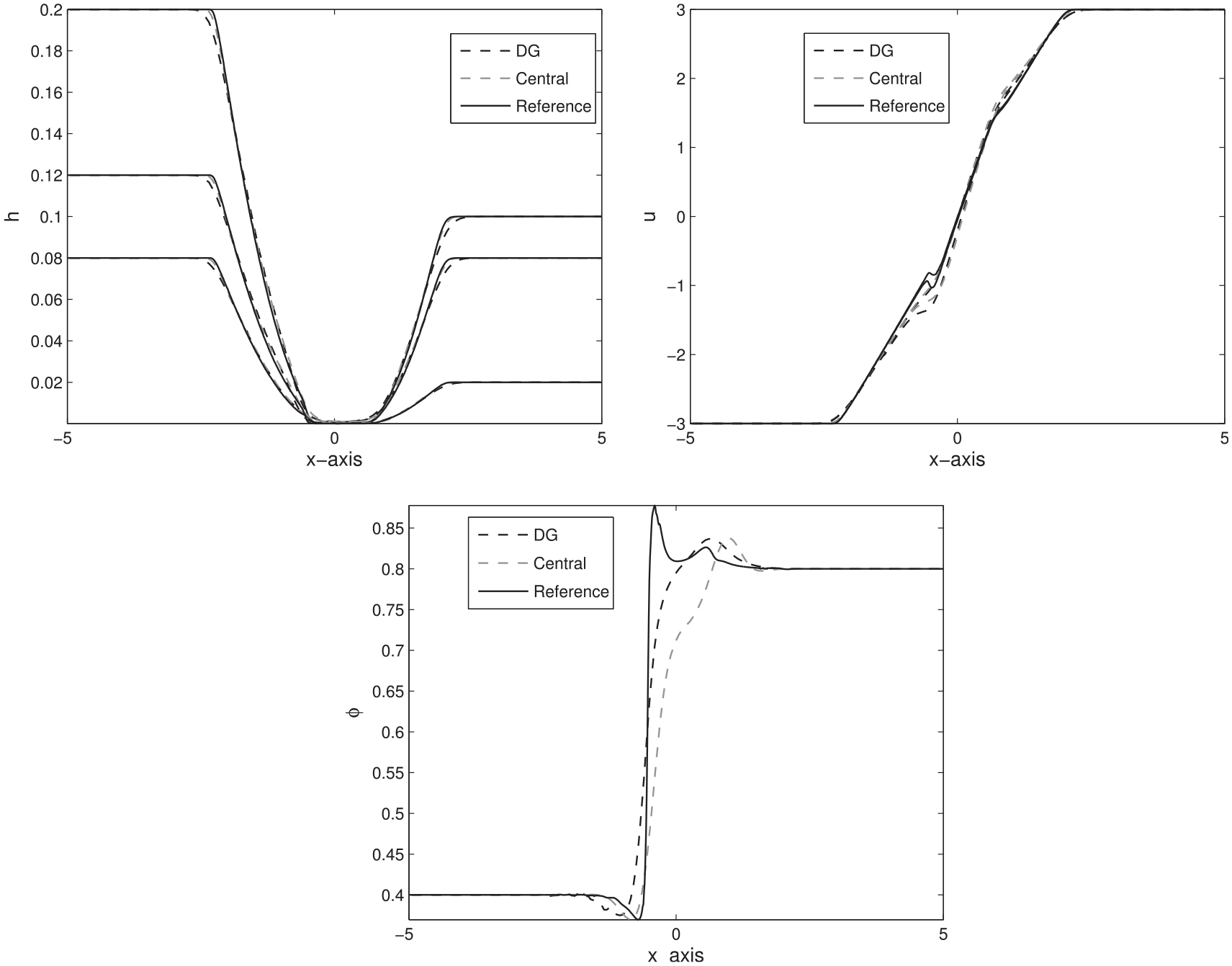
Problem 4c: dry bed generation. Comparison of DG and central NT schemes at time
Test case
In test case
Problem 5: interface propagation
This problem is considered to verify the performance of our proposed RK-DG method to capture and propagate the discontinuities over time. In order to validate the schemes, this example has been widely used for multi-layer flows.27,28 The initial data for this problem are given by


Initially, the location of interface is at

Problem 5: interface propagation. Comparison of DG and central NT schemes at time
Problem 6: perturbation of a steady state at rest
In order to confirm the well-balanced property of the proposed RK-DG method, we consider a test problem incorporating non-flat bottom topography. The same test problem was presented in Qamar et al. 5 and Pelanti et al. 6 In this way, we added a discontinuous rectangular topography in the right-hand side of the model to check the ability of our suggested well-balanced scheme. In this problem, we study the behavior of a small perturbation which satisfies the steady-state conditions at rest given in equation (18) over a variable bottom topography defined as

Initially, we take a small perturbation of the flow depth

where
Problem 6: comparison of L1-errors in the schemes.

DG: discontinuous Galerkin.

Problem 6: convergence study of DG and Central NT schemes. Comparison of L1-errors in total height and solid volume fraction in both schemes at different grid points.
It is very clear from the set of first three figures displayed in Figure 10 that the initial perturbation splits into four waves, two left-going waves, and two right-going waves that leave the domain from the left edge, Figure 10 shows at

Problem 6: perturbation of a steady state at rest. Comparison of DG and central NT schemes at time
Those numerical schemes which are not well-balanced present in the literature may produce unphysical disturbances in such kind of numerical test cases. 29 Hence, our computational methods have the ability to capture physically correct reflected waves, without producing spurious oscillations in the simulated results.
Conclusion
In this article, a high-resolution RK-DG method was extended for the first time to address the incompressible TPSF model. Our proposed numerical scheme has the good ability to capture sharp discontinuities and avoids spurious oscillations in the solutions. The performance and accuracy of the proposed scheme were checked quantitatively and qualitatively by considering several numerical case studies. It was observed that the present scheme effectively captures all the sharp discontinuities in the solutions, and preserves the positivity of the flow variables like flow height and volume fraction. For validation and comparison, the central NT scheme was also applied to the same model equations. A good agreement was found between the results of both schemes. However, it was observed that the RK-DG scheme gives better resolution of the sharp discontinuities produced in the profiles of physical parameters.
Footnotes
Handling Editor: James Baldwin
Declaration of conflicting interests
The author(s) declared no potential conflicts of interest with respect to the research, authorship, and/or publication of this article.
Funding
The author(s) received no financial support for the research, authorship, and/or publication of this article.
