



Abstract
In this article, a weighted essentially non-oscillatory (WENO) scheme is implemented to simulate two-phase shallow granular flow (TPSF) model. The flow is assumed to be incompressible and it is regarded as shallow layer of granular and liquid material. The mathematical model consists of two phases, that is, solid and liquid. Each phase has its continuity and momentum equation. The presence of the equations are coupled together involving the derivatives of unknowns which make it more challenging to solve. An efficient numerical technique is needed to tackle the numerical complexities. Our main intrigue is the numerical approximation of the above-mentioned solid-liquid model. The weighted essentially non-oscillatory (WENO) scheme of order 5 is utilized to handle the shock waves and contact discontinuities appear in the solution. The results are compared with the results already available in the literature by conservation element and solution element (CESE) scheme. It is observed the WENO scheme produces less errors as compared to CESE scheme and also effectively handle the shocks.
Introduction
In this article, we investigate depth-averaged two-phase shallow granular flow (TPSF) model for gravity-driven mixtures of solid and liquid. The motivation behind studying two-phase flows is because of its wide range applications to debris flows and avalanches. 1 In most of the cases, the mathematical equations of these flows form hyperbolic conservation laws. The most challenging task for the scientists is the approximation of such flows. Noteworthy endeavors have been made in recent years for modeling and simulation of two-phase flows.
Savage and Hutter2,3 commenced the work on one-dimensional single-phase flow model which was proposed to study avalanches. Later, they extended it to two-dimensions 4 and several authors generalized the results on more complex basal topography.5–10 Through depth-averaged models, incredible progress has been made in enhancing numerical and scientific evidence of geophysical flows. As of late, numerous higher order numerical schemes implementing these depth-averaged models have been able to solve with significant success.11–15 The two-phase shallow granular flow model considered in this article is a variant of Pitman and Le 16 fluid model, comprising of shallow layer of liquid and solid phases. In literature, the impacts of the liquid phase17–19 are not taken into consideration in a number of models used to approximate true avalanches. Though it plays a crucial role in the mobility of flow. 20
The equations of two-phase shallow granular flow model form a system of hyperbolic conservation laws. This model have been studied by numerous scientists while assuming sufficiently small differences between phase velocities.14,15,21–23 When analyzing geophysical flows, the assumption of hyperbolicity is reasonable because solid and liquid are quite often quickly brought into kinematic equilibrium by inter-phase interactions.
20
Pelenti et al.14,15 approximated the two-phase granular model by using a finite volume Godunov-type technique based on the Riemann solver (Roe-type). Unfortunately, the Roe-type scheme produces negative values of physical variables like height and solid volume fraction. Later, Riemann solver based finite volume scheme (FVS) was implemented to solve the two-phase shallow granular flow model.
21
In Yan et al.,
24
the authors numerically investigated the Eulerian-Eulerian and Eulerian-Lagrangian two-phase flow models. The kinetic flux-vector splitting (KFVS) and CE/SE schemes were extended to solve two-phase shallow granular flow.22,23 In Zia and Qamar,
23
the schemes preserves the positivity of height only for
A well-balanced numerical scheme can handle small perturbations in the steady state solutions effectively in comparison with ordinary numerical scheme (not well-balanced). Therefore well-balanced schemes are more appropriate to compute turbulent fluctuations mainly in steady flows, whereas schemes which does not possess the property of being well-balanced can only handle perturbations at the level of truncation error with the given grid. For the depth averaged models, a lot of work in literature have been done on well-balanced schemes.14,15,21,25–28
In this study, a fifth-order finite volume WENO numerical technique 29 is designed to solve the shallow two-phase flow model. The proposed numerical scheme is more simple and fundamentally distinctive than the computational methods that were devised to solve the mentioned model in the articles.14,15 Initially in 1987, Harten and Osher 30 introduced the finite volume essentially non-oscillatory (ENO) numerical scheme. This scheme obtained arbitrarily high order accuracy in smooth regions, resolved the steep gradients efficiently and did not produce spurious oscillations in the vicinity of sharp gradients. Later in 1988, Shu and Osher 31 developed the finite difference ENO scheme with total variation diminishing Runge-Kutta (TVD-RK) time discritization procedure. Subsequently, Liu et al. 32 proposed the improved version of finite volume ENO numerical scheme, namely third order finite volume weighted essentially non-oscillatory (WENO) numerical scheme. Soon after in 1996, Jiang and Shu 33 introduced the fifth order WENO numerical scheme. After that, the WENO numerical approach has been revised, extended, and improved for several fields of science and engineering, for detail see References.34–44 The key idea in developing the WENO numerical scheme is used a convex combination of interpolations or reconstructions from different candidate stencils, rather than using only one of them as in the case of ENO. The combination coefficients, also called nonlinear weights, are chosen in such a way that if all candidate stencils contain smooth solution then these nonlinear weights should be selected very close to the linear weights, which could provide the highest possible order of accuracy from the combined stencil. Further, if a candidate stencil contains a steep gradient, while at least one other candidate stencil that does not contain steep gradient, then the candidate stencil that contains a steep gradient should be assigned a very small weight, thus its influence toward the approximation is negligible, for more detail see Shu et al.33–35 Hence, the suggested numerical approach effectively resolves sharp discontinuities while maintaining high order accuracy in smooth areas.
This article is structured as follows. Section 2 presents 1D shallow granular two-phase flow model. Section 3 is devoted for the derivation of WENO scheme. The numerical test cases are carried out in section 4. Finally, conclusions are drawn in section 5.
Shallow granular two-phase flow model
A shallow layer of liquid-solid mixture over an even surface is considered. Let

The velocities in


Here,

where,

The continuity equations for

where,

The conditions on the variables for this model are:

or, with

Introduction to fifth order WENO Scheme
The development of a finite volume WENO numerical technique for numerical approximation of two-phase flow model is presented in this section. Because the model under consideration can be expressed in a concise manner as

as well as dividing the space

where

Where, monotone numerical flux is denoted by

where


where



and


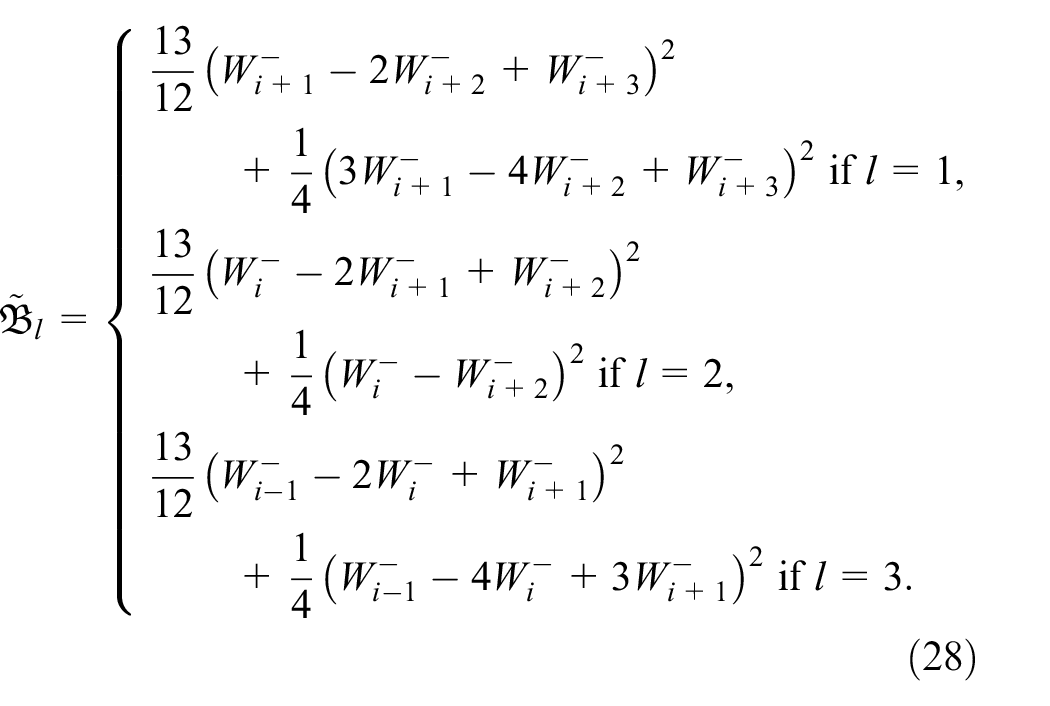
The nonlinear weights

and

To avoid the denominator becoming zero,
The linear weights are denoted by


and
The spatial reconstruction process is now finished. On the right-hand side of equation (13), the nonzero terms is discretized after that,


The averaged value at cell

The values of cell
Further,

alternatively, the equation above may be written as

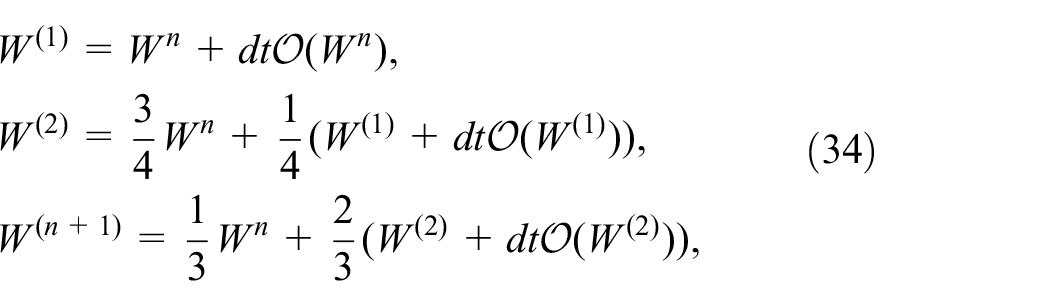
Now, we use the third-order TVD RK technique 29 to solve the system of ordinary differential equation (33) as

Numerical test problems
To validate the proposed WENO scheme several numerical test problems are considered here. In all the experiments, we set
Problem 1:
In this test case, we computed the
Problem 2: Simple Riemann test problem.
Problem 3:

This problem is also discussed in References.15,22,23 The interface is located at


Here, we take
Problem 3: Dam break problem (Rarefaction into vacuum of the fluid constituent).

Problem 2: simple Riemann problem: on 300 cells, t = 0.5 yielded the following results.
Here, the flow for


There is no liquid on the right side of the interface
Problem 4: Spreading of a granular mass

Problem 3: dam break problem. Results at
In this problem, we consider the case of spreading of granular mass on a horizontal surface. The velocities of both the phases are taken as zero initially, that is

Here,
Problem 5: Propagation at interface.

Problem 4: spreading of granular mass.
The purpose of considering this test problem is to check the effectiveness of our suggested WENO scheme in capturing the discontinuous profiles over time. This is a very hard test problem for any numerical scheme. Several authors used this test case to validate numerical schemes.22,28,48 The initial data are given as


Here,
Problem 6: Dry bed generation.
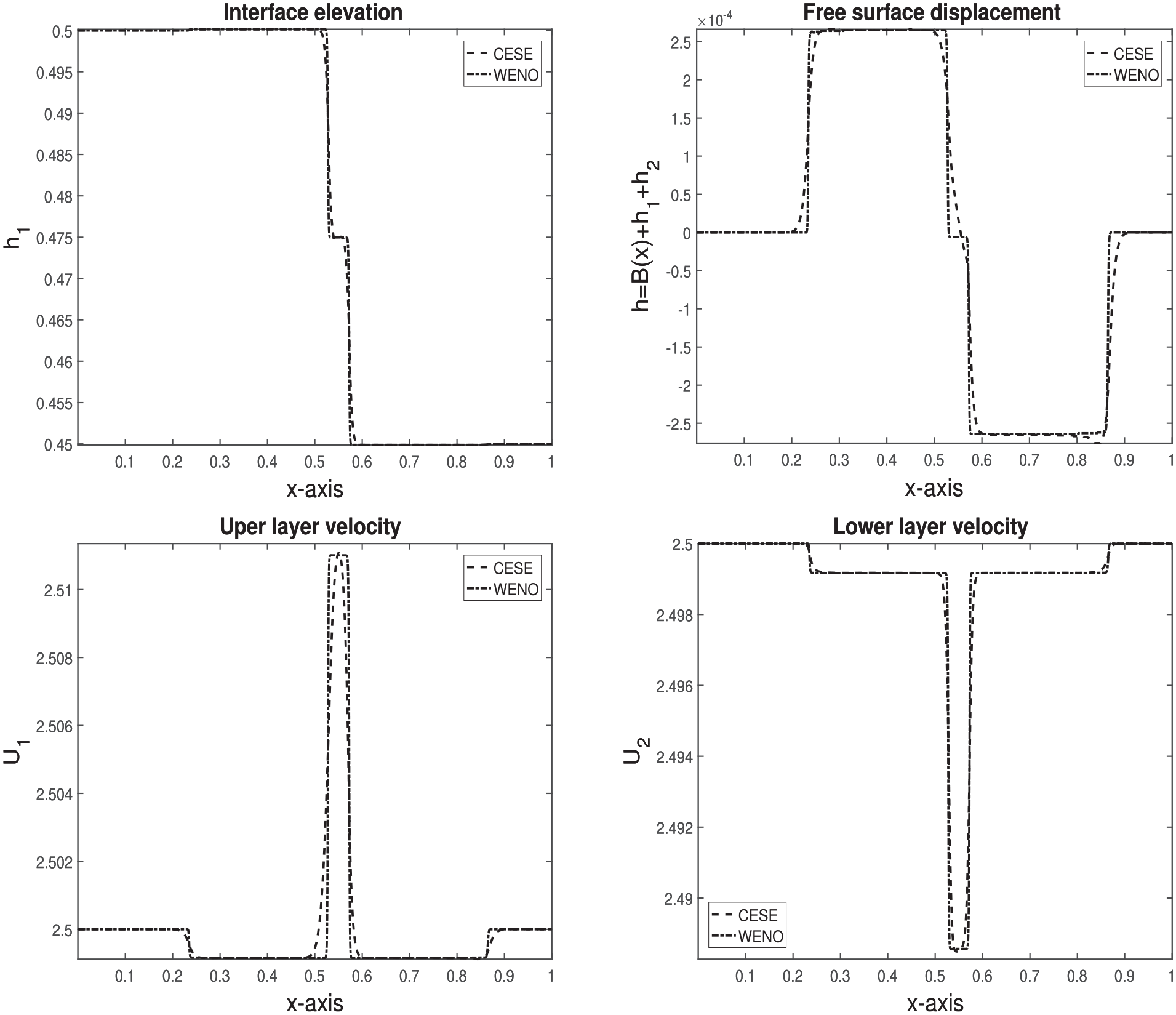
Problem 5: interface evolution outcomes (top left), free surface displacement (top right), upper layer velocity (bottom left) and lower layer velocity (bottom right).
This test problem is related to the formation of a dry bed zone. The left and right state data for this problem is,


The initial discontinuity is at
The results are shown in Figure 5. The solution consist of two oppositely moving rarefaction waves generating a dry bed region in between. The results by WENO scheme are compared with the CESE scheme. The WENO scheme gives better resolution of the shocks.

Problem 6: dry bed generation.
Conclusions
An incompressible two-phase shallow granular flow model is numerically investigated by fifth order WENO scheme. The proposed scheme is capable of capturing sharp discontinuities and accurately handle the dry bed zones for all values of
Footnotes
Handling Editor: Chenhui Liang
Declaration of conflicting interests
The author(s) declared no potential conflicts of interest with respect to the research, authorship, and/or publication of this article.
Funding
The author(s) received no financial support for the research, authorship, and/or publication of this article.
