




Abstract
The coupled unsteady power-law conducting fluid flow and continuous dusty viscous fluid flow under the influence of magnetic field are solved using the finite difference method. The resistive forces of Darcy porous medium and the external uniform magnetic field are applied on the flow. The second-order accurate finite difference schemes are applied on the coupled governing equations to transform the non-linear partial differential equations to linearized system of algebraic equations. This system is solved iteratively using the generalized Thomas algorithm. Some results are introduced to study the convergence and stability of the present works. The effects of non-Newtonian fluid, continuous dusty particles, Darcy model on the velocity field, and friction factor of both the fluid and dust particles phases are demonstrated.
Keywords
Introduction
The two-phase magnetohydrodynamic (MHD) fluid flow is very important in engineering applications such as aerodynamics equipment and MHD generators. The efficiency of these devices is affected by magnetic, Darcy resistance forces and dust particles. The high particle concentration leads to higher particle-phase viscous stresses and can be accounted for endowing the particle phase by the so-called particle-phaseviscosity.1–5 The dusty viscous fluid flow between parallel plates has been studied using perturbation method under the influence of volume fraction of the particles.1,3 Unsteady flow of dusty conducting fluid through pipes has been studied analytically and numerically under the influence of magnetic field.2,4 Velocities, skin friction factors, and volumetric flow rates are computed and discussed. Madhura and Swetha 5 studied the influence of volume fraction of dust particles on flow through porous rectangular channel. They used Laplace transform and finite difference method (FDM) to obtain velocities and skin friction factors for fluid as well as dust particles.
The non-Newtonian fluids in porous medium have many engineering applications such as nuclear reactors, solar devices, polymer processing industries, food industries, and petroleum’s reservoirs. The dusty flow of non-Newtonian fluids is studied by many authors.6–11 Non-Newtonian viscoelastic and temperature-dependent viscosity effects on hydromagnetic dusty fluid flow between parallel plates are studied.6–8 These problems have been solved analytically and numerically to compute velocities and friction factors under influences of magnetic and porous medium resistances. Steady two-dimensional dusty fluid flow over surfaces has been studied.9–11 FDM has been applied on the governing equations to obtain shear stresses.
The aim of present work is to study and compute the effects of continuous dusty viscous particles and conducting power-law fluid and Darcy resistance force on the velocities and skin friction factors of both fluid phase and particle phase. Second-order accurate finite difference schemes are applied to solve the coupled non-linear differential equations of fluid and dust particles. A linearization technique is applied on these equations to transform them to linearized ones. Iterations are used to achieve convergence and stability of linearized governing equations with boundary conditions.
Formulation of the problem
The dust particles are assumed to be electrically non-conducting, spherical in shape, and uniformly distributed throughout the fluid. The two plates are assumed to be electrically non-conducting. A constant pressure gradient is applied in the x-direction and a uniform magnetic field
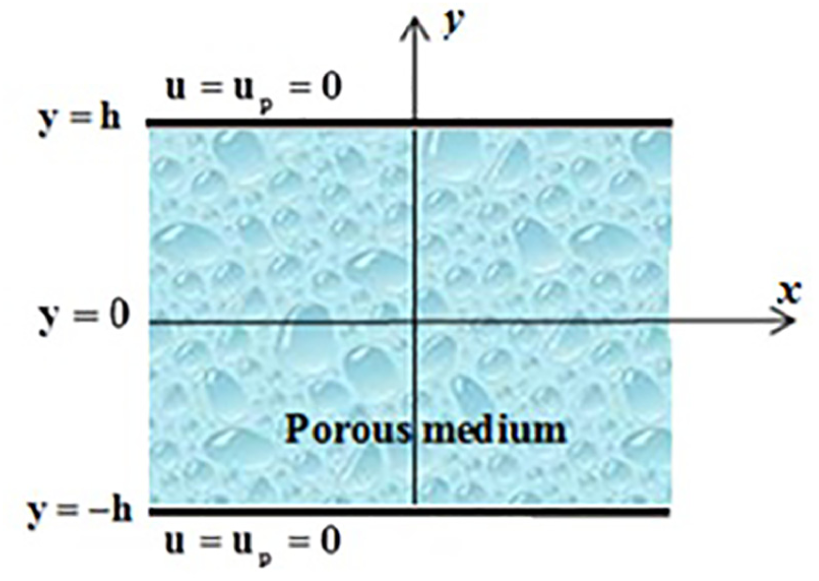
Problem geometry and boundary conditions.
The momentum equation for fluid phase is given by6,12

where

The Hall current and ion slip are neglected, since the magnetic Reynolds number is very large. Thus, the current density

Solving equation (2) for

In terms of equation (3), equation (1a) may be rewritten as follows6,7

where
The apparent viscosity

Newton’s second law including stresses gives the motion of the dust particles in the following form1,2

It is assumed that the pressure gradient is impulsively applied at

For


Introducing the following dimensionless variables and parameters
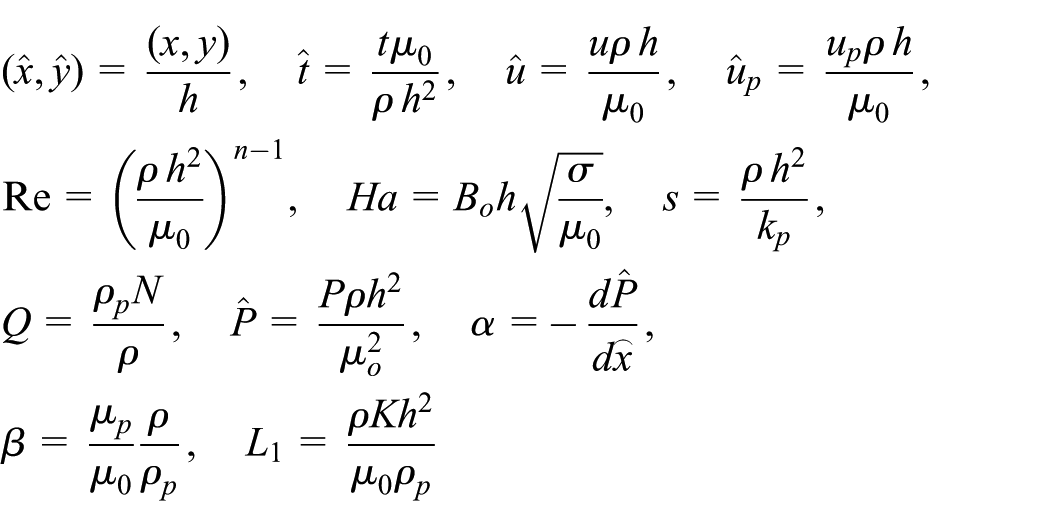
Equations (4)–(7) take the following form, and hats are dropped for simplicity


The method of solution (FDM)
The governing equations (8)–(11) with condition (11) represent an initial-boundary value problem of non-linear partial differential equations. Consider the following substitutions

Governing equations (8)–(10) are rewritten as follows



where bar notation refers to the iterated terms which transform the system equations (12)–(15) to a linearized one. These equations with condition (11) represent a system of linearized partial differential equations which is solved numerically using FDM. The Crank–Nicolson implicit method 12 is used at two successive time levels where the finite difference equations relating the variables are obtained by writing the equations at the mid-point of the computational cell as shown in Figure 2.

The computational cell.
The infinite domain of solution (


Similar difference schemes are used for other dependent variables. Finally, the resulting block tri-diagonal system is solved using generalized Thomas algorithm. 12
The skin friction factor is an important fluid flow parameter because it is very important in the engineering applications as they are important factors that can be used to improve the shape and efficiency of equipment in aerodynamics. This parameter is computed after solving the governing equations.
The skin friction factor is defined as follows13,14

The dimensionless form of skin friction factors for fluid and dust particles is written, respectively, as follows


Error analysis
The central differences and averages at mid-point of cell in Figure 2 have a truncation error (TE) of second-order accuracy, that is,
Sample of convergence of present results (pseudo-fluid).
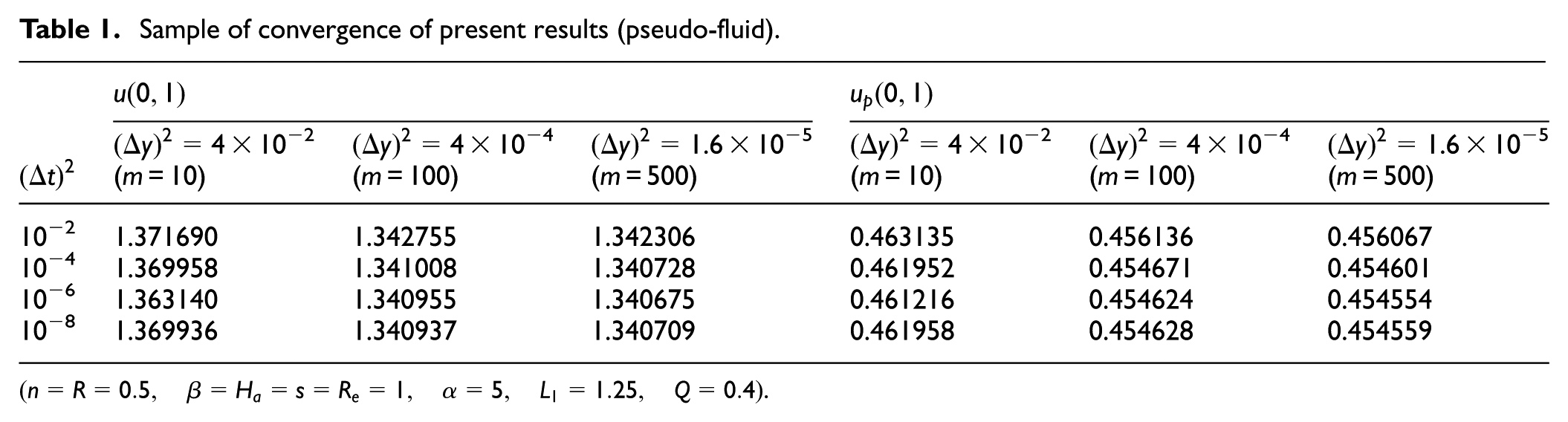
Sample of convergence of present results (Newtonian fluid).

Sample of convergence of present results (dilatant fluid).

Sample of convergence of skin friction factor

Tables 1–3 illustrate a sample of convergence of present solution depending on the influences of
Table 4 shows a sample of convergence of skin friction factor
Figure 3 shows the comparison between the present results with Attia
15
for

Comparison of time development of central plane velocities with Attia: 15 (a) fluid velocity and (b) particle velocity.
Results and discussions
Computations are made for
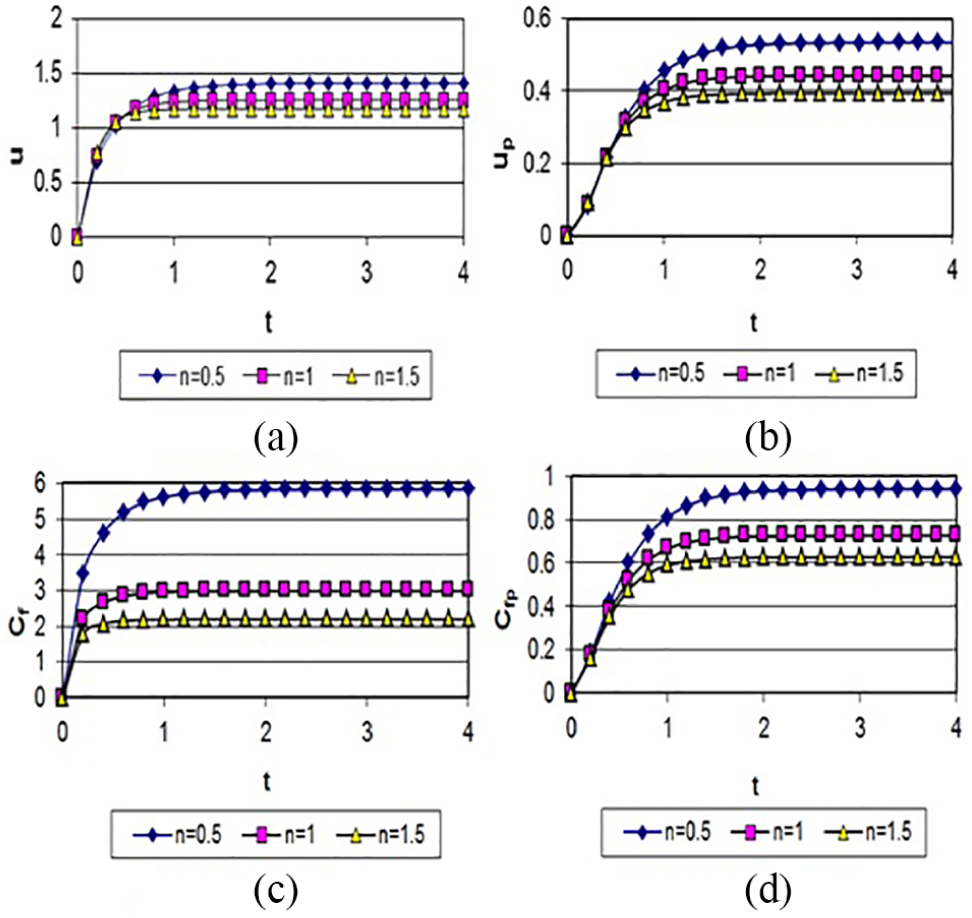
Effect of power law index n on time development of (a) fluid velocity: u(0, t), (b) particle velocity: up(0, t), (c) fluid friction factor: Cf(t), and (d) particle friction factor: Cfp(t) with Ha = β = 1.
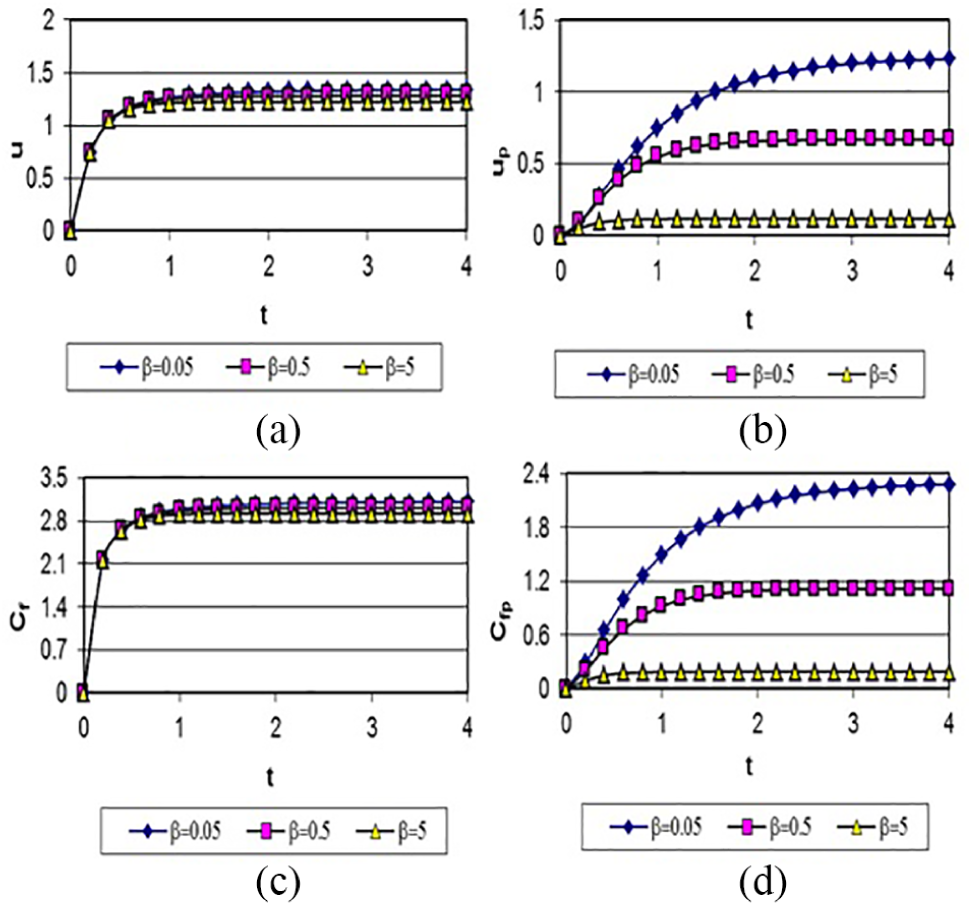
Effect of viscosity ratio β on time development of (a) fluid velocity: u(0, t), (b) particle velocity: up(0, t), (c) fluid friction factor: Cf(t), and (d) particle friction factor: Cfp(t) with Ha = n = 1.

Effect of Hartmann number Ha on time development of (a) fluid velocity: u(0, t), (b) particle velocity: up(0, t), (c) fluid friction factor: Cf(t), and (d) particle friction factor: Cfp(t) with β = n = 1.

Influence of time on profiles of (a) fluid velocity profile: u and (b) particle velocity profile: up with n = 0.5.

Influence of time on profiles of: (a) fluid velocity profile: u and (b) particle velocity profile: up with n = 1.

Influence of time on profiles of (a) fluid velocity profile: u and (b) particle velocity profile: up with n = 1.5.

Influence of time on profiles of (a) fluid velocity profile: u and (b) particle velocity profile: up with β = 0.05.

Influence of time on profiles of (a) fluid velocity profile: u and (b) particle velocity profile: up with β = 0.5.

Influence of time on profiles of (a) fluid velocity profile: u and (b) particle velocity profile: up with β = 5.
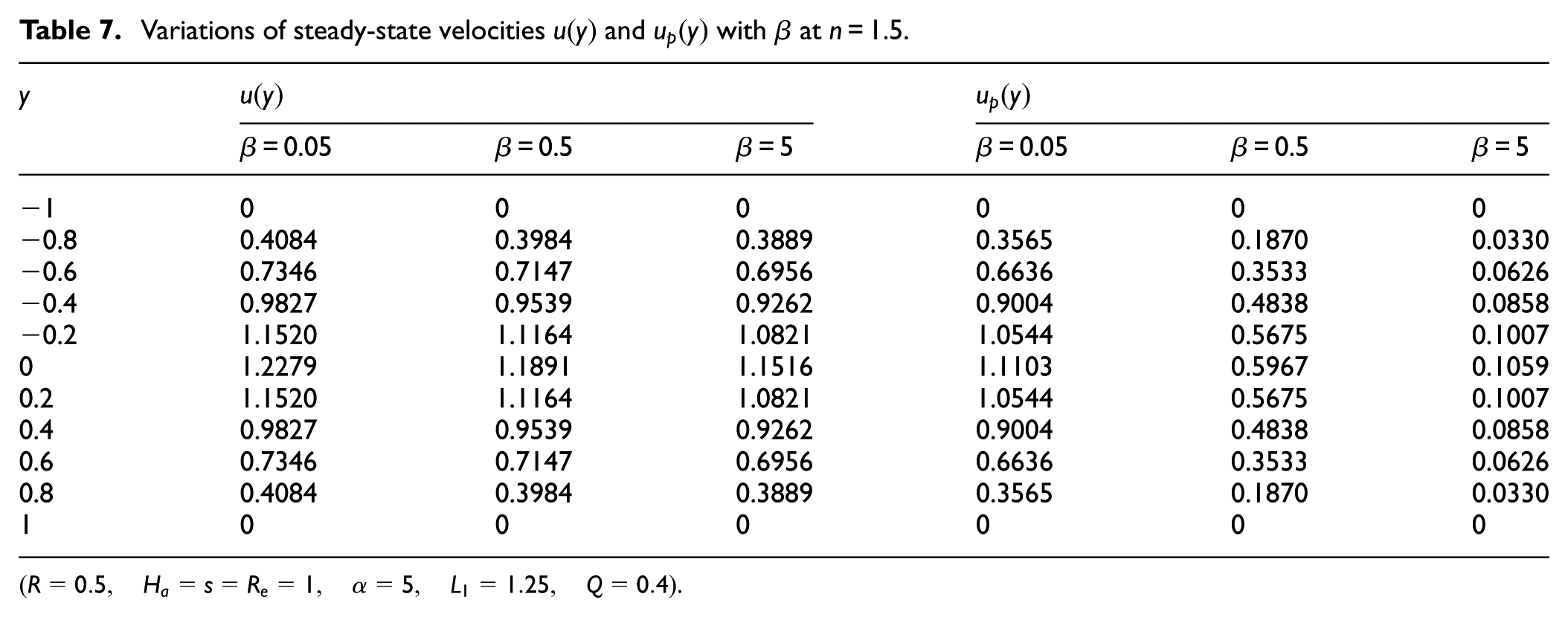
Variations of steady-state velocities

Variations of steady-state velocities

Variations of steady-state velocities
Variations of steady-state central velocities
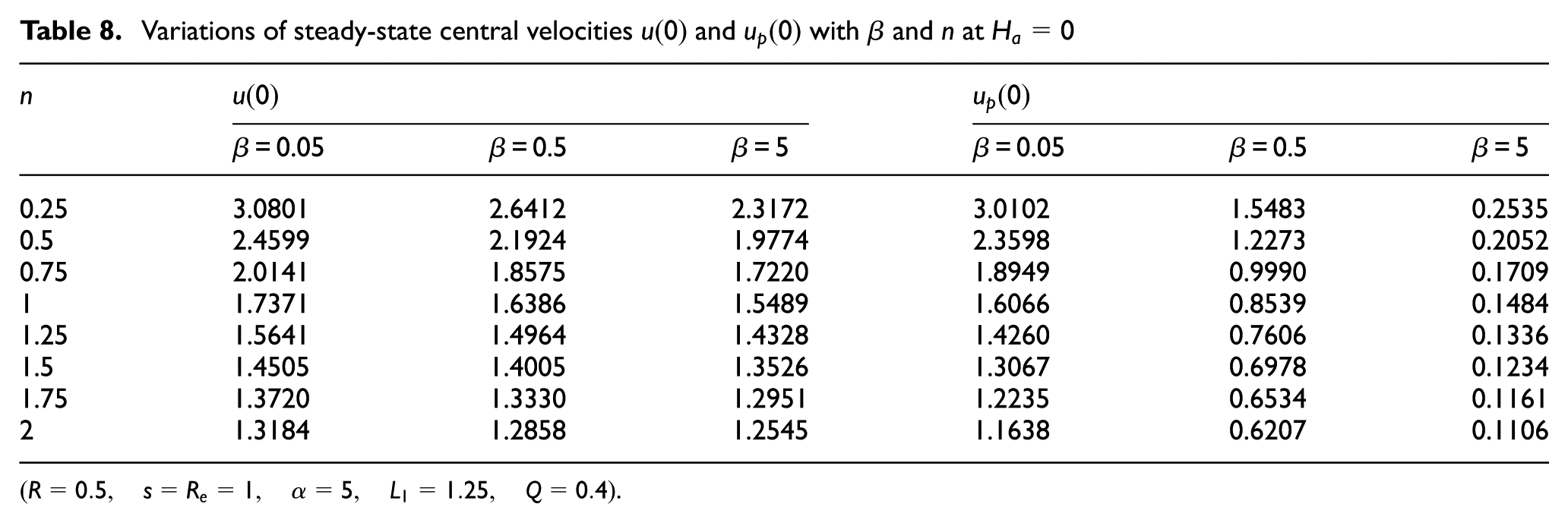
Variations of steady-state central velocities

Variations of steady-state skin friction factors

Variations of steady-state skin friction factors
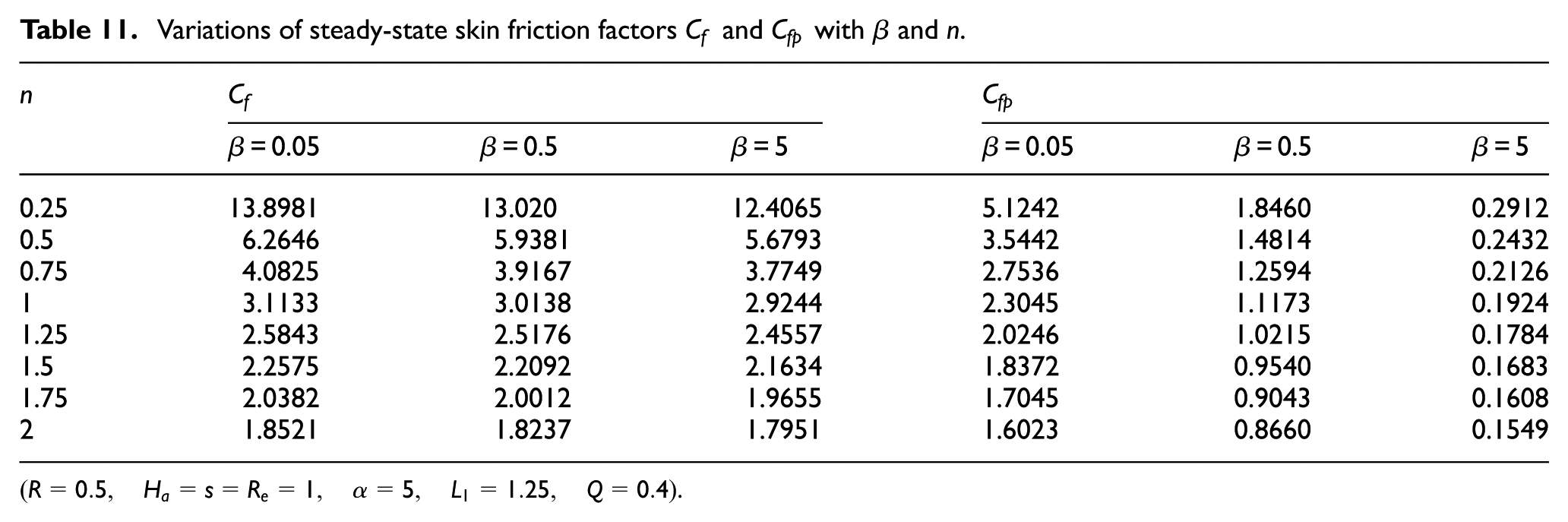
Figure 4(a)–(d) illustrates the effect of power law index n on time development of central plane velocities
Figure 5(a)–(d) illustrates the
Figure 6(a)–(d) illustrates the effect of Ha on time development of central plane velocities
Figures 7(a) and (b), 8(a) and (b), and 9(a) and (b) show the velocity profiles
Figures 10(a) and (b), 11(a) and (b), and 12(a) and (b) show the velocity profiles
Conclusion
The continuous dusty viscous particle model and the non-Newtonian power-law fluid flow are considered between two parallel stationary plates. The conducting fluid was studied considering magnetic and Darcy resistance forces. The influences of power law index, viscosity ratio, and Hartmann number on the velocities and skin friction factors for both the fluid and particle phases are studied. The second-order accurate FDM has been used to compute the velocities and friction factors. The generalized Thomas algorithm is applied on linearized system of equations. It is observed that the particle phase is influenced by particle viscosity ratio more than the fluid phase because it is the main parameter that governs the dusty particle motion. It is also observed that the fluid phase reaches its steady state faster than the particle phase. An error analysis is studied and tabulated to achieve the convergence and stability of present results.
Footnotes
Appendix 1
Handling Editor: James Baldwin
Declaration of conflicting interests
The author(s) declared no potential conflicts of interest with respect to the research, authorship, and/or publication of this article.
Funding
The author(s) received no financial support for the research, authorship, and/or publication of this article.
