




Abstract
Forced convection of non-Newtonian Casson fluid laminar boundary layer flow past an isothermal horizontal flat plate in non-Darcy porous media is studied using Darcy–Forchheimer–Brinkman model. Similarity variables are used to transform the boundary layer equations. The boundary layer equations are reduced into system of first-order differential equations using similarity method. Then, solved numerically using adaptive Runge–Kutta–Fehlberg scheme simultaneously with shooting technique. The effects of Casson parameter, porosity, first- and second-order porous resistances, and Prandtl number on the fluid flow and heat transfer are investigated in terms of the local skin friction and local heat transfer parameters. In addition, velocity and temperature boundary layer profiles are plotted for all considered parameters. It is found that the heat transfer could be enhanced by increasing the Casson parameter and the porous resistance terms. To the contrary, the increase in the porosity reduces heat transfer rates. Finally, the increase in the Prandtl number enhances the heat transfer rates.
Introduction
Convection heat transfer over flat plates attracted researchers due to its importance and valuable implications on other geometries as well. Lin and Lin 1 introduced similarity solutions for forced convection laminar flow over an isothermal or uniform heat flux surface for fluids of different Prandtl numbers. Sparrow and Yu 2 studied boundary layer over porous plate, and they derived local nonsimilarity models based on two and three equations and compared these models to the similarity solutions. Steinrück 3 studied the mixed convection boundary layer equations and obtained similar solutions based on buoyancy parameter and inverse proportionality between temperature difference and leading edge distance, respectively. Steinrück 4 also utilized a spatial stability analysis for the leading edge large distances. Chamkha et al. 5 studied the magnetohydrodynamic (MHD) forced convection flow over a non-isothermal wedge with the presence of heat source/sink and radiation effects. They assumed permeable wedge surface and used nonsimilarity transformation. Vafai and Tien 6 considered the Darcy–Forchheimer model to study the boundary layer flow using volume-averaging method. Vafai and Thiyagaraja 7 analyzed the fluid flow and heat transfer for different interface regions of porous media. Kaviany 8 studied non-Darcian flow over flat plate using expansion and integral method defining Darcian and non-Darcian regimes. Nakayama et al. 9 investigated local similarity solutions of fluid and heat transfer flow in non-Darcian porous past a flat plate and found in good agreement with results from finite difference method. Kumari et al. 10 considered high porosity non-Darcian model where the porous inertia is found to have noticeable effect on the fluid flow and heat transfer. Hossain et al. 11 used the local nonsimilarity method together with Keller box method to obtain numerical solutions for non-Darcy forced convection flow over a wedge with variable free stream and fluids of different Prandtl numbers. They compared the results of three methods, local nonsimilarity method based on two and three equations, the finite difference method, and the series solution method. Mukhopadhyay and Mandal 12 used Darcy–Forchheimer–Brinkman model with convective boundary condition to analyze heat transfer past a flat plate, and they noticed that surface temperature increases with increase in the convective parameter and the heat transfer enhances as Prandtl number increases. Pantokratoras 13 studied the convection in a Darcy–Brinkman porous media. He used finite volume technique to solve the nonsimilar flow and consequently investigate the different convection regimes under the influence of the various parameters.
The exploration of non-Newtonian fluids has brought considerable interest in research due to its increasing importance in industry and applications, especially those related to the food and biomedical industries. Mendes et al. 14 studied the heat and friction coefficients for several non-Newtonian fluids models. Gupta et al. 15 investigated the suction/blowing effects on non-Newtonian fluid over a porous flat plate. They derived analytical solutions for the velocity and temperature. Completo et al. 16 investigated blood analogous non-Newtonian H2O/glycerine/xanthan mixtures and found the optimum concentration that imitates blood viscosity. Gnambode et al. 17 used large eddy simulation (LES) to explore power-law fluids of turbulent flows and estimated correlations for velocity perturbations and kinetic energy. Vasu et al. 18 investigated the effects of radiation and heat sink/source on heat and mass transfer flow of Walters-B fluid past a plate. Recently, Khan et al. 19 studied the effects of thermophoresis on three non-Newtonian fluid models, namely, Jeffrey, Maxwell, and Oldroyd-B. They found that thermophoretic effect enhanced the thermal conductivity of Jeffrey fluid over the Oldroyd-B and Maxwell fluids. Casson non-Newtonian fluid is a fluid based on yield stress. It is widely used in biomedical models and has been investigated by many researchers.20–27 Nakamura and Sawada 20 studied the laminar steady flow for non-Newtonian (biviscosity fluid) within an axisymmetric stenosis using finite element method. Nadeem et al. 21 derived analytical solution using Adomian decomposition method for MHD boundary layer flow of a Casson fluid with permeable exponentially shrinking sheet. Mukhopadhyay and Mandal 22 investigated the forced convection of Casson fluid past a porous wedge and studied the influence of the different parameters. Mythili and Sivaraj 23 focused on the effects of chemical reaction with higher order and uneven source/sink heat on Casson fluid passing a vertical cone and flat plate with radiation effects. They found that velocity and temperature boundary layer thicknesses shorten with increase in the radiation parameter. Recently, Mohyud-Din et al. 24 investigated the effects of radioactivity Casson fluid flow in asymmetric porous channel. They used Galerkin’s and Runge–Kutta–Fehlberg scheme to solve the system of differential equations. They showed that heat transfer rate at the top wall decreases as the permeability decreases, while the rate at the bottom wall increases. Mohyud-Din et al. 25 used similarity transformation and analytical solution to study Casson fluid between parallel plates. Also, Zaib et al. 26 studied the forced convection of Casson nanofluid passing a wedge using similarity transformation together with the Keller box method. They found that increasing Casson parameter will increase the velocity while decreasing the temperature. Durairaj et al. 27 implemented finite difference technique to study Casson fluid immersed in non-Darcy porous media past vertical cone/flat plate geometries with heat generation or absorbing. They found that Soret/Dufour effects are noticeable on heat/mass transfer rates and the heat generation/absorbing is significant in anticipating heat transfer rates of moving fluids. Furthermore, Mahanthesh and Gireesha 28 investigated the Marangoni convection effects of magnetic Casson fluid flow in dusty particles. They found that Nusselt number is larger for non-Newtonian Casson dusty fluid compared to Newtonian dusty fluid as dust concentration and thermal dust parameter increase. However, Nusselt number for dusty Casson fluid is less than dusty fluid at large values of Prandtl number.
The boundary layer flow is very crucial in understanding many fluid and heat transfer flow problems. Wei et al. 29 proposed a spatial parabolized model based on the boundary layer theory, and they studied the spatial growth of shear layers. Furthermore, Qawasmeh and Wei 30 introduced an isentropic Navier–Stokes equations model to explore the temporal development of shear layers. Wei et al. 29 and Qawasmeh and Wei 30 transformed the partial differential equations into reduced-order ordinary differential equations using scaling technique that results in capturing similar coherent structures.
In this study, we investigate the forced convection for non-Newtonian Casson fluid flow in saturated porous media past a horizontal isothermal surface. The porous media model used is the Darcy–Forchheimer–Brinkman model with uniform porosity. Similarity variables are used to transform the boundary layer equations into reduced ordinary differential equations model. An adaptive Runge–Kutta–Fehlberg scheme simultaneously with shooting technique is used to solve the reduced model. Figures are plotted to show the effects of Casson parameter, porosity, Prandtl number, and porous inertia resistances on the velocity and temperature non-dimensional profiles. Finally, the wall parameters—local skin friction parameter and local heat transfer parameter—are tabulated to quantify the effects of the different parameters on the fluid flow and heat transfer. This problem has not been solved before with the current degree of generality and complexity.
Analysis
A steady, two-dimensional flow of an incompressible Casson fluid in porous media past a horizontal surface is considered. Assuming constant properties and neglecting viscous dissipation. For the two-dimensional, steady boundary layer flow considered, we adopted the rheological equation of state for a Casson fluid. The flow is assumed to be isotropic and incompressible. The biviscosity model proposed by Nakamura and Sawada 20 is implemented. This model is widely used to represent Casson fluid22–25

where
For our case, two-dimensional flow with boundary layer theory, the above equations become

and

where



Here, u and
With the following boundary conditions, impermeable, isothermal, no slip surface, and uniform free stream

Now, introduce the following parameters and transformations



where
With the above transformations, the continuity equation is satisfied automatically from the definition of the stream function, where
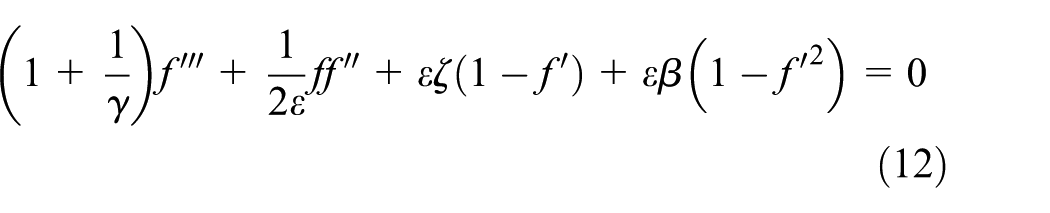


where

When


In the non-dimensional form, the local skin friction parameter becomes
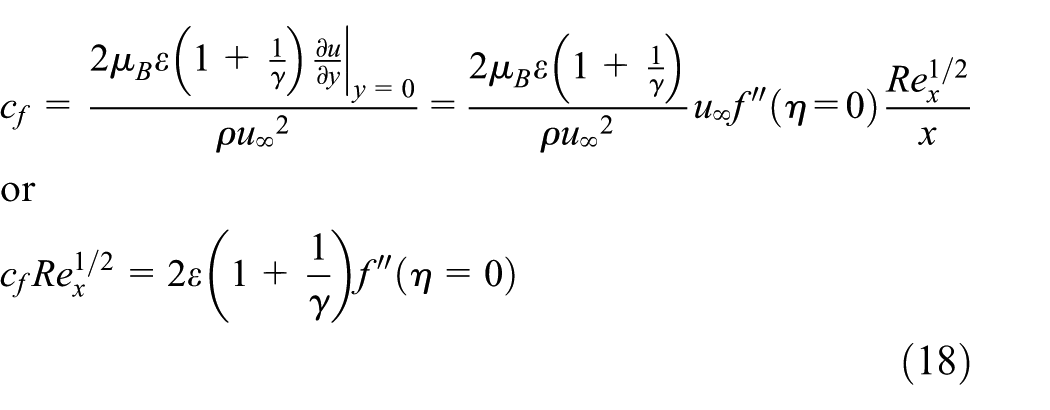
and


In the non-dimensional form, the local heat transfer parameter becomes
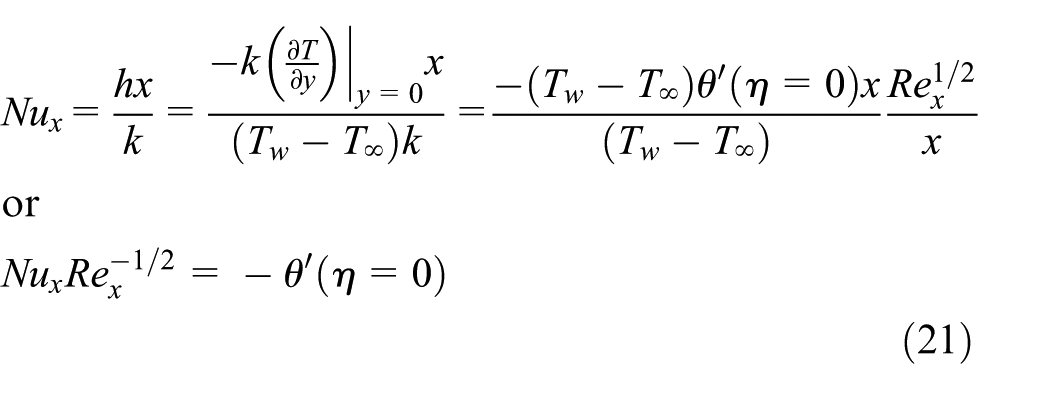
Numerical solution
The system of similarity equations is nonlinear ordinary differential coupled equations. Here, solution for such system is obtained using a Runge–Kutta–Fehlberg method simultaneously with shooting technique. In this method, the system of equations (12)–(14) are reduced to system of first-order differential equations of the form

where q is
In order to validate the numerical methods, we compare the results with those from the literature. For Newtonian fluid
Values of

Similarity method analysis
The similarity method adopted in this study is examined by comparing the results to those of the nonsimilarity method and local similarity method. The comparison is made for Newtonian fluid
Values of

Results and discussion
In this study, we study the effects of Casson parameter, porosity, porous resistance, and Prandtl number on forced convection over a horizontal flat plate. Figures 1 and 2 show the boundary layer non-dimensional velocity and temperature profiles for different Casson parameters. The increase in the Casson parameter shortens both the velocity boundary layer and temperature boundary layer thicknesses. In addition, the increase in the Casson parameter increases the velocity and decreases the temperature. The effects of the non-Newtonian Casson parameter and the first-order porous resistance

Non-dimensional velocity profile for different values of

Non-dimensional temperature profile for different values of
Values of

Values of

The effects of the porosity on the non-dimensional velocity and temperature profiles are shown in Figures 3 and 4. The increase in the porosity decreases the velocity and increases the temperature. In addition, increasing the porosity widens both the velocity boundary layer and the temperature boundary layer thicknesses. It is noticed from Figures 3 and 4 that velocity and temperature profiles get very close at higher porosity. This trend is attributed to the effect of relatively high porous inertia terms, and so, low permeability. The effects of porosity and

Non-dimensional velocity profile for different values of

Non-dimensional temperature profile for different values of
Values of

Values of

The effects of first-order porous resistance

Non-dimensional velocity profile for different values of
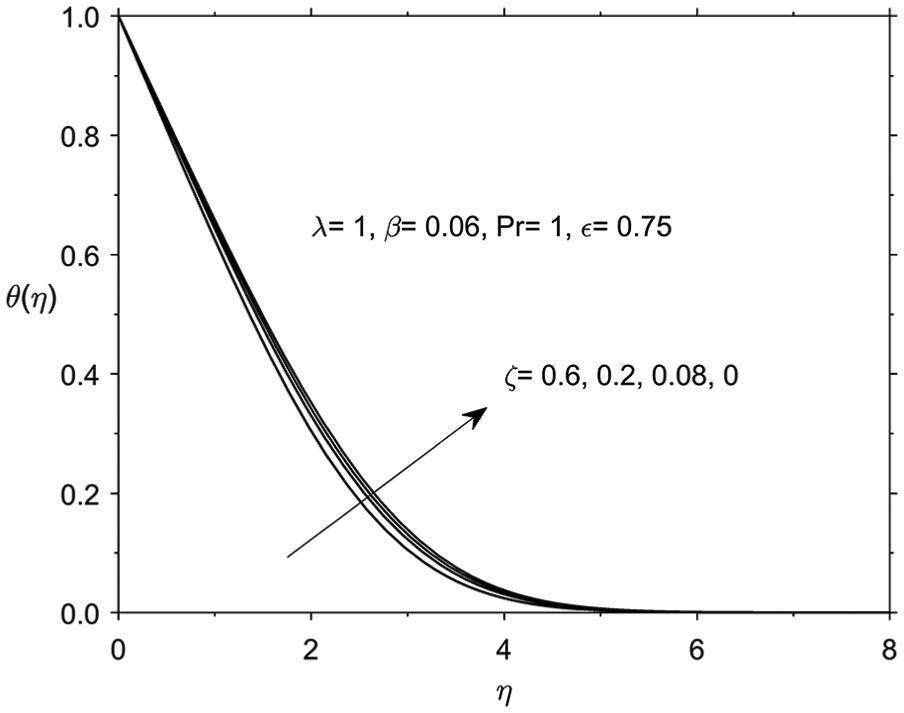
Non-dimensional temperature profile for different values of
The effects of second-order porous resistance “quadratic drag”
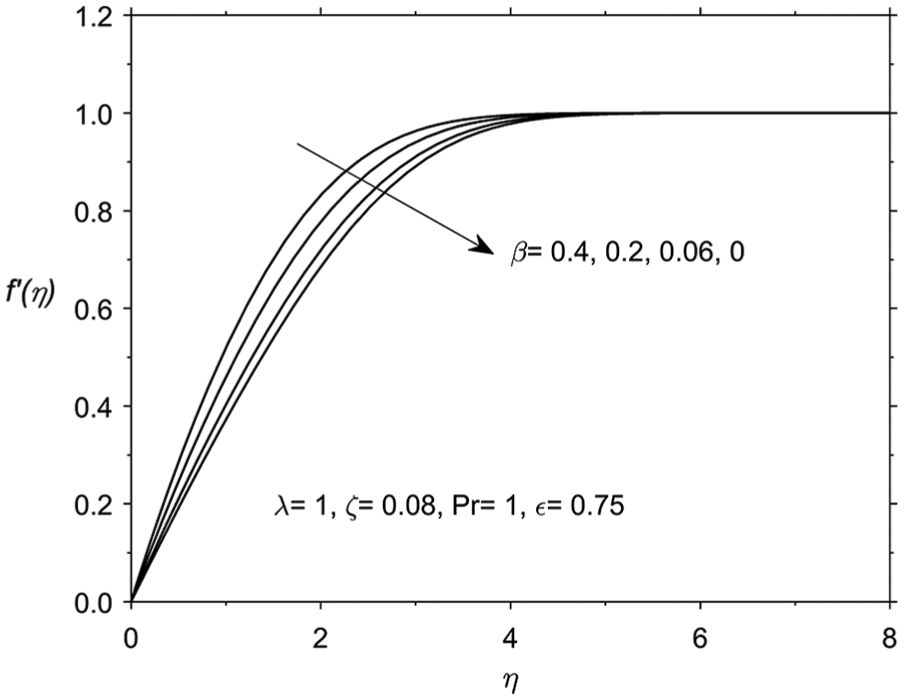
Non-dimensional velocity profile for different values of

Non-dimensional temperature profile for different values of
Values of
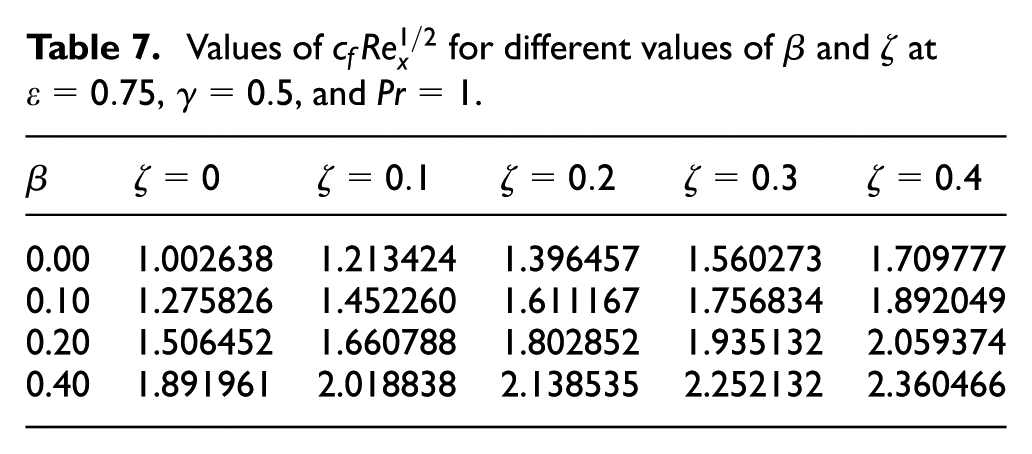
Values of

The effects of Prandtl number Pr on the boundary layer temperature profile are shown in Figure 9. The Prandtl number has no influence on the velocity profile as it only appears in the energy equation and not in the momentum equation, where the momentum equation is not affected by the solution of the energy equation. It is noticed that the increase in the Pr increases the temperature boundary layer thickness, which is due to the increase in the momentum to thermal diffusivities ratio. The effects of Pr and ζ on the wall temperature gradient are shown in Table 9. As shown, the increase in the Pr and ζ increases the local wall heat transfer parameter, as a result of more fluid motion and less conduction heat transfer between the Casson fluid layers, and so enhances the convection heat transfer.

Non-dimensional temperature profile for different values of Pr.
Values of

Conclusion
This study presents numerical solutions for forced convection heat transfer of non-Newtonian Casson fluid in saturated porous media over horizontal isothermal surface. The boundary layer equations are transformed into a system of ordinary differential equations using similarity method. The resulting ordinary differential equations are solved by an adaptive Runge–Kutta/shooting scheme. For the first time, the above model is solved with all the parameters included. A parametric study is carried out to identify each parameter’s effect on the velocity boundary layer and the temperature boundary layer. Therefore, on the wall skin friction parameter and the wall heat transfer parameter.
It is found that the velocity boundary layer thickness shortens with the increase in the Casson parameter, and first- and second-order porous resistances, while it widens with the increase in the porosity. The thermal boundary layer thickness shortens with the increase in the Casson parameter and shortens slightly with the increase in the first- and second-order porous resistances, while it broadens with the increase in the porosity. The velocity increases with the increase in the Casson parameter, and first- and second-order porous resistances, while it decreases with the increase in the porosity. The temperature decreases with the increase in the Casson parameter and Prandtl number, slightly with the increase in the first- and second-order porous resistances, while temperature increases with the increase in the porosity.
For the wall parameters, the wall skin friction parameter increases with the increase in the porosity, and first- and second-order porous resistances, while it decreases with the increase in the Casson parameter. The wall local heat transfer parameter increases with the increase in the Casson parameter, Prandtl number, and first- and second-order porous resistances, while it decreases with the increase in the porosity. Finally, increase in the Casson parameter enhances the convection heat transfer because of less Casson fluid shearing and hence less fluid-conduction heat transfer.
Footnotes
Appendix 1
Handling Editor: Bo Yu
Declaration of conflicting interests
The author(s) declared no potential conflicts of interest with respect to the research, authorship, and/or publication of this article.
Funding
The author(s) received no financial support for the research, authorship, and/or publication of this article.
