




Abstract
An experimental platform of gas cloud deflagration is built in this study, and the propane–air premixed gas blasting experiment was carried out in curved pipes with different lengths. The effect of pipe length on combustible gas explosion and the influence of explosion shock wave on thin-walled pipe loading were also studied. The experimental device included photoelectric, pressure, and strain sensors which were used to evaluate the explosion parameters and stress of the thin-walled pipe. The result was that the longer the pipeline, the higher the wall overpressure and the bigger the maximum tube wall. The pressure time curve was consistent with the thin-walled strain time–history curve. The pipe bend accelerates the flame propagation to a certain extent, and the pipe length influenced the law of flame ignition and explosion in pipe integrally; the longer the pipe, the greater the pressure and the speed of the flame. The maximum explosion pressure appears at the end of the pipe, and the loading of the shock wave on pipe wall belongs to dynamic response.
Introduction
Bending pipes are often used in the industrial piping system and combustible gas transmission pipe network and inevitably causes heavy casualties and property losses because of fire and explosion accidents. Therefore, the study on the combustion law of combustible gas in the bending pipes is very important to exploring the law of accident evolution and also its prevention and control. The propagation theory of the flame in large curvature bend was first proposed by Edwards and Thomas, 1 and the interaction among the plane waves in the complex wave systems in 90° pipes was studied, showing that the shock waves were locally extinguished and lead to re-ignition due to the combined action of the incident wave, reflected wave, and rarefaction wave during its propagation process in bending pipe. Phylaktou et al. 2 found that the flame propagation velocity increased four times in a 90° bending short pipe, so did the flame acceleration at the same location in the barrier with a 20% blocking rate. Sato et al. 3 made a research on the propagation characteristics of methane–air premixed flame in a 90° semi-closed bending pipes with high-speed photography and time-line tracing techniques. They found that the flame was a circular arc in the bending part when it propagated from an open end to a closed end; however, when the flame propagated in the opposite direction, it became sharp and axially stretched on the inside of the bending pipe. Thomas and Williams 4 studied the interaction between the detonation wave and the restraints and analyzed the fine structure of the Mach stem produced by the encounter of detonation waves and wedge under the overpressure damage effect produced by the detonation wave. Tagawa et al. 5 concentrated on the heat transfer characteristics of the turbulent flame in U-shaped square pipe, and the results showed that a strong pressure gradient was caused by the radial direction of the pipe, which would produce anomalous phenomena such as antigradient heat transfer. Wang et al. 6 conducted an experiment of gaseous detonation propagation in semicircular bending pipe, and the results showed that the intensity of shock wave increased from convexity to concave wall gradually, and the cell size changed significantly after the detonation wave. He and Chen 7 obtained a result showing that when the premixed flame spread to 90° bending pipe, the flame front was distorted and then the symmetrical structure was destroyed. In addition, the distortion of the convex wall was more intense, and the flame front gradually exceeded the concave surface. Kris et al. 8 pointed out that when the 90° bending section was located in the middle of the entire pipe, the front flame propagation velocity increased by 24%. Xiao et al. 9 investigated the influence of bending pipe on the early flame deformation and drew the conclusion that the combustion flow affected by the flame intensity and the flame propagation in a closed 90° bending pipe had gone through four processes, and the vortex near the flame had a more pronounced effect on the flame propagation characteristics. There have been quite a few studies on the internal structure of a flame in a bended pipe, but there were few researches on the law of flame propagation changes in the bending section due to the increase in the straight pipe length near the bending section.
Explosion shock wave propagated in the pipe often produced partial or whole fracture damage to the pipe wall under explosion loading, leading to the loss of pipe’s original function10,11 and even erosion caused by gas explosion, as well as thinning and tearing of the pipe wall causing multiple explosions to exacerbate accident consequences.12,13 Brown et al. 14 and Johns et al. 15 studied the shock on the hollow round pipe systematically and made a detailed description on the penetration law of low carbon steel tube caused by the projectile body in a low velocity range of 4–14.1 m/s. Zhang and Stronge 16 made an experimental study on the damage caused by the hollow thin-walled soft steel pipe under the lateral impact and established the pipeline failure mode under the positive and oblique impact of multiple projectile bodies. Kouretzis et al. 17 simplified the pipe into a three-dimensional thin elastic columnar wall with analytical methods to deduce the function expression of stress–strain distribution in the pipe during explosion loading. Jama et al.18,19 analyzed the overall and partial deformation of square steel pipe through numerical simulation and experimental method and came to the results that the hardening effect of strain rate was very important to predict the whole and local deformation of the beam, which turned out the thermal softening should not be ignored. Lu et al. 20 carried out an experiment to study the impact of the acetylene–air mixed gas explosion shock wave on the scaled thin-walled cylindrical shell model and obtained the dynamic response characteristics of the thin-walled cylindrical shell structure under the combustible gas explosion. The results showed that the overpressure and strain peak of the wall surface were always the highest in the area of positive reflection, and the model with a height/diameter ratio (H/D) of 1 was superior to others in resisting the deformation. All these works presented above were instructive for the analysis of thin-walled cylindrical shell failure under impact loading, but little research has been done on the dynamic response of pipe wall during combustible gas explosion in pipe or tank with large L/D ratio.
Many scholars have carried out researches on the combustion law of combustible gas and the loading effect of explosive shock wave on the pipe structure. However, the study on the influence of bending pipe in the process of premixed gas detonation and the loading effect of gas cloud explosion on the thin wall of pipe are extremely inadequate. Therefore, the test and analysis on the experiments of propane–air premixed gas combustion in closed bending pipes with different lengths are carried out, which can provide theoretical supports for the safety design and strength check of the pipe structure.
Material and methods
The experimental device of this article was mainly composed of gas distribution system, ignition system, test piping, and experimental data acquisition system (Figure 1). The design pressure of the experimental pipe was 6 MPa, and the inner diameter of the pipe was 125 mm. EPT-6 ignition energy test bed was adopted as the ignition device with adjustable ignition energy. The minimum and maximum ignition energy is 50 and 1000 mJ, respectively. The test acquisition system included a flame sensor, a pressure sensor, a strain sensor, a dynamic data acquisition, and processing system. The ignition, horizontal, bending, and vertical pipes were, respectively, numbered from I to IV in Figure 1.

Sketch map of experimental device.
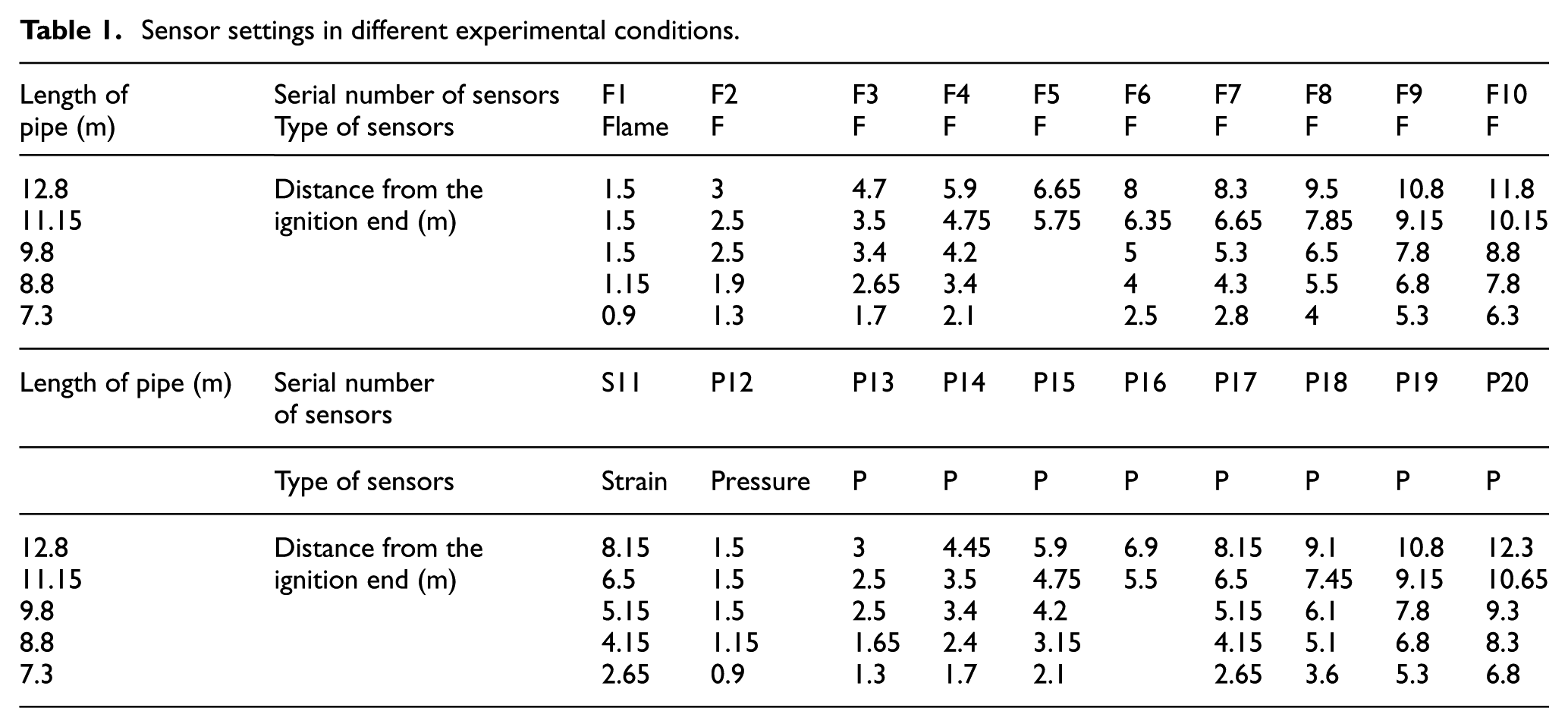
All the data in Table 1 refer to the distance of sensors away from the ignition end. The experiment was carried out with no-loading in closed pipe with the length of 12.8, 11.15, 9.8, 8.8, and 7.3 m, respectively. In the case of only the length of the horizontal pipe section II change, the detonation characteristics of combustible premixed gas in the closed pipes with different lengths and the dynamic response of the pipe wall were studied. The sensor layout in each experimental condition is shown in Table 1, where F1–F10 are the flame sensors, S11 is the strain sensor, and P12–P20 are the pressure sensors. The flame propagation speed is measured by photoelectric sensors. In the experiment, ignition energy is 1000 mJ, the volume partial pressure ratio was used to configure premix gas, and propane–air mixture concentration is 4%.
Sensor settings in different experimental conditions.
Results
Influence of pipe structure on the velocity of flame propagation
It can be seen from Figure 2 that the flame propagation velocity increased with the increase in propagation distance from 0 to 8.15 m in the bending pipe with the total pipe length of 12.8 m, and the propagation law was similar to that of straight pipe under the same condition. The flame velocity dropped sharply to 90.77 m/s at point a (inflection point). Then, the flame velocity increased rapidly to 212.29 m/s at point b, after which it reached its peak value at point c. The airflow propagated back at the bend and reduced the flame propagation velocity. However, after passing through the bend, the flame appeared in a new round of acceleration, and the acceleration was much larger than the acceleration in the straight pipe under the same condition. The flame peak velocity was 33.57% higher than that of the straight pipe with the same length. The experimental result shows that 90° bending pipe has significant effect on the flame acceleration, especially after the bending section.

Relationship between flame speed and distance in straight pipe and 90° bend pipes.
Influence of pipe length on the flame propagation characteristics of bending pipe
Using the inflection point of the 90° bend as the original point, flame propagation velocity–distance curve in the pipes with different lengths was plotted, as depicted in Figure 3. There were some differences in the flame propagation velocity curves in the pipes with different lengths, but the flame propagation velocity was almost the same at the initial stage of flame propagation. With the propagation of the flame, the flame front was disturbed and corrugated; the enlargement of combustion reaction area and the increase in the combustion velocity resulted in rapid increase in flame propagation velocity. The longer the straight pipe, the longer the flame acceleration time and the greater the flame velocity.
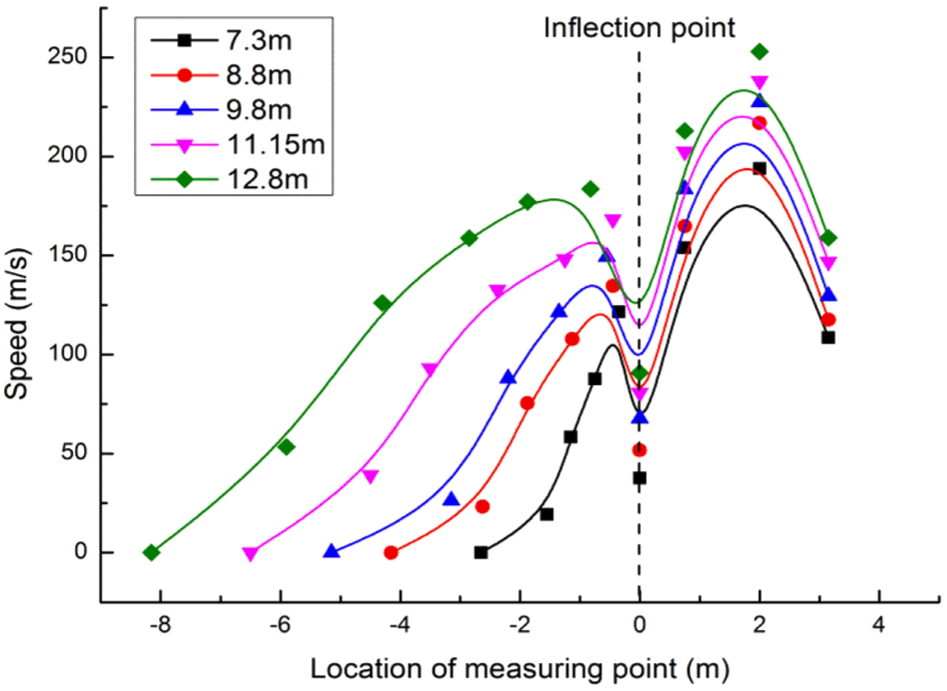
Flame propagation velocity.
When the flame propagated to the bending pipe section, the propagation direction of stable shock wave changed due to the abrupt change in pipeline structure; therefore, its original stable propagation conditions were destroyed, and unstable combustion or weak explosion occurred. During the propagation process of shock wave in the bending pipe, it was affected by the interaction with the incident wave, reflected wave, rarefaction wave, and their corresponding reflections on the concave surface, which decreased combustion reaction and the flame propagation velocity. The lowest flame propagation velocity appeared at the inflection point of the bending pipe, as shown in Figure 3.
After the flame passed the inflection point, the flame front deformed, expanded, and stretched, leading to rapid increase in its surface area. In this case, the combustion area increased sharply which intensified the combustion reaction and enhanced the shock wave. Meanwhile, a larger flow field gradient was formed under the action of the prodromal shock wave, making the flame surface more bending and folded. All these positive feedback coupling effects lead to a sharp increase in flame propagation velocity. The speed of the flame reached its peak value after 2 m of accelerated propagation when it passed the bending point. The flame propagation velocity increased with the pipe length, and the maximum flame propagation speed increased by 30.68% when the pipe length increased from 7.3 to 12.8 m,
Influence of pipe length on explosion overpressure
The relationship between the flame propagation distance and the explosive pressure near the bending is described in Figure 4. The ignition end and the inflection point are taken as the “0” point of the x-axis in Figure 4(a) and (b). The law of overpressure changes in the pipe and the influence of pipe length on explosion overpressure were investigated. In Figure 4(a), it is known that the pressure at the measuring point close to the ignition point was approximately equal at the initial ignition stage. With the increase in propagation distance, the explosion overpressure rose gradually and reached the maximum value before entering the bend. The longer the pipe, the more flammable gas was involved in the explosion reaction, so there was more time and space for the flame to accelerate and react, which caused higher turbulence and burning intensity of combustible gas. The explosion pressure increased with the increase in pipe length, so the explosion pressure in the long pipe was higher than that in the short pipe. However, the rate of increase in pressure in long pipe was faster than that of short pipe; the reason is that the shorter the pipe, the smaller the distance between the pressure forward and the flame forward, so the interaction between the two was greater which caused the pressure to increase faster.

Relationship between the overpressure and the propagation distance: (a) the relationship between the explosion overpressure in the pipe and the ignition distance. The black, red, blue, pink and green represent the ignition distance of 7.3m, 8.8m, 9.8m, 11.15m and 12.8m, respectively and (b) the relationship between the explosion overpressure in the pipe and the distance from the inflection point. The black, red, blue, pink and green represent the distance from the inflection point of 7.3m, 8.8m, 9.8m, 11.15m and 12.8m, respectively.
Through the comparison between Figure 4(a) and (b), it can be seen that the explosion pressure has been restored and slightly increased at 0.95 m away from the bending point. Thus, it came to the conclusion that the shock wave has been restored to a plane wave with an equivalent distance of 7.5 times the pipe diameter in this experiment.21,22 After that, the explosion pressure gradually increased with the increase in propagation distance and reached its peak value at the end of the pipe. In vertical pipe, the explosion pressure at the same position increased with the pipeline length. The maximum explosion pressure increased by 15.13% when the pipe length increased from 7.3 to 12.8 m. In long pipe, when the shock wave became the plane wave, its intensity was observably stronger than that in short pipe, which compressed and heated the unburned gas ahead. Besides, the reflection shock wave from the pipe end also disturbed the internal flow field, so the unburned gas was quickly involved in the reaction under high temperature and turbulence. The longer the section II (which is noted in Figure 1), the more intense of burning and explosion at the same position in vertical pipe, the faster the burning rate, the more heat released from the reaction, and the higher the pressure rose.
The decrease in the pipe length in the horizontal pipe section (II) in front of the bend affects the flame acceleration in the pipe and the intensity of burning and explosion of flammable gas in the reaction zone before entering bend, causing the flame acceleration in the vertical pipe which is not able to reach a higher level,23,24 and the reaction intensity of the combustion area is gentle. It can be seen that the length of pipeline has a large effect on propane combustion and explosion. The longer the length of pipe, the greater the pressure and flame speed in the pipe.
Influence of pipe length on pressure distribution in bending pipe
When the shock wave propagated into the bending section, the influence of the concave wall structure on the shock wave and the flame structure is different. The concave wall structure mainly affected the combustion process, flame propagation law, and the effect of the shock wave on the pipe wall. In order to study the influence of bending pipe on the shock wave propagation process and the pressure distribution in the pipe, the test sensor was set up according to Figure 5.

Sensor arrangement on bend section.
Figure 6 shows the law of the peak pressure changes at the concave and convex walls of each measure point in bending section in different lengths of pipe. When the flame propagated nearby the bending section, the intensity of the combustion wave would be reduced by the rarefaction wave effect when the combustion wave was diffracted along the convex expansion wall surface. However, the intensity of the combustion wave would be enhanced when the combustion wave propagated along the concave compressed wall, which would cause the peak pressure of each measuring point of the concave wall surface to be higher than that at the corresponding convex wall surface. The explosion pressure on the concave wall side of the bending pipe decreased gradually to the minimum pressure at the inflection point b (Figure 6), whose value was about 91%–96% of the pressure at point a, the pressure gradually rose again after the shock wave passed point b, and the pressure of point c was similar to that of point a. The explosion pressure on the convex wall side of the bending pipe showed a continuous downward trend until the bend outlet, and the pressure of point c was about 73%–78% of point a. This is because the shock wave produced oblique reflection from pipe wall in the bending section, and the compression wave produced at the concave wall surface made the energy accumulated. What’s more, the flow field pressure dropped after the shock wave passed the inflection point, causing a release of energy which would work on the unburned area; therefore, the explosion became more intense and the peak pressure rose more rapidly. The shock wave intensity was attenuated by the rarefaction wave when it was diffracted along the convex wall. At points 1 and 2, the rarefaction waves were relatively strong, so the peak value of explosion pressure declined rapidly. The intensity of rarefaction wave decreased after changing its direction, so its influence on the shock wave was weakened and the pressure attenuation became smaller. The longer the pipe, the faster the pressure recovers. When the shock wave propagated 0.4 m to point d, the influence of the thinning wave and the compression wave produced by the bending structure has disappeared, the pressure increases rapidly, and the pressure rising speed of the concave wall is lower than the convex wall.
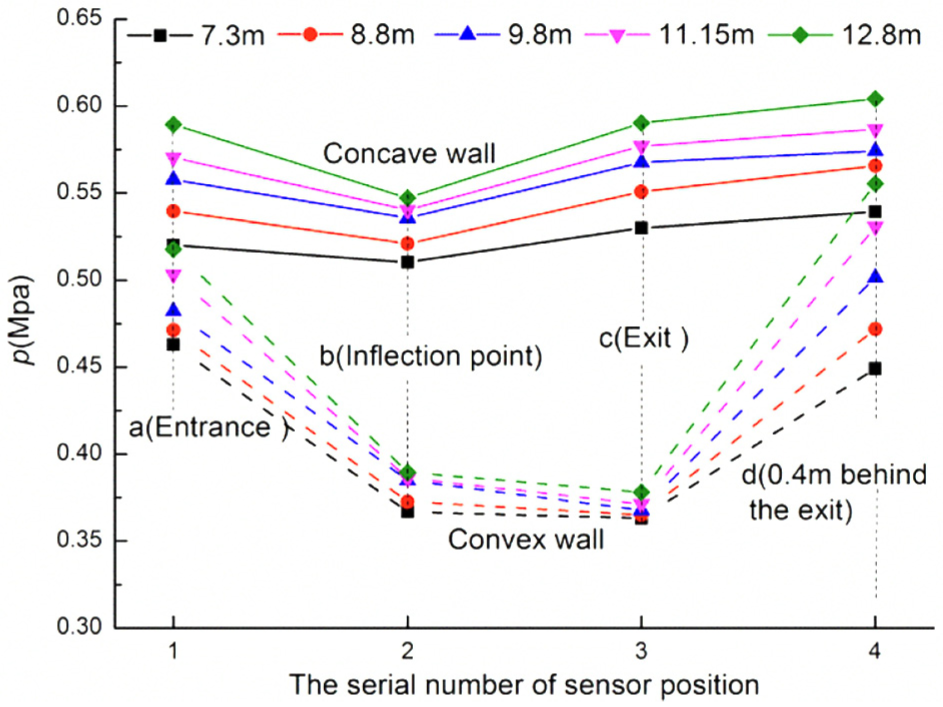
Peak pressure on bend section of different pipe lengths.Lines in different colors represent the peak pressure on bend section of pipe with different lengths: “a” represents the entrance of bend, “b” the inflection point of bend, “c” the exit of bend, and “d” the measuring point at 0.4 m behind the exit.
Discussion
Analysis on the stress and strain characteristics of thin wall in bending section pipe
This article analyzed the dynamic law of pipe thin wall during the process of gas combustion and explosion in pipes with different lengths. The signal obtained from strain sensor at 90° angle was analyzed and compared with the pressure signal at the same position. Figure 7 shows the comparison of pressure wave propagation and wall strain at 90° corners of bending pipes with different lengths.

Pressure and shock strain at the 90° bend of the pipe with different lengths.
As indicated in Figure 7, the variation trend of pressure signal and strain signal is basically consistent at the inflection point of the pipes with different lengths. Taking the bending pipe of 12.8 m as an example, the circumferential strain of the pipe wall was a dynamic response which was produced by the sudden circumferential stress under the impact loading on the pipe thin wall when the prodromal shock wave propagated to the bending section. In Figure 7, the red frame identified the correspondence between the prodromal shock wave pressure and the dynamic strain of the pipe thin wall. In the bending section, a sudden change in the prodromal shock wave pressure occurred, so the pipe’s annular expansion was enhanced and the strain was mutated accordingly. Because the pipe was closed, a positive excitation effect of the back and forth reflected waves was generated in the pipe end which accelerated the combustion reaction, so the shock pressure increased continuously and the wall strain continued to increase. At the same time, the lateral wall flame of the bending section was affected by the compression wave, and the transverse waves generated at the corner were reflected back and forth along the upper and lower walls, whose surfaces were successively loaded to produce a larger circumferential strain. When the combustion reaction came to the end, the shock wave attenuated in the process of back and forth reflection and the wall strain finally reached a stable state.
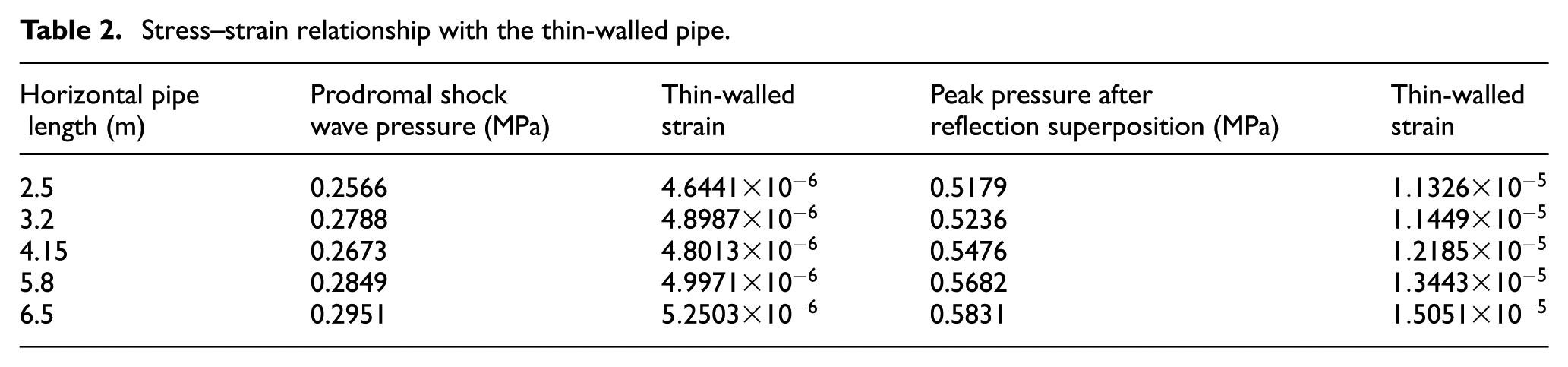
It is known from Table 2 that the strain of the thin wall of the pipe increased with the increase in the pipe length, and the pressure of the prodromal shock wave in the pipe was about half times of the peak pressure after reflection superposition, which met the wall reflection effect. The relationship between the shock wave pressure and the thin-walled strain in the pipe under the experimental conditions satisfied the following equation:
Stress–strain relationship with the thin-walled pipe.
Analysis on strain rate of the pipe thin wall
In order to explore the characteristics of the thin-walled loading of inflection point, the corresponding thin-walled strain rate was obtained by first derivation for the main strain within low-frequency band of 0–48.83 Hz and 48.83–97.66 Hz (Table 3).
Strain rate at 90° inflection point of pipe with different lengths.

It can be seen from Table 3 that the length of the straight pipe has a significant influence on the thin-walled strain rate. The main running strain rate signal of the pipe strain subject was bigger than 10−3 s−1. The longer the experimental pipe, the greater the maximum strain rate of the pipe wall, which generally increased in the order of 10−4. The thin-walled pipe strain was a dynamic response under the impact loading.
Conclusion
This article mainly studied the combustion characteristics of the propane–air premixed gas in the closed 90° bending pipe and the loading effect of the shock wave on the wall by changing the length of the straight pipe. The following conclusions are obtained:
The bending pipe could stimulate the flame acceleration to a certain extent. After the flame passed the bending pipe, the propagation velocity was reduced under the combined action of the multi-wave, and the lowest flame propagation velocity would appear at the inflection point. However, the flame velocity recovered rapidly after passing the bending pipe and reached a peak after accelerating the propagation by 2 m.
The effect of pipe length on propane combustion and explosion was integral. The general law was that the longer the pipeline, the greater the flame propagation speed and the explosion overpressure. The maximum flame propagation speed increased by 30.6% when the pipe length increased from 7.3 to 12.8 m.
Both the explosion overpressure of the wall in the bending section and the maximum wall strain showed an increasing trend with the increase in pipe length. The compression wave from the concave wall made the peak pressure of each measuring point higher than the pressure at the corresponding position of the convex wall. The peak pressure of each measuring point first decreased along the concave wall and then rose, which is just opposite to the convex wall.
The variation trend of pressure signal and strain signal is basically consistent. The lateral wall flame of the bending section was affected by the compression wave, and the transverse waves generated at the corner were reflected back and forth along the upper and lower walls, whose surfaces were successively loaded to produce a larger circumferential strain. The loading of the shock wave on pipe wall belongs to a dynamic loading.
Footnotes
Handling Editor: Hongfang Lu
Declaration of conflicting interests
The author(s) declared no potential conflicts of interest with respect to the research, authorship, and/or publication of this article.
Funding
The author(s) disclosed receipt of the following financial support for the research, authorship, and/or publication of this article: This work was financially supported by the National Key R&D Program of China (No. 2017YFC0805100), the National Natural Science Foundation of China (No. 51204026), the Science and Technology Project of the Ministry of Public Security (No. 2016JSYJD04), and major projects supported by the Natural Science Research of Jiangsu Higher Education Institutions (Nos 17KJA440001 and 16KJA170004).
