




Abstract
On the basis of structural features and working principle of polycrystalline diamond compact–roller hybrid drill bit, a detachable experiment device with adjustable structural parameters are designed and manufactured for the hybrid bit, and accordingly, drilling experiments under different working conditions are conducted. The experiment results show that, first, the introduction of cones is beneficial to increasing the penetrating ability of the polycrystalline diamond compact cutters in hard formation, which is significant to improve the rock-breaking efficiency. Second, torque of the hybrid bit is obviously lower than the polycrystalline diamond compact bit of the same size, while roughly equal to that of the cone bit, which means the hybrid bit has a favourable drilling stability and is good for tool-face control in directional drilling. Third, as cone extrudes higher than the polycrystalline diamond compact cutters, the weight on the cone and the torque on the bit are both larger, but the larger fluctuation of the weight on bit is more severe. Fourth, with the decrease in hardness and increase in brittleness of the rock, the weight on the cone will increase accordingly. In conclusion, the hybrid bit has obvious technical advantages when drilling in hard and inhomogeneous formation as well as in directional and horizontal drilling.
Introduction
For major countries in the world, oil and gas are the most important strategic energy resources. 1 Nowadays, exploration and development of oil and gas are moving from conventional toward unconventional reservoir (e.g. low-permeable reservoir), from land toward offshore and from shallow toward deep and ultra-deep formation. 2 As the percentage of the formation of poor drillability becomes much higher than before, it is well known that the inefficiency of drilling in the complex formation is the technological bottleneck of increasing drilling speed. Recent years, drill bit researchers from all over the world have conducted a series of worthwhile studies on new bit structures and new drilling methods to overcome this difficulty.3–9 Fortunately, in 2009, a hybrid bit, which combines the structural features and the working principles of fix-cutter polycrystalline diamond compact (PDC) bit and roller cone bit, was developed by one service company as one of the successful cases.10–13
As far back as 1930, the American Floyd L. Scott and his staff had invented the first hybrid bit which combines a fishtail and a roller cone bit. 14 And then, in 1980s, both the Smith 15 and Reed Company 16 put forward technical patents on hybrid PDC (polycrystalline diamond composite) cutter–roller cone drill bit. But unfortunately, limited by the low impact resistance of PDC compacts of that time, this advanced idea had not been commercialized successfully. With the development of PDC compact, the impact resistance and the abrasive resistance of the PDC cutter have been significantly improved, which provides technical support to the application of hybrid bit. 3 In 2010, Baker Hughes Company published the technical characteristics as well as the field test results of this hybrid drill bit. The test results showed that this type of hybrid bits was capable to drill in hard or heterogeneous formation with high efficiency, more particularly, both the torque and the torsional vibration of the bit were lowered, and the stick-slip effect was reduced.17–20
As a new bit type, study on the rock-breaking method of this hybrid drill bit can seldom be found. For further study on it, the Rock Bit Laboratory of SWPU (Southwest Petroleum University) has conducted a series of systematic research on the hybrid bit technology21,22 and has achieved some research findings. This article introduced a modular hybrid drill bit experimental apparatus with the structural parameters being adjustable and presented the hybrid drill bit rock-breaking experiments under different rock properties and relative height. By studying their effects on the distribution of weight on bit (WOB) on two cutting structures and torque on bit (TOB) characteristics, it can provide basis for improving formation adaptability, rock-breaking efficiency and steerability of the hybrid bit.
Working principle and WOB-TOB characteristics of PDC–roller hybrid bit
As shown in Figure 1, the cutting structure of PDC–roller hybrid bit is a combination of fixed PDC cutting units and roller cone cutting units. During the hybrid bit drilling in the formation, cutters on the PDC cutting units are driven to revolve along the bit axis by the rotating bit body to scrape the bottom-hole rock; on the other hand, besides the revolution round the bit axis, the roller cone also rotates along its own axis; this composite motion will propel the teeth on roller cone to break the bottom-hole rock by impact crushing and create many craters on the bottom hole. For the hybrid bit, rock-breaking relies mainly on the scraping action of the PDC units while subsidiarily on the impact crushing of the roller cone. In the bottom area covered by both PDC unit and roller cone unit, teeth on the cone create craters on the bottom hole by impact crushing, thus making the cutters of PDC unit easily penetrate into bottom-hole rock and scrape the formation. 23

PDC–roller hybrid bit (right) combines PDC bit (left) and roller cone bit (middle).
Roller cone bits work by impact excavation mode, and they are currently used in hard rock formations. Since cones roll on the rock, the TOB of a roller cone bit is not sensitive to WOB. PDC bits operate in softer rock formations because of an efficient shearing mode. However, due to the shearing motion, the PDC bit requires large torque to overcome rock resistance. In another word, the PDC bit torque is sensitive to WOB. High torque sensitivity to WOB implies that small changes in WOB will easily change the direction in a way that is not wanted. Studies have shown that the relation of torque and weight of PDC bit and roller cone bit is approximately linear, 24 as shown in Figure 2.

Relation of torque and weight of PDC bit and roller cone bit.
So, the relationship between WOB and TOB of roller cone bit and PDC bit can be expressed as

where
Similarly, the TOB of hybrid bit can be expressed as

where

where
For a single PDC cutter, the normal force is 25

where
If the number of PDC cutter is n, the WOB distributed on PDC cutting units is

For a single roller cone tooth, the normal force is proportional to the

where
If the number of teeth contacting with the bottom hole is m, the WOB distributed on roller cone units is

The total WOB is

If the ratio of the PDC cutter units WOB to total WOB is

Combining equations (2)–(9), the total TOB can be derived as

Namely

From equation (11), if
As shown in Figure 3, if the relative height between the two cutting units is

Assuming that the maximum penetration depth of the hybrid bit is
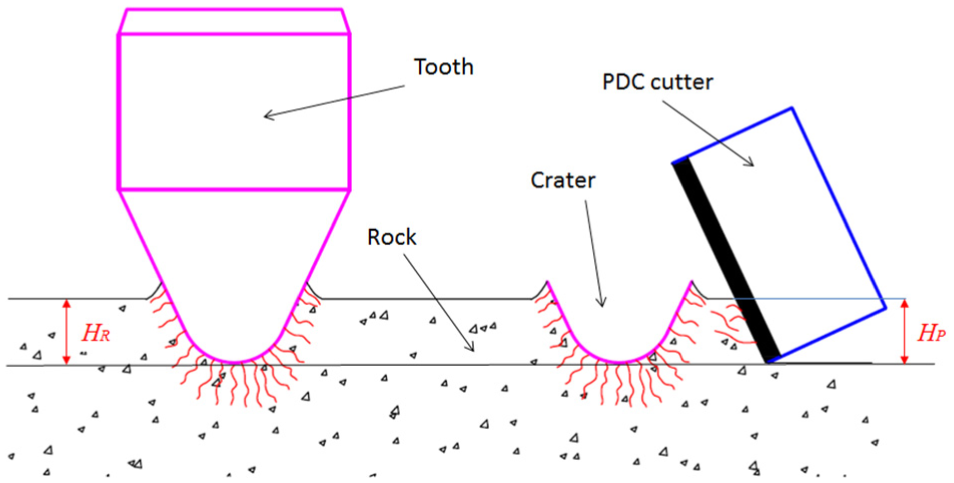
Relative height between the two cutting units.
It can be seen that the factors affecting the torque characteristics and weight distribution of hybrid bit are the following:
Relative height between the PDC cutter unit and the roller cone unit;
Roller cone structure, such as tooth density, tooth ring density and tooth shape;
PDC cutter structure, such as profile shape, blade shape, cutter density and cutter angle;
Properties of drilled formation.
The focus of this article is mainly on the relative height and rock properties.
Designing and building of the experimental apparatus for PDC–roller hybrid bit
Figure 4 is a three-dimensional (3D) structure diagram of the modular hybrid bit (8.5 in.) experimental apparatus with adjustable parameters. The apparatus consists of two fixed PDC units and two roller cone units, where the diameter of the PDC cutter is 14 mm and the number of the cutters is 14, while the diameter of the insert is 12 mm and the number of tooth rows is 6.
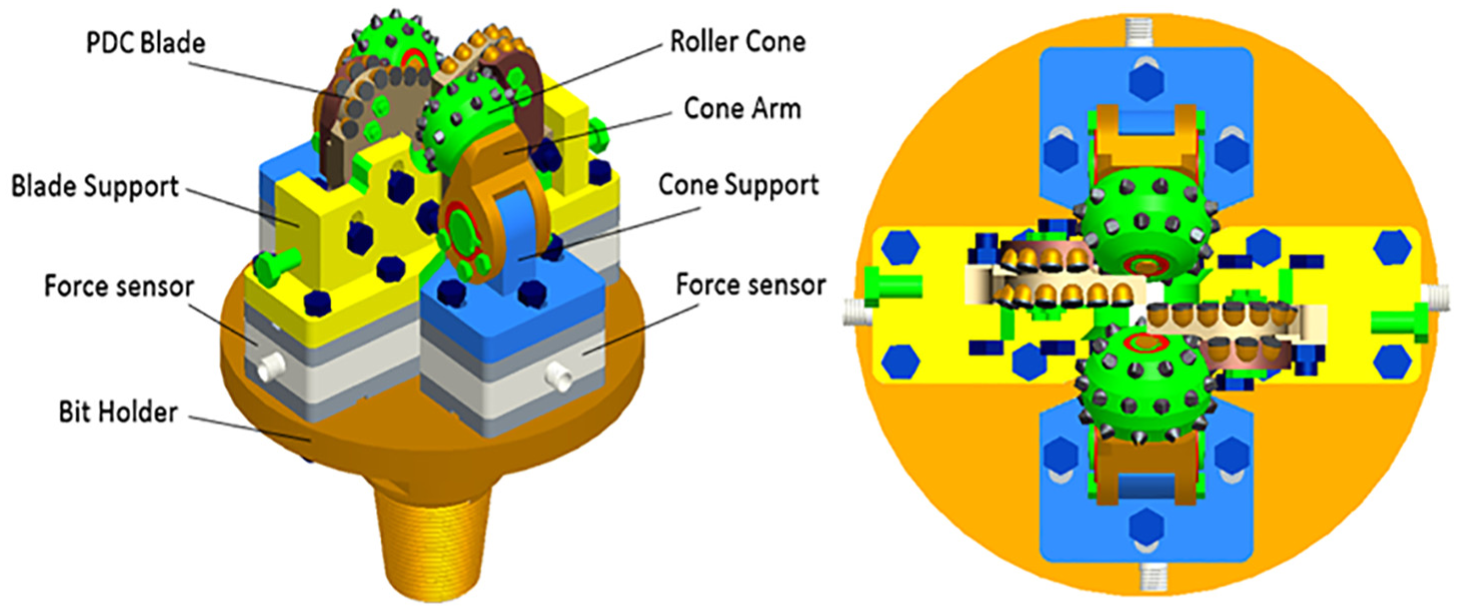
Three-dimensional structure diagram of the experimental apparatus.
The adjustable parameters include the following:
Structural parameters of the roller cone unit: offset, journal angle, teeth-set density, and tooth shape;
Structural parameters of the PDC unit: cutter-set density and cutter diameter;
Composite structural parameters: cutting profile, relative height between PDC and roller cone units, and compound mode of two coverages.
As a support equipment, force sensor was invented to test the load distribution of both the PDC and roller cone units. During the experiment, the force sensor, operating together with the connector transducer, will provide working load data for the quantitative analysis of drilling process.
Figure 5 presents the photographs of the experimental apparatus being built.

The assembled PDC–roller hybrid bit experimental apparatus.
Indoor rock-breaking experiments
Using the above apparatus, rock-breaking experiments have been conducted on Wusheng sandstone (less hard), Jialing limestone (hard) and granite (very hard) with various structural parameters. As factors that impact the rock-breaking mechanism, journal angle, teeth shape, teeth-set density of the cone and number, crown shape, cutter-set density of the wing blades, as well as the relative height between the PDC unit and the roller cone unit have been, respectively, tested in the experiment.
Parameters being directly tested include WOB, TOB, rate of penetration (ROP) and WOB distribution of both PDC and roller cone units.
Figure 6 presents the photographs of the experiment process.

Rock-breaking experiment with the experimental hybrid drill bit.
Analysis of experiment results
Rock-breaking method concluded from the bottom-hole pattern
Figure 7 shows the bottom-hole patterns of hybrid bit (8.5 in.) drilling in Wusheng sandstone, Jialing limestone and granite. Figure 8 shows the bottom-hole pattern of the PDC bit and the roller cone bit (8.5 in.). The bottom-hole pattern of the hybrid drill bit obviously differs from that of a PDC bit or a cone bit. In the overlapped coverage of PDC and roller cone units, craters crushed by the teeth on roller cone are distributed on the concentric-circle scraping tracks created by the PDC cutters. Namely, the scraping tracks of the PDC cutters and crushing craters of the cone teeth have created a rugged pattern in the overlapped coverage on the bottom hole.

Bottom-hole patterns of 8.5 in. PDC–roller hybrid bit drilling in different rock samples: Wusheng sandstone (left), Jialing limestone (middle) and granite (right).

Bottom-hole pattern of 8.5 in. PDC bit (left) and 8.5 in. roller cone bit (right).
There are two reasons for the inefficiency of PDC bit when drilling in the hard formation. On the one hand, PDC cutters can hardly penetrate into rock; on the other hand, the high contact stress of each cutter can easily lead to thermal wear of the cutter. From the bottom hole of the hybrid drill bit, it is known that both cone teeth and PDC cutters break the bottom-hole rock. Craters created by the cone teeth make the bottom hole rugged, which enables the PDC cutters to easily penetrate into formation and to achieve a better cooling performance. In conclusion, the hybrid bit performs much better than conventional PDC bits when drilling in the hard formation.
Nevertheless, since cone teeth need much higher load than the PDC cutters to penetrate into rock, the rock-breaking efficiency of the hybrid bit is lower than conventional PDC bits when drilling in relatively soft formation, namely, hybrid bit is not suitable for drilling in relatively soft formation.
WOB distribution
The WOB distribution refers to the WOB sharing ratio between PDC units and roller cone units. WOB distributed on either PDC units or roller cone units could be measured by the corresponding 3D force sensors on the bit.
1. Impact of rock property on WOB distribution
Figures 9 and 10 represent the WOB distribution between PDC and roller cone units on Wusheng sandstone, Jialing limestone and granite, respectively, with WOB and bit structure being the same. Figure 9 shows the WOB distribution with roller cone aligned with the PDC unit, while Figure 10 shows the WOB distribution with roller cone overhung the PDC unit by 1 mm. It can be seen from the charts that the PDC unit shares a larger WOB ratio than the roller cone unit, and that the roller cone unit shares the smallest WOB on the Wusheng sandstone, larger on the granite, and largest on the limestone. Thus, conclusions can be drawn that both the hardness and brittleness of rock have an impact on the WOB distribution of roller cone. On the one hand, the WOB distribution of the roller cone increases as the rock hardness increases; on the other hand, too high a rock brittleness will scale down the WOB distribution of roller cone since brittle rock–like granite tends to suffer from volumetric fracture under impact crushing of the roller cone.
2. Impact of relative height on WOB distribution

WOB distribution with roller cone aligned with the PDC unit.

WOB distribution with roller cone overhung the PDC unit by 1 mm.
As shown in Figure 11, the WOB is set as 1.4t; the columns, respectively, represent the WOB distribution with roller cone overhung the PDC unit by 0, 0.5, 1 and 1.5 mm. Obviously, the WOB distribution of the roller cone increases progressively as the overhang gets larger. Particularly, when the overhang gets larger than 1 mm, the roller cone unit will share more than half of the WOB.
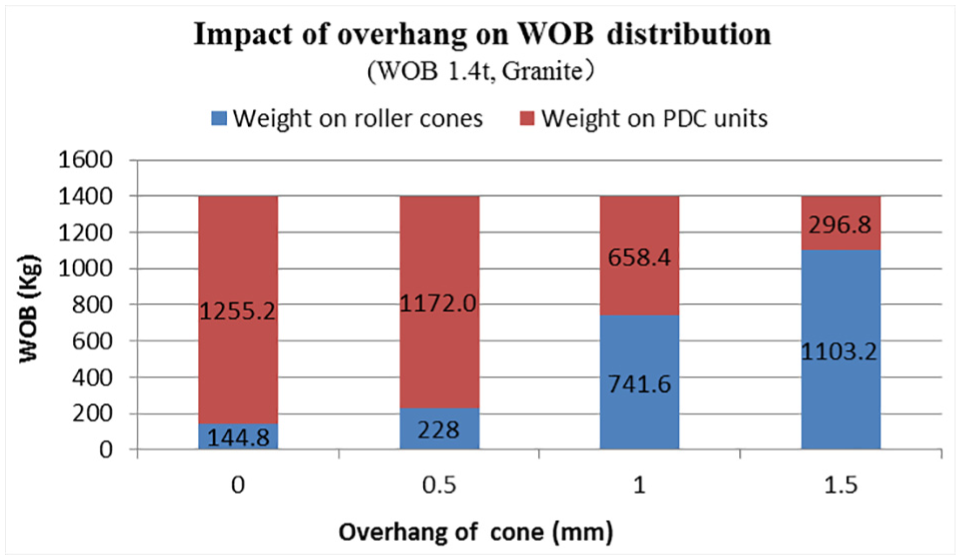
Impact of relative height on the WOB distribution.
Impact of bit structure on drilling performance
1. Comparisons of drilling force between the hybrid bit, conventional PDC bit and cone bit.
Figure 12 represents the comparisons of WOB fluctuation(variance yields) between the experimental hybrid bit, conventional PDC bit and cone bit, with the rock being Wusheng sandstone and WOB being the same. Figure 13 shows the comparisons of TOB between the experimental hybrid bit, conventional PDC bit and cone bit, with the rock being Wusheng sandstone and WOB being the same.

Comparisons of WOB fluctuation between bits of different structures.
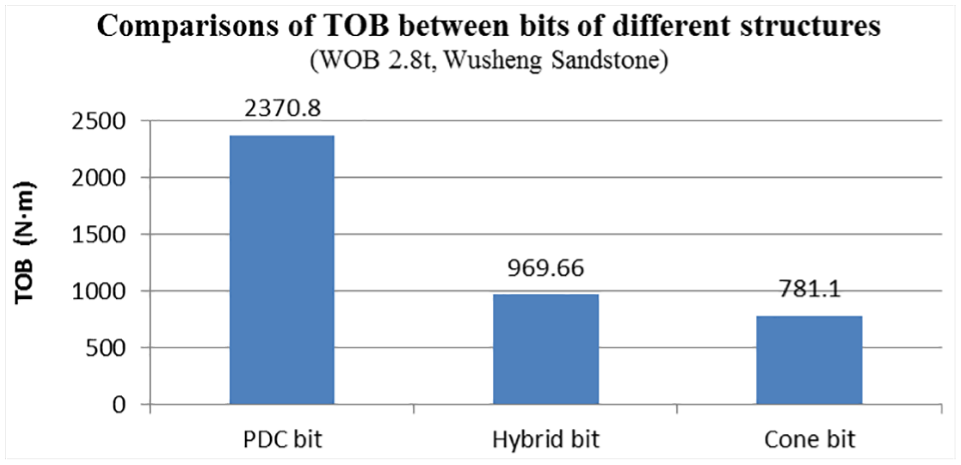
Comparisons of TOB between bits of different structures.
According to Figure 12, WOB fluctuation of the hybrid bit is obviously lower than that of a cone bit and slightly higher than that of a PDC bit. Figure 13 shows that the TOB of the hybrid bit is obviously lower than that of a PDC bit and slightly higher than that of a cone bit, the reason being pure rolling of roller cone has obviously lowered the TOB of the hybrid drill bit. Since the roller cone bit crushes rock by rolling and impacting the rock surface, but the PDC bit drags rock by shear-cutting action, the TOB of the PDC bit is larger than the roller cone bit. Furthermore, the cutters of the PDC bit break rock continuously, while the teeth of roller cone bit contact and break rock alternatively, so the WOB variance of the roller cone bit is larger than the PDC bit. For the hybrid bit, because the structure of the roller cone limits the penetration depth of PDC cutters and minimizes the amount of torque needed for the drilling process, the TOB of the hybrid bit is smaller than the PDC bit and bigger than the roller cone bit. In addition, a low TOB is conductive to tool-face control for the bit when drilling in a directional well.
2. Impact of overhang on drilling performance
Figures 14 and 15, respectively, represent the comparisons of WOB fluctuation between bits of different overhangs and the impact of relative height on TOB. According to the figures, as the overhang of the roller cone gets larger, the WOB fluctuation of the hybrid drill bit rises, while the TOB of it reduces. The reason is that if the roller cone gets a larger overhang relative to the PDC unit, the WOB shared by the cone will increase, and the rolling impact effect will be more notable; meanwhile, the WOB shared by the PDC unit will decrease, which finally results in a lower TOB for the hybrid drill bit.
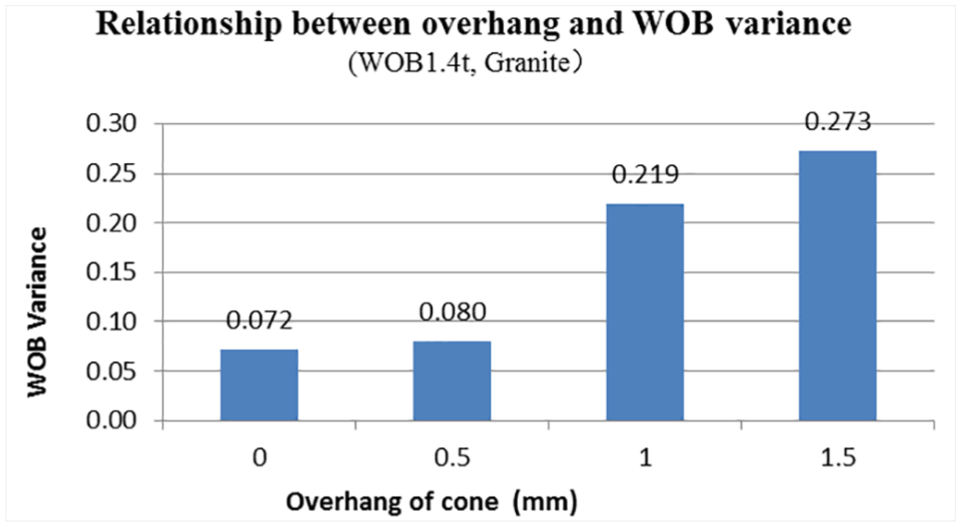
Comparisons of WOB fluctuation between bits of different overhangs.

Impact of relative height on TOB.
Conclusion
Results of the indoor experiments show that both the scraping action of PDC units and the impact crushing of roller cone remain the same as the conventional PDC bits or cone bits, but the combination of two rock-breaking methods has significantly changed the drilling process of the PDC cutting structure. Craters created by the cone teeth make the bottom hole rugged, which enables the PDC cutters to easily penetrate into formation and cut the rock discontinuously to achieve a better cooling performance. In conclusion, the existence of roller cones enables the hybrid bit to get better drilling performance than a conventional PDC bit in hard formation.
Since roller cone teeth need much higher load than the PDC cutters to penetrate into rock, the rock-breaking efficiency of hybrid bit is lower than the conventional PDC bits when drilling in relatively soft formation, namely, hybrid drill bit is not suitable for drilling in relatively soft formation.
TOB of the PDC–roller hybrid bit is obviously lower than a conventional PDC bit, which will not only reduce the torsional vibration and the stick-slip effect, but is also conductive to tool-face control for the drilling of a directional well. Therefore, the hybrid drill bit is expected to be suitable in direction well drilling or horizontal wells.
When designing a hybrid drill bit, the roller cone could be set with some overhang relative to the PDC unit. Otherwise, if the well is deep or if the soft formation comes first, the roller cone could be set aligned with or some lower than the PDC unit.
The hybrid bit is a ground-making technology which has broken the assumption that vibrations resulting from roller cones will break the stability of PDC cutting and accelerate the impact damage of the PDC cutters. The success of the hybrid drill bit technology shows us that the combination of both moving and fixed cutting structures is an effective method to drill in the formation of poor drillability; more attention should be paid and further study on it should be conducted to explore the more effective and feasible application.
Footnotes
Handling Editor: Sunday Ojolo
Declaration of conflicting interests
The author(s) declared no potential conflicts of interest with respect to the research, authorship, and/or publication of this article.
Funding
The author(s) disclosed receipt of the following financial support for the research, authorship, and/or publication of this article: This work was funded by the National Natural Science Foundation of China (No. 51374176 and No. 51304168), SWPU Science & Technology Fund (No. 2013XJZ012), Ministry of Education Key Laboratory of Oil and Gas Equipment, Science and Technology Innovation Talent Engineering Project of Sichuan Province (No.2015097) and Sichuan Provincial University’s Key Laboratory of Rock Breakage Mechanics and Drilling Bits.
