




Abstract
The aim of this study is to investigate the impact of the bus stop near the signalized intersection on the traffic flow from two aspects, traffic volume and delay. A modified Optimal Velocity model is established to analyze the dynamic traffic flow near a signalized intersection with curbside bus stops, and two cases including bus stops placed upstream and downstream the intersection are simulated to compare the impacts. The influencing factors, including the entering probability and the distance between a bus stop and its neighboring signalized intersection, are considered in this study. The simulation results indicate that the impact of the bus stop on the traffic flow is significant when entering probability is above the critical value, and gradually disappears as the distance increases. With respect to the volume, the downstream bus stop is greatly superior to the upstream one when the distance is less than 70 m, and slightly inferior to the upstream one when the distance ranges from 70 m to 200 m. With regard to the vehicle delay, the upstream bus stop is better than the downstream one. We hope these findings will be helpful to offer scientific guidance for the public transport planning and management.
Introduction
In the past few decades, traffic flow theories have been attracting the attention of many researchers. Traffic simulation, as a method of traffic flow theory research, is a technique of reproducing the dynamic process of traffic flow by means of computer mathematics models. In recent years, several traffic simulation models have been proposed, such as the stimulus–response model, safety distance model, optimal velocity (OV) model, artificial intelligence–based model, and others. The OV mode based on the cellular automata, in particular, has attracted a lot of attention. This model can simulate the spatiotemporal evolution of complex systems with discretization time, space, and state variables, so it is considered to be an idealization of a physical system, 1 such as traffic system.
Signalized intersections play an important role in management of the urban traffic system. With the rapid development of Chinese urbanization and motorization, traffic jam and traffic accidents in cities become more and more serious, especially at the intersections.2,3 Of course, a coordinated signal control system is very useful to alleviate congestion. 4 Many Chinese cities also adopted some car ownership policies to limit the number of cars on the road. 5 In addition, public transport priority policies are also regarded as one of the effective means to solve traffic congestion. However, in order to give full play to the priority role of public transport, it is very important to set up a reasonable bus stop. Considering the convenience and safety of passengers traveling and transferring between the perpendicular bus lines,6,7 bus stops are commonly located near the signalized intersections, which can be placed upstream or downstream of the neighboring intersection. Due to the tight constraints on streets in cities, buses always occupy a travel lane while dwelling at the stop to load and unload passengers. 8 The dwelling bus would form a bottleneck, which may have a serious impact on the traffic flow near the intersection and constrain the performance of the intersection. Consequently, the study of the location of a bus stop near a signalized intersection is important to both the public traffic management and the traffic theory development.
Numerous studies have focused on the impacts of bus stops close to the signalized intersection.7,9–11 In these studies, different analytical models are established to evaluate the impacts of bus stops on the performance of its neighboring intersection, especially variations of the traffic volume near the intersection. Several studies have established traffic simulation models to investigate the impacts.8,12–15 For example, Wong et al. 8 built a simulation model to analyze the impact of a bus stop upstream of a signalized intersection in a single-lane traffic system, where the lane-change behavior was not allowed. But real traffic is always a multilane system, and the following vehicles will change to a better driving condition lane when a leading bus dwells at the bus stop. Zhao et al. 13 used a cellular automata model to study the impacts of bus stops which reside upstream of its neighboring intersection or downstream of it. Then they built another cellular automata model to study the effect of a bus stop between two nearby intersections. 14 These two works assumed that the dwelling time of buses is constant. However, the facts of the situation are not always like this. According to a previous study, the dwelling time is always distributed randomly. 11 Moura et al. 15 used a micro-simulation model to find the optimal location of a bus stop near a signalized intersection. However, the changes of the traffic volume near the intersection have not been elaborated.
Moreover, debates on optimal location about a bus stop relative to its neighboring intersection have not been settled. Terry and Thomas 16 found that the downstream bus stop was better. Otherwise, Fitzpatrick et al. 17 draw the opposite conclusion. This can be attributed to different factors being considered, such as the distance between the bus stop and the intersection, traffic volume, bus dwell time, and so on. 8 Therefore, recent studies investigating the optimal location of bus stops close to the intersection considered some different influence factors. Zhao et al. 13 found that the upstream bus stop was superior to the downstream one when it was not far away from the intersection. Gu et al. 7 discovered that the downstream bus stop was better when the intersection approaches saturation, or when the bus dwell time was too long. Up to now, how to reside the bus stop near a signalized intersection under different circumstances has yet to be settled. Therefore, it is necessary to perform further analysis.
Due to the advantage of traffic flow simulation, this study attempts to build a simulation model to reproduce the dynamic process of traffic flow near the intersection with curbside bus stops in a two-lane traffic system. Because of the simplicity and few parameters, an extended OV model with lane-changing rule is established to investigate the impacts of a bus stop on traffic flow from both the traffic volume and vehicle delay aspects around its neighboring intersection. Therefore, an OV model for a signalized intersection with curbside bus stops is presented in section “The model.” In section “Simulation and results,” the simulation results are analyzed and the traffic impacts of bus stops from two aspects, traffic volume and vehicle delay, are shown. Finally, the conclusions are given in section “Conclusion.”
The model
The car-following model
In this study, the symmetric two-lane traffic system is considered and Jiang’s full velocity difference (FVD) model is used as the basic car-following regulation in which the velocity of each vehicle is adjusted instantly in the light of the distance and the velocity difference between vehicle n and its leading vehicle

where the parameter

According to formula (2), the minimum expected velocity corresponds to
Besides
Similar to the study of Wong et al.,
8
in this two-lane model with a signalized intersection, when approaching the intersection, each vehicle moves on the road in a car-following state. If there is no leading vehicle on the approach, the vehicle proceeds at its desired velocity and checks the signal continuously. When the signal is green, the vehicle moves forward and passes the stop line. When the signal becomes red, the vehicle calculates the minimum stopping distance

where
Meanwhile, there will be a comparison between this minimum stopping distance and the distance from the vehicle to the stop line. If the minimum stopping distance is less than or equal to the distance to the stop line, the vehicle will be decelerated smoothly and stopped in front of the stop line. Otherwise, it will proceed continuously. If there is a leading vehicle on the approach, the vehicle will move forward according to formula (1). In addition, if there is already a stopping vehicle in front of the stop line, the minimum stopping distance will be compared with the distance from the vehicle to the stopping vehicle. If the minimum stopping distance is less than or equal to the distance to the stopping vehicle, the vehicle will be decelerated smoothly and stopped behind the stopping vehicle.
Similarly, for a bus, when approaching the bus stop, the minimum stopping distance is compared with the distance from the bus to the bus stop. If the minimum stopping distance is less than or equal to the distance to the bus stop, the bus will be decelerated smoothly and stopped at the bus stop. Otherwise, it proceeds continuously according to formula (1). If there is already a bus dwelling at the bus stop, the minimum stopping distance will be compared with the distance to the dwelling bus. When the minimum stopping distance is less than or equal to the distance to the dwelling bus, the bus will be decelerated smoothly and stopped behind the dwelling bus.
Furthermore, according to previous studies,11,19 in this study the dwelling time
Lane-changing rules
Generally, if there is a more ideal lane, the lane-changing behavior will be happed when a vehicle is hindered by the leading vehicle. But the lane-changing behavior must be based on two essential criteria. One is the incentive criterion which means that the driving condition of the target lane is better than the original one. For example, the vehicle could move forward at a desired speed. The other is the security criterion which means that the vehicle could not collide with the neighboring vehicles on the target lane or the original lane during the lane-changing behavior.
In Figure 1,

or as

where

Configuration of a road link with an intersection and a bus stop.
For buses, when approaching or entering the bus stop, there is a different lane-changing rule to follow. Generally, in order to facilitate dwelling at the bus stop, a bus is inclined to move forward on Lane2. If a bus is proceeding on Lane2, it will not change to Lane1. If a bus is on Lane1 currently, there will be a lane-changing behavior as long as the condition of Lane2 is not worse than Lane1.
As shown in Figure 1,

where

where

The schematic of probability
The condition
Simulation and results
The simulation of this two-lane dynamic traffic state with bus stops close to a signalized intersection is carried out under the open boundary condition. At each time step, the position of the last vehicle on each lane is checked. If the position of the last vehicle is greater than
There are two types of vehicles: buses and cars. The mix probability
For buses

For cars

The length of the road

Impact of the bus stop on traffic volume
In order to analyze the impact of a bus stop close to the signalized intersection on the traffic volume, the traffic volume changes under different

The relationship between the traffic volume and the entering probability
As shown in Figure 3, regardless of whether the bus stop resides upstream or downstream of the intersection, with the increase of the entering probability
Furthermore, as shown in Figure 3, the capacity of the intersection increases as the distance
It can also be seen from Figure 3 that, in the case with an upstream bus stop, the increment of capacity becomes slow when the distance

The traffic volume variation versus the distance
As shown in Figure 4, the location of the bus stop influences the traffic volume at the signal intersection significantly. When
Impact of the bus stop on delay
Delay is always viewed as an important measure to analyze the operating characteristics and service level of a signal intersection. Numerous models have been established to evaluate the delay (the details shown in the literature20–25). In general, delay often refers to the difference between the ideal time and the actual time when traversing a road section, 25 such as an intersection. Here, the ideal time corresponds to the travel time under ideal conditions. Similarly, the actual time means the travel time under real conditions. In order to investigate the impact of the bus stop on the delay, in this study, the ideal time is calculated as

where
In order to determine the length of the road section, the time–space diagrams of the trajectories for the simulated vehicles are depicted in Figures 5 and 6. Here the entering probability
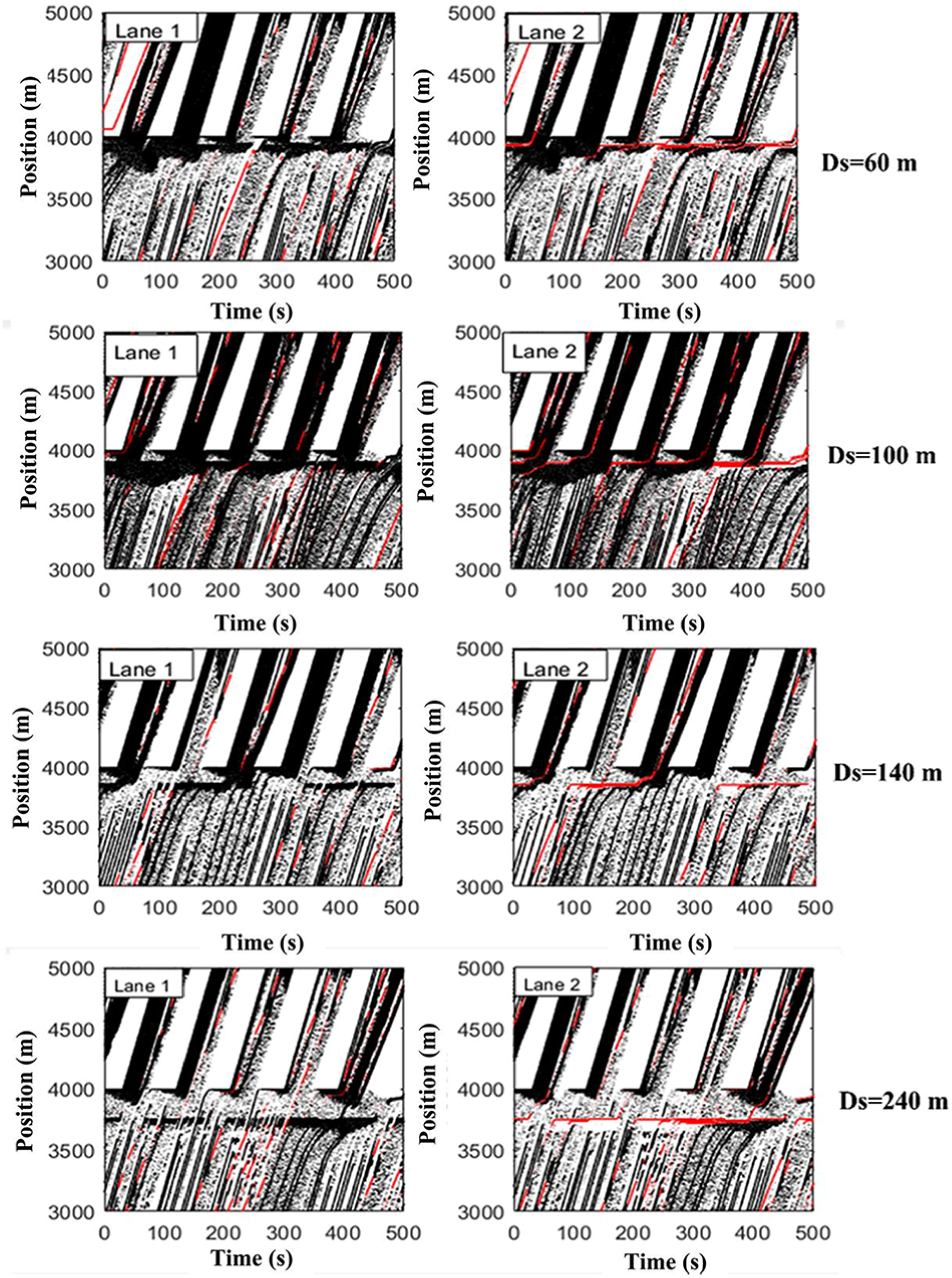
Time–space diagram for the case with a bus stop locating upstream of the intersection. The black lines are trajectories of cars and the red lines are trajectories of buses. The left row denotes the time–space diagram of Lane1, whereas the right one denotes that of Lane2.

Time–space diagram for the case with a bus stop locating downstream of the intersection. The black lines are trajectories of cars and the red lines are trajectories of buses. The left row denotes the time–space diagram of Lane1, whereas the right one denotes that of Lane2.
Furthermore, in order to determine the ideal velocity, it is necessary to investigate the velocity trajectory for any simulated vehicle. The velocity for the 200th vehicle with different

The trajectory of velocity for the 200th vehicle for the case with a bus stop locating upstream of the intersection.
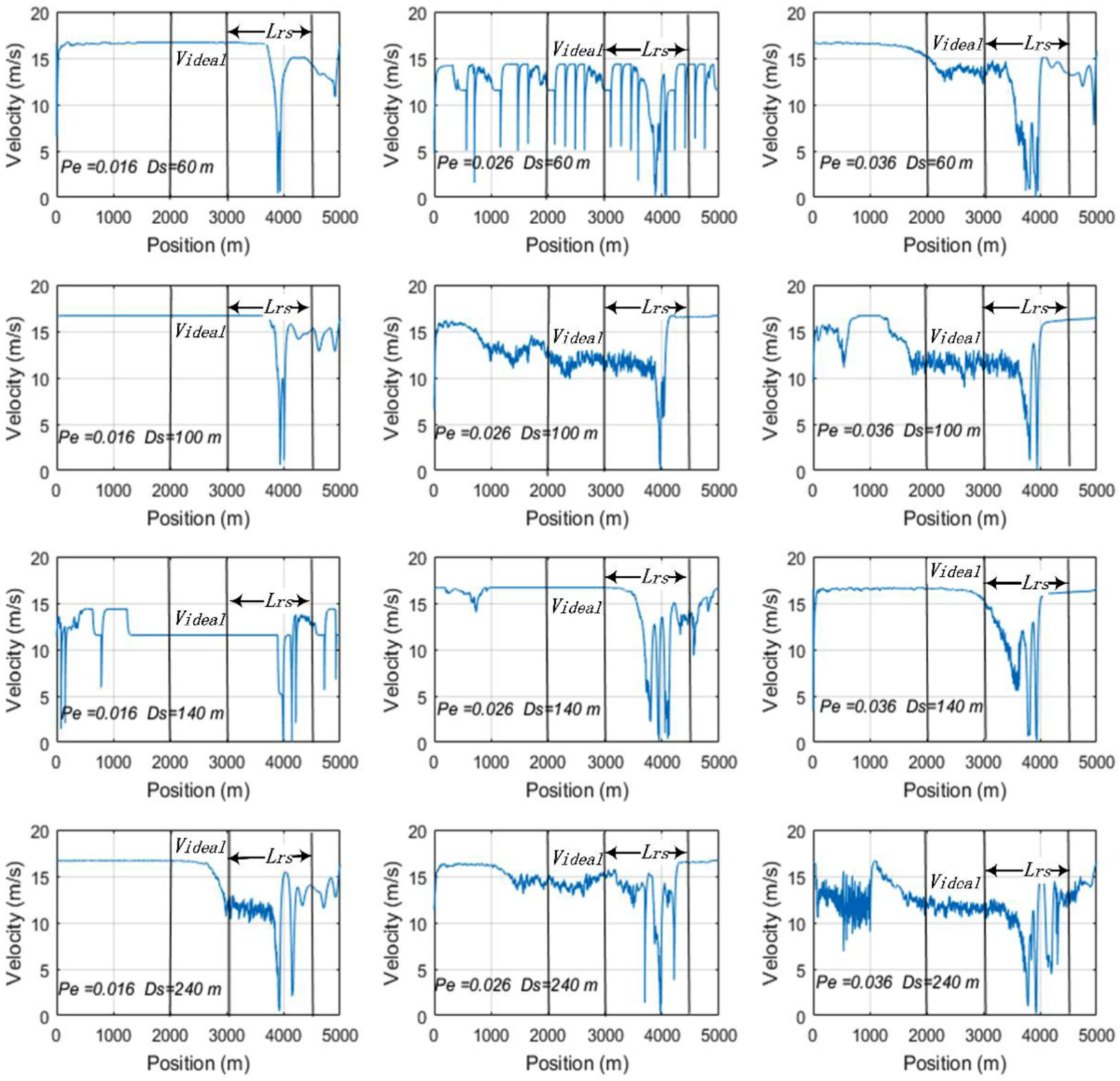
The trajectory of velocity for the 200th vehicle for the case with a bus stop locating downstream of the intersection.
When
In order to further analyze the impact of these two parameters

The relationship between the delay and the distance
In addition, from Figure 9, the upstream bus stop is advantageous over the downstream one in terms of vehicle delay. When a bus stop is located upstream of the intersection, the stopping buses or the buses waiting to stop will hinder not only the vehicles that get through the intersection without stopping, but also the vehicles that stop and wait at a red light. On the other hand, when the bus stop is downstream of the intersection, the stopping buses will influence the traffic flow leaving the intersection, leading to small scope congestion. Hence, vehicles take more time to traverse the road section, and the total delay time is relatively longer. Furthermore, it is also shown that the superiority of the upstream bus stop is obvious, while the distance
Conclusion
Public transport has been regarded as the main means to solve urban traffic problems, such as pollution and traffic congestion. In order to facilitate passengers to travel, many bus stops will be located near the road intersection in urban areas. However, the location of the bus stops near the intersection will directly affect the traffic efficiency of the road. This study establishes an extended OV model to investigate the impacts of different bus stop locations from both the traffic volume and vehicle delay aspects.
The simulation results are summarized as follows:
The bus stop close to the intersection has a greater impact on the traffic volume only when the entering probability
In terms of the impact on traffic volume, the downstream bus stop is greatly superior to the upstream one when
With respect to the impact on vehicle delay, the upstream bus stop outperforms the downstream one, especially when the entering probability
These results indicate that, if the entering probability
There are also two limitations in this study. One is the identical parameters in the OV model for buses and cars, such as the sensitive parameter
Footnotes
Handling Editor: James Baldwin
Declaration of conflicting interests
The author(s) declared no potential conflicts of interest with respect to the research, authorship, and/or publication of this article.
Funding
The author(s) disclosed receipt of the following financial support for the research, authorship, and/or publication of this article: This work was financially supported by the Higher Educational Scientific Research Projects of Inner Mongolia Autonomous Region (Project No. NJZY17012).
