




Abstract
The management capability of workshop production scheduling has been recognized as one of the important factors for the resource efficiency, delivery time and customer satisfaction of manufacturing enterprises. Therefore, a method for evaluating the management capability of production scheduling is proposed to optimize the production management. The accuracy, timeliness and effectiveness of production scheduling are measured by the formulation, execution, change and completion of the management process of production. The index model for management capability of production scheduling is established, which was driven by the data of actual production. Then, (1) scheduling generation time index, (2) scheduling execution deviation index, (3) scheduling change index and (4) scheduling completion index are built to quantitatively evaluate the capacity of production scheduling management. Finally, the usefulness and feasibility have been proved in an automobile parts–manufacturing enterprise. This article quantitatively evaluates the management capability of production scheduling. Both theoretical and results are demonstrated that the method is highly effective. The evaluation can help decision makers to better organize the production scheduling.
Introduction
With the increasingly fierce competition, the uncertainty market environment and personalized customer demand has put forward higher requirements for manufacturing production plan and scheduling. The management capability of production scheduling (MCPS) has been recognized as core competitiveness to determine the resource efficiency, delivery time and customer satisfaction of manufacturing enterprises. 1 However, the original production plan and scheduling are deviated from the actual production process due to uncertain factors, such as the arrival of the workpiece, the fluctuation of processing time, the failure of processing equipment, 2 and market demand change. 3 Then, the feasibility and accuracy of the original production plan and scheduling are reduced. 4 Therefore, MCPS evaluation is considered as an important role on quick response to production disturbance, effective reduction of production cost, rational allocation of manufacturing resources and optimization of control of production process. 5
At present, the research on the direction of production scheduling mainly focuses on the inaccurate processing time, 6 the production disturbance event, 7 the production capacity fluctuation 8 and the user demand change. 9 It generally adopts stochastic programming, 9 fuzzy programming 10 and robust scheduling 11 or studies the optimization model of different goals, such as in Sihn et al. 12 who studied an interdisciplinary multi-criteria optimization using hybrid simulation to pursue energy efficiency through production planning and scheduling. Ha et al. 13 proposed a new measure with cumulative absolute forecast error to evaluate forecasting methods in terms of total cost for the aggregate production planning and scheduling. Wen et al. 14 developed a two-stage multi-period hybrid programming model with compensation function based on uncertainty theory to minimize the total remanufacturing cost. It also includes targets such as maximum makespan, 15 tardiness and advance time 16 and flow time. 17 It should also address quality, effectiveness, profit and loss and stability performance indicators. On average, the research of production scheduling management mainly focuses on the production scheduling management information system 18 and the establishment, optimization 19 simulation 20 and robust processing of uncertainty21–23 of the production scheduling model, which greatly improves the ability of production scheduling in enterprise. In the evaluation of production scheduling capability, Guinery’s 24 research showed that effective production scheduling is critical to any competing manufacturing business. Mapokgole and Mbohwa 25 evaluated the performance of production scheduling from an economic perspective. Xu et al. 26 proposed an intelligent method to provide accurate prediction of scheduling performance indexes, which is capable of being used in the real world shop floor. Himmiche et al. 21 proposed a discrete event systems (DES)-based evaluation approach for robust production scheduling under machine failures.
Analysing the above research results, the research gaps are as follows: existing production scheduling management pays much attention to the uncertain factors of the production system and its optimization algorithm. However, the level of production scheduling management capability should be examined by actual production conditions of the workshop, but the research in this area is relatively lacking. To overcome this problem, this article combines the expected results of production scheduling management with the actual results evaluation. It analyses the data of production scheduling management and uses measure model to find out the relationship among these information. It proposes the index model of MCPS to evaluate the management capability objectively and accurately, so as to provide reference for the production scheduling management.
Methods
This research content mainly includes the following: (1) driver and challenge, (2) method framework and (3) the building process of the index model of MCPS.
Driver and challenge
Since the 21st century, manufacturing industry has been facing increasing pressure from resources 27 and environment. 28 Production management is one of the most important parts of enterprise management to enhance the core competitiveness. 29 The production scheduling is the action programme to carry out production management and to accomplish the production goal. It includes the enterprise production plan and the workshop production scheduling, and most of the work of production management is finally implemented into the workshop.
The workshop production scheduling is the overall arrangement of production tasks by the enterprise, and the scheduling for the variety, quantity and quality of production products is formulated concretely to meet the needs of orders. Some experts and scholars have studied the effectiveness of production scheduling from the perspective of robustness30,31 to improve the execution ability of production scheduling. A good MCPS can deepen the enterprise’s understanding of the production process mechanism and key data, improve the production capacity and reduce the inventory cost of production.
So, the preparation and implementation of production scheduling are the main means to improve workshop management level and to achieve good economic benefits. It is necessary to measure and evaluate the MCPS, so as to strengthen the production management and control of the workshop and improve the coordination and organizational ability of the production plan and scheduling of the workshop.
Therefore, how to effectively use a large amount of production data and to excavate its value, to realize the analysis and evaluation for MCPS, has become an urgent problem to be solved for optimization control of production management.
Framework for MCPS evaluation
MCPS is seen as an important part of the core competitiveness of manufacturing enterprises. Reasonable scheduling of workshop production can reduce unnecessary planning changes, complete orders on time, meet customer needs and improve production efficiency. Because of the systematization and complexity of production planning and scheduling management activities, the qualitative evaluation is therefore difficult to provide a scientific basis for the enterprise to improve the level of production management. In view of this, a positive and non-dimensional index is established to quantitatively describe the MCPS.
The process of production scheduling management mainly includes four steps: formulation, execution, change and completion. Then, the index model of MCPS includes scheduling generation time index, scheduling execution deviation index, scheduling change index and scheduling completion index. The index model uses variance and dimensionless values to quantify the evaluation indicators, which makes the evaluation method simple and operable. It transforms qualitative description into quantitative result to avoid possible errors caused by subjective judgement.
It combines the expected effect of production scheduling management with the evaluation of actual results. It also takes the data of production scheduling management as the analysis object and uses the data-driven technology to find out the relationship among these information, so as to excavate the information and knowledge and then objectively and accurately evaluate the MCPS (Figure 1).

Framework for evaluation for MCPS.
Evaluation model of MCPS
According to the management process of formulation, execution, change and completion for production scheduling, this article constructs four evaluation indexes of scheduling generation time index, scheduling execution deviation index, scheduling change index and scheduling completion index (Figure 2).

Evaluation model of MCPS.
The definition
Because the dimension of each evaluation index is different, it is not convenient for the comparison of each index. According to the nature of the target, the following parameters are used to standardize the performance parameters of the original evaluation indexes.
Benefit index

Cost index

where
The MCPS is constructed to measure the accuracy, timeliness and effectiveness. Model assumptions are as follows:
Production model and product are fixed in workshop.
Within a certain period of time, the capacity and resources of the scheduling are determined.
The actual operation of the process and production system information is clear.
The calculation of key parameters of the model is based on the statistical data of the latest time series.
According to different characteristics of a target, the evaluation index is non-dimensional. Thus, the mathematical model for MCPS is as follows

where
Formula (3) synthetically measures MCPS with the scheduling generation time index, scheduling execution deviation index, scheduling change index and scheduling completion index of the scheduling.
Scheduling generation time index
Scheduling generation time index is the time from receiving orders to work orders. For the workshop, the shorter the scheduling generation time, the greater the likelihood of completing the ordered tasks on time and thus better the production scheduling management. Therefore, the scheduling generation time index evaluates the timeliness of the production scheduling management. Comparing the dispatch time between receiving order and work order, it was found that the greater the deviation, the worse the schedule management. Therefore, this article establishes the class variance to evaluate the workshop scheduling generation time index as follows

where
Scheduling generation time index is the description of the deviation degree between work order time and receiving time. The smaller the value of the production scheduling, the better the timeliness of the management.
Scheduling execution deviation index
Scheduling deviation refers to the difference between the actual production and the planned output per working day. Scheduling deviation index is a quantitative evaluation of the accuracy of production scheduling management. When the actual production quantity and the production quantity of each working day are closer to each other, the workshop production scheduling execution is better, which reflects the higher production scheduling management ability.
Therefore, this article makes the variance of the class as the representation of the scheduling deviation index

where
The variance of the class is the standard deviation from the actual production quantity, and the smaller the value, the better the effect of the implementation of the scheduling, and therefore, the higher the ability to scheduling management.
Scheduling change index
In the production process, due to the existence of a series of factors such as emergency processing tasks, safety accidents and equipment failure, it would inevitably lead to changes in production scheduling. In this article, the number of planned changes in the production process of each batch of products is analysed and scheduling change index is built. The scheduling change index is a quantitative description of the change of the production scheduling. The ideal value of the production scheduling change is 0. Thus, the deviation between the actual production scheduling and the ideal value is taken as the parameter; the establishment of the scheduling change index is as follows

where
The smaller the scheduling change index, the better the ability of the workshop to control the production scheduling. It shows that the effectiveness of the production scheduling management is higher.
Scheduling completion index
Scheduling completion index refers to the proportion of each batch of products produced to the number of products required by customers’ deadline. The number of batch in each workshop is
This article selects the variance between the completion rate and the best completion rate as the completion rate index. So, the scheduling completion rate index is as follows

where

where
The greater the scheduling completion index, the better the production capacity. It indicates that the scheduling management ability of the workshop is better, and so the best completion rate is 1.
Case study
Background
The method for evaluating MCPS is applied in an automobile parts–manufacturing enterprise. The company is engaged in the design and manufacture of automotive powertrain components. In 2017, the company signed a long-term cooperation contract with a Japanese-owned automobile brand. The host factory adopts lean production mode, requiring suppliers at all levels to pull production, encouraging first-level suppliers to control second-level suppliers. The host factory puts forward higher requirements on the products’ delivery timeliness. This is a challenge for a traditional and extensive mechanical processing enterprise. In order to meet the requirements of the host factories, this enterprise adopted some measures to urge the outsourcing processing enterprises to strengthen the management ability of production planning and scheduling and required the outsourcing processing enterprises to produce according to the varieties and quantities required by the orders. The timeliness of outsourcing processing enterprises has become the key indicators of the optimal choice.
Results
This method is used to carry out the quantitative evaluation of the MCPS of outsourcing processing resources, which provides support for the optimal selection of outsourcing processing resources. A part of the automobile bridge in the enterprise needs quenching and decarbonization. Because of the uncertainties of orders, the high energy consumption and material consumption in the production organization process, these outsourcing processing resources become difficult to carry out production plan management efficiently. Frequent changes in production plans result in delays in the production delivery time of the enterprise. Some of the data are shown in Table 1.
Partial orders of outsourcing processing enterprises.

The enterprise can decompose order information of the host factory in time by enterprise resource planning (ERP) system for the outsourcing processing resources. The quenching and decarbonization order issued by the enterprise to different outsourcing processing resources is different (Table 2).
Part receiving order date and work order date.

According to formula (4), the values are
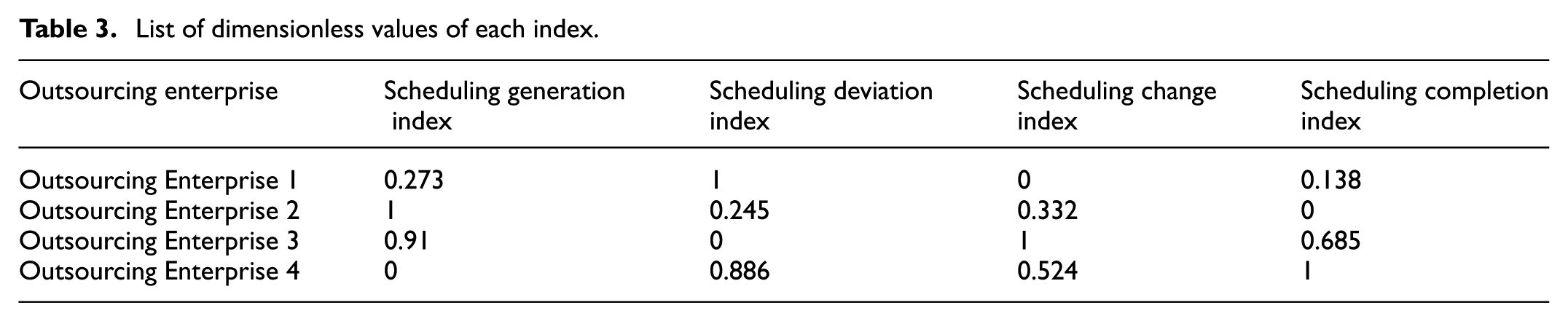
Similarly, the results of the other three indicators are calculated separately and the results are shown in Table 3.
List of dimensionless values of each index.
For production scheduling management capacity of the four indicators of the weight factor, the experts with AHP were finally identified as
According to formula (3), the calculation of the MCPS of each workshop, as shown in Figure 3, is

MCPS of each workshop in outsourcing enterprises.
Comparing its size, we get
MCPS based on production data-driven technology has the following advantages: first, it can quantitatively describe the size of the MCPS. Second, statistical data are easy to obtain, and the model is simple and fast. At last, based on the results, it can provide reference for the improvement of production scheduling management capability.
Discussion and management enlightenment
Compared with the similar direction of literatures,6,13 this article focused on the coordination of personnel, machinery, equipment and materials in the workshop by evaluating the MCPS. It ensures that production plans are completed on time and in good quality. It is very important for production managers to know and grasp the production schedule in time, to study and analyse various factors affecting production and to take corresponding countermeasures according to different situations so as to narrow the gaps.
Through the above examples, it can be observed that this method can accurately compare the size of management capacity of workshop production scheduling from qualitative description to quantitative description.
For the production management, it only needs to collect relevant information and process it with the data mining method to realize from subjective comparison to objective evaluation and to improve the accuracy and objectivity of the results. It evaluates the process of production scheduling management in workshop, and the effective use of comprehensive and accurate information resources can rationally and efficiently organize and coordinate the various elements of the production scheduling process.
For the enterprise management, it makes the workshop production management orderly, rationalized and standardized, while making rational use of effective funds and resources to meet customer needs. It not only cultivates the intellectualization of enterprises but also improves the comprehensive management level of enterprises, integrates the internal and external resources of enterprises and creates conditions for the improvement of the core competitiveness of enterprises.
Conclusion
MCPS is an important part of the core competitiveness of manufacturing enterprises. Accurate and efficient MCPS can reasonably arrange workshop production plan, reduce unnecessary scheduling changes, complete orders on time, make customers satisfied and improve the competitiveness of enterprises in the market. Therefore, how to evaluate the MCPS is the key to optimizing production management. Taking into consideration the formulation, implementation, change and completion of production scheduling, this article constructs the index model of MCPS with the plan generation time index, scheduling execution deviation index, scheduling change index and scheduling completion index, which evaluates the accuracy, timeliness and effectiveness of production scheduling management. It realizes the quantitative research on the MCPS for production managers to know and grasp the production schedule in time and takes corresponding countermeasures so that production plans are completed on time and in good quality. It provides support for decision makers to better organize the production scheduling and the enterprise to improve the workshop production management level.
Footnotes
Handling Editor: ZhiWu Li
Declaration of conflicting interests
The author(s) declared no potential conflicts of interest with respect to the research, authorship and/or publication of this article.
Funding
The author(s) disclosed receipt of the following financial support for the research, authorship and/or publication of this article: The study was supported by the Natural Science Fund of Anhui Province (grant nos. KJ2016A769 and KJ2014ZD31), Anhui outstanding talents support programme (grant nos. gxyqZD2018082 and 2016XQNRL004), Programme for Innovative Research Team in Suzhou University (grant no. 2018kytd01), Anhui Science and Technology Innovation Strategy and Soft Science Research Project (grant no. 201806a02020041) and Suzhou Mechanical Equipment Co-innovation Engineering Technology Research Center (grant no. SZ2017ZX07).
