




Abstract
An experimental study was performed on the splitting tensile strength of steel fiber reinforced concrete using cube and cylinder specimens. Effects of volume fraction, aspect ratio, geometry, and tensile strength of steel fiber on the splitting tensile strength of steel fiber reinforced concrete with different water-to-binder ratio were investigated systematically. The test results showed that the splitting tensile strength of steel fiber reinforced concrete increases with volume fraction and aspect ratio of steel fiber. And it can be improved more obviously by hooked-end steel fiber compared with wave-shaped and corrugated steel fibers. Steel fibers with higher tensile strength (>600 MPa) are recommended for steel fiber reinforced concrete with compressive strength larger than 70 MPa. A factor used to convert cubic strength to cylindrical strength for steel fiber reinforced concrete was obtained, which is 0.738 for compressive strength and 0.96 for splitting tensile strength. In addition, a calculation method for predicting the splitting tensile strength of hooked-end steel fiber reinforced concrete including impact coefficient of steel fiber was developed based on the test results, which shows reasonable predictions for all test data.
Keywords
Introduction
Steel fiber reinforced concrete (SFRC) is being widely used in structural engineering around the world in recent decades. Steel fibers in concrete can connect adjacent surfaces of micro-cracks, delay the formation of cracks, and restrain the propagation of cracks by reducing the crack tip opening displacement.1–4 The reinforcement mechanism of deformed steel fibers is mainly composed of bonding, pullout, and mechanical anchoring effect. 5 The de-bonding, pulling out, and breaking of steel fiber consume a great deal of energy. Therefore, the addition of steel fiber into concrete can significantly improve the compressive strength and tensile strength of concrete structure, and then SFRC shows good plastic properties.1,6 The tensile strength is one of the most important mechanical properties for concrete, which is usually described as the splitting tensile strength due to its simplicity of operation and relative narrow dispersion for test results. 7 The test of splitting tensile strength was initially proposed by Tsuneo Akazawa in Japan in 1943; based on the results of many Japanese researchers, a standard test method for splitting tensile strength of concrete was made in 1951; later, the splitting method with strips was prescribed in ASTM and RILEM in 1962 and 1966, respectively. 8
In accordance with previous research results, it is notable that the test result of splitting tensile strength depends on the specimen’s size and shape. 9 Nowadays, two types of standard specimens are usually used in the test of splitting tensile strength, namely, cubes and cylinders. Cubes (150 mm) are mostly used in China, the United Kingdom, Singapore, and European countries, while cylinders (150 mm in diameter, 300 mm in height) are popular to be used in the United States, Canada, Australia, New Zealand, South Korea, and so on.9,10 Up to now, several researches have been done to investigate the relation between the tensile strengths obtained from cubes and cylinders, and developing an equation for converting the strength of cubes into the strength of cylinders could be of considerable significance to designers.
Kadleček et al. 7 and Xuan 11 pointed out that the splitting tensile strength depended on the size of cross-section under tension. Based on a series of experiments, the correlations between the splitting tensile strength and the fracture area of the tested specimens were established by Kadleček et al. 7 and Xuan 11 as equations (1) and (2), respectively. Zhou 12 also gave equation (3) by the method of regression analysis based on the test results and collected data


where ft,x is the splitting tensile strength of concrete specimens with arbitrary size, ft,150 is the splitting tensile strength of standard cube specimen, and A is the size of fracture section corresponding to ft,x. However, the above-published empirical relations were proposed for plain concrete, and the applicability to SFRC remains to be determined. Therefore, it is significant to set up a bridge between the analytical and design approaches for structural SFRC developed based on the cylinder or/and cube strengths.
Influencing factors for the splitting tensile strength of SFRC have been studied by numerous researchers during past few decades, and the results showed that the splitting tensile strength of SFRC is closely related to the compressive strength, volume fraction, and aspect ratio of steel fiber.2,13 Khaloo and Kim 3 proposed a model for predicting the splitting tensile strength

where fft is the splitting tensile strength of SFRC, ft is the tensile strength of the corresponding plain concrete, ρf is the volume fraction of steel fiber, and a and b are constants. Song and Hwang 14 and Zhang et al. 15 took the compressive strength of concrete into account and offered another model

where fc is the compressive strength of plain concrete and c is a constant. Obviously, equations (4) and (5) only consider the volume fraction of steel fiber and tensile/compressive strength of the plain concrete. In other literatures,4,16–18 a characteristic parameter was introduced to evaluate the effect of steel fiber on the splitting tensile strength

where λf is the characteristic parameter of steel fiber and lf/df is the aspect ratio of fiber. Equation (6) considered the combined effect of steel fiber volume fraction and aspect ratio; however, the steel fibers used in these literatures are of certain kinds. Steel fibers with different shapes have different enhancing effects on the splitting tensile strength, as their distinct abilities of bonding and anchorage performance are various.19,20 Therefore, it is essential to propose a universal calculation method for research and practical engineering of SFRC.
In this work, effects of water-to-binder ratio (W/B), volume fraction, aspect ratio, geometric shape, and tensile strength of steel fiber on the splitting tensile strength of SFRC were investigated systematically. Based on the test result, the correlation coefficients between compressive strength and splitting tensile strength of cube and cylinder specimens were determined, respectively. Through regression analysis on data from previous researches and this article, the impact coefficient of hooked-end steel fiber in calculation equation for splitting tensile strength of SFRC in JG/T 472-2015 was revised.
Experimental program
Raw materials, mix proportion, and test specimens
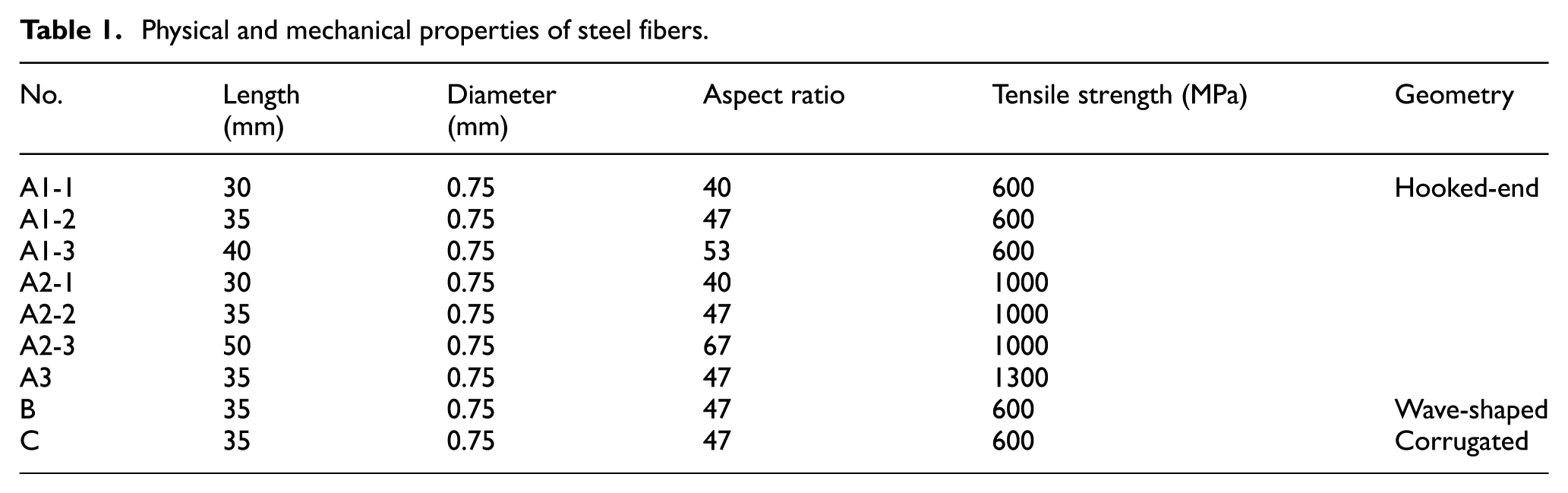
In this study, type I Portland cement 42.5R (C) and type C fly ash (FA) in the dosage of 20% cement replacement were used as cementitious materials. River sand (S) with maximum particle size of 5 mm and crushed limestone (G) with particle size of 5–20 mm were used as fine and coarse aggregate, respectively. Polycarboxylate water reducer agent (WRA) was added in different dosage to adjust the workability of concrete mixture and confine the slump of fresh concrete within the range of 35–50 mm. The physical and mechanical properties of steel fibers used in this test are shown in Table 1 and Figure 1.
Physical and mechanical properties of steel fibers.

Size and geometric shape of steel fibers: (a) size of steel fibers, (b) hooked-end, (c) wave-shaped, and (d) corrugated.
According to the standard of SFRC (JG/T 472-2015), 21 20 concrete mix proportions were designed and provided in Table 2. Cube specimen with size of 150 mm × 150 mm × 150 mm and cylinder specimen with 150 mm in diameter and 300 mm in height were prepared in this work. The details of concrete specimens are provided in Table 3.
Mix proportion of concrete.

Details of concrete specimens.
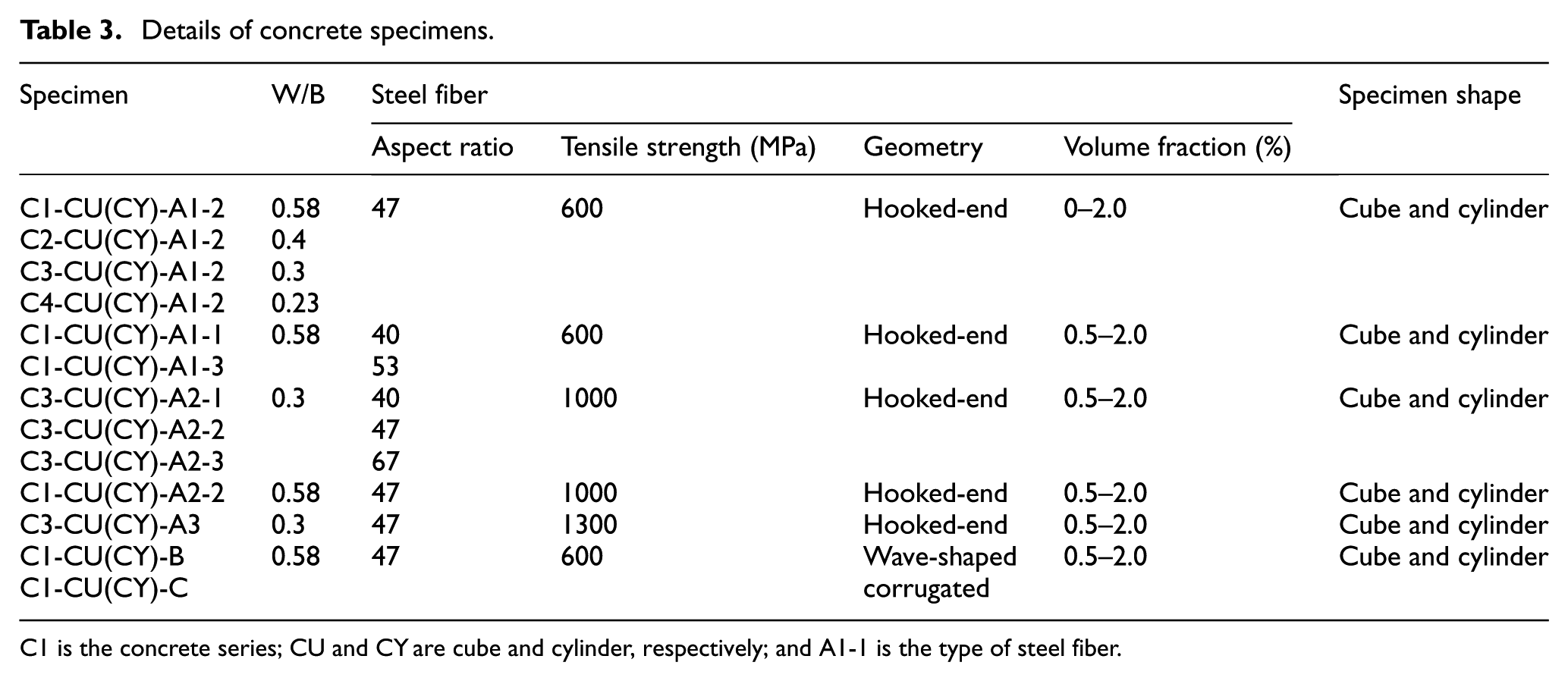
C1 is the concrete series; CU and CY are cube and cylinder, respectively; and A1-1 is the type of steel fiber.
Specimen molding and testing methods
The specimens were cast and then compacted on a vibration table and were demolded after approximately 24 h and cured at 20°C ± 1°C, ≥95%RH for 90 days to allow the hydration reaction of fly ash to fully proceed.
Referring to the standard GB/T50081-2002, 22 compression and splitting tension tests were carried out on a 3000-KN universal compression machine. Figure 2 shows the setup used for the compression and splitting tension tests. The loading rate for compression tests was 0.5 MPa/s when the strength of concrete was less than 60 MPa and 0.8 MPa/s for concrete strength lager than 60 MPa. And the loading rate of splitting tension tests was 0.05 MPa and 0.08 MPa when concrete strength was lower and higher than 60 MPa, respectively.

Test setup: (a) compression machine, (b) compression test, and (c) splitting tensile test.
Results and discussions
In the following analysis, the splitting tensile strength ratio of SFRC to plain concrete, fft/ft, was adopted to eliminate the influence of plain concrete on different SFRC series. The test results of compressive and splitting tensile strength are shown in Tables 4 and 5, respectively.
Compressive strength test results (MPa).

The value in the [ ] is the standard deviation. The value in the () shows the percentage of strength increase over that of the plain concrete.
Splitting tensile strength test results (MPa).

The value in the [ ] is the standard deviation. The value in the () shows the percentage of strength increase over that of the plain concrete.
Compressive strength
Effect of steel fiber volume fraction on the compressive strength of SFRC is shown in Figure 3. It is clear that the compressive strength increases with the increase in steel fiber volume fraction from 0% to 2% and the relationship can be described as linear, regardless of the geometrical feature of testing specimens. Besides, the slope of fitted line increased gradually from C1 to C4. It indicates that the compressive strength improves faster with the increase in volume fraction when water-to-binder ratio is smaller. Seen from Table 4, the compressive strength increment in cube specimens from C1 to C4 is 19%, 24%, 27%, and 36%, respectively, for steel fiber volume fraction 2.0%. ACI 544.1R-96 6 pointed out that in compression, the ultimate strength is only slightly affected by the presence of fibers, with observed increases ranging from 0% to 15% for up to 1.5% by volume of fibers. The test results in previous researches13,14,18,23 showed that the ultimate increases in compressive strength varied in the range of 8%–21% and it reached 37% with steel fiber content 1.5% in literature. 3

Effect of steel fiber volume fraction on compressive strength: (a) cube and (b) cylinder.
Splitting tensile strength
Water-to-binder ratio and volume fraction of steel fiber
As shown in Figure 4, the splitting tensile strength increases linearly with the increase in volume fraction for concrete strength from C1 to C4. Similar to compressive strength, the splitting tensile strength improves faster with the increase in volume fraction when concrete strength is higher. With the decrease in water-to-binder ratio from 0.58 to 0.23, the increase in splitting tensile strength reached 76%, 80%, 85%, and 97% for cubes, respectively, with volume fraction 2.0%, and 85%, 84%, 97%, and 111% for cylinders, respectively. With the decrease in water-to-binder ratio, the thickness of water film surrounding the steel fibers reduced and then the porosity of interface transition zone decreased, which leads to an enhancement in the bond strength between steel fibers and concrete. As a consequence, the pulling-out process of steel fibers will consume a great deal of energy when SFRC is under loading. 24 Therefore, the strengthening effect of steel fiber on the splitting tensile strength of SFRC is more remarkable in the SFRC with a higher compressive strength.

Effect of steel fiber volume fraction on splitting tensile strength: (a) cube and (b) cylinder.
Aspect ratio of steel fiber
Figure 5 presents the influence of aspect ratio. The splitting tensile strength ratio presents an upward trend with the increase in aspect ratio, although some results are not ideal due to the unavoidable contingency in the test. The maximum increase in tensile strength of A1-1, A1-2, and A1-3 SFRC reached 73%, 80%, and 95% for cubes, respectively, and 82%, 84%, and 108% for cylinders, respectively, with volume fraction 2.0%. The results indicate that in certain range of aspect ratio, larger steel fiber aspect ratio provided a greater enhancement effect on the splitting tensile strength of SFRC. According to the mechanic theory of composite material, steel fibers with larger aspect ratios are able to cross over more cracks and bear higher tensile stress, which makes them more effective in strengthening the SFRC.

Effect of steel fiber aspect ratio on the splitting tensile strength: (a) cube of C1 SFRC, (b) cylinder of C1 SFRC, (c) cube of C3 SFRC, and (d) cylinder of C3 SFRC.
Geometric shape of steel fiber
Figure 6 shows the effect of geometric shape of steel fiber on the splitting tensile strength of SFRC. It can be seen that hooked-end steel fiber has the best enhancement effect on the splitting tensile strength of SFRC, while the effect of wave-shaped steel fiber is the slightest. Nevertheless, there is no obvious difference when the volume fraction of steel fiber is small. The increment in tensile strength of B, C, and A1-2 SFRC reached a maximum of 54%, 61%, and 80%, respectively, for cubes and 61%, 84%, and 84%, respectively, for cylinders with volume fraction 2.0%.

Effect of steel fiber geometry on splitting tensile strength: (a) cube and (b) cylinder.
Hooks of steel fiber increase the friction force and interlock force between fibers and concrete matrix. Besides, in the process of pulling out, the hooks have a tendency of being straightened, which delayed the crack of concrete. The longitudinal scotches of corrugated steel fiber generate strong interlock force with concrete matrix. However, the waves of wave-shaped steel fiber make it hard for the fibers and matrix materials to homogeneously distribute in the concrete matrix, which to some extent reduces the strengthening effect of fibers although they can increase the friction force. It has been reported by Li 25 that hooked-end SFRC had better bond performance between hooked-end steel fiber and concrete matrix than other type of fibers. Therefore, hooked-end steel fibers are recommended in SFRC.
Tensile strength of steel fiber
Figure 7 shows the effect of steel fiber tensile strength on splitting tensile strength of SFRC. For the specimens of C1 concrete, there is no obvious difference between the splitting tensile strength ratio of these two kinds of SFRC. However, the results are multiple when the concrete strength is enhanced. For steel fibers with tensile strength of 1000 and 1300 MPa, the splitting tensile strength of SFRC is close to each other and yet it is larger than that of SFRC with 600 MPa steel fiber. Through observing the fracture surface of the destroyed specimens, it can be seen that most of the steel fibers in C3 SFRC were pulled out rather than ruptured. The steel fibers in C1 SFRC were simply pulled out without breaking. The reason lies in that the bonding strength between fibers and concrete matrix is relatively lower for C1 SFRC compared with that of C3 SFRC, causing the fibers pulled out before broken. On the contrary, fibers in C3 SFRC are broken in the first place for its stronger bonding strength with the concrete matrix. The above results illustrate that the tensile strength of steel fiber should be suitable for SFRC with respect to concrete strength in order to achieve its full strengthening potential of the composite materials.
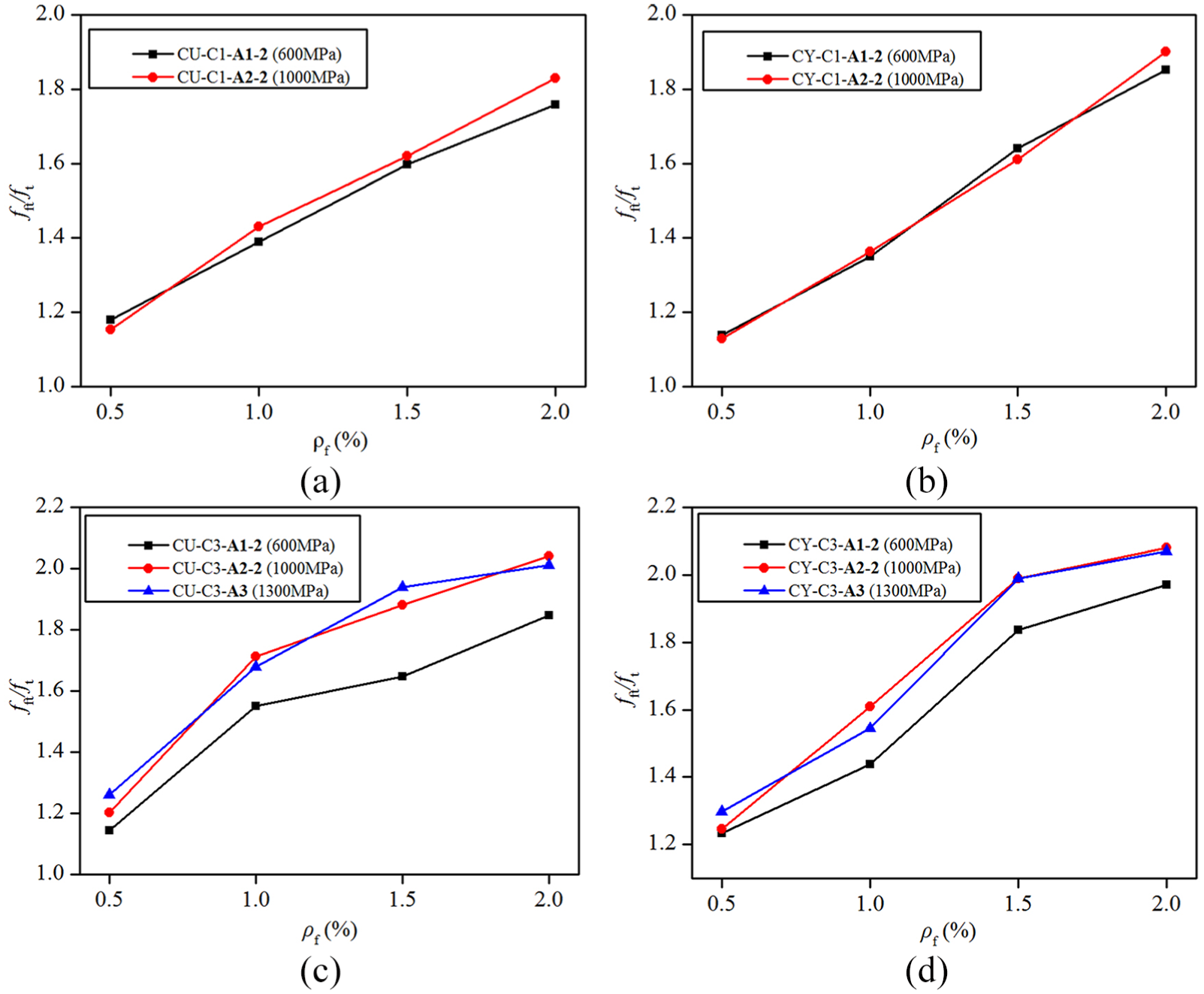
Effect of steel fiber tensile strength on splitting tensile strength: (a) cube of C1 SFRC, (b) cylinder of C1 SFRC, (c) cube of C3 SFRC, and (d) cylinder of C3 SFRC.
Correlation between strength of cube and cylinder
Based on the test results, correlation of compressive and splitting tensile strength between cubes and cylinders was established through linear regression analysis. The strength of cubes and cylinders is set as X axis and Y axis, respectively, in Figures 8 and 9. The conversion factor for compressive strength of cube and cylinder of SFRC is 0.738, and it equals to 0.96 for splitting tensile strength. The value of R-square comes up to 0.995 and 0.997 separately, which indicates that the fitting result is highly reliable.
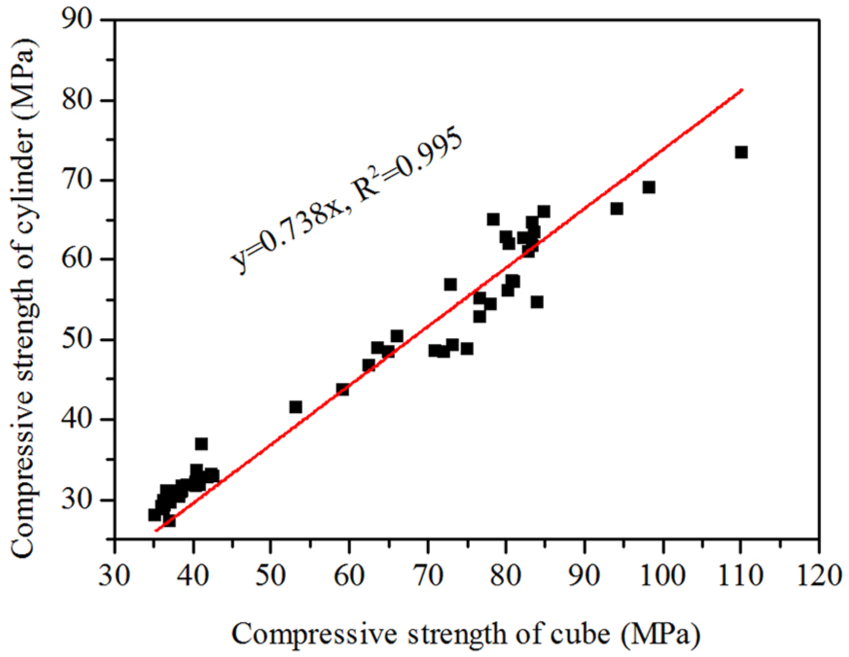
Proposed relation between compressive strength of cube and cylinder specimens.

Proposed relation between splitting tensile strength of cube and cylinder specimens.
Empirical equation for splitting tensile strength
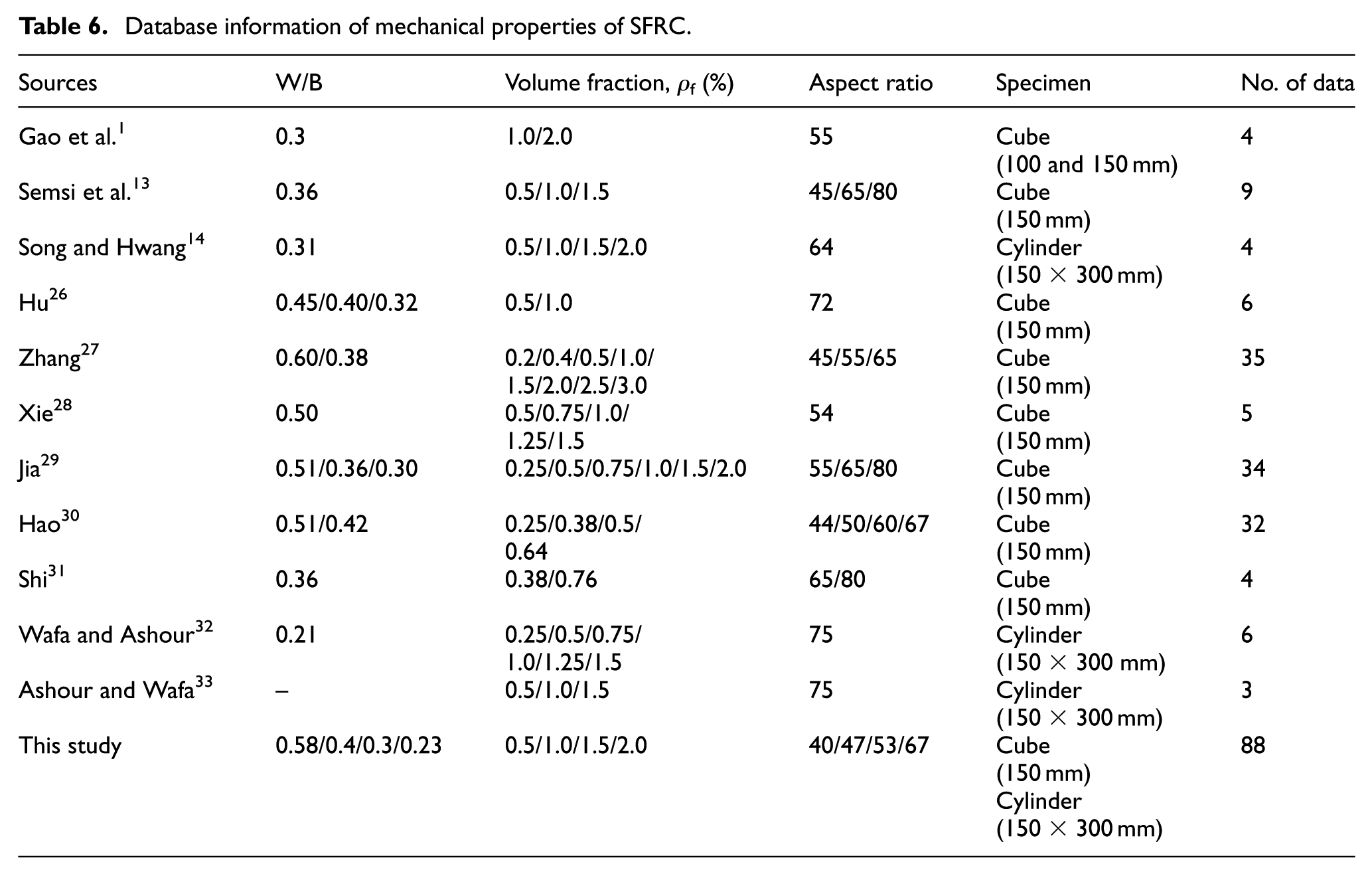
Concerning the excellent strengthening effect of hooked-end steel fibers, a total of 230 data from this test and other literatures1,13,14,26–33 were gathered together to propose an equation for splitting tensile strength of hooked-end SFRC. The general information of the database is presented in Table 6. The database encompasses SFRC with water-to-binder ratio from 0.21 to 0.60 and aspect ratio of hooked-end steel fibers from 40 to 80. All the compressive strength values are either standard cube specimen (150 mm) or converted to standard cube strengths using conversion factor 0.738 obtained from Figure 8.
Database information of mechanical properties of SFRC.
The above researches have shown that concrete strength, steel fiber volume fraction, and aspect ratio have remarkable influence on the splitting tensile strength. Equation proposed by JG/T 472-2015 is expressed as follows

where αt is the impact coefficient of steel fiber, a fitted parameter to characterize the enhancement effect of steel fiber.
Based on the proposed equation (7), regression analyses were conducted to the experimental data together with collected data to revise the impact coefficient of hooked-end steel fiber as shown in Figure 10. The data were divided into two groups according to the strength of SFRC. The obtained results are as follows.
For concrete with 20–45 MPa

For concrete with 50–110 MPa


Regression analyses on splitting tensile strength of SFRC: (a) 20–45 MPa and (b) 50–110 MPa.
Furthermore, in order to evaluate the deviation between experimental data points and predicted values, statistic mean (μ), mean square deviation (σ), and coefficient variation (γ) of experimental/predicted ratio were adopted. The statistical analysis results of the equations proposed by this research as well as equations suggested by JG/T 472-2015 are presented in Table 7. The comparison shows that the proposed equations are more accurate and show good agreement with the equation proposed by JG/T 472-2015.
Comparison of predicted and experimental data.

Conclusion
From the present research on SFRC, the main conclusions are summarized as follows:
The compressive strength increases linearly with volume fraction of steel fiber from 0% to 2.0%, and increases faster with the decrease in water-to-binder ratio. The maximum increment reached 37% with volume fraction 2.0%.
The increase in splitting tensile strength with volume fraction and water-to-binder ratio parallels with compressive strength, and the maximum increase reached 143% with volume fraction 2.0%; hooked-end steel fibers exhibit better boosting capacity, which is more effective to strengthen the tensile strength of SFRC than corrugated and wave-shaped steel fibers; steel fibers with tensile strength of 1000 and 1300 MPa have better enhancement effect than that of 600 MPa when the compressive strength of SFRC is larger than 70 MPa.
An important conversion factor for strength of cube and cylinder of SFRC was determined, which is 0.738 and 0.96 for compressive and splitting tensile strength of SFRC, respectively.
An empirical equation for calculating the splitting tensile strength of hooked-end SFRC was established based on experimental results and the impact coefficient changes when the compressive strength of SFRC varies. The calculated results by equation of JG/T 472 and present research fit well with the experiment data, which indicates that both equations are reliable for the design of SFRC.
Footnotes
Handling Editor: Zuzana Murčinková
Declaration of conflicting interests
The author(s) declared no potential conflicts of interest with respect to the research, authorship, and/or publication of this article.
Funding
The author(s) disclosed receipt of the following financial support for the research, authorship, and/or publication of this article: This study was financially supported by the National Natural Science Fund (nos 51578510 and 51808508) and China Postdoctoral Science Foundation (no 2018M642786).
