In this article, a novel discrete system based on an economic model is introduced. Conditions for local stability of the model’s fixed points are obtained. Existence of supercritical Neimark–Sacker bifurcation is shown around the game’s Nash equilibrium. Existence of stable period-2 orbits resulting from flip bifurcation around the game’s Nash equilibrium is also proved. Existence of chaotic dynamics in the proposed game is also shown via two routes: Neimark–Sacker bifurcation and flip bifurcation. Based on the bifurcation theory of discrete-time systems, sufficient conditions of transcritical bifurcation are derived and applied to the proposed model. The interesting phenomenon of coexisting multi-chaotic attractors, such as coexistence of two, three, four, and five-piece chaotic attractors, is found in the proposed model. For this reason, numerical simulations of basins of attraction are performed to verify the appearance of this important phenomenon that reflects the unpredictability and higher complexity in the proposed game.
Studying the dynamics of economic games has recently become the focus.1–10 As a small number of firms produces homogeneous products and dominate the trade, the universal market is said to be oligopolistic. This was first introduced by A Cournot.11 The complex dynamics of oligopolistic games arise from the fact that reaction of competitors must also be considered by firms. Therefore, this kind of economic competition may lead to existence of bifurcations and chaos.
Dynamic complexity in duopoly games was studied by Dana and Montrucchio.12 Askar13 discussed the complex dynamic properties of Cournot duopoly games with convex and log-concave demand function. Dynamic analysis of duopoly game whose competitors participating in carbon emission trading was presented by Zhao and Zhang.14 The rise of complex phenomena in a kind of Cournot duopoly games, whose demand functions have no inflection points, has been studied in Askar.15 A mixed Cournot game with boundedly rational competitors was investigated by Zhu et al.16 Dynamic analysis in a Cournot investment market with heterogeneous competitors was performed by Ding et al.17 Askar et al.18 have studied the dynamic duopolistic Cournot games with discrete-time scales taking into consideration linear cost and unknown inverse demand function. Furthermore, Askar and Alnowibet19 have studied the stability of Nash equilibrium point in a delayed Cournot duopolistic game. Elsadany and Matouk20 discussed the dynamics in a Cournot duopoly game based on delayed bounded rationality. Also, Elsadany21 introduced a novel Cournot duopoly game based on local profit maximization. Anderson et al.22 studied basins of attraction in a Cournot duopoly model of Kopel. In addition, dynamics of Cournot games with n players were investigated by Ahmed and Agiza.23 Ding et al.24 discussed the dynamics in Cournot game with bounded rationality and time delay for marginal profit. Alnowibet et al.25 investigated complex dynamics and control in Cournot triopoly game formed based on a log-concave demand function. For further similar recent works on dynamics of triopoly games, one can read the previous works.26–35
Elsadany21 studied Cournot duopoly game with bounded rationality and with relative profit maximization. The resulting game has four equilibria including the Nash fixed point which was numerically shown to have double routes to chaos via Neimark–Sacker and period-doubling bifurcations. Here, we extend the model given in Elsadany21 so that it involves three players. Our generalized model has eight equilibria including the Nash fixed point. So, rich variety of dynamical behaviors is obtained such as existence of supercritical Neimark–Sacker, flip bifurcations, and coexistence of multi-chaotic attractors. Furthermore, existence of the transcritical bifurcation is found and proved here. Therefore, the generalized game is classified as a novel triopoly game with bounded rationality based on a local profit maximization. Moreover, a new approach for examining existence of the transcritical bifurcation in discrete-time dynamical systems is introduced here and applied to the proposed model.
The new results and techniques in this work can also be applied to other economic models such as the factional-order financial models.36 This can be achieved by discretizing the fractional-order system using a suitable discretization method of the utilized fractional-order differential operator to make the fractional economic model becomes more appropriate and realistic.
The remainder of this article is organized as follows. In section “Description of the game,” a novel triopoly game with bounded rationality is modeled based on a local profit maximization. In section “The game’s fixed points and their local stability,” some sufficient conditions on local stability of the game’s eight fixed points are provided. In section “Existence of Neimark-Sacker bifurcation around the Nash fixed point and the first route to chaos in the novel triopoly game” existence of supercritical Neimark–Sacker bifurcation around the game’s Nash equilibrium is shown and the first route to chaos in the game is illustrated. In section “Existence of flip bifurcation around the Nash fixed point and the second route to chaos in the novel triopoly game,” the second route to chaos is depicted after existence of supercritical flip bifurcation around the Nash equilibrium. In section “Existence of transcritical bifurcation around the Nash fixed point,” sufficient conditions for existence of transcritical bifurcation in maps are derived and successfully applied to the proposed model. In section “More chaotic attractors and coexistence of multi-attractors,” more chaotic attractors and coexistence of multi-attractors in the model are shown in addition to computations of basins of attraction to verify the appearance of such unpredictability and higher complexity in the proposed game. In section “Conclusion,” summary and prospect for our present work are made.
Description of the game
We consider a market with monopolistic sector with three firms producing differentiated products. Based on the assumption of Singh and Vives37 of utility function, we introduce the following quadratic and strictly concave utility function
where is the output supplied by the ith firm (rational player), , . This utility function implies the following inverse demands
The payoff of the firm i is given as follows
where is the corresponding market price and is the cost function of the ith firm.
Now, the cost function of each firm is presented as
where are, respectively, the shift costs of and The relative profit of the ith player is defined here as the difference between its absolute profit and the sum of the absolute profits of other players, that is
Also, it is assumed that the absolute profit of one firm is higher than the sum of profits of the other two firms. For example, the relative profit of player 1 is described as
and its corresponding relative profit maximization is obtained by setting
where Similarly, the conditions of relative profit maximization for players 2 and 3 are, respectively, given as
From an economic perspective, we should assume that . Now, we suggest that the myopic adjustment mechanism38 is adopted by the three players so that
where refers to the speed of adjustment of the ith player and is the corresponding marginal relative profits.
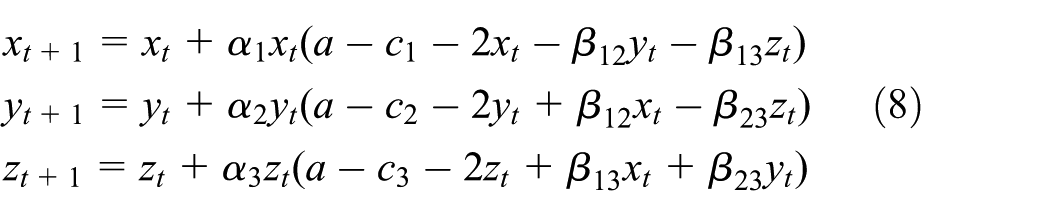
Replacing in equation (7) by , respectively, with equations (5) and (6), the following three-dimensional discrete-time dynamical system is obtained
where
The game’s fixed points and their local stability
The game admits the following fixed points
where
It is easy to check that the Nash fixed point is positive as The Jacobian matrix of map (8) at Nash point takes the form
where
Remark 1
A necessary condition for the fixed point of system (8) to be locally asymptotically stable (LAS) is that all its eigenvalues must have modules less than one. If one eigenvalue has modulus greater than 1, then the fixed point is unstable.39
Theorem 1
The fixed point is LAS if .
Proof
The Jacobian matrix (9) evaluated at is given as
and has the eigenvalues So, the conditions in this theorem ensure that
Remark 2
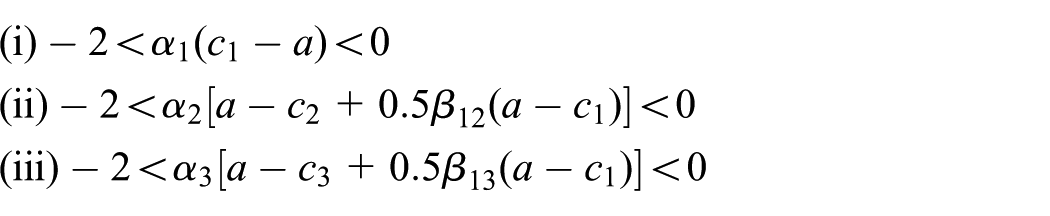
It is clear that fixed point is unstable in real economic model.
Theorem 2
The fixed point is LAS if all the following conditions hold
Proof
The Jacobian matrix (9) evaluated at is
and has the eigenvalues and . Hence, the conditions in this theorem ensure that . □
By the same way, the following theorems can be proved.
Theorem 3
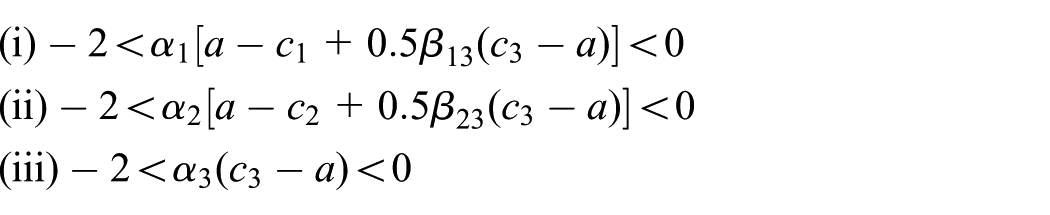
The fixed point is LAS if all the following conditions hold
Theorem 4
The fixed point is LAS if all the following conditions hold
Based on the above-mentioned theorems, we obtain the following Lemma 1.
Lemma 1
If is LAS, then the fixed points are unstable. However, if , is LAS, then is unstable. Moreover, in real economic model, is always unstable.
To find the sufficient conditions for local stability of the fixed point , we first evaluate the Jacobian matrix (9) at this point. So, we get
where , .
Thus, we have the following theorem.
Theorem 5
The fixed point is LAS if all the following conditions hold
Proof
The characteristic equation of Jacobian matrix (10) has the form
where , are respectively, the trace and determinant of the matrix M defined as
So, according to Remark 1 and the Jury conditions,40 the fixed point is LAS if
where . Then, it is clear that the stability conditions (12) are satisfied if the inequalities (11) hold. The theorem is now proved. □
Similarly, the sufficient conditions of local stability of the fixed points can be obtained. They are summarized by the following theorems.
Theorem 6
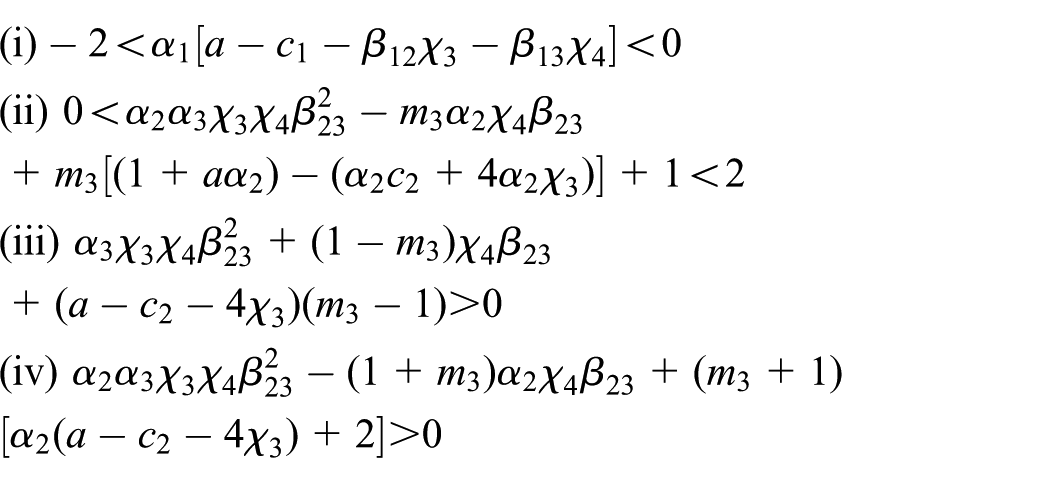
The fixed point is LAS if all the following conditions hold
where
Theorem 7
The fixed point is LAS if all the following conditions hold
where
Finally, the characteristic equation of the Nash fixed point is written as follows
So, according to Routh–Hurwitz criterion,41 the Nash fixed point is LAS if
Existence of Neimark–Sacker bifurcation around the Nash fixed point and the first route to chaos in the novel triopoly game
For the parameter values , and , the Nash point satisfies the eigenvalue condition of Neimark–Sacker bifurcation42 at the critical bifurcation parameter . If , all the conditions (equation (14)) are satisfied, and therefore, is LAS. As , some of the conditions (equation (14)) are not satisfied. Hence, the Nash fixed point changes from stable to unstable as passes through the critical value at which Neimark–Sacker bifurcation exists. Then, we need to study the direction and stability of Neimark–Sacker bifurcation. For this reason, we first employ the change in variables in order to transform the Nash fixed point to the origin. Hence, we have the following transformed system
which has also the following form
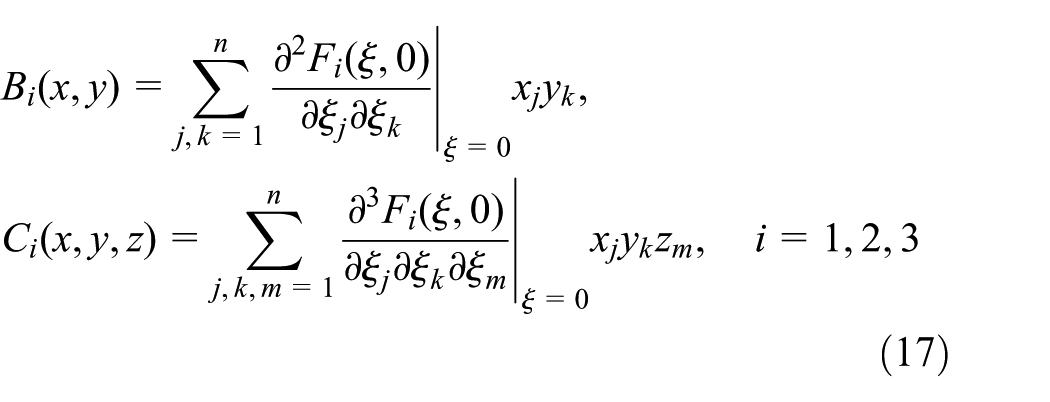
where J is the Jacobian matrix of system (15) evaluated at (0,0,0) and the matrices B,C are, respectively, defined by
If the zero fixed point of system (15) exhibits a Neimark–Sacker bifurcation, the Jacobian matrix has a simple pair of complex eigenvalues The direction of bifurcation of the resulting closed invariant curve is determined by calculating first the Lyapunov coefficient 43
where
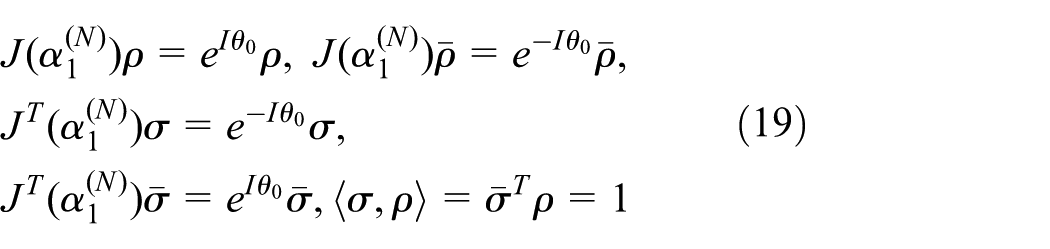
and is the identity matrix of order three. The complex vectors and appearing in equation (18) satisfy the following properties
Motivated by the above-mentioned discussion, the following theorem is presented.
Theorem 8
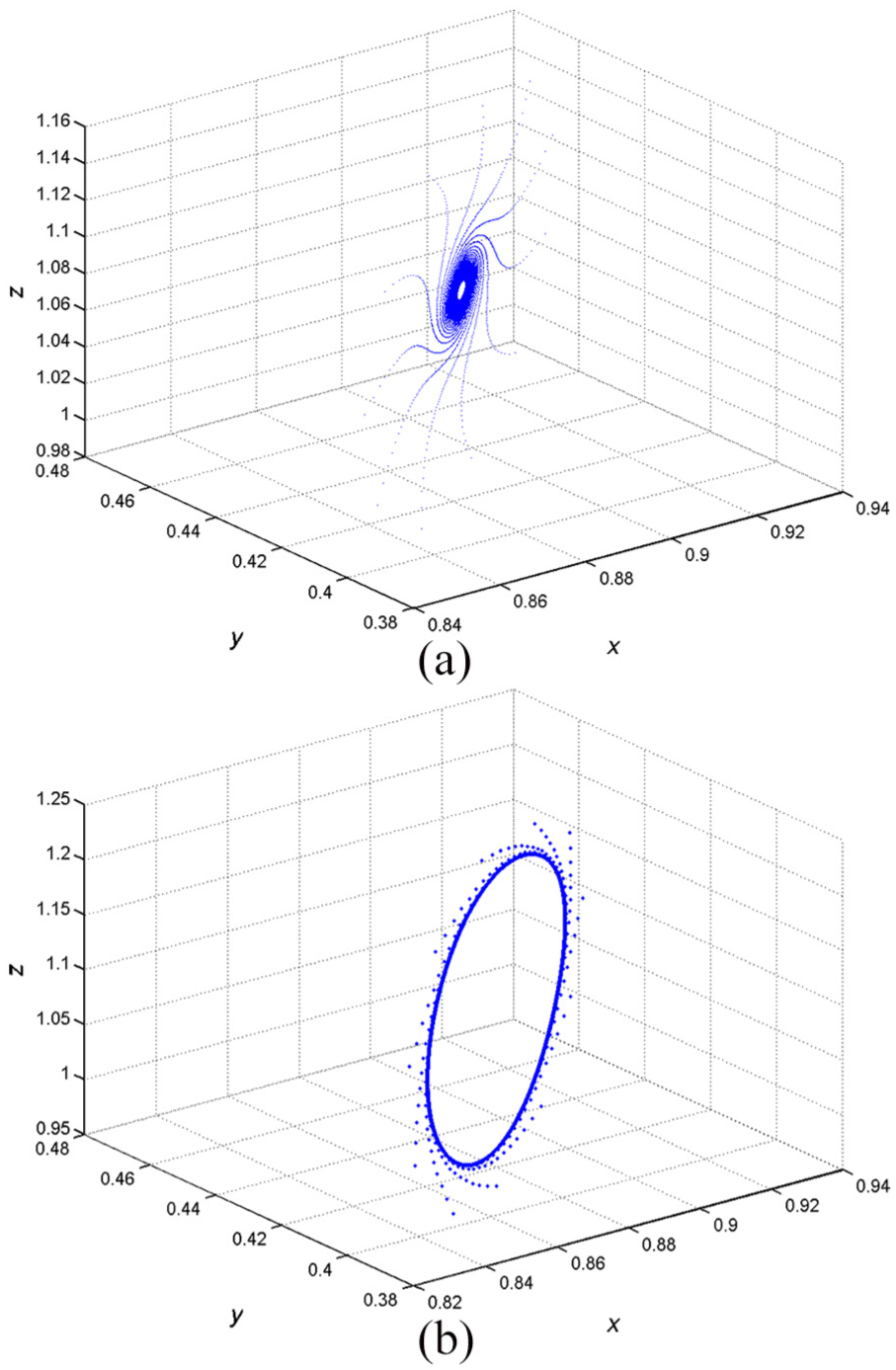
The novel triopoly game model (8) exhibits supercritical Neimark–Sacker bifurcation around the Nash fixed point using the parameter values and the critical bifurcation parameter . Therefore, a stable closed invariant curve bifurcates from , while this fixed point changes from stable to unstable as passes through the critical value .
Proof
The Jacobian matrix (9) evaluated at the Nash fixed point using the parameter values and the critical parameter is given by
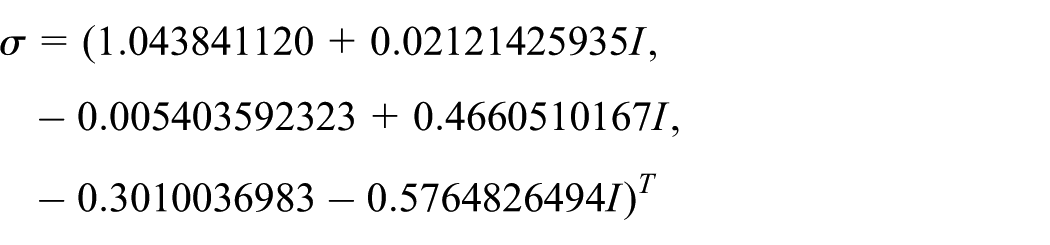
with eigenvalues and the corresponding eigenvectors
that satisfy the relations (equation (19)). Thus, the multi-linear functions B,C appearing in equation (17) are given as
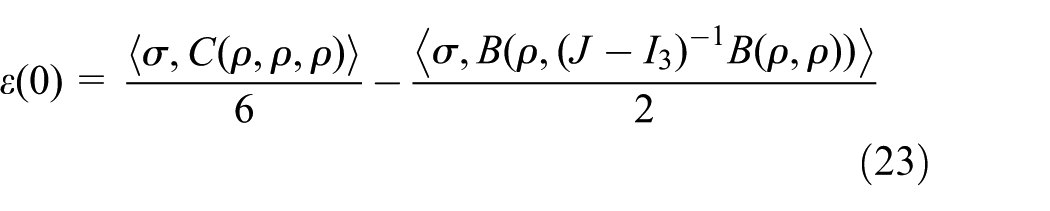
Hence, the quantities appearing in equation (18) are computed as follows
Inserting equation (22) into equation (18) makes which verifies the existence of a stable closed invariant curve around the Nash fixed point . □
Figure 1 shows the creation of a stable closed invariant curve around the Nash fixed point as shown by Theorem 8.
The phase portraits of system (8) show the creation of a stable closed invariant curve using the parameter values and setting the dynamical parameter (a) and (b) .
The first route to chaos in the novel triopoly game via Neimark–Sacker bifurcation
As using the parameter values and with increasing the dynamical parameter , the Nash fixed point loses its stability via a Neimark–Sacker bifurcation leading to chaos as depicted in Figure 2(a). This means that the speed of adjustment of the first player may take a destabilizing role in the market in such a way that the dynamics of the market become completely unpredictable when the speed of adjustment corresponding to the first player is sufficiently increased. The spectrum of maximal Lyapunov exponent corresponding to Figure 2(a) is shown in Figure 2(b) which verifies the existence of chaos after the occurrence of Neimark–Sacker bifurcation. Figure 3 shows two attractors describing the chaotic dynamics in model (8) when and equals to .
System (8) by varying the dynamical parameter and setting the parameter values shows (a) the bifurcation diagram and (b) the spectrum of largest Lyapunov exponent.
The phase portraits of system (8) show existence of chaotic attractors using the parameter values and setting the dynamical parameter (a) and (b) .
Existence of flip bifurcation around the Nash fixed point and the second route to chaos in the novel triopoly game
For , the Nash fixed point satisfies the eigenvalue condition of flip bifurcation at the critical bifurcation parameter , that is, , and the other eigenvalues lie inside the unit circle. Therefore, , where
So, by direct calculations, we obtain the eigenvectors that satisfy all the relations (19) and they are given by
Hence, the multi-linear functions defined in equation (17) are computed as follows
The bifurcating period-2 orbits are stable if (unstable if ), where is determined by the following formula43
The selection of parameters , , and make . Also, as , all the inequalities (14) hold and therefore is LAS. However, as , the second inequality of equation (14) is not satisfied. Hence, the Nash fixed point changes from stable to unstable as passes through the critical value where stable period-2 orbits resulting from flip bifurcation appear. These results are summarized in the following theorem which has already been proved.
Theorem 9
The novel triopoly game model (8) exhibits supercritical flip bifurcation around the Nash fixed point using the parameter values and the critical bifurcation parameter , that is, when the dynamical parameter passes through , the Nash equilibrium loses its stability via period-doubling bifurcation resulting stable period-2 orbits.
The second route to chaos in the novel triopoly game via flip bifurcation
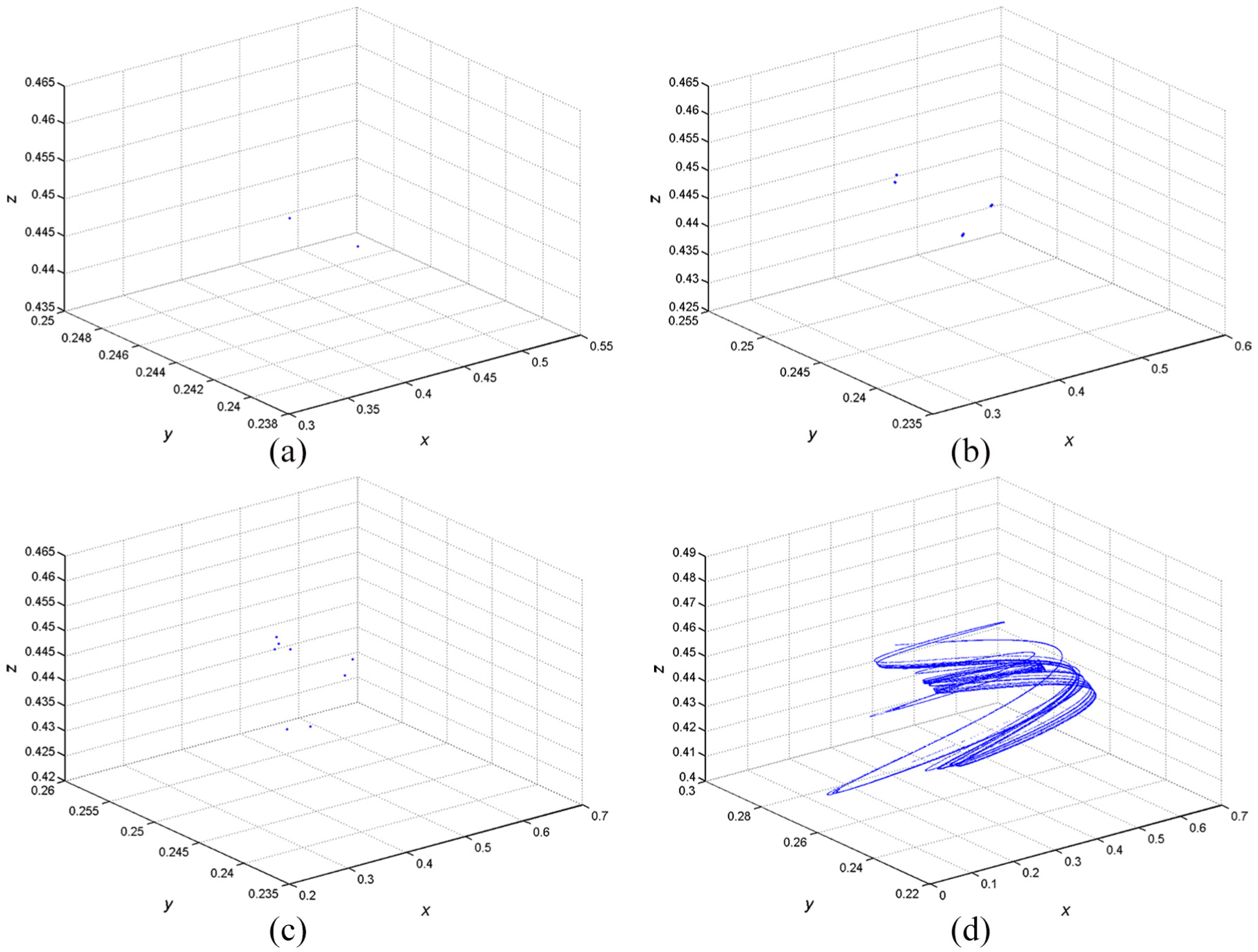
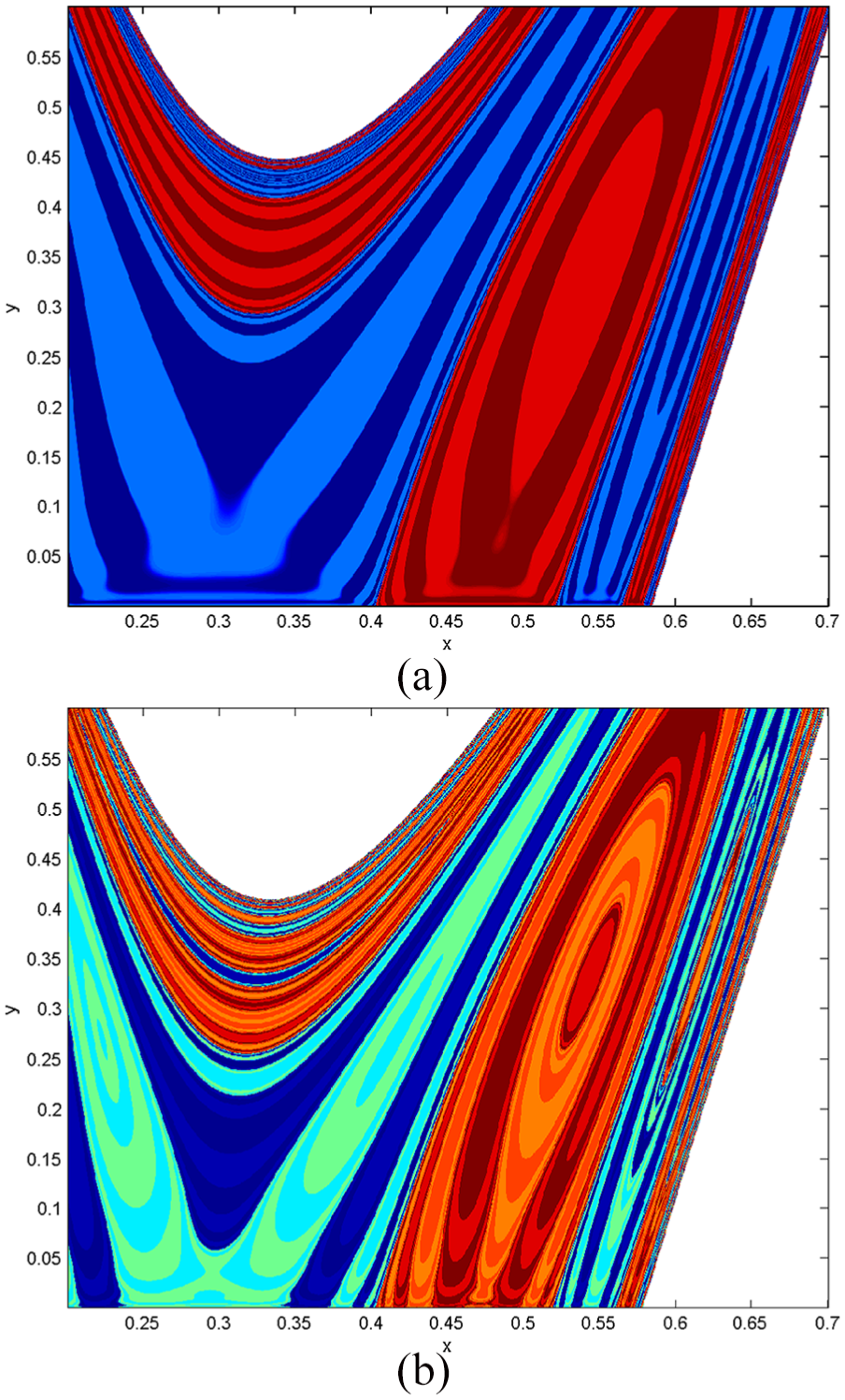
By selecting and increasing the dynamical parameter the Nash equilibrium loses its stability via a flip bifurcation leading to chaos as illustrated in Figure 4(a). So, it is also shown that the speed of adjustment of the first player has a destabilizing role in the market. The spectrum of maximal Lyapunov exponent corresponding to Figure 4(a) is shown in Figure 4(b), which verifies the existence of chaos after the appearance of flip bifurcation. The attractors corresponding to this scenario of period-doubling bifurcations leading to chaos are depicted in Figure 5. The basin sets of attraction related to period-4 and period-8 phase diagrams are shown by Figure 6, which shows complexity of basins’ structures.
System (8) with varying dynamical parameter and setting the parameter values shows (a) the bifurcation diagram and (b) the spectrum of largest Lyapunov exponent.
The phase diagrams of system (8) using the parameter values show (a) period 2 for , (b) period 4 for , (c) period 8 for , and (d) merged chaotic attractor for .
Basin of attraction of system (8) using the parameter values and setting the dynamical parameter (a) and (b) . White color refers to non-convergent orbits.
Existence of transcritical bifurcation around the Nash fixed point
In this section, we derive sufficient conditions for existence of transcritical bifurcation. Then, these conditions will be applied to our model.
Theorem 10
If
then map (15) exhibits transcritical bifurcation at , where
Proof
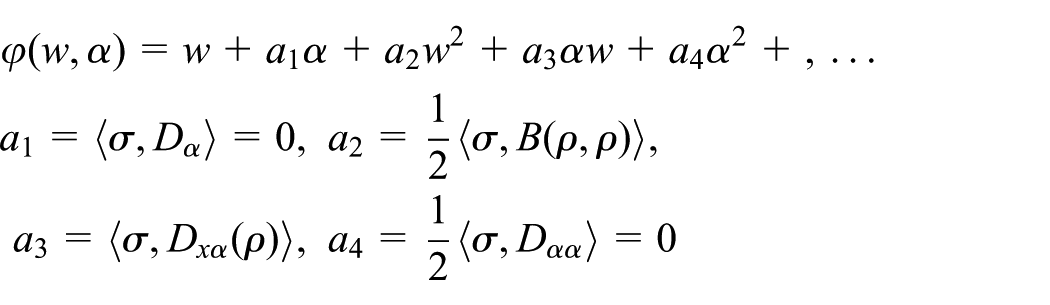
Assuming that the vector , according to the center manifold theory and using the decomposition , system (15) can be restricted to the vector field
where
It is clear that the fixed point of system (24) is nonhyperbolic with eigenvalue . So, according to the bifurcation theory,44 system (24) exhibits a transcritical bifurcation at the critical parameter provided that
So, if the conditions of this theorem hold, then conditions (25) hold. This completes the proof.
As , the Nash fixed point satisfies the eigenvalue assignment of transcritical bifurcation at the critical bifurcation parameter, that is, , and the other eigenvalues remain inside the unit circle. Furthermore, the quantities in the above theorem is calculated as
Therefore, a transcritical bifurcation occurs in system (8) at using the above-mentioned values of parameters.
More chaotic attractors and coexistence of multi-attractors
The coexistence of multi-attractors is another interesting phenomenon whose occurrence indicates the complexity and unpredictability of the model’s dynamics. Existence of two-piece strange attractor is shown for , and existence of four-piece strange attractor after period-doubling bifurcation is also obtained for . These results are given in Figure 7. The corresponding basins of attractions are depicted in Figure 8, in which Figure 8(a) shows basins of attractions of two-piece strange attractor for (basins in brown and light color) and Figure 8(b) shows basins of attractions of four-piece strange attractor for (basins in red, orange, blue, and light blue). However, the white color refers to the basin of attraction of non-convergent orbits. Then, these pieces are merged in one chaotic attractor for as depicted in Figure 9.
The phase diagrams of system (8) using the parameter values show (a) two-piece strange attractor for and (b) four-piece strange attractor for .
Basin of attraction of system (8) using the parameter values and setting the dynamical parameter (a) and (b) .
Appearance of a merged chaotic attractor of system (8) using the parameter values and dynamical parameter .
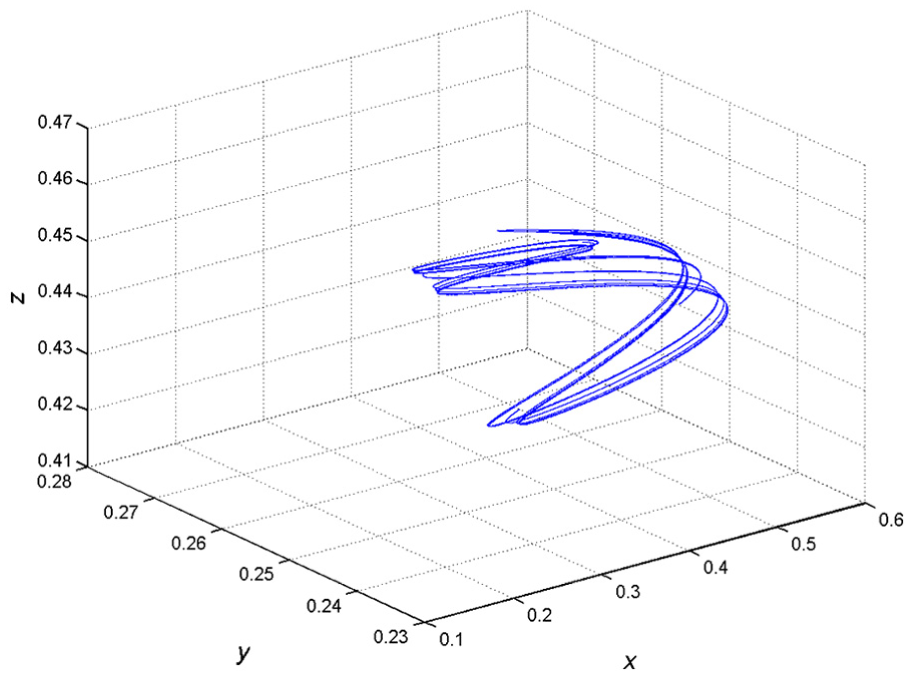
Another chaotic attractor is shown in Figure 10 using the selection of parameters and the dynamical parameter .
Chaotic attractor of system (8) using the parameter values and dynamical parameter .
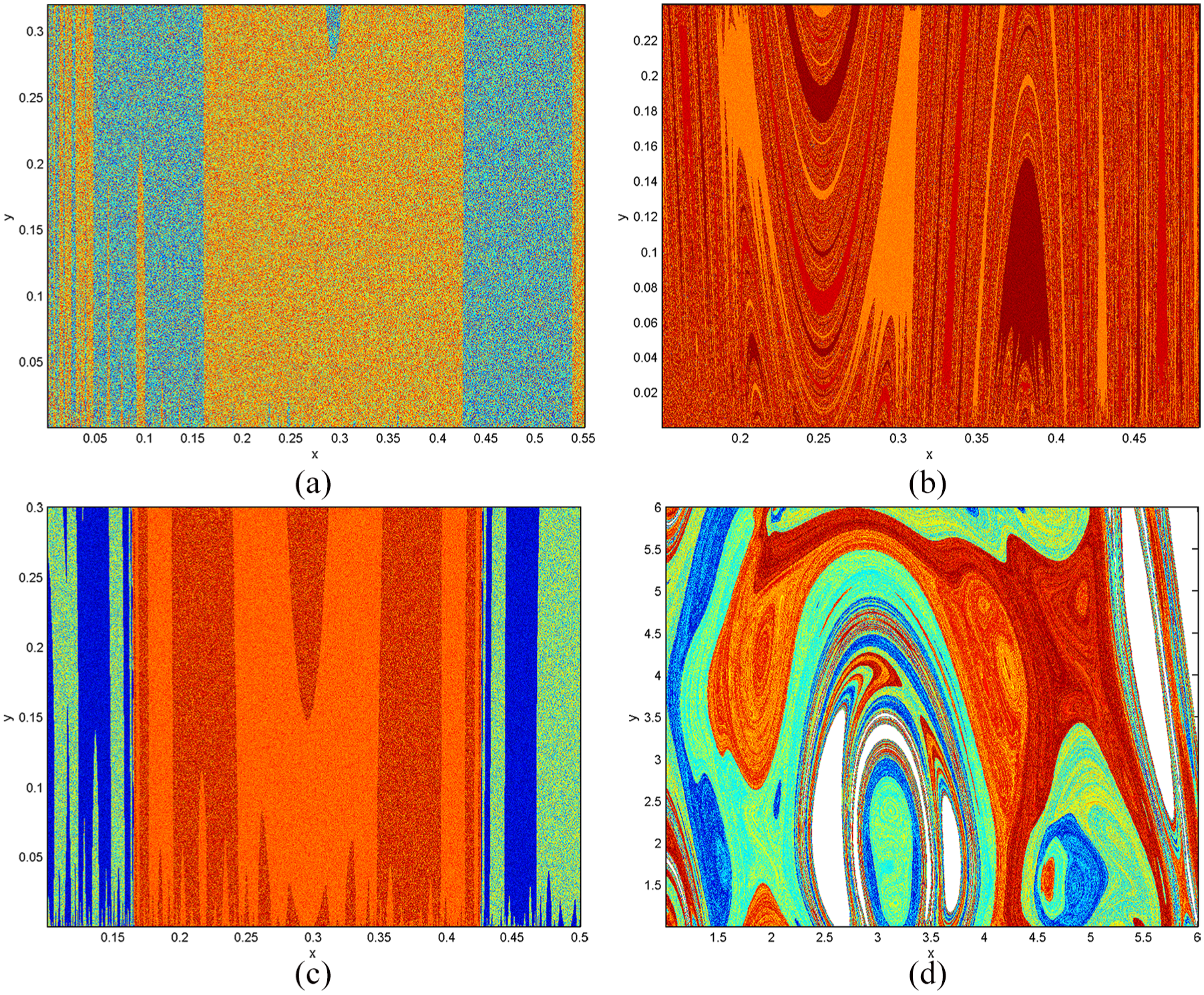
Furthermore, Figure 11 depicts coexistence of two, three, four, and five-piece chaotic attractors in the novel triopoly game model (8). The corresponding dynamics are explained as follows: two-piece chaotic attractor is shown for as depicted in Figure 11(a). Coexisting Period-7 attractor and three-piece chaotic attractor are shown for as depicted in Figure 11(b). Four-piece chaotic attractor is shown for as illustrated in Figure 11(c). Five-piece chaotic attractor is shown for as given in Figure 11(d). The corresponding basins of attractions are given in Figure 12, which can be explained as follows. Figure 12(a) shows basins of attractions of two-piece chaotic attractor given in Figure 11(a) (basins in orange and light blue). Figure 12(b) shows basins of attractions of coexisting Period-7 attractor (basin in light brown) and three-piece chaotic attractor given in Figure 11(b) (basins in orange, red and maroon). Figure 12(c) shows basins of attractions of four-piece chaotic attractor given in Figure 11(c) (basins in blue, orange, red, and light green). Figure 12(d) shows basins of attractions of five-piece chaotic attractor given in Figure 11(d) (basins in blue, yellow, maroon, orange, and aqua) and white color refers to non-convergent orbits. Thus, it is shown that the novel triopoly game model (8) is characterized by a higher degree of unpredictability and complexity of basins’ structures.
The phase diagrams of system (8) show (a) two-piece chaotic attractor for ; (b) coexisting Period-7 attractor and three-piece chaotic attractor for ; (c) four-piece chaotic attractor for ; and (d) 5-piece chaotic attractor for .
Basins of attraction related to Figure 11 show the case of (a) two-piece chaotic attractor, (b) coexisting Period-7 attractor and three-piece chaotic attractor, (c) four-piece chaotic attractor, and (d) five-piece chaotic attractor.
Conclusion
In this article, a novel triopoly game with bounded rationality has been modeled according to local profit maximization. Sufficient conditions for local stability of the model’s fixed points have been proved and they have been found to be strongly consistent on the kind of adjustment adopted which may take a destabilizing (stabilizing) role in the market. Existence of supercritical Neimark–Sacker bifurcation has been shown around the game’s Nash equilibrium. Existence of stable period-2 orbits resulting from flip bifurcation around the game’s Nash equilibrium has also been verified. Existence of chaotic dynamics in the proposed game has been shown via two routes: Neimark–Sacker bifurcation route and flip bifurcation route. Based on the bifurcation theory of discrete-time systems, sufficient conditions of transcritical bifurcation have been derived and applied to the proposed map. Finally, coexisting multi-chaotic attractors such as coexistence of two-, three-, four-, and five-piece chaotic attractors have been found in the proposed game. Computations of basins of attraction have been performed to verify the appearance of this important phenomenon. Therefore, it has been verified that the dynamics of the proposed game show more unpredictability and higher complexity comparing to other existing triopoly games. Applying the new results and techniques in this article to the discretized fractional-order economic models is an interesting point for future research work.
Footnotes
Acknowledgements
The authors thank the anonymous reviewers for their useful comments.
Handling Editor: James Baldwin
Declaration of conflicting interests
The author(s) declared no potential conflicts of interest with respect to the research, authorship, and/or publication of this article.
Funding
The author(s) disclosed receipt of the following financial support for the research, authorship, and/or publication of this article: This work is supported by Deanship of Scientific Research at King Saud University (research group no. RG-1438-046).
ORCID iD
AE Matouk
References
1.
PuuT.Chaos in duopoly pricing. Chaos Soliton Fract1991; 1: 573–581.
2.
AskarSSAbouhawwashM.Quantity and price competition in a differentiated triopoly: static and dynamic investigations. Nonlinear Dyn2018; 91: 1963–1975.
3.
AskarSSElettrebyMF.The impact of cost uncertainty on Cournot oligopoly games. Appl Math Comput2017; 312: 169–176.
4.
AskarSSAl-khedhairiA.Analysis of nonlinear duopoly games with product differentiation: stability, global dynamics, and control. Discrete Dyn Nat Soc2017; 2017: 2585708.
5.
AskarSSEl-WakeelMFAlrodainiMA.Exploration of complex dynamics for Cournot oligopoly game with differentiated products. Complexity2018; 2018: 6526794.
6.
AskarSS.On complex dynamics of monopoly market. Econom Model2013; 31: 586–589.
7.
AhmedEHassanSZ.On controlling chaos in Cournot games with two and three competitors. Nonlinear Dyn Psychol Life Sci2000; 4: 189–194.
8.
AskarSSAlnowibetK.Nonlinear oligopolistic game with isoelastic demand function: rationality and local monopolistic approximation. Chaos Soliton Fract2016; 84: 15–22.
9.
MatoukAEElsadanyAAXinB.Neimark–Sacker bifurcation analysis and complex nonlinear dynamics in a heterogeneous quadropoly game with an isoelastic demand function. Nonlinear Dyn2017; 89: 2533–2552.
10.
PecoraNSodiniM.A heterogeneous Cournot duopoly with delay dynamics: Hopf bifurcations and stability switching curves. Commun Nonlinear Sci Numer Simul2018; 58: 36–46.
11.
CournotA. Researches into the principles of the theory of wealth, Engl. Trans., Irwin Paper Back Classics in Economics (Chapter VII). Paris: Hachette, 1963.
12.
DanaRAMontrucchioL.Dynamic complexity in duopoly games. J Econ Theory1986; 40: 40–56.
13.
AskarSS.Complex dynamic properties of Cournot duopoly games with convex and log-concave demand function. Oper Res Lett2014; 42: 85–90.
14.
ZhaoLZhangJ.Analysis of a duopoly game with heterogeneous players participating in carbon emission trading. Nonlinear Anal Model Control2014; 19: 118–131.
15.
AskarSS.The rise of complex phenomena in Cournot duopoly games due to demand functions without inflection points. Commun Nonlinear Sci Numer Simul2014; 19: 1918–1925.
16.
ZhuXZhuWYuL.Analysis of a nonlinear mixed Cournot game with boundedly rational players. Chaos Soliton Fract2014; 59: 82–88.
17.
DingZLiQJiangSet al. Dynamics in a Cournot investment game with heterogeneous players. Appl Math Comput2015; 256: 939–950.
18.
AskarSSAlshamraniAMAlnowibetK.Dynamic Cournot duopoly games with nonlinear demand function. Appl Math Comput2015; 259: 427–437.
19.
AskarSSAlnowibetK.Cooperation versus noncooperation: Cournot duopolistic game based on delay and time-dependent parameters. Chaos Soliton Fract2016; 91: 580–584.
20.
ElsadanyAAMatoukAE.Dynamic Cournot duopoly game with delay. J Complex Syst2014; 2014: 384843.
21.
ElsadanyAA.Dynamics of a Cournot duopoly game with bounded rationality based on relative profit maximization. Appl Math Comput2017; 294: 253–263.
22.
AndersonDRMyranNGWhiteDL.Basins of attraction in a Cournot duopoly model of Kopel. J Differ Equ Appl2005; 11: 879–887.
23.
AhmedEAgizaHN.Dynamics of a Cournot game with n-competitors. Chaos Soliton Fract1998; 7: 2031–2048.
24.
DingZZhuXJiangS.Dynamical Cournot game with bounded rationality and time delay for marginal profit. Math Comput Simulation2014; 100: 1–12.
25.
AlnowibetKAskarSSElsadanyAA.Complex dynamics and control investigation of a Cournot triopoly game formed based on a log-concave demand function. Adv Mech Eng. Epub ahead of print 26 July 2017. DOI: 10.1177/1687814017702810
26.
AgliariAGardiniLPuuT.The dynamics of a triopoly Cournot game. Chaos Soliton Fract2000; 11: 2531–2560.
27.
AgliariAGardiniLPuuT.Global bifurcations of basins in a triopoly game. Int J Bifur Chaos Appl Sci Eng2002; 12: 2175–2207.
28.
PiredduA.Chaotic dynamics in three dimensions: a topological proof for a triopoly game model. Nonlinear Anal Real World Appl2015; 25: 79–95.
29.
ChenFMaJHChenXQ.The study of dynamic process of the triopoly games in Chinese 3G telecommunication market. Chaos Soliton Fract2009; 42: 1542–1551.
30.
MaJSunZ.The research on price game model and its complex characteristics of triopoly in different decision-making rule. Nonlinear Dyn2013; 71: 35–53.
31.
MaJWuK.Complex system and influence of delayed decision on the stability of a triopoly price game model. Nonlinear Dyn2013; 73: 1741–1751.
32.
NaimzadaATramontanaF.Two different routes to complex dynamics in an heterogeneous triopoly game. J Differ Equ Appl2015; 21: 553–563.
33.
TuHWangX.Complex dynamics and control of a dynamic R&D Bertrand triopoly game model with bounded rational rule. Nonlinear Dyn2017; 88: 703–714.
34.
AndaluzJElsadanyAAJarneG.Nonlinear Cournot and Bertrand-type dynamic triopoly with differentiated products and heterogeneous expectations. Math Comput Simulation2017; 132: 86–99.
35.
SiFMaJ.Complex dynamics in a triopoly game with multiple delays in the competition of green product level. Int J Bifur Chaos Appl Sci Eng2018; 28: 1850027.
36.
JajarmiAHajipourMBaleanuD.New aspects of the adaptive synchronization and hyperchaos suppression of a financial model. Chaos Soliton Fract2017; 99: 285–296.
37.
SinghNVivesX.Price and quantity competition in a differentiated duopoly. Rand J Econ1984; 15: 546–548.
38.
DixitA.Comparative statics for oligopoly. Int Econom Rev1986; 27: 107–122.
39.
ElaydiSN.An introduction to difference equations (Undergraduate texts in math). 3rd ed.New York: Springer, 2005.