




Abstract
Calcium silicate hydrate seeding is a promising accelerator for cement hydration. In this work, calcium silicate hydrate nanoparticles with various CaO/SiO2-ratios were prepared by means of mechanochemical approach. X-ray diffractometry, scanning electron microscopy and laser granulometry were used to study the properties of the calcium silicate hydrate particles. The evaluation of the effectiveness of calcium silicate hydrate seeds on the cement hydration was conducted by heat flow calorimetry and compressive strength tests using ordinary Portland cement and early strength white cement. Results show that the main crystalline phase in the final product is crystalline calcium silicate hydrate (Ca1.5SiO3.5·xH2O). An acceleration of 6.08 h or 28.03% on the hydration of P.O 42.5 type Portland cement as well as a 78% increment of compressive strength 24 h after water addition can be achieved using calcium silicate hydrate seeds. Compared to the P.O cement, calcium silicate hydrate nanoparticles are less effective in the P.W white cement, which indicates the nature of the cement is a crucial factor to influence the effectiveness of the calcium silicate hydrate seeds as well.
Keywords
Introduction
It is well known that the production of cement consumes not only a large amount of fossil energy but also emits excessive carbon dioxide. According to statistics, 7%–8% of annual anthropogenic CO2 emission derives from cement industry.1,2 Several measures have been taken to mitigate the negative environmental impact of cement production such as the enhancement of combustion technology in kiln, the use of alternative fuels (e.g. recycled rubber, plastics, and biomass), and the refinement of clinker mineralogy which allows the reduction of the calcination temperature as well as the clinker content in the final product etc.
Compared to the effort made during the production of cement, the partial substitution of clinker in the cement production is less economically invasive to reduce the CO2 emission.3–5 Nevertheless, the early strength development of concrete will be impaired by the reduction of clinker share, which may give rise to financial problems for construction companies and customers.6,7
Thus, accelerators were used to accelerate the early hydration of cement to increase the early strength. Traditional accelerators such as calcium salts have certain side-effects, for example, retardation of cement hydration under certain concentration or strong negative impact on the late cement strength. 8 Calcium silicate hydrate (C-S-H) seeds, on the contrary, can prevent these weaknesses as an accelerator. The dosage of C-S-H nanoparticles can significantly accelerate the early cement hydration because of its very large surface area and high activity. 9 The C-S-H seeds as nuclei can stimulate further nucleation of C-S-H. However, research shows that C-S-H nanoparticles have a better acceleration effect than other nanoparticles such as nanosilica or metal oxide nanoparticles since one of the main cement hydrated products is calcium silicate hydrate itself.10,11
Currently, pozzolanic method,12,13 sol-gel method,14–16 and precipitation method17,18 are three main methods for the preparation of C-S-H seeds in the literature. The mechanochemical method is a branch of pozzolanic reaction, which is based on the following chemical reaction

A milling machine is usually used by means of mechanochemical method to enhance the turnover speed of the raw materials. The milling can remove the reaction products forming at the surface of the silicon dioxide continuously, therefore more unreacted SiO2 can react with Ca(OH)2 to accelerate the turnover. 19 The typical reaction times vary from few hours to several days depending on the sorts and parameters of milling machine. Compared to other reaction conditions of pozzolanic method, (such as ambient condition at room temperature for weeks to a month and hydrothermal synthesis, which requires a sealed autoclave with elevated temperature and pressure), the mechanochemical treatment has a modest requirement of equipment and reaction duration, which may develop a better economical perspective.14,20
The aim of this work is to investigate the characteristics of C-S-H nanoparticles prepared by means of mechanochemical method with various CaO/SiO2 (C/S)-ratios and its effect on the early hydration of ordinary Portland cement and early strength white cement.
Experimental program
Mechanochemical synthesis of C-S-H seeds
Fresh calcium oxide was achieved by the calcination of calcium carbonate (AR, SCR, China) for 4 h at 1000°C in a muffle furnace. Based on the C/S-ratio and solid/water ratio, a required amount of deionized water and nanosilica sol (Ludox AM, Grace, USA) with an average particle size of 12 nm was added after the CaO was cooled under inert condition. A 250-mL agate jar was filled with the mixed dispersion and grinding balls. A white dispersion of C-S-H seeds was synthesized after the sealed jar was milled by a planetary ball mill (QM-3SP4, instrument factory of Nanjing University, China) for 12 h with a rotating speed of 130 r/min.
Study on the characteristics of C-S-H seeds
The freshly prepared samples were freeze-dried for the investigation of properties of the product. An X-ray diffractometer (D/max2550VB3+/PC, Rigaku International Corporation, Japan) was used to provide the information of crystal phases after the synthesis. A field emission environmental scanning electron microscope (Quanta 200 F, FEI, USA) was utilized to study the microstructure of C-S-H seeds. The average particle size of the freeze-dried sample was determined by a laser particle size analyzer (LS230, Beckman Coulter, USA).
Experiments on cement hydration
Heat flow calorimetry measurements and compressive strength tests were performed to evaluate the accelerating effect of C-S-H seeds on the cement hydration. P.O 42.5 type Portland cement (OPC, CONCH, China) and P.W 52.5R type white cement (Aalborg, China) were used for both experiments. The standard of these cement type is GB175-2007. The chemical composition of the binder materials is shown in Table 1.
Chemical compositions (manufacturers data) of P.W 52.5R and P.O cement 42.5 (in wt%).

For heat flow calorimetry, samples were placed into the calorimeter (TAM Air 8CH, Waters, USA) after 2 g of cement were mixed in a sealed PE bottle with deionized water. A desired amount (by weight of cement; BWOC) of the C-S-H seeds was premixed with the deionized water to adjust the w/c ratio which is 0.5 for all samples. The record of hydration heat lasted for 2 days at 20 °C.
For compressive strength tests, a single batch of 450 g of cement was mixed with a calculated amount of the premixed water/C-S-H dispersion and 1350 g ISO standard sand using a mortar mixer. For each batch of cement, three 4 × 4 × 16 cm3 cuboids were prepared for compressive strength tests. The cuboids were cured in a standard curing room at 20°C ± 1°C with a relative humidity ≥90%, demolded 11.5 h after initial mixing, and were further stored in the standard curing room until testing. Tests were performed according to ISO 679:1989. 21
Results and discussion
Since the nature of calcium silicate hydrate in the C-S-H seeds can influence the hydration process, the study on the properties of C-S-H seeds is of particular interest. Figure 1 shows the X-ray diffractometry (XRD) results of freeze-dried C-S-H seeds with various C/S-ratios after the 12-h preparation in the planetary ball mill machine. Two crystalline phases can be found using XRD. The main phase in the samples with lower C/S-ratio (n(Ca)/n(Si) ≤ 1) is calcium silicate hydrate (Ca1.5SiO3.5·xH2O, d1 = 0.304 nm, d2 = 0.182 nm, d3 = 0.279 nm), which indicates that the calcium dioxide derived from the calcium oxide in the raw material is completely reacted during the mechanochemical process. However, portlandite (Ca(OH)2, d1 = 0.263 nm, d2 = 0.492 nm, d3 = 0.180 nm) is abundant in the final product with higher C/S-ratio. The C/S-ratio can also affect the peak intensity and the degree of crystallinity of the crystalline C-S-H phase in the sample. Besides, a broader peak from 5° to 10° can be found in each XRD pattern, indicating the existence of semicrystalline calcium silicate hydrate in the C-S-H seeds.

XRD patterns of different C-S-H seeds with various C/S-ratios after 12 h milling.
Scanning electron microscopy (SEM) pictures of lyophilized C-S-H which was synthesized under the mechanochemical method with various C/S-ratios ranging from 0.4 to 2.0 are shown in Figure 2. All samples have a highly segmented surface. Figure 2(a)–(d) indicates that these particles are probably big agglomerates from small primary particles. According to the SEM pictures, these original particles have a spherical shape with an average diameter of approximately 40–50 nm. The particle size of freshly prepared C-S-H with different C/S-ratios was measured by laser granulometry without further treatment as well. It seems that the C/S-ratio does not influence the particle size much, since the results from laser granulometry were d90 = 4.29, 4.56, 4.59, and 4.68 μm for n(Ca)/n(Si) = 0.4, 1.0, 1.5 and 2.0, respectively, yet the values of the results are much bigger compared to the particle size of primary particle in the SEM pictures. This phenomenon is possibly derived from the Ostwald ripening, which can cause the increase in the particle size due to the decrease in the interface energy.

SEM pictures of C-S-H made by 12-h long mechanochemical process: (a) n(Ca):n(Si) = 0.4; (b) n(Ca):n(Si) = 1.0; (c) n(Ca):n(Si) = 1.5; and (d) n(Ca):n(Si) = 2.0.
However, the C/S-ratio of raw material may influence final product on their way to agglomerate. Primary C-S-H particles with lower C/S-ratios arrange in a combination of chain-like conformation and layered structure. On the contrary, samples with higher C/S-ratios show a cauliflower-like structure. As mentioned in the introduction, the silica gel continuously reacts with calcium hydroxide during the mechanochemical process. The amount of Ca(OH)2 may have an effect on the orientation of C-S-H nucleation. This is also in good accordance with the XRD patterns (see Figure 1).
Dispersing agents, which can often affect the kinetic of cement hydration, are not used in the experiments, since the aim of this work is to study the effect of C-S-H seed itself on the cement hydration. It is to be expected that the C-S-H nanoparticles can be better dispersed with dispersants and therefore have a better accelerating effect, since the accelerating behavior is C-S-H surface related.
Figures 3 and 4 show the results of heat flow calorimetry of P.O 42.5 cement with addition of the C-S-H particles. According to Figure 4, C-S-H seeds with various C/S-ratios and same concentration (1.0% BWOC) can accelerate the early hydration of P.O cement. The accelerating effect of the C/S-ratio will be reduced by the increment of C/S-ratio, yet the differences are tiny. This is in good accordance with the measurements of laser granulometry. The smaller C-S-H particles offer more surface area for the nucleation, which indicates a better acceleration of cement hydration. However, dosage of C-S-H shows significant influence on the effect of C-S-H seeds. The fastest heat flow maximum could be reached at 15.61 h after water addition containing 2.0% BWOC C-S-H particles (n(Ca): n(Si) = 0.4), which is a distinct acceleration compared to the heat flow maximum of the pure P.O cement at 21.69 h. This enhancement (6.08 h, 28.03%) can also be explained by the increase in the nuclei due to the addition of C-S-H seeds.

Heat flow calorimetry of P.O 42.5 with the addition of C-S-H seeds with different C/S-ratios.

Heat flow calorimetry of P.O 42.5 with the addition of C-S-H seeds with various dosages.
Contrast to the P.O 42.5 cement, C-S-H particles can barely accelerate the hydration of P.W 52.5R cement (see Figures 5 and 6). The most effective acceleration of this cement type is the addition of C-S-H seeds with a C/S-ratio equal to 2 and a dosage of 1.0% BWOC. Under this condition, the maximum of heat flow calorimetry could be determined at 6.54 h, which is just 8.81% or 0.63 h faster than the peak value 7.15 h of pure P.W 52.5R cement. This discrepancy of accelerating effect of C-S-H particles on cement hydration is due to cement itself. Compared to the P.O 42.5 cement, which contains mainly clinker, 5%–20% blended materials, and certain gypsum, P.W 52.5R can harden more rapidly as it is an early strength cement per se. Thus, the hydration of white cement cannot be accelerated effectively with the addition of C-S-H particles. The influence of dosage and C/S-ratio on the accelerating effect of C-S-H on P.W cement hydration is therefore trivial as well. It can be also concluded that an optimization for the preparation of C-S-H seed is needed for each type of cement. 16
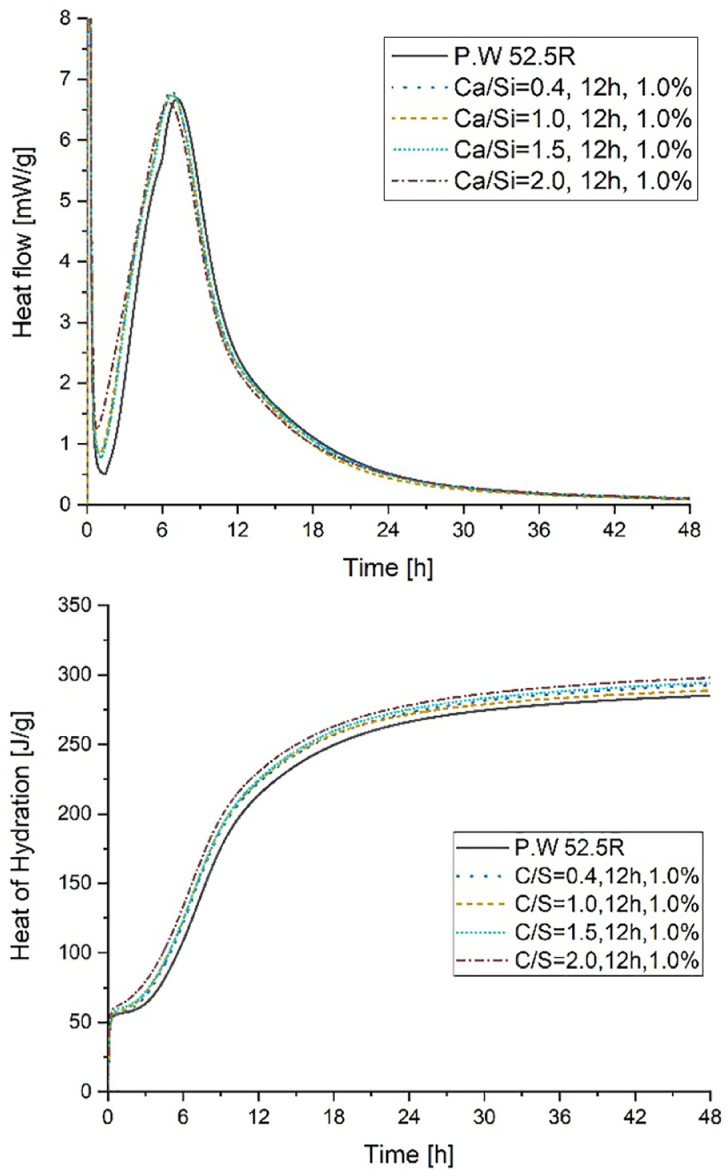
Heat flow calorimetry of P.W 52.5R with the addition of C-S-H seeds with different C/S-ratios.

Heat flow calorimetry of P.W 52.5R with the addition of C-S-H seeds with various dosages.
The results of compressive strength tests of P.O and P.W cements with and without C-S-H seeds within the first 24 h are shown in Figure 7. The development of the compressive strength is in good accordance with the result of heat flow calorimetry, since a higher early compressive strength is due to the earlier hydration of C3S and the higher reaction rate a faster formation of C-S-H phase as well as the addition of extra C-S-H particles. After 24 h, the compressive strength of samples containing 1.0% BWOC of C-S-H seed (n(Ca): n(Si) = 0.4) is 78.5% higher compared to pure P.O 42.5 cement. The increment of compressive strength of P.W cement with addition of C-S-H seeds is much less compared with the one of P.O cement, which is also in agreement with the results shown in Figures 5 and 6.

Compressive strength development within the first 24 h.
Conclusion
The mechanochemical synthesis is a simple method to synthesize C-S-H seeds, which can effectively accelerate the cement hydration. XRD, SEM, and laser granulometry were used to study the properties of C-S-H nanoparticles with various C/S-ratios. XRD patterns show the existence of crystalline calcium silicate in the final product after the mechanochemical process. SEM pictures reveal the influence of C/S-ratio on the morphology of C-S-H seeds. Calcium-rich particles tend to aggregate in cauliflower-like form, whereas silicon-rich seeds form a chain-like shape. C-S-H seeds with an average particle size of approximately 4 μm are made up of primary C-S-H nanoparticles which have an average particle size of 40–50 nm. Thus, it is to be expected that the use of dispersants could improve accessibility of the particles surfaces for nucleation reactions and further improve the performance of C-S-H seeds.
Results of heat flow calorimetry and compressive strength tests show a strong and positive effect of C-S-H particles on the P.O 42.5 cement, whereas P.W 52.5R cement can be less affected by the addition of C-S-H. Both the properties of the C-S-H and the nature of the cement type are crucial factors to influence the effectiveness of the C-S-H seeds.
Footnotes
Handling Editor: Grzegorz Golewski
Declaration of conflicting interests
The author(s) declared no potential conflicts of interest with respect to the research, authorship, and/or publication of this article.
Funding
The author(s) disclosed receipt of the following financial support for the research, authorship, and/or publication of this article: This research was supported by the Open Fund of State Key Laboratory of Disaster Reduction in Civil Engineering (grant no. SLDRCE18-05), the Fundamental Research Funds for the Central Universities (22120170261), and sponsored by the International Science and Technology Cooperation Projects of Shanghai (contract no. 12230708700).
